






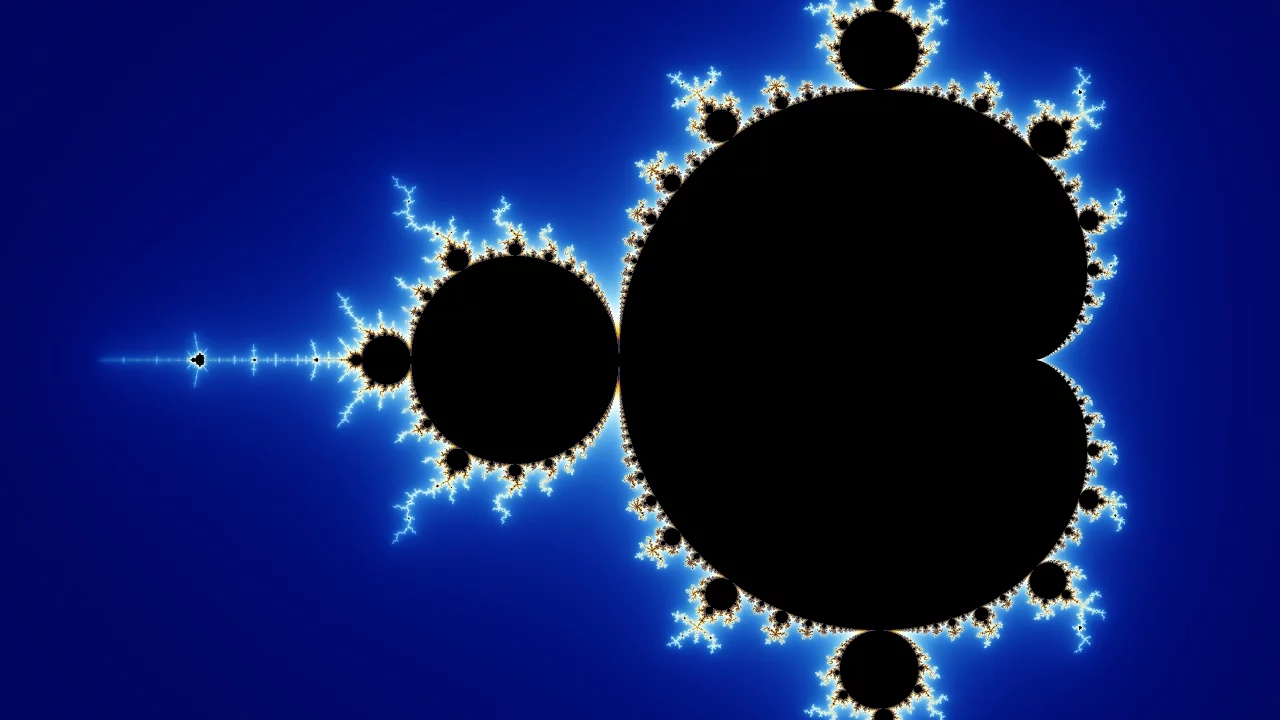

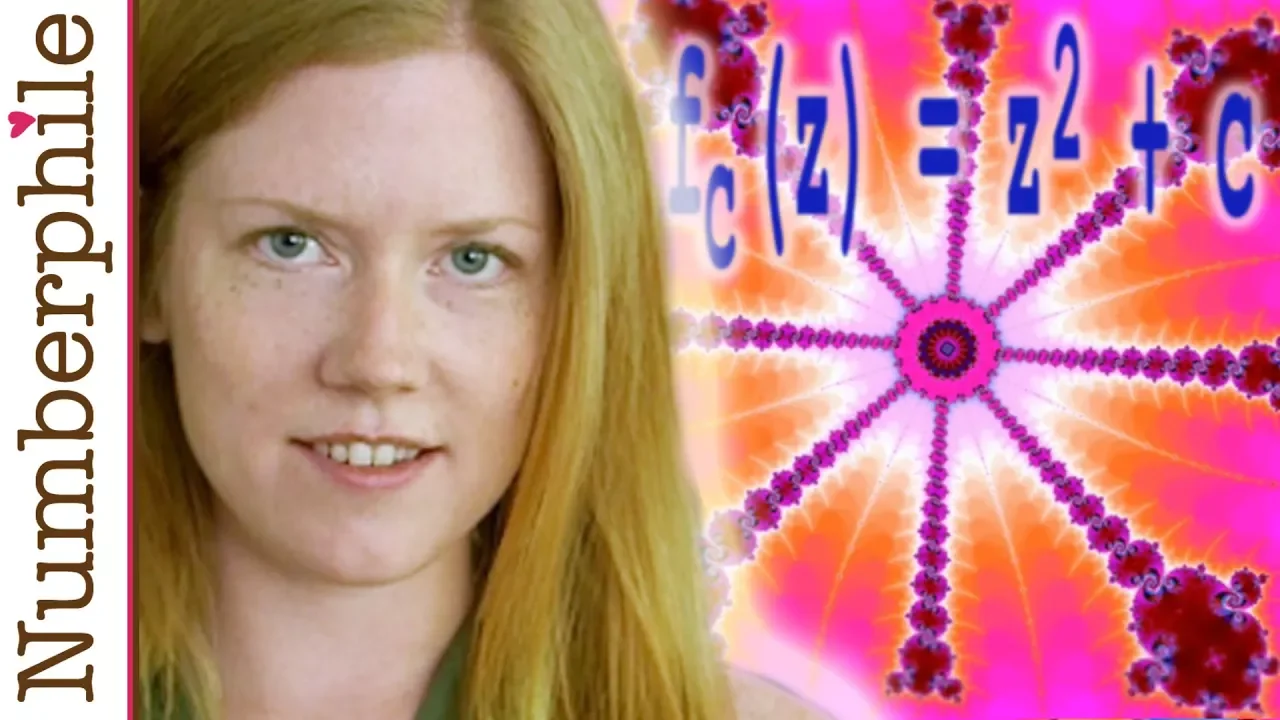














Julia Sets are fractals generated by iterating the complex function Z = Z² + C, where C is a constant and Z varies across the complex plane; unlike the Mandelbrot Set which keeps Z fixed at zero and varies C, Julia Sets have two distinct types—connected sets with a filled center (containing the origin) and disconnected 'dust' made of infinitely many separate pieces—and the Mandelbrot Set acts as a map showing exactly where Julia Sets are connected versus disconnected, with embedded Julia Sets appearing within the Mandelbrot Set that exhibit a fascinating 'memory' property where their symmetry doubles repeatedly (2-way, 4-way, 8-way, 16-way, etc.) as you zoom in, ultimately revealing miniature Mandelbrot Sets at their centers.
Julia Sets and Their Relationship to the Mandelbrot Set
Added:Understanding of complex numbers, including arithmetic operations and their representation on the complex plane.
The concept of iterative function systems, specifically how repeated application of a function yields sequences of numbers (orbits).
Basic familiarity with the Mandelbrot set's definition and its role as a parameter space.
Introductory topological concepts such as connectedness, open/closed sets, and boundary points.
The mathematical proofs behind the Fatou-Julia theorem and the classification of Fatou components.
Holomorphic dynamics, exploring the iteration of transcendental functions like sine, cosine, and exponential functions in the complex plane.
Fractal dimension analysis, including the Hausdorff-Besicovitch dimension, to quantify the complexity of Julia sets.
Computational rendering techniques, such as escape-time algorithms and distance estimation for generating high-resolution fractals.
The application of complex dynamics in chaos theory, bifurcation theory, and real-world physical systems.
191K views3.1Klikes13:58Original Release: 2020-04-01
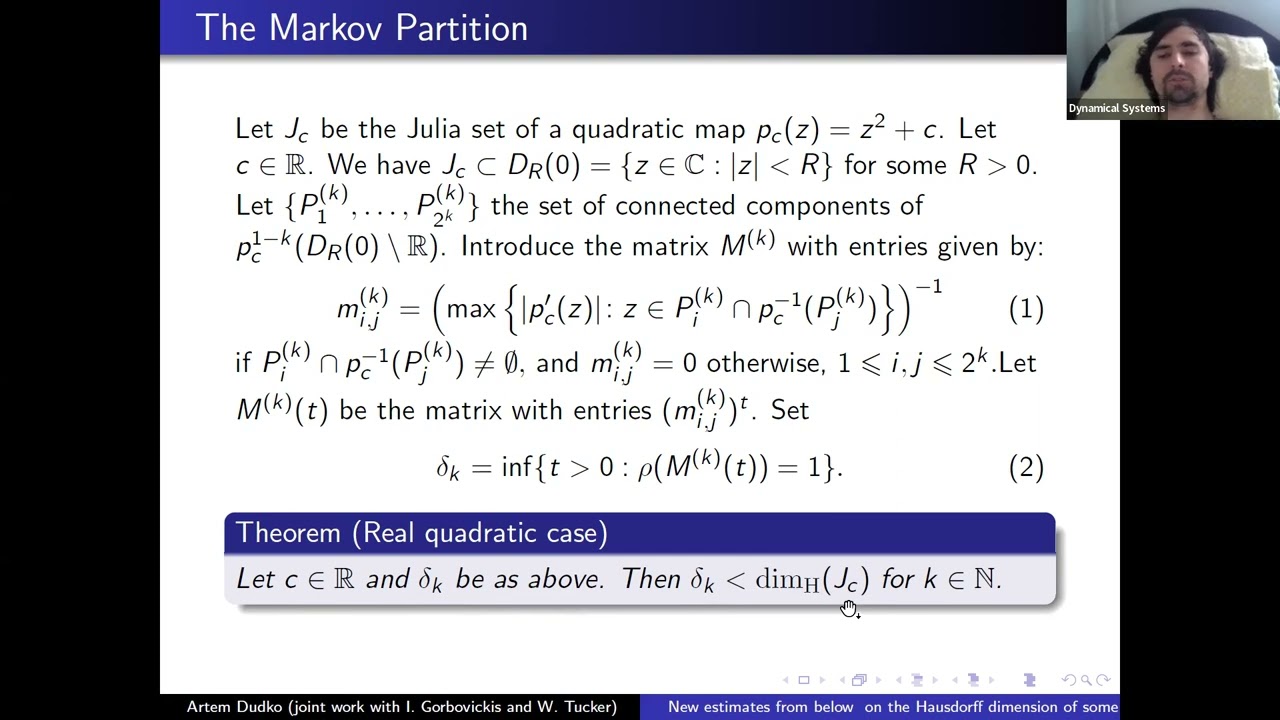
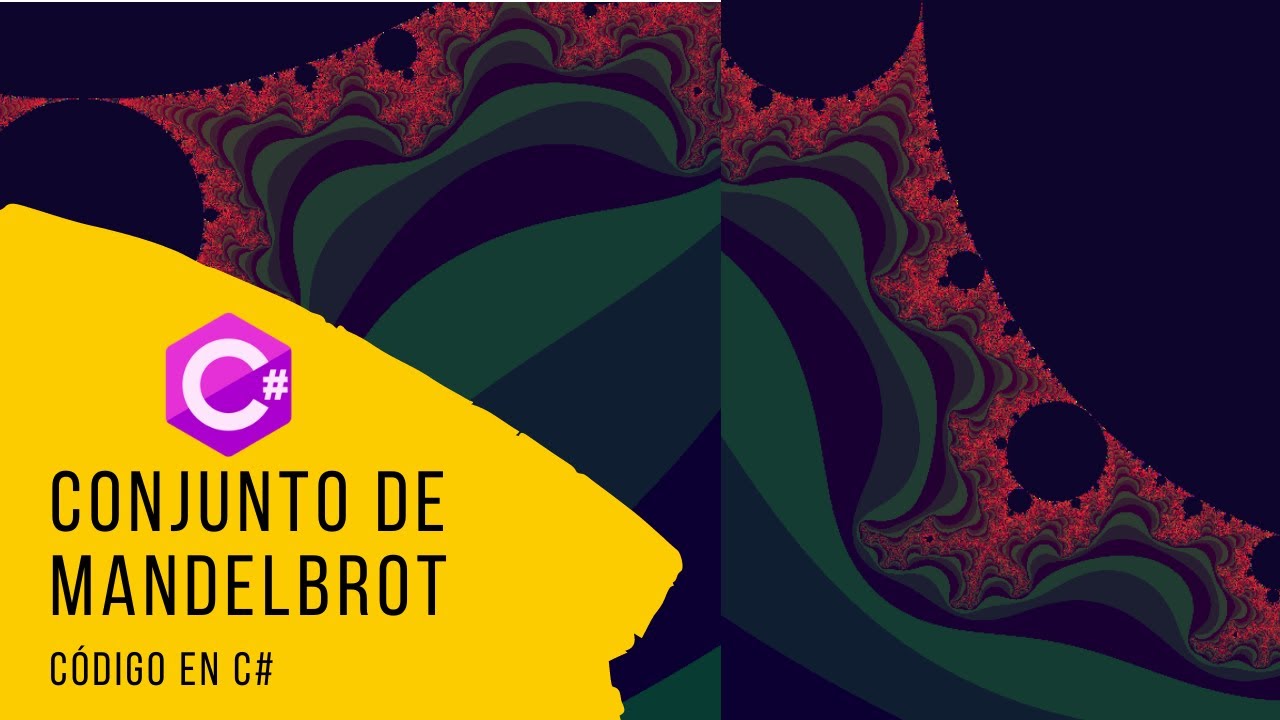
welcome to video number two in the first video we introduced the Mandelbrot set and in particular we focused on orbits in this video we're going to focus on the Julia sets we're going to see how they are calculated and how they relate to the Mandelbrot set the relationship is actually very fascinating if you love the Mandelbrot set make sure you watch the video right through until the end to learn how the Mandelbrot set seems to have a memory of its own anyways let's get started with this video we now you can technically have a Julia set using many different formulas but today we're only going to focus on one particular formula Z equals Z squared plus C as we saw in the last video this is also the formula for the Mandelbrot set so what is the difference well whether we generate the Mandelbrot set or a Julia set depends on how we set the initial values of Z and C the process of iteration is the same recall that when we calculated the Mandelbrot set we set Z equal to zero and C to the point of interest to build a Julia set we just make C a constant unlike the Mandelbrot set C remains constant over the whole image Zed is initially assigned to the point of interest is actually a whole Julia set image for every value of si if I change the value of C I get a new image the idea behind a Julia set is actually more fundamental than the Mandelbrot set and the idea of creating Julia sets is much older with the Julia set what we are doing is actually mapping how a complex function behaves let me stop here and clarify some terminology for our function Z equals Z squared plus C wish to refer to the whole black area I'll call it a field Julius it the Julius it is actually only the edge of the black area not the whole thing it's mathematical definition is the set of all points where the nearby orbits diverge no matter how close that nearby orbit is actually it's not that important for our purposes but it's worth realizing that if a mathematician says Julia sitting he has quite a specific meaning and that meaning might be a little different from what you were expecting if you learnt about the Mandelbrot set first okay now back to the fractals the Julia sets always have a two-way rotational symmetry around the origin we will see why this is the case in a later video when we build a filled Julia set step by step additionally there are two types of Julia sets the first type is where the hole filled Julia set is connected in this case the origin or zero is also part of the filled Julia set and is colored black the other type of Julia set is simply dust it is broken into infinitely many small pieces you we don't find Julia sets that are broken only into a couple of pieces they always hole or they are dust now a guy named Mandelbrot was very interested in which failures of C are connected Julia's and which ones are dust so he grabbed out a massive IBM computer and did some programming let's have a look at what he found using a more modern perspective because there is an image for each value of C on the complex plane we can plot a series of images on the complex plane like this the center of each individual image is located at its corresponding value of si it's possible to make these images a little smaller so that we can fit more onto the screen now watch what happens when I make them really small you we are looking at a bunch of small images and all of a sudden we can see the Mandelbrot set that is no coincidence if i zoom into the center of each of those little images the picture becomes even clearer you when Mandelbrot created his first image which was only made with ASCII computer text he was studying the behavior of the Julia sets the Mandelbrot set is actually a map showing where the Julia sets are connected and where they are not if we pick any value of C from within demands brought set the corresponding Julia set will be connected if we pick a value of C outside the Mandelbrot set the corresponding Julia set will be infinitely disconnected and this is actually the definition of the Mandelbrot set you can render the Mandelbrot set this way because it just so happens that all the connected Julia sets have a filled or black center pixel here is the animation one more time so that you can see what is happening you the Mandelbrot and Julia sets are related in more ways than that so happens that when we explore deep into the Mandelbrot set we find shapes that are very similar to Julia sets this is particularly obvious when we zoom close to a mini Mandelbrot locally the orbits of the Mandelbrot set are behaving a little like Julia sets and I guess this is not too surprising because the iteration process is so similar we call them embedded Julius it's the embedded Julia sets are always connected because the Mandelbrot set itself is connected however there is one big surprise at the center of every embedded Julia set we find a mini Mandelbrot you the mini Mandelbrot is founded twice the depth is where we found the embedded Julia set so deep embedded Julia says have even deeper mini Mandelbrot's at the center the next big surprise is that inside these embedded Julia sets the Mandelbrot set remembers where it came from to see what I mean let's zoom into the Mandelbrot set starting with this embedded Julia take notes of the features I pass we'll start by zooming to the edge of the embedded Giulia for a little passed about six spirals you then we will zoom at the tip of the line you now at the middle of a line passing by some embedded Julia's you finally let's dive into the center of an embedded Julia set and try to find a mini Mandelbrot it's interesting to examine the sequence of shapes that we will now pass firstly we see the edge of our original embedded Julia and we zoom past about six spirals except now that there are two of them roughly rotational symmetrically arranged then we find our line at a gang two of them next we find where we zoomed at the center of the line but it is split in two forming a cross and we cruise past several embedded Julia sets so everything up to this point was repeated but we had to weigh rotational symmetry if we were to repeat the last little bit of two-way symmetry we would get four-way symmetry and so that is what we find here is a four-way symmetrical version of our first embedded giulia shape our lines follow you I'm sure by now you getting the idea next we have a way symmetry and it replies again you then 16y symmetry but you may be noticing that the distance to each symmetry increases having 32 and 64 ways symmetry follow eventually the symmetry will become infinite and everything collapses into a mini Mandelbrot but I can assure you that if you look very close to the Mandelbrot set the symmetry keeps doubling at its edge 1024 2048 and so on let's have a closer look you and there is our original embedded Juliet with about six spirals arranged precisely in lines around the mini Mandelbrot now if you are clever about where you are zooming in you can use this remembering property to create some artistic shapes I'll place some links in the description to a couple of videos that do this before I wrap up this video I'd like to show you that it is actually the Julia set that holds these properties although we find it in the Mandelbrot set it seems to be a feature of the Julia sets themselves I will take C close to the inside of the mini mandible and render the corresponding Julia set let's have a look at the result you that's it for this video in the next video we will be building Julia set step-by-step using a very interesting animation I have developed this give you a visual understanding as to why the Julia sets are rotationally symmetrical and why they form the shapes they do you
Up Next

128:44
Paradoxes in Philosophy: Exploring Fundamental Puzzles
@Sleeplessphilosophers
386 views•2026-01-09

4:43
Elliptic Curve Cryptography Explained: ECC, ECDSA, ECDH
@PracticalNetworking
28.5K views•2024-10-21

10:44
Fourier Series Introduction: The Big Idea Explained
@DrTrefor
387K views•2021-05-03

6:00
The Mathematical Impossibility of Accurate World Maps
@Vox
23.3M views•2016-12-02
Related Study Plans & Knowledge Roadmaps
Structured learning paths in Mathematics
mathematics
Tensor Calculus: Vectors to Riemann Curvature
01Mathematical Foundations: Linear Algebra & Calculus
02Covectors, Dual Spaces, and Tensor Basics
03The Metric Tensor and Index Gymnastics
+ 2 more learning modules
40h5 modules
Explore Roadmap
mathematics
Gödel's Incompleteness: Logic, Proofs & Limits
01Introduction to Formal Systems & Hilbert's Dream
02Set Theory, Cardinality, and Cantor's Diagonal Argument
03Arithmetization and Gödel Numbering
+ 2 more learning modules
14h5 modules
Explore Roadmap
mathematics
Galois Theory: Fields, Groups & Solvability
01Foundations of Abstract Algebra: Groups & Fields
02Polynomials & Field Extensions
03Splitting Fields & Symmetries
+ 2 more learning modules
24h5 modules
Explore Roadmap
mathematics
Non-Euclidean Geometry: Models & Geodesics
01Euclid's Fifth Postulate and the Birth of New Geometries
02Hyperbolic Space and the Poincaré Disk Model
03Geodesics: Defining Straight Lines in Curved Spaces
+ 2 more learning modules
15h5 modules
Explore Roadmap