

![[벙커1특강] 파토, 김상욱 - 과학같은 소리하네: 함 찔러보는 양자역학](https://i.ytimg.com/vi/NVgeV9ACexY/maxresdefault.jpg)










Paradoxes are fundamental puzzles that reveal the limitations of human reasoning and challenge our intuitive understanding of reality, serving as powerful tools for exploring the boundaries of logic, language, and scientific explanation.
Paradoxes in Philosophy: Exploring Fundamental Puzzles
Added:Basic Propositional Logic: Understanding truth values, logical consistency, and the structure of self-referential statements.
Hume's Problem of Induction: The philosophical challenge of justifying inductive reasoning and predictions about the future.
Classical Determinism: The Newtonian view of the universe as a predictable, causal system governed by physical laws.
Introduction to Epistemology: Basic concepts of belief, justification, and how scientific hypotheses are confirmed.
Gödel's Incompleteness Theorems: Exploring how mathematical logic handles self-reference and limitations within formal systems.
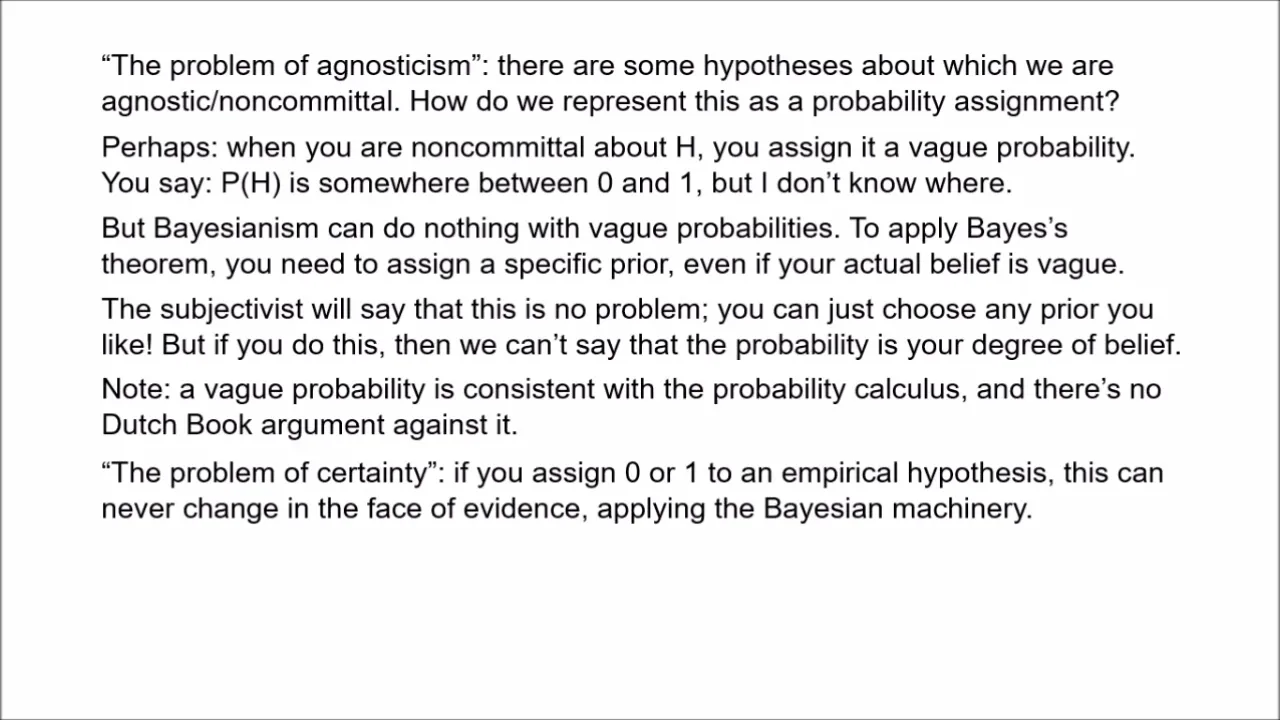
Bayesian Confirmation Theory: Advanced probabilistic frameworks designed to address inductive puzzles like Goodman's Grue paradox.
Quantum Mechanics and Chaos Theory: How modern physics and non-linear systems challenge the deterministic model of Laplace's Demon.
The Free Will Debate: Investigating compatibilist and incompatibilist responses to causal determinism.
386 views4likes2:08:44Original Release: 2026-01-09
Welcome to Sleepless Philosophers, where deep ideas meet restful nights. If you enjoy these journeys through philosophy, please like and subscribe and turn on notifications for daily uploads. To support the channel, consider leaving a super thanks. Any amount helps us continue creating content. You can also become a member to request video topics.
We're not monetized, so your support truly makes the difference. Now, let the philosophy begin. Epimenides paradox. A poet from Cree named Epimemenades once declared that all Cretans are liars. And this statement, simple as it seems, has echoed through the centuries as one of the earliest recorded paradoxes, a puzzle that predates even the formal study of logic and yet contains within it the seeds of contradictions that still trouble philosophers today. If Epimemenades himself is a and he claims that all cretins are liars, then his statement must be a lie. But if his statement is a lie, then not all cretins are liars, which means some cretins tell the truth, which could include Epimemenades himself, which means his statement might be true after all, which means all cretins are liars, which means his statement is a lie, and the cycle begins again. The paradox is not quite as airtight as the liar paradox that would emerge later because calling someone a liar does not mean they always lie, only that they lie sometimes. And so there remains a sliver of logical escape. A possibility that Epimemenades is telling the truth on this one occasion while still being a liar in general or that his statement is partially true and partially false depending on how it is interpreted.
St. Paul referenced the paradox in his letter to Titus, quoting Epimemenades and adding that the statement is true, seemingly unaware or unconcerned with the logical contradiction embedded in his endorsement. And this has led to centuries of theological and philosophical debate about what Paul intended and whether scripture itself contains a paradox.
The ancient Greeks recognized the puzzle, but lacked the formal tools to fully analyze it, treating it more as a rhetorical curiosity than a serious threat to logic. And it was not until the development of modern symbolic logic that the deeper implications became clear.
The paradox belongs to a family of self-referential statements that collapse under their own weight. And Bertrren Russell would later use variations of this structure to reveal cracks in the foundation of mathematics, proving that not all sets can be safely defined, that not all statements can be assigned a truth value without contradiction.
Some philosophers argue that the Epimemenades paradox is weaker than its descendants because it depends on empirical facts about creatins rather than purely logical structure and that if we simply reject the premise that all cretins are liars, the paradox dissolves unlike the pure liar paradox which creates contradiction through its form alone. Others see it as an early recognition that language can turn against itself, that statements about truth and falsehood require careful handling, that self- reference introduces dangers that must be acknowledged and navigated. The paradox also raises questions about identity and generalization, about what it means to make sweeping claims about groups of people and whether such claims can ever be fully coherent when the speaker is part of the group being described.
Epimemenades stands at the origin of a long tradition of logical puzzles, his words reverberating through time. A poet who may not have fully understood what he had unleashed, but who nevertheless gave voice to one of the fundamental tensions in human thought. The way that truth can fold back on itself and become strange, unstable, uncertain.
Goodman's grew paradox. When emeralds turn blue at midnight, a philosopher invents a new color term, grew. And grew is defined as follows. An object is grew if it is observed before time t and is green or if it is not observed before time t and is blue where t is some future date perhaps January 1st of next year and this definition is strange is artificial combines observation and time in a way that ordinary color terms do not. But the definition is precise is perfectly clear. And now the philosopher considers emeralds and notes that all emeralds observed so far have been green. And these observations support the hypothesis all emeralds are green.
And the same observations also support the hypothesis all emeralds are grew because all observed emeralds satisfy both descriptions. They are green which means they are grew up to time t. And both hypotheses are equally well supported by the evidence. Both fit all observations perfectly. And yet the two hypotheses make different predictions about the future. The first predicts that emeralds examined after time t will be green. The second predicts they will be blue. And so we have two hypotheses equally supported by evidence making opposite predictions. And the question is which hypothesis should we believe?
which generalization should we project into the future and Nelson Goodman poses this as a problem about projectability about which predicates can legitimately be used in inductive inferences and this is the grew paradox also called Goodman's new riddle of induction a puzzle that shows that not all evidence supported hypotheses are equal that some predicates are projectable and others are not and the challenge is to explain what makes green objectable and grew not. What distinguishes legitimate from illegitimate generalizations?
Imagine living in a world where emeralds are grew, where all emeralds observed before time t are green, but all emeralds examined after time t are blue.
And from the perspective of someone before time t, this is indistinguishable from a world where emeralds are simply green. All observations are the same.
And yet the two worlds are radically different, will diverge dramatically after time t. And the puzzle is that evidence accumulated before t does not distinguish between these possibilities, does not tell us which world we inhabit.
And so induction alone cannot determine which hypothesis to accept, cannot tell us whether emeralds are green or grew.
And this reveals that induction requires more than just fitting evidence.
requires principles about which predicates are projectable, which generalizations are legitimate. And these principles cannot themselves be justified inductively without circularity.
Visualize the timeline with time t marking a boundary. And on one side of the boundary, all observed emeralds are green. And the question is, what happens after the boundary? Do emeralds remain green or do they become blue? And the hypothesis all emeralds are grew says they switch colors. But this switching is built into the definition of grrew is a feature of how the predicate is defined rather than a feature of emeralds themselves. And this reveals something important that the grew hypothesis is gerrymandered is artificially constructed to fit past observations while making a different prediction about the future. And our intuition is that such gerrymandered hypotheses should not be projected, should not be taken seriously. But explaining why requires articulating a principle that distinguishes natural from gerrymandered predicates.
Goodman's own solution appeals to entrenchment argues that green is projectable because it has been used successfully in many past inductions has become entrenched in our language and our theories. While grrew is a newcomer is defined artificially has no history of successful projection. And so we should prefer green over grew not for any logical reason but for pragmatic reasons because green has proven its worth. And this solution ties projectability to linguistic and scientific practice. Makes it a matter of history rather than logic. And some find this unsatisfying find it too relativistic. But Goodman argues that there is no deeper justification available that entrenchment is as good as justification gets for inductive inference.
Another response argues that grew is not a genuine predicate is not natural because it is defined in terms of observation and time includes reference to specific moments and observers and genuine properties should be observer independent should not change based on when or whether they are observed and green is natural in this sense refers to a real property that objects have regardless of observation. While grew is artificial is defined through disjunction and reference to observation. And so only natural predicates are projectable. And this solution requires explaining what makes a predicate natural. What distinguishes genuine properties from artificial constructions. And this leads to metaphysical questions about the nature of properties about whether naturalness is objective or conventional.
A third response from a basian perspective argues that grew hypotheses are less probable than green hypotheses given reasonable prior because grew hypotheses postulate discontinuities postulate that properties change suddenly at arbitrary times and such discontinuities require explanation require reasons and in the absence of such reasons we should assign low prior probability to grew hypothesis and And so while grew fits the evidence as well as green, grrew is less probable overall because of its lower prior and this solution appeals to simplicity and parimony treats continuous properties as more probable than discontinuous ones and explains projectability in terms of prior probabilities rather than entrenchment or naturalenness.
The Grrew paradox also reveals that the problem of induction is deeper than Hume recognized because Hume worried about justifying any inductive inference about showing that the future will resemble the past. But even if we accept induction, we face Goodman's problem. We must choose which respects the future will resemble the past. Must decide which predicates to project and different choices lead to different predictions. And there is no algorithm, no mechanical procedure that tells us which predicates are projectable, which generalizations are legitimate. And so induction requires judgment, requires background knowledge, requires engagement with the actual practice of science rather than pure logical analysis. The paradox extends beyond emeralds and colors, to any inductive inference, to all attempts to generalize from observed to unobserved cases.
Because for any pattern we observe, for any regularity we find, there are infinite grew like predicates that fit the pattern up to now but diverge in the future. And choosing between these predicates cannot be done on evidential grounds alone, requires additional principles requires distinguishing projectable from non-projectible predicates. And every scientific theory makes such choices implicitly assumes that certain predicates are natural and others artificial. And Goodman's paradox makes these assumptions explicit. Forc's recognition that induction is not just about fitting evidence, but about choosing the right vocabulary, the right predicates, the right way of carving up the world. The clock approaches time t and emeralds remained green as they always have been. And the grew hypothesis is refuted is shown to have been wrong. But before time t the evidence supported grew as much as green and this shows that evidence alone was insufficient. That something beyond evidence guided our preference for green. Our confidence that emeralds would remain green rather than turning blue. And that something is what Goodman's paradox investigates. What it challenges is to articulate. And the paradox remains not fully resolved, not answered by any single theory that satisfies everyone, but persistent as a challenge to theories of induction. A test case for accounts of scientific reasoning and a reminder that generalizing from experience requires more than logic. requires substantive assumptions about the world, about which properties are real and which are artificial, about which patterns will continue and which will break. And these assumptions cannot be justified inductively without circularity, cannot be proven logically, without begging the question. And so induction rests ultimately on judgment, on practices that have proven successful, on entrenchment or naturalness or simplicity. And Goodman's group paradox reveals this foundation, exposes the principles we rely on but cannot fully justify. And the paradox endures as one of the most important problems in philosophy of science.
Laplas's demon, the mind that knows everything that will ever happen. A supremely intelligent being, a vast intellect that knows the position and velocity of every particle in the universe at a single instant, stands outside time and space. And this being, this demon, as Pierre Simon Llas called it in 1814, possesses the complete laws of physics, the equations that govern how particles interact and move. And with this information, the precise state of every atom and the exact rules of motion, the demon can calculate the future can determine with perfect accuracy where every particle will be at any future time. Can predict every event, every thought, every decision, every outcome, from the fall of a raindrop to the rise of civilizations, from the collision of atoms to the death of stars. And in principle, the demon could also calculate the past, could trace every particle's trajectory backward to determine exactly how the present arose from previous states. And so this demon, given sufficient computational power, could know everything that has happened and everything that will happen. The entire history of the universe, past and future, encoded in a single snapshot of the present. And this is Laplas's demon, a thought experiment about determinism, about whether the universe is a clockwork mechanism, where the future is entirely determined by the past, where free will is an illusion, where everything that will ever happen is already decided, already implicit in the current state of things.
Imagine the demon's knowledge as a vast table, infinitely long, listing the position and velocity of every particle, every electron, every quark, every photon, trillions upon trillions upon trillions of entries. And the demon has access to all this information perfectly, knows it exactly with infinite precision. And the demon also knows Newton's laws or perhaps Einstein's field equations or quantum mechanics. knows the rules that govern how these particles influence each other, how forces propagate, how energy transfers. And with this knowledge, the demon can simulate the universe, can run the equations forward in time, calculating step by step how the particles will move, how they will collide and interact. And the simulation produces a prediction, a complete specification of the universe at every future moment. And this prediction, if the laws of physics are deterministic, is not probabilistic but certain. The future is determined, fixed, inevitable, and the demon knows it all. The implications are profound and troubling.
Because if Lapas's demon is possible, if the universe is deterministic, then free will becomes problematic, becomes perhaps an illusion. Because every decision you make, every thought you have, every action you take is the result of particles in your brain following physical laws. And those particles are moving according to rules determined by their initial conditions.
And those initial conditions were set by earlier states going back to the beginning of the universe. And so your choices are not free, but predetermined, decided billions of years ago when the universe began. And you are not an agent but an automatan. A complex machine that operates according to fixed rules. And the feeling of making choices, of deliberating and deciding is a subjective experience produced by computational processes in your brain.
But the outcome was never in doubt, was determined from the start. And this conclusion undermines moral responsibility, undermines the concepts of praise and blame, undermines the notion that people could have done otherwise, and it raises the question of what it means to be human if our actions are all predetermined.
But Lapas's demon faces several obstacles, several reasons why, even in principle, it might be impossible. The first obstacle is quantum mechanics which was unknown in Laplas's time but is now recognized as fundamental to physics and quantum mechanics is probabilistic not deterministic.
The Heisenberg uncertainty principle states that we cannot know both the position and velocity of a particle with perfect precision. There is an irreducible indeterminacy, a fundamental limit on what can be known. And when we measure a quantum system, the outcome is random, governed by probabilities but not determined. And so Laplas's demon cannot have the precise initial conditions it needs. Cannot know the exact state of the universe. And even if it could, the laws of quantum mechanics only predict probabilities for future events, not certainties. And so the future is genuinely open, not determined. And Laplas's demon is impossible. The second obstacle is chaos sensitivity to initial conditions where tiny unmeasurable differences in starting states lead to vastly different outcomes over time. Weather systems, planetary orbits, fluid flows, all exhibit chaotic behavior where prediction becomes impossible beyond a certain time horizon because errors in measurement, no matter how small, grow exponentially and eventually dominate.
And even if quantum mechanics were not an issue, even in a classical deterministic universe, practical prediction would be impossible for chaotic systems. And the demon would need infinite precision, infinitely accurate knowledge of initial conditions. And any finite approximation, no matter how good, would fail after sufficient time. And so the demon's predictions would be useless for complex systems on long time scales.
The third obstacle is computational.
Even if the demon had perfect information and deterministic laws, simulating the universe requires computing power, requires processing the interactions of every particle. And the universe contains roughly 10 to the 80 particles. And computing their evolution requires resources. And some physicists have argued that simulating the universe would require a computer as large as the universe itself. And such a computer could not run faster than the universe it simulates. Could not predict the future faster than the future unfolds.
And so the demon could not tell you tomorrow's events before tomorrow arrives. And the demon becomes useless as a predictor reduced to a mere recorder that reconstructs what has already happened rather than foretelling what will happen.
Visualize the universe as a vast machine. Gears turning, particles moving, and Laplas's demon standing outside, watching the machine, knowing the position of every gear, the velocity of every component, and calculating how the machine will continue to turn. But the demon is blocked by quantum uncertainty, cannot measure the gears precisely enough, is blocked by chaos, cannot maintain accuracy over time, is blocked by computational limits, cannot perform the calculation fast enough. And so the demon, mighty as it seems, is impossible. The universe resists total prediction, resists complete knowledge, not because of practical limitations, but because of fundamental features of physical law and determinism, even if it were true, does not grant us the power to predict. And the demon remains a thought experiment, a symbol of a kind of knowledge that cannot exist, a vision of omniscience that is ruled out by the nature of reality itself.
Laplas's demon also raises philosophical questions about explanation and understanding. Because even if we cannot predict the future, even if determinism fails or the demon is impossible, we still seek to explain why things happen, to trace causes and effects, to understand the mechanisms that generate events. And this explanatory project does not require lelacian determinism, does not require perfect prediction, but only patterns, regularities, laws that hold approximately. And science proceeds without the demon, without omniscience by finding partial explanations, probabilistic models, statistical regularities, and these are sufficient for understanding, for technology, for navigating the world. And the demon's impossibility does not doom science but liberates it. Frees it from the burden of total prediction. Allows it to focus on what can be known rather than lamenting what cannot. The demon sits in conceptual space. All knowing and impotent. Knowing everything but unable to act, unable to exist, blocked by uncertainty, by chaos, by computation.
And Laplas's vision of a deterministic clockwork universe fades, replaced by a more subtle picture. A universe governed by laws but not wholly determined. Open to chance, to randomness, to emergence, where the future is not written in the present, but unfolds through processes that are partly lawful and partly random. And free will, though not proven, is at least not obviously refuted. And moral responsibility, though challenged, survives because even if determinism were true, even if all actions are caused by prior states, we still distinguish between actions that flow from deliberation and those that do not, between agents who respond to reasons and those who do not. And these distinctions matter. Ground our practices of praise and blame. and Laplas's demon, impossible and paradoxical, remains a touchstone in debates about determinism, free will, and the limits of knowledge. A thought experiment that has shaped centuries of discussion and continues to challenge our understanding of what it means to predict, to know, and to be free.
McTagot's paradox of time, why past, present, and future are contradictory.
A philosopher named JME McTagot constructs an argument attempting to prove that time is unreal, that temporal distinctions are contradictory, that past, present, and future cannot coexist. And the argument begins by distinguishing two ways of thinking about time. The A series which orders events as past, present or future, and the B series which orders events as earlier than or later than each other.
And McTagot argues that the A series is essential to time. That change requires events to move from future to present to past that without this passage. Without the A series there is no real time. But the A series is contradictory generates logical problems and therefore time is unreal is an appearance generated by our temporal perspective but does not correspond to ultimate reality. And this is McTagot's paradox of time. One of the most famous and most controversial arguments in the philosophy of time. An argument that has shaped all subsequent debates about the nature of time, about whether time is real or elucory. About whether the passage of time is objective or subjective.
Imagine time as having two aspects. The a series aspect where events are classified as past, present or future.
Where we say the meeting is future is happening now in the present was passed yesterday and events change their a series position move from future to present to past and this movement is time's passage is what makes time dynamic and the B series aspect where events are ordered as earlier or later where we say the meeting is later than breakfast and earlier than dinner and these B series relations are fixed do not change the meeting is always later than breakfast regardless of when we consider it. And McTagot argues that the A series is essential for real time.
That the B series alone is not sufficient. That time requires passage, requires events to change from future to present to past. But the A series is contradictory and so time is impossible is unreal. The paradox emerges from the fact that a series properties are contradictory. Every event is past and present and future. The meeting is future before it occurs, is present when it occurs, is past after it occurs. And so the meeting has all three properties is past and present and future. And these properties are incompatible.
Cannot all be instantiated by the same event. And so the a series generates contradiction. And the standard response is to say that events have a series properties at different times. The meeting is future at earlier times.
present at its time of occurrence, past at later times. And this seems to resolve the contradiction by indexing a series properties to times. But McTagot argues this does not help because now we must ask whether the times themselves are past, present or future. And the same problem recurs. If the time at which the meeting is future is itself past, then the meeting is past and future and contradiction remains. An indexing to times does not eliminate the contradiction but only pushes it back.
McTagot argues that the only way to avoid contradiction is to eliminate the a series to accept that events do not really move from future to present to past. That passage is elucory. That reality consists only of the B series only of earlier later relations. But the B series without the A series is not real time. is only a static ordering, lacks the dynamism, lacks the passage that is essential to time. And so time is unreal, is an appearance that our consciousness generates from a fundamentally timeless reality. And McTagot's position is a form of idealism about time, treats time as mind dependent, as not part of the ultimate structure of reality.
Visualize the paradox as a vicious circle. Events have a series properties but these properties are contradictory.
So we index them to times but then times have a series properties which are contradictory. So we index to second order times but these are contradictory and the regress continues and the contradiction is never eliminated only relocated. And McTagot concludes that the A series is inherently contradictory, cannot be made coherent and must be rejected. And with it goes time itself, which requires the A series for its reality. One response to McTagot's paradox, the tenseless or B theory response, accepts MCtagot's argument that the A series is contradictory, but denies that time requires the A series. argues that the B series is sufficient for real time, that earlier later relations constitute time and passage is an illusion is a feature of our temporal perspective and the universe exists as a four-dimensional block, a block universe where all times are equally real and past, present and future are not objective features of reality but are indexical, are relative to a perspective. And this B theory has become orthodoxy in philosophy of time is widely accepted as avoiding McTagot's paradox while preserving the reality of time. Another response, the tense store a theory response denies that the a series is contradictory argues that mtagot's argument involves a mistake that a series properties are not really contradictory because they are indexed to times in a non-proatic way and the meeting being future at t1 and past at t2 is not contradictory is just the normal way temporal properties work and a theorists argue that passage is real that the present is objectively real that the future is open and the past is fixed and McTagot's argument fails because it assumes that a series properties must be simultaneous to be contradictory when they are not simultaneous are at different times and this response preserves the A series preserves passage and rejects McTagot's conclusion that time is unreal a third response from presentism argues that only the present exists, that past and future are unreal. And so events do not have contradictory a series properties because only present events exist and only present properties are real and the meeting is not simultaneously past, present and future because only one of these is real at any time. And presentism avoids McTagot's paradox by radical onlogical restriction by accepting that most of time does not exist. And this preserves the reality of the present preserves passage but faces difficulties explaining how truths about past and future can be true if past and future do not exist.
McTagot's paradox has been enormously influential, has shaped all debates about time, has forced philosophers to clarify their positions, to distinguish A theories from B theories, to recognize that different conceptions of time, have different metaphysical commitments, and the paradox remains controversial, remains debated, with some accepting McTagot's conclusion that time is unreal, some accepting that the A series is contradictory, but denying that this makes time unreal. And some denying that the A series is contradictory and no consensus exists. And the paradox endures as one of the most important arguments in metaphysics. An argument that challenges our ordinary understanding of time forces recognition that temporal passage, the movement from future through present to past is philosophically problematic. And whether time is real or illusory remains one of philosophy's deepest questions. And McTagot's paradox continues to structure the debate, continues to force philosophers to grapple with the nature of time, with whether passage is objective or subjective, with whether reality is a static four-dimensional block or a dynamic unfolding present.
And the paradox persists, unsolved and perhaps unsolvable, a permanent challenge to theories of time.
Morton's Fork, when both choices lead to the same doom, a tax collector in 15th century England faces a dilemma when assessing how much wealthy citizens should pay, and the collector observes that some nobles live extravagantly, displaying their wealth openly, and others live frugally, claiming poverty.
and Archbishop John Morton serving as Lord Chancellor under King Henry VIIIth devises a strategy to extract taxes regardless of which lifestyle the noble chooses and the strategy is simple and brutal. If a noble lives extravagantly then clearly they have money and can afford to pay high taxes. And if a noble lives frugally then clearly they are saving money and must have accumulated wealth and can afford to pay high taxes.
And either way, the noble must pay.
There is no escape, no strategy that avoids taxation. And this trap, where two apparently opposite choices lead to the same unwanted outcome, became known as Morton's fork, named after the archbishop who wielded it. And the term has entered common usage to describe any situation where someone must choose between two options that both lead to the same undesirable result where the appearance of choice masks the reality of inevitability.
Imagine being a noble in Morton's England, weighing your options, trying to decide whether to live well or live simply, and realizing that either choice leads to heavy taxation, that the tax collector has closed off all escape routes, has constructed a logical trap where your strategy is irrelevant, where you lose regardless of what you choose.
And this creates a sense of futility, a recognition that the game is rigged, that the appearance of agency is illusory. And Morton's Fork exemplifies a class of situations where apparent choices are not genuine choices, where different paths converge on the same destination, and the only real choice is whether to accept the inevitable or to refuse to play the game at all. The structure of Morton's fork appears throughout logic, rhetoric, and strategy. Wherever someone constructs an argument that covers all cases that shows that regardless of what premises are accepted, a certain conclusion follows. And such arguments can be powerful tools of persuasion, can trap opponents in positions where they cannot escape the conclusion. But they can also be facious, can hide implicit assumptions or false dichotoies, can present apparent inevitability that dissolves under scrutiny. And distinguishing genuine Morton's forks from apparent ones requires careful analysis of whether the two paths really do lead to the same conclusion or whether there are hidden differences, hidden escape routes. Visualize the fork as a Y-shaped path, two branches diverging, one path representing extravagance, and one representing frugality, and both paths lead to the same destination. The tax collector's office and the noble walking either path arrives at the same place. And the fork is not a choice between outcomes, but a choice between routes to a predetermined outcome. And the futility comes from recognizing that movement, that action, that strategy, all are pointless, all lead to the same end. And the only way to avoid the destination is to refuse to walk, to opt out of the entire framework. Morton's Fork differs from a dilemma where two choices lead to different undesirable outcomes and the chooser must select the lesser evil because in Morton's Fork the outcomes are the same are equally bad and the choices between different routes to that bad outcome and this makes Morton's Fork particularly frustrating particularly demoralizing because at least in a dilemma there is a meaningful choice a decision that matters but in Morton's Fork the choice does not matter. The outcome is fixed and the appearance of choice is a cruel illusion. The concept has applications in game theory in situations where a player's strategies are dominated, where regardless of what the player does, the outcome is worse than some alternative the player cannot access. And recognizing Morton's Forks is important for strategic reasoning, for understanding when continued play is pointless, when the game should be abandoned rather than played, because playing only wastess resources without changing the outcome. Morton's fork also appears in legal and political contexts where laws or policies are designed to be inescapable where any action a person takes falls under the law's scope and this can be legitimate can reflect comprehensive regulation of a domain but it can also be oppressive can create situations where individuals have no legal way to avoid a burden no option but compliance and recognizing such structures is important for identifying ifying injustice for understanding when law has become a trap rather than a framework for freedom. The paradox also has psychological dimensions because facing Morton's fork creates learned helplessness creates the sense that choices do not matter that outcomes are predetermined regardless of effort or strategy. And this can lead to resignation, to ceasing to resist, to accepting the inevitable. and oppressive systems often work by creating Morton's forks. By ensuring that resistance and compliance lead to similar outcomes, that fighting and surrendering are equally futile. And breaking out of Morton's fork requires either finding a hidden third option, a way to refuse the binary choice, or accepting one path and finding meaning in the choosing, even if the outcome is fixed. Some philosophers argue that life itself is Morton's fork.
That all paths lead to death. That whether we live virtuously or wickedly, happily or miserably, we end up in the same place non-existent. And this can be a source of nihilism. Can undermine the sense that choices matter. But it can also be liberating, can free us to choose based on values rather than outcomes. to recognize that if all paths lead to death, then what matters is the path itself, the journey, not the destination, and Morton's fork becomes an invitation to find meaning in process rather than result. The Archbishop's strategy was effective, was brutal, extracted taxes efficiently, and the nobles paid unable to escape the logic, unable to find a strategy that avoided the fork. And Morton's Fork entered history, became a term of art, became a warning about inescapable traps, about situations where apparent choice conceals actual constraint, and the fork remains present in contemporary debates about policy, law, and strategy. a reminder that not all choices are meaningful, that sometimes the appearance of freedom masks the reality of compulsion, and that recognizing Morton's fork is the first step toward escaping it, toward finding the third option, the refusal to engage, the rejection of the binary. And the fork stands, points in two directions, both leading to the same place. And the challenge is to see the fork for what it is. To recognize when choice is elucory, when strategy is futile, and when the only real option is to walk away, to refuse the fork entirely, to create a new path that the fork's designer did not anticipate. And Morton's Fork remains a timeless trap, a logical structure that appears whenever someone seeks to eliminate all escape routes to ensure that whatever choice is made, the desired outcome follows. And the fork endures as a reminder that the appearance of choice can be deceptive.
That freedom requires more than options.
Requires that options lead to genuinely different outcomes. And that when options converge, when the forks prongs meet, choice becomes meaningless. And only opting out restores agency.
Parit's teleransportation paradox.
Imagine a future where technology allows instant travel across vast distances through a process called telet transportation. A device scans your body down to the atomic level, recording the exact position and state of every particle, and then transmits this information to a distant location where another device reconstructs you perfectly, assembling a body atom by atom according to the transmitted blueprint. And the reconstruction is flawless. Every memory intact, every scar reproduced, every thought continued. And the reconstructed person steps out of the receiving chamber believing themselves to be you. Feeling no discontinuity, no sense that anything strange has occurred.
The philosopher Derek Parett asked a disturbing question about this process.
Are you the person who steps out of the receiving chamber or did you die in the scanning chamber? And a copy, a duplicate with all your memories and personality is now living your life. And if the scanning process destroys the original body as it records the information, then perhaps it is still you continuous in some sense. But what if the original body is not destroyed?
What if the scanner leaves you standing in the departure chamber intact and alive while the reconstruction appears in the receiving chamber? And now there are two of you, both with equal claim to being the original. Both feeling that they are you. And if both are you, then identity has become plural. But if only one is you, then which one? And what criterion could possibly distinguish them when they are physically and psychologically identical? Parett used this thought experiment to challenge the intuition that personal identity is what matters in survival. Arguing that what matters is not identity. Not being numerically the same person but rather psychological continuity and connectedness. The preservation of memories, personality, beliefs, desires and ongoing projects. And if these are preserved then survival has occurred even if strict identity has not. And so the reconstructed person is you in every way that matters even if they are not numerically identical to the original you. And the question of whether identity is preserved is a question about what we care about rather than a deep metaphysical fact. The paradox becomes more troubling when variations are introduced. Suppose the telet transportation device malfunctions and creates not one but two reconstructions.
Both perfect, both claiming to be you.
And now identity must branch, which seems impossible because identity is supposed to be a onetoone relation. A thing is identical only to itself. And yet both reconstructions have an equal claim. And if identity is not preserved in this case, then why should it be preserved in the normal case where only one reconstruction appears? And if it is not preserved, then every time you use the teleansporter, you die and a new person with your memories takes your place. Living a life they falsely believe is a continuation of yours.
Parett embraced the conclusion that identity is not what matters. That we should care about psychological continuity rather than numerical identity. And that the concept of a persisting self, a single unified person who endures over time is less important than we ordinarily think. that what makes your future self matter to you now is not that they are literally the same person, but that they are psychologically connected to you in the right ways. And if those connections can branch or spread across multiple individuals, then so be it. Identity is not sacred, not the ultimate ground of value or concern.
The telet transportation paradox has implications for how we think about personal survival. About whether what matters in death is the sessation of psychological continuity or the sessation of biological life. About whether uploading consciousness to a computer or creating digital copies would constitute survival or merely the creation of simulacra. and about whether the self is a metaphysical entity or a convenient fiction we use to organize experience.
The paradox also challenges intuitions about moral responsibility because if identity is vague or plural, then questions about who is responsible for past actions or who deserves future rewards become murky and the unity of the person which underpins much of ethics and law begins to dissolve.
Parettit's teleransportation scenario remains one of the most powerful thought experiments in philosophy, a story that uses imaginable technology to expose deep questions about identity, survival, and what it means to be a person.
Forcing recognition that the boundaries of the self, like the boundaries of clouds and cats, may be far less clear and far less important than common sense suggests. and that the question of whether you survive telet transportation may have no determinate answer or many answers or may simply be the wrong question to ask.
Schroinger's cat the pet that's both alive and dead. A cat sits in a sealed box, a box that cannot be opened or observed from the outside. And inside the box with the cat is a device, a quantum mechanism that has a 50% chance of killing the cat within 1 hour. and a 50% chance of leaving the cat alive.
Perhaps a vial of poison that will break if a single radioactive atom decays. And the decay is a quantum event, genuinely random with no way to predict whether it will happen in the next hour. And so after 1 hour has passed, the cat is either alive or dead. 50/50 odds. And this seems straightforward. But the paradox emerges when quantum mechanics is taken seriously when the rules of quantum theory are applied consistently because quantum mechanics says that before a measurement is made, before the box is opened and the cat is observed, the system exists in a superp position, a combination of both possible states simultaneously. And so the cat is both alive and dead at the same time, existing in a strange limbo where neither state is definite until observation collapses. The superp position and forces the system into one state or the other. And this is Schrodinger's cat, a thought experiment devised by physicist Irvin Schrodinger in 1935 to illustrate what he saw as the absurdity of applying quantum mechanics to macroscopic objects to show that something was wrong with the standard interpretation of quantum theory.
Imagine the situation step by step. At the beginning, the cat is alive. The radioactive atom has not yet decayed and the quantum state is well defined. But as time passes, the atom enters a superp position of decayed and not decayed because quantum mechanics describes it with a wave function that assigns amplitudes to both possibilities. And these amplitudes evolve smoothly. And the atom is in a state of quantum indeterminacy, neither definitely decayed nor definitely not decayed until a measurement is made. And this indeterminacy is not ignorance, not a matter of the atom being in one state or the other and we just do not know which, but a genuine feature of quantum reality. The atom literally does not have a definite state until measured.
And because the poison release is coupled to the atom state, the poison is both released and not released. And the cat is both dead and alive, existing in a superp position of macroscopic states.
And this conclusion seems absurd. Seems to violate everything we know about cats and boxes and life and death. And Schrodinger intended it to be absurd to show that something must be wrong with the orthodox interpretation of quantum mechanics. That the theory cannot be applied consistently to large objects.
That there must be a boundary somewhere between the quantum realm where superp positions occur and the classical realm where objects have definite states.
The paradox has generated an enormous amount of discussion and debate in physics and philosophy with different interpretations of quantum mechanics offering different resolutions. The Copenhagen interpretation, the dominant view in Schroinger's time, says that the wave function collapses upon measurement. That the act of observation forces the system into one definite state. And so when the box is opened and the cat is observed, the superp position collapses and the cat becomes definitely alive or definitely dead. But this raises questions about what counts as a measurement, about what constitutes an observer, about whether consciousness is required to collapse the wave function or whether any physical interaction suffices. And these questions remain controversial and the Copenhagen interpretation does not provide clear answers does not specify where the quantum classical boundary lies.
The many worlds interpretation offers a different resolution saying that the wave function never collapses that both outcomes occur that the universe splits into two branches. One where the cat is alive and one where the cat is dead. And both branches are equally real. And the observer also splits becoming two versions, one observing a live cat and one observing a dead cat. And each version believes they have observed a definite outcome. But from a global perspective, both outcomes happen. And the superp position is resolved not by collapse but by branching. And this interpretation avoids the measurement problem. Avoids the need to specify what counts as a measurement. But it introduces other difficulties. The proliferation of parallel worlds, the question of what it means for both outcomes to be real, and whether this is a genuine solution or merely a reformulation of the problem.
Decoherence theory provides another perspective focusing on the interaction between the quantum system and its environment. And it shows that macroscopic objects like cats are constantly interacting with their surroundings, with air molecules, with photons, with thermal radiation. And these interactions cause the quantum coherence. The delicate phase relationships that allow superp positions to be destroyed very rapidly in a fraction of a second for macroscopic objects. And once coherence is lost, the system behaves classically, appears to be in one definite state. And so the cat never actually exists in a superp position of alive and dead or exists in such a state for only an immeasurably short time before decoherence converts it to a classical mixture, a probabilistic state where the cat is either alive or dead. We just do not know which until we look. And this dissolves the paradox by denying that macroscopic superp positions persist long enough to be observable.
The paradox also raises questions about the role of consciousness in quantum mechanics about whether an observer must be conscious to collapse the wave function. And some interpretations suggest that consciousness plays a special role that the cat remains in superp position until a conscious being opens the box and perceives the outcome.
And this view has been criticized as mystical, as importing mind into physics in ways that are unnecessary and unhelpful. And most physicists reject it, preferring interpretations that treat measurement as a physical process involving interactions with macroscopic devices not requiring consciousness. But the question remains open, debated, unresolved. And Schrodinger's cat sits at the center of this debate, a symbol of the deep puzzles that quantum mechanics presents.
Visualize the box sealed and opaque. And inside the cat waits, and the quantum device ticks, and the atom hovers in superp position. And according to quantum mechanics, the entire contents of the box, the atom, the device, the poison, the cat, all exist in a superp position of two macroscopically distinct states. alive cats no decay and dead cat decay. And this superp position is described by a wave function that smoothly evolves. And the two branches of the wave function correspond to two different realities. And yet before the box is opened, there is only one box, one cat, one system. And the paradox is that quantum mechanics seems to say the cat is both alive and dead. While common sense says the cat is either alive or dead, we just do not know which. And this clash between quantum formalism and classical intuition is the heart of shrouding as cat. A paradox that has no agreed upon solution that different interpretations resolve in different ways and that continues to drive research in the foundations of quantum mechanics. In efforts to understand what measurement means, what quantum states represent, and how the quantum world relates to the classical world we experience, the box sits on the table, the hour passes, and the cat's fate is sealed. Or is it? Or is the cat in limbo, suspended between life and death, waiting for observation to make reality definite? And the paradox endures not because physicists do not understand quantum mechanics, but because quantum mechanics, understood correctly, leads to conclusions that seem impossible, that violate everyday experience, that force choices between interpretations that are empirically equivalent, but conceptually divergent. And Schroinger's cat remains the most famous illustration of this strangeness, a thought experiment that has entered popular culture. A paradox that symbolizes the weirdness of quantum reality. And the cat, alive and dead, real and hypothetical, continues to haunt physics and philosophy, a permanent reminder that the quantum world is not merely different in degree from the classical world, but different in kind, governed by rules that defy visualization and resist intuitive understanding. And the paradox persists, unresolved in the deepest sense, a puzzle that reveals the limits of human intuition and the challenge of making sense of a theory that works perfectly in practice but remains mysterious in principle.
The Achilles and the tortoise. Achilles, the swift-footed hero of Greek legend, agrees to race a tortoise. And to make the contest fair, the tortoise is given a head start, perhaps 100 m. And the race begins and Achilles runs swiftly toward the point where the tortoise started. But by the time he reaches that point, the tortoise has moved forward, a small distance, perhaps 10 m. And so Achilles runs toward that new position.
But again, by the time he arrives, the tortoise has advanced a bit further, perhaps 1 meter. And this process continues. Each time Achilles reaches where the tortoise was, the tortoise has moved ahead. And it seems that Achilles can never quite catch up, never quite overtake the slower creature. And yet, common sense insists that of course Achilles will pass the tortoise. That speed wins races that the faster runner always overtakes the slower given enough time and distance. And this contradiction between logic and intuition is Zeno's most famous paradox, a puzzle that has captivated philosophers and mathematicians for over two millennia.
Zeno of Ala constructed this argument in the fifth century B.CE as part of his defense of Palmenadian monism. The idea that reality is one unchanging whole and that motion and plurality are illusions.
And the paradox was meant to show that the concept of motion leads to absurdity. That if we accept that space and time can be divided infinitely, then the faster can never overtake the slower. And since this conclusion is obviously false, something must be wrong with our assumptions about motion and change.
The paradox rests on the idea that Achilles must complete infinitely many tasks, reaching the first point where the tortoise was, then the second, then the third, and so on without end. And if each task takes some amount of time, however small, then infinitely many tasks would require infinite time. And yet in reality Achilles catches and passes the tortoise in a finite time.
And so where is the error? Aristotle argued that the paradox confuses potential and actual infinity. That while the path can be divided into infinitely many segments in thought.
Achilles does not actually perform infinitely many separate actions. He simply runs continuously and smoothly.
And the infinite division is an artifact of analysis, not a feature of the motion itself. The resolution became clearer with the development of calculus which showed that an infinite series of diminishing intervals can sum to a finite total that 1 + 110th + 100th and so on converges to a specific finite value. And so the infinite number of time intervals Achilles requires to reach each successive position also sum to a finite time. The time it takes him to overtake the tortoise. Yet the paradox retains a strange power, a sense that something about infinity remains counterintuitive.
That the idea of completing an infinite number of steps feels impossible even when mathematics insists it is not. and philosophers continue to debate whether the mathematical resolution truly captures the conceptual problem or merely sidesteps it. The paradox also connects to questions about the nature of space and time. Whether they are continuous or discrete, whether motion is genuinely smooth or composed of tiny jumps, whether there is a smallest possible distance or duration beyond which reality cannot be divided. And these questions remain open in modern physics where quantum mechanics and theories of spaceime suggest that the classical picture of smooth continuous motion may break down at the smallest scales.
If you enjoy these explorations of paradox and the limits of thought, consider subscribing so you never miss a journey into philosophy's most perplexing puzzles. And perhaps leave a comment sharing where you are in the world as you listen to these ideas unfold. Achilles and the tortoise remain locked in their eternal race, a metaphor for the human attempt to reconcile the finite with the infinite, the continuous with the discrete, the logical with the intuitive. And the paradox endures as a reminder that even the simplest motion, a hero chasing a tortoise, conceals within it mysteries that have not been fully solved. Questions that linger at the boundary where mathematics meets reality, where reason meets experience, where what must be true according to logic clashes with what obviously is true according to the world.
Russell's paradox.
In the year 1901, a young mathematician named Bertrand Russell discovered a contradiction so profound that it shattered the foundations of mathematics and forced an entire generation of logicians to rebuild their discipline from the ground up. And this contradiction became known as Russell's paradox. A simple question about sets that revealed a fatal flaw in the way mathematicians understood collections and categories. A set is merely a collection of objects. And sets can contain anything. Numbers, colors, ideas, even other sets. And at first this seems harmless enough. A set of all chairs, a set of all prime numbers, a set of all books ever written. Some sets contain themselves as members, and some do not. And this too seems straightforward. A catalog of all cataloges would include itself because it is also a catalog. While a list of all fruit does not include itself because a list is not a fruit, Russell posed a deceptively innocent question. Consider the set of all sets that do not contain themselves. Does this set contain itself? And the mind stumbles immediately into contradiction.
If the set contains itself, then by definition it should not contain itself because the rule states it only includes sets that do not contain themselves. But if it does not contain itself, then it must include itself because it fits the criteria perfectly. And so the paradox loops without end, a perfect logical knot that cannot be untied.
This was not merely a clever riddle or a philosophical curiosity. It was a disaster for mathematics because at the time mathematicians believed they could organize all of mathematical knowledge using set theory, a system proposed by Gayorg Canour that treated sets as the fundamental building blocks of reality.
But Russell's paradox proved that naive set theory was inconsistent, that it allowed contradictions to exist within its structure, and if contradictions are permitted, then anything can be proven true or false, rendering the entire system useless. Russell himself compared the paradox to a barber in a village who shaves all and only those men who do not shave themselves. And the question arises, does the barber shave himself?
And if he does, then he should not because he only shaves men who do not shave themselves. But if he does not, then he must because he shaves all men who do not shave themselves. And the loop tightens again. Mathematicians scrambled to patch the damage. And various solutions emerged over the following decades. Zermalo and Frankl developed a new version of set theory that imposed strict rules about which sets could exist, forbidding the kind of self-reference that allowed Russell's paradox to form. While type theory introduced hierarchies that prevented sets from containing themselves by assigning different logical levels to different kinds of objects.
Others embraced parconsistent logic systems that allow contradictions without collapse or rejected the entire project of grounding mathematics in set theory seeking new foundations altogether.
Russell's paradox also influenced philosophy beyond mathematics, touching on questions of language, meaning, and self-reference, revealing that not all grammatically correct statements are logically coherent. That some sentences create traps from which reason cannot escape. The paradox appears in unexpected places. In computer science, where recursive definitions can cause programs to crash, in legal systems where laws reference themselves in contradictory ways in everyday thought, whenever categories attempt to classify themselves, it stands as a reminder that even the most rigorous systems of thought contain limits, that logic itself is not immune to paradox, that the quest for certainty and completeness may be forever haunted by statements that twist back on themselves. ves and devour their own meaning.
The Abene Paradox: Why groups choose what nobody wants. A family sits on a porch in Coleman, Texas on a hot afternoon, comfortable, playing dominoes, and the father-in-law suggests driving to Abalene for dinner, 53 mi away in a car without air conditioning.
And the suggestion is not enthusiastic, is tentative. But the son-in-law says, "Sure, sounds good." not because he wants to go, but because he assumes others want to go and he wants to be agreeable. And the wife says, "Yes, if you all want to go." And the mother-in-law says, "Of course." And they all pile into the car and drive to Abalene in dusty heat, arrive hot and tired, eat mediocre food, drive back exhausted, and sitting on the porch again. Someone admits they didn't really want to go and then everyone admits they didn't want to go. Admits they only agreed because they thought others wanted it. And the entire group took an action that no individual wanted. Choose an outcome that everyone preferred to avoid. And this is the Abene paradox described by management professor Jerry Harvey. A phenomenon where groups make decisions that contradict the preferences of all members. where collective action diverges from individual preferences, not through majority rule or compromise, but through misperception, through failure to communicate, through assumptions about what others want. And the paradox reveals that agreement is not always consensus, that unanimous decisions can be unwanted by everyone, and the Abene paradox shows a different kind of collective irrationality from Condors cycles or voting paradoxes. shows irrationality that arises from social dynamics, from conformity pressure, from reluctance to dissent. And the paradox remains relevant for understanding group decision-making, for recognizing that groups can fail not just through conflict, but through false consensus, through everyone going along with what nobody wants. Imagine the psychology of each family member. Each sits on the porch comfortable. Each prefers staying home, but each hears the suggestion and thinks, "Well, if someone is suggesting it, they must want it. I don't want to be the one who ruins everyone's plans. I should be agreeable. Go along. Be a team player." And so each agrees, despite preferring to stay, and no one voices their actual preference. No one says, "I'd rather stay home." And the group collectively creates a false impression, creates the appearance of consensus when none exists, and everyone interprets others agreement as reflecting genuine preference rather than social accommodation. And this mutual misperception drives the group toward an outcome no one wants. And the paradox unfolds, the trip is taken, the unwanted dinner eaten, and only afterward does truth emerge. Does communication clarify that everyone preferred staying home?
And the group confronts the absurdity, the recognition that they did something no one wanted through failure to communicate authentically.
The Abene paradox differs from group think where group members genuinely conform their preferences to the group, genuinely come to believe the group view. And abolene involves no genuine preference change. involves only misperception, only assumption about what others want. And members maintain their private preferences, but suppress them out of social pressure, out of desire to be agreeable. And this suppression is the source of the paradox creates the gap between public agreement and private preference. And the gap allows groups to pursue actions that everyone opposes. And breaking the paradox requires someone to voice dissent to say actually I'd prefer not to go and this dissent can reveal that others feel the same can break the false consensus but disscent is risky is socially uncomfortable requires challenging what appears to be group preference and most people avoid this prefer to go along and the paradox persists. Visualize the Abene paradox as a coordination failure where the optimal outcome requires everyone to reveal their true preferences. Requires honest communication. But social norms and psychological tendencies prevent this.
Create pressure toward agreement, toward accommodation, toward not rocking the boat. And these pressures are strongest when relationships matter, when group harmony is valued, when dissent risks social costs. and family dinners and work teams and community groups all face abolene risks. All can make decisions that no one wants through false consensus, through failure to communicate authentically. And the paradox shows that agreement is not always good, that unanimous decisions can be wrong, that groups need mechanisms for authentic communication, need cultures that encourage dissent, need permission to disagree.
One lesson from the Abene paradox is the importance of honest communication, of creating environments where people feel safe expressing disagreement, where dissent is welcomed rather than punished, and organizations that suffer repeated abene paradoxes often have cultures of false harmony, have norms that discourage challenging proposals, have leaders who interpret dissent as disloyalty, and these cultures create conditions for Abelene, create pressure toward agreement. And preventing the paradox requires changing culture, requires valuing truth over harmony, requires encouraging people to voice concerns. And this is difficult, requires conscious effort, requires leadership that models disagreement, that rewards dissent, that avoids shooting messengers.
Another lesson is about decision-making procedures, about how groups can avoid abolene through structured processes, through anonymous voting, through devil's advocate roles, through explicit checking for consensus, through asking not just who agrees but who disagrees and why. And these procedures create space for disscent, create permission to voice opposition, and reduce pressure toward false consensus. and effective groups use these procedures systematically. Build them into decision-making. Recognize that surface agreement may hide opposition and these procedures are especially important for highstakes decisions for commitments that are costly to reverse and the trip to Abalene is costly is unpleasant for everyone and could have been avoided with better communication.
The abalene paradox also appears in organizational settings, in corporations where teams pursue strategies that no one really supports, in committees that adopt policies no member wants, in groups that invest in projects everyone privately doubts. And these organizational abines are costly, waste resources, damage morale, produce outcomes that serve no one's interests.
and preventing them requires organizational awareness, requires training people to recognize abene dynamics, requires creating cultures where speaking up is safe, where disscent is valued. And many organizations fail at this, have cultures of deference, have hierarchies, where subordinates agree with superiors even when privately opposed. And these cultures are abeneprone, create repeated paradoxes. and organizational effectiveness requires breaking these patterns.
Some argue that the abene paradox is overstated, that genuine cases are rare, that most group decisions reflect genuine preferences of at least some members, and while everyone agreeing despite everyone opposing is uncommon, partial abiline is more common, where some members oppose but remain silent, and the group pursues a course that a vocal minority supports while a silent majority opposes. And this partial abolene is still problematic, still produces sub-optimal outcomes. And preventing it still requires encouraging disscent requires creating safety for opposition.
The paradox also raises questions about responsibility, about who is responsible when groups make decisions no one wants.
And the answer is everyone and no one.
Everyone contributed through silence, through false agreement, through failure to voice opposition. But no one individually caused the outcome. No one individually chose wrongly. Each made a reasonable social decision to accommodate perceived group preferences.
And the collective outcome is worse than any individual action merited. And this shows how social dynamics can produce results that exceed individual culpability can create group failures that no individual intended. And avoiding such failures requires collective awareness, requires group level solutions, requires changing communication patterns and decision procedures.
The family sits on the porch afterward, hot and tired and annoyed, and someone admits they didn't want to go. And the admissions cascade, and everyone realizes the absurdity, realizes they collectively did something no one wanted. And the Abene paradox is revealed, and laughter mixes with frustration, and the lesson is learned.
the importance of honest communication, the danger of false consensus, the need to voice dissent, and the paradox remains remains a permanent reminder that groups can fail not just through conflict but through excessive agreeableness, through mistaken assumptions about others preferences, through social pressures that suppress authentic communication. And the Abelene paradox endures as a cautionary tale about group decision-making.
A demonstration that agreement is not always consensus, that unanimous decisions can be wrong, and that preventing collective irrationality requires creating environments where disscent is safe, where truth is valued over harmony, and where groups communicate authentically rather than accommodating falsely.
Ola's paradox. Why the night sky is dark when it should blaze with light. Look up at the night sky and you see darkness.
Scattered stars against a black background. Empty space between the points of light. And this seems natural, seems obvious. The sky is dark because there are not many stars because most of space is empty. But in an infinite eternal universe filled with stars, this darkness becomes paradoxical, becomes something that should not exist. And this is Alb's paradox named after German astronomer Heinrich Wilhelm Albers who discussed it in 1823 though the puzzle was recognized earlier by others including Johannes Kepler and Edmund Hi.
And the paradox asks why the night sky is dark when simple reasoning suggests it should be blazing bright as bright as the surface of the sun in every direction. The argument proceeds as follows. If the universe is infinite in spatial extent and has existed forever, and if stars are distributed roughly uniformly throughout this infinite space, then every line of sight from Earth extended far enough must eventually intersect the surface of a star. Because in an infinite universe with infinite stars, every direction contains a star somewhere along that sight line, perhaps nearby or perhaps trillions of light years away. but somewhere. And so the entire sky should be covered with stellar surfaces, should glow with the brightness of a star, and there should be no dark spaces, no black background, only light. And yet we see darkness. We see mostly empty space with occasional bright stars. And this contradiction is paradox.
Visualize the reasoning more carefully.
Imagine dividing the universe into concentric shells around Earth, like layers of an onion, each shell at a different distance, and count how many stars are in each shell. A shell at distance r has volume proportional to r 2 time the shell thickness because the surface area of a sphere grows as r 2.
And if stars are uniformly distributed, then the number of stars in the shell is proportional to r 2. But the brightness of each individual star falls off as 1 / r^ 2 due to the inverse square law of light. Light spreads out as it travels.
And so the total brightness contributed by all stars in a given shell is the number of stars times the brightness per star which is r 2 * 1 / r 2. And these factors cancel and each shell contributes the same total brightness regardless of distance. And since there are infinitely many shells in an infinite universe, the total brightness is infinite and the sky should be infinitely bright. And even if we account for stars blocking each other, eventually every sight line intersects a star and the sky should glow uniformly with the brightness of stellar surfaces.
The resolution of Alba's paradox involves recognizing that the universe is not infinite and eternal in the way the paradox assumes. Modern cosmology tells us that the universe has a finite age about 13.8 billion years and light travels at a finite speed. And so we can only see light from stars within our observable horizon. stars whose light has had time to reach us. And this limits the number of stars we can see.
And more importantly, the universe is expanding and distant stars are receding from us. And their light is redshifted, stretched to longer wavelengths and lower energies by the expansion of space. And this red shift dims distant starlight. And for sufficiently distant stars, the red shift is so extreme that their light is shifted into the infrared or radio spectrum. invisible to our eyes. And the combination of finite age and cosmological expansion means that only a finite amount of starlight reaches us and the night sky is dark.
Not because stars are sparse, but because the universe has not existed long enough for light from all stars to reach us and because expansion dims the light from distant sources.
Another factor is the finite lifetime of stars. Stars are not eternal. They form.
They shine for millions or billions of years and they die. And in a finite age universe, not all regions have had time to form stars and not all stars have been shining throughout cosmic history.
And so the background radiation from stars is further reduced and these factors combine to ensure that the night sky is dark despite the vast number of stars in the universe. The paradox also touches on thermodynamics and equilibrium because if the universe were infinite, eternal and static with stars distributed uniformly, then eventually the radiation from all these stars would fill space uniformly. Space would reach thermal equilibrium with stellar surfaces, and everything would be at the same temperature as the surface of a star, about 6,000° Kelvin, and Earth would be vaporized, life would be impossible, and the darkness of the night sky is evidence that the universe is not in thermal equilibrium, is not static and eternal, but is instead dynamic, expanding, and young.
Albus's paradox played a role in the development of modern cosmology. It was one piece of evidence that the universe cannot be static and eternal. That something must be different about the large scale structure of space and time.
And when Edwin Hubble discovered in the 1920s that the universe is expanding, that distant galaxies are receding from us, this provided a natural resolution to Ola's paradox. The expansion redshifts and dims distant light, preventing the accumulation of infinite brightness. And the finite age of the universe, confirmed by observations of the cosmic microwave background and the distribution of galaxies, completes the resolution, ensuring that we see only a finite amount of cosmic history, only the light from stars within our past light cone.
The paradox also has poetic resonance.
It asks why there is darkness, why night exists, why space is not filled with light. And the answer is that darkness is a consequence of time and change, of the universe having a beginning, of stars being born and dying, of space expanding and carrying light away. And darkness becomes not an absence but a presence, not a void but a canvas.
Evidence of cosmic history, evidence of the dynamic evolving universe we inhabit. And the dark night sky, far from being empty or boring, is rich with information tells us about the finite age of the cosmos, about the expansion of space, about the distribution and evolution of stars and galaxies. Alber's paradox resolved but not forgotten remains a reminder that even simple observations like the darkness of night can contain profound mysteries can require deep theories to explain and can reveal fundamental truths about the nature of the universe. The stars shine against the darkness, scattered lights in an empty sky. And the darkness itself is meaningful, is informative, is the signature of a finite age expanding universe. And Ola's paradox resolved by modern cosmology endures as a teaching tool as an illustration of how seemingly simple questions can have complex answers and as a monument to the human capacity to wonder about the ordinary to see puzzles where others see only the familiar and to pursue those puzzles until the universe reveals its secrets.
Moore's paradox. The philosopher G. E.
Moore identified a peculiar class of statements that seem absurd or irrational to assert even though they may be true. And these statements take the form, "It is raining, but I do not believe it is raining." Or, "I believe it is raining, but it is not raining."
And these statements, while not logical contradictions, strike us as deeply strange, as something no rational person would say. And this strangeness is Moore's paradox, a puzzle about the relationship between belief, assertion, and truth that has implications for epistemology, the philosophy of language, and the nature of self-nowledge.
Consider the statement, "It is raining, but I do not believe it is raining." And suppose this statement is true. It really is raining, and the speaker genuinely does not believe it. Perhaps they are looking out the window but not paying attention or they are in a state of denial. And so the two conjuncts are both true and there is no logical contradiction. The world can be such that it is raining and such that someone does not believe it is raining. And yet if someone asserts this statement if they say out loud it is raining but I do not believe it is raining. The assertion seems absurd, self-defeating, almost incoherent. And the absurdity does not lie in the content of the statement which may be true but in the act of asserting it in the pragmatic dimension of language use. The paradox arises because assertion carries an implicit commitment to belief. When someone asserts that P they normally implicate even if they do not explicitly state that they believe P that they take P to be true and so asserting it is raining implicates that the speaker believes it is raining but the second conjunct explicitly denies this belief and so the assertion as a whole both implicates and denies that the speaker believes it is raining and this creates a pragmatic contradiction a clash not between the truth conditions of the statement but between the commitments carried by different parts of the assertion.
Ludvik Vitkinstein famously analyzed Moore's paradox arguing that it reveals something important about the grammar of belief about the way belief and assertion are related. And Vitkinstein suggested that saying I believe P is not a report of an inner mental state, not a description of something going on in the mind, but rather a different way of asserting P, a way of committing oneself to P with a certain degree of caution or tentiveness. And if this is right, then I believe it is raining. But it is not reigning is paradoxical because it both asserts and denies the same thing. It commits to the truth of the proposition while simultaneously withdrawing that commitment.
Others have analyzed the paradox in terms of rational constraints on belief and assertion, arguing that rationality requires a certain coherence between one's beliefs and one's assertions. That if you assert P, you should believe P.
And if you believe P, you should regard P as true. And so asserting it is raining, but I do not believe it is raining, violates these coherence requirements. It displays a kind of epistemic irrationality, a failure to properly integrate one's assertions with one's beliefs, even if the statement itself is not logically contradictory.
The paradox also has a dual form involving belief rather than assertion.
Consider the statement, I believe it is raining, but it is not raining. And again this may be true. Someone can believe something false. But believing this conjunction seems irrational because if you believe the first conjunct that you believe it is raining and you also believe the second conjunct that it is not raining then you are aware that one of your beliefs is false.
Yet you continue to hold both beliefs.
And this seems like a paradigm case of irrationality.
holding contradictory beliefs while being fully aware of the contradiction.
The more paradoxical statements reveal a kind of blindness that rational agents have about their own beliefs. You cannot rationally believe I believe P but not P. Even though this statement may be true because believing it requires simultaneously believing P since you believe that you believe P and beliefs about your own beliefs are generally reliable and believing not P which is the second conjunct and so you end up believing both P and not P which is a straightforward contradiction and so the more paradoxical belief collapses into an ordinary contradiction when believed even Though it is not a contradiction when merely entertained or stated by someone else. The paradox connects to issues about self-nowledge and the transparency of belief. The idea that we have a special kind of access to our own mental states that we know what we believe in a way that is different from how we know what others believe. And Moore's paradox suggests that this access is not merely causal or empirical, but involves a kind of rational or conceptual connection. That there are norms governing the relationship between belief and self-escription of belief. Norms that make certain combinations of beliefs irrational even when they are not logically contradictory.
The paradox also appears in contexts involving other propositional attitudes.
There are more paradoxical statements involving knowledge such as P is true but I do not know it which seem strange to assert even though they may be true.
There are billions of truths that any given person does not know and there are versions involving desire intention and other mental states each revealing similar tensions between the attitude and the self-escription of that attitude.
Some philosophers have argued that Moore's paradox reveals the limits of a purely truth conditional semantics. The view that the meaning of a sentence is fully captured by its truth conditions, by the conditions under which it is true or false. Because more paradoxical sentences have clear truth conditions.
They are true when both conjuncts are true. And yet they are assurally defective. They cannot be rationally asserted. And this suggests that meaning involves more than truth conditions.
That it includes pragmatic dimensions, norms of assertion, and the commitments that speakers undertake when they use language. Others have explored formal models of Moore's paradox using epistemic logic and doxastic logic, systems that formalize reasoning about knowledge and belief. And these formal models can represent the structure of more paradoxical statements and prove that they are not logically contradictory while also showing why they lead to incoherence when believed or asserted. And this formal work has illuminated the structure of the paradox and connected it to other puzzles in epistemic logic such as the knowability paradox and the surprise examination paradox.
Moore's paradox remains a touchstone in philosophy of mind and language. A simple puzzle that continues to generate insights about the nature of belief, the norms of assertion, the structure of self-nowledge, and the relationship between logic and rationality. And it stands as a reminder that coherence and consistency are more complex than they first appear. that there are ways of being irrational that do not involve believing logical contradictions.
That the pragmatics of language use constrain what can be rationally asserted in ways that go beyond the truth or falsity of what is said. And that the relationship between mind and world, between belief and truth, between what we think and what we say is mediated by norms and commitments that are not fully captured by the formal apparatus of logic. And the statement sits there, it is raining, but I do not believe it is raining. True, perhaps, yet absurd, unsayable, a combination of words that no rational speaker would utter. And the paradox persists, a permanent fixture in the landscape of philosophy, a puzzle that illuminates the boundaries of rational thought, the limits of self-nowledge, and the strange logic that governs the relationship between belief and assertion, between what we think and what we can coherently say about what we think.
Intentional blindness. Why a gorilla walks through your vision. unseen. A person watches a video, follows instructions to count how many times basketball players wearing white shirts pass the ball, and they count carefully, focus on the white team, track the passes, and reach a final count. And then they are asked whether they noticed anything unusual, and they say, "No, nothing unusual. Just basketball players passing the ball." And then they watch the video again, this time without counting. And they are shocked to see that a person in a gorilla suit walked through the middle of the scene, stopped in the center, beat their chest, and walked off. And this gorilla was visible for 9 seconds, passed directly through the action, was large and obvious, and yet the person did not see it the first time, was completely unaware, was blind to the gorilla despite looking directly at it. And this is inattentional blindness demonstrated famously by Daniel Simons and Christopher Shabbre in their invisible gorilla experiment. A phenomenon showing that attention is necessary for conscious perception. That we can look directly at something and not see it if we are not attending to it. And inattentional blindness reveals that perception is not simply determined by what falls on the retina, but is determined by what receives attention.
And without attention, even salient obvious stimuli can be invisible, can pass unnoticed. And this challenges the idea that we consciously perceive everything in our visual field. shows that consciousness is limited to attended stimuli and inattentional blindness has profound implications for understanding attention consciousness and the limits of awareness.
Imagine the experience from the inside.
You're focused on counting passes, tracking the white shirts, following the ball as it moves, and your attention is fully engaged, is consumed by the counting task. And the gorilla walks through, but you do not notice it. It does not register, does not enter consciousness.
And the reason is that your attention is elsewhere, is focused on the white team.
And the gorilla is not relevant to the task, is not expected, is not attended to. And without attention, the gorilla remains unconscious, remains invisible despite being visible in the sense that the image falls on your retina, that your eyes are open and pointing at it.
And this distinction between seeing with the eyes and seeing with attention reveals that conscious vision requires more than physical stimulation. Requires attention. requires that processing reach a certain level and inattentional blindness shows what happens when this does not occur. Shows that stimuli can be physically present but mentally absent.
In attentional blindness differs from change blindness in that it occurs even without the need for comparison occurs for stimuli that are continuously present not just for changes. And the phenomenon shows that attention operates not just to encode changes but to enable any conscious perception. And when attention is fully engaged elsewhere when there is no spare attentional capacity even salient unexpected stimuli are missed are not processed to the level of consciousness. And this demonstrates that attention is a limited resource cannot be allocated to everything simultaneously. And when fully allocated to one task, nothing else reaches awareness. And the gorilla illustrates this dramatically is an unexpected salient stimulus that should capture attention that would capture attention under normal circumstances.
But when attention is fully engaged in counting passes, the gorilla is filtered out is processed preconciously but does not reach awareness.
Visualize attention as a gate and stimuli must pass through the gate to reach consciousness and the gate is narrow allows only a limited number of stimuli through. And when the gate is occupied by task relevant stimuli by the white shirted players and the ball irrelevant stimuli like the gorilla are blocked are filtered out and processing of the gorilla stops at an early stage.
extracts basic features but does not construct a conscious representation and the gorilla remains invisible. And this gating model explains inattentional blindness. Explains why stimuli that are physically present can be perceptually absent because consciousness requires passing through the attentional gate and only attended stimuli pass through.
Inintentional blindness has practical implications for understanding accidents, for recognizing that drivers can look directly at pedestrians or other vehicles and not see them if attention is focused elsewhere. And looking is not the same as seeing.
Vision requires attention. And when attention is engaged with navigation or conversation or phone use, stimuli outside the focus of attention can be missed. And this contributes to accidents, to collisions that seem inexplicable because the driver was looking, had clear sight lines, but did not see, did not notice the hazard. And understanding in attentional blindness is crucial for improving road safety, for recognizing the limits of human perception, and for designing systems that account for these limits. The phenomenon also has implications for understanding consciousness. For debates about whether consciousness requires attention, whether you can be conscious of unattended stimuli, and inattentional blindness suggests that consciousness requires attention, that unattended stimuli are not conscious, are processed unconsciously, and consciousness is limited to the small set of attended stimuli. And this supports the view that consciousness is sparse is not the rich field of awareness we subjectively experience, but is a narrow spotlight that illuminates only what attention selects. And the subjective richness is an illusion, is created by the fact that attention moves rapidly, samples different regions, and wherever it lands, detail emerges. And we confuse this serial sampling with parallel richness. assume that because detail is available everywhere, it must be present everywhere. But inattentional blindness shows this is false. Shows that unattended regions are not conscious, are invisible even when physically visible.
One response to inattentional blindness argues that some stimuli do capture attention automatically, do break through even when attention is engaged elsewhere, and highly salient or biologically significant stimuli like your own name or threatening faces or sudden loud noises capture attention, override current focus and enter awareness. And this suggests that inattentional blindness is not absolute, is not a complete gate that blocks all unattended stimuli, but is a selective filter that allows some stimuli through based on salience and relevance. And the gorilla, while salient, is not personally relevant, not threatening, not expected, and so does not capture attention, does not override the counting task. And this response preserves some role for stimulus-driven attention while acknowledging that inintentional blindness demonstrates the dominance of goal- directed attention.
Another implication concerns legal contexts, concerns eyewitness testimony, and the reliability of visual reports.
Because if people can miss large obvious stimuli like gorillas when attention is engaged elsewhere, then eyewitnesses can miss critical details of crimes, can fail to notice perpetrators or weapons or actions even when looking directly at the scene. And this challenges the assumption that eyewitnesses see everything. That memory failures are due to forgetting rather than to never encoding. And inattentional blindness shows that encoding requires attention.
and attention is limited and eyewitnesses cannot be expected to have noticed everything and testimony must be evaluated with this in mind must recognize the limits of attention and perception.
The gorilla walks through the frame, visible and obvious and yet unseen, unnoticed, invisible due to inattention, due to the focus on counting passes. And the phenomenon reveals that consciousness requires attention. That seeing requires more than physical stimulation, requires cognitive engagement, requires processing resources that are limited, and when fully allocated elsewhere, nothing else reaches awareness. And the gorilla remains hidden. Hidden not by camouflage or occlusion, but by inattention, by the filter that protects consciousness from overload, that selects what matters and ignores the rest. And inattentional blindness endures as one of the most striking demonstrations in psychology. A phenomenon that challenges naive assumptions about perception that shows the limits of awareness that reveals consciousness as sparse and selective.
And the gorilla continues to walk unseen through countless viewings, invisible to half the viewers, shocking to those who missed it. And the phenomenon persists, demonstrating that attention is the gateway to consciousness. And without attention, even gorillas are invisible.
Maxwell's demon, the tiny creature that could break the universe. Imagine a box divided into two halves by a partition.
The partition has a small door operated by a tiny intelligent being. A demon as physicist James Clark Maxwell called it in 1867.
And the box contains gas molecules bouncing around randomly, some moving fast and some moving slow. Hot molecules and cold molecules mix together, and the demon perched at the door watches the molecules approach and makes decisions.
When a fastmoving hot molecule approaches from the left, the demon opens the door and lets it pass to the right. And when a slowmoving cold molecule approaches from the right, the demon opens the door and lets it pass to the left. And when molecules moving in the wrong directions approach, the demon keeps the door closed. And over time, this sorting process concentrates hot molecules on the right side and cold molecules on the left side, creating a temperature difference without any energy input. Just the demon's intelligence and careful timing. And once a temperature difference exists, it could be used to run a heat engine, to extract work, to power machines. And this seems to create energy from nothing. Seems to violate the second law of thermodynamics.
which states that entropy always increases, that heat flows from hot to cold and never the reverse without work being done. And so Maxwell's demon presents a paradox, a thought experiment where intelligence appears to defeat fundamental physical law, where information and cleverness seem to allow perpetual motion. And this puzzle troubled physicists for over a century until the resolution emerged from understanding the relationship between information and thermodynamics.
Visualize the demon at work watching molecules approach. Each molecule carrying kinetic energy, moving at some velocity determined by temperature, and the demon perceives each molecule, measures its speed, decides whether to open or close the door, and executes the decision perfectly. And after many such operations, the gas on the right is hotter than the gas on the left. Entropy has decreased in the gas. Order has emerged from disorder. And this seems impossible because the second law of thermodynamics is supposed to be universal, supposed to apply to all closed systems. And the box with the demon should be a closed system. No energy enters or leaves. And yet entropy decreases. And if entropy can decrease, then the second law is violated. And if the second law can be violated, then all of thermodynamics collapses. Heat engines could run at impossible efficiencies. Refrigerators could cool without power input. The universe's arrow of time could reverse. And physics, as we know it, breaks down.
The resolution emerged gradually through the work of several physicists, including Leo Sillard, Leon Brillowan, and Charles Bennett. And the key insight is that the demon must gather information about the molecules, must measure their velocities, must store this information in memory, and these operations have thermodynamic costs. The demon's brain or computer or measuring device must interact with the molecules to measure them. And this interaction dissipates energy and more importantly, the demon's memory fills up with information about past measurements. And eventually the memory must be erased to make room for new measurements. And Ralph Landau proved in 1961 that erasing information has a fundamental minimum thermodynamic cost. Erasing one bit of information requires dissipating at least a certain amount of heat proportional to temperature. And this heat generation increases the entropy of the environment. And when the entropy increase from information erasia is included in the accounting the total entropy of the system plus demon never decreases. The second law is preserved.
The demon cannot create a perpetual motion machine because the cost of gathering and erasing information exactly compensates for the entropy decrease in the gas. Imagine the demon's memory as a tape with bits that record whether each molecule was fast or slow.
And as the demon sorts molecules, the tape fills up. Zero for slow molecule, one for fast molecule, and the tape grows longer and longer. And eventually, the demon runs out of memory space and must erase the tape to continue operating. And the eraser process, Landau showed, must dump heat into the environment, must increase entropy elsewhere, and the entropy increase from eraser is at least as large as the entropy decrease from sorting. And so the net change in entropy is zero or positive, never negative. And the second law holds the demon cannot beat thermodynamics. Intelligence and information do not provide a loophole.
They are themselves subject to thermodynamic constraints and information is physical, has energy costs, has entropy, and cannot be manipulated freely without thermodynamic consequences.
The paradox and its resolution have profound implications for computer science, for the theory of computation, for the relationship between information and physics. Because Landau's principle establishes that computation has fundamental physical limits, that there is a minimum energy cost for irreversible operations like erasing bits. And this cost sets a lower bound on the energy consumption of any computer. And it explains why computers generate heat. Why data centers require enormous cooling systems. Why information processing is not free. And it unifies information theory and thermodynamics.
Showing that bits and entropy are connected. That forgetting information has thermodynamic consequences. That memory eraser increases disorder in the universe.
Maxwell's demon also appears in discussions of the arrow of time. The question of why time flows forward, why we remember the past but not the future, why causes preede effects. And the second law of thermodynamics provides an answer. Entropy increases. And this increase defines a direction for time.
And if Maxwell's demon could violate the second law, then the arrow of time could reverse. The past and future could become symmetric. And the resolution of the demon paradox reinforces the second law confirms that entropy really does always increase when all systems including observers and their memories are accounted for. And this grounds the arrow of time in fundamental physics connects our subjective experience of time's flow to objective thermodynamic processes.
The demon has also inspired practical research into nanocale systems and molecular machines because modern technology approaches the scale where Maxwell's demon scenarios become relevant where individual molecules can be manipulated where quantum effects and thermal fluctuations dominate and researchers have built experimental realizations of Maxwell's demon using feedback control using sensors and actual uators to sort particles or extract work from thermal fluctuations.
And these experiments confirm Landau's principle confirm that information processing has thermodynamic costs and they explore the limits of miniaturization, the minimum size and energy consumption of computers, and the ultimate efficiency of engines and refrigerators.
The tiny demon sits at the door watching molecules, sorting them, concentrating energy, and for a moment it seems to defeat the second law. Seems to create order from chaos. But the illusion fades when the full system is considered. When the demon's memory and the information it gathers are included. When the cost of eraser is accounted for and the second law stands unbroken universal and the demon far from being a threat to thermodynamics becomes a tool for understanding it. A thought experiment that revealed deep connections between information and entropy, between computation and physics, between what we know and what we can do. And Maxwell's demon endures not as a paradox, but as a solved problem with profound implications. A puzzle that took over a century to fully resolve. And a reminder that even the most abstract thought experiments can illuminate fundamental truths about the physical world, about the nature of information, about the limits of what is possible, and about the deep unity between different branches of physics, between thermodynamics and information theory, between entropy and knowledge. And the demon remains a fixture in physics pedagogy, a symbol of the power of thought experiments, and a monument to the principle that information is physical, that knowledge has costs, and that nothing, not even intelligence, escapes the iron laws of thermodynamics.
Gabriel's horn paradox, a three-dimensional solid of revolution, is formed by taking the curve y equals 1 /x for x greater than or equal to 1 and rotating it around the x-axis. And this creates a shape that resembles a horn or a trumpet. Wide at one end near x equals 1 and tapering endlessly as x increases toward infinity, growing ever narrower but never closing, extending infinitely far in one direction. And this shape is called Gabriel's horn, named after the archangel whose trumpet signals the end of days. And the paradox is that this infinite horn has finite volume but infinite surface area. And this seems contradictory or at least deeply strange because if the volume is finite then you could fill the horn with a finite amount of paint. But if the surface area is infinite then you would need an infinite amount of paint to coat the surface. And so it seems that you can fill the horn but cannot paint it. And this apparent impossibility is Gabriel's horn paradox.
The mathematics is straightforward. The volume of the horn is calculated using the formula for volumes of revolution integrating from 1 to infinity the area of circular cross-sections. And the cross-section at position x has radius 1 /x. And so the area is<unk> * 1x^ 2. And integrating this from 1 to infinity gives pi a finite volume. Meaning the horn could contain pi cub units of liquid. And the surface area is calculated using the formula for surface area of revolution. Integrating the circumference of each cross-section multiplied by an element of arc length.
And this integral diverges. It grows without bound as the upper limit of integration increases. And so the surface area is infinite. And this combination finite volume and infinite surface area is what creates the paradox.
The resolution of the paradox lies in recognizing that paint as a physical substance has thickness. It is not a mathematical surface with zero thickness but a three-dimensional coating. And if the paint has any positive thickness, however small, then painting the inside of the horn requires filling a three-dimensional region, not just covering a surface. And the volume of this region is finite because it is contained within the horn which has finite volume. And so a finite amount of paint suffices to coat the inside to any specified thickness, and the paradox dissolves. The apparent impossibility is an artifact of treating paint as if it were a zero thickness mathematical surface when in reality it is a substance with volume.
Another way to see the resolution is to note that the distinction between filling and painting is not as sharp as it seems. Filling the horn means occupying its entire interior volume while painting the surface means adding a thin layer. But if the layer has thickness, then painting is a form of filling. Filling a thin shell around the surface. And since the horn has finite volume, any shell within it also has finite volume. And so painting properly understood requires only a finite amount of paint. And the paradox arises from conflating mathematical surface area which can be infinite. With physical coating, which requires volume, and volume is finite. Gabriel's horn also raises questions about the nature of infinity in geometry, about what it means for a geometric object to be infinite and whether infinite objects can have finite properties. And the horn shows that they can. That infinite extent in one dimension, length, is compatible with finite extent in another dimension, volume. And this is not unique to the horn. Many geometric objects exhibit similar behavior.
infinite regions with finite area, infinite surfaces with finite curvature.
And these examples show that infinity is not a single uniform concept, but comes in degrees and dimensions, and that intuitions about finite objects do not always transfer to infinite objects. The paradox also appears in discussions of limits and convergence because the volume integral converges to a finite value while the surface area integral diverges and this difference reflects the rates at which the integrans decrease as x increases. The volume integrant decreases like 1 /x^2 fast enough that the sum over an infinite range is finite. While the surface area integrant decreases like 1 /x not fast enough to produce a finite sum. And this distinction between different rates of decay is central to analysis and calculus. determining which infinite series converge and which diverge, which integrals are finite and which are infinite. Some philosophers and mathematicians have used Gabriel's horn to argue about the nature of mathematical existence, about whether infinite objects like the horn really exist or are merely useful fictions because the horn cannot be physically realized. No physical material extends infinitely and no physical process could construct an infinite shape. And so the horn is an idealization, a mathematical abstraction. And the paradox, if it is one, is a feature of this abstraction rather than a claim about physical reality. And this raises the question of whether mathematical paradoxes reveal truths about an independent mathematical realm or merely expose the limits of our abstractions and idealizations.
Gabriel's horn has also been used in pedigogy to teach students about improper integrals, about the difference between convergence of volume and surface area, about the importance of careful calculation and the dangers of relying on intuition. And the paradox is memorable. It sticks in the mind. A striking example that challenges assumptions and forces students to think carefully about what integration measures and what infinity means. And for these reasons, the horn remains a staple of calculus courses. A classic example that generations of students have encountered and puzzled over. The horn extends to infinity, narrowing as it goes, its volume contained, its surface spreading without bound. And the paradox asks whether this makes sense, whether an object can be filled but not painted. And the answer is that paint has thickness, that coating requires volume, that mathematical surfaces and physical substances are different, and that the paradox is resolved by attending carefully to what filling and painting actually mean. And the horn remains a beautiful and strange geometric object. A shape that embodies the counterintuitive properties of infinity. A reminder that infinite objects do not behave like finite objects scaled up, but follow their own logic, their own rules, and that intuition trained on the finite is an unreliable guide to the infinite. And Gabriel's horn sounds on infinite in reach but finite in substance. A paradox that is no paradox once understood. A puzzle that teaches about integration, about infinity, about the relationship between mathematical idealization and physical reality, and about the need to distinguish between what can be calculated and what can be realized, between the abstract and the concrete, between the mathematical and the material. And the horn remains a fixture in mathematics, a lesson in calculus, a paradox that resolves itself once the terms are clarified. Once the mathematics is understood, once the nature of paint and surfaces and volume is properly considered and the paradox fades, leaving behind understanding, leaving behind a deeper appreciation for the subtleties of infinite geometry and for the care required when reasoning about objects that extend without end.
The arrow paradox. Motion seems so simple, so obvious. An arrow flies through the air from bow to target, and no one doubts that it moves. Yet, the ancient Greek philosopher Zeno of Ala posed a question that has troubled thinkers for over 2,000 years. A question about whether motion is even possible at all. And this is the arrow paradox, one of Zeno's many arguments against the reality of change and multiplicity.
Consider an arrow in flight frozen at a single instant of time. At that precise moment, the arrow occupies a specific region of space exactly equal to its own length and width. It is not in two places at once. It is simply where it is motionless, static, indistinguishable from an arrow at rest. At the next instant, the same is true. The arrow occupies a space equal to itself, motionless at that frozen moment, and at the next instant and the next. And if time is composed of a sequence of such instance, then at every instant the arrow is motionless. And if the arrow is motionless at every instant, then how can it be said to move at all? For motion would require the arrow to be in more than one place at a single instant or to be in a state of transition rather than a state of rest. And yet at any given instant there is no motion only position. Zeno used this paradox to support the aliatic philosophy of Palmenades which held that change and motion are illusions that reality is a single unchanging whole and that the apparent diversity and movement we perceive are mere deceptions of the senses.
The arrow paradox strikes at the very concept of instantaneous velocity. the idea that an object has a speed at a single moment in time. And Aristotle attempted to refute Zino by arguing that time is not composed of indivisible instance but is continuous. That motion is not a series of static positions but a process that unfolds over intervals and that the paradox arises only if we mistakenly treat time as a collection of frozen moments rather than a flowing continuum.
Modern physics offers a different resolution through calculus where velocity is defined as the derivative of position with respect to time. A limit that describes how position changes as the time interval approaches zero. And in this framework, instantaneous velocity is a well- definfined concept.
The arrow does have a speed at each moment, even though speed is not a property that can be observed in a single instant, but only inferred from the relationship between position and time. Yet some philosophers argue that the arrow paradox still points to something genuine and unresolved. A mystery about how the static and the dynamic relate. How a series of stillnesses can add up to motion. How being in a place can somehow become moving between places. Quantum mechanics adds another layer to the puzzle because at the subatomic level, particles do not have definite positions and velocities simultaneously.
The Heisenberg uncertainty principle states that the more precisely we know a particle's position, the less precisely we can know its momentum. And in some sense, the arrow paradox prefigures this strange quantum behavior. The idea that motion and position are not entirely compatible descriptions of reality. The paradox also connects to debates about the nature of time itself. Whether time is discrete or continuous, whether it flows or is an illusion, whether the present moment is all that exists, or whether past and future are equally real, and whether change is fundamental or derivative. Zeno's arrow hangs suspended in thought, motionless at every instant, yet undeniably in flight.
A puzzle that refuses to vanish despite millennia of analysis. A reminder that even the most basic experiences, the flight of an arrow, the passing of time, the reality of motion, rest on assumptions that can be questioned. That beneath the surface of the obvious lies a tangle of conceptual difficulties that no amount of mathematics or physics has entirely smoothed away, and the arrow flies still. Or perhaps it never moved at all, frozen forever in the paradox that bears its
Up Next
8:27
Backward Induction in Game Trees: Sequential Move Game Theory
@AshleyHodgson
127.8K views•2021-08-26
4:43
Elliptic Curve Cryptography Explained: ECC, ECDSA, ECDH
@PracticalNetworking
28.5K views•2024-10-21
10:44
Fourier Series Introduction: The Big Idea Explained
@DrTrefor
387K views•2021-05-03
6:00
The Mathematical Impossibility of Accurate World Maps
@Vox
23.3M views•2016-12-02
Related Study Plans & Knowledge Roadmaps
Structured learning paths in Mathematics
mathematics
Tensor Calculus: Vectors to Riemann Curvature
01Mathematical Foundations: Linear Algebra & Calculus
02Covectors, Dual Spaces, and Tensor Basics
03The Metric Tensor and Index Gymnastics
+ 2 more learning modules
40h5 modules
Explore Roadmap
mathematics
Gödel's Incompleteness: Logic, Proofs & Limits
01Introduction to Formal Systems & Hilbert's Dream
02Set Theory, Cardinality, and Cantor's Diagonal Argument
03Arithmetization and Gödel Numbering
+ 2 more learning modules
14h5 modules
Explore Roadmap
mathematics
Galois Theory: Fields, Groups & Solvability
01Foundations of Abstract Algebra: Groups & Fields
02Polynomials & Field Extensions
03Splitting Fields & Symmetries
+ 2 more learning modules
24h5 modules
Explore Roadmap
mathematics
Non-Euclidean Geometry: Models & Geodesics
01Euclid's Fifth Postulate and the Birth of New Geometries
02Hyperbolic Space and the Poincaré Disk Model
03Geodesics: Defining Straight Lines in Curved Spaces
+ 2 more learning modules
15h5 modules
Explore Roadmap