This video provides a technical tutorial on how to generate parse trees using Python's Natural Language Toolkit (NLTK) library, demonstrating the process of analyzing sentence structure through computational linguistics methods.
How to Get a Parse Tree Using Python NLTK: NLP Guide
Added:Deep Dive
Basic proficiency in Python programming, including installing external libraries (via pip) and manipulating strings and lists.

EXTERNAL LIBRARIES - Beginner Python Tutorial (Pt 8)
2.1K
External libraries are pre-written code collections that extend Python's functionality, with over 137,000 available; to install them, use 'pip install package_name' in the command prompt or terminal, then import them into scripts using 'import package_name' or 'from package import function' for specific functions, and use library functions by calling them with the package prefix (e.g., 'cs50.getint()').
Click to watch →

【Schoo】Python超入門 -1回目- | 辻 真吾 先生
61.5K
External libraries extend Python's functionality. pip (built-in package manager) installs libraries via 'pip install [name]', upgrades with 'pip install --upgrade', lists installed packages with 'pip list', and searches with 'pip search'. conda (for Anaconda environments) offers similar functionality with 'conda install', 'conda update', 'conda list', and 'conda search'. Libraries are only loaded into memory when imported, so adding libraries doesn't increase Python's runtime size. Missing libraries cause import errors that can be resolved by installing them.
Click to watch →

Dicas para aprender Python - Live de Python #190
24.5K
pip (Python Install Packages) is the standard tool for installing external libraries in Python. The Python Package Index (PyPI) is the repository where libraries are stored. pip makes it easy to install third-party libraries that extend Python's functionality beyond its built-in capabilities.
Click to watch →
![R$1650,00 Com Esse Projeto Python Freelancer! [Como Fazer]](https://i.ytimg.com/vi/4ZSWZg2daqQ/maxresdefault.jpg)
R$1650,00 Com Esse Projeto Python Freelancer! [Como Fazer]
127K
Python libraries (packages) must be installed before use. The instructor demonstrates installing openpyxl (for reading Excel files) and selenium (for browser automation) using pip install command. This installation step is essential for any automation project requiring external libraries.
Click to watch →
![[파이썬] 자동매매를 위한 쌩기초 파이썬 따라하기 (1)](https://i.ytimg.com/vi_webp/Nr8h8kRjx2w/maxresdefault.webp)
[파이썬] 자동매매를 위한 쌩기초 파이썬 따라하기 (1)
1.1K
Python comes with built-in libraries (like os, datetime, pandas) that are included when you install Python. However, many useful libraries are not built-in and must be installed separately. The 'pip install' command is used to download and install external libraries. For example, 'pip install pykrx' installs the pykrx library for Korean stock data. After installation, you can import and use the library in your code. The instructor demonstrates this in Google Colab, showing how to install libraries and verify successful installation.
Click to watch →
Deep Dive
Fundamental concepts of Natural Language Processing (NLP), specifically sentence tokenization and Part-of-Speech (POS) tagging.
NLTK Python 3 - Tokenization & Part of Speech Tagging Explained
1.7K
Tokenization is the process of breaking down text into smaller units called tokens, which can be words, punctuation, or other meaningful elements, serving as the foundational step in natural language processing pipelines; NLTK provides built-in word_tokenize and sent_tokenize methods for this purpose. Part of speech tagging extends this by assigning grammatical labels (such as noun, verb, adjective, adverb) to each token, which is essential for resolving word ambiguity and understanding sentence structure, with NLTK's pos_tag function automatically tagging tokens based on their linguistic context.
Click to watch →

Part of Speech Tag (POS), Part 1
19.7K
Part-of-speech (POS) tagging is the foundational process of identifying syntactic categories for each word in a sentence, enabling downstream NLP tasks like parsing, information extraction, sentiment analysis, and machine translation. Categories include nouns, verbs, adjectives, adverbs, pronouns, determiners, prepositions, and connectives. Words are classified into closed class (fixed, functional words like prepositions and pronouns) and open class (content-bearing words like nouns and verbs that frequently acquire new members). Tagging operates at different granularities: coarse-grained identifies broad categories, while fine-grained distinguishes tense, number, and person agreement. The Penn Treebank provides 45 standardized tags widely used in NLP applications. Noun tags include NN (singular common noun), NNS (plural common noun), and NNP (singular proper noun). Verb tags encompass VB (base form), VBD (past tense), VBN (past participle), VBG (gerund/present participle), VBP (non-third person present tense), and VBZ (third person singular present tense). Adjective tags are JJ (positive), JJR (comparative), and JJS (superlative). Adverb tags include RB (positive), RBR (comparative), and RBS (superlative). Pronoun tags are PRP (personal pronoun), PRP$ (possessive pronoun), and POS (possessive marker). Determiner tags include DT (determiner) and CD (cardinal number). Conjunction tags are CC (coordinating conjunction) and IN (preposition).
Click to watch →
POS Tagging (I)
216
This comprehensive section covers foundational NLP concepts: tokens are language units (words, punctuation, numbers); sentences are sequences of tokens; tokenization breaks sentences into tokens; parse trees represent syntactic structure; corpora are large document collections for linguistic research (e.g., Brown Corpus with 1 million English sentences). Language models predict language behavior through grammar rules and probability distributions, with two approaches: linguistic (rule-based) and empirical (statistical/machine learning). Part of Speech (POS) assigns grammatical categories to words based on syntactic function, including nouns, verbs, adjectives, adverbs, prepositions, articles, interjections, pronouns, and conjunctions. Modern systems like Penn Treebank use 45 tags. POS categories are divided into content words (nouns, verbs, adjectives, adverbs with lexical meaning) and function words (determiners, conjunctions, prepositions indicating relationships). Categories are further divided into open class (can expand with new words) and closed class (relatively fixed). POS tagging enables grammar checking, information extraction, machine translation, paraphrasing, and speech synthesis. Three main approaches exist: rule-based, statistical (using Hidden Markov Models, Maximum Entropy Markov Models, and Conditional Random Fields), and hybrid methods.
Click to watch →
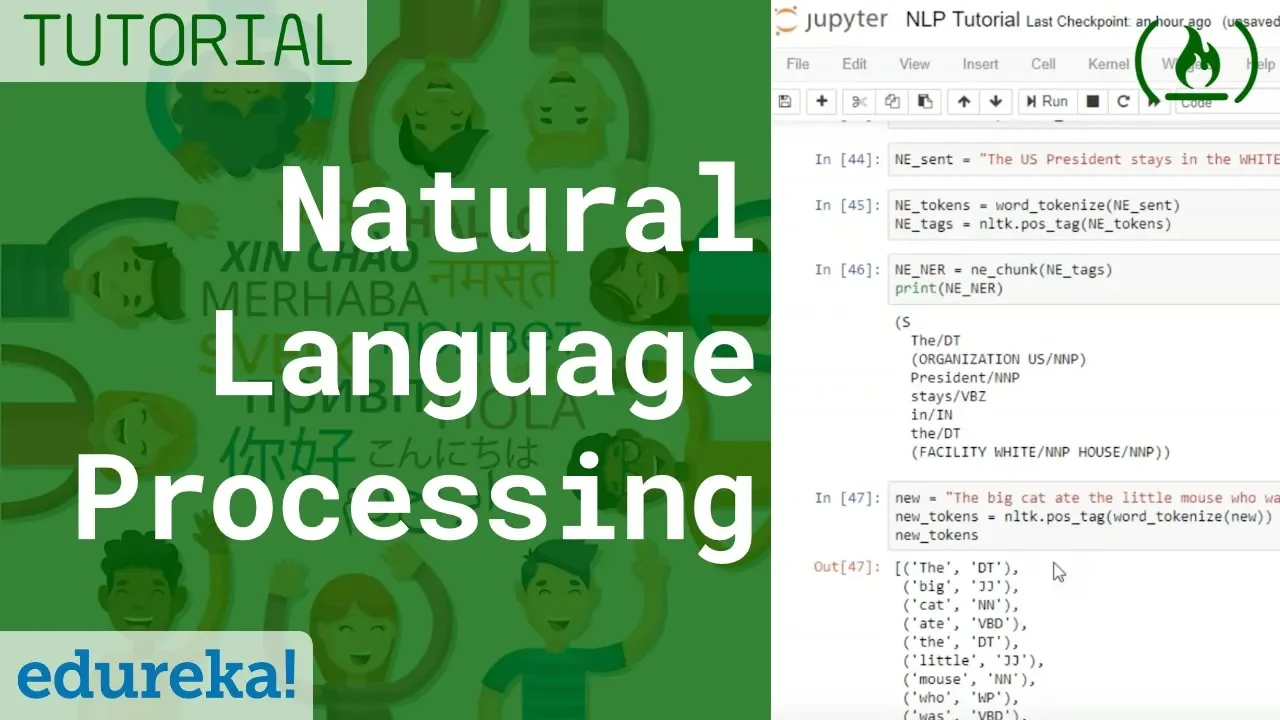
Natural Language Processing (NLP) Tutorial with Python & NLTK
400.4K
To perform POS tagging in NLTK, first tokenize the sentence using word_tokenize(), then apply nltk.pos_tag() on the tokenized list. The output assigns tags like 'NN' for noun, 'VB' for verb, 'DT' for determiner, 'JJ' for adjective, 'WRB' for wh-adverb, and 'IN' for preposition. For example, the sentence 'Timothy is a natural when it comes to drawing' produces tags: ['Timothy/NN', 'is/VBZ', 'a/DT', 'natural/JJ', 'when/WRB', 'it/PRP', 'comes/VBZ', 'to/TO', 'drawing/NN'].
Click to watch →
Part of Speech Tagging - Natural Language Processing With Python and NLTK p.4
214.3K
The NLTK part-of-speech tagging process involves two main steps: first tokenizing text into individual words using nltk.word_tokenize(), then applying nltk.pos_tag() to assign part-of-speech labels to each word. The result is a list of tuples where each tuple contains a word and its corresponding tag.
Click to watch →
Deep Dive
Introduction to formal grammar theory, particularly Context-Free Grammars (CFGs) and how production rules define sentence structure.
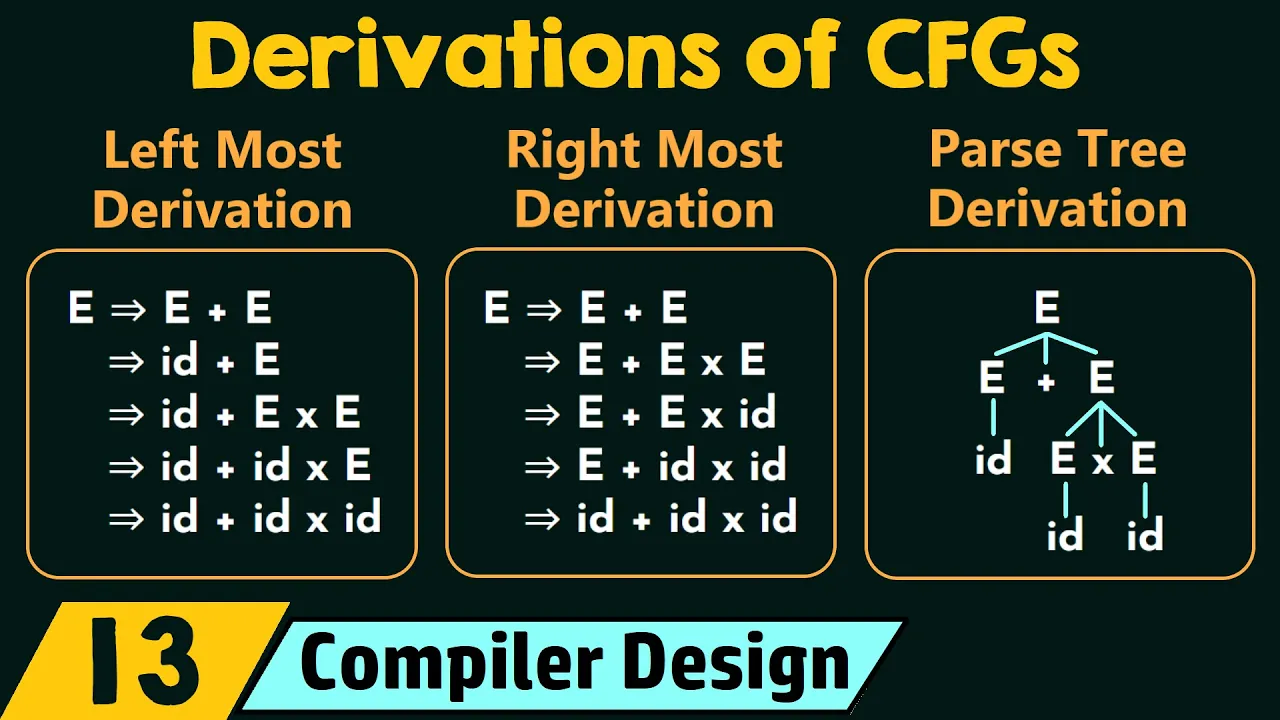
Derivations of CFGs
207K
Context-free grammars (CFGs) are fundamental to syntax analysis in compilers. A CFG consists of four components: N (non-terminals), T (terminals), P (production rules), and S (start symbol). The start symbol must be a non-terminal. For a grammar to be context-free, every production rule must have exactly one non-terminal on the left-hand side and any combination of terminals and non-terminals (including epsilon) on the right-hand side. This structure allows the parser to generate valid strings by systematically replacing non-terminals with terminal and non-terminal combinations according to the production rules.
Click to watch →

Context Free Grammars and Languages Formal Definition
121.3K
A context-free grammar (CFG) is a formal system consisting of variables (non-terminals), terminals, production rules, and a start variable, where derivations generate strings by replacing non-terminals with terminals according to the rules; a context-free language is any language that can be generated by at least one CFG, and CFGs are more powerful than regular grammars since they can describe languages like balanced parentheses and equal numbers of 0s and 1s that regular languages cannot.
Click to watch →
3.1 Context Free Grammar | CFG | Introduction | Definition | Representation | Examples | TOC | FLAT
37.3K
A Context-Free Grammar (CFG) is a formal grammar defined by four components: a set of non-terminals (V), a set of terminals (T), a start symbol (S), and a set of production rules (P). In CFG, each production rule has exactly one non-terminal on the left-hand side and any combination of terminals and non-terminals (including epsilon) on the right-hand side. CFGs are widely used in compiler design and programming language syntax definition because they can describe hierarchical structures like palindromes, where production rules generate strings by expanding non-terminals into terminal symbols through leftmost or rightmost derivations.
Click to watch →
ΠΛΗ30 - ΜΑΘΗΜΑ 4.1 - ΓΡΑΜΜΑΤΙΚΕΣ ΧΩΡΙΣ ΣΥΜΦΡΑΖΟΜΕΝΑ - ΘΕΩΡΙΑ 1/3 (ΟΡΙΣΜΟΣ)
19.9K
A context-free grammar (CFG) is a formal system consisting of production rules that generate all and only the strings of a language. Unlike regular expressions which generate regular languages, CFGs can produce more complex languages including those requiring balanced structures. A CFG is formally defined as a quadruple (V, T, S, P), where V is the set of variables, T is the set of terminal symbols, S is the start variable, and P is the set of production rules. Each production rule has the form A → w, where A is a single variable and w is a string of variables and/or terminals. The grammar generates strings through derivations starting from the start symbol S, applying production rules recursively until no variables remain.
Click to watch →
Lec-47: What is Context free grammar in TOC | Formal Definition
1.5M
A context-free grammar (CFG) is formally defined as a 4-tuple (V, T, P, S), where V is a finite set of variables (non-terminal symbols), T is a finite set of terminal symbols, P is a finite set of production rules, and S is the start symbol; each production rule in P has exactly one variable on the left-hand side and any combination of variables and/or terminal symbols on the right-hand side, enabling the generation of strings in the context-free language.
Click to watch →
Prerequisite Knowledge
- Concept 01Basic proficiency in Python programming, including installing external libraries (via pip) and manipulating strings and lists.
- Concept 02Fundamental concepts of Natural Language Processing (NLP), specifically sentence tokenization and Part-of-Speech (POS) tagging.
- Concept 03Introduction to formal grammar theory, particularly Context-Free Grammars (CFGs) and how production rules define sentence structure.
Subsequent Learning
- Step 01Exploring Probabilistic Context-Free Grammars (PCFGs) to resolve syntactic ambiguity in natural language parsing.
- Step 02Transitioning from Constituency Parsing to Dependency Parsing, which focuses on binary grammatical relations between words rather than phrasal constituents.
- Step 03Understanding parsing algorithms, such as the CYK (Cocke-Younger-Kasami) algorithm, Chart parsing, and Shift-Reduce parsing.
- Step 04Applying syntactic parse trees to downstream NLP tasks such as Information Extraction, Semantic Role Labeling, and Machine Translation.
Problem Setup
Analysis Start
Core Solution
Verification Steps
Edge Cases
Wrap-Up
Problem Setup
0:10Playing Section
- 1
Introduces a technical question and its solution path.
- 2
Encourages persistence and a creative mindset.
Dependency Parsing and Deep Learning vs. Constituency Grammar
While NLTK is excellent for teaching constituency parsing (phrase structure trees), modern Natural Language Processing has largely shifted toward dependency parsing and deep learning-based representations. Constituency parsing can be computationally expensive, rigid, and poorly suited for free-word-order languages. Modern NLP practitioners often prefer dependency parsing—which maps direct relationships between words rather than nested phrases—using faster, production-ready libraries like spaCy. Furthermore, state-of-the-art transformer models (like BERT and GPT) capture syntax implicitly within high-dimensional vector spaces, bypassing the need for explicit rule-based parse trees entirely in most practical applications.
Deep Dive
Exploring Probabilistic Context-Free Grammars (PCFGs) to resolve syntactic ambiguity in natural language parsing.
PCFG Models for Ambiguity Resolution in NLP Parsing
12.2K
Probability Context-Free Grammar (PCFG) is a statistical model that extends traditional Context-Free Grammar by assigning probabilities to production rules, enabling effective ambiguity resolution in natural language parsing through a four-step process: defining production rules, training the model by calculating rule probabilities using frequency counts, generating different parse trees for ambiguous sentences, and selecting the most probable parse tree as the best interpretation.
Click to watch →

Basics of Probabilistic Context-Free Grammars (PCFGs) | NLP
35.8K
A Probabilistic Context-Free Grammar (PCFG) extends a standard context-free grammar by assigning probabilities to each production rule, where the probabilities for all expansion options of any non-terminal must sum to one; the probability of a parse tree is calculated as the product of the probabilities of its constituent rules, enabling the resolution of syntactic ambiguity by selecting the highest-probability parse tree for a given sentence.
Click to watch →
![Probabilistic Grammars: How Computers Resolve Ambiguity in Language [Lecture]](https://i.ytimg.com/vi/itJXYgkHwUo/maxresdefault.jpg)
Probabilistic Grammars: How Computers Resolve Ambiguity in Language [Lecture]
639
Probabilistic context-free grammars (PCFGs) resolve sentence ambiguity by assigning probabilities to each possible parse tree, where the probability of a tree equals the product of its production rule probabilities; parameters are learned using maximum likelihood estimation from annotated data like the Wall Street Journal corpus, and smoothing techniques such as lexicalized grammars with backoff or subtree caching via the Chinese restaurant process prevent zero-probability estimates while capturing common linguistic patterns.
Click to watch →
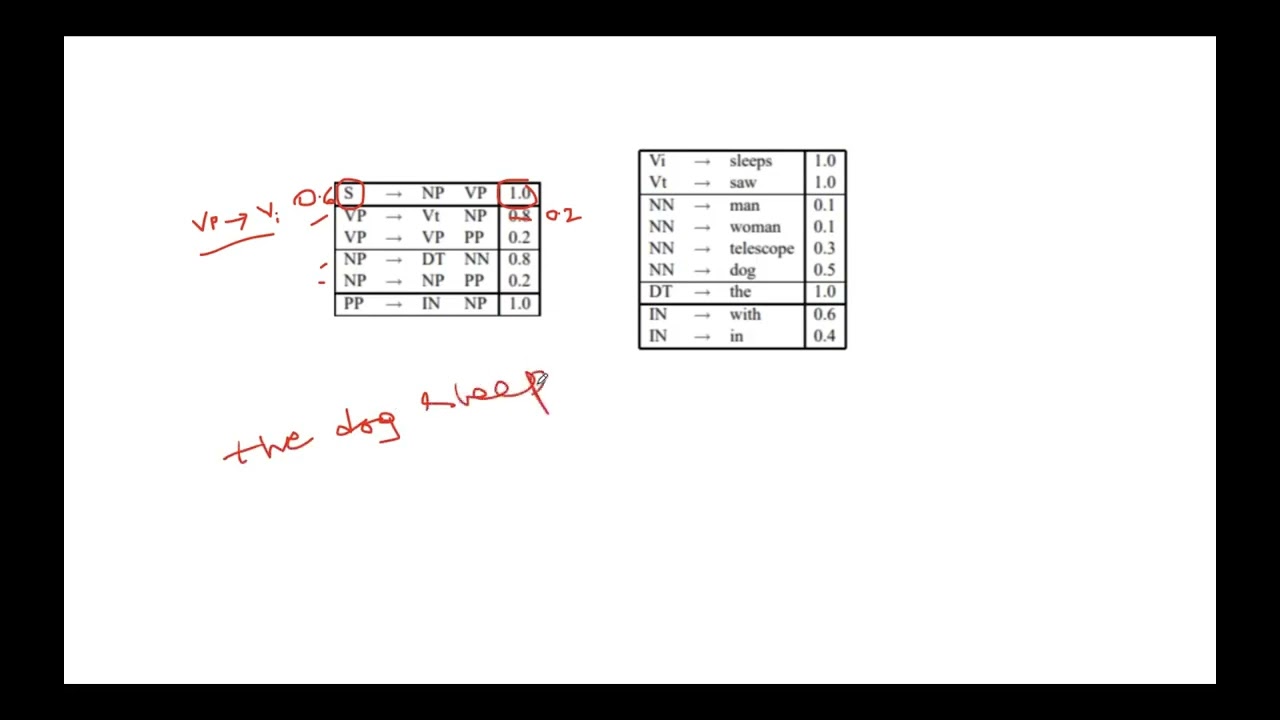
Lecture 27# Probabilistic based parsing | Probabilistic Context Free Grammar(PCFG's) | NLP
9K
Probabilistic Context Free Grammars (PCFGs) are an extension of traditional Context Free Grammars where each production rule is assigned a probability, allowing the identification of the most likely parse tree for ambiguous sentences; the key constraint is that the sum of probabilities for all production rules of any non-terminal must equal 1, enabling the calculation of sentence probability as the product of probabilities along the chosen parse path.
Click to watch →

CMU Advanced NLP 2021 (14): Syntactic Parsing 1
1.9K
Context-free grammars (CFGs) are the primary formalism for representing constituent grammars, consisting of non-terminals, terminals, start symbol, and production rules. Any CFG can be converted to Chomsky Normal Form for efficient parsing. The fundamental challenge is ambiguity - grammars produce many possible trees for a single sentence. Probabilistic CFGs (PCFGs) solve this by attaching probabilities to rules, allowing the parser to return the most probable tree using dynamic programming algorithms like CKY. PCFG probabilities are derived empirically from tree banks using maximum likelihood estimation, ensuring proper normalization.
Click to watch →
Deep Dive
Transitioning from Constituency Parsing to Dependency Parsing, which focuses on binary grammatical relations between words rather than phrasal constituents.
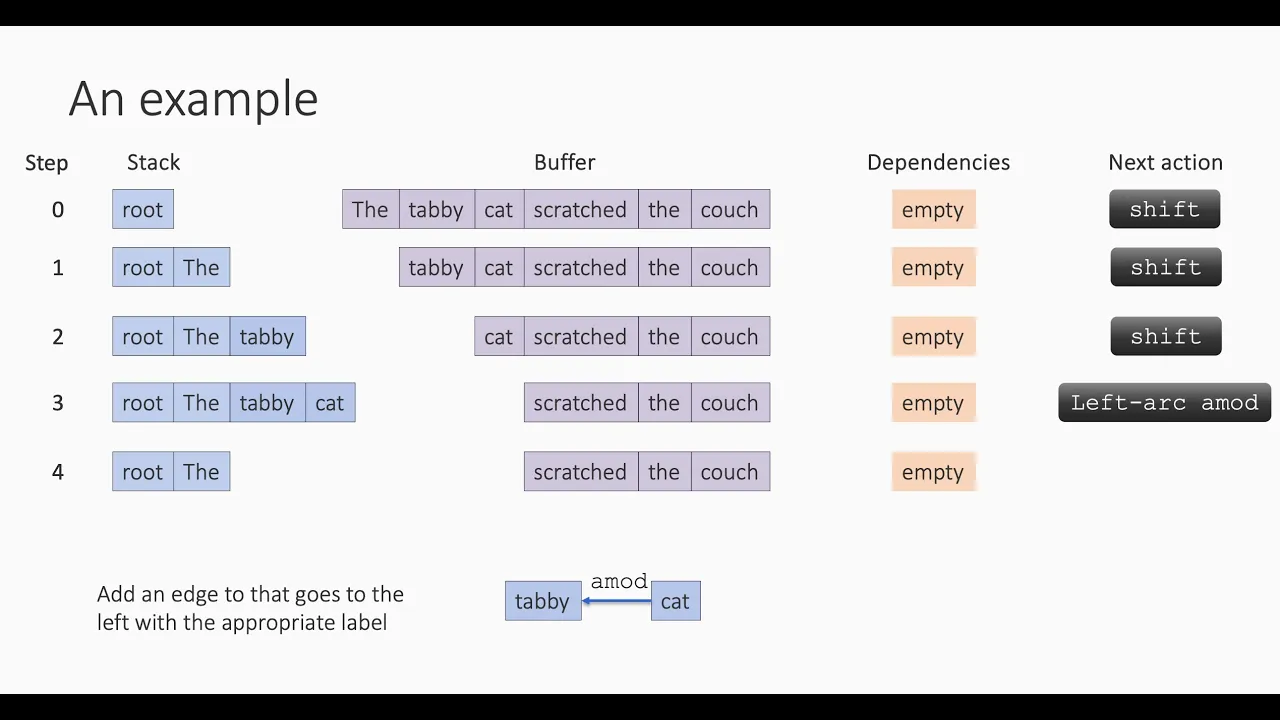
Dependency parsing
139
Dependency parsing analyzes sentence structure by identifying directed binary relationships between words, where each word (except the root) has exactly one head and may have multiple dependents, unlike constituency parsing which builds hierarchical phrase trees; the transition-based algorithm uses a stack, buffer, and set of actions (shift, left arc, right arc) to iteratively construct the dependency tree, with evaluation measured through unlabeled attachment score (correct head-child relationships) and labeled attachment score (including correct grammatical labels).
Click to watch →

Lecture 21# Dependency Parser | NLP
6.8K
Dependency parsing is the opposite of constituency parsing—it establishes direct relationships between individual words rather than dividing sentences into phrases. A head word is the most important word whose removal destroys the phrase's meaning, while dependents provide additional information. The root word (typically the main verb) connects to all other words through directed arcs. Each arc carries a tag indicating the grammatical relationship, such as adjective modifier (amod) or determiner (det). A key principle: heads can exist without dependents, but dependents lose meaning without their heads.
Click to watch →

(Q)LoRA; Course wrap
327
Syntactic parsing assigns grammatical structure to text. Constituency parsing breaks sentences into hierarchical phrase structures (noun phrases, verb phrases), useful for languages with fixed word order. Dependency parsing describes direct grammatical relations between words, with Universal Dependencies (UD) providing a unified schema across 100+ languages. Syntactic structure helps with: (1) Question answering (identifying subject-object relationships), (2) Machine translation (handling different word orders), (3) Understanding complex sentences (e.g., 'visiting relatives can be annoying' has different meanings based on structure).
Click to watch →
W4_L2: Dependency parsing
266
Dependency parsing analyzes sentence structure by establishing binary grammatical relations between words through directed, labeled edges, forming a dependency tree where each word (except the root) has exactly one head; unlike constituency parsing which uses recursive phrase structures, dependency parsing is particularly effective for free word order languages like Indian languages (Tamil, Telugu, Hindi, Malayalam) due to its focus on individual word relationships rather than phrase boundaries. Two main parsing approaches exist: transition-based parsing using shift-left arc-right arc operations for efficient linear-time processing, and graph-based parsing using maximum spanning tree algorithms for global optimization and handling non-projective dependencies. Evaluation metrics include labeled attachment score (LAS), unlabeled attachment score (UAS), precision, and recall to measure parsing accuracy.
Click to watch →
R & Python - Parsing Part 1.1 (2022)
191
Dependency parsing transforms constituency parsing by focusing on word relationships rather than hierarchical constituents. Each word (except root) depends on a single head word, creating directed acyclic graphs. The head word typically serves as the verb, determining semantic relationships including subject (actor), object (thing acted upon), and modifiers. This approach clarifies ambiguous sentences by tracing which noun is modified by which prepositional phrase. Dependency graphs are classified as projective (edges drawn without crossing) or non-projective (crossing edges required). Unlike constituency parsing, dependency parsing provides better semantic representation of sentence meaning.
Click to watch →
Deep Dive
Understanding parsing algorithms, such as the CYK (Cocke-Younger-Kasami) algorithm, Chart parsing, and Shift-Reduce parsing.
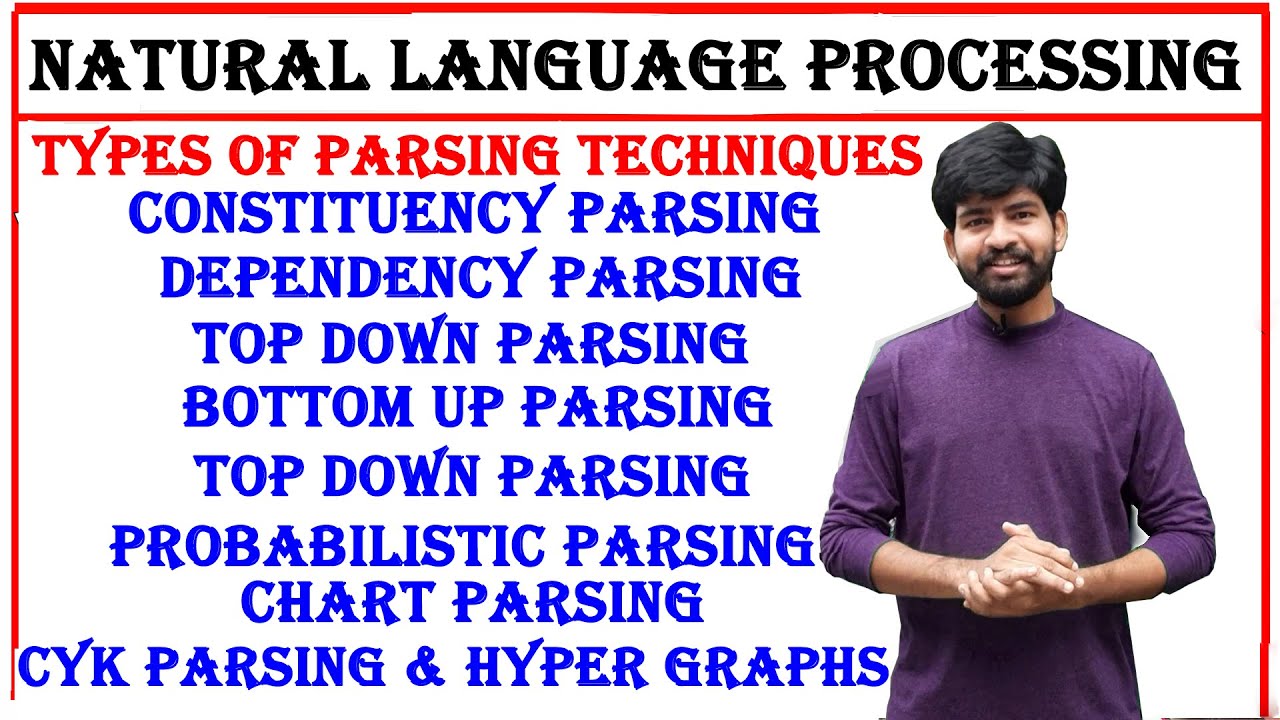
parsing techniques, constituency, dependency, top down, bottom up, chart, cyk, probabilistic parsing
3.4K
Chart parsing optimizes parsing efficiency by maintaining a table (chart) that stores all derived grammar rules for reuse across similar sentences, eliminating redundant computations. The CYK parser implements this efficiency using dynamic programming with Chomsky Normal Form grammars. It arranges words in a table and fills it diagonally by combining adjacent pairs according to grammar rules, systematically exploring all possible phrase combinations until the complete sentence structure emerges.
Click to watch →

CYK PART1
121
The CYK algorithm is a chart parsing algorithm named after Co, Young, and Kasami, who independently developed similar approaches in the 1960s. It determines whether a sentence belongs to a language defined by context-free grammar (CFG). CFG is a formal grammar system where rules can be applied without considering surrounding context—only individual words matter. The algorithm uses a bottom-up strategy, building parse trees from individual words up to the complete sentence structure. This context-free property simplifies parsing by eliminating the need to analyze word placement relative to other words.
Click to watch →

CYK Algorithm Made Easy (Parsing)
240.6K
The CYK (Cocke-Younger-Kasami) algorithm is a dynamic programming method for determining whether a given string can be generated by a context-free grammar; it works by constructing a table where each cell contains all non-terminal symbols that can derive the corresponding substring, starting with individual characters and progressively combining substrings of increasing length using Cartesian products of production rules until the entire string is processed.
Click to watch →

#22 || Parsing Algorithms || Shift Reduce Parser || NLP || #nlp
9.6K
This comprehensive segment covers the complete theory and practice of shift-reduce parsing. The parser reduces strings to the start symbol using production rules, consisting of a stack for storing grammar elements and an input tape for the input string. Two fundamental actions are performed: shift (pushing input symbols to stack) and reduce (replacing stack symbols with non-terminals according to production rules). Non-terminals appear on the left-hand side of rules, terminals on the right. The demonstration shows creating a three-column table (stack, input, action) and systematically processing the string through alternating shift and reduce operations until the start symbol is reached. The process concludes with acceptance when reduction to the start symbol succeeds, or rejection if no further reductions are possible.
Click to watch →
![How to Parse a Sentence with the CYK Algorithm [Lecture]](https://i.ytimg.com/vi/O-x3krZ3A-Q/maxresdefault.jpg)
How to Parse a Sentence with the CYK Algorithm [Lecture]
7K
The CYK algorithm is a dynamic programming method for parsing sentences in context-free grammars, which determines whether a sentence is grammatical and identifies the most probable parse by building a chart where each cell represents whether a non-terminal can cover a specific subspan of the sentence, starting from singleton spans (base case) and combining shorter spans at pivot positions to fill longer spans, with complexity proportional to the cube of the sentence length; this algorithm can be extended to probabilistic parsing by tracking maximum probabilities instead of booleans and using backpointers to recover the actual parse tree.
Click to watch →
Deep Dive
Applying syntactic parse trees to downstream NLP tasks such as Information Extraction, Semantic Role Labeling, and Machine Translation.

Constituency parsing
278
Constituency parsing is the task of assigning a hierarchical syntactic structure to a sentence, breaking it down into constituents (words or phrases functioning as units) using a parse tree. The CKY algorithm, a dynamic programming approach, finds the most likely parse tree for a given sentence by applying probabilistic context-free grammars (PCFGs). PCFGs extend context-free grammars by associating each production rule with a probability, estimated from annotated treebank data. The algorithm works by initializing a table where each cell represents a substring, then filling it bottom-up by considering all possible split points and combining probabilities of compatible rules. This approach resolves syntactic ambiguities by selecting the highest-probability parse tree, which is essential for downstream NLP tasks like machine translation, semantic role labeling, and grammar checking.
Click to watch →

Constituency parsing; CKY algorithm
131
Syntactic parsing has several important applications: (1) Resolving ambiguous sentences by identifying different syntactic structures, (2) Semantic role labeling to determine who did what to whom, (3) Machine translation between languages with different word orders (like English SVO to Welsh VSO), and (4) Grammar checking to identify ungrammatical sentences containing errors.
Click to watch →

LECTURE 4: SYNTAX AND PARSING (YOAV GOLDBERG)
334
Parsing provides structural knowledge that enables better NLP performance. For sentiment analysis, understanding word relationships helps determine if a sentence is positive or negative. For machine translation, translating to trees rather than strings improves translation quality. For information extraction, understanding word relationships helps extract facts from text. For question answering, knowing what a word indicates requires structural knowledge. Parsing can recover structure without understanding word meanings, using only part-of-speech tags, which allows learning from relatively few data.
Click to watch →

SYNTACTIC PARSING
111
Syntactic parsing is an NLP technique that analyzes the grammatical structure of sentences to understand how words relate to each other, enabling machines to interpret meaning by identifying relationships between words and phrases through processes like tokenization, part-of-speech tagging, and hierarchical representation construction using either rule-based methods (context-free grammars, hidden Markov models) or statistical approaches (probabilistic models, machine learning), with applications in machine translation, text summarization, question answering, and speech recognition.
Click to watch →
Fast, Accurate and Robust Multilingual Syntactic Analysis – Slav Petrov (Google) - 2012
101
Parser adaptation extends beyond maximizing parse accuracy to optimizing for downstream task performance. Pre-ordering demonstrates this principle by incorporating syntax into machine translation through word reordering before translation, improving BLEU scores by 1-1.5 points on Japanese-to-English translation. Augmented loss perceptron training formalizes this approach by iteratively training on both parse accuracy and task evaluation scores, sampling from k-best parse lists and updating parameters based on which parse yields better task performance. This extrinsic training paradigm recognizes that different tasks value different syntactic analyses—parsers optimized for question answering may differ from those optimized for translation. The research demonstrates that adapting parsers to specific applications leads to better downstream task outcomes than generic accuracy maximization, establishing a new paradigm where parser training objectives align directly with application requirements rather than abstract linguistic measures.
Click to watch →
Problem Setup
Analysis Start
Core Solution
Verification Steps
Edge Cases
Wrap-Up
Problem Setup
0:10- 1
Introduces a technical question and its solution path.
- 2
Encourages persistence and a creative mindset.
Dependency Parsing and Deep Learning vs. Constituency Grammar
While NLTK is excellent for teaching constituency parsing (phrase structure trees), modern Natural Language Processing has largely shifted toward dependency parsing and deep learning-based representations. Constituency parsing can be computationally expensive, rigid, and poorly suited for free-word-order languages. Modern NLP practitioners often prefer dependency parsing—which maps direct relationships between words rather than nested phrases—using faster, production-ready libraries like spaCy. Furthermore, state-of-the-art transformer models (like BERT and GPT) capture syntax implicitly within high-dimensional vector spaces, bypassing the need for explicit rule-based parse trees entirely in most practical applications.
Basic proficiency in Python programming, including installing external libraries (via pip) and manipulating strings and lists.
Fundamental concepts of Natural Language Processing (NLP), specifically sentence tokenization and Part-of-Speech (POS) tagging.
Introduction to formal grammar theory, particularly Context-Free Grammars (CFGs) and how production rules define sentence structure.
Exploring Probabilistic Context-Free Grammars (PCFGs) to resolve syntactic ambiguity in natural language parsing.
Transitioning from Constituency Parsing to Dependency Parsing, which focuses on binary grammatical relations between words rather than phrasal constituents.
Understanding parsing algorithms, such as the CYK (Cocke-Younger-Kasami) algorithm, Chart parsing, and Shift-Reduce parsing.
Applying syntactic parse trees to downstream NLP tasks such as Information Extraction, Semantic Role Labeling, and Machine Translation.
344 views2likes2:38@TheDebugZoneOriginal Release: 2023-06-22
foreign welcome back to another technical video today we're going to be going through a question going through those answers and hopefully it leads to your solution remember stay a little bit crazy just like me to get through to your resolution now let's get started [Music] foreign [Music] [Music] [Music] foreign [Music] thank you [Music] [Applause] [Music] and guys that's it I hope this video has helped you and get you through to that resolution you needed if it did please I'd appreciate it if you hit subscribe now until the next time that you need technical help I hope you have a good one cheers
Up Next
31:45
Convert CFG/CNF Grammar Code from Scala to Python
@computationallinguisticsil6494
163 views•2018-03-07
87:26
Introduction to Secure Multiparty Computation with Yehuda Lindell
@fhe_org
7.7K views•2021-02-04
4:55
HTTP Requests Explained: GET, POST, PUT, DELETE
@codecademy
103.1K views•2021-10-07

19:25
Enigma Machine Mechanics: WWII Encryption Explained
@JaredOwen
13.2M views•2021-12-11
Related Study Plans & Knowledge Roadmaps
Structured learning paths in Computer Science
computer-science
Container Runtimes: Namespaces, Cgroups & Go
01Linux Systems & Go Programming Foundations
02The Core of Isolation: Chroot and Filesystems
03Linux Namespaces: Process Isolation
+ 3 more learning modules
32h6 modules
Explore Roadmap
computer-science
Building a CHIP-8 Emulator: Rust & CPU Basics
01Computer Architecture Foundations (Bits & Bytes)
02Rust Programming for Systems Development
03CHIP-8 Virtual Hardware Specifications
+ 2 more learning modules
32h5 modules
Explore Roadmap
computer-science
Building BitTorrent: Go, P2P & Concurrency
01Go Fundamentals & Concurrency
02Networking Foundations & P2P Architecture
03Bencode Parsing & Torrent Metadata
+ 3 more learning modules
26h6 modules
Explore Roadmap
computer-science
Actor Models (C++ Concurrency & Lock-Free)
01C++ Multi-Threading Foundations
02Thread Pools and Task Scheduling
03Atomics and Lock-Free Queue Design
+ 3 more learning modules
45h6 modules
Explore Roadmap