









![[마플교과서] [미적분] [2. 미분법] [01. 지수로그함수의 미분] [1. 지수함수와 로그함수의 극한(1)] [9강]](https://i.ytimg.com/vi/joFoVYtlUaE/maxresdefault.jpg)









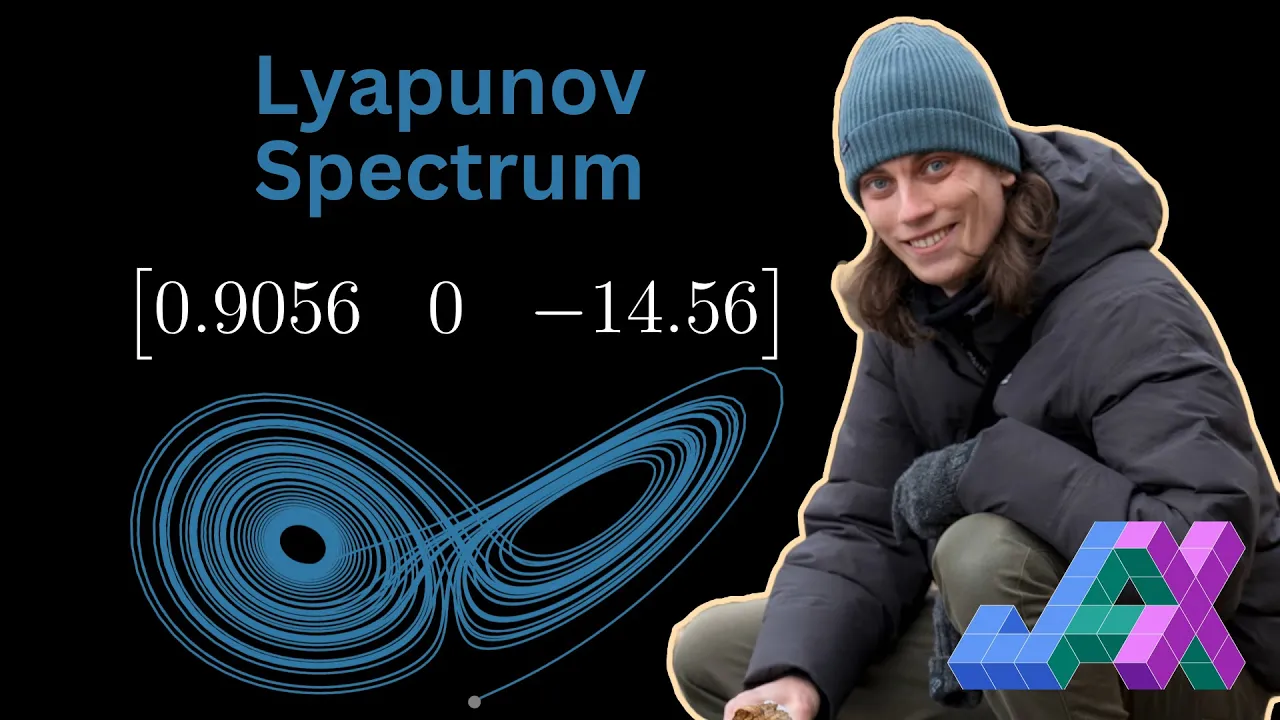

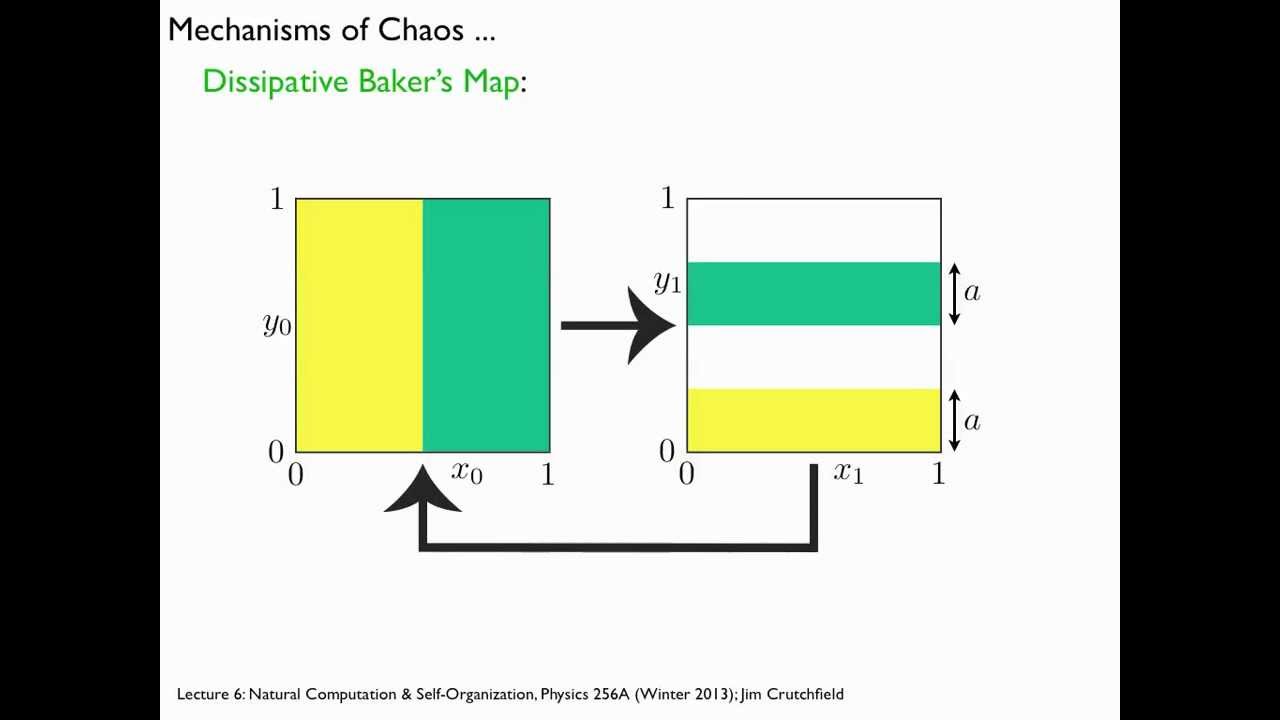

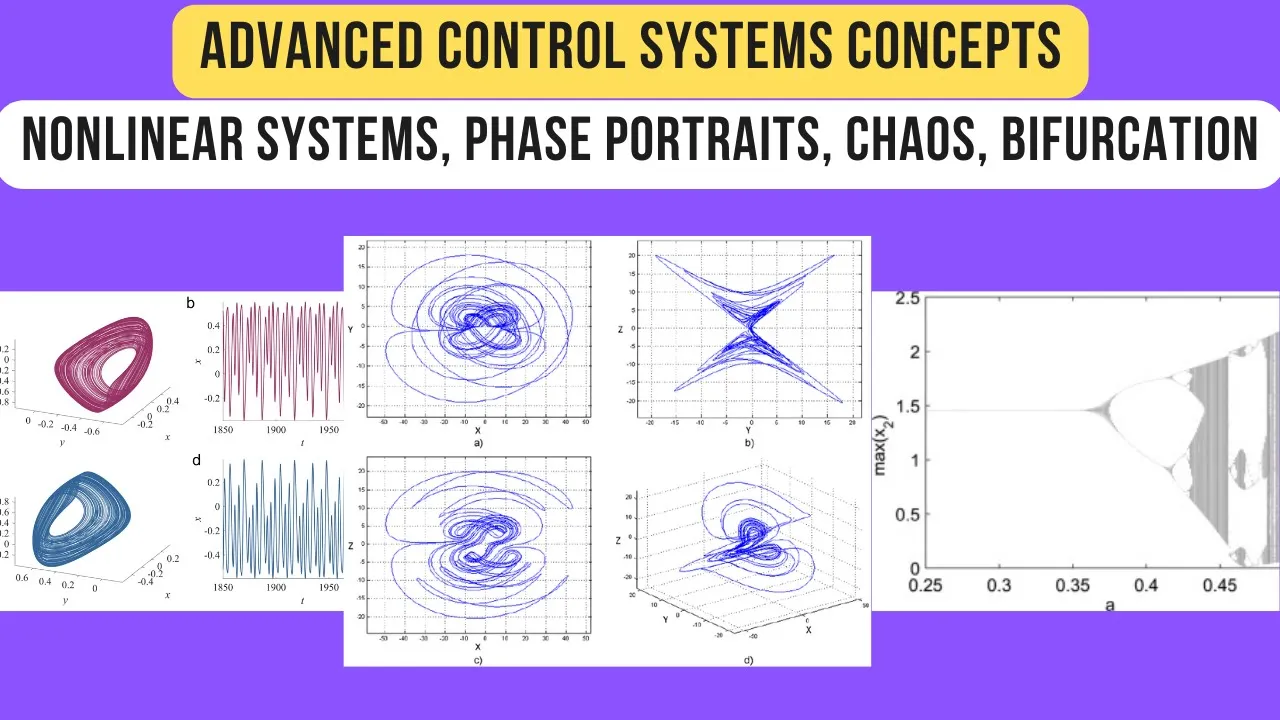


Lyapunov exponents measure the average exponential rate at which nearby trajectories diverge in a dynamical system, with positive exponents indicating unstable equilibria (exponential divergence) and negative exponents indicating stable equilibria (exponential convergence); for a one-dimensional system x(t+1) = f(x(t)), the Lyapunov exponent at an equilibrium point is given by the natural logarithm of the absolute value of the derivative f'(x*) at that point.
Lyapunov Exponents Explained: Stability & Chaos in Difference Equations
Added:Basic concepts of discrete dynamical systems and difference equations, such as the Logistic Map.
The definition of fixed points (equilibria) and how to determine their stability using linear approximation (derivatives).
Fundamental calculus concepts, specifically the chain rule, limits, and the natural logarithm.
An intuitive understanding of chaotic behavior and 'sensitive dependence on initial conditions'.
Generalizing Lyapunov exponents from discrete-time difference equations to continuous-time differential equations.
Calculating the full spectrum of Lyapunov exponents for multi-dimensional systems and understanding the Kaplan-Yorke (Lyapunov) dimension.
Exploring bifurcation theory and observing how Lyapunov exponents transition from negative to positive as a system enters chaos.
Applying numerical methods and algorithms (e.g., Wolf's algorithm) to estimate Lyapunov exponents from experimental time-series data.
188 views3likes11:55Original Release: 2021-02-08
so in the last video we defined the open of exponents and used them to measure this idea of sensitive dependence on initial conditions um we gave a formal definition of what's being meant by sensitive to that dependence it was this delta epsilon definition where we say if we if uh if we have some distance delta that we care about no matter what distance epsilon we started out with now there exists some point that's within that distance that after some amount of time diverges uh let's draw this out to make a little bit more clear so let's see let's give an illustration and i'm not going to draw this on the real line i'm going to draw this in r2 just to make the illustration a little bit easier to draw so let's suppose we have some point x naught and we have some other point let's call it y naught that's that starts out close well then you have some trajectory that x naught goes on each of your points so maybe that goes there and then there and then there and then there there and so on okay and our point why not the trajectory of that maybe it starts out and it still remains relatively close but after some amount of time it diverges and so trajectories let start near x naught don't stay near trajectories don't stay near uh each other uh right so even if you start off even just a tiny distance away from each other it matters a lot because you don't actually stay together and so you diverge over time and we want to measure this and so one way of measuring this is just to ask well how far apart are two different trajectories that start out near each other going to be after t steps and that's precisely what this delta of epsilon t is measuring here and we used a very simple example where we each time we're just doubling the value of x and we haven't we actually have a stable sorry an unstable equilibrium at x not equal to zero and so given that we have this unstable equilibrium at x not equal to zero we expect that things to go away from zero exponentially fast and so we can quantify that by just uh writing out substituting things in and so obviously everything doubles and so the distance is also going to double over time so you start with some distance epsilon and this these quantities here determine uh how fast the two trajectories diverge and obviously in this case this is easy because one of those directories is just the equilibrium which stays in place and so we just have to measure how far the other directory moves away from zero the two directories diverge and when we do that we find that for this very simple example well there is a linear dependence on epsilon and an exponential dependence on t and that is precisely the sort of thing we're trying to measure so like as time as time gets longer and longer um the uh how quickly does the does everything move away so we gave a potential definition of a leopon of exponent by just saying okay well let's just measure as time gets big and epsilon gets small and the epsilon gets small how quickly does this diverge and so we wrote it in list format to match the format of this solution here up near up at the top and then to make that a bit more precise what we did is we took limits as epsilon approaches zero uh and then we end up getting this derivative which is nice and you also get as t goes to infinity well that doesn't factor out as nicely so instead we just keep it as a limit in our definition so once we've done that uh we can actually define something instead of like we sort of had a heuristic idea of what we meant by these limits as t goes to infinity and as epsilon goes to zero and one nice thing to do is just to define our leopard of exponent as that limit so that is our definition 2.8 here and you know that we sometimes have that the leopard of x-men doesn't actually depend on the initial condition so normally in our definition it depends on what our x-naught is right so it depends on what trajectory and some other directory uh close to it etc um if lambda of x naught is independent of x now that is it doesn't matter where you start uh you still have the same sort of weird of like exponential dependence on the how long it's been since you've started a directory close to your initial starting point then you can just refer to it as a single leopard of exponent of the function and this is uh i came on the side that it turns out this the open off exponent is related to our whether our equilibria are stable or unstable so note that it's a more general definition because you don't have to be at an equilibrium in order to talk about stability or instability instead or you can talk about the leoponov exponent at any point but when you do have an equilibrium one of things you can notice that stable equilibria have negatively open of exponents because you're getting exponentially or an unstable equilibria have positively opened of exponents uh let's give an example of that so example let's let uh actually let me [Music] say all locally asymptotically stable which is most of the stability that we've been talking about in this class but let me just uh make that explicit so let's let uh x sub t plus 1 be equal to x sub t plus x sub t squared over two well an x bar is equal to zero and one are the equilibria and this is pretty easy to verify so you plug in zero you get zero again you plug in one you get one again and so now let's compute the leoponof exponents of the equilibria compute the opponent exponents at the equilibria okay so what's your function f of x f of x is equal to x plus x squared over 2 which means that f prime of x is equal to one half plus x so then f prime of zero is equal to one half and f prime of one is equal to three halves and so note of course that our zero equilibrium is then stable because by the first derivative test and our one equilibrium is unstable since the absolute value is greater than one also by our first derivative test well well then we can compute the leopoldop exponents at 0 and 1 respectively so this is just the limit as t goes to infinity of 1 over t times the sum from k equals zero to t minus one of well what is it of uh what we want is uh f prime of xk but we know that uh these are equilibria so xk is just always equal to zero so this is just the sum of the natural logarithm of f prime of zero and so you have t copies of this and so this uh the ts all cancel out and the summations all cancel out so this is just equal to the natural log of one half which is equal to minus the natural log of two which is less than zero ultimately we can do the same thing for uh leave the open of xml of one so that's the limit as t goes to infinity of one over t the sum from k equals zero to t minus one of the natural log of f prime of one which is three halves which is equal to the natural log of three halves which is equal to the natural log of three minus the natural log of 2 which is greater than zero okay and so it turns out in this particular case our statement was actually true so our stable equilibria had a negatively open of exponent and our unstable equilibrium have a positively opponent exponent because uh for the stable equilibrium everything of the asymptotic locally asymptotically stable local equilibrium everything was getting closer and so the negatively open of excellent sort of talks about this exponential closeness whereas in the opposite case when the exponent was positive well then you go away exponentially quickly okay uh so in practice uh you would approximate this with a computer and um you'll note that it's one important thing is that given any directory the leopard excellent of the first step on the trajectory is the same as the leopard of exponent on the j step of the trajectory and this is pretty easy to see by our limit right so uh note that the limit as t goes to infinity of 1 over t times the sum from k equals zero to t minus one natural log of uh f prime of k uh well you have infinite uh you have implement different uh things right so you're adding together an infinite number of things as that goes to uh and then the dividing out and so even if you start at a later point you still have an infinite number of things there and so the finite things in the initial part don't actually matter and so those all fall out and so you can do your estimation that way and often uh in practice it's nice to do this after some number of steps because then that helps things converge a little bit faster and so if you're writing a computer program to compute the opponent of exponents oh this is what you would do instead or one of the things you might want to do and lastly these things are general these concepts are generalizable to systems of equations we're not going to spend too much time on that but the basic idea is that when you deal with systems of equations then you have to use the jacobian matrix and the eigenvalues and the spectral radius rather than just the value itself and that so that gets a little bit more complicated then we're not going to spend too much time on that in this class but it's important for you to know because a chaos is actually a feature of systems of uh difference equations in addition to just as like a single first order difference equation um i think that's about all for this exam uh these examples and hopefully that sort of helped illustrate a little bit what the sense of dependence on like on the initial conditions and the open of exponents are
Up Next
27:18
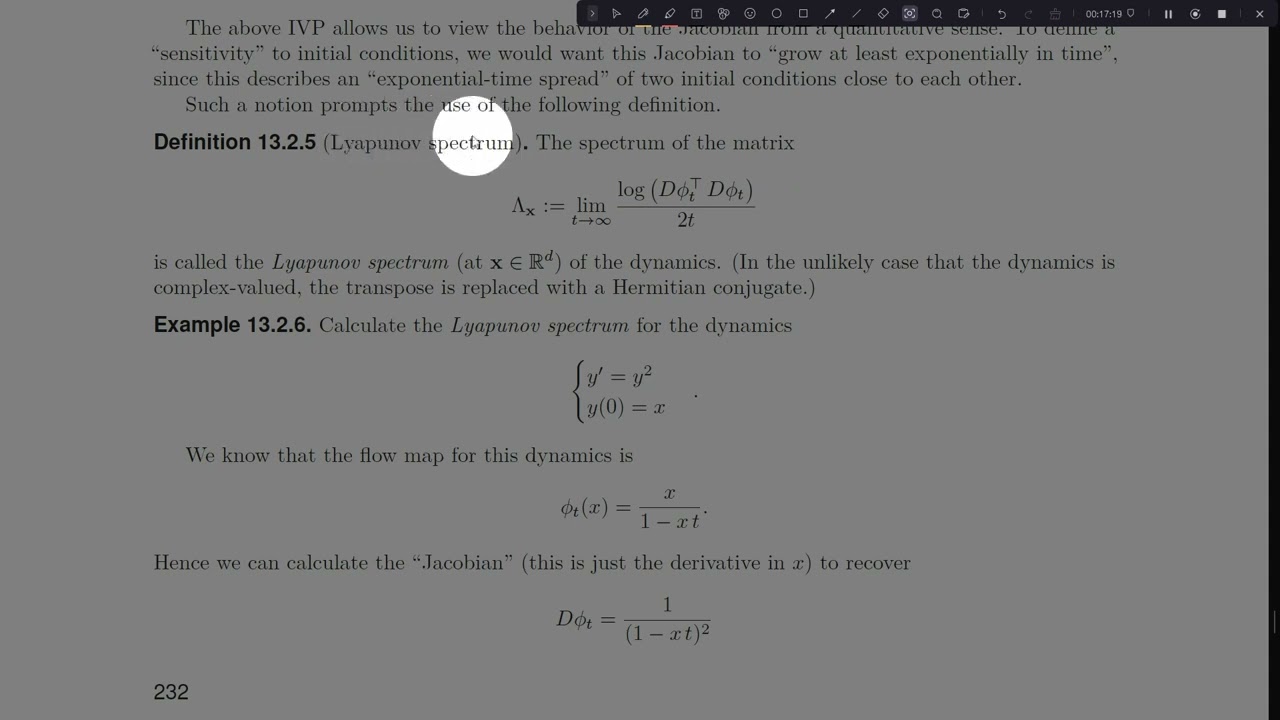
Understanding Chaos Theory: Lyapunov Exponents & Sensitivity
@evancamrud_phd
690 views•2023-04-21

4:43
Elliptic Curve Cryptography Explained: ECC, ECDSA, ECDH
@PracticalNetworking
28.5K views•2024-10-21
10:44
Fourier Series Introduction: The Big Idea Explained
@DrTrefor
387K views•2021-05-03

6:00
The Mathematical Impossibility of Accurate World Maps
@Vox
23.3M views•2016-12-02
Related Study Plans & Knowledge Roadmaps
Structured learning paths in Mathematics
mathematics
Tensor Calculus: Vectors to Riemann Curvature
01Mathematical Foundations: Linear Algebra & Calculus
02Covectors, Dual Spaces, and Tensor Basics
03The Metric Tensor and Index Gymnastics
+ 2 more learning modules
40h5 modules
Explore Roadmap
mathematics
Gödel's Incompleteness: Logic, Proofs & Limits
01Introduction to Formal Systems & Hilbert's Dream
02Set Theory, Cardinality, and Cantor's Diagonal Argument
03Arithmetization and Gödel Numbering
+ 2 more learning modules
14h5 modules
Explore Roadmap
mathematics
Galois Theory: Fields, Groups & Solvability
01Foundations of Abstract Algebra: Groups & Fields
02Polynomials & Field Extensions
03Splitting Fields & Symmetries
+ 2 more learning modules
24h5 modules
Explore Roadmap
mathematics
Non-Euclidean Geometry: Models & Geodesics
01Euclid's Fifth Postulate and the Birth of New Geometries
02Hyperbolic Space and the Poincaré Disk Model
03Geodesics: Defining Straight Lines in Curved Spaces
+ 2 more learning modules
15h5 modules
Explore Roadmap