














![[Linear Algebra] Injective and Surjective Transformations](https://i.ytimg.com/vi_webp/WpUv72Y6Dl0/maxresdefault.webp)
![43) Bir Matrisin Rankı ve Sıfırlılığı [Nullity and Rank of A Matrix]](https://i.ytimg.com/vi_webp/ky8BMv9Nk8I/maxresdefault.webp)







![[이얼 전공수학] Lay 선형대수학 제42강 제4장 벡터공간 - 4.5절 벡터공간의 차원 (2)](https://i.ytimg.com/vi/s1Q1z1VM_SI/maxresdefault.jpg)
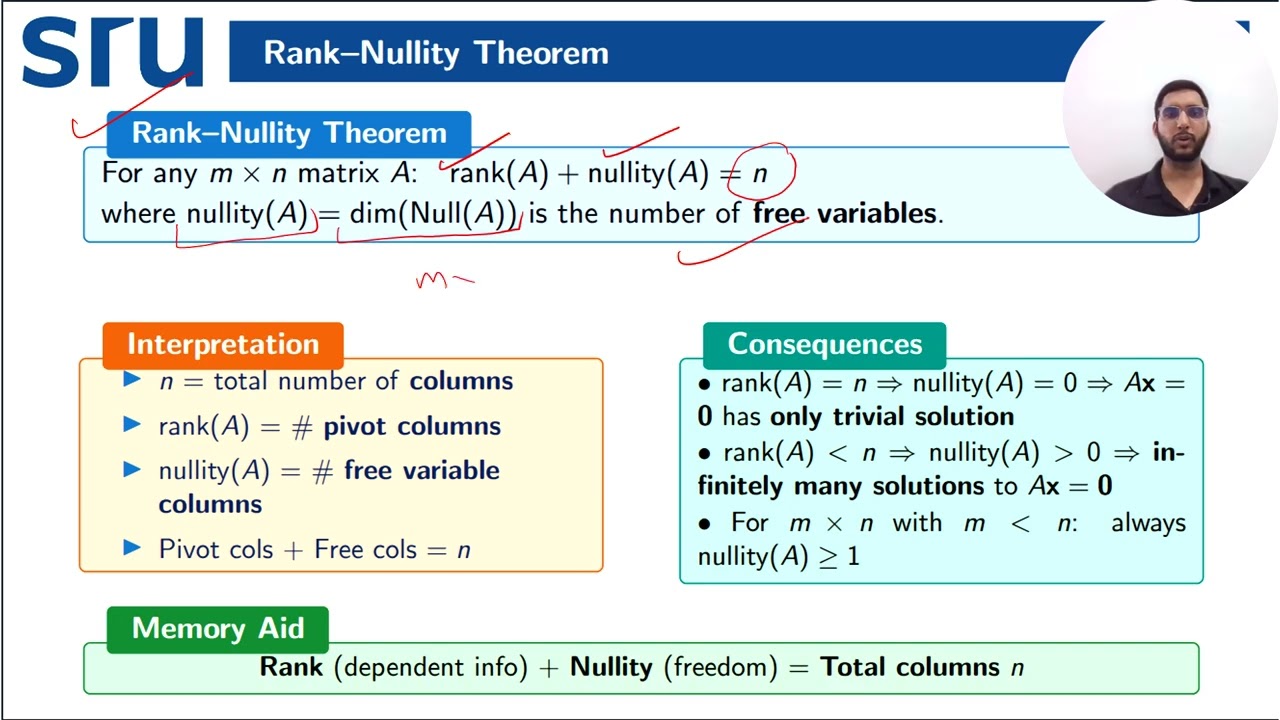
The Rank-Nullity Theorem states that for a linear transformation T from a finite-dimensional vector space V to another vector space W, the dimension of the domain V equals the sum of the rank (dimension of the image/range) and the nullity (dimension of the null space). This theorem establishes an inverse relationship between how 'good' a linear transformation is (its rank, or ability to map to diverse outputs) and how 'bad' it is (its nullity, or tendency to collapse many inputs to zero).
Rank Nullity Theorem: Proof & Intuition (Linear Algebra)
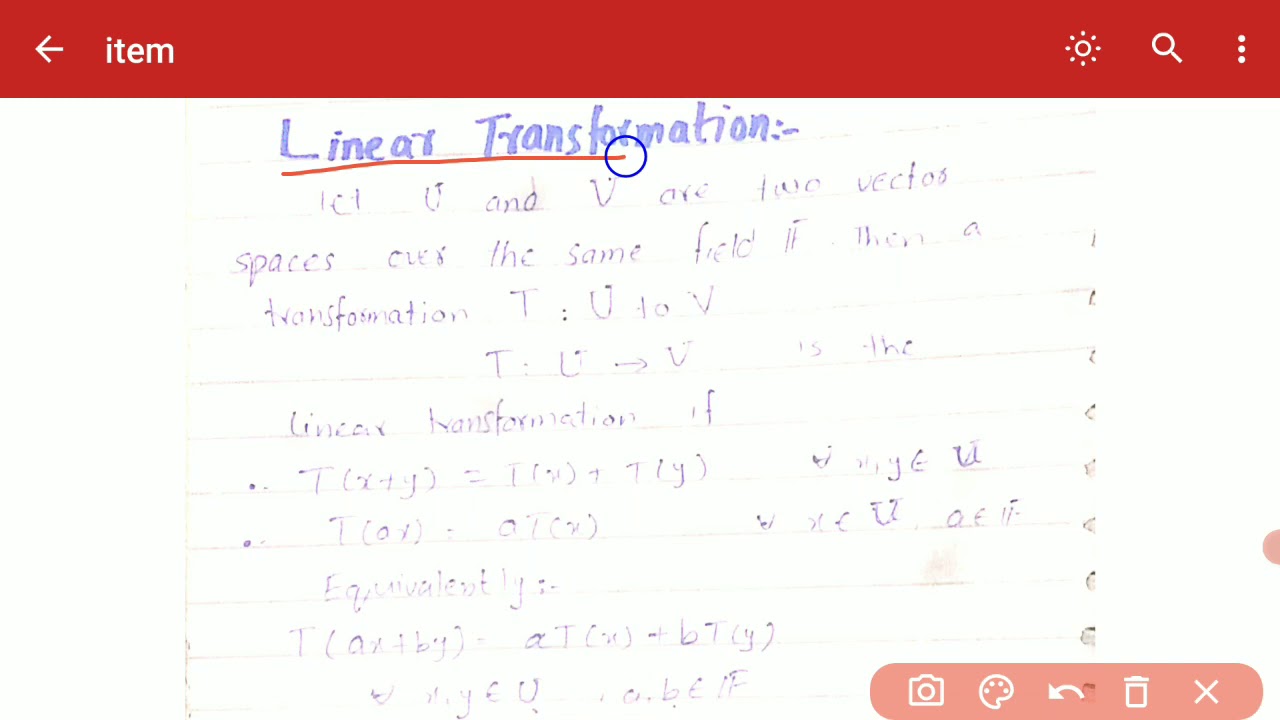
Added:Definition and properties of linear transformations between vector spaces.
The concepts of vector space bases, spanning sets, linear independence, and dimension.
The definition of the Kernel (Null Space) of a linear map and its dimension (Nullity).
The definition of the Image (Range) of a linear map and its dimension (Rank).
Characterizing injective (one-to-one) and surjective (onto) linear transformations using rank and nullity.
The Invertible Matrix Theorem and how rank-nullity determines matrix invertibility.
The Fundamental Theorem of Linear Algebra and the relationships between the four fundamental subspaces of a matrix.
Applying the Rank-Nullity Theorem to analyze the solvability and dimensionality of solution spaces for systems of linear equations.
27.9K views637likes12:49Original Release: 2019-05-21
thanks for watching and today I would like to prove one of my favorite linear algebra theorems called the rank nullity theorem and this is completely improvised so bear with me what does the rank nullity theorem say theorem suppose vnw or finite dimensional vector spaces finite dimensional vector spaces MT is a linear transformation from V to W so it's linear then it turns out the rank of T and the dimension of the null space are related then you have the following if you add that dimension of the null space of T and the rank of T which by definition all it is it's the dimension of the image so forget all the pivots dolphins of okay dimension of the image of T if you add them up you actually get the dimension of your input space and this proof will show why we need the dimension of the input space not the output space and what is this thing it says that the remember the null space measures how bad a linear transformation is the rank measures how good a linear transformation is this says that they balance out the better a linear transformation the less worse it is so the higher dimension of the image the lower the dimension of the null space of T conversely the bigger the null space of T the smaller its image if it says lots of vectors to zero then it cannot have a big image if it sends if it has a big image it cannot spend lots of vectors to zero all right and without further ado let me prove this so proof let's start with the basis of the null space so let beta V 1 up to VM be a basis for an olive okay so let me give you a little picture so this is V and this is no of T maybe need more space for that actually so this is V and subspace is null of T and suppose V 1 up to VN those are you VI is right and what we want to do let's extend it so it's a small space let's extend it to be a whole basis of V so extend data to a basis V 1 up to VN so the same vectors but more than that so V n plus 1 data up to VN avi so we start with those V 1 up to viens and then we just add vectors until we get a whole basis and all that's enough to show so M is the dimension of the null space it's just enough to show that somehow the dimension of the or like the rank of T is just n minus m and the way we do this is just claim it would make sense to say vivre M plus 1 up to VN is a basis for the image of T because remember what the image lies in the output space so we need something in W but here's the thing what does T do T takes all those vectors in the null space and sends it to 0 so all those vectors get sent to 0 the other ones are what's important because T sends those vectors to the range see if I send this one here this one here I know it gets a bit messy but all those vectors are in the image because by definition the image is just the set of all outputs of T so all we need to show actually is that T of VM plus 1 up to T of VN is a basis for the image so clean T of VN plus 1 that the T of the end is a basis for the image of why would we be done because then and and which is the dimension of V would be equal to M plus n minus M why is that important well this is trivial but look M is then the dimension of the null space because there Edna vectors in the basis for null space and then this one has n minus M vectors so that would be the dimension of the image of T and then the point is once we show this as a basis then we are done so let's show it so which I'll see to show two things show that it's linearly independent and then it spans so let's show linear independence so suppose let's say a n plus 1 T the n plus 1 plus dot dot dot plus a and T V n is the 0 vector 0 vector in W and all we need to show is that those coefficients are 0 but look T is a linear transformation so we get T of a n plus 1 VN plus 1 plus dot dot dot plus a and V n equals to the 0 vector but what does that mean it means that T takes this vector and sends it to the null space so a.m. plus 1 VN plus 1 I'm sorry she sends it to the 0 vector therefore this vectors in the null space Plus a.m. yeah so this isn't a null space of T which I like to remind you we have a basis of which is the span of v1 up to V yeah and then what do we have so that a.m. plus 1 VN plus 1 plus dot dot dot plus a + VN because it's in the span it's equal to let's say V 1 V 1 plus tatata plus BN v r and then just put everything on the left-hand side so minus p1 v1 dot the dot minus BM VM plus a.m. plus 1 VN plus 1 plus dot dot plus a n BN is the 0 vector in this isn't big but look we know that the whole set is a basis remember because we extended it to be a basis in particular this set is linearly independent which means that all those coefficients are 0 all the things so B 1 equal 0 dot dot dot B M equals 0 a and plus 1 like s minus minus minus a n plus 1 equals 0 and equal 0 and you see that's precisely what we want we suppose some linear combination gave you the zero vector there for that and we showed that the only combination is the trivial combination all right so this shows is linearly independent now let's show that it spans so suppose you have a random vector in the image so suppose W is in the image of T which means that W is TV for some B but now remember this huge set is the basis so V is just a linear combo of V 1 dot dot dot of let's say yeah - once I am VM we'll need this plus a n plus 1 VN plus 1 plus dot dot dot plus a n VN for some a 1 up to a okay but we don't care what year we care but W so let's just apply T to it so TV like you're watching TV that's T of a1 b1 plus dot dot dot plus a.m. yeah but that's just a one T V 1 plus da plus am TV n plus a.m. plus 1 TV n plus 1 a TV n but now remember what was V 1 up to VM they are all in the null space so T V 1 up to t VN they are 0 and so in the end we get that W equals to am 1t w vm 1 plus 1 plus am TV n so what do we have any vector in the image is a linear combo of those basis vectors and therefore it's balanced so it's in this panel a set that we want TV n plus 1 and therefore we are done this set is in fact a basis for our image and therefore just by adding up those two dimensions we get it it's the same as a dimension of V and it's important as the dimension of V because we're technically adding no vectors in V we started with the basis for the null space of V and extended it to a basis of all of the that's why it's not that mention of W and I get no pivots involved just pure linear algebra all right if you like that if you want to see more math please make sure to subscribe to my channel thank you very much
Up Next

11:36
Diagonalizing a Matrix: Eigenvalues and Eigenvectors Explained
@mitocw
199.1K views•2016-05-06
4:43
Elliptic Curve Cryptography Explained: ECC, ECDSA, ECDH
@PracticalNetworking
28.5K views•2024-10-21
19:08
Dominated Convergence Theorem Explained | Real Analysis
@drpeyam
19.9K views•2020-09-25

6:00
The Mathematical Impossibility of Accurate World Maps
@Vox
23.3M views•2016-12-02
Related Study Plans & Knowledge Roadmaps
Structured learning paths in Mathematics
mathematics
Tensor Calculus: Vectors to Riemann Curvature
01Mathematical Foundations: Linear Algebra & Calculus
02Covectors, Dual Spaces, and Tensor Basics
03The Metric Tensor and Index Gymnastics
+ 2 more learning modules
40h5 modules
Explore Roadmap
mathematics
Gödel's Incompleteness: Logic, Proofs & Limits
01Introduction to Formal Systems & Hilbert's Dream
02Set Theory, Cardinality, and Cantor's Diagonal Argument
03Arithmetization and Gödel Numbering
+ 2 more learning modules
14h5 modules
Explore Roadmap
mathematics
Galois Theory: Fields, Groups & Solvability
01Foundations of Abstract Algebra: Groups & Fields
02Polynomials & Field Extensions
03Splitting Fields & Symmetries
+ 2 more learning modules
24h5 modules
Explore Roadmap
mathematics
Non-Euclidean Geometry: Models & Geodesics
01Euclid's Fifth Postulate and the Birth of New Geometries
02Hyperbolic Space and the Poincaré Disk Model
03Geodesics: Defining Straight Lines in Curved Spaces
+ 2 more learning modules
15h5 modules
Explore Roadmap