







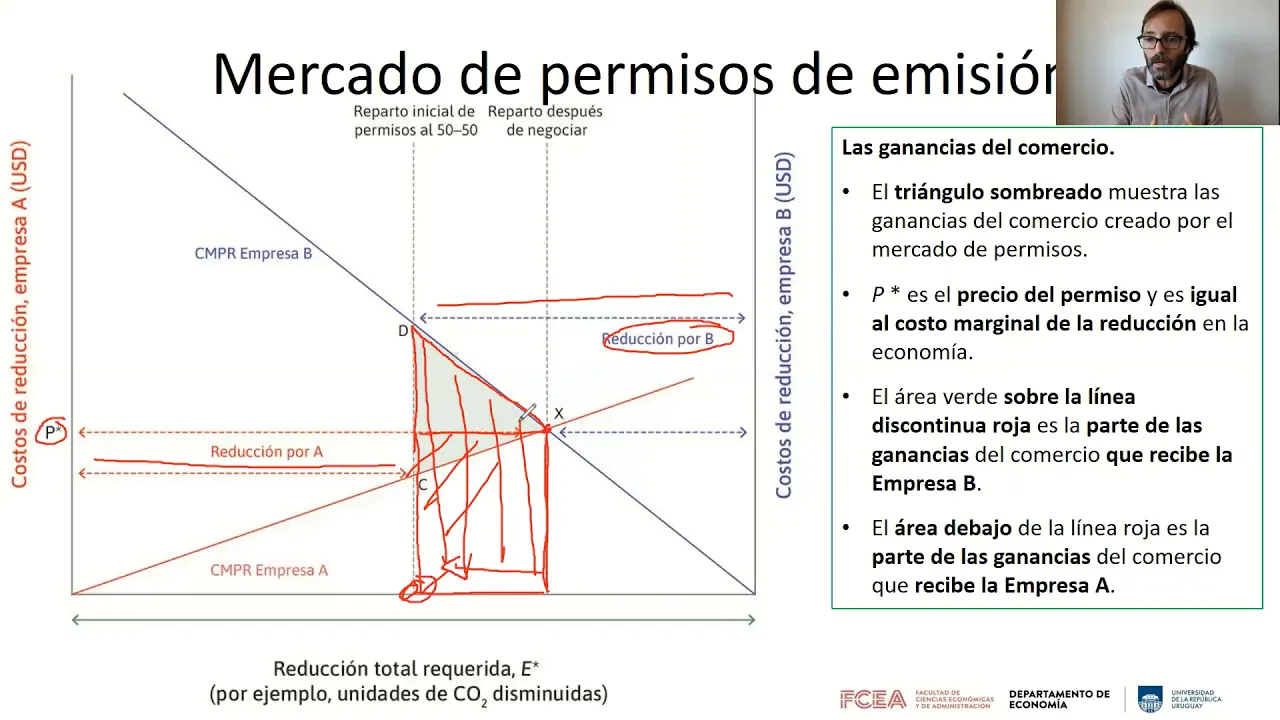











This debate explores two market-based approaches to reducing greenhouse gas emissions: carbon tax (a direct price on carbon emissions) and cap and trade (a system setting emission limits with tradable permits). The carbon tax approach, exemplified by British Columbia's implementation, provides price certainty and transparency, with revenue returned to citizens. Cap and trade, used in the EU, sets emission quantity limits but faces challenges including regulatory complexity, potential gaming of the system, and the need for international cooperation. The debate highlights that both systems aim to reduce emissions through market mechanisms but differ fundamentally in what they guarantee: carbon tax guarantees a price signal while cap and trade guarantees emission reduction targets.
Carbon Tax vs. Cap and Trade: Economic Debate Analysis
Added:my name is Franklin juice I am the president of our McCombs MBA clean tech student group and I'm going to be the moderator of the debate lucky you isn't it appropriate that my right hand between the line of fire so I'm going to tell you I mean give an introduction of these two guys and then tell you a little bit about the format of debate first suppressor John Doggett and I thought this was pretty appropriate that he'll be defending the carbon tax he's also my professor and um he's his ta so this is an opportunity anyway he's a senior lecturer here in the Department of Management he received his BA from the Claremont men's college his JD from Yale and MBA from Harvard he is on a research in international entrepreneurship global competition competition and sustainability and energy and since 1999 he is led quite a few of the trips abroad that the global connectionist trips to Austria China Japan Korea Malaysia Mexico Singapore and he'll be leading some trips this year before coming into India next year I'm sorry in 2010 yeah China give you rest Jim Nolan he will be defending cap and trade and he is uh the distinguished lecturer in Department of finances distinguished senior what's that mages he's been here longer than I oh he has thought this be a his MBA from here the University of Texas he has talked with undergraduates and graduates and he's also taught in the Executive MBA program in Mexico and Dallas as well as in he's taught in Vienna he has seen numerous teaching awards and he's a professor as it mentions that about me he sees whatever most popular teachers need one won any award you could win I've water however I've never beaten him in the debate and this is gonna be the first time nothing else matters yeah before so would a professor's if you're not familiar have been rated among the top all about the top of all of our professors in the columns so they're quite popular and for good reason they're excellent professors Jim Nolan professor of corporate finance business valuation M&A he is also the faculty advisor for venture fellows and the entrepreneur Society and he's also talked quite a few of courses for executives in the community and actually outside as well with Dell and Texas Instruments Petsmart shell quite a few motorola and he's on the board of directors of an independent bank a recycling company in a medical distribution let's go alright so the format first how many people are for a cap-and-trade system raise your hand if they're for Coventry it's ok if you don't know any we just want to get an idea first carbon tax okay you're qualified to be a US Congress person undecided kind of blending the two yeah all right well so here's how it's gonna go we're gonna have five rounds first round we're gonna introduce the audience cap the trade and taxes the carbon tax sorry and then we're going to talking about why each of them are better you get to make the argument then we're gonna have the crossfire debate and then we take a little bit of a break and that's what we're gonna bring in our some of our outside experts and then there's going to be a public Q&A so first order of business is to figure out whose argument goes first go first tonight I concede you might see no you go on first buddy because you pick you pick carbon tax and then scoured the entire faculty to find someone to debate you nobody but me would take on the challenge and so I get stuck with Captain Chris so you go at first but excuse me whyever wins he doesn't care about the facts he just makes you laugh you go alright I'm in favor of carbon tax and I think last week I was in South Carolina and one of the students I was talking to said it's not a carbon tax let me call it carbon credit for a very simple reason unlike okay this is not working so you'd be the finger unlike some people I think it's very important to understand that global warming is a real issue now there's some people say it's the Liberals are making you stew it it's a false issue but I prefer to look at hard data and the hard data is this we know that there is a global warming event called the Ice Age we had nothing to do with it it came and went without us but it happens these things happen but what we also know is that in 1820 the number of humans on the planet was a billion people and now there's 6.8 billion people on the planet with all the toys and other things that use hydrocarbons looks like and so my initial premise is this where the global warming is being caused by humans or not anybody who says an additional 5.8 billion people on the planet and industrial Ellucian and all the things that we have that used hydrocarbons as having no impact on the environment is blind we are having an impact so the only question is what do we do to minimize an impact maybe by minimizing that impact we reduce global warming maybe we don't remember the ice age came and went and we were not around we weren't doing anything we went around make it well maybe we wore and will not have an impact but my position is that's irrelevant we need to do everything we can to minimize how much we screw up the environment and the conversation so the only question is what's the best way to do that and I'm convinced that cap-and-trade is not so what's the carbon tax a carbon tax says we're gonna measure the carbon content of everything everything you buy everything you use and have a price plus attacks like when you go to the gasoline pump and you see the price of gas what's the federal gas tax or state gas tax or when you go and buy things they're subject to sales tax you see the price you paid for it plus the sales tax very clean very clear everybody can see it but more importantly it's like the good old days before they had unit pricing on products so you'd go to a store and you'd look at two or three versions of Syria or deodorant or bleach and they'd have different sizes and different prices and you'd have to do math in your head to figure out which one was more cost-effective and then they invented the unit pricing so you can compare the price per ounce or the price per pound for the price for peaks and suddenly became very clear that some things that look like they were just the same in fact we're either more or less expensive we've had decades of experience with consumers being able to go into stores see that price differential and then decide this is what I want to do carbon tax gives you the ability to do that it's transparent and it's clear more importantly it's already in existence and when our neighbors from the British Columbia which is a for those of you who are educated Oklahoma that is part of Canada and it's north so how does it work and the British Columbia they've come up with a revenue neutral form of carbon tax and explain please what they do is they start off with the charge of $10 Canadian per ton of carbon it goes up by what five dollars Canadian each year so eventually gets to $30 Canadian and that's two things you know what the tax is you know what the cost is and you know what's going to happen to it it is predictable it is clear it is transparent and therefore businesses know what they have to do they know the cost is going to go up unlike cap-and-trade you don't need a bunch of accountants or bookkeepers or EPA sheriffs to regulate the system the price is going to go up and all you have to do is look at the actual cost and the either side wouldn't you want to do it next slide does that looks for those of you who can't read there's a picture of how it works okay it's very simple and transparent which is one of the reasons I like it next slide what they've done in British Columbia is they said for every dowel that we take in carbon tax we're going to give it back to the people when you hear it my dear friend mr. Nolan says excuse me professor Nolan says about what they're going to do with the cap-and-trade money the one people aren't going to see it or the people the taxpayers and so what they found in British Columbia not only have they given the money back to the people it is a revenue neutral deal for every dollar they take that dollar goes back to the people okay next slide and if you could read this slide which of course you can't you would see that it has lowered the taxes of every single taxpaying group in the great province of British Columbia last slide before I stop my version is a little different the problem I have with cap and trade among other things is that they're going to take money in the name of helping the environment and as speaker Pelosi said we're going to use that money to fund healthcare well health care is important it should be funded but not with cap-and-trade if we're going to take money out of our economy to deal with dirty air that money should be used to how clean the air and doggish version says we take this money we use it as credits to help clean the air my times up that's why stop talking all right well I've been asked to defend the cap-and-trade system and we're gonna go over a little bit of what the basic fundamentals of a cap-and-trade system are without getting into specifics of whether that there are different bills there's cap and dividend captain and caulk and cap and frame there's lots of other different ways of how you what you're going to do with it and the biggest thing revolves around the issuing of permits whether you're going to grandfather and give them free or whether you're going to auction them off and charge a price and if so I can set a reserve price and have the equivalent of for the taxes so John's the argument that it doesn't do anything is not transparent will we'll talk about that but basic comes down to what we we don't have a production problem we don't have a supply problem we have a demand problem we've got to change people's behaviors so it comes down to what's the best way to change people's behaviors is a character sticks okay carbon tax currently is punitive there's no upside okay other than to charge people a tax for this whether you believe that government is the best vehicle for getting people to change or whether you believe the marketplace is a better way a more efficient way of getting people to change and deal with this problem next slide all right so I've got this little stages of grief okay so assuming that you believe that we are killing the planet and it's dying okay then where are we in these stages of grief I mean at first we had shock you know you have al gore and Inconvenient Truth talking about all the things that are happening to the planet and then we've got some emotional release going on there's a lot of you know pretty environmental extremism on one side and people in denial on the other and then there's preoccupation with the crisis and this you know every word people find it interesting that frito-lay has a sustainability department for a company that I wouldn't say would be necessary I mean their sponsor of this I don't want to say but uh but I find that interesting but symptoms of physical and emotional distress we are seeing scientific evidence so like John said whether you believe that it's caused by carbon or not I think most people come around that the scientific evidence is saying that so I think we're right about that point right now so whatever Congress does I can tell you right now there's going to be hostile reactions next so whether they pass a carbon tax you're going to have certain segments of the comedy and lobbyists that are going to fight that system if you do cap and trade you're going to have people say it's not a fair system you can gain the system all kinds of issues like that we do know that there has been cap and trade done with sulphur dioxide and we've seen it with acid rain the problem is we've got nothing to benchmark it against to say that the cost-benefit is better than a carbon tax yes you know British Columbia has a system that they it's one year old they did it in 2008 first of all John makes the assumption and I don't want to start debating and fighting the carbon tax yet but he makes the assumption that the tax is going to go and it's going to offset and be revenue neutral I mean Canada doesn't have a 12 trillion dollar deficit so the fact that Nancy Pelosi is going to give it back to us and some other kind of offset I have a hard time believing that number two is that if we go into the guilt phase that's when we'll actually start to probably see some changes the question is how do we get people to that level next page right so carbon trade verses the carbon tax basically the obstacle obstacles right now is to convince everybody that climate change is real and immediate so even some people that believe they think that the temperature increases aren't fast enough we don't have to react quickly other people say got it with passed the time second is that carbon is the primary contributor to the problem the third that the actions taken by the United States whether it's a tax or a cap and trade are going to be followed by the country and that it'll be fair and then finally that the economic cost of implementing one of these system doesn't offset the benefit and that you know you're going to get into arguments over whether jobs are created destroyed where they get moved overseas no matter which system that we talk about so both actually these are more similar than they are different they're both comprehensive they're upstream okay they're they could be auctioned off in a cap-and-trade it's very similar to an upstream carbon tax system John talked about taxing each individual item I think you're going to probably have to move upstream and tax it at the producer level or even go all the way back to the energy producer or do you go to the coal mine that's that's the question okay the primary difference is the certainty and what's what's certain and what's uncertain under a tax the government says the price and then the market determines volume and John's assuming that price elasticity and carbon okay is going to follow other commodities and other sectors that we have and so at $30 you said Canada is going to raise it for $30 a time you want to use unity can i how much does that translate to an increase in the price of gas mine said boy I bought stop driving my SUV for nine cents so that's only four five dollars it gets up to about 40 cents an extra tax all right so all right then finally and the difference while we just forget this format and disco model Nestor okay let's start with the BCS poll of where Yale and Harvard is our relatives actually graduated diploma slams your degrees guys I think I just won let's stop the debate there one more slide and then I'm gonna say that one more siding them okay I'm lining up so cap-and-trade what it basically comes down to is that there is a cap that limits the quantity so the difference is at access the price let the market determine quantity and cap-and-trade you set the quantity limits and then let the market determine the price we'll see so I can exceed my cap right I can yeah and I can also pay the tax that's right okay and we'll get to that so all right the trade part allows me to swap among myself the permits to emit greenhouse gases okay and then the governments can reduce the legal limit that they allow over time by the number of permits the grit so that's the trade part so the cap is you limit the volume of permits based on so one permit per ton metric ton of co2 equivalent and then each year you can reduce that and then the marketplace then develops the trade so we can take the lead on this in the United States in other countries can follow and will be the marketplace for this carbon trading that goes on rather than to see that to some other country that we then become a follower rather than a leader yeah because they gave away the permits rather than auction them off they grandpa's after your birth story so we'll see all right but my turn to do what captain trade sucks okay I want my slides okay I want my I don't know use of slits use my slides if you'd like come on Franklin faster come on guy next slide next slide okay all right it's real simple the answer is no it is not the solution okay what are you doing okay it is in fact a tax masquerading as something else and what makes it really important is that it is the next subprime fraud it is going to be a disaster for our economy now why would I say that for cap and trade the work and my dears team senior distinguished lecturer colleague said it you're going to have to have the government setting the cap and then the government regulating how many credits are given and all the market can do is to price it well here's the problem of cap and trade it's a cap based on what the amount of co2 that you admit at the time a government regulator comes to measure it what are the chances that they have to actually have an appointment to show up at your factory 100 percent I can't just show up and say we need to measure what's going on your smokestack and so what are the chances that people have factories are going to say okay maybe when you show up it's going to be everybody stay home day so that the amount of carbon going out of the smokestack is less that day because that becomes our cap for the year and then tomorrow when the government regulators are gone it's back to normal polluting business that's the first problem and somebody has to regulate it what we know for sure is is that if we monitor every single source of carbon including all the cows which by the way the largest source of carbon the United States 24/7 it's going to take more people to monitor carbon than their people in America and so we can't do that so if we can't do that we're going to have to start making assumptions and one of the assumptions is nobody is going to game the system the second problem with cap-and-trade is as my dear esteemed colleague said if for some reason you're admitting over your cap you can still buy permits you just have to pay a fine and so if you are very wealthy very polluting company and you don't give a crap about anything as long as you can find somebody's gonna sell you a permit you can continue to pollute until you kill the planet cap-and-trade does nothing about that at all because as my dear friend so honestly stated when Congress gets hold of the trains of dollars this is going to suck out of our economy you're not going to use that dime to clean the environment they're going to use it they make up for all the money they've been borrowing from China to balance the budget so it have no impact on the economy next line no impact on clean air the most important thing about it it's based on a pessimistic negative anti human way of thinking about innovation why frankly the supporters of cap and trade are the 21st century let i'ts they do not believe in technology they do not believe in innovation they do not believe that there's anything that we can do to encourage people give people excitement about creating technology that can clean the air other than we're gonna punish and I don't know about you and you're a child and your parents said it's gonna hurt me more it's gonna hurt you we knew they rely we're gonna hurt their hands might get sore but guess what subu house was getting sore this is the same thing it is a fraud it is a scheme and none of the money is going to go to help the environment if we care about the environment which I do if we're going to take money out of the economy in the name of cleaning up the environment which I think we should then that money should go to do one thing which is clean up the environment and cap-and-trade will not do that next slide what we know is existing system is going to miss 30% of all sources of emissions because it's going to miss landfills and it's going to miss a lot of things like cows and there's some problems to stroke string trimmer you've seen those little things that cut leaves to stroke Trump gasoline that little string trimmer admits more greenhouse gas emissions than forty Toyota Corollas because I bet you've never seen a string trimmer with a catalytic converter scrapped onto the back of it they have nothing to clean the air so wouldn't it make more sense to ban those and come up with new technology and I happen to be on a company that makes propane powered string trimmers that the EPA loves so much they've given us the 2008 clean air technology of the Year award because we have zero evaporated emissions cuz we're using propane we're a lot cleaner string trainers finally if this is such a great idea then the Europeans who have tried it would say oK we've tried it we've decided cap and trade makes sense and so we're going to make some improvements duple going to keep it Nicolas Sarkozy the president of the France has introduced legislation that is being debated today by the French parliament that scrap that cap-and-trade and introduce a carbon tax and if the French think cap-and-trade doesn't work hold it cucumber next one how much more time to have five form that's wonderful oh gosh there will be nothing left Jim I tell you hey here's the other problem of cap-and-trade it's based on an assumption that we reduce carbon input by 80% by 2050 it's going to have a big impact on the environment there's a minor problem we've never imagined carbage but we still do not know how much carbon is safe for the environment this is an arbitrary number that's been pulled out of some some hat and we don't know if that's the right number maybe it's 60% maybe it's 90% maybe it's a hundred and ten percent maybe we need carbon negative environment nobody knows for sure because there's no science to support the number 80% why is there no science because in 1990 nobody was measuring carbon that's the benchmark what's wrong with having the benchmark that nobody ever measured because it doesn't mean anything to other data points you can see this go next slide here's what happened when the Europeans tried it they started in 2005 which is four years ago what they found was that the only way they could do it was to accept anything that was not a very large company because they couldn't justify having the infrastructure to go out every single mom-and-pop store all over the EU and by doing that they exempt that 55% of all the emissions but in spite of that just focusing on the 10,000 largest companies in Europe but they saw in Germany is that the price electricity went up 25 percent in the first two years more importantly what they saw was that the most efficient folks who are running businesses that required a lot of energy because they were just using tax cap and trade versus encouraging innovation those companies started to shut down and move jobs to other countries which were not playing by the same rules the goal was to reduce the amount of greenhouse gases emissions two years after the European Union cap-and-trade scheme went into place admissions went up in fact if you looked at every single European country that have signed Kyoto and it's tried to live up with Kyoto emissions have gone up why because it's a treaty it has nothing to do with innovation that's nothing to do with creativity and it doesn't work which is why Nicolas Sarkozy is saying we need to go to something that's clear simple and transparent that generates money that can be used to invest in technology that will clean the air in fact what we're finding is that it could double the cost next slide and so in Germany there's cement manufacturers who cares about submit all it does is be the foundation for building things cement manufacturers saying if the cap-and-trade system that the EU is imposing actually continues to go the way it's going their price of energy could double and it could take half of all the revenue translation you won't get cement made in Germany anymore and where is it gonna be made it's gonna be made in other countries that aren't going to cooperate next slide so why is that important Jim talked about the price there has to be a price there has to be a floor but where does that come from it's made up by the government the cap is made up by the government and as a result this is the system that we're going to create and then we're going to figure out whether or not it works but it doesn't reflect the external harms it is totally this price and Kapoor totally uncoupled from what's going on in the barman let me give you a couple examples next slide remember in the good old days when last bullet point when the price of electricity went through the roof in California with a cap-and-trade system the cost of regulating the system would be greater than any benefit to the economy because the price of carbon credits would explode if the price of electricity went up why did the price of electricity go up because we nobody was investing in clean energy production technology and in Europe they had the exact opposite they pass cap-and-trade and immediately after they pass cap-and-trade the price of carbon credits fell to the ground what does that mean you thought you're gonna pay to use an example $3 a credit now you're only paying five dollars a credit Oh what the heck I can just complete as much as I want because it doesn't cost me anything to buy anything that Europeans wouldn't sound like that but that's what we found out because the price is completely artificial next slide the bottom line is here's the strongest argument in favor of cap-and-trade this is the argument from Kyoto for it to work since we all are on the same planet all countries must agree to participate and for those countries that don't want to participate we can bribe them we can use money that we're pulling from the United States and Europe and we can give it to us ok guys next slide I'm almost out of time I know I'm almost at a time so if you like giving billions of dollars of permits to badly behaving governments and giving them the incentive to cheat then you really like cap and trade if you think that sucks and you have to do carbon tax well I find it extremely interesting that you know I'm known John and he's been a Cogley caller your friend of mine for a long time and I always thought being a entrepreneurship professor that he was really into capitalism and free markets and fiscal conservativism and get the government out of my way let innovation it turns out that you're nothing but a bunch of big government liberal tax-and-spend guy right I mean somehow that the market somehow the market setting price that that's artificial but the government setting a taxes I mean you're using the fridge as an example gee I mean the European Union could screw up a wet dream how do you possibly how do you possibly get 27 countries that all are issuing permits and giving them away and grandfathering expect that system to work and you use that as your cap and trade example come on so I like to teach using analogies so I'm going to use this analogy that all of you can understand and it'll put it in in context so one of my pet peeves at this university is our parking system that's going to be my cap-and-trade okay so John where's your car parked right now then the brazos garage okay by the way such as sustainability guy how come here and ride your bike I know where your house is so and by way because unlike you I Drive a hybrid I don't drive o matic could walk or you could have taken the bus or you could have done other things no please these people printed on recycled paper in pain but you you've drove the car I'm gonna make your deal how much I'm gonna make you do thank you wait I'm gonna make you a deal Jim I will walk if you give up steak no come out I am going there I am going you can how much tax will it take to get you to change behavior to ride your bike and I can tell you there's no amount of tax because I live near you that will get me to ride a bike to this camp look at me I am NOT riding a bike and I will pay your tax no matter what you charge so you're saying that I can violate the rules by just buying more permits I can pay the tax in fact who are the big iMacs I'd made 40 billion dollars profit you tax me all I want and if you do I can still pay the tax and you'll every small business and consumer in this country and cap-and-trade won't yeah because it's market-based they're gonna let so alright so so number one so so let's go into the next slide so let's just take the parking system here so right now you're in the garage when you walked up here were there empty spaces in the up 11 absolutely okay and who's issuing the permit the government the university so that's a real efficient so you some how do you think the government is efficiently going to solve this problem okay I'm much raised by way my I'm parked illegally right now so in other words I don't mind paying the tax John because I didn't want to walk as far as you so I'm parked illegally okay I don't have a problem with that okay and by the way it's stifling innovation I'd much rather pay any of these people out here that what I'm going to pay for this parking ticket to ballet me okay and that's what cap-and-trade would do we would have a least incentive for people that can trade and create opportunities for people rather than just so I'm coming to the conclusion maybe we ought to just let you join the Obama administration why don't we just buy all the coal mines all the oil companies and all the energy companies and just make them government-run - and then we saw the problem handling they've already got they've already got the car company so they can set the standards there so if you're going to make a government solution intact so here John you're good at this taking wallets tell me how much I get to keep okay tell me what I get to keep at yours and you have ID so you can spend it freely yeah you're right the European Union they gave away in grandfather most of theirs they didn't charge they didn't set a reserve they didn't auction it off that money could have been used okay your money is that could have been used as R&D lots of innovation research so the fact that they didn't have any money that's one problem too - I'll set those so first of all in a cap-and-trade system you're going to you're going to calculate the amount of greenhouse emission you're right I'm not going to measure every cow on the planet but neither is a carbon tax okay so you're assuming that you can get to attack that's going to influence okay so we saw when how long did they tax cigarettes are there are any non-smokers left done how many times that they tax in tax and changed any behavior at all so your your the system is broken and you want to implement that again the so we can set a cap we can distribute the permits we auction them off we take the money we use that money then we could if the energy prices go up I can rebate that I can make it fair I can give more to low income people then to high income people and if but I'm going to limit it's the only thing guaranteed is I'm setting the limit apartment you're setting price you can't tell me how much you're going to take carbon out of the out of the system go on to the next one so I've got a little chart here of some of the pros and cons the next what is just carbon tax he's already gone over this so let's foot through that okay number one a carbon tax we'll never happen number one there isn't the resolve a politician there is no way that when they have to get reelected they're going to increase taxes like that in a down economy the reason we want cap and trade is because our politicians are weak that's right and it's rip its economic reality okay they're gonna raise attacks right now they can get health care through so how they gonna get a tax on carbon with people that are going to raise prices and cut jobs so you're saying that if we can't do the right thing we should do something anyway even if it's wrong no because if you push a carbon tax nothing will get done if you do cap-and-trade will get something done because I mean politically it will it isn't acceptable so like I said the sulfur dioxide program we've seen it work before another one is that climate change is is the problem is with carp is not with the pricing problem it's a problem with volume guaranteeing that targets met is the only way to do it pricing and going to do it by itself science can determine then how much the cap so they're saying the politicians are going to set it at least this way okay Dee so I find it interesting that you think that the cap is made up but the tax amount they're going to charge isn't by Congress that they're going to use some scientific method to set this tax I think that this system cap-and-trade gives you more flexibility and I think that that the marketplace we can say that we're the world will follow there's no way you're going to get the same tax across the board you didn't even get a court in Kyoto so there's no way you're going to get every country and if there's a differential in tax then I will move my business to worth the cheapest tax to play the advantage of a carbon tax there are some the British Columbia carbon tax shift has been a temporary success that given that it's only a euro much smaller economy it establishes a price which does make and I will say as a finance person having price certainty is helpful in determining investment decision making policy so having a volatility but if the carbon market is big enough there would be a way to create a marketplace for hedging and for futures and things like that to get it less variable carbon the cap-and-trade could be subject to gaming but again if you set reserves so that there isn't you're not don't let it fall into ten dollars you know or the two dollars that you set a reserve price at 30 and if they don't buy it those carbon prices and to talk about it's it's hard for people it's easy to put pressure on politicians to change the tax if I buy a permit and I bought it for $100 I'm gonna resist anything if I Bank those to lower that price okay because I've got an investment in so I'm gonna want those prices to stay at that level or go up because I've got an investment in those those permits if I go on the disadvantage next slide there are disadvantage to both of these the price volatility as I said is a problem for cap and trade the gaming and market imperfections but those can be regulated offsets that's been the other problem with some of these is that if you allow people to say well I planted the forest over here and that gives me some offset so I can pollute more you just have to limit that you can't allow that type of thing even though it does make the system more efficient and less costly we've already seen what targeting specific technologies can do and that's what will happen with a carbon tax the government will take that and say we ought to be an ethanol and we know what happened with that and so they're going to pick and choose which technologies and the government that's really good at doing that the pressure on the government to issue more permits could be a problem just like it'd be pressure and lobbyists would attack any kind of tax system and then returning revenues is probably not as easy as giving tax rebates but again the problem is going to be disproportional someone that can buy more permits or also the same people that can pay a higher tax on the downside of carbon tax you can see that it achieves emission reductions okay indirectly through price rather than directly by setting a cap polluters may just pay the tax so again at $20 okay per ton of the tax you're looking at maybe a six cent difference so John said he likes this transparency that he likes this unit pricey can anyone in here tell me what the federal tax and the state tax on gasoline is so the fact that they're going to now say and you got a carbon tax is that going to change your behavior at all he also said that they did that with unit pricing in the grocery store when you shop John do you really look at that stuff absolutely okay one last thing so the last thing then with the historic deficits he's saying its revenue shifting British Columbia could do that the United States with our deficits the chances are there being no revenue shift and this would just be another tax and give me my wallet back so I'm done crossfire let's go yes the big problem with this entire debate is that it's an idiosyncrasy idiosyncratic myopic narcissistic debate it's going on the assumption that all that counts is the United States and Western Europe next life the reality is according to New York Times China now is the largest source of greenhouse gases in the world and in fact the real number is China and India alone represents 25% of all the greenhouse gases emitted in the world thanks life and they have said No Deal so to go back to the previous slide if you look at the slope of the top line which is China we can find cap-and-trade then they have a reduction but if we don't come up with a system that is simple and transparent that the Indians the Chinese and the Brazilians and the Indonesians and the Mexican Jews will make no bit of difference what we do because they refuse to participate will screw up our economy and they will continue to pollute more and more as their economies double triple quadruple has both the CIA McKenzie and Goldman fabric says they're going to do so we have to come up with a system that has a possibility of being adopted worldwide and the only one is carbon tax next slide please next slide well a by the way it's go previous slide minor detail I don't care what he says the US Senate announced yesterday they will not take up a climate change bill into the spring forget Copenhagen now let's talk about real politics what's going to happen in the spring of 2010 every single member of the House of Representatives is going to be up for reelection 1/3 of the US and it's going to be up for reelection what is the chance after fighting over health care in the spring of an election year they're gonna say let's screw the rest of the economy up it's not gonna happen especially with cap-and-trade which is far too complex where the cost of regulating it are going to be massive it is a I know why you like it Jim it is an accountants and financial full of blood flow Employment Act ok and we don't need that ok next line here is a fact that most American politicians do not understand according to Goldman Sachs and McKinsey in the next ten years they're gonna be seven hundred and fifty million new members of the middle-class of Brazil Russia India and China buying things that members of the middle class buy things that use electricity and if we don't have a system that is global that can be easily regulated and these guys aren't playing with it doesn't make a darn bit of difference what we do in our economy to our economy it will not have any impact on the environment if our goal is to clean the air then we have to come up with something that is easy to adopt worldwide next line you want to look at this this is giving a little data the far right for you from the big purple blue bubble is per-capita consumption of electricity by Americans the little small olives on the far end are capacity per capita consumption of electricity by Indian and Chinese now what's important about this is the largest bubble represents 308 million people the two small ones in the other end represent two and a half billion people so what happens when you have 750 new members of the middle class in the next 10 years or according to Goldman three and a half billion new members of the middle class of these countries in the next 40 years to the size of that bubble a small increase because you have two and a half billion people represents a massive consumption of energy so if you care about the environment any system that we adopt here can't be one that says we're better than the Italians it has to be a system that can make sense to developing countries whose economies are exploding and the only hope we have is a carbon tax or carbon credit system one more slide let me give you an example these are pictures of high-end housing developments in Beijing the People's Republic of China looks like California it's not this is Beijing I've been there I've seen them and they cost a heck a lot more than the costs to buy houses like that here next slide here's a picture of pudong and shanghai took my students there took this picture but here's what will give you a sense of why it is crucial that the Chinese and the Indians being involved in this conversation next slide the top is pudong in Shanghai 1990 and the bottom is Padang in 1999 go back one slide this was done in nine years and it's happening all over China all over India remember Indiana China alone represent 40% of the world's population so the problem I have with cap and trade is that the infrastructure that's required for it to work simply will not work outside of the United States and Europe nobody's going to waste the time and energy trying to do that the only hope we have if we're going to next slide if we're going to have an impact on economies that are growing this fast which already are the greatest sources of greenhouse gases in the world and they're going up if they have a system that's clear and transparent that is almost impossible it's very difficult to gain and that is not cap-and-trade next slide next slide another example Shanghai's in the middle of China this is Shenzhen a little small city of 30,000 people in southern China across the border from Hong Kong that's this is what Shenzhen looked like in 1979 next slide this is what Shenzhen looks like today go backwards 79 today 30,000 of 79 nine million today this is happening all over China it's starting to happen over India this is where the game is going to be won or lost and cap-and-trade makes no sense in that context the only hope you have is carbon trading one more because as people join the middle class they are going to buy and use more things they're going to generate and consume generate gases and consume energy that is happening they really don't care about Nancy Pelosi or anybody else she's irrelevant to their life this scheme is going to have your scheme will have no end Packt on this at all the only hope we have is its carbon tax next slide because this is the norm this would be illegal in the United States a plant like this next slide it's not illegal in China it's not illegal in India it's not illegal in Vietnam it's not illegal in Indonesia this is the norm this is what we have to work on next slide people hate it it's a reality that we wouldn't see here next slide and the air that is polluted in China and India and Vietnam doesn't stay there it's not like the Simpsons movie where you have a big hermetically sealed glass over a China over Asia next slide and in fact as NASA has shown air that goes up in the air in Asia ends up being in other places and this slide specifically says on some days three-quarters of all the black carbon particulate soot in LA and San Francisco comes from Asia three-quarters what happens ten years from now when there's an extra 700 million Chinese and Indian middle class people who are living like we do with all the emissions if we don't have a scheme that invests money that's taken out into clean technology next slide and my final slide is this is a peat moss fire in Indonesia in 1997 that one fire was responsible for 17% of all the particulates released into the atmosphere and that fire burned for a year and a half if we don't engage the rest of the world we have no chance of solving this problem and cap-and-trade is something that Washington politicians do to be able to take money and screw up our economy so they can finance the mess they've made in things their only hope we have is carbon tax no pictures John I didn't know you were bringing pictures my problem yes is that you're assuming that we pass a carbon tax here which politically like I said is dead on arrival so even if it gets to the spring is not going to go anywhere but how do you get the rest of the world to implement a carbon tax can't even get it in a you can't get treaties done how you going to get them to tax their people to raise prices to the point where you're 750 million people aren't going to buy things because the price six cents more a gallon for that thirty dollar tax returns them is going to stop them from behaving you want me to answer that question sir what I love about my approach which is raising money is that all of its going to go to be invested in clean technologies that then can be weakened so watch and a permit code because it doesn't work that way well you already said the guys got guys and gals are going to buy these permits and they're gonna hold onto them hoping that the market the government auction them the government's got the docs web trade that cycle that secondary mark whatever speaker Pelosi said she's gonna use the dollars what do you think you going to use the tax dollars force you're gonna use my permit dollars you're gonna damn you use your taxes oh that's right that's why the dog of approach is doing what it has any hope of being successful which is you say we're gonna do this we're gonna take this money we're going to invest it in clean technology you can't use it for anything else say that for permit I mean they they buy something I could say that for purpose we might have an agreement okay are you willing I can set a reserve are you what a difference between me setting a reserve price of $30 a ton and your $30 pack because then if you don't pay $30 we don't have an auction you don't have a permit and you don't get to produce so the difference is my price goes up every year gets higher and higher and if the economy expands there's going to be more carbon emitted and you're gonna have to keep increasing taxes now the next thing you know like said you've got my whole lot the thing problem with socialism done is that eventually you run out of people with money you know eventually the people with money just run well there's nothing I can say about that I know you can tax us but a hundred percent for the limit okay well let's do carbon credits we'll give you credits oh and that's that what that's as bad as giving these offsets how do you monitor that you tell me you invested in this technology and it's giving me certain results maybe rather than that you're proven how you prove it you prove it by measuring the impact mean those unexpected inspections that we're going to get when I prove it that same problem we have with carbon parents it's easier to do if you're talking to scientists and business people and you're not trying to monitor every single business every single cow every single landfill it's a lot easier takes fewer people easier them to manage okay so you're telling me that every country in the world is going to pass a carbon tax and the tax is going to be the same amount we're I don't I'm not going to move to a country that that tests of you have finally fallen into my trap okay oh you're gonna bribe like we did what the Shah of Iran a few other things that really that trap all we have to do is collect enough money to invest in new clean tech businesses to get them to the scale that they can sell their products globally and we won't need to subsidize them anymore because you saw what's going on in China their people want clean air also and if we are the only people exit like the bubble idea I think for the amount of taxes you're going to charge me I think I build a bubble over time in India and maybe that grass fires huh I mean the total docs come on John I mean you're acting like that you can get consensus on taxation across all these nations how do you do that we do talk about all the problems with this cap-and-trade say you don't need consensus all you need to do is have a few countries doing this and investing all the money into clean technology you create a new industry as that industry begets scaled large enough they can sell product the government choose which technologies are going to bring us out of this carbon problem have you ever heard of the Internet sir the Department of Defense was responsible for that have you ever heard of Boeing Boeing came to life my serve the Department of Defense yes the government screws most things up but everyone so well they give something right so let's give them a chance because they what both of those examples have been privatized not the government running it yeah but they took the loan will never be proud but they took a lot of government money they get rewarded I can use permits to do that
Up Next

Carbon Pricing Explained: Carbon Tax vs. Cap-and-Trade Systems
@PICSClimate
6.8K views•2013-06-28

Impact of Yuan in Indo-Russian Trade Amid Sanctions
@WION
261.9K views•2022-07-01
Behavioral Economics Explained: Rationality, Nudges, and Risk
@crashcourse
1.1M views•2016-03-12

The Age of Easy Money: Fed & Inflation | Full Documentary
@frontline
21.2M views•2023-03-15
Related Study Plans & Knowledge Roadmaps
Structured learning paths in Economics