


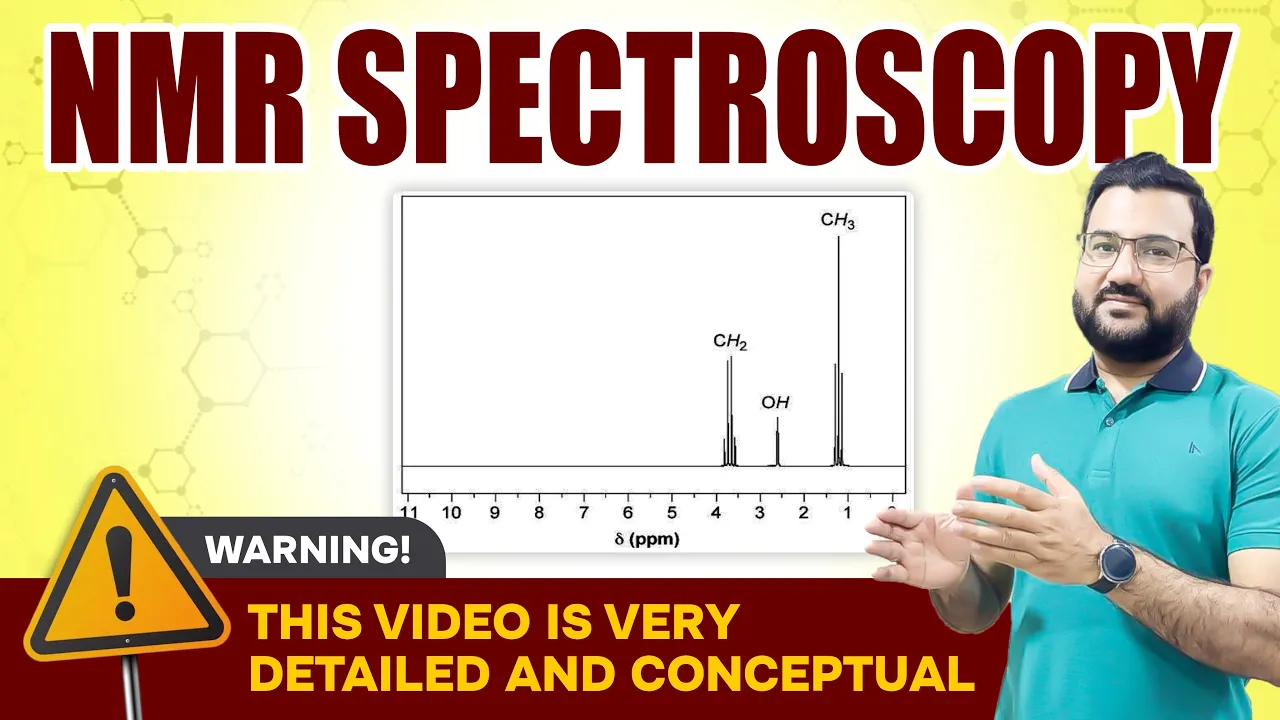











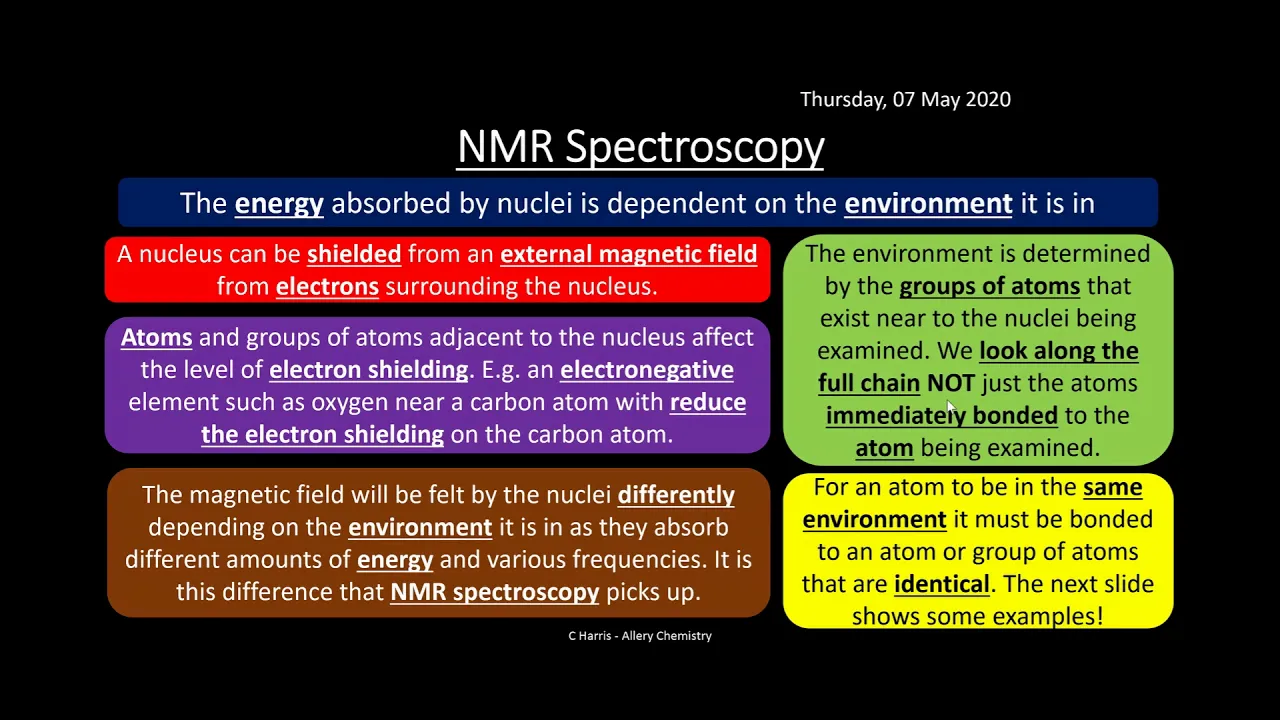





NMR spectroscopy works by placing nuclei with odd mass numbers (like hydrogen-1 and carbon-13) in a strong magnetic field, where they align parallel or anti-parallel; when radio waves provide energy to flip nuclei from their lower-energy parallel state to higher-energy anti-parallel state, they emit detectable signals that create peaks in the spectrum. The position of each peak (chemical shift) reflects how strongly the nucleus feels the magnetic field, which depends on its chemical environment—specifically, electron shielding from electronegative atoms. More deshielded nuclei require more energy to flip and appear further downfield (higher ppm). Proton NMR provides additional structural information through peak intensity (integration) showing proton ratios and peak splitting (N+1 rule) revealing adjacent proton counts, enabling determination of molecular structure.
NMR Spectroscopy Explained: Spectra Analysis for Chemistry Students
Added:by the end of this video you should be able to look at a spectrum like this and figure out the structure of the organic molecule that caused it let's start with the fundamentals what is NMR NMR stands for nuclear magnetic resonance you might have heard of a similar technique in medicine called magnetic resonance imaging or MRI in fact when MRI was first developed it was originally called nmri or nuclear magnetic resonance imaging but the nuclear part was dropped because this was during the Cold War when people weren't too keen on the sound of anything nuclear as chemists we know that the word nuclear simply refers to the atomic nucleus and as such there isn't anything inherently dangerous about it as the name suggest both MRI and NMR involve the use of magnets with MRI we get an image and with NMR we get a spectrum so how does NMR work let's imagine we have a very big very strong magnet inside this magnetic field we put a much smaller bar magnet the bar magnet will rotate so that it's parallel with the external magnetic field because this is its lowest energy state now if we reach in and physically exert our own energy we can rotate the bar magnet into an anti-parallel position we can think of the anti-parallel position as a high energy state with a stronger external magnetic field we would need to exert more energy to rotate the bar magnet and hence there will be a bigger difference in energy between the parallel and anti-parallel States remember this because it's going to come up again later if we were now to release the bar magnet it would rotate and relax back to its low energy position parallel with the external magnetic field so in summary by adding a certain amount of energy to the system which depends on the strength of the external field we can rotate the magnet to a higher energy state which will then relax back to the low energy state after a brief period of time this is essentially how NMR works because certain Atomic nuclei can behave as Tiny magnets when we put these nuclei into a large magnet they will line up with a magnetic field next we add energy to the system by posting them with radio waves the nuclei would absorb certain radio photons and will be moved into an anti-parallel position this is called resonance after a short period of time they will realign themselves with the field and release the absorbed photons which are then detected to give a peak in the Spectrum now not all Atomic nuclei will interact with the magnetic field the only nuclei that can are the ones which either have an odd number of protons or an odd number of neutrons this is because protons and neutrons have certain intrinsic properties such as mass and charge but they have another one called spin with an odd number of protons or neutrons the nucleus will have an overall spin which allows it to behave as a magnet the two most important Isotopes in organic chemistry that can be examined by NMR are carbon 13 and hydrogen 1.
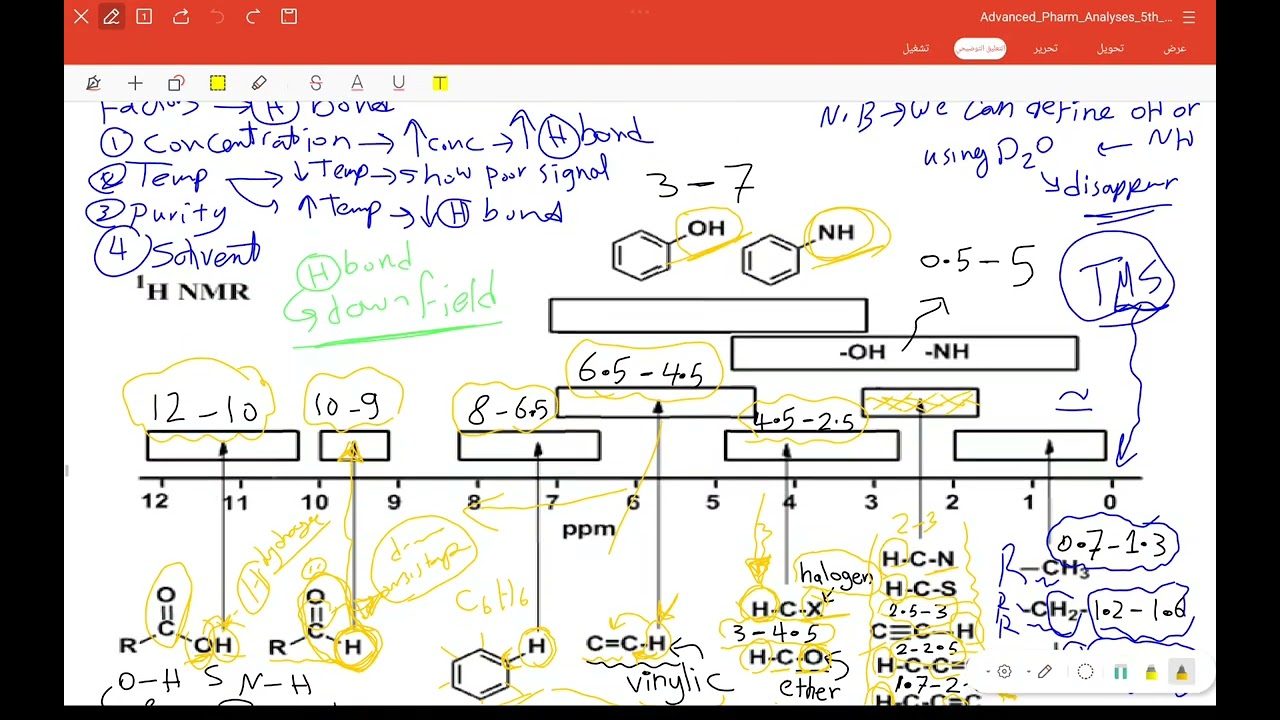
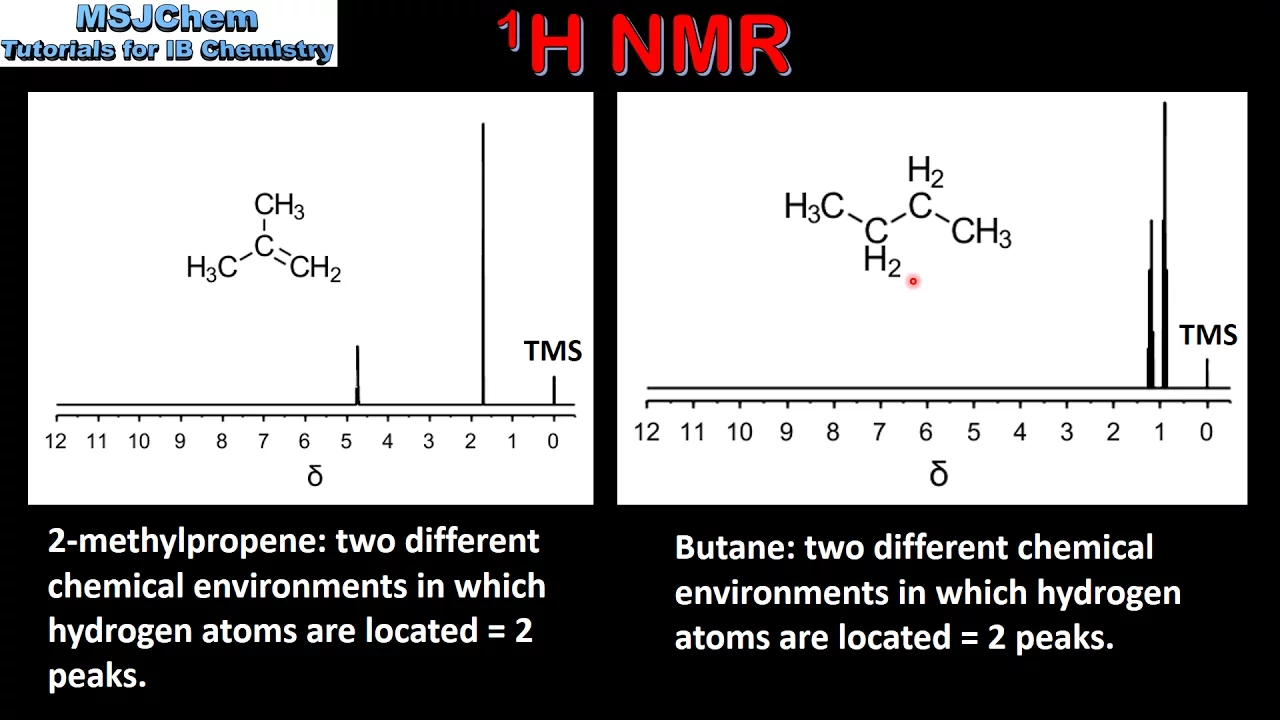
hydrogen 1 NMR is more commonly known as proton NMR since a hydrogen-1 nucleus only consists of a single proton carbon-12 has even numbers of protons and neutrons so it's not visible by NMR however even though carbon 13 only makes up around 1.1 percent of all carbon it's important to bear in mind that any sample of any organic compound that you might be examining by NMR will contain trillions and trillions of molecules so statistically throughout the whole sample there will be enough carbon 13 in each position of the molecule to allow you to see the entire structure whatever our sample is when we run it in an NMR spectrometer we'll need to dissolve a small amount of it in an appropriate solvent for NMR we use a solvent such as cdcl3 also known as deuterated chloroform regular chloroform has the molecular formula chcl3 since this contains a hydrogen of its own it would leave a significant Peak on a proton NMR Spectrum which could obscure Peaks from your sample to avoid this we use solvents which do not contain any hydrogens deuterated chloroform has had its irregular hydrogen swapped out for a deuterium atom deuterium is an isotope of hydrogen which has both the proton and a neutron in the nucleus giving it a mass number of two deuterium resonates at a different frequency to regular hydrogen so deuterium Peaks don't show up when doing regular proton NMR this means there's no risk of a deuterated solvent obscuring any hydrogen Peaks the same solvent can be used for carbon 13 anymore even though it contains a carbon atom because it will produce a very recognizable Peak which can be removed before we need to do any analyzing so the next question is how do we distinguish between different nuclei with NMR well that depends on the environment of the nucleus the environment is determined by what that atom is bonded to we need to be able to look for equivalent environments let's take a look at propane this molecule has three different carbon atoms let's look at what each one is bonded to carbon number one is bonded to three hydrogens and one ethyl group carbon number two is bonded to two hydrogens and two methyl groups carbon number three is bonded to three hydrogens and one ethyl group so carbons one and three are bonded to the exact same groups and are therefore in identical environments to each other this means that propane only has two carbon environments it also has two hydrogen environments as all hydrogens bonded to the same carbon are identical to each other so all three hydrogens coming from carbon number one are all in the same environment making them identical to the hydrogens coming from carbon number three let's take a look at a more complicated example with two methylpropyl ethanoates also known as isobutyl acetate we'll number the carbons again to make it easier to navigate the molecule pause the video here and see if you can identify the number of carbon and hydrogen environments let's start with carbon the correct answer is that there are five carbon environments the reason is that carbons 1 and 3 are equivalent they're both identical methyl groups coming from carbon number two they're bonded to the exact same groups and hence are in the same environment all of the other environments are unique as they are each bonded to different groups how about hydrogen there are four hydrogen environments in this molecule again the hydrogens on carbons 1 and 3 are all equivalent so they're all in identical environments carbon number five has no hydrogens on it and all of the other hydrogen environments are unique as their respective carbons are all bonded to different groups so that's how to identify the environment but why does the environment affect the position of the NMR Peak at all aren't the nuclei the same either way well yes and no every carbon 13 nucleus is identical in that they all consist of six protons and seven neutrons however when they're in different environments the electron clouds surrounding the nuclei changes just like protons and neutrons electrons also possess a spin so they can help to Shield the nucleus from the external magnetic field if a carbon 13 is bonded to an electronegative element Like Oxygen the electrons around the carbon-13 nucleus are pulled away when the electrons are pulled away the nucleus is more exposed which allows it to feel the external magnetic field even more strongly than it normally would remember earlier when I said that with a stronger external magnetic field we would need to exert more energy to rotate the bar magnet and hence there will be a bigger difference in energy between the parallel and anti-parallel States well since our carbon 13 nucleus is now feeling a stronger external magnetic field due to the de-shielding it will also have a bigger difference in energy between the parallel and anti-parallel States this means that more energy is required to flip it so it absorbs a higher frequency radio Photon when it flips and later emits that higher frequency radio Photon when it flips back so in summary when a nucleus is in a different environment its electron cloud is affected meaning it will have a different amount of shielding compared to other environments which changes how strongly it feels the external magnetic field which in turn changes how much energy is required to flip it more de-shielded nuclei require more energy to flip than more shielded nuclei this results in different environments producing peaks in different positions on the Spectrum an NMR Spectrum looks something like this notice that with NMR Spectra the horizontal axis is backwards with zero on the right hand side and the numbers getting bigger towards the left the chemical shift is related to the radio frequency and is measured in parts per million if a nucleus is more de-shielded its peak will have a higher value of chemical shift and is described as being downfield if a nucleus is more shielded its peak will have a lower value of chemical shift and is described as being up field so the closer a nucleus is to an electronegative atom the more de-shielded it will be as a result it feels the external magnetic field more strongly so more energy is required to flip it this translates to a higher chemical shift so the peak will appear further to the left or more down field when running an NMR Spectrum we need to add a small amount of a reference standard to our sample the reference standard we use is tetramethylsylane the reason we use this is that it has four carbons all in the same environment and 12 hydrogens all in the same environment this means it will give a very clear Peak whether it's used for carbon 13 NMR or for proton enema the other reason is that carbon is actually more electronegative than silicon so the carbons and by extension the hydrogens are actually partially negative in this molecule in other words they're quite strongly shielded especially compared to the carbons and hydrogens in most organic compounds as a result the carbon nuclei and the hydrogen nuclei in this molecule feel the external field less than most other carbons and hydrogens so a relatively small amount of energy is required to flip them this gives rise to a peak which is more up field than the peaks in our actual sample we set this peak as 0 PPM and the other Peaks are all relative to it the TMS Peak is then removed so it usually doesn't appear in the Spectrum we could go into a lot more depth with NMR and talk about Concepts like quantum numbers precession and Fourier transforms but what we've covered so far should hopefully give you a decent enough fundamental understanding about how the technique works now let's start analyzing some Spectra this is the carbon 13 NMR Spectrum for a molecule with the molecular formula c3h8o in this spectrum we can see that there are three Peaks which tells us that each of the three carbons in the molecule are in three unique environments by looking at the positions of the Peaks and comparing them to values from the data sheet that will be given in an exam we can see that these two peaks are in the range we'd expect for carbons bonded to other carbons and this peak is in the range for a carbon bonded to an oxygen by the way be aware that the exact values on the data sheet can vary slightly from exam board to exam board since they're more like guidelines Peaks can exist outside of these ranges depending on what else is bonded nearby piecing all of this information together this makes it likely that this molecule is propan 1o this fits with the molecular formula as well as the number of environments and the positions of the Peaks it couldn't be the structural isomer propane tool because this only has two carbon environments not three in an exam you're unlikely to be asked to solve a complicated structure using carbon 13 NMR because it's very difficult to piece together a larger molecule using this technique only for more complicated structures you would instead use proton NMR the reason we use proton NMR instead of carbon 13 NMR is that there are two additional pieces of information we can learn to help us solve the structure let's take a look at the proton NMR Spectrum for a molecule with a molecular formula c6h12o2 just like with the carbon 13 NMR Spectrum we can look at the number of Peaks to determine the number of proton environments in this case there are four and we can look at the positions of the Peaks to determine what kind of environments there are however we have even more information that can help us here the first piece of extra information is the peak intensity also known as the peak area or the peak integration these numbers next to the Peaks represent the ratio between the numbers of protons in each environment so going from left to right we have a ratio of 2 to 3 to 1 to 6. now it's important to bear in mind that this is just the ratio between the numbers of protons in each environment so the actual numbers of protons could in theory be four to six to two to twelve or even 20 to 30 to 10 to 60 although this one's pretty unlikely however since we know that our molecular formula contains 12 hydrogens this ratio must represent the actual number of protons in the structure as two plus three plus one plus six equals twelve so all the protons are accounted for so these numbers tell us how many hydrogens can be found in each environment the second bit of extra information is the peak splitting you'll have noticed that a couple of these peaks look a bit weird this is because they've been split splitting is caused by the protons in adjacent environments the amount of splitting tells us how many protons are next door to the protons in that environment and is due to something called the N plus one rule here n represents the number of adjacent protons let's say we're looking at environment a and there are two protons next door in environment B due to the N plus one rule the peak for environment a will be split into two plus one which is Three Peaks known as a triplet let's go through the different splitting possibilities if the peak is not split and remains as a single Peak it's called a singlet the N plus one rule tells us that there would be zero adjacent protons if the peak is split into two it's called a doublet and the N plus one rule tells us that there would be one adjacent proton if the peak is split into three it's called a triplet and will have two adjacent protons if it splits into four it's called a quartet and will have three adjacent protons any more than that we can call it a multiple it let's go back to our spectrum and go through what we've got so far we have a Peak at around 0.9 PPM which is a doublet with a peak intensity of 6.
this tells us that there are six protons in this environment with one proton on the carbon next door the next Peak is around 1.8 PPM and is a multiple it with a peak intensity of one this tells us that there is one proton in this environment with many hydrogens on the adjacent carbons after this we've got to Peak at around 2 PPM which is a singlet with a peak intensity of three this tells us that there are three protons in this environment with no adjacent hydrogens at all finally we have a Peak at around 4.3 PPM which is another doublet but this one has a peak intensity of two this tells us that there are two protons in this environment and that there is one proton on the carbon next door in an exam you should write all of this out because you can pick up a lot of Marks here even if you can't figure out the final structure now comes the tricky bit piecing it all together this can take a lot of practice so just stick with it and it should get easier the first thing that stands out to me here is that we have two environments which each have a single proton next door as evidenced by the fact that they're both doublets in addition to this we have another environment which contains a single proton as evidenced by the fact that it has a peak intensity of one moreover the peak for this environment is a multiplet indicating that it's adjacent to many other hydrogens all of this points to the fact that these two environments are adjacent to this environment these two have one proton next door this environment contains one proton they fit together so this single proton is most likely a CH and must have six protons on one side and two protons on the other side this means we'll have two methyl groups on one side and a ch2 on the other side so far this fits with the peak intensities and with the peak splitting so if we're correct so far we've already accounted for four out of our six carbons and nine out of our twelve hydrogens we still have to find where our two remaining carbons three remaining hydrogens and two remaining oxygens fit in the one Peak we haven't accounted for yet is the singlet with a peak intensity of three this will most likely be a ch3 group and since it's a singlet it cannot have any adjacent hydrogens this tells me that it can't be next to the ch2 group here it must be separated somehow if we have a ch3 group somewhere at the other end of the molecule we now have one remaining carbon and two remaining oxygens to fit in the most likely place to fit them will be an s Master group this would separate the ch3 from the rest of the hydrogens leaving its peak as a singlet the only question remaining is which way round does the Ester group go we configure this out by the peak positions if we look at the data sheet we can see that a proton which is bonded to a carbon which is bonded to a carbonyl group can usually be found in the region 2 to 3 PPM a proton which is bonded to a carbon which is single bonded to an oxygen can usually be found in the region 3 to 4.1 PPM so since the ch3 peak is around 2 PPM it must be bonded to a carbonyl so the ester linkage will be this way round this gives us two methyl propyl ethanoids also known as isobutyl acetate the same molecule we looked at earlier when learning about environments again don't worry if this all seems overwhelming to you it will take practice to be able to do this for yourself but hopefully you're following the logic behind everything so far let's take a look at another proton NMR Spectrum this time for a molecule with a molecular formula c6h1002 pause the video here and see if you can solve this structure before I go through it okay so I'm going to first go through the Peaks present there are Four Peaks in total so there are four proton environments in our molecule we have a Peak at around 1 PPM which is a triplet with a peak intensity of three this tells us that there are three protons in this environment with two protons next door next we have a Peak at around 2.2 PPM which is a singlet with a peak intensity of three this tells us that there are three protons in this environment with no adjacent protons we then have a Peak at around 2.5 PPM which is a quartet with a peak intensity of two this tells us that there are two protons in this environment with three protons next door finally we have a Peak at around 3.6 PPM which is a singlet with a peak intensity of 2. this tells us that there are two protons in this environment with no adjacent protons now the first thing I notice here is a pair of Peaks that I always look out for in proton NMR Spectra we have a triplet with a peak intensity of three and a quartet with a peak intensity of 2. the triplet with a peak intensity of 3 must be a ch3 group and since it's a triplet there are two protons next door the quartet with a peak intensity of two must be a ch2 group and since it's a quartet there are three protons next door so these two peaks are connected it's just a ch2 ch3 group you'll often see these peaks in an NMR spectrum because they represent the end of an alkyl chain so just like that we've already assigned two of our Four Peaks the other two peaks are both singlets which tells me that both of these environments are isolated as in they're not adjacent to any other hydrogens one of them will be a ch2 group since it has a peak intensity of two and the other will be a ch3 group since it has a peak intensity of three now how can we ensure these groups are all separated so that the splitting all makes sense well that's where the oxygen has come in so far we've assigned four out of six carbons all 10 hydrogens but neither of our oxygens there are still still two carbons and two oxygens to fit into the structure this tells me that there are most likely a couple of carbonyl groups separating the other groups from each other piecing this all together we get hexane 2 for diode this also explains why the peak for this ch2 group is shifted so far downfield outside the normal range for a proton which is bonded to a carbon which is bonded to a carbonyl it's because it's bonded to not one but two carbonyl groups this is a great example of how the range is given in a data sheet are more like guidelines rather than strict boundaries let me know in the comments how close you got to solving this structure something else I'd like to briefly talk about is oh Peaks and nh2 Peaks both of these will always show up as a singlet when looking at them in proton NMR the other thing is that if we look at the data sheet these Peaks can show up anywhere so we have a way to confirm whether or not a given singlet is due to an oh or an nh2 what we need to do is re-run the sample through the NMR spectrometer with a little bit of d2o mixed in d2o is deuterated water also known as heavy water it's the same as regular water but where each hydrogen has been replaced by a deuterium atom remember deuterium is an isotope of hydrogen but with a neutron in the nucleus as well as a proton giving it a mass number of two when we add d2o to our sample the hydrogens in any oh or nh2 groups in the molecule are exchanged for deuterium atoms remember since deuterium resonates at a different frequency to regular hydrogen the Peaks don't show up when doing regular proton NMR this means that any oh Peaks or nh2 Peaks that were present in the original Spectrum will disappear in the second Spectrum when we add d2o okay now that we've gone through a few examples together hopefully this is all starting to make a bit more sense again don't worry if you're still finding it difficult it was hate practice to be able to do this there's also nothing wrong with a bit of trial and error when doing this for yourself when you get close try and draw out a possible structure and see if it works with all the information you've got if not you can keep trying until you get there if you found this video helpful please consider subscribing to support the channel and let me know in the comments if you have any questions
Up Next

Coupling Constant in NMR Spectroscopy: Organic Chemistry Explained
@readysetorgo
316.2K views•2014-07-28
Biocatalysis and Catalysis in Islatravir Synthesis | Merck Webinar
@SCIwheresciencemeetsbusiness
675 views•2020-10-08
1H NMR: Determining Number of Peaks from Structure
@MSJChem
59.2K views•2017-04-06

Edible Water Bottles: A DIY Guide to Sodium Alginate Spherification
@ryan
10.5M views•2019-06-21
Related Study Plans & Knowledge Roadmaps
Structured learning paths in Chemistry