









![[유기화학 생존 노트] 19장_8강_핵자기 공명 분광법(NMR)의 개요](https://i.ytimg.com/vi/UPQyIWAVa9w/maxresdefault.jpg)
![chem335 lecture [1-26-21]: intro / ch10 (NMR)](https://i.ytimg.com/vi/xumwGPOL-OI/maxresdefault.jpg)













![Structure Determination from Spectra (3) (H NMR, C NMR, IR) [Ketone, Alkyl halides, Alcohols]](https://i.ytimg.com/vi/f-MLZkL20Zo/maxresdefault.jpg)
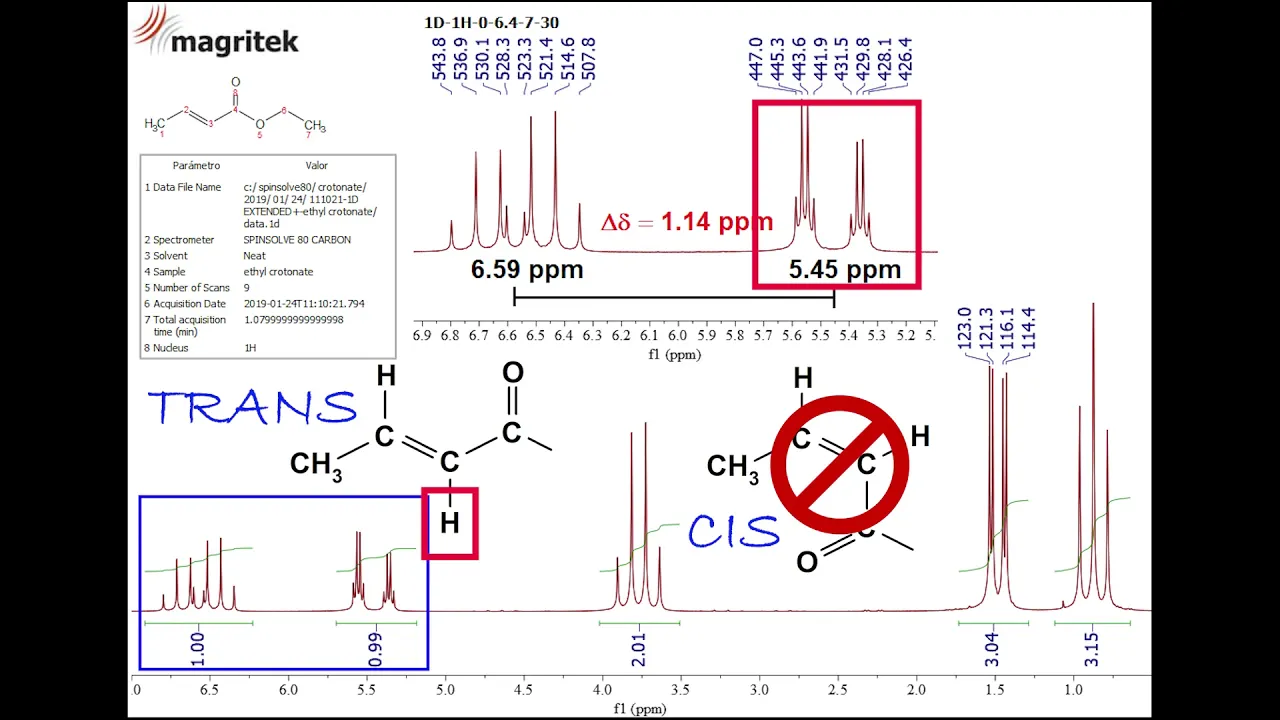
A coupling constant (J value) in proton NMR spectroscopy is the distance between peaks in a multiplet signal, measured in Hertz, which indicates the strength of magnetic interaction between coupled protons; since coupled protons affect each other reciprocally, they share the same coupling constant, and the higher peak in a doublet always points toward the proton causing the splitting, helping identify which protons are interacting in a molecule.
Coupling Constant in NMR Spectroscopy: Organic Chemistry Explained
Added:Basic principles of Proton NMR (1H-NMR) spectroscopy, including chemical shift (ppm) and signal integration.
The concept of spin-spin splitting and the application of the n+1 rule for simple multiplets.
How to identify chemically equivalent and non-equivalent protons in organic molecules.
The physical basis of nuclear spin states and magnetic resonance in organic compounds.
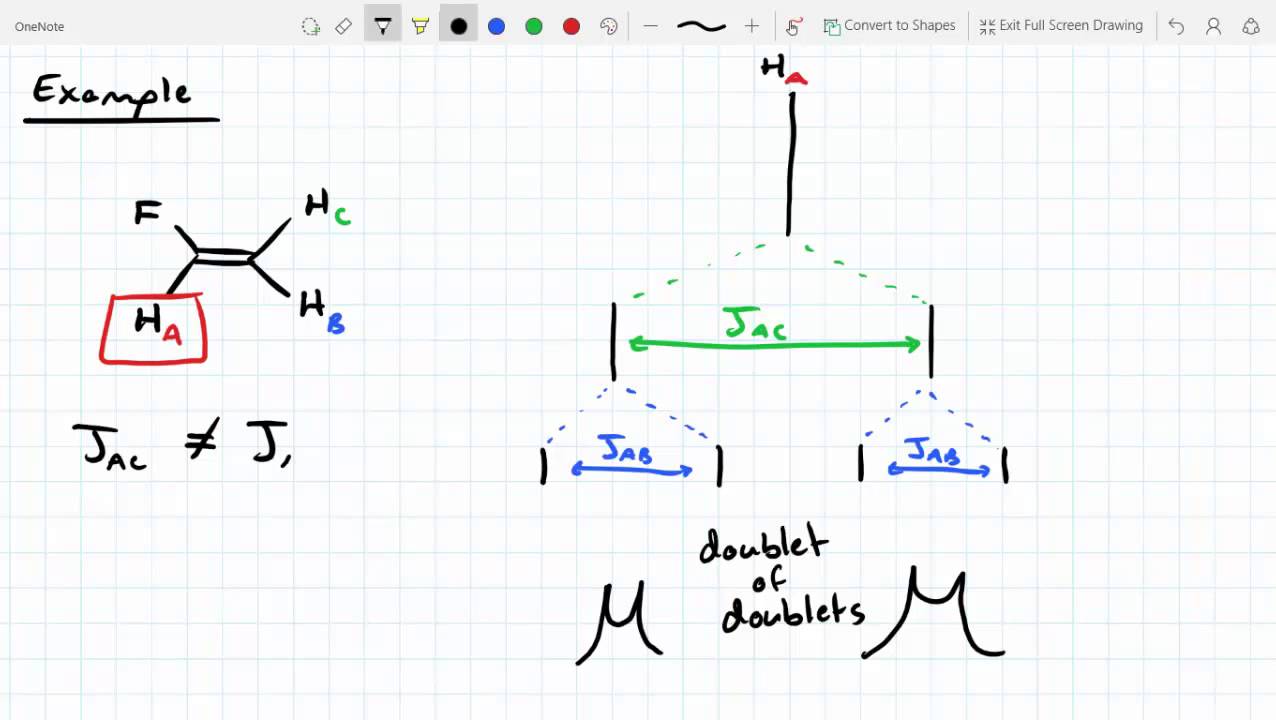
Analyzing complex coupling patterns, such as doublets of doublets (dd) or doublets of triplets (dt), using coupling trees.
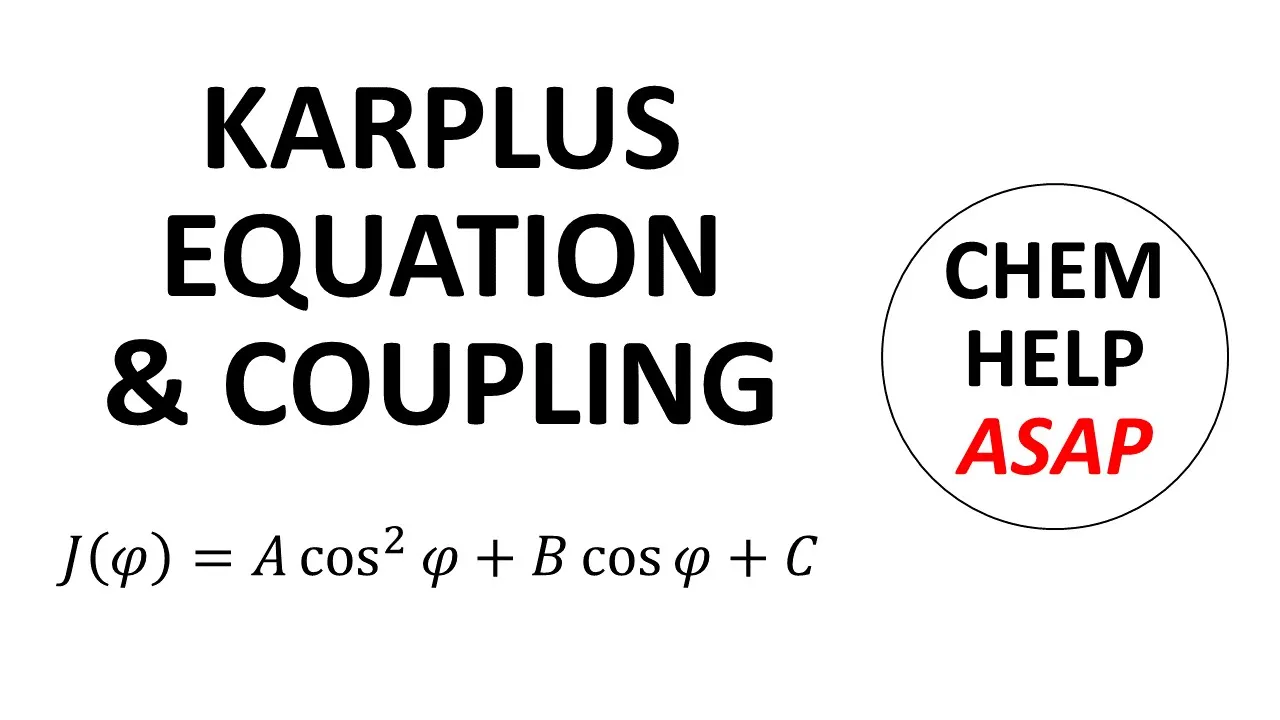
Applying the Karplus equation to correlate coupling constants (J-values) with dihedral angles and molecular conformation.
Understanding second-order coupling effects (strong coupling) where peak distortion goes beyond simple 'roofing'.
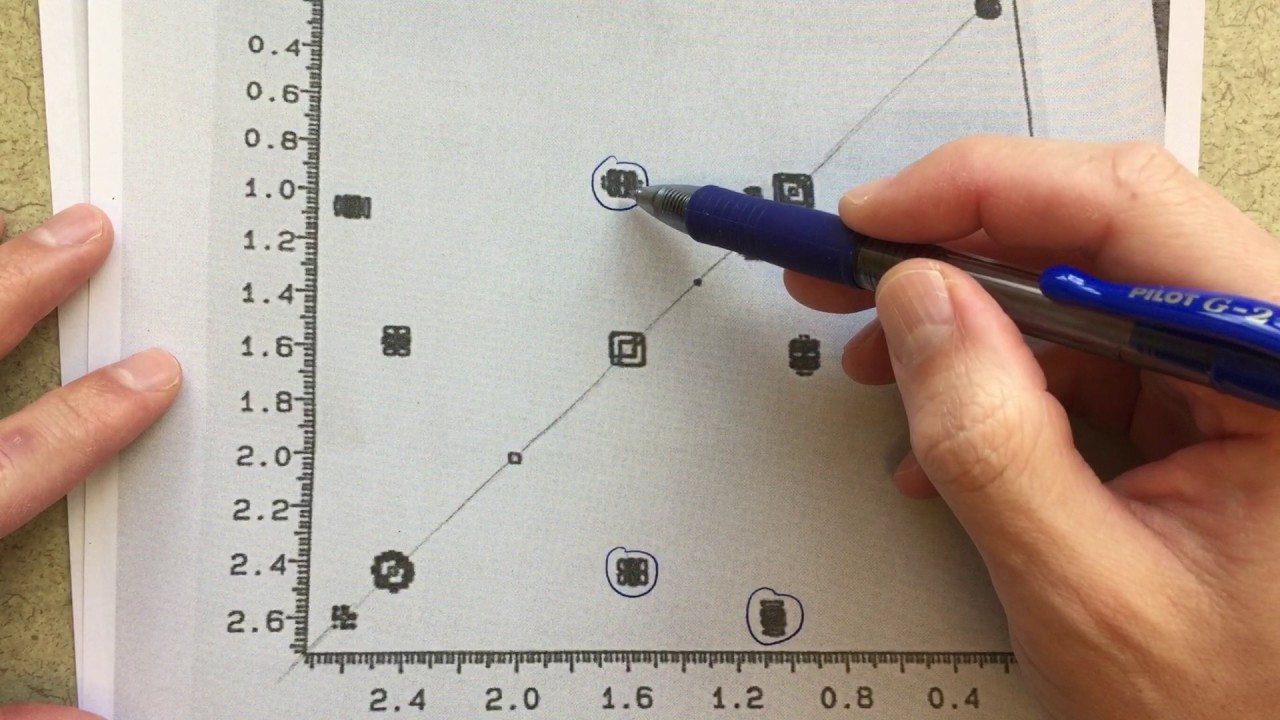
Utilizing 2D NMR spectroscopy techniques, such as COSY (Correlation Spectroscopy), to map proton-proton connectivity.
Solving complete structure elucidation problems by integrating 1H-NMR, 13C-NMR, IR, and Mass Spectrometry data.
316.2K views1.1Klikes6:09Original Release: 2014-07-28
- [Voiceover] If you look at the red and blue protons, they're both attached to this carbon, and if we see this double bond here, we have these different groups attached to this double bond, and since there's no rotation around the double bond, the red and the blue protons are locked into different environments, therefore, they are NOT chemically equivalent, and since those protons are not equivalent, they can couple together, and since this is occurring on the same carbon, we call this geminal coupling, so geminal coupling here, so geminal, referring to the fact that both protons are on the same carbon, and coupling can occur, so those protons are close enough where they can affect each other.
So let's think about first, the NMR spectrum with no coupling, so we would expect one signal for the blue proton, and one signal for the red proton.
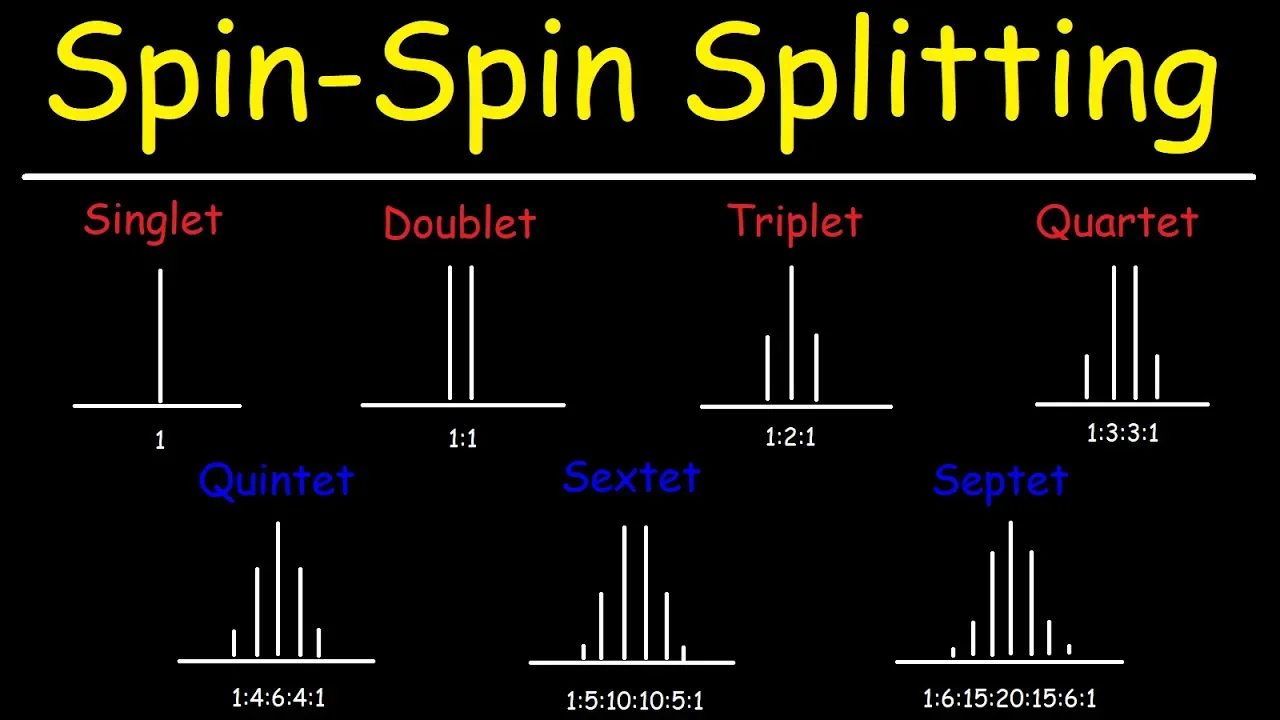
So here's the spectrum with no coupling, but we know that the red proton's magnetic moment can align either with the external magnetic field, or against the external magnetic field, and that causes the signal for the blue proton to be split into two, so if I go down here, so we actually see a doublet for the signal for the blue proton.
Same thing for the blue proton.
The magnetic moment can be aligned either with the external magnetic field, or against it, and that splits the signal for the red proton into a doublet, so two peaks for the signal for the red proton.
I went into much more detail about this in the spin-spin splitting/spin-spin coupling video.
In this video, we're more concerned with the idea of the coupling constant, and the coupling constant refers to the distance between the peaks of a signal.
So if you think about the distance between the two peaks of this signal, that is the coupling constant, and the coupling constant is the same for both of these signals, because these protons are splitting each other.
They are coupled together.
The coupling constant is measured in Hertz, so it turns out to be 1.4 Hz, and if it's 1.4 Hz for this one, it must be 1.4 Hz for this one, because those protons are coupled together.
The reason why we use Hertz, is because it's the same coupling constant no matter what NMR spectrometer you're using, so it doesn't matter what the operating frequency is.
You're going to get the same coupling constant.
Alright, if we look at the actual NMR spectrums, over here is a zoom-in of the actual NMR spectrum.
The signal for the red proton is right here, and the signal for the blue proton is over here.
So, when I looked at the spectrum with interaction, the spectrum with coupling between the protons, we just assumed that the heights of these two peaks were the same, but if I look at the actual NMR spectrum, they're not quite the same.
So this one right here is a little bit higher, and if you draw an arrow pointing towards the higher peak, that arrow points towards the signal of the proton that's causing the splitting.
So that arrow is pointing to the right, and that's where we find the signal for the red proton, which is causing the splitting of the blue proton.
So the doublet points towards the proton with which it is coupled, and the same thing for this signal.
So this peak's a little bit higher, so we draw an arrow pointing towards the higher peak, and so the doublet points toward the proton with which IT is coupled, and so you get this situation where you get these doublets with like a roof over their head.
So if you could imagine this roof over them like that.
So, sometimes you'll see this on an NMR spectrum, and if you think about that they're pointing towards the proton with which it is coupled, sometimes it can help you when you're trying to understand what's going on in your NMR spectrum.
Alright, let's look at another example for a coupling constant, so let's look at this molecule, and let's focus on the ethyl group.
So, over here, this carbon has two protons, so we expect one signal for those protons, and then over here, this carbon has three protons, so we would expect another signal for these protons.
Let's focus in on the protons in blue.
So how many neighboring protons do we have?
Well, those protons in blue are attached to this carbon.
The next-door carbon is this one.
So how many neighbors?
One, two, three, so three neighboring protons, so n is equal to three.
I'm using the n plus one rule.
We expect n plus one peaks, so three plus one is equal to four, so we would expect a signal with four peaks, so we would expect a quartet.
So let me go ahead and draw that down here, so we would expect a quartet for that signal, so this is supposed to represent what you would see on an NMR spectrum.
Next, let's do the protons in red here, so how many neighboring protons do they have?
Well, they're all attached to this carbon, and the next-door carbon is here, and we have two protons on the next-door carbon, so we have two neighbors, so n is equal to two, and so we'd expect two plus one peaks, so three peaks, or a triplet.
So let me see if I can draw in a triplet here.
So this would be the signal for these protons.
Since the red and the blue protons are splitting each other, the coupling constant is the same.
So the distance between the peaks should be the same, so it turns out to be 7 Hz, so this distance should be 7 Hz, the same with this distance, so we just have to pretend like they're all equivalent here, and the same for this one, so a coupling constant of 7 Hz.
Same for this signal.
So this distance should be 7 Hz, and also for this one, so hopefully this just gives you an insight into the idea of a coupling constant, which you'll need, to understand more complex splitting, which we'll talk about in the next video.
Up Next

10:18
1H NMR Spectra Interpretation: Part I Examples
@chem233uiuc4
79.4K views•2015-08-27
83:56
Biocatalysis and Catalysis in Islatravir Synthesis | Merck Webinar
@SCIwheresciencemeetsbusiness
675 views•2020-10-08

10:10
Properties of Ethers and Crown Ethers | Organic Chemistry
@readysetorgo
57.9K views•2012-09-19

17:31
Edible Water Bottles: A DIY Guide to Sodium Alginate Spherification
@ryan
10.5M views•2019-06-21
Related Study Plans & Knowledge Roadmaps
Structured learning paths in Chemistry
chemistry
Nuclear Chemistry: Decay, Meds & Fuel Cycle
01Introduction to Nuclear Structure and Radioactivity
02Decay Dynamics and Kinetics
03Radiation Interaction and Detection
+ 2 more learning modules
24h5 modules
Explore Roadmap
chemistry
Supramolecular Chemistry: Forces & Machines
01Foundations of Chemical Bonding and Intermolecular Forces
02Introduction to Host-Guest Chemistry
03Thermodynamics and Dynamics of Self-Assembly
+ 2 more learning modules
16h5 modules
Explore Roadmap
chemistry
Photochemistry: Excited States & Reactions
01Foundations of Light-Matter Interactions
02Molecular Orbitals and Electronic States
03Photophysical Processes and Jablonski Diagrams
+ 2 more learning modules
18h5 modules
Explore Roadmap
chemistry
Coordination Chemistry: Bonding & Properties
01Introduction to Transition Metals and Ligands
02Crystal Field Theory (CFT) and Geometry
03Magnetic Behavior and Spin States
+ 2 more learning modules
14h5 modules
Explore Roadmap