






![chem335 lecture [1-28-21]: ch10 (NMR)](https://i.ytimg.com/vi/XPa8A_itgw4/maxresdefault.jpg)




![[유기화학 생존 노트] 19장_12강_¹H NMR 해석(4)_스핀-스핀 갈라짐](https://i.ytimg.com/vi/TDzINqjLoLo/sddefault.jpg)






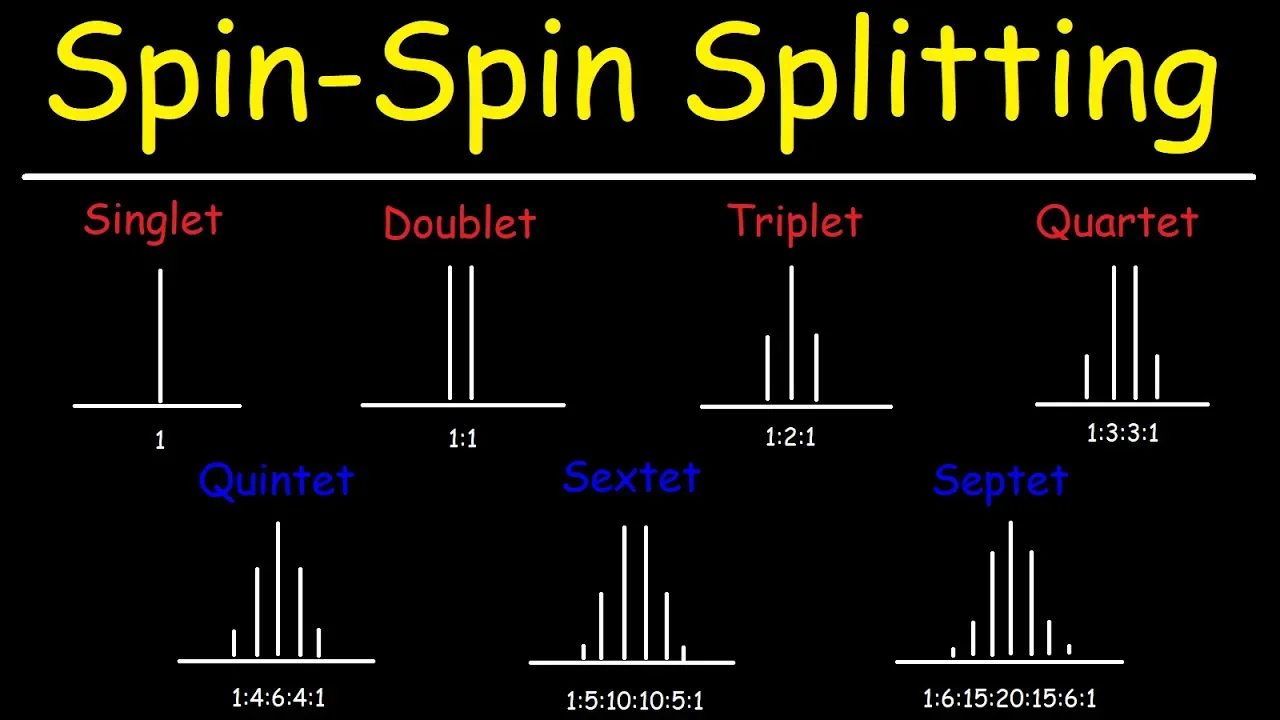
When a proton has two different kinds of neighboring protons with different coupling constants, the n+1 rule fails, and a splitting tree must be used to predict the splitting pattern; each line of the initial split is further split by the next neighboring group, resulting in complex patterns like doublets of doublets or sextets, whereas equal coupling constants would produce the simpler triplet predicted by the n+1 rule.
Complex Splitting in NMR Spectroscopy Explained
Added:Understanding the basic principles of Proton NMR (1H-NMR) spectroscopy, including chemical shift and signal integration.
Mastery of simple spin-spin coupling and the standard N+1 rule for equivalent neighboring protons.
The ability to identify and distinguish between chemically equivalent and non-equivalent protons within a molecular structure.
An understanding of what the coupling constant (J-value) represents physically and how it is measured in Hertz.
Applying complex splitting analysis to determine molecular stereochemistry, such as cis/trans alkene coupling and identifying diastereotopic protons.
Exploring advanced 2D NMR spectroscopy techniques, like COSY (Correlation Spectroscopy), to map out complex spin-coupling networks.
Understanding chemical and instrumental decoupling techniques used to simplify highly complex, overlapping NMR spectra.
Solving complex structure elucidation problems for unknown organic compounds by combining 1D and 2D NMR data with IR and Mass Spectrometry.
372K views2.2Klikes7:55Original Release: 2014-07-28
- More complex splitting occurs when a proton has two different kinds of neighbors.
And a good example of this is the blue proton that I circled in Cinnamaldehyde.
So the blue proton has a signal with a chemical shift about 6.7 parts per million.
So down here is a zoomed in view of the signal for the blue proton.
Let's look at neighboring protons.
So the blue proton is on this carbon, and we have a carbon next door right here with one proton, so there's one neighboring proton.
Here's another carbon next door with one proton, so we have two neighboring protons.
So let's try to apply the n plus one rule here.
So if n is equal to two, we have two neighboring protons, we would expect n plus one peaks.
So two plus one is equal to three, so a signal with three peaks or a triplet.
But that's not what we see for the signal for the blue proton.
We see one, two, three, four lines here.
So the n plus one rule doesn't work in this case.
And that's because the n plus one rule works when the neighboring protons are equivalent and here the two neighboring protons are not equivalent.
So we need a new way to explain the signal for the blue proton.
And we're going to use what's called a splitting tree.
So we're going to start with the signal for the blue proton, so here's the signal for the blue proton.
It's going to be split by the proton next to it, this proton in red.
And the coupling constant between the red and the blue proton is 12 hertz.
So let's go ahead and show, let's show this signal is split into a doublet, so let me go ahead and draw in the blue lines here.
So we get the signals split into a doublet, the coupling constant is 12 hertz, so this distance here represents 12 hertz.
So why can we think about it being split into a doublet?
Well you can think about a variation of the n plus one rule here, right?
So we're talking about one neighboring proton, so n is equal to one, so one plus one is equal to two, so we split the signal into a doublet with two lines.
Alright, now let's think about what happens with the other protons, so this one.
Ok well that's going to take each line of the doublet that we just drew and split it into another doublet.
So this line gets split into a doublet, and this line gets split into a doublet.
The coupling constant this time is six hertz.
So this distance here represents six hertz, and this distance represents six hertz.
So why was each line split into two?
Well once again we can use a modification of the n plus one rule here.
We're talking about one neighbor here, so n is equal to one, so one plus one is equal to two, so each line is split into two.
So each line is split into a doublet.
For this line and for this line.
This line is split into a doublet, too.
So we get four lines for the signal of the blue proton.
If we go over here we see those four lines, one, two, three and four.
And we call this a doublet of doublets, or a double doublet.
What would happen if the coupling constants were the same?
So let's just pretend like they're both 12 hertz, so let's go ahead and draw what we would see for the signal.
So we have our blue proton's signal, is split into a doublet by the red protons, so let's go ahead and draw in our doublet here.
And let's say this distance represents 12 hertz, so 12 hertz here, and let's say the coupling constant over here was also 12 hertz, so instead of six hertz.
So each line of the doublet we just drew is split into another doublet from our other neighbor.
And this time I'm going to show a coupling constant of 12 hertz.
So each line of the doublet in blue is split into another doublet.
So the line in blue on the left is split into a doublet, and the line in blue on the right is split into a doublet, because of our one neighboring proton.
Well I changed the coupling constant so now I just have to pretend like now we're dealing with 12 here, so the coupling constants are the same.
And notice what this gives us, this gives us a triplet, right?
So here is one line and then we're going to get this peak, and then we're going to get this peak here.
So if the coupling constants are the same, you get a triplet, you get what the n plus one rule predicted.
So that's just something to think about with the origin of the n plus one rule.
Let's do another example.
So let's go down here and let's look at this molecule.
So we're going to focus in on this proton here in blue.
And we have neighboring protons right?
So this neighboring proton, the coupling constant between those two is 12 hertz, and then over here, we have two neighboring protons, and the coupling constant between the magenta protons and the blue is seven hertz.
So let's think about the signal for the blue proton here, so here we have the signal for the blue proton, which isn't split, let's think about what the red proton is going to do.
We have one neighbor, so one plus one is equal to two.
So we're going to split the signal for the blue proton in two, so we get a doublet here, so let me go ahead and draw in the doublet.
The coupling constant was twelve hertz, so this distance right here is 12 hertz.
Now you have a situation where we're thinking about the magenta protons, we have two of them.
So n is equal to two, so two plus one is equal to three.
So the magenta protons are going to split each line of the doublet that we just drew into a triplet.
So we're going to get a triplet here, let me go ahead and draw that in.
So for a triplet, and our coupling constant is seven hertz, so let me see if I can draw that here.
So that distance is supposed to represent seven hertz, So let me draw that in.
So this distance is seven hertz, this distance corresponds to seven hertz, and one line of our doublet is split into a triplet now.
Same thing happens for the other line, right?
Same thing happens for this line right here, we need to split that into a triplet because of these magenta protons.
So we're going to split that into a triplet, once again, we need to think about a distance of seven here, seven hertz.
So we have on both sides, we have seven hertz, let me go ahead and draw that in, so this is talking about seven hertz, and this is talking about seven hertz.
So that one line is split into a triplet, so let's draw that in here, one, two and three.
So finally, how many peaks would we expect for the signal for this blue proton?
So one, two, three, four, five, six.
So we would expect six peaks for this signal, for this blue proton, because of the neighboring protons which are on different types of environments.
So this is complex splitting.
Up Next
26:19
2D NMR Worked Example 1: COSY Analysis for Isomer Differentiation
@organicwithgrace5388
70.3K views•2020-04-09

83:56
Biocatalysis and Catalysis in Islatravir Synthesis | Merck Webinar
@SCIwheresciencemeetsbusiness
675 views•2020-10-08

10:10
Properties of Ethers and Crown Ethers | Organic Chemistry
@readysetorgo
57.9K views•2012-09-19

17:31
Edible Water Bottles: A DIY Guide to Sodium Alginate Spherification
@ryan
10.5M views•2019-06-21
Related Study Plans & Knowledge Roadmaps
Structured learning paths in Chemistry
chemistry
Nuclear Chemistry: Decay, Meds & Fuel Cycle
01Introduction to Nuclear Structure and Radioactivity
02Decay Dynamics and Kinetics
03Radiation Interaction and Detection
+ 2 more learning modules
24h5 modules
Explore Roadmap
chemistry
Supramolecular Chemistry: Forces & Machines
01Foundations of Chemical Bonding and Intermolecular Forces
02Introduction to Host-Guest Chemistry
03Thermodynamics and Dynamics of Self-Assembly
+ 2 more learning modules
16h5 modules
Explore Roadmap
chemistry
Photochemistry: Excited States & Reactions
01Foundations of Light-Matter Interactions
02Molecular Orbitals and Electronic States
03Photophysical Processes and Jablonski Diagrams
+ 2 more learning modules
18h5 modules
Explore Roadmap
chemistry
Coordination Chemistry: Bonding & Properties
01Introduction to Transition Metals and Ligands
02Crystal Field Theory (CFT) and Geometry
03Magnetic Behavior and Spin States
+ 2 more learning modules
14h5 modules
Explore Roadmap