













![AP Psychology Unit 1 Review [Everything You NEED to Know]](https://i.ytimg.com/vi_webp/4yvfd8aoUBc/maxresdefault.webp)
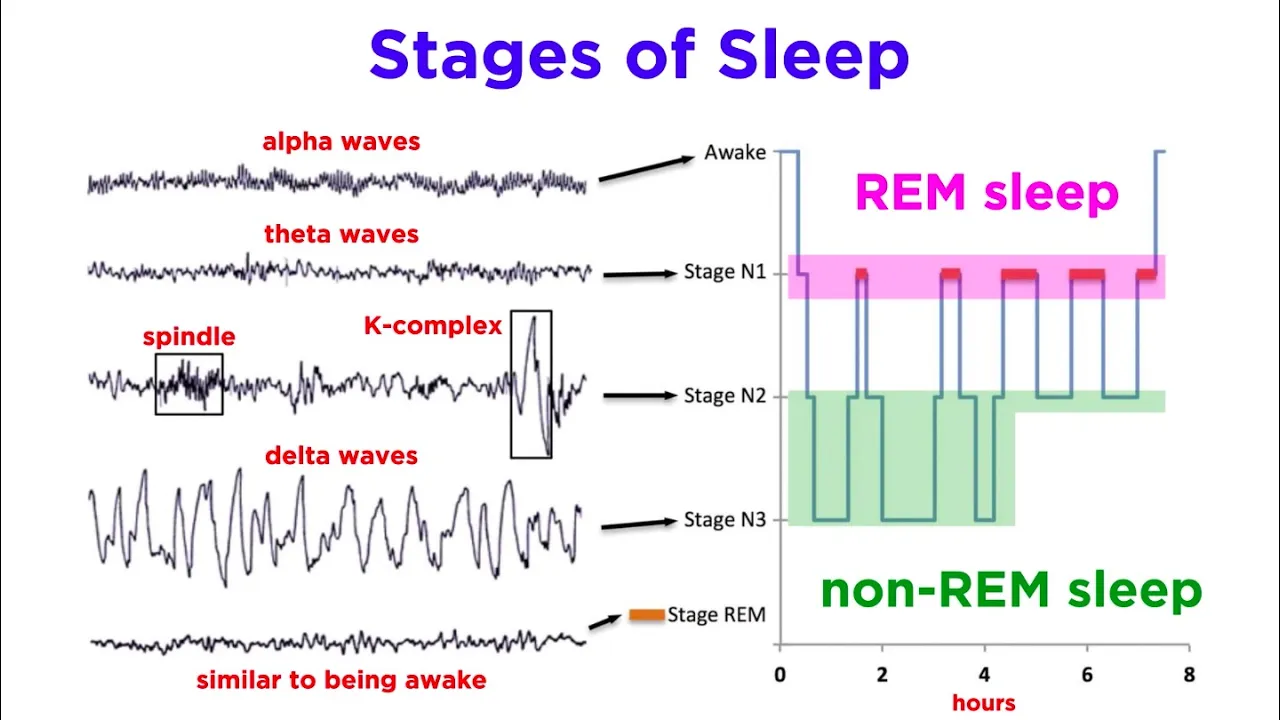






Sleep consists of four main stages (N1, N2, N3, and REM) that occur in approximately 90-minute cycles during a normal night, with N1 being light sleep featuring theta waves and hypnagogic hallucinations, N2 involving sleep spindles and K-complexes that help maintain sleep and consolidate memories, N3 (slow-wave sleep) producing delta waves and being the deepest stage where sleepwalking occurs, and REM sleep featuring rapid eye movements and muscle paralysis where most dreaming happens; these sleep cycles are regulated by circadian rhythms, which are the body's internal biological clocks that follow a 24-hour cycle and control body temperature, metabolism, and sleep-wake transitions, explaining why people feel sleepy at consistent times daily and why jet lag occurs when traveling across time zones.
Stages of Sleep and Circadian Rhythms | MCAT Biology
Added:Voiceover: Even though you're not conscious during sleep, your brain is deceptively active.
It goes through multiple cycles with distinct brain patterns, and it's very important to your ability to perform normal functions when you're awake.
You have four main stages of sleep which occur in approximately 90 minute cycles during a normal night of sleep.
The first three stages are all considered non-rapid eye movement, or non-REM which I'm going to abbreviate as N1, N2, and N3.
N1 is the stage between sleep and wakefulness.
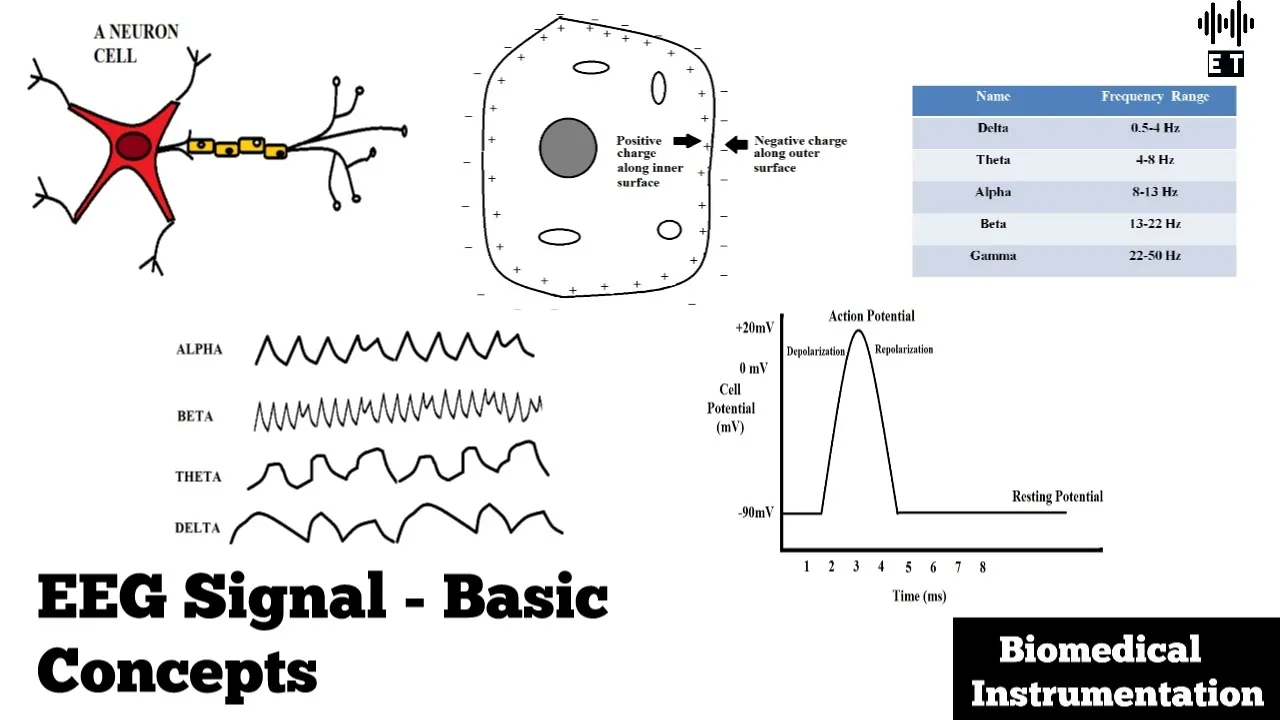
This is when your brain starts producing theta waves.
You might experience strange sensations known as hypnagogic hallucinations, just kind of a fun name.
These can include hearing or seeing things that aren't there such as seeing a flash of light, or a lot of people hear someone calling their name, or a phone ring, or a doorbell, or something like that.
Or if you've been doing something really repetitive just before bed, then that can recur in your hypnagogic state.
For example, if you've been on a boat all day, you may still feel like you're on water when you drift off to sleep even if you're on dry land.
Or something that's actually called the Tretis effect, if you've been playing Tetris for a long time right before bed, then you might experience visual images of blocks or something all moving in the same direction kind of like the blocks in the game.
Another common feeling during this stage is a feeling of falling.
That leads to what's called hypnic jerks, or those muscle twitches you sometimes experience as you fall asleep.
So that's N1, our first, lightest stage of sleep.
Then we move into N2 which is a slightly deeper stage of sleep.
Although it's still pretty easy to wake up someone in N1, people in N2 are harder to awaken.
We see more theta waves as well as something called sleep spindles and K-complexes.
Sleep spindles are these bursts of rapid rhythmic brain activity.
There's a lot we don't know about the purpose of each sleep stage and the function of these brain waves, but some researchers think that sleep spindles help inhibit certain cognitive processes or perceptions so that we maintain a tranquil state during sleep.
For example, sleep spindles in some parts of the brain are associated with people's ability to sleep through loud noises.
K-complexes are kind of similar, but they're a different type of brain activity that's also thought to suppress cortical arousal and keep you asleep basically.
They're also thought to help with sleep-based memory consolidation which is the theory that some memories are transferred into your long-term memory during sleep.
What's cool is that even though K-complexes do occur naturally, you can also make them occur by gently touching someone who's in this stage of sleep like just brushing against their skin and that will induce some K-complex activity.
What your brain does is sort of assess that the touch on the skin is non-threatening, and it suppresses the processing of that stimuli to help keep you asleep.
Beyond N2 we have N3.
This is our last non-REM stage.
N3 is also called slow-wave sleep because as you might guess brain waves are very slow.
These are called delta waves.
They have a range of about point five to two hertz.
You get basically a half to two oscillations of these brain waves per second.
When you're in N3 sleep, you are very much dead to the world, and really difficult to wake up.
If you walk or talk in your sleep, this is the stage where those things happen.
The last stage we need to talk about is REM sleep.
REM is R-E-M, stands for rapid-eye movement.
That's because this stage is when your eyes move really rapidly beneath your lids.
Also, most of your other muscles are paralyzed.
This paralysis might actually be a good thing because most dreaming occurs during REM sleep.
If you weren't paralyzed your muscles might act out whatever you were dreaming about which could be unsafe for you and anyone sleeping near you depending on what type of dreams you have.
REM sleep is sometimes called paradoxical sleep because your brain actually seems very active and awake, but your body is prevented from doing anything.
It's kind of crazy.
Now in a normal night of uninterrupted sleep, you cycle through these stages about four or five times each.
It takes about 90 minutes to go through a complete cycle, but the order, it doesn't just go one, two, three, REM.
The order within a cycle tends to go from N1 to N2 to N3 and then back to N2 before entering REM sleep, and then back to N1, and then it starts all over again.
How long each stage lasts depends partially on how old you are, and partially on how long you've been asleep.
You tend to do a lot more slow-wave sleep, or N3 sleep in the first few hours, and then more REM sleep right before you wake up.
That's why if you really want to try to remember your dreams, you can set your alarm to go off a little earlier than usual like 15 minutes so you'll get jerked out of REM sleep and are more likely to remember what you dreamed.
You know that you get tired probably around the same time every afternoon or evening, and you might wonder how your body knows when to fall asleep, or why a lot of people get tired in the afternoon.
The answer lies in something called our circadian rhythms.
Just like our sleep has cyclical stages, so does our wakefulness, and our transition for wakefulness to sleeping.
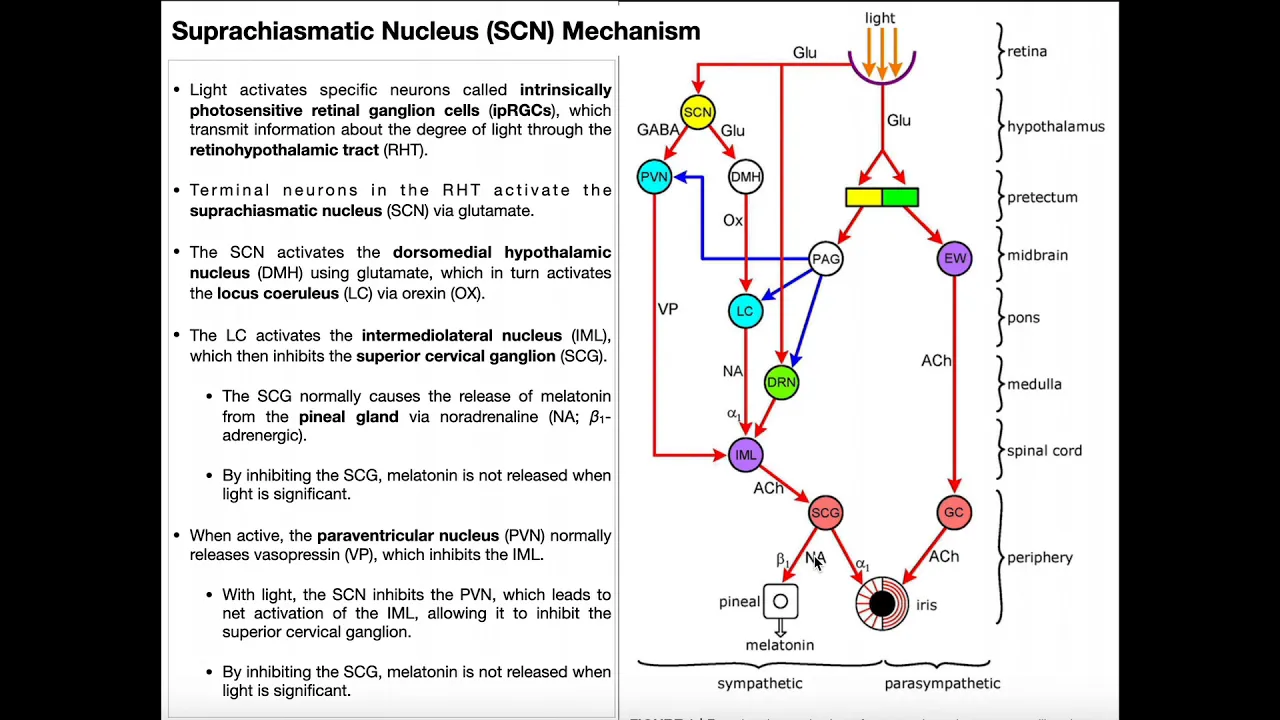
Circadian rhythms are our regular bodily rhythms across a 24-hour period which is also called our internal biological clock.
These cycles control our body temperature which rises during the day, and then takes a brief dip in the early afternoon, and then goes up again in the evening, and then falls during the nighttime.
So it can control our body temperature, and our sleep cycle, all sorts of things.
Daylight is a big queue for circadian rhythms, and even artificial light can affect your circadian clock.
That's why when you travel somewhere with a big time difference, airplanes will usually adjust the lights in accordance with the time zone of your destination.
They're trying to help you reset your biological clock, but resetting that clock can take time which is when you experience jet lag.
Your biological clock says it's time to go to sleep, but your new time zone says it's time to wake up.
That transition can be a little taxing if you're traveling.
These circadian rhythms also change as you age which is why a lot of younger people tend to be night owls, but as they age older people tend to wake up and go to bed early.
Your circadian rhythms can also prevent you from sleeping in when you want to sometimes.
So maybe you get up every day at six AM Monday through Friday, and then Saturday you can finally sleep in, but you'll still wake up around six AM.
That's because your internal biological clock has adjusted to you waking up at that time so it regulates your metabolism, body temperature, sleep cycles so that you wake up at the same time.
Up Next
How Caffeine Works: Adenosine Receptors Explained
@Medicurio
411.3K views•2017-04-06

Graphic Medicine: Comics for Collaborative Healthcare Communication
@nationalpatientadvocate
189 views•2023-12-04

PV Loops Explained: Contractility, Ea, and Preload Effects
@khanacademymedicine
40.5K views•2012-11-28

Stages of Labor and Vaginal Birth | Childbirth Animation
@nucleusmedicalmedia
52.1M views•2017-08-18
Related Study Plans & Knowledge Roadmaps
Structured learning paths in Medicine