






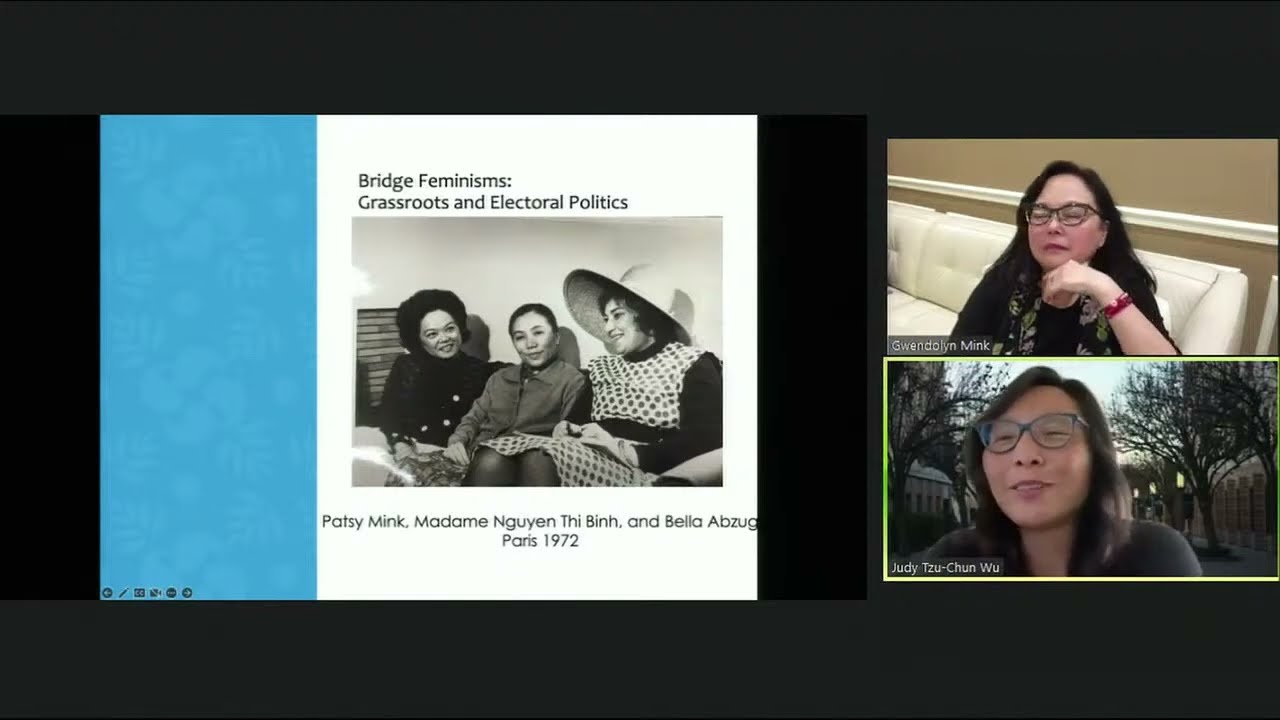





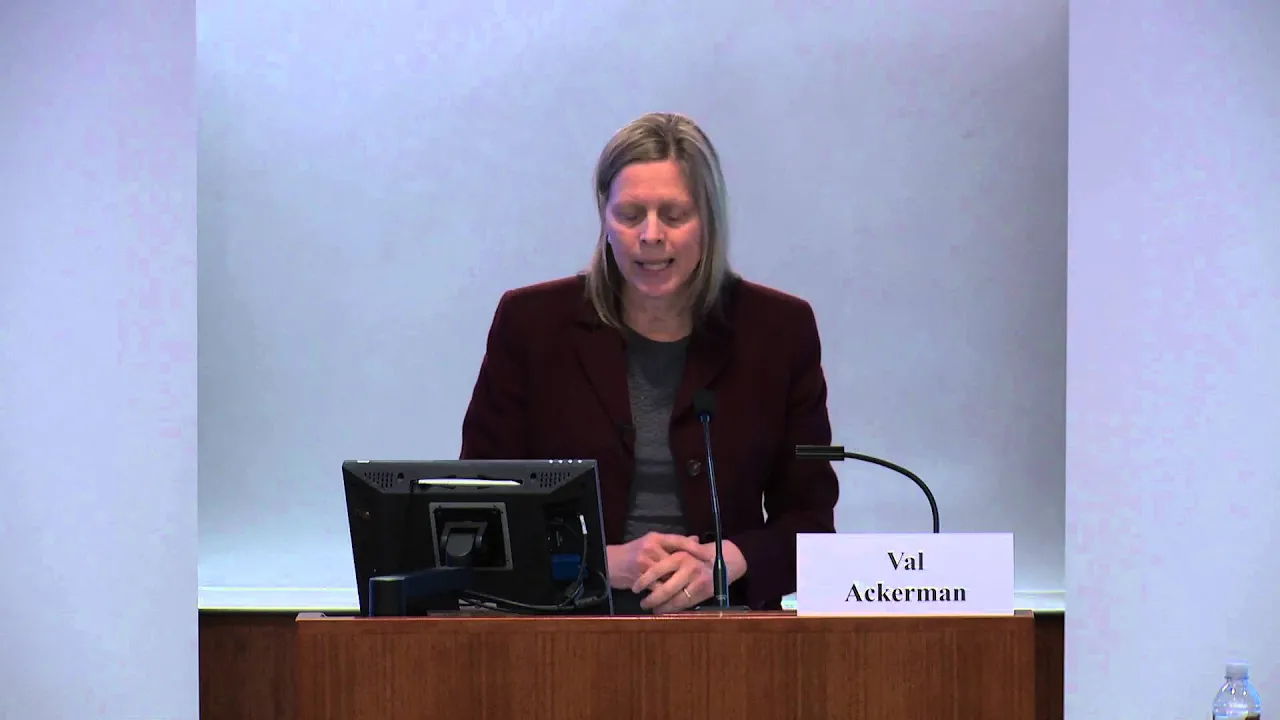



Representative Patsy Mink, the first woman of color elected to Congress, was instrumental in drafting Title IX, which prohibits sex discrimination in education programs receiving federal funding; however, her efforts faced fierce opposition from the male athletics lobby, culminating in a dramatic House floor vote where she was pulled away during a critical moment, yet ultimately prevailed when Speaker Carl Albert ordered a revote, ensuring the landmark legislation's passage and transforming opportunities for women in American education and athletics.
Title IX's Hidden History: The Patsy Mink Story | Educational Documentary
Added:The historical context of Second-Wave Feminism and the Civil Rights Movement in the United States during the 1960s and 1970s.
The basic structure of the U.S. legislative branch, including how bills are drafted, debated, and passed into law by Congress.
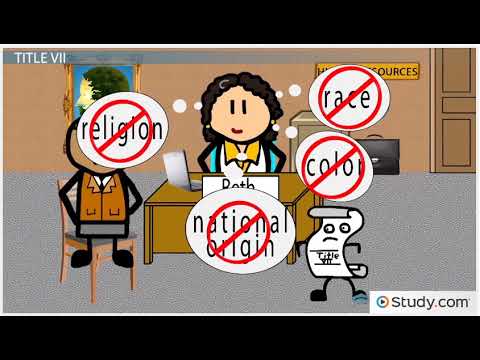
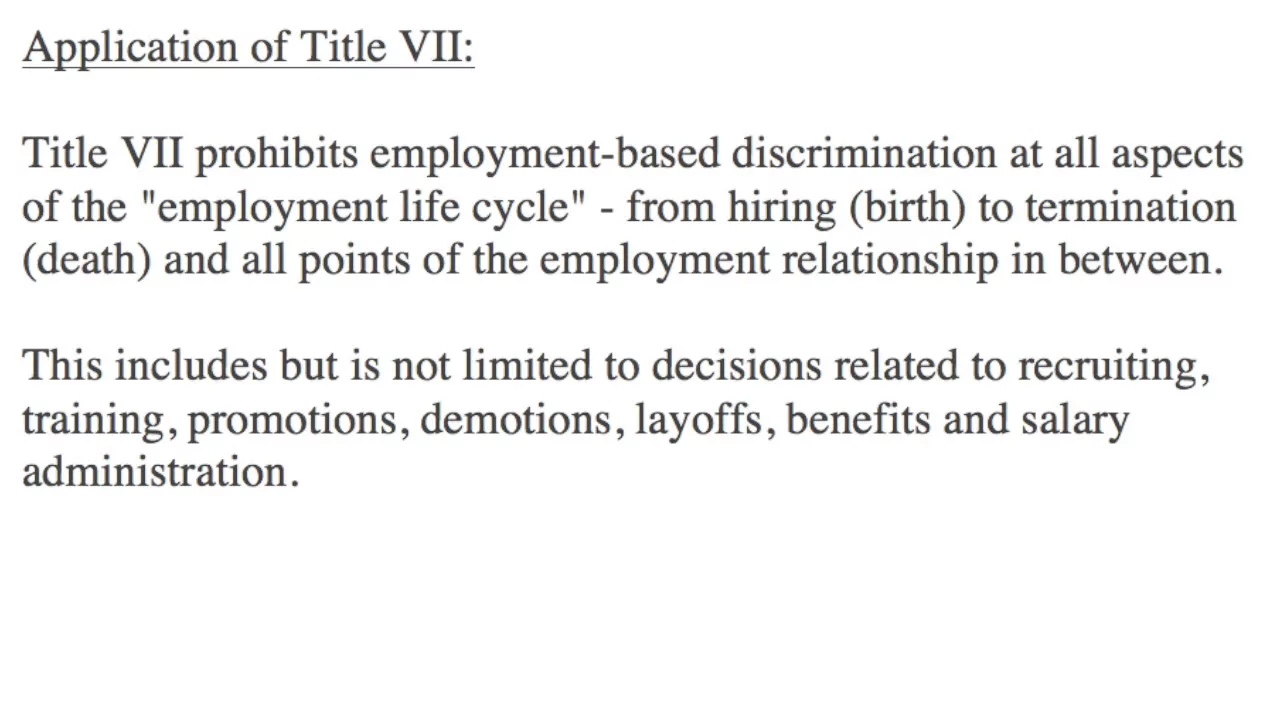
The fundamental legal definition and primary purpose of the Civil Rights Act of 1964, specifically Title VII, which set the precedent for federal anti-discrimination laws.
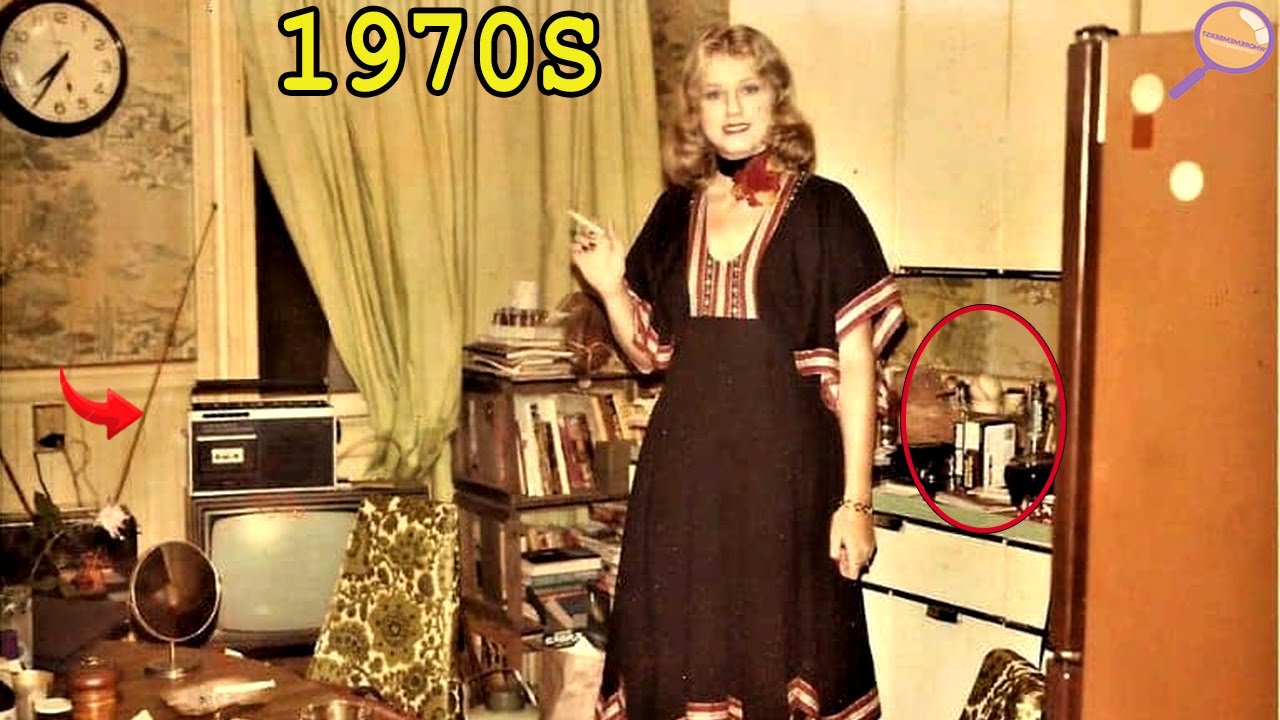
The systemic educational and athletic disparities faced by women in American academic institutions prior to the 1970s.
The evolution of Title IX enforcement, including its modern application to campus sexual harassment, assault, and LGBTQ+ student rights.
The life and broader political legacy of Patsy Mink, focusing on her achievements as the first woman of color and first Asian-American woman elected to Congress.
The long-term quantitative and qualitative impacts of Title IX on the growth of women's professional and collegiate sports over the past 50 years.
Current legal debates and policy shifts surrounding Title IX, such as differing presidential administrations' interpretations of gender identity and funding equity.
74.5K views2.2Klikes20:48Original Release: 2022-06-23
“And now let’s all play ‘What’s My Line?’” [APPLAUSE] “Now to meet our first challenger.
Will you enter and sign in, please?” “Patsy T. Mink, right?” [APPLAUSE] “That’s my mother.
First woman of color to be elected to Congress.” “Do you have a title other than missus?” “Yes.” “Do you spend a lot of time in this country, in the United States?” “Yes.” “Her most significant accomplishment is Title IX, which forever transformed athletics in America.
And it almost didn’t happen because of me.” [MUSIC PLAYING] “It was sort of a chartreusey mustard color, if I recall correctly.
A Ford Pinto.” [MUSIC PLAYING] “We got in the car to go see Woody Allen’s movie ‘Love and Death.’ I think it was a Wednesday.
The future of equality, in some large way, was on the table that day when the personal and the political collided.
Are you ready to go there?” [MUSIC PLAYING] “The story has a great ending in Washington, D.C., on Capitol Hill, but begins in the Hawaiian islands at the turn of the 20th century.
By the time my great-grandparents arrived, Hawaii was a territory, so it was part of the United States.
His name was Gojiro, born in Japan, recruited to work for a sugar cane company on the island of Oahu, essentially indentured.
Couldn’t stand the working conditions, so he jumped his contract.
He was the first of a long family tradition of taking a stand against injustice the only way he knew how.
As my great-grandparents, you don’t know what your children might produce in the next generation or the generation after that.
Dec. 6, 1927.
They named her Patsy Matsu Takemoto.” [MUSIC PLAYING] “My mother.
Schoolteachers would say, ‘What do you want to be when you grow up?’ She would say, ‘I want to be a doctor.’ She was laughed at.
That’s not something girls aspired to or did.
She was thinking, I want to be able to do what the doctor does, and didn’t really see any reason why there should be obstacles in her path.
My mother was an American citizen by birth, being born into a U.S. territory.
By the 1940s, with World War II, the open discrimination of Japanese Americans second-class citizens who needed to be surveilled and restricted — that was really, really upsetting for her.” [MUSIC PLAYING] “We ended up at the University of Nebraska.
She got there, and she wanted to live in a regular dorm.
She couldn’t.
She was told she should go to the International House and apply for a room there because she wasn’t white.
Something needed to be done, so begins to mobilize an antiracism campaign.
Make speeches, publish letters to the editor in the school newspaper.
‘I found the College of Medicine polluted with germs, germs of a discriminating nature.
I found that the dormitories were not open for people like myself.
I found that affiliation with sororities and fraternities was impossible for anyone with skin any darker than the superciliously arrogant whites.’ Patsy Takemoto, age 19.” [MUSIC PLAYING] “She didn’t get into any medical school.
Not one.
She said, in some cases, was explicitly told she was denied because she was a woman.
She was profoundly disappointed.
She wanted to change the whole system.
She thought, why don’t you try law school?
You are an advocate.” [MUSIC PLAYING] “She was one of two women in her law school class.
That’s my mother.
She meets my father a couple of years into law school, John Francis Mink.
My father was at the University of Chicago as a graduate student in geology and geophysics.
Their eyes met.
They knew they were made for each other.
He would blast opera.” [MUSIC PLAYING] “They got married in January of 1951, Patsy Takemoto Mink.
And in March of 1952, she had one kid, which was me, Wendy.
After law school, nobody would hire her.” “She might make you a darn good employee.
What’s wrong with her?” “She’s a woman, isn’t she?” “She said, ‘I’m going to have to find a different path.’ If a law firm had been willing to hire her in Chicago, she wouldn’t have gone back to Hawaii.
If I can’t get hired, I’m going to run for office.
There was just no stopping her.
Now, at this point, Hawaii was a territory.
So in 1956, she ran for the Territorial House of Representatives.” [MUSIC PLAYING] “She won.” “Representative Patsy Takemoto Mink.” “I think the time has come for the American people and for the Congress of the United States to search its conscience and to recall back to 1898, the promise they gave to the people of Hawaii upon annexation that, when we were ready, we would become a state.” “I don’t think that the people there know enough about the problem to cast an intelligent vote or make intelligent decisions.” “It’s no longer a question of pleading for statehood, to my mind.
It’s a question of rising up in indignation.
I feel that the people here are ready and want statehood.” [MUSIC PLAYING] “Hawaii’s voters, faced with the first opportunity to participate in the nation’s government, responded with a record ballot, cast by 93 percent of those eligible.” “When statehood was declared, this was her chance to go to Washington.” [MUSIC PLAYING] “She decided to run for Congress.
It had been a nasty race, an expected reaction of people who were used to certain social norms.
Politically, men had all of the power.
It was entrenched.
Men made the laws.
A whole social system was against her.
They would come up to me at rallies and, you know, ‘When was the last time your mother baked cookies for you?‘ ‘If you need to go to a party tomorrow, would your mother have time to take you to go get a dress?’ She was somehow an inadequate mother.” “Election time in the 50th state.
Democrat Daniel Inouye, Japanese American war hero, will represent the new state in Congress to influence the course of Hawaii’s development for years to come.” [MUSIC PLAYING] “She was devastated sitting at the breakfast table.
Now what?
Where do we go from here?” [MUSIC PLAYING] “The Democratic National Convention in 1960, a year after the defeat, my mother was asked to give one of the speeches in defense of civil rights.” “And down there on the floor addressing the convention in support of the platform committee recommendation on civil rights is Mrs. Patsy Takemoto Mink.” “When she started speaking, people listened.” “I urge you to support the platform and to give this nation one of the greatest weapons of peace, the winning of the respect and admiration of the entire world.
Thank you very much.” “That was a pretty big deal and, as a woman of color, an even bigger deal.
That was certainly a gift that helped her attract electoral attention, and in 1964, she ran for Congress a second time.
In every election, the big contest was the primary contest.
Two guys of reasonably high stature in the party were running, as was my mother.
I didn’t want to see my mother devastated.
For me, for every election, there was this incredible anxiety. Worrywart.
She also called me pumpkin.
So I was either pumpkin or worrywart.
I was worrywart that night.
I was so anxious that they left me at home election night.
My father, the numbers guy, kept reading the printouts of various precincts.
Every time he read one, he’d call me.
My grandmother, her expectations of my mother were to maintain a mighty clean household.
She didn’t expect my mother to go on and get a law degree or enter politics or become the first woman of color to be elected to Congress.
Yeah.
We all moved to Washington.” “Whenever anybody as beautiful as Mrs. Mink gets her picture in the paper, I remember.” “It’s wonderful to have you here.
It’s wonderful to have such a — as Bennett says — beautiful representative of the State of Hawaii.
It’s a beautiful state, and it deserves you, ma’am.” “Thank you very much.” “Thanks very much for being our guest, Mrs. Mink.” [MUSIC PLAYING] “Immediately, she got to work.” “We do have a national responsibility to speak for the women in the country.
And so I have assumed that role.
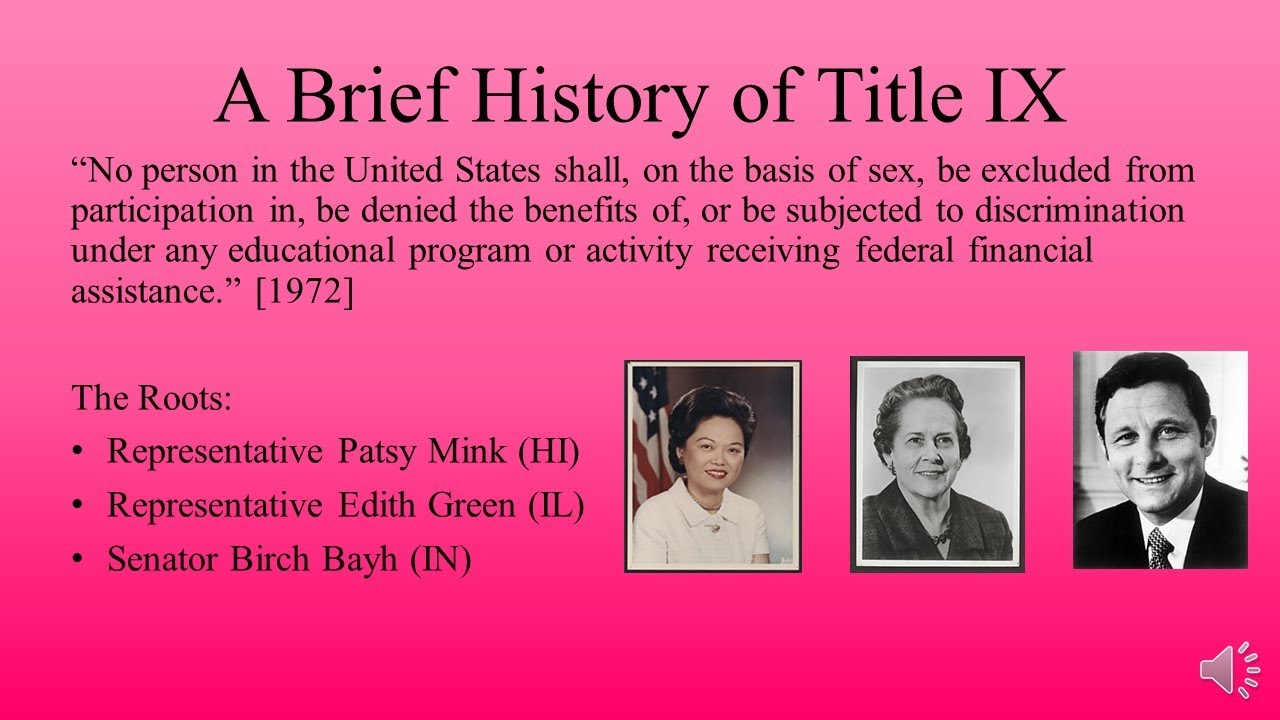
No matter how excluded they have been in the past, the individual does count, and we can make an impact.” “Her most significant accomplishment is Title IX, which prohibits discrimination against students on the basis of sex.
It’s not actually new language.
It’s borrowed language from the Civil Rights Act, which didn’t cover gender equality in education.
It’s the Education Act Amendments of 1972.
I don’t think anybody knew the full effect of those 37 words.
Richard Nixon signed the bill into law shortly after the burglars broke into the Watergate.” [MUSIC PLAYING] “But the story wasn’t over.
Within months of becoming law, they became fully aware that there were pretty big implications, specifically for athletics, which led to the enraged awakening of the male athletics lobby, men who didn’t want to share money and men who didn’t want women in their sport.” “Does equal opportunity mean equal funding?” “You’re concerned about funding women’s athletic programs.
Is that correct?” “Correct.” “Do you think women will ever play collegiate football?” “Not at Oklahoma. We are very concerned, to the point we feel that it possibly might threaten the program.” “Why are you running away?
“Why are you running away?
Afraid of us?” [OVERLAPPING VOICES] “Women’s sports certainly will be non-revenue-producing, and naturally I do not feel like total budget should be split equally.” “That didn’t age well.
John Tower was a senator from Texas, and Robert Casey was a representative from Texas, both of whom took on the defense of male athletics.
Representative Robert Casey wanted to exempt physical education from coverage under Title IX.
The Casey Amendment.
If Casey won, there were enormous consequences.
Physical education would become the first domino.
She wasn’t going to let it happen.
It was my mother and her allies in Congress waging the fight with legions of feminists lobbying.
Casey Amendment is debated.
My mother makes an impassioned speech against the Casey Amendment.
It was a battle down to the wire.
This was the definitive moment for athletics equity.” [MUSIC PLAYING] “The future of equality in some large way was on the table that day.” [MUSIC PLAYING] “The vote gets underway.” [MUSIC PLAYING] “Meanwhile, I got in the car.” “All those in favor, please signify by saying aye.
[INAUDIBLE] “An oncoming car crashed into us.” [TIRES SCREECHING] [PHONE RINGING] “Mr. Rangel.” “Aye.” [PHONE RINGING] “Phone call comes to her on the floor.
Your daughter’s unconscious in intensive care.” [INAUDIBLE] “I got the brunt of impact.
The ultimate family-versus-career moment.
That my mother was even in the hospital with me, given the stakes of what was happening in Washington, D.C., seems sort of insane to me.” [BANGING] “The Casey Amendment wins 212-211.
It lost by one vote, my mom’s vote, yes.
The windshield flew at me.
All the glass fell.
It cut my face here.
Yeah, it’s all along here, the side of my mouth.” [MUSIC PLAYING] “I’m sure the male athletics lobby were celebrating on the night of the 16th, but things were happening.
Her colleagues in Congress, especially Congresswoman Abzug of New York, who was a good friend, fought in her absence.
Many expressed concern for what was going to happen to me, even a substantial number of pro-Casey people.
Yeah.
It was the speaker’s decision, Speaker Carl Albert of Oklahoma.
He always said, ‘Patsy and I see eye to eye,’ because they were both short.
I mean, he was a short man.
Given my mother’s abrupt departure, thought about it, considered it and decided: revote.
Many on the other side came around.
So in the end, 215-178 in favor of deleting the Casey Amendment from the Education Appropriations bill.
My mom won.
Girls and women won.
Feminists won.
Yes.
‘No person in the United States shall, on the basis of sex, be excluded from participation in, be denied the benefits of or be subjected to discrimination under any education program or activity receiving federal financial assistance.’” “Casey with the rebound.” “That is called Title IX.” “But it was very difficult getting into, into school and getting into the professions.
I couldn’t find a job.
And what all of my contemporaries at home say, ‘Oh, my goodness, what you’ve done to politics at home’ and, you know, ‘Wish we had never heard of Patsy Mink,’ I say, ‘Well, it’s because of all of your attitudes that drove me into politics.
If you’d given me a job when I came home from law school, I would have been very happy.’” “I am the child of someone who made a huge difference for women and girls in education.
She taught me change might be slow but changes can happen.
I did screw it up with the Pinto, right, for two days.” [LAUGHING] [MUSIC PLAYING]
Up Next

27:24
Athletes and Activism: The Intersection of Sports and Politics
@NBCNews
32.1K views•2021-06-08

24:30
BRICS Pay and de-dollarization: A New Financial Order Emerges? | 55 chars
@DannyHaiphongYT
164.6K views•2024-10-22

7:33
Government Surveillance Methods: 10 Ways You May Be Watched
@BeAmazed
1.6M views•2017-04-09
10:19
Explaining the Saudi-Iranian Proxy Conflict in the Middle East
@Vox
18.2M views•2017-07-17
Related Study Plans & Knowledge Roadmaps
Structured learning paths in Political Science
political-science
Economic Statecraft: Sanctions & Chokepoints
01Foundations of Geoeconomics and Economic Statecraft
02The Mechanics of Weaponized Interdependence
03International Sanctions: Types, Implementation, and Efficacy
+ 2 more learning modules
12h5 modules
Explore Roadmap
political-science
Central Bank Independence: Politics & Policy
01Foundations of Central Banking and Monetary Policy
02The Time Inconsistency Problem & Inflation Bias
03The Delegation Model and Designing Independence
+ 2 more learning modules
12h5 modules
Explore Roadmap
political-science
Consociationalism: Power-Sharing & Stability
01Democratic Dilemmas in Divided Societies
02Introduction to Consociational Democracy
03The Four Pillars of Consociational Design
+ 2 more learning modules
12h5 modules
Explore Roadmap
political-science
Rebel Governance: Legitimacy, Economy & State
01Foundations of Rebel Governance and Statehood
02Establishing Political Legitimacy and the Rebel Social Contract
03Wartime Economies and Rebel Resource Management
+ 2 more learning modules
14h5 modules
Explore Roadmap