Solomon Asch's 1951 conformity experiment demonstrated that individuals often conform to group opinions even when those opinions contradict reality, revealing the powerful influence of social pressure on human judgment and decision-making.
Asch's Conformity Experiment Explained (1951) | Social Psychology Animation
Added:Deep Dive
Introduction to Social Psychology: Understanding how individual thoughts, feelings, and behaviors are influenced by the actual, imagined, or implied presence of others.

Introduction to Social Psychology
111.1K
Social psychology is the scientific study of how individuals' thoughts, feelings, and behaviors are shaped by the actual, implied, or imagined presence of others; this field demonstrates that social context profoundly influences human behavior through two key principles: the powerful effect of situational factors and the subjective interpretation of situations, which social psychologists study using both correlational methods (examining natural associations between variables) and experimental methods (randomly assigning participants to manipulate independent variables and measure dependent outcomes).
Click to watch →

Intro to Social Psychology
22K
Social psychology is the scientific study of how individuals' thoughts, feelings, and behaviors are influenced by the actual, imagined, or implied presence of others, examining the interaction between individual psychology and social contexts. The field encompasses multiple approaches including the situational approach (which emphasizes how social contexts and environments shape behavior), interpersonal influence (how social incentives and rewards affect behavior), social learning and diffusion (how behaviors are learned and spread through observation and imitation), and cognitive approaches (which focus on information processing and mental processes). Key topics include social norms, group behavior, leadership, nonverbal behavior, persuasion, prejudice, discrimination, social identity, and interpersonal relationships. Socialization is a lifelong process that begins in early childhood and significantly shapes personality and behavior patterns.
Click to watch →
What is Social Psychology? An Introduction
541.6K
Social psychology is the scientific study of how humans behave, think, and feel in social situations, examining how individual behavior is shaped by social influences, group dynamics, and situational contexts; key theories include attribution theory (explaining others' behavior through internal or external factors), self-perception theory (how we judge our own behavior), social identity theory (how group membership affects self-concept), cognitive dissonance theory (conflict between beliefs causing psychological discomfort), and evolutionary psychology (biological roots of social behavior), with landmark experiments like the Stanford Prison Experiment and Milgram's obedience studies revealing how social pressures can dramatically influence human behavior.
Click to watch →

大学で学ぶ社会心理学を全部解説する授業|恋愛・人間関係・集団心理など
272
Social psychology studies how others influence our thoughts, feelings, and behaviors. Gordon Allport defined it as the scientific study of how individuals' thoughts, feelings, and behaviors are influenced by the actual, imagined, or implied presence of others. The field emerged around 1908 when Ross and McDougall published foundational works. Key principles include: (1) Social psychology studies individuals within social contexts, not in isolation; (2) Behavior is a function of both person and environment (B = f(P, E)); (3) Research uses correlational and experimental methods; (4) The replication crisis since the 2010s highlights the importance of replication.
Click to watch →

مدخل إلى "علم النفس الإجتماعي" #علم_النفس_الاجتماعي (1).
27.7K
Social psychology is a branch of psychology that studies how individuals' thoughts, feelings, and behaviors are influenced by the presence of others, whether actual, imagined, or implied, focusing on the reciprocal influences between individuals and groups in social contexts rather than studying society or groups as a whole.
Click to watch →
Deep Dive
The Concept of Social Influence: Grasping how external social factors can alter an individual's attitudes, beliefs, or actions.

ब्रह्मचर्य | नष्ट हुई शक्ति दोबारा कैसे प्राप्त करें! | #abksir #abhimanyukumawatsir #ottbharat
97.7K
The speaker explains that humans have two faces: one that represents their own personality and another that represents their social influence. In the modern era, social influence comes not only from people we physically interact with but also from the content we consume on our phones. The speaker emphasizes that the content we follow and watch becomes part of our social influence and can either strengthen or weaken us.
Click to watch →

🔥 GENGETONE MIX 2024 VOL.1 | ARBANTONE & GENGETONE VIDEO MIX 2024 | VDJ SARJENT ft.TIKTALKER MANDY
325.9K
The content references the concept of social influence, which refers to the ways in which individuals' thoughts, feelings, and behaviors are affected by others. This is demonstrated through the repeated emphasis on being influenced by others in social contexts.
Click to watch →

Andre Taulany Marah-Marah! Mau Bubarin PREDIKSI!! Pada Susah Diatur!!
4.5M
The video discusses the concept of social influence and consumer behavior. Desta explains that he bought a white shoe for a Metallica concert because he was influenced by his friend who was wearing black. He mentions that he felt challenged by his friend's choice and wanted to stand out. This illustrates how social influence can drive consumer behavior, and how people may make purchasing decisions based on the choices of others rather than their own preferences. The video also explores decision-making and prioritization, with Desta presenting hypothetical scenarios where someone has to choose between different options. Desta explains that he would choose to use one perfume for life rather than changing perfume daily because changing perfume daily would be too complicated. He also presents a scenario where someone has to choose between being a Hollywood actor who cannot return to Indonesia or being an Indonesian actor who cannot travel abroad. Desta explains that he would choose to be a Hollywood actor because he values the opportunity to work internationally, even though it means not returning to Indonesia. This illustrates how decision-making often involves weighing different factors and prioritizing based on personal values and goals.
Click to watch →

Influencia Social
23K
Social influence refers to how other people affect our individual behavior, challenging the belief that we are independent, autonomous beings. This concept emerged within social psychology, which studies how social contexts, cultural backgrounds, and interpersonal interactions shape our actions. William James proposed that psychology should consider the influence of others on individual behavior, marking the early development of this field. Social influence encompasses how historical, geographical, economic, climatic, and social conditions affect individual variations in behavior.
Click to watch →

モテモテになるロブロックス..
666.4K
This segment introduces 'aura' as a metaphorical concept representing personal charisma and social influence. The presenter explains that aura is essential for becoming 'mote mote' (popular/charismatic). The video humorously demonstrates that aura can be inherited from family members and allows one to attract various types of people and objects. The presenter shows how aura enables breaking conventional social boundaries, including attracting people across gender lines, interacting with inanimate objects like vehicles, and even supernatural beings. The segment culminates in the presenter attracting a national president, illustrating the comedic concept that extreme charisma can transcend all social and physical limitations.
Click to watch →
Deep Dive
Basic Experimental Design in Psychology: Familiarity with terms like independent variables, dependent variables, and the role of 'confederates' (actors working for the researcher).

PSYC 5, Chapter 8, pt1
170
A basic experiment is the simplest type of experimental design that includes one independent variable (IV) and one dependent variable (DV), with the IV always being manipulated rather than measured. All experiments must have three key features: manipulation of the IV, random assignment, and experimental control, which work together to eliminate confounding variables and establish internal validity—the extent to which researchers can draw cause-and-effect conclusions. The distinction between basic research (research for the sake of knowledge) and applied research (research to address real-world problems) is separate from the distinction between basic experiments and other experimental designs.
Click to watch →
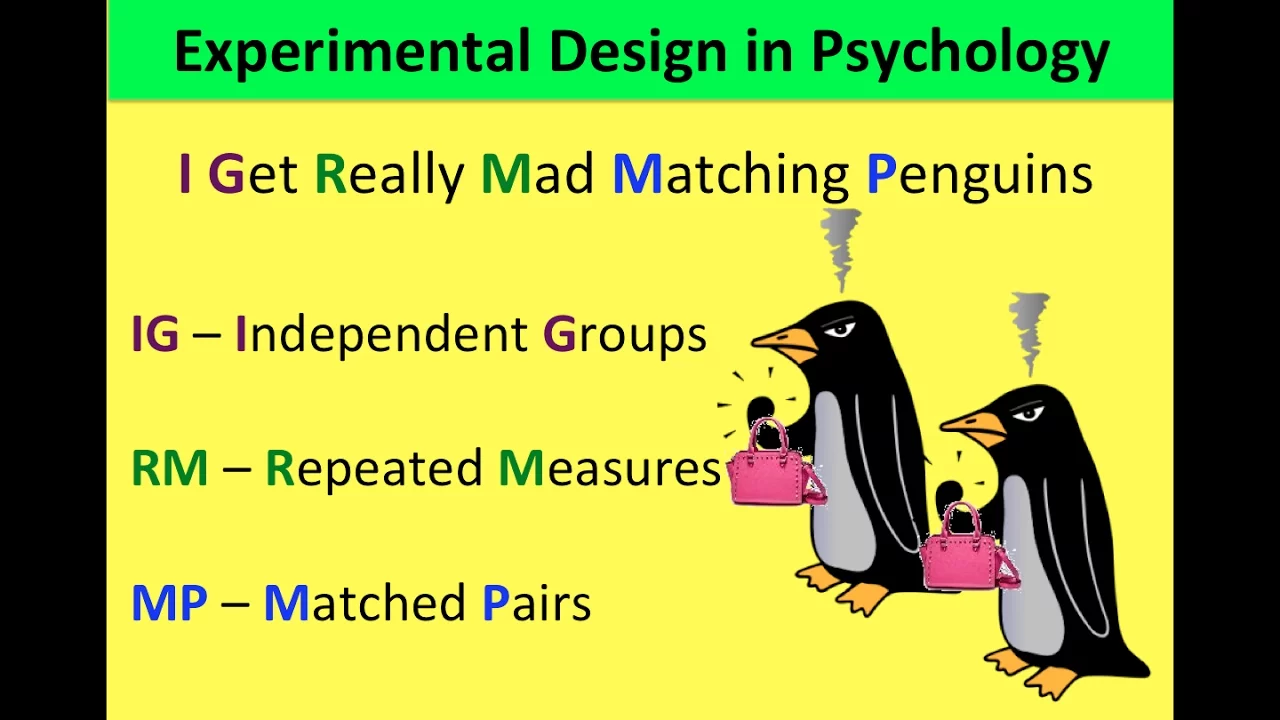
Experimental Design in Psychology (AQA A Level)
21K
Experimental design in psychology involves arranging participants to maximize validity and reliability, with three main approaches: Independent Groups Design (participants are split into separate groups, each experiencing only one condition of the IV, reducing demand characteristics and order effects but requiring more participants and potentially introducing participant variables); Repeated Measures Design (all participants experience all conditions of the IV, providing more data and eliminating individual differences but risking demand characteristics and order effects, which are controlled through counterbalancing); and Matched Pairs Design (participants are matched on relevant characteristics before being assigned to different conditions, combining strengths of the first two designs but requiring extensive matching time and never achieving perfect matches).
Click to watch →

Экспериментальная психология. Лекция 5. Экспериментальные планы. Кондиционные исследования. Часть 1.
383
This comprehensive section covers the complete foundation of experimental psychology. It begins with defining experiments as specially organized situations where researchers manipulate independent variables and measure dependent variables. The core challenge is controlling extraneous variables—factors researchers cannot control but that may influence outcomes. The solution lies in equalization: distributing potential confounding variables evenly across conditions. Basic designs include simple between-subjects comparisons (R O X O notation) and repeated measures designs. Quasi-experimental designs lack random assignment or control groups, threatening internal validity. Single-group pre-post designs face maturation threats and practice effects. True experiments require both random assignment and control groups to establish causality. Factorial designs examine two or more independent variables simultaneously using N x M notation, enabling detection of both main effects and interaction effects. The Latin square design provides an efficient alternative by ensuring each level of one variable appears once with each level of another. Analysis of Variance (ANOVA) compares group means by examining variance ratios, distinguishing between-group variance from within-group variance. Appropriate measurement scales matter: nominal/categorical, ordinal, and interval scales each have different analytical implications.
Click to watch →
Experimental design Psychology explained
835
Experimental design in psychology involves three main approaches: independent group design (different participants in each condition, avoiding order effects but requiring more participants), repeated measures design (same participants in all conditions, reducing participant variables but risking order effects), and matched pairs design (different participants matched on key variables, balancing both approaches). Researchers control extraneous variables through counterbalancing, random allocation, randomization, and standardized instructions to ensure valid, generalizable results.
Click to watch →

Experimental design characteristics, meaning, limitation, types of experimental design
265
Experimental design is a scientific method for studying behavior under controlled conditions, where researchers manipulate an independent variable (e.g., noise levels) and measure its effect on a dependent variable (e.g., concentration) by comparing an experimental group (receiving treatment) with a control group (receiving no treatment), using random selection and random assignment to ensure valid results that can be replicated and generalized to larger populations.
Click to watch →
Deep Dive
Individual Decision-Making vs. Social Dynamics: Recognizing the inherent tension between personal sensory perception and group consensus.

Decision Making Part- 1 for NABARD Grade A
33.1K
Individual decision making is an autocratic way where decisions are taken by an individual without input from other organization members. This is common in smaller companies where decisions are made quickly. Group decision making involves people coming together to decide on something, such as a board of directors meeting. Group decisions involve collective input and discussion.
Click to watch →

Better than MBTI. How this personality test helps you know yourself better - VeryFastOne #63.1
998
This segment examines two dimensions of social dynamics and decision-making: community preference and decision-making consequences. The community preference question distinguishes between marketplace communities (larger groups, dynamic interactions, 30+ people) and mountain communities (smaller groups, intimate connections, 10 or fewer people). The decision-making consequences question examines whether individuals are more likely to be in situations where they make quick decisions and need to correct mistakes, or where they are patient but miss opportunities to act. These dimensions reveal fundamental differences in social energy requirements and attitudes toward risk, opportunity cost, and the value of time versus accuracy. The assessment distinguishes between speed and action versus thoroughness and information gathering.
Click to watch →

CORREÇÃO AFA 2022 - INGLÊS
1.5K
Some decisions are more individual while others are more social. It is important to consider the specific situation when deciding whether to follow others. There is no universal formula for all decisions. When you have sufficient information to make a clear choice, you should trust your own judgment.
Click to watch →

EXAM MANAGEMENT DES ORGANISATION RATT 2025 PROF LAFAC TRIK JDIDA GRP 1/2......8 CORRIGE PAR ECO ABDO
4.5K
Individual decision-making occurs when a single person has the authority to make decisions, while group decision-making involves multiple people contributing to the decision process. Individual decision-making: (1) Is faster and more efficient, (2) Provides clear accountability, (3) Can be more decisive, and (4) May lead to decisions based on limited perspectives. Group decision-making: (1) Considers multiple perspectives, (2) Increases buy-in and commitment, (3) Can lead to better solutions, and (4) May be slower and more complex.
Click to watch →

CLASE 02 DECISIONES GERENCIALES
413
Decisions should be made individually or in groups based on several criteria: Who has the information (if the leader has all information, individual decision-making may suffice; if information is distributed among team members, group decision-making is better), the complexity of the problem, and whether team members need to be motivated to execute the decision. Complex problems with organizational inexperience should tend toward group decision-making.
Click to watch →
Prerequisite Knowledge
- Concept 01Introduction to Social Psychology: Understanding how individual thoughts, feelings, and behaviors are influenced by the actual, imagined, or implied presence of others.
- Concept 02The Concept of Social Influence: Grasping how external social factors can alter an individual's attitudes, beliefs, or actions.
- Concept 03Basic Experimental Design in Psychology: Familiarity with terms like independent variables, dependent variables, and the role of 'confederates' (actors working for the researcher).
- Concept 04Individual Decision-Making vs. Social Dynamics: Recognizing the inherent tension between personal sensory perception and group consensus.
Subsequent Learning
- Step 01Normative vs. Informational Social Influence: Exploring Deutsch and Gerard's distinction between conforming to fit in versus conforming to be correct.
- Step 02Milgram's Obedience Experiments: Studying the logical next step of social influence—how individuals react to direct commands from authority figures.
- Step 03Variables Moderating Conformity: Investigating how factors like group size, unanimity (the presence of an ally), task difficulty, and writing answers privately affect conformity rates.
- Step 04Groupthink and Collective Behavior: Examining how the desire for harmony or conformity in a highly cohesive group results in irrational or dysfunctional decision-making outcomes.
- Step 05Cross-Cultural Perspectives on Conformity: Comparing conformity rates between individualistic cultures and collectivistic cultures.
Introduction
Key Concepts
Deep Dive
Final Insights
Introduction
0:11Playing Section
- 1
Initiates core discussion with audience.
- 2
Sets up foundational context for the topic.
The 'Child of Its Time' and Cultural Relativity Critique
While Solomon Asch's 1951 experiment is widely cited as proof of a universal human tendency to conform, critics argue its findings are highly specific to its historical and cultural context. Researchers like Perrin and Spencer (1980) labeled the study a 'child of its time,' noting that 1950s America was an era of intense social conservatism and McCarthyism. When replicating the study in later decades or different cultures, conformity rates were often significantly lower. Additionally, critics highlight the experiment's low ecological validity: comparing line lengths is a trivial, artificial task with no real-world consequences, meaning it may not accurately predict behavior in high-stakes social situations. Finally, the data itself is often reframed; participants actually gave independent, correct answers in about two-thirds of the trials, suggesting the study demonstrates human independence just as much as it does conformity.
Deep Dive
Normative vs. Informational Social Influence: Exploring Deutsch and Gerard's distinction between conforming to fit in versus conforming to be correct.

Г.М.Андреева. Социальная психология 5/8
245
Informational and normative social influence represent two distinct mechanisms of conformity. Normative influence occurs when individuals conform to be accepted by the group and avoid rejection, accepting the group's opinion as a social norm. Informational influence occurs when individuals conform because they believe the group provides accurate information about reality, especially in ambiguous situations. Research by Deutsch and Gerard showed that these two types of influence operate through different psychological mechanisms and can be distinguished experimentally.
Click to watch →

Chapter 12: Social Psychology Lecture (OpenStax Psychology 2e)
150
Normative social influence is about belonging—people align with the group to fit in, feel accepted, and avoid rejection. The behavior may not match private beliefs, but it keeps social peace. Informational social influence is about accuracy—in ambiguous situations, people treat the group as a source of reality. They follow because others seem to know what's true. This can be sensible when others truly have better information but risky when the confident group is confidently wrong.
Click to watch →

#Psychology|#Robert a Baron|#Social Thought and Social Behavior|#Social Influence|#Chapter16|#Part 4
2.5K
Normative social influence occurs when we follow others' approval-seeking behavior to fit in and meet others' expectations. Informational social influence happens when we conform because we want to be right and need guidance from others, especially in unfamiliar situations. For instance, at a foreign cultural event, we might copy others' behavior to appear competent.
Click to watch →

Module 44
261
Normative social influence occurs when people conform to gain social approval or belonging, such as during teenage years when fitting in is important. Informational social influence occurs when people conform because others' ideas and behaviors make sense and change their understanding of reality. The key difference is that normative influence is about social acceptance, while informational influence is about believing others are correct.
Click to watch →

social influence in psychology | Conformity | Obedience | Compliance | Hindi | Urdu
14.7K
Normative social influence occurs when people conform to gain social acceptance or avoid rejection, as seen when individuals agree with a group to fit in. Informational social influence happens when people look to others for guidance on how to behave, especially in ambiguous situations. Both types explain why individuals may change their behavior to align with social groups.
Click to watch →
Deep Dive
Milgram's Obedience Experiments: Studying the logical next step of social influence—how individuals react to direct commands from authority figures.

Самое страшное дело в истории Америки !
259.8K
Stanley Milgram conducted controversial social psychology experiments from August 1961 to May 1962 to demonstrate how ordinary people could be induced to obey authority figures even when doing so violated their own moral principles. Participants were instructed to administer electric shocks to another person (an actor) whenever they made mistakes on a questionnaire. Despite believing they were causing real harm, most participants continued increasing the voltage to maximum levels simply because an authority figure told them to do so. Milgram concluded that following clear commands caused individuals to shift responsibility for their actions onto the authority figure, effectively transforming themselves into passive instruments rather than active agents of their behavior. This research has profound implications for understanding how ordinary citizens might participate in harmful actions under hierarchical command structures.
Click to watch →

Литература Закулисья. Олег Насобин
18.4K
Stanley Milgram's obedience experiments demonstrated that ordinary people, when instructed by an authority figure, would administer increasingly severe electric shocks to another person despite their natural moral objections. The experiments, originally conducted in Germany but replicated in America, revealed that the human capacity for obedience to authority is universal. This finding is crucial for understanding how the backstage system maintains control over populations.
Click to watch →

But Will It Work?
1.3K
Stanley Milgram's experiments showed most people will inflict severe pain on strangers simply because an authority figure commanded them. Results were independent of education, IQ, income, and religion. Subjects showed visible stress, begging to stop, shaking, and crying while obeying. When allowed to stop, stress immediately evaporated. This demonstrates that people have been trained to ignore moral judgment and blindly obey authority, even when causing harm.
Click to watch →

Destructive obedience
181.2K
Stanley Milgram conducted 18 obedience studies between 1961-1963 at Yale University, publishing his seminal paper in 1963. The experiment involved participants randomly assigned as 'teachers' who administered electric shocks to 'learners' (stooges) when they answered incorrectly. Despite psychology academics predicting only 0-3% compliance, 65% of ordinary participants administered what they believed were lethal 450-volt shocks. The victim was a 47-year-old accountant, and participants received $450 for participation. Milgram later developed the six degrees of separation concept and found correlations between television viewing and antisocial behavior. The experiment explored why individuals obey destructive orders, partly inspired by the Adolf Eichmann trial.
Click to watch →

L'EXPÉRIENCE DE MILGRAM - La soumission à l'autorité
448.7K
Stanley Milgram (1933-1984) was an American psychologist famous for his obedience experiments conducted between 1960-1963. The experiments aimed to investigate human tendencies toward authority submission. Participants believed they were testing learning methods, with one person randomly assigned as 'teacher' and another as 'learner.' The teacher administered electric shocks to the learner for incorrect answers, with voltage increasing progressively. This foundational setup established the framework for examining how ordinary people respond to conflicting moral demands from perceived legitimate authority.
Click to watch →
Deep Dive
Variables Moderating Conformity: Investigating how factors like group size, unanimity (the presence of an ally), task difficulty, and writing answers privately affect conformity rates.

Normative Social Influence & Its Moderators
160
Social Impact Theory provides a framework for understanding when and why people conform due to normative social influence. Three primary variables moderate conformity levels: (1) Relationship strength - people conform more to groups that hold significant importance in their lives because their belonging needs are more intensely activated; (2) Proximity - people conform more to groups they interact with regularly since they are more aware of social consequences; (3) Group size - larger groups exert greater conformity pressure than smaller groups. These variables determine how strongly normative influence affects individual behavior in different social contexts.
Click to watch →

Developing the Theoretical Framework: Concepts, Theory, Models and Applications
5.3K
Moderating variables alter the strength or direction of relationships between independent and dependent variables. They should be introduced when previous research shows inconsistent findings about the relationship—some studies find positive effects, others find negative or no effects. Baron and Kenny established that moderating variables specify the conditions under which a given effect occurs. Examples include demographic factors like gender or marital status that might strengthen or weaken relationships between variables like satisfaction and loyalty.
Click to watch →

SOC 101: Conformity as a Sociological Variable
1.5K
Conformity is not a constant psychological trait but a sociological variable that can be measured and manipulated through specific social conditions; research by Solomon Asch and Stanley Milgram demonstrates that conformity depends on independent variables such as the presence and size of opposition, the availability of allies, repetition of pressure, proximity to victims, authority figure presence, and the clarity of authority commands, rather than individual psychological characteristics.
Click to watch →

PDD-UKTPT BIDANG PENGAJARAN SERDOS SMART 2024 - CE GUNAWAN - INSTITUT MANAJEMEN WIYATA INDONESIA
187
Moderating variables (variabel moderasi) are variables that influence the relationship between independent and dependent variables. They can strengthen or weaken the relationship between variables. For example, in a study of parental education and child behavior, the environment (such as peer environment) can moderate this relationship. A good environment may strengthen the positive effect of parental education on child behavior, while a poor environment may weaken it. Moderating variables are positioned between independent and dependent variables in research models.
Click to watch →

2 . การสร้างกรอบแนวคิดในการวิจัย
57.5K
Moderating variables (ตัวแปรกด) are external variables that affect the strength or direction of the relationship between independent and dependent variables. For example, parental education level might strengthen or weaken the relationship between book availability and reading ability. Intervening variables (ตัวแปรแทรก) exist between IV and DV, explaining the mechanism through which IV affects DV. For example, creative integration capability translates workforce diversity into organizational effectiveness. These variables help researchers understand the complete causal chain and avoid oversimplified conclusions.
Click to watch →
Deep Dive
Groupthink and Collective Behavior: Examining how the desire for harmony or conformity in a highly cohesive group results in irrational or dysfunctional decision-making outcomes.

【人類が消えるとどうなる?】面白すぎて眠れない大人の雑学まとめ「作業用/たっくー切り抜き」
290.2K
Groupthink is a psychological phenomenon where individuals in groups suppress dissenting opinions and conform to majority views, leading to irrational or extreme decisions. This occurs because group members feel pressure to conform and individual responsibility becomes diffused. The video explains that even intelligent adults can be influenced by groupthink, and that the more people in a group, the more extreme their collective behavior becomes. This phenomenon explains why bullying and other harmful group behaviors can occur despite individual moral objections.
Click to watch →

Mahogany Jackson, New Video Footage, of the 8 F!GHTING her and K!LLING her outside on the Mattress
86.3K
Groupthink can lead to collective criminal behavior where individuals participate in harmful activities. The host explains that the perpetrators were described as 'Satan kids' who 'don't care about no life' and 'don't care about themselves or anybody else.' The host notes that these individuals 'don't even value their goddamn hair' and 'threw their whole life away.' This demonstrates how group dynamics and shared negative values can lead individuals to commit crimes they might not consider if acting alone.
Click to watch →

Understanding The Exquisite Balance Of Life
75.1K
A lot of the worst horrors throughout human history were imbalances due to imbalances in culture and herd mentality. This leads to market crashes, speculative bubbles, toxic ideologies like communism and Nazism, and wrong wars. Human collectives tend to be pretty bad at balancing themselves—they balance for a while but then veer off a cliff. Corporations can do great, balance themselves, innovate, create new products, but eventually ossify, start using algorithms instead of thinking, lose ability to innovate, retain clients and employees, and fall off a cliff. This happens through groupthink because people stop thinking independently.
Click to watch →

Een internationale coronasekte: prof. Michaéla Schippers en Ramon Bril
71.7K
Groupthink describes how groups reduce complex problems to single solutions, often at the expense of considering alternatives. When entire populations adopt this mindset, it creates global-level groupthink. Cult-like organizations share characteristics including closed structures, suppression of critical thinking, extensive personal control, and exclusive claims to wisdom. These organizations create 'us versus them' mentalities and position themselves as the only path to safety. The Just World Hypothesis—the belief that the world is fair—further reinforces groupthink by making people accept outcomes as deserved rather than questioning systemic issues.
Click to watch →

"The place is an absolute S***HOLE!" -Anthony Cumia GETS HONEST about Donald Trump's D.C. TAKEOVER
175.3K
The video criticizes protest behavior as an example of groupthink, where individuals lose independent thought and simply repeat slogans without understanding or reasoning. The speaker argues that protesters who chant slogans without independent thought are like 'zombies' or 'herd animals' who cannot articulate their own positions or solutions. When asked substantive questions about their protests, protesters become frustrated and lash out, demonstrating a lack of independent critical thinking and problem-solving ability.
Click to watch →
Deep Dive
Cross-Cultural Perspectives on Conformity: Comparing conformity rates between individualistic cultures and collectivistic cultures.

Japan's Harshest Proverb
332
This section explores fundamental cultural differences in how conformity is perceived. In America, individuality and rebellion against the status quo are valued; the nation was founded on rebellion, and major movements carry this spirit. Americans generally view conformity as restrictive. In contrast, Japan views conformity as righteous, proper, and even liberating. Conformity feels liberating when collective expectations align with personal values, freeing individuals from decision-making burdens and providing consistency and reliability. This explains why the same behavior might feel oppressive in one culture and acceptable in another, highlighting how cultural context shapes perceptions of social norms and workplace interactions.
Click to watch →

Social Psychology Chapters 8 & 9
106
Conformity is defined as a change in behavior or belief resulting from real or imagined group pressure. It tends to occur even in large groups. Conformity can be beneficial (maintaining social order like waiting in line) or harmful (leading to dangerous behaviors like drinking and driving). In Western cultures, conformity is often viewed negatively as submission and compliance, while in Eastern cultures, it is seen positively as communal sensitivity, responsiveness, and cooperative team play.
Click to watch →

同調圧力は日本人だけ?屈しない人になる方法,公認心理師川島達史,ダイコミュ
1.7K
Conformity pressure is the psychological phenomenon where individuals change their opinions or behaviors to match group expectations. Solomon Asch's 1951 experiment demonstrated this powerfully: 74% of participants conformed to incorrect group answers despite obvious evidence. Japanese replication by Frazier (1966) showed similar results (74% conformity), though with slightly fewer conforming responses (2.92 vs 3.84). Hashimoto's cross-cultural research revealed that while both cultures show conformity tendencies, Americans score higher on independent self-expression, while Japanese score higher on harmony-seeking and exclusion avoidance. The actual cultural difference is relatively small (around 10%), suggesting conformity is a universal human tendency rather than a culturally exclusive trait.
Click to watch →

Topic 7 1 What is Conformity
134
Conformity is a change in behavior or belief resulting from real or imagined group pressure, manifesting in three forms: compliance (following rules without changing private beliefs), obedience (following direct commands), and acceptance (changing both behavior and beliefs); while Western cultures typically view conformity negatively, Eastern cultures like Japan embrace it, as illustrated by the proverb 'the nail that sticks up gets hammered down,' and research shows social behaviors are inherently contagious, as demonstrated by yawning experiments.
Click to watch →

Conformity Research: Solomon Asch, Part 2
403
This section explores how conformity manifests across different cultures. Mori's 2010 study used optical illusion glasses to conduct Asch experiments without confederates, finding large gender differences in Japanese samples. Cultural context significantly influences conformity patterns. Japanese culture demonstrates particularly strong conformity, as illustrated by an example where a burglar was caught because he had to take off his shoes when entering an apartment and put them back on before climbing out the window. This example shows how deeply ingrained social norms are in Japanese culture, affecting even individuals who have chosen a life of crime.
Click to watch →
Introduction
Key Concepts
Deep Dive
Final Insights
Introduction
0:11- 1
Initiates core discussion with audience.
- 2
Sets up foundational context for the topic.
The 'Child of Its Time' and Cultural Relativity Critique
While Solomon Asch's 1951 experiment is widely cited as proof of a universal human tendency to conform, critics argue its findings are highly specific to its historical and cultural context. Researchers like Perrin and Spencer (1980) labeled the study a 'child of its time,' noting that 1950s America was an era of intense social conservatism and McCarthyism. When replicating the study in later decades or different cultures, conformity rates were often significantly lower. Additionally, critics highlight the experiment's low ecological validity: comparing line lengths is a trivial, artificial task with no real-world consequences, meaning it may not accurately predict behavior in high-stakes social situations. Finally, the data itself is often reframed; participants actually gave independent, correct answers in about two-thirds of the trials, suggesting the study demonstrates human independence just as much as it does conformity.
Introduction to Social Psychology: Understanding how individual thoughts, feelings, and behaviors are influenced by the actual, imagined, or implied presence of others.
The Concept of Social Influence: Grasping how external social factors can alter an individual's attitudes, beliefs, or actions.
Basic Experimental Design in Psychology: Familiarity with terms like independent variables, dependent variables, and the role of 'confederates' (actors working for the researcher).
Individual Decision-Making vs. Social Dynamics: Recognizing the inherent tension between personal sensory perception and group consensus.
Normative vs. Informational Social Influence: Exploring Deutsch and Gerard's distinction between conforming to fit in versus conforming to be correct.
Milgram's Obedience Experiments: Studying the logical next step of social influence—how individuals react to direct commands from authority figures.
Variables Moderating Conformity: Investigating how factors like group size, unanimity (the presence of an ally), task difficulty, and writing answers privately affect conformity rates.
Groupthink and Collective Behavior: Examining how the desire for harmony or conformity in a highly cohesive group results in irrational or dysfunctional decision-making outcomes.
Cross-Cultural Perspectives on Conformity: Comparing conformity rates between individualistic cultures and collectivistic cultures.
6.5K views55likes8:00@baskentpsikolojiOriginal Release: 2015-04-27
foreign foreign foreign speech foreign fore [Music] for foreign speech foreign speech [Music] [Music] [Music] wa [Music] [Music] [Music] every [Music] [Music] [Music] all right friend [Music] [Music] spee fore foreign speech [Music] speech let [Music] creeper [Music] right [Music] right [Music] there there [Music] L huh [Music] where L look [Music] M where there [Music] foreign foreign speech foreign foreign speech foreign speech foreign forign spe for foreign speech foreign good old [Applause] [Music] [Music] [Music]
Up Next
10:08
Social Influence, Conformity & Groupthink | Psychology Crash Course
@crashcourse
3.1M views•2014-11-12

68:32
Cognitive Skills for Differentiated Instruction | Teacher PD
@BrainWareLearning
631 views•2017-12-17

9:55
Thinking, Fast and Slow: Daniel Kahneman Animated Book Summary
@FightMediocrity
2.3M views•2015-06-05

6:40
The Nocebo Effect: How Beliefs Can Cause Real Harm
@CGPGrey
10.4M views•2013-12-23
Related Study Plans & Knowledge Roadmaps
Structured learning paths in Psychology
psychology
Neuroscience of Creativity: Networks & Training
01Foundations of Creative Cognition
02The Cognitive Neuroscience of Insight & Fixation
03The Triple Network Model of Creativity
+ 1 more learning modules
15h4 modules
Explore Roadmap
psychology
Imposter Syndrome: Etiology & CBT Framework
01Defining the Imposter Phenomenon
02Socio-Developmental Etiologies
03CBT Fundamentals & Thought Distortions
+ 2 more learning modules
15h5 modules
Explore Roadmap
psychology
Adult ADHD: Executive Dysfunction & Scaffolding
01Neurobiology of the ADHD Brain
02The Core Triad of Executive Deficits
03Executive Dysfunction and Emotional Regulation
+ 2 more learning modules
12h5 modules
Explore Roadmap
psychology
Loneliness: Evolution, Neurobiology & CBT
01Evolutionary Origins of Human Connection and Loneliness
02The Neurobiology and Physiology of Chronic Loneliness
03Maladaptive Social Cognition: The Psychological Loop
+ 2 more learning modules
12h5 modules
Explore Roadmap