

























Bridges have evolved from living root bridges in Meghalaya, India, to modern steel and concrete structures, with each era introducing revolutionary materials and techniques—from Roman stone arches to iron girders, suspension cables, and pre-stressed concrete—demonstrating humanity's continuous innovation in overcoming geographical barriers while balancing utility, resistance, and aesthetic beauty.
The Evolution of Bridge Engineering: From Ancient Roots to Modern Marvels
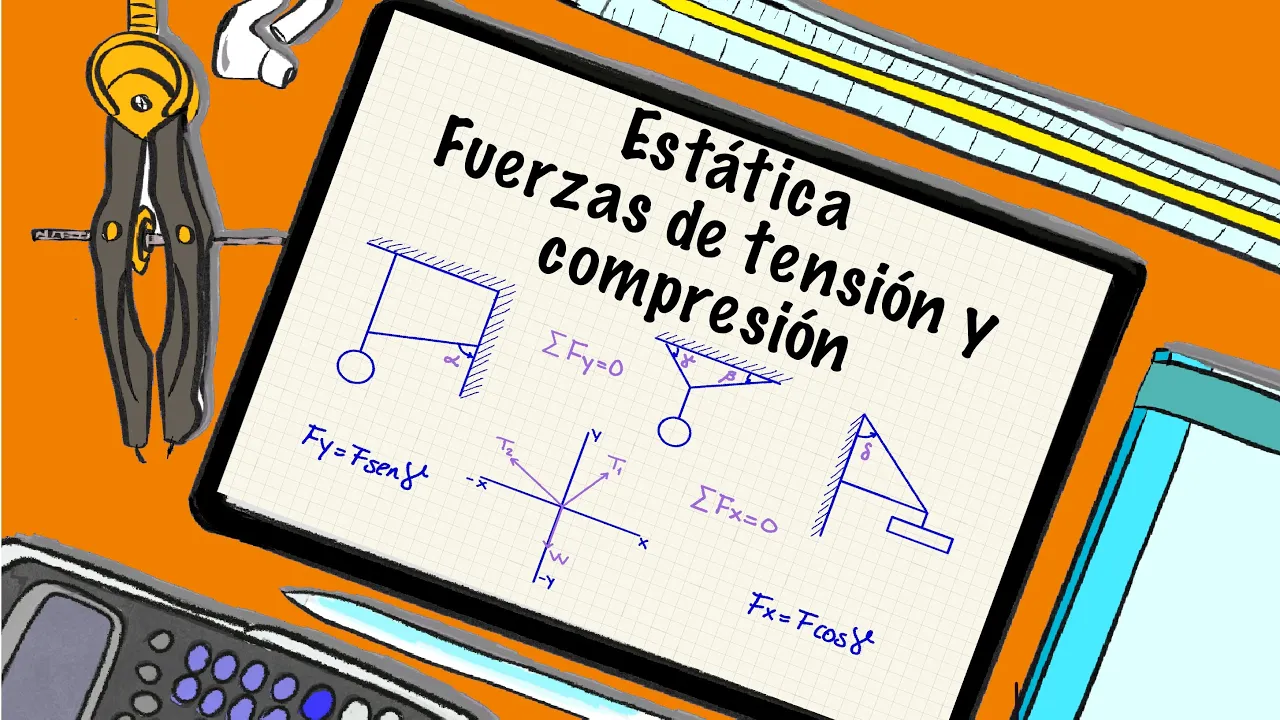
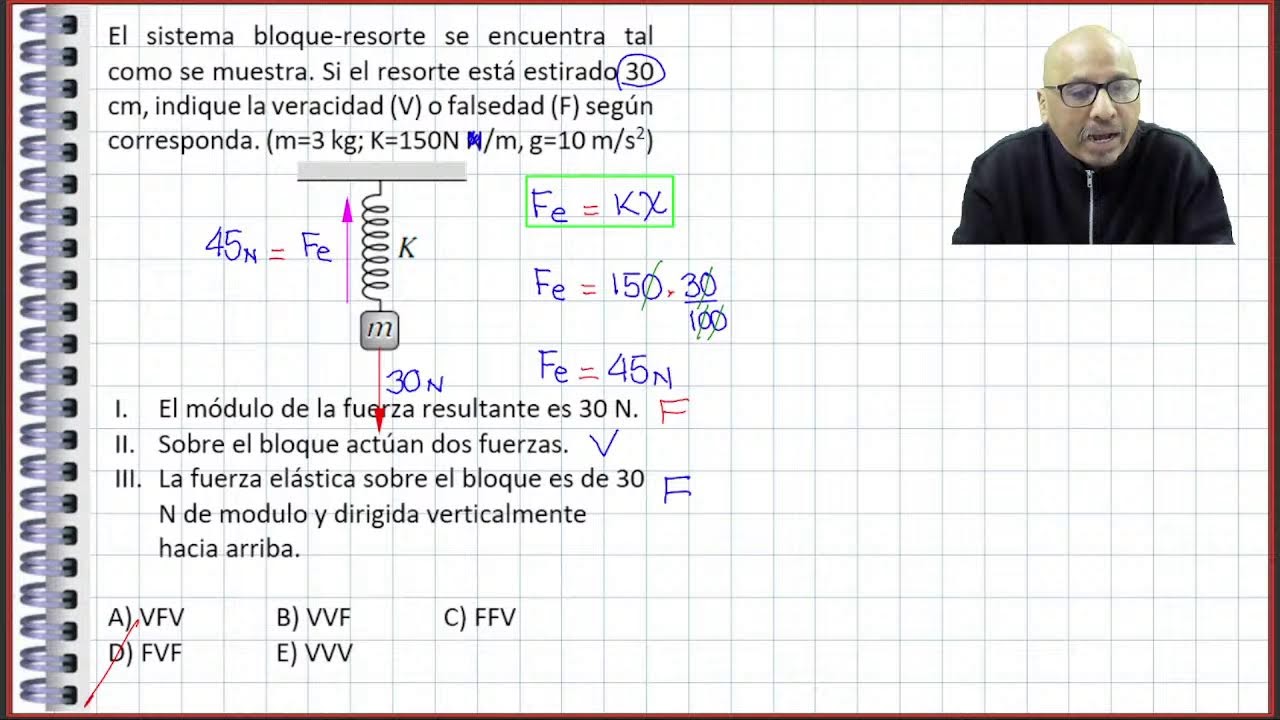
Added:Basic concepts of Newtonian mechanics, specifically static equilibrium, tension, and compression forces.
The fundamental properties of common construction materials, such as concrete, steel, wood, and stone, including their tensile and compressive strengths.
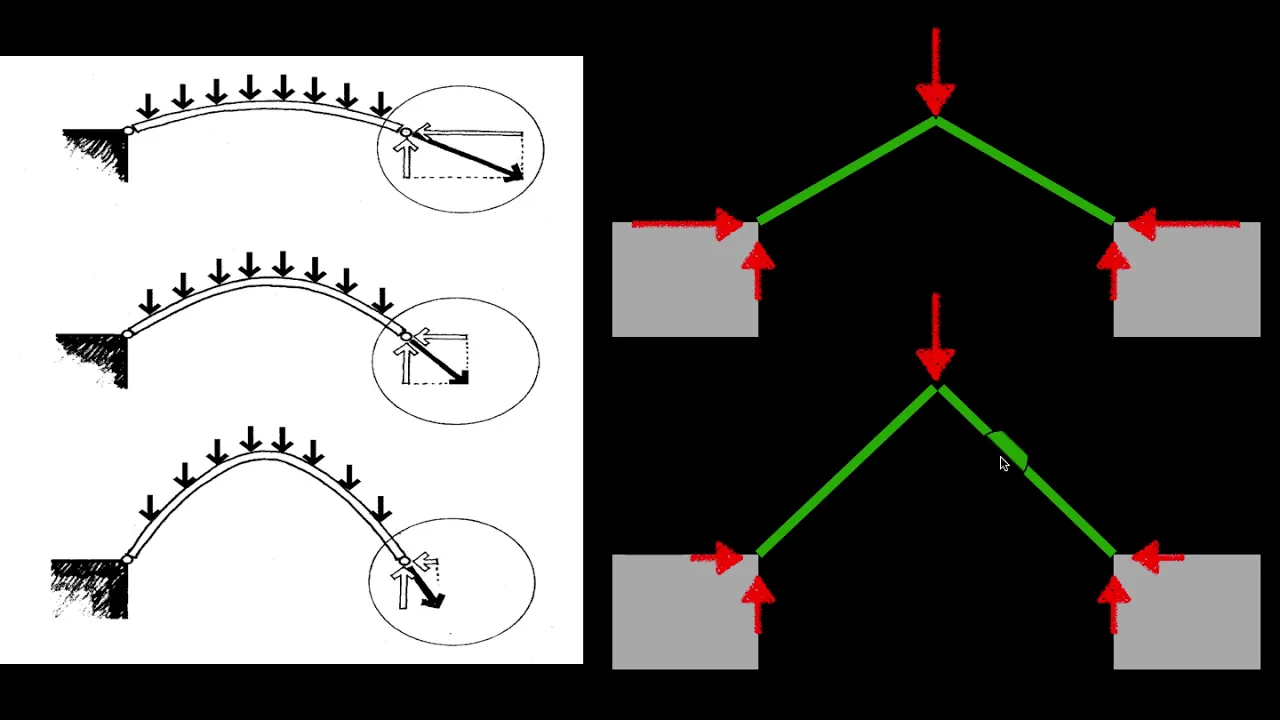
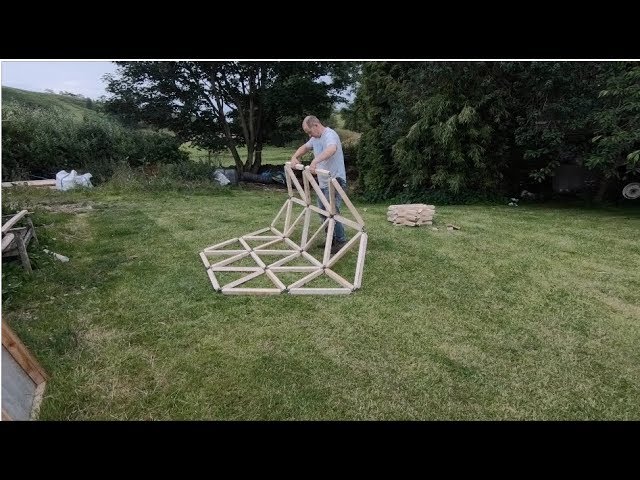
Geometric principles of structural stability, particularly how shapes like triangles (trusses) and arches distribute physical loads.
A general historical overview of early human civilizations and their basic infrastructure needs.
Dynamic structural analysis, including how bridges withstand aerodynamic forces (wind) and seismic activity (earthquakes).
The study of structural forensics and famous bridge failures, such as the Tacoma Narrows Bridge, to understand resonance and aeroelastic flutter.
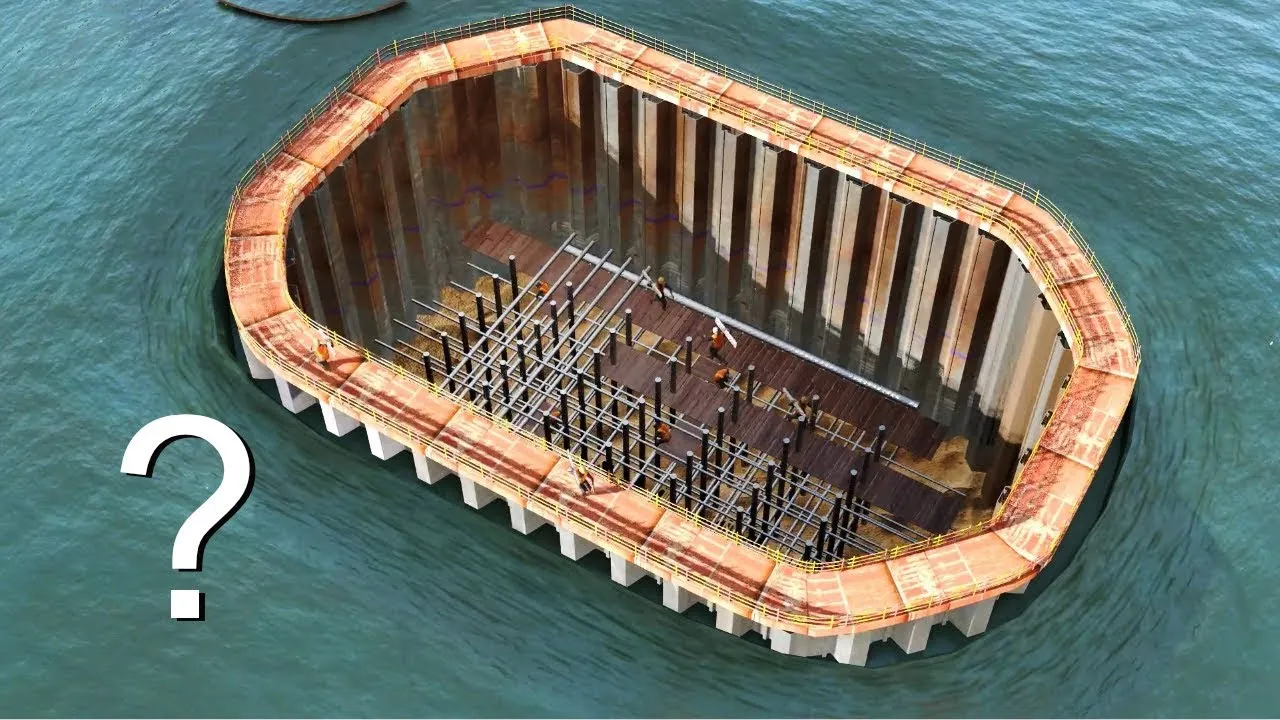
Geotechnical engineering principles, focusing on deep foundation systems, cofferdams, and underwater pier construction.
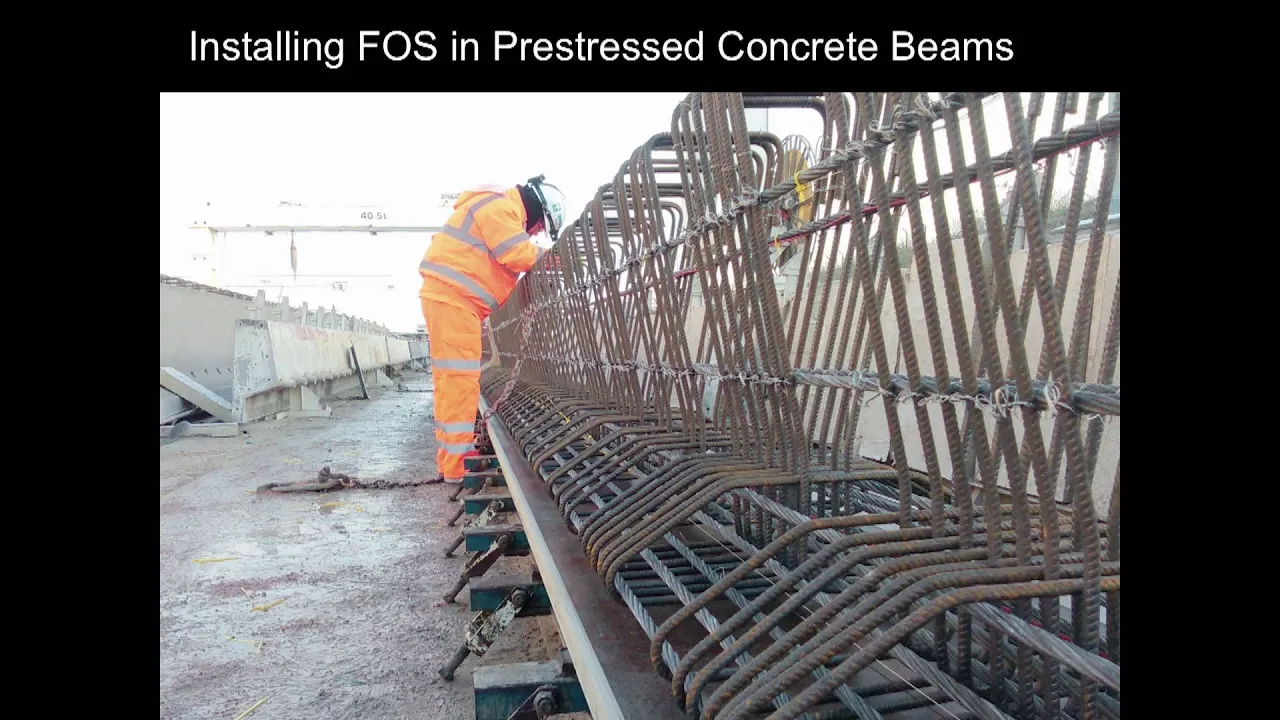
Smart infrastructure technologies, such as integrating fiber-optic sensors and IoT devices for real-time structural health monitoring.
2.5M views11.9Klikes52:07Original Release: 2020-11-20
reaching the world on the other side.
Crossing the bay. First a curiosity, then a necessity. One which has urged man [music] from the dawn of his history to develop construction methods that enable him to cross barriers.
But bridges are more than just technological [music] feats. They are links between men.
Lea Bellow is a geoysicist.
She'll be following in the footsteps of [music] exceptional builders, revealing the secrets behind the construction of iconic works, and discovering the challenges faced by engineers who build even higher and even further.
No engineer in his right mind would have chosen this place to build a bridge.
Unfortunately, that was where a bridge was needed.
A scientific investigation [music] to discover how men design and construct civil structures.
True expressions of human genius to bridge [music] the gap.
[music] [music] Leabello first heads to [music] northeast India and the state of Megaa to discover a hidden treasure.
Located on the border with Bangladesh, a third of the state is covered [music] by dense damp forest.
Numerous streams wind [music] through the valley, representing obstacles for the movements of the villages.
For almost 500 years, they have intelligently [music] tamed nature by building bridges using the roots of living trees.
Be careful. It's very slippery.
Slowly, here is the bridge for you. The living root bridge.
See the roots.
It's like something out of a fairy tale.
Is the bridge still in use?
Every day. Every day we have people living in the village on the top. They come through this to go to the garden.
Monsoon time with so much water. Without this bridge, they cannot cross this.
This kind of activity had been going on for many centuries in this area. So it's been a common thing here. This is fus elastica. It has got long stem roots. It can sit on rocks and ch roots into the stream bed. So that's how they started using this. It grows very well alongside streams and rivers. And see the size of the roots. This bridge is so strong. It can carry 100 people.
Abandoned in the 1980s in favor of new concrete bridges, the living bridges have been the subject of a rehabilitation program launched 15 years ago. Today, local inhabitants protect these wonders of nature. In [music] all, the valley has about two dozen of these bridges, some of which spann 20 m where we are going to show you the last but not the least and the best in this place.
There are two bridges.
We have the double decker.
Very special bridge. The only one of its the kind in the world. It's the unique double decker root bridge.
Unique in the world. The living root bridges of Megallaya are also the only bridges to actually get stronger with age.
This exceptional example of bioengineering [music] illustrates just how man can tame his environment to build foot bridges to take him over natural obstacles.
The first bridges in history were all built using plants or plant-based materials, vines, rope, wooden planks, [music] and so on. Primitive bridges which are still constructed and maintained in some parts of the world like in the foothills of the Himalayas.
In less forested [music] areas, man turned to a more resistant material, stone.
Some of these prehistoric bridges still stand today.
During [music] the final millennia before our era, stone dominated the history of bridge building until the Romans perfected [music] the art.
For almost 5 centuries, [music] the Roman Empire reigned over Europe and the Mediterranean.
To expand [music] their territory, the Romans developed an important network of roads and bridges.
This construction-minded people built numerous large-scale [music] structures in stone, some of which are still standing after 2,000 years, [music] like the Pondigar in the south of France, which was constructed in the middle of the first century of our era.
Its [music] dimensions are impressive, 47.6 It's 6 m high with a span of 275 m.
This iconic Vestig is the highest elevated Roman aqueduct bridge in the world. From the bottom up, its three tiers have 6, 11, and 35 arches respectively.
Vaulting has been used since the Mesopotamian period, but not all the time. The solution discovered by the Romans was to build semic-ircular archers with centering with the lateral thrust exerted on piles with very strong foundations. This produced much wider arch spans from a few meters to 35 m across.
Once the piles [music] were sunk into the riverbed, the next task was to construct the archways.
The semic-ircular vaulting forms a structure which can span [music] an empty space with successive arches. To build the arches, a solid support was needed, known as a centering.
This constituted two wooden semicircles with the same form as the intended [music] arch and served as the framework. The blocks of stone were then laid on top of the [music] wooden centering until the last one, the keystone.
[music] On the first tier of the bridge, the arches were thus formed with three parallel sections of stones.
[music] This form allowed the Romans to build arches with unprecedented [music] spans, but it did have its limits. If an arch [music] were to span more than 40 m, the quantity of stone would be too heavy and the vaulting would collapse under its own weight.
It's often said that the Romans were the greatest builders in antiquity. But what do we know about the exact construction techniques and methods they used? We know a huge number of things but not everything. Firstly, their construction techniques were absolutely remarkable.
Their level of engineering clearly surpassed that of the ancient Greeks who were also great engineers.
And Vituvius, the Roman architect and engineer, left us the only known book on the subject, which we can now consult for all our studies of the archaeology of antiquity.
Vituvius was the author of the only surviving treaty on the architecture of antiquity. It's [music] an expose of the art of Roman construction and it lists the tools and techniques employed by these master [music] builders.
From a theoretical point of view, we learn of their acute sense of proportion.
The lines of their [music] buildings form harmonious dimensions and employ incommenserable numbers such as pi [music] or the square roots of 3 and 5.
The Romans set out to construct for eternity. Their use of infinite numbers actually enabled them to obtain the absolute and also thanks to this geometrical system, stonemasons also knew the methods perfectly.
And so they could reproduce on the spot on a much larger scale of course the plans which had been drawn by the architect.
While the pondar remains a [music] model of aestheticism and architectural perfection, it was actually constructed for a very precise purpose to bring fresh water to Neim, one of the largest cities in Gaul with 20,000 inhabitants.
The spring chosen was the Fontender, some 50 km [music] away from Nee.
The distance wasn't a problem for the architects, but something else was.
[music] They had hoped to find a spring much higher up than the arrival point.
But unfortunately, the Fontandura was only 17 m higher.
That meant the builders had to construct an aqueduct with an extremely gentle slope. One of the gentlest in antiquity.
How gentle was it?
24 cm per kilometer.
A gradient equivalent to only 1 mm every 4 m. And without expert [music] calculations, it was impossible to ensure a regular slope along the full 50 km of the aqueduct, especially across the pond.
That means that you have a channel with a slope like this, fairly steep, followed by a very gentle slope and then another steepish one. So in the central part, the bridge, water flowed much more slowly. So the result is the water rose in the channel and once the aqueduct was in service, they realized that it overflowed from the pond.
So the original wall only came up to here and to stop the water overflowing, they had to build up to here.
Exactly.
This masterwork [music] of antiquity supplied neem with water for almost 500 years until the fall of the Roman Empire. The construction of immense architectural and engineering works disappeared with the dark ages and was only resumed 500 years later in around the year 1000 with the expansion of Christendom and the power of the church.
The builders of the Middle Ages readopted the [music] techniques and methods of Roman architects.
[music] Over the following centuries, some bridges were remarkable because houses and shops were constructed on them.
Most of these have disappeared such as the old London Bridge and NRAAM Bridge in Paris.
But others have valiantly survived like the Rialto Bridge in Venice and the Ponttovecio in Florence.
But there was no true architectural evolution until the [music] Renaissance.
Between the Roman Empire and the Middle Ages, there was pretty much no progress from a technical viewpoint.
The real break came later in the late 17th century, early 18th century with a noticeable lightening of the general line of bridges.
Gradually, semic-ircular arches with centering were replaced by elliptic [music] arches which offered a wider arch span. Consequently, bridges became lighter and slender and this meant they could cross greater distances.
But it wasn't until the middle of the 18th century that the first big technological break came with Jean Rudolfph Peroni.
Considered to be the father of modern engineering, he was also the first to understand the true mechanics of a stone arched bridge.
He established that each arch was not freestanding from the others and that the thrust was shared between the spans.
This crucial observation meant that the thickness of a bridge's piles could be considerably reduced.
Pyrene harved the thickness of the piles. He developed an understanding somewhat systematic one could say today of how bridges functioned. So he built bridges in a different way to traditional ones. With his bridges the thrust of each span kept the others in equilibrium. Unlike the pond where if one arch collapsed others might yield.
The arches of the modern bridge were much more interlin and the thrust went from arch to arch right to the abutments.
Stone thus dominated the history of bridges until the industrial revolution.
In the late 18th century, early 19th century, the [music] mastery of iron allowed engineers to design structures with new profiles.
Iron was the great revolution for bridges.
It was about 60 times more resistant to pressure and thrust than stone, and that would lead to considerably lighter structures.
Iron resisted tensile strength as well as pressure.
That meant that architects could finally drop the arch, which had been the dominant form of bridges since Roman times.
Iron enabled builders to construct bridges with triangular crossarss.
Both lighter and more resistant, bridges could span even greater distances.
The rapid [music] development of the railways demanded new technological solutions to cross rivers and valleys.
Engineers stopped at nothing.
like spanning [music] the deepest gorges where no one had ever dreamed of taking on nature and bridging the gap.
The Garabi vioaduct is a striking example of this daring. It was designed by Gustafel, a visionary engineer and determined architect whose solid yet elegant bridges reached heights [music] that gave his contemporaries vertigo.
Located in the heart of the massive central, the Gabby vioaduct crosses [music] extremely undulating terrain.
565 m long and 120 m high, the rail bridge rests on [music] seven piles and a single main arch with a span of 165 m.
What was there here before the construction of the bridge? nothing at Gabe. Absolutely nothing. They had to lay new roads just to get to the site.
Then they had to construct accommodation for the men who would work on the vioaduct.
Why construct a bridge where nothing existed? So that the train with its passengers and goods could reach the region.
As rail was developing everywhere in France, there was still no line through the Kalile department linking Paris directly with Bezier without skirting around the massive SAL.
Here it is.
Why?
The gigantic work site began in 1880.
The vioaduct was erected in just four years. An incredible technological feat for the time.
Keep going. Almost there.
The Garabi vioaduct was the test bed for revolutionary technology. And it was while constructing this bridge that Gustaf Ephel patented his famous latis girders used several years later for the Eiffel Tower.
The structure is mesmerizing, totally fascinating and in the signature eel style with the open lace gutters which allows the wind to pass through.
That's right. It's a very airy structure.
How was it constructed? Was the whole thing just assembled here? Half of it was preassembled in the workshops in the Valawa Pere near Paris. The other half was hot riveted together here in Gabe.
The rot iron girders were assembled with rivets. These small shafted iron [music] fasteners inserted between each piece of the structure. Once heated to red or [music] white hot and the tail of the rivet has been hammered flat, they hold the pieces together when they cool. Once the bridge was finished, it must have been a huge event for the region. Yes.
And not only for the region, but the whole civil engineering world. The bridge was marveled at due to its height as far as the United States. It's one of the two most talked about works by Eel among the hundred he built around the world.
[music] [music] The Garabi vioaduct and the Eiffel Tower erected four years later are testaments to [music] Gustaf Ael's genius and perfect mastery of iron.
Iron dominated the history of [music] bridges in the late 19th century.
Constructions multiplied throughout Europe and the United States.
But few engineers understood how iron and notably cast iron would react over time with the constant crossings of trains.
Often hastily constructed, [music] bridges became the stage of some terrifying disasters.
In the [music] United States, almost 200 of them collapsed in the 1880s.
These repeat mark the end of the iron bridge.
Engineers turned to a new much more resistant material, steel, [music] an alloy of iron and carbon. The development of which took metal work from the domain of craft work into that of science. [music] One, highquality steel has far superior mechanical qualities compared to iron.
So you can go much further with it. Two, it had a big impact from the early 20th century on because unlike iron, it could be welded and that would totally transform assembly technology. Today, no one would even imagine building a large work of engineering without steel.
Steel opened the door to rapid technological progress.
Across the globe, sleekl looking bridges sprung up across rivers, breaking records with spans of several hundred meters, like the fourth bridge in FTH, Scotland.
But back to the [music] early 19th century, another method of construction was born in the United States.
The suspension bridge.
Bridges where the road deck is hung below wire suspension [music] cables firmly anchored in abutments on the river banks.
The suspension bridge is a very simple idea and it's not that complex to construct. The main thing back then was to make sure the steel used in wire cables was of good quality so they wouldn't snap. There was a lot of debate because for a long time bridges were suspended by chains then by cables then by modern groups of cables.
With cables made of steel suspension bridges became all the rage.
But it was the daring of a German-B born engineer which would give the United States one of the wonders of the modern world. The Brooklyn Bridge in New York.
To better understand how this bridge [music] changed the history of engineering and that of New York, Leia Bellow joins Dave Freda on the banks of the East River. This photographer, a specialist in bridges, is a fountain of knowledge when [music] it comes to the Brooklyn Bridge.
This legendary bridge, 1,825 m across, beat all span and height records.
Construction [music] started in 1870, giving rise to an era of ambition and sacrifice of an entire family.
The Roblings, John Robling, who designed the bridge, unfortunately, he didn't have a chance to see his bridge completed.
He was surveying the footings for the bridge on the south side of the Brooklyn Tower. A ferry had come in. He didn't see it and it crushed his foot and the only treatment he wanted was pouring water on it. Unfortunately, he died of tetanus. So his son Washington Robing then took over as chief engineer. So Washington was the one who actually built the bridge. He went down into the quesons to help the men dig out the muck and the rocks below. He wanted to be part of the team but they didn't know again about Kesan disease about the change in air pressure. He wound up being laid up in his bed in his bedroom.
So his wife Emily Robling then transferred all the information from him Washington to all the workers. So Emily Robling was very instrumental in helping of building the great Brooklyn Bridge.
She was one of the first woman civil engineers that really helped. what she did was absolutely incredible.
I think without Emily Robing, you wouldn't have the Brooklyn Bridge today.
[music] The construction of what was then the world's biggest suspension bridge was dotted with numerous problems and disasters.
Starting with the most ambitious and dangerous [music] stage in the project, the sinking of the immense foundations in the bed of the East River.
The construction of [music] the foundations employed an innovative process.
Washington Robing had two giant wooden [music] quesons made measuring 50 m long by 30 m wide.
The imposing blocks of granite [music] for the towers were laid on top which gradually sank the quesons to the riverbed.
Once there, at a depth of 30 m, compressed [music] air was injected into the giant boxes so they could resist water [music] pressure.
In this damp, [music] cramped, pressurized space, laborers dug for several months in order to anchor the piles in the bedrock.
The rubble and mud rose to the surface via a central [music] conduit, and within only four years, the two towers had begun to rise [music] from the East River.
At the time, little was known of the effects of pressure [music] on the human body.
Contractors and workmen began to suffer from strange illnesses. [music] The quesons on the Manhattan side were at 30 m deep, which means the pressure inside would have been three times more than surface pressure. That must be what made it so dangerous for the men working inside when they return to the surface.
Yes. Now, I used to scuba dive, so I know the dangers of decompressing. If you come out to ambient pressure too fast, it's like opening a soda bottle.
Open the top too quick, the gases come out too fast. That's the same thing with the nitrogen in your blood. It would come out, it settles into the joints.
It's extremely painful. So they now know you have to come out into ambient pressure very slowly. They didn't know that back then. So they called it Kesan's disease because almost everyone that went into the quesan came out in extreme pain. A lot of men died.
Despite the [music] numerous challenges, the 90 m tall towers were completed in [music] 1875 and the installation of the cables could begin.
This is the four main cables. These main cables is what holds up the road deck.
Each cable contains wires like this.
5,434 wires make a 15 and 3/4 in cable. Each cable can withstand the pull tension of 25 million pounds. They were anchored in anchorages on both sides of the bridge.
[music] The main cables are original. Some of the engineers I know worked on the bridge and the cables that are made of wire like this are in great condition.
They're galvanized. This is the first suspension bridge in the world to use galvanized steel wires. It's steel coated with zinc. Zinc oxidizes but it doesn't rust and it protects the steel underneath it. So this could last the two 300 years easily.
To prove the solidity of the cables, master mechanic EF Farington crossed the East River suspended from them.
In all, 23,000 km of cables were installed.
After 13 years of work, the bridge was finally completed. Its inauguration [music] on May the 21st, 1883 was a national event.
All of New York was invited. The president was here. The mayor was here.
It was called Decoration Day. The entire city basically shut down to celebrate the opening of the Brooklyn Bridge. A week later, there was what's called the bridge stampede. Someone had tripped on decoration day. a week later and people thought the bridge was collapsing and a lot of people were trampled to death unfortunately. So to compensate for that, Washington Robing had a whole herd of elephants to walk across the bridge and that proved to the public that the bridge was very safe. I believe this bridge can last for centuries. It is a marvel of engineering. Uh hopefully many future New Yorkers and other people around the world will be able to see this great structure.
The Robing's Brooklyn Bridge is now known the world over and is one of New York's most iconic landmarks.
Over 130 years later, it's still standing. A genuine work of prowess given the know-how of the time.
It inspired other famous large bridges [music] like the Washington Bridge on the other side of Manhattan and the Golden Gate in San Francisco.
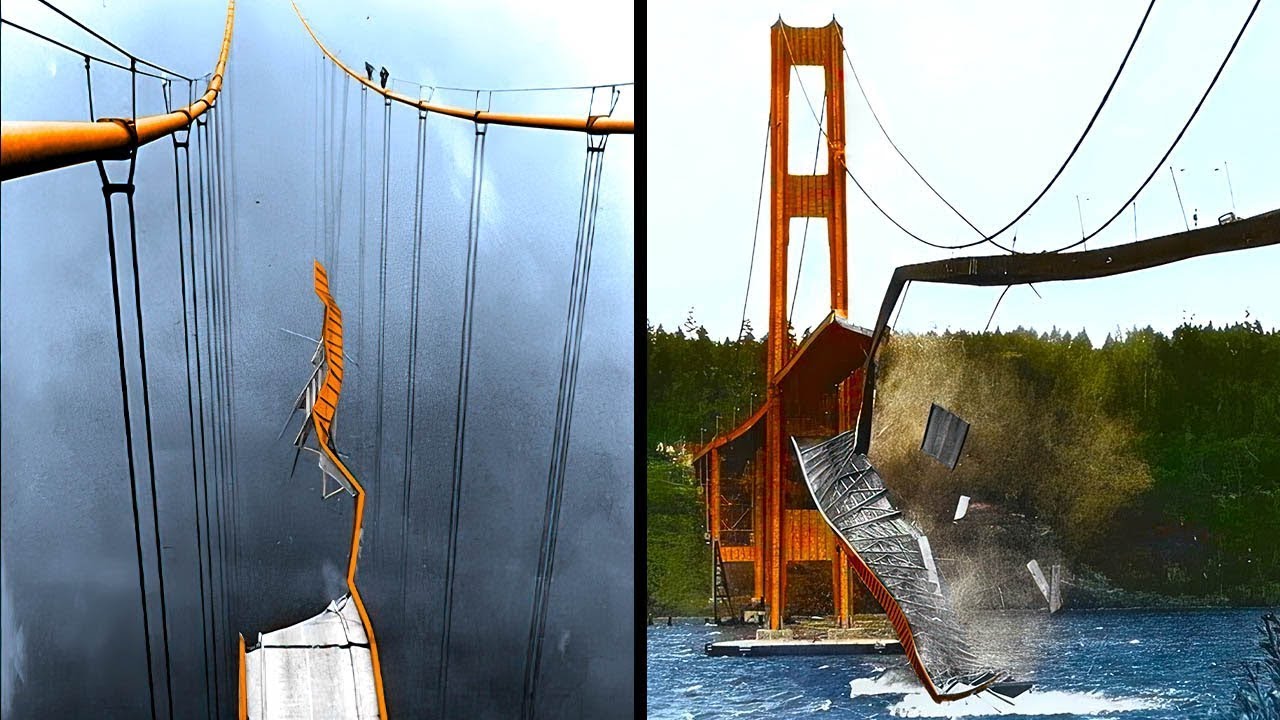
But other bridges have proved less longlasting. The first Tacoma Narrows Bridge in the state of Washington would collapse under the effects of a suspension bridge's main enemy, the wind.
Last July, the nation hailed the opening of the new $6.5 million Tacoma Narrows [music] Bridge over Pugid South.
This is the opening of the Tacoma Narrows Bridge, right?
Yes. It was inaugurated on July 7th, 1940. And the bridge started oscillating up and down from the outset.
During the summer of 1940, people visited the bridge just to see it swaying. It became a tourist attraction and it became famous. Yes. From the very beginning except that in November there was the first storm of the fall.
It wasn't a big storm but there were winds of 70 km an hour through the straight and instead of oscillating up and down the deck started to twist from one side to the other. It was an amplitude of almost 9 meters.
And after an hour, at about 11:00 in the morning, the whole central section gave way and collapsed into the Tacoma Narrows.
Oh, yes. There it goes.
Which leaves us with a marvelous example of how not to build a suspension bridge.
One of America's finest structure.
Fortunately, the collapse of the bridge claimed no victims.
Puget Sound except for a terrified dog locked in the car in the middle of the bridge.
Not a person was lost, but it's a real tragedy.
[music] When the wind blew on the Tacoma Narrows Bridge, air pressure was exerted on the edges of the deck, transferring its energy into the structure itself and causing the roadway to bend and sway.
After the collapse of the bridge, architects and engineers began to study much more deeply the impact of the wind on bridges.
But it wasn't until the 1970s that aerodynamics became a science [music] in its own right.
From then on, the decks of bridges were streamlined to facilitate the flow of air around the structure so as to prevent [music] any risk of swaying.
With the invention [music] and mastery of new materials, during the 20th century, man would [music] be able to build longer, higher bridges with even more impressive dimensions.
It was the age of concrete, the king of bridge building, and much cheaper than steel.
And it would benefit from a revolutionary process developed [music] by French engineer fine which was perfect for civil engineering works.
Pre-stressed concrete.
Pre-stressed is concrete that has been compressed so that the traction exerted on it is more than compensated by the stress exerted on it. For example, if you make a beam out of sugar cubes, it won't resist traction at all. But if you compress the cubes, you can then place a small object on them, say an eraser, and the sugar beam will hold firm because the disintegrating effect produced by the eraser's weight is nullified by the fact that the cubes are more tightly packed together.
[music] This new material has been used on most of the bridges which stand today, and it would be used in hybrid bridges [music] such as cable stayed bridges constructed with a mixture of concrete and steel. [music] A cablestayed bridge doesn't need the expensive anchoring of the suspension bridge because the deck is no longer suspended [music] from a gigantic main cable, but supported by series of individual cables running directly from the pylons.
This new model [music] spread across the globe in the second half of the 20th century, breaking all kinds of records like in 1995 with the Pond Normandy and its span of 856 m.
Nothing seemed able to halt the [music] ambitions of architects and engineers.
Not even the wrath of [music] nature which has managed to destroy a number of their bridges like during the earthquake in Kobe, Japan in 1995. [music] Across [music] the Gulf of Corinth stretches the Rio Antio Bridge.
It links the Pelpines to mainland Greece at a point where 2 and 12 km separate the two shores.
The region sits between two tectonic plates, making it one of the most seismic in Europe.
No engineer in his right mind would have chosen this place to build a bridge.
Unfortunately, that was where a bridge was needed.
Project director Jean Paul Tessier worked for over 5 years with overseeing engineer Gilda [music] Mlong.
Together they came up with unprecedented solutions.
The first difficulty was the depth of the water 65 m. That's no longer the field of bridge building but of offshore engineering. Secondly, the seabed was of a very poor quality. And thirdly, there are faults that are constantly active, meaning the distance changes between the two coastlines. And during a strong earthquake, there could be a sudden change of several meters.
When we discovered the scale of the work, we were sorely tempted to close the file and refuse it. At the same time, we liked the idea of facing a massive challenge and we thought there must be a solution.
The bridge has to be capable of withstanding earthquakes of up to seven [music] on the RTER scale.
So the main challenge was to lay sufficiently solid foundations to ward off the wrath of the earth.
But preliminary studies showed the seabed to [music] be particularly unstable with the poor quality of the seabed. Our first idea was the classic one to dig down to find better quality ground.
But after detailed analysis, we soon found out that the bedrock was at a depth of about 1,000 m.
So that was totally unfeasible and unrealistic. Then after doing a lot of research, we came up with a totally innovative concept.
Due to the extreme depth of the bedrock, the engineers soon abandoned the idea of laying foundations under the seabed.
Instead, they decided to consolidate it using a brand new solution. Each of the four huge pylons rest on groups of 200 hollow steel pipes [music] driven into the bed. The pipes measure 25 to 30 m long with a diameter of 2 m. These were then covered with a bed of gravel 3 m thick on which the foundations [music] called peer footings simply rest.
The dimensions of the footings are gigantic.
Each is divided into 32 compartments and have a diameter of 90 m.
They remain the biggest pier footings ever constructed.
The Rio Antio Bridge has another [music] particularity.
Rather than lower and upper pylons, there are pylons of a single block of concrete.
The suspended deck is continuous from one end to the other. It passes between the pylons [music] and is suspended by only 368 stays.
It's a genuine floating roadway, so in case of an [music] earthquake, it can gently sway.
And to prevent the deck from hitting the pylons, the engineers [music] had to come up with an ingenious system to stabilize the bridge.
Let's start with the big central tube.
It's a rigid tube which holds the structure transversely in high winds.
But for a major earthquake which can't be withstood by the rigid support, there's a fuse inside which breaks allowing the small tube to enter the big one.
So one, two, three, four shock absorbers come into play. Very similar to the shock absorbers in your car, when you go into a hole, they absorb the energy.
Beneath each of the pylons, the deck is maintained by this system of fuses and 10 m long shock absorbers, and over 400 different measuring instruments [music] monitor the bridgeg's movements in real time.
On June the 8th, 2008, the screen suddenly went berserk when an earthquake of 6.5 magnitude struck the south of Greece.
During the 2008 quake, things went according to plan. The connections broke, the shock absorbers absorbed the shocks, and the deck was allowed to sway freely. So, it was a genuine life-siz test of whether our project was wellounded or not.
Thanks to the shock absorbers, during an earthquake, the deck can move laterally 3.5 m without hitting the pylons.
Rio Antio is an extraordinary bridge.
Extraordinary because it's a bridge implanted in an extraordinary environment.
Every bridge marks a victory over the elements, earth, water, and air.
And a number of them are veritable feats due to the uniqueness of the terrain they cross.
In the majestic gorge valley of the river Tarn in southern France, [music] the Mio Viaduct has become the new world record holder of bridges with its 2,460 m [music] cable stayed deck 275 m in the air.
It was constructed to free Mio of a curse, its constant traffic jams.
But to reroute the highway, the new road would have to cross one of the deepest gorges in Europe with a width of 2 1/2 km.
[music] Michelle Vojour is a graduate of France's top engineering school, the Achel de Poni.
He has worked on almost [music] 200 bridges during his career.
He's known as the father of the Pond Normandy and participated [music] in the design of the Vasco de Gama bridge in Lisbon, Portugal.
At Mio, the complex geography of the valley was for a long time a real brain teaser for the engineer.
Several routes were envisaged because we had to cross a large network of valleys.
At the outset, the elevated solution going from plateau to plateau didn't come to mind because of the necessary height of the pylons. And then an expert road construction engineer said to us, "Why don't you stay up at the same level as the plateaus?" And we thought, "We're stupid. That's what we have to do."
Never had engineers built so [music] high up.
Once the route was decided, the designer then had to imagine the [music] profile best suited to the landscape.
My idea was to construct a cable stayed bridge with multiple spans.
Why? Because for the bridge to be slender and transparent, cable stays would be the best. Plus, it's also the most effective structure to bear the load, allow larger spans, and thus fewer pylons.
With British architect Norman [music] Foster, Michelle Viller's team worked on finalizing the plans for the vioaduct for almost 10 years. Work finally began in 2001.
A gigantic [music] work site on which Mark Bonamo worked as the engineer who oversaw the building of the metallic roadway.
You feel tiny.
Yes, you do.
How many meters up is it from here to the top? 245 m.
245 m.
It's the tallest pylon in the world.
With its [music] 24,460 m long deck, the Mio Vioduct is one of the longest cable [music] stayed bridges in the world. It rests on seven pairs of piles and pylons 342 m apart. The bridge reaches a [music] maximum height of 343 m, making it taller than the Eiffel Tower.
[music] What's the width at the base of the pylon? The base is the size of a tennis court and the concrete is 5 m thick.
Underneath there are four big piles, 18 m deep and 4 m in diameter. and all that anchors this pylon in the rock below.
[music] During work, the seven pylons were built at the same time to gain in speed. Each was given its own crane to pour in concrete.
The pylons grew 4 m every 3 days. In December [music] 2003, 2 years after the construction began, the pylons were complete. Each of these splits in two for [music] the last 94 meters. A characteristic shape that wasn't chosen by chance.
A bridge, even when constructed to take limited deformations into account, remains extremely supple. So, we had to choose a shape for the piles and pylons to give them the necessary rigidity to restrict deformations while also allowing longitudinal dilations of the deck due to variations in temperature.
It's to [music] allow for deck movements that the piles and pylons divide into two slender shafts at the top. [music] The entire deck was constructed on the [music] ground in workshops on the plateaus either side of the bridge.
150 men aided by robots carried out over 1,000 km of welding to [music] assemble the steel roadway.
How did you manage to get the structure in place?
I came up with the idea of pushing it into position. Not a classic form of pushing because the pylons are so high.
The tallest is 245 m.
Plus, they're very flexible, so they wouldn't have resisted classic pushing.
So, we invented a sliding system with wedge conveyors, our famous wedges.
[music] Each conveyor was made up of two wedges which slide over each other with the use of jacks. The first lifting wedge slid under [music] the second, supporting the roadway. This second wedge was then raised 2 cm and as it was no longer resting on [music] the piles, it could advance.
Once in position, the first wedge slid again. The conveyor was back to its original position and the cycle could recommence to advance the roadway [music] 60 cm x 60 cm.
Thanks [music] to this system, the only one of its kind in the world, the north and south sections of the deck joined up [music] in May 2004 after 15 months of sliding.
To get the pylons [music] upright, the engineers sought inspiration from ancient techniques and developed [music] a tailor-made lifting system.
They basically copied the model invented by the Egyptians to raise their obelisks at Luxor.
Constructors must know all the techniques used for at least the past 4,000 years, whether they're Egyptian, Roman, 19th century, 20th century.
When you mix all that together, you can build great works of civil engineering that will be part of the long history of human construction.
So, it's a blend of history and technology.
After only 3 years of work carried out by almost 600 people, the completed bridge stood majestically above the gorge of the Tarn Valley.
It was opened on December the 14th, 2004 by then President Jacqu Shiraak. A proud memory for Misha Veojour.
What really touched me about the occasion was when President Shur got out of his car, looked at it and went, "That was fantastic."
More than 10 years after its construction, the Mio Viaduct still holds the record for the tallest pylon in the world.
But in the past decade, [music] other limits have been stretched.
Recently, engineers have broken new records. With its pylons [music] spaced 1,48 m apart, the cable stayed span record is held by the third bridge across the Bosphorus designed by Michelle Viller in Istanbul.
And China has recently broken the height record with a bridge culminating at [music] 565 m above the Bipen River.
So are there any boundaries that can't be crossed?
I don't know how far we can push the limits. We could envisionage wider and wider spans, but we'd need a new kind of material. Traditional materials like concrete and steel will eventually become too heavy for exceptionally wide spans.
A suspension bridge with steel cables has its limits.
The moment it can no longer bear its own weight, You have to stop.
Things will continue to evolve, but in the short term, I don't foresee any major revolution.
Before erecting ever bigger bridges, engineers will undoubtedly develop new materials, but they won't depart from the founding principles which form the singularity of these works of [music] engineering art.
Beauty and efficiency. You need the two and echoes back to the principles of Vuvius 2,000 years ago which are utilitas feritas vinestas. Utilitas is usefulness. A bridge must have a purpose. Feritas is resistance. A bridge must hold and it must be longlasting.
And finally vinestas which is beauty and elegance.
Heat. Heat. N.
Heat. Heat.
Up Next
11:53
Via Appia Antica & Roman Aqueducts: Ancient Engineering & Masonry Travel Guide
@MikeHaduck
6.5K views•2025-01-30

30:32
Ultrasonic Transducers: Resonant Frequency Measurement and Horn Design
@imajeenyus42
229.9K views•2017-02-22

54:16
Polymer Environmental Degradation: Mechanisms & Stabilization
@iit
1.8K views•2012-07-10
33:39
How a Student's Question Saved a NYC Skyscraper from Collapse
@veritasium
22.8M views•2025-04-26
Related Study Plans & Knowledge Roadmaps
Structured learning paths in Engineering
engineering
Building Acoustic Levitators: Physics & Arduino
01The Physics of Sound and Standing Waves
02Piezoelectric Transducers and H-Bridge Drivers
03Arduino Programming: Generating 40 kHz Signals
+ 2 more learning modules
14h5 modules
Explore Roadmap
engineering
Building Peltier Cloud Chambers: Particle Tracks
01Cosmic Rays & Cloud Chamber Physics
02Thermoelectric Cooling (TEC) Fundamentals
03Custom Liquid-Cooling Loop Design
+ 2 more learning modules
18h5 modules
Explore Roadmap
engineering
Yagi-Uda Antennas: Modeling, Build & VNA Test
01Introduction to RF and Antenna Fundamentals
02Yagi-Uda Antenna Design Principles
03Antenna Modeling and Simulation in 4NEC2
+ 2 more learning modules
18h5 modules
Explore Roadmap
engineering
ECG Monitor Design: Op-Amps, Filters & Noise
01Electronics & Breadboard Basics
02Op-Amps and Instrumentation Amplifiers
03Bioelectricity and ECG Fundamentals
+ 2 more learning modules
18h5 modules
Explore Roadmap