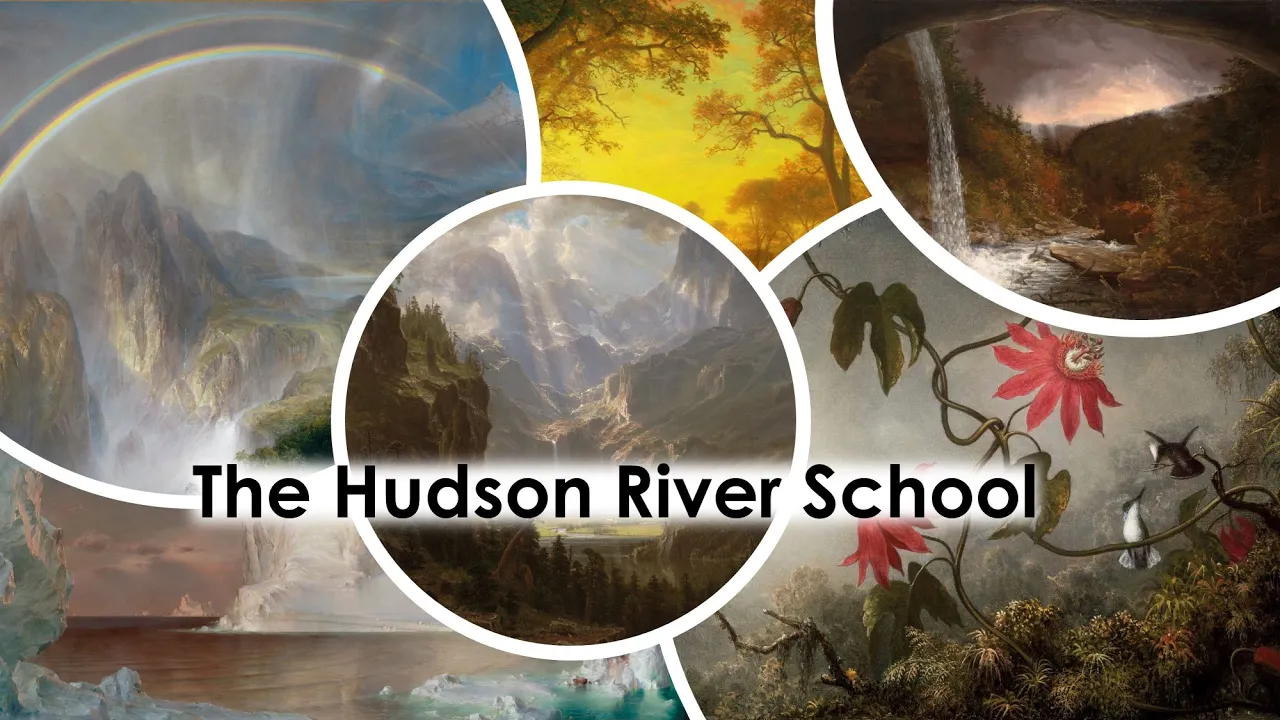
















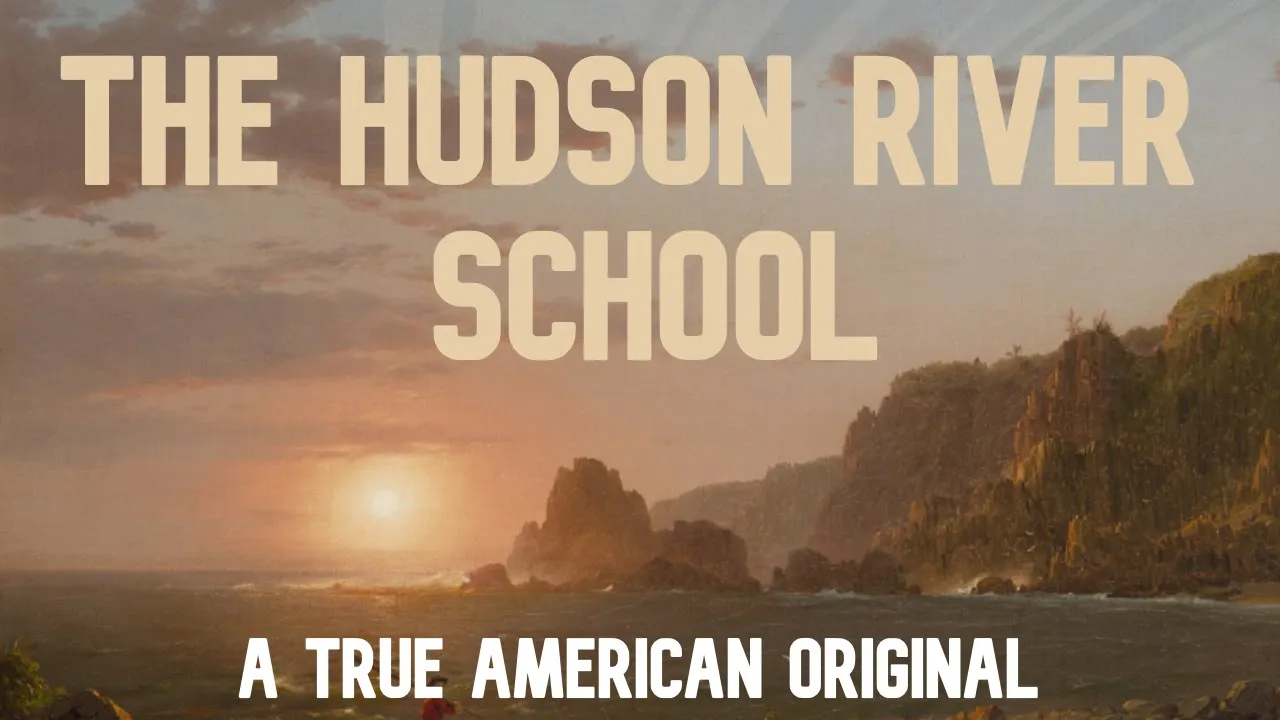








Thomas Cole (1801-1848), an English-American painter, pioneered the Hudson River School by creating The Course of Empire (1836), a five-painting series that uses landscape allegory to illustrate the cyclical rise and fall of civilizations—from primitive beginnings through pastoral development, imperial glory, violent destruction, to final desolation—thereby demonstrating how visual art can convey complex historical narratives more powerfully than text alone.
Thomas Cole: The Course of Empire and American History
Added:Understanding of the Hudson River School, its aesthetic values, and Thomas Cole's role as its founder.
Familiarity with the artistic movement of Romanticism, specifically the concept of 'the sublime' in nature.
Knowledge of 19th-century American history, including the concept of Manifest Destiny, industrialization, and Jacksonian democracy.
The definition and function of allegory in visual art, where literal elements represent deeper moral or political meanings.
An introductory grasp of cyclical theories of history, particularly the rise and fall of classical civilizations like Rome.
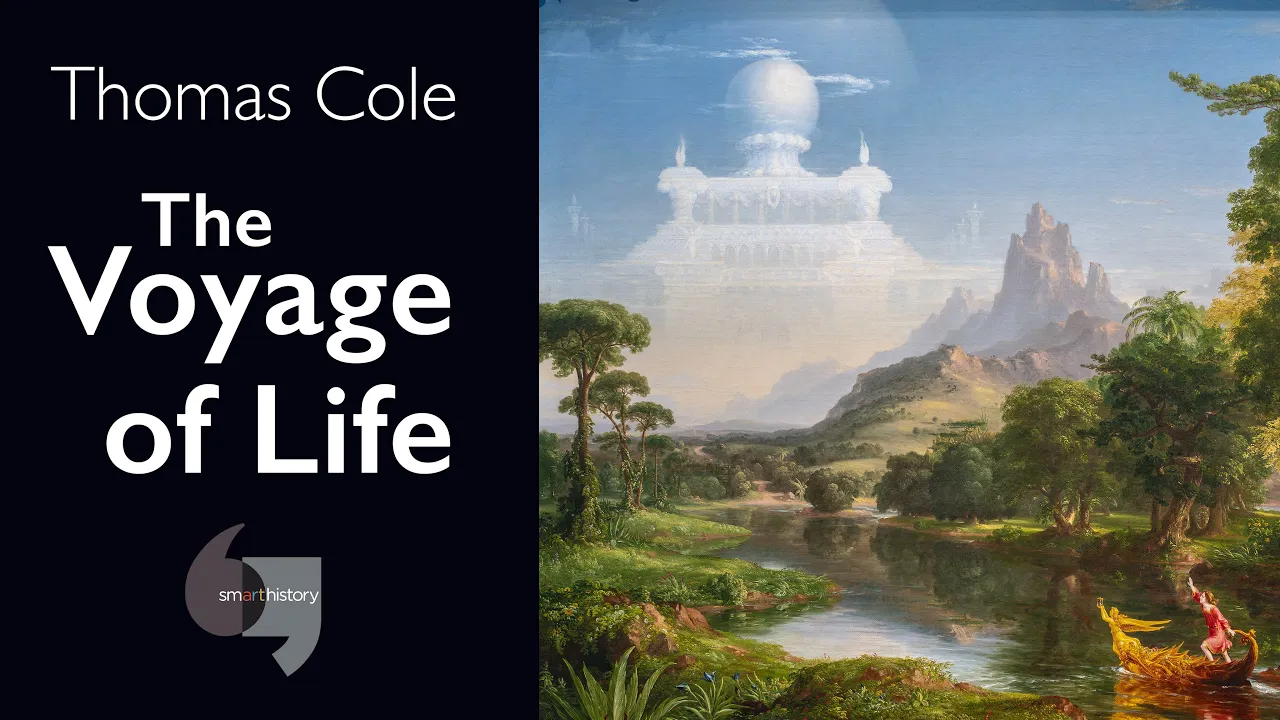
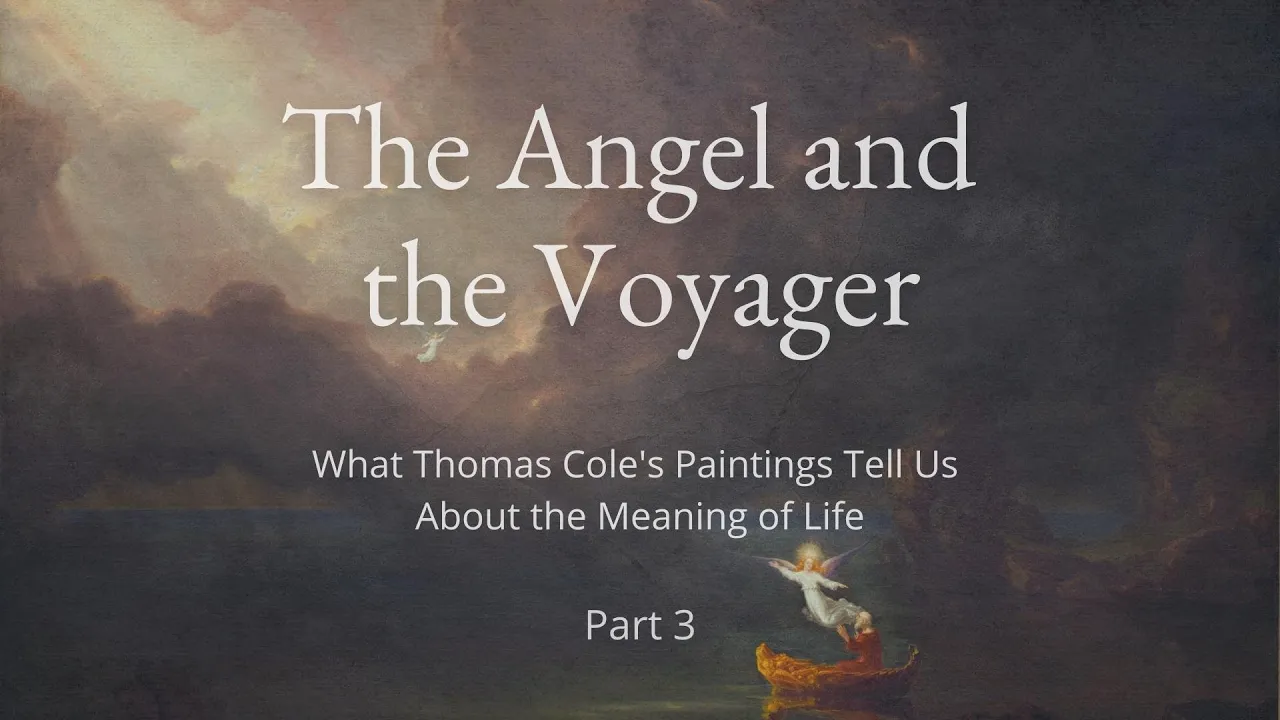
A comparative analysis of Cole's 'The Course of Empire' with his other major allegorical series, 'The Voyage of Life'.
Exploration of how the Hudson River School's portrayal of wilderness influenced the early American conservation movement and the establishment of National Parks.
An examination of post-colonial and revisionist art history critiques regarding the erasure of Indigenous populations in 19th-century American landscape paintings.
A study of literary connections to Cole's work, such as the writings of Washington Irving, James Fenimore Cooper, and Lord Byron's poetry on the ruins of empires.
Analysis of contemporary eco-art and modern visual critiques of industrialization, anthropocene acceleration, and climate change.
206.7K views16.6Klikes12:23Original Release: 2024-08-02
Within the field of History, it seems perfectly standard, obvious even, that historians are writers. In the purest sense: capital-H History is a literary genre presenting the past as a narrative record – so yeah that tracks – but even if we expand our definition a bit to include biographies, poetry, philosophy, or theater, it all begins with someone somewhere scribbling out words. As we’ve seen elsewhere, writing is such an effective means of communicating a world that even authors who had no intention of Doing History whatsoever still end up weaving their lives, context, and culture into those documents. Intentionally or not, all writing from the past tells us something about the past – and to me that sounds like academically-unassailable carte blanche to make this History-Makers series about whomever the hell I want. And frankly, the weirder of a pull, the more fun it is to analyze, so let’s take this to the logical extreme and get away from text entirely.
Enter: Visual Media, the artifacts, art, and architecture which offer us a vivid, tangible window into the past. Much like books, the arts tell us plenty about the culture, artist, and moment in time that created them, but with the added bonus of beauty and subtlety that only visual media can bring. Look you don’t need me to explain how paintings work, but what is new and interesting is how they can convey history. Of course, there’s plenty of art that makes history feel alive: like, ironically, Jacques Louis David’s Death of Socrates dramatizing the climax of the text in the single moment Socrates almost trivially grabs the fatal goblet of hemlock while fully absorbed in a rousing discussion on the other side of him – So much characterization in a single action. Then there’s more symbolic paintings like Raphael’s School of Athens, which shows the philosophical differences between Plato & Aristotle through contrasting hand gestures – hundreds of pages of philosophy summed up in no time. Artwork is indispensable to a full appreciation of history.
One step further and we’re in the realm of the allegorical, the paintings that skip literal meaning to craft a deeper message, and that takes us to Thomas Cole: the early-1800s English-American painter whose work is not only gorgeous on its own account, but expresses deep historical ideas with a passion and richness that no written words can capture. So, to learn why this painter is as much a historian as any record-keeping writer, Let’s do some History.
When Thomas Cole was born in 1801, no one could have predicted his future status as Landmark American Painter, especially since he was born in England – half a century earlier they were part of the same empire, but after all that Revolution business the Americans were very protective of the distinction. When his family emigrated to that freshly-independent United States of America in 1818, little Tommy took an interest in art. He studied at the Pennsylvania Academy of the Fine Arts, but was still a relative amateur when he got his big break in 1825: as three of his paintings sitting in a bookshop window caught the eye of famed American artists Asher B Durand and John Trumbull, who exclaimed that “This youth has done at once, and without instruction, what I cannot do after 50 years’ practice.” And out of everybody on the continent, I’d venture Colonel Trumbull, “The Painter Of The American Revolution”, could clock the difference between Beginner’s Luck and Generation-Defining Talent. In very short order, Thomas had himself mentors, patrons, and an inaugural spot on the National Academy of Design. Good for Tommy.
So, what did Cole actually paint?
In a word: Landscapes. America was a new nation, trans-Atlantic settlement was scarcely 200 years old, and the continent’s most striking feature was its vast inland wilderness, in contrast to the densely-urbanized, industrializing societies of Europe. Thomas wanted to capture the beauty of that distinctly-American landscape, so he moved upstate to the Catskills where he could hike to his heart’s content, sketching and documenting everything in sight to help guide his paintings.
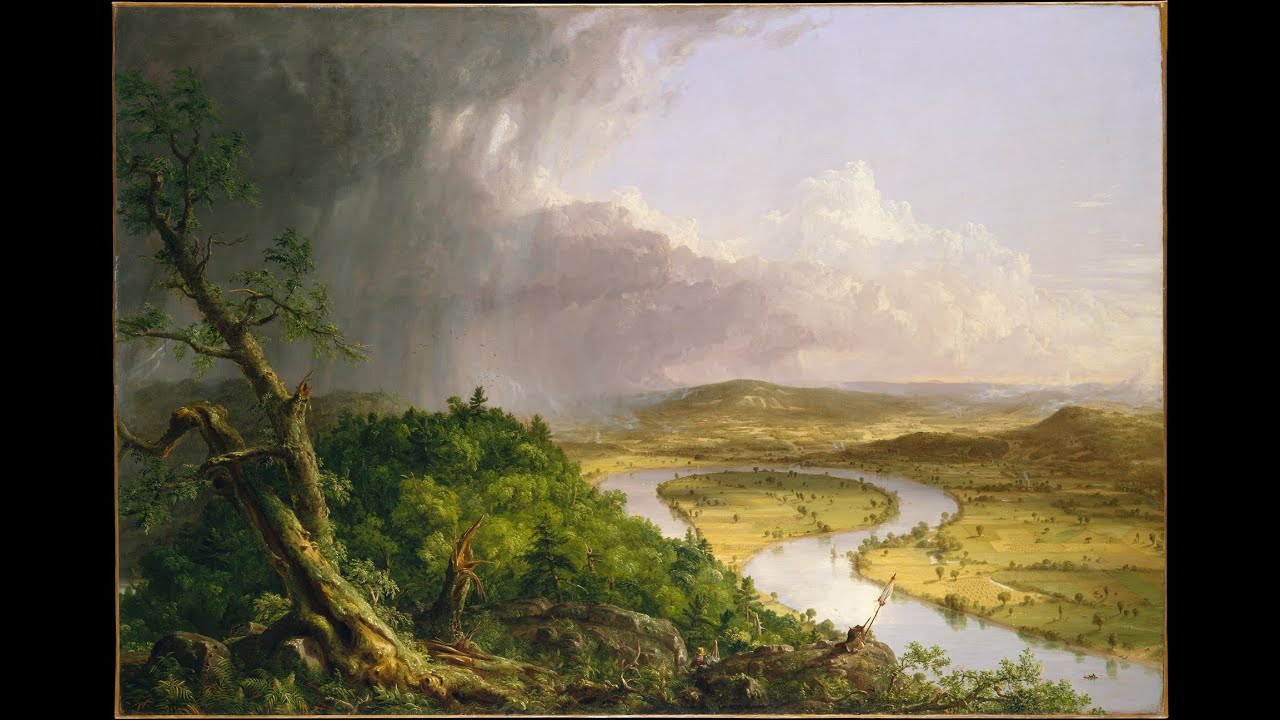
A standout example of both his method and his mastery is The Oxbow, a view from Mount Holyoke in Massachusetts.
At a glance, it’s a view of storm-clouds, clear skies, dense forest, and beautiful fields in the valley below, wrapping around the titular Oxbow of the Connecticut river. All expertly painted, but ultimately a straightforward scene from nature – however, Cole couldn’t miss the opportunity to comment on the subject matter through the subject matter. See, the composition is cleanly bisected: on the left are clouds and forest of the wild, and on the right is the clear sky and cultivated agriculture of human society – there’s a story here of the pure wilderness receding as mankind lays its claim, metaphorically reflected in the clearing skies above. Society is still in harmony with the landscape, as its boundaries are set by the river, still set by nature, but the question is how long that virtuous equilibrium will last. Tommy-boy snuck a little self-portrait doing some painting en-plein-air, but he’s up in the mountain amid the trees: Mr. Cole made his priorities clear. That’s a surprising depth to what’s otherwise a pretty view of a river valley, and it's characteristic of Cole’s quest for “A higher style of landscape”, what was later termed the “Hudson River School” of painting. But in his letters, Thomas himself did not consider The Oxbow a “fancy” painting. That begs the question: if that’s just a view, what does count as fancy?
Well, after a few years abroad, Cole painted his answer. See, between 1829 & ‘32, Cole embarked on every artist’s dream business-trip: The Grand Tour. Beginning in England and working his way down to Italy, he studied famous artworks, surveyed the sights, felt feelings when looking at Roman ruins, and met other Americans on tour who commissioned Cole for paintings. But most consequential of all, he conceived a multipart landscape series tracing the rise and fall of an imagined ancient civilization. He got a patron to fund the project, and he got to work. Three years later in 1836 he presented The Course of Empire: the work which decisively earned Cole’s place as a History-Maker and, by his own words, was some Very. Fancy. Painting.
On canvas, the Course of Empire is five views of the same fictional landscape: a spot near the water with a pointy mountain in the distance. Each painting is a different angle of the scene at a different time of day: passing through sunrise, morning, midday, sunset, and night. But at its core, the Course of Empire is also a history in 5 acts, following an archetypical civilization through its origins, growth, peak, fall, and ruin. As the story evolves, the empire changes the landscape around it, forging a gleaming capital before inevitably collapsing into an overgrown wreck. The underlying thesis here is not revolutionary – as historians like Ibn Khaldun spelled out the cyclical nature of history quite explicitly in prior centuries – but Cole’s innovation is in rendering that idea so elegantly and evocatively as artwork. So, let’s see what we can learn.
Working our way through the ages, we start with a sunrise on the Savage State: the mountain is center of frame, catching the first light as the storm-clouds recede. Humanity is just starting to claim a place in nature, with a circle of teepees around a fire and boats in the water. In the foreground, a hunter chases a deer, signifying we’re a ways off from formal agriculture – but this society already has a character to it, with tools, crafts, and dance. Cole isn’t making any 1:1 comparisons here, but drawing on Native American motifs was clearly a calculated choice for this first scene, and as we progress, we’ll see how and why he pulls disparate cultural aesthetics together.
As morning passes and the sky clears up, we find ourselves in the Pastoral State. Our view of the mountain and the bay is clearer now because the foreground woods have given way to sheep fields, alongside a sliver of town near the shore, and a stonehengy-lookin’ temple crowning the hill. Of course, those trees didn’t just go upstate, humans cut them down – this foreground tree-stump is evidence of the violence human progress inflicts on nature. But as this society evolves, it specializes: we see a boy doodling on a bridge, an old man sketching out geometry, wily youths enjoying song and dance, nondescript ritual activities up in the temple, and exactly one soldier peeking out behind a rock, another ominous sign of things to come. Nature is receding, and not just for noble intentions like agriculture and art – but in this moment, there’s a calm, there’s a balance, and there’s a promise of future greatness.
Untold generations later, the midday sun beams down on a glittering marble metropolis, as a military triumph celebrates the Consummation of Empire. At the height of its glory, every surface of the landscape has bent to civilization’s will, with grand temples and palaces dominating the frame, bridges spanning the central waterway, and colonnades sprawling all the way up to the mountaintop. Nature is no longer here, it’s just the hidden layer underneath the empire’s construction budget. And that funding was not acquired through good old-fashioned commerce, but conquest. Because this scene is a victory parade: warships flood the harbor, golden statues of armor cap the triumphal arch on the bridge, soldiers spill out along the parade route, and the great general in red shows off the spoils of the latest in what’s clearly a long line of conquests.
But when violence becomes a way of life, it can become a reflex, and at a very young age, as with we see with a pair of boys in green and red, scuffling over toy boats in a fountain.
This painting is a study of opulence, of splendor beyond conception: yet it is nonetheless greedy.
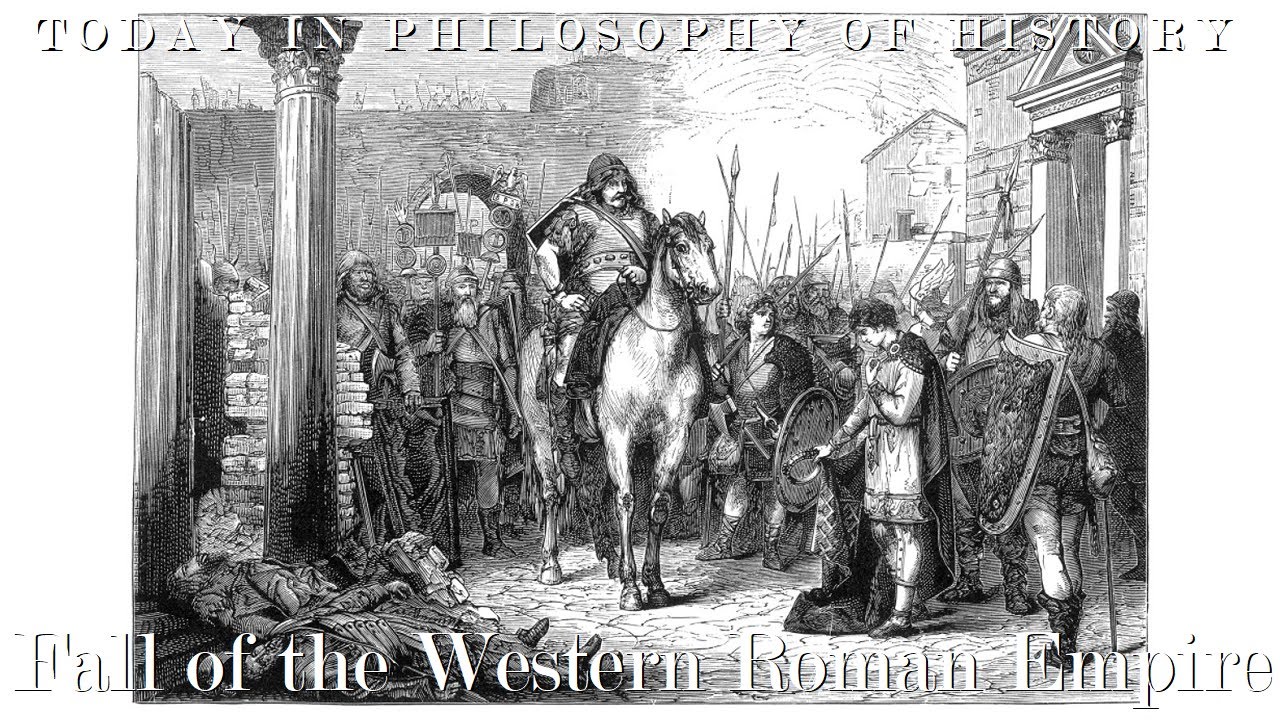
If all this isn’t enough, then nothing is. And such will be the empire’s undoing, as fires break out and smoke blots out the sky in the most iconic canvas of the series: Destruction. The city floods with so much violence it’s impossible to figure out where to even start – the towering statue of a warrior without a head, the makeshift bridge over the harbor buckling under the weight of battle, the war galleys crashing and sinking into the roiling waves, the women running from soldiers, the temples and palaces blazing in the background and drawing to mind John Martin’s depiction of actual hell in his Pandaemonium. But as we focus in, we get a sense of what might have happened here – there are plenty of foreign-coded combatants, seemingly in reference to the Vandal sack of Rome and the Persian Wars, but true to the Roman model, this is a civil war between factions of the empire, signified by green and red banners on either side of the harbor – and the green team’s catapult is pointed suspiciously towards the royal palace on the red side. The core tragedy plays out in miniature in the bottom-right fountain: where an old man in green leans exhaustedly over a dead man in red, face-down in the bloody water – the grisly end foreshadowed decades earlier by the young boys in the fountain. Damn, pour one out for Mario.
Now, while Cole observed that “the decline of nations is generally more rapid than their rise,” the aftermath is the slowest of all, and so we arrive at the final scene in the series: Desolation. The moon rises over a ruined and overgrown bay, the lighthouses are broken, the bridge is out, the palace and temples are gone, and a single column catches the last sliver of daylight. The grand architecture of the empire receives what it had done to nature, becoming a canvas to be covered in green. The only clue that time isn’t standing still is the wildlife that’s finally returned to the scene – birds, deer, lizards, even little ducks – nature is humble, but its return is inevitable. And that giant rock once again becomes the dominant force in the landscape. As Cole describes the painting: “The gorgeous pageant has passed, the roar of battle has ceased, the multitude has sunk in the dust, the empire is extinct.” Taken together, the Course of Empire is the kind of art that hooks into your brain and never lets go. We’ve heard many of these core ideas before, but when we can see centuries of history happening in front of us, it clicks in a way beyond words and becomes an innate understanding. That’s why the Destruction is a near-universal shorthand for the Fall of Rome. It’s hauntingly beautiful. And even when looking back at the Savage or Pastoral state, you know it’s coming. It’s as inevitable as the passing of the sun through that metaphorical day. Cole explored similar cycles in later works like the 4-part Voyage of Life and two-part Departure and Return, but those aren’t the history paintings and I gotta stay on topic here – The Course of Empire goes beyond mere history scenes to paint an entire study of historiography, using vivid allegory to achieve a higher style of landscape and then putting those paintings in conversation with each other. Cole saw art as a great and serious mission with the power to impress a sentiment and enforce a truth.
When he painted the series in the 1830s, he was reacting against the militarist expansionism of the Andrew Jackson administration, against the destruction of native societies and their natural landscapes in the American West. This is a position that later painters in the Hudson River School didn’t necessarily share, as their artwork became more heavily tinged with Manifest Destiny in later decades. Cole, for his part, had some justifiable worries about where that path might lead the Republic, and given the Civil War broke out 3 decades later, I can’t say he was terribly off the mark. The Course of Empire held a pointed warning for his fellow Americans, but the enduring strength of the paintings is their universality. The empire evokes the classical world, but its underlying story has played out in every era and every continent. That said, we risk falling into misleading generalizations when we use 5 paintings as an omni-plot for all of human history, but the Course of Empire isn’t trying to be definitive – rather, it’s a meditation on the cycle, it’s a lens – it takes what we’ve read in books and makes it real, gives it a sense of feeling and place. Cole reaches for the high concepts by painting an allegory from something as simple as a landscape. And that’s the power of damn good artwork: Thomas Cole doesn’t help you learn history, he makes you understand it… I just can’t believe he had to kill Mario for it. Brutal.
Thank you for watching.
I have had the Course of Empire on my library wall for years and I’m so happy I’ve finally gotten the chance to discuss Cole’s work. I hope any artists in the audience can forgive my utter cluelessness about his specific painting technique – as far as I have the vocabulary to say: it’s just really pretty. I can’t put my finger on it, there’s just something about the light. Oh well, guess I’ll have to stare at his paintings some more. I’ll see you in the next video!
Up Next
3:40
Thomas Cole, The Oxbow: Hudson River School Analysis
@marsharussell1907
159 views•2021-01-09

114:18
Christian Iconography: History, Theology, and Meaning | Fr. Panayiotis Papageorgiou
@Trisagionfilms
58.8K views•2020-02-21
7:48
Ukiyo-e Art: History, Woodblock Printing & Influence
@japanathand
6.3K views•2023-06-08

16:34
Earliest Depictions of Jesus in Art: 10 Ancient Images Explained
@UsefulCharts
5.9M views•2022-06-03
Related Study Plans & Knowledge Roadmaps
Structured learning paths in Art History
art-history
Gothic Cathedrals: Engineering, Light & Society
01The Birth of the Gothic: Romanesque to Suger's Vision
02The Structural Triad: Pointed Arches, Ribbed Vaults, and Flying Buttresses
03Theology of Light: Lux Nova and Sacred Geometry
+ 2 more learning modules
14h5 modules
Explore Roadmap
art-history
Pre-Raphaelites: Realism, Symbolism & Critique
01The Victorian Art Establishment and Academic Formula
02The Founding of the PRB and Radical Realism
03Medieval Revivalism and Literary Symbolism
+ 1 more learning modules
8h4 modules
Explore Roadmap
art-history
Street Art: From Subways to Art Market
01Subcultural Origins in Philadelphia and New York (1970s)
02The Subway Era and Style Wars (Late 1970s - 1980s)
03The East Village Scene and Early Gallery Crossover
+ 2 more learning modules
10h5 modules
Explore Roadmap
art-history
Classic Maya Art: Iconography, Glyphs & Ritual
01Foundations of Classic Maya Visual Culture
02Deciphering Maya Hieroglyphs & Text-Image Integration
03Sacred Geography and Cosmological Architecture
+ 2 more learning modules
14h5 modules
Explore Roadmap