












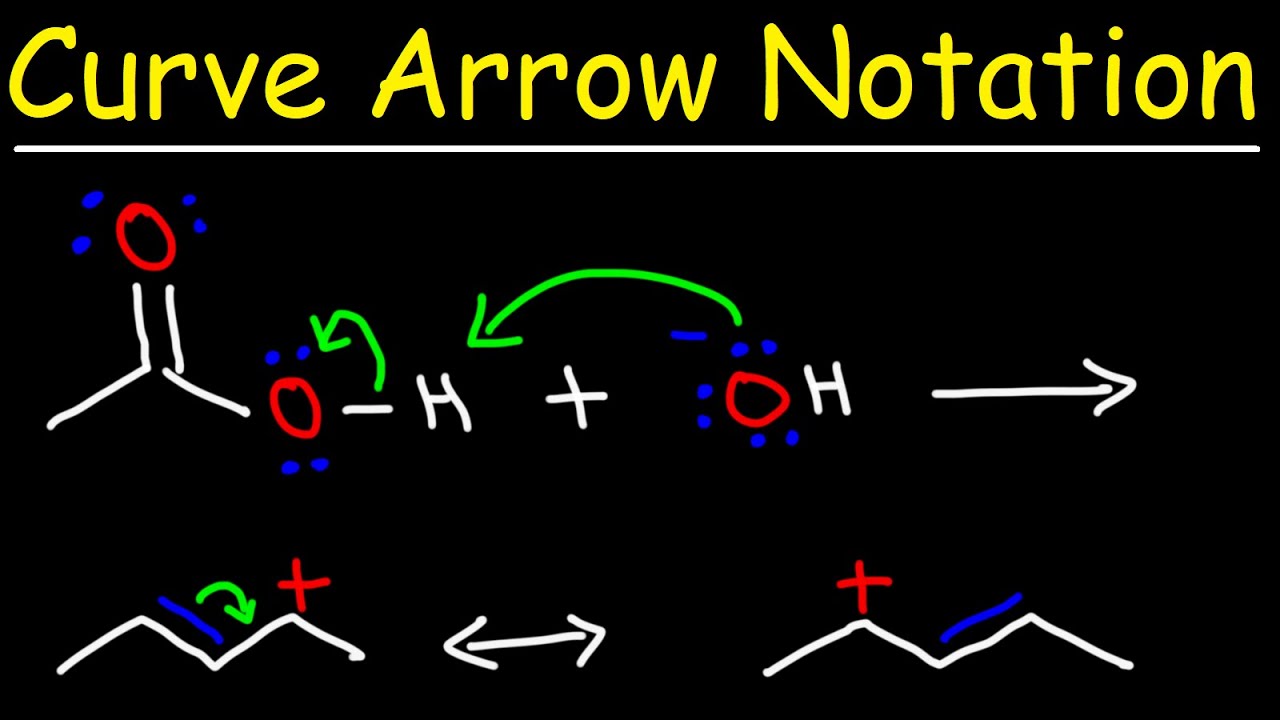







This lesson introduces four fundamental curved arrow-pushing steps in organic reaction mechanisms: (1) Nucleophilic Attack, where a nucleophile donates a lone pair to form a new bond with an electrophile; (2) Loss of Leaving Group, where a bond breaks and electrons go to the leaving group; (3) Proton Transfer (Bronsted-Lowry acid-base reaction), where a proton moves from one atom to another via electron pair donation; and (4) Carbocation Rearrangement, where the carbocation shifts position without changing molecular composition. Additionally, radical reactions use half-headed arrows to show single-electron movements. Curved arrows always show electron movement, not atomic movement, with double-headed arrows representing two-electron movements and half-headed arrows representing one-electron movements.
Curved Arrow Pushing in Reaction Mechanisms | Organic Chemistry
Added:reaction mechanisms and curved arrow pushing to be the topic in this last lesson on a chapter of organic reactions and mechanisms now we're going to go through and identify the four most common mechanistic steps and the associated curved arrow pushing we'll actually work through several examples show that arrow pushing which shows the movement of electrons involved in each because these are things you're definitely going to need to get down and understand fairly well before we start using them in the mechanisms of well over a hundred reactions by the time you finish second semester now this is your first time joining me my name is chad and welcome to chad's prep where my goal is to make science both understandable and maybe even enjoyable and this is my brand new organic chemistry playlist i'll be releasing these lessons weekly throughout the 2020-21 school year so if you don't want to miss one subscribe to the channel click the bell notifications you'll be notified every time i post a new lesson alright so mechanism so mechanisms are just a big sequence of steps where we show all the bonds being broken and all the bonds being formed uh on the way and in the order in which they happen and converting reactants into products now it turns out there's four very common mechanism steps now it's not an exhaustive list but it's the four most common that'll come up time and again and then we'll do one that's kind of going to be stand alone from those four they're one of the less common types so but those four types are going to be nucleophilic attack they're going to be loss of a leaving group proton transfer which is just simply a bronsted-acid-based reaction and then finally we'll have a rearrangement and specifically we'll do a carbocation rearrangement which will be the most common type of rearrangement you'll see but later in second semester you might see a couple of other funky rearrangements but if i'd say in first semester here the only type of rearrangement you're likely to see is a carbocation rearrangement all right so let's take a look at the first couple here and in this case i'm going to give you reactants and products and then we're going to have to fill in the curved arrow pushing that shows us how to get from reactants to products and the idea here is that again these curved arrows are going to show us the movement of electrons and first principle is that when you've got a double headed arrow and when i mean when i say double headed arrow i mean where it's got the two heads to it that shows the movement of two electrons whereas if i've got a half-headed arrow that shows the movement of one electron at a time and that'll be important so most of the time we're gonna be dealing with two headed arrows and showing the movement of two electrons at a time but when we deal with ra in reactions involving radicals as we'll see we'll be using these much more commonly so and radicals aren't going to be super common we'll have one big chapter we deal with radicals but most of the rest of organic chemistry we'll see very few reactions actually involving radicals and we're not going to spend a lot of time on them so the last reaction the chapter will deal with these but up until that point the most common foremost common again types of steps are all going to involve moving pairs of electrons at a time so if we look at this first one here so we look at reactants and products and you say okay what's different and it really helps if you draw in all the lone pairs especially early on when you're starting to get these mechanistic steps down and stuff and in this case you see that bromine's got four lone pairs and in the end he's only got three one of those lone pairs must have done something i also see that i've got a new bond between carbon and bromine that didn't exist on the reactant side and so now i can see oh so one of these lone pairs on bromine must have been used to make that new bond and so the arrow we draw is from one of the lone pairs to the atom it ends up bonded to and so notice i didn't draw the arrow to the positive sign i drew it to the carbon at least i got as close to it as i could get with that positive sign being in the way but to the carbon itself and in this case we call this nucleophilic attack so just like i pointed out in the last lesson i like to think of nucleophilic attack as nucleophilic attach so we say the nucleophile attacks the electrophile in this case the electron rich species donating electrons to make the bond would be called the nucleophile and the species being bonded to would be called the electrophile and this is one of the more common mechanistic steps we'll see throughout organic chemistry here in this case that's the only arrow just one arrow showing that these two electrons have been used to make a bond to this carbon and voila there those two electrons have now become those two electrons in the bond that's nucleophilic attack all right so if we look at the next step here this is actually the exact reverse of the first reaction so instead of making the bond between bromine and carbon here now we're going to have that bond between bromine carbon we have it to begin with but it breaks in the process and so in this case i can see that those two electrons in that bond aren't present in the product so those have to go somewhere where do they go well i can see that i've got three lone pairs on bromine so and we're going to end up with four and so in this case we're going to take and draw an arrow from the electrons in the bond again the arrows always show where electrons go not where atoms go we'll take those two electrons and we'll make them go to the bromine as they'll be a lone pair on that bromine atom and in this case if all we're doing is breaking a bond so as we're doing here we refer to that as loss of a leaving group usually results in two separate species but that's not always the case but it is the most likely scenario so loss of a leaving group so now we've covered two of the more common mechanistic steps nucleophilic attack loss of a leaving group so we'll see a couple more examples we'll do we'll see another nucleophilic attack but we'll also see bronsted-acid-based reaction ae proton transfer we'll also see a rearrangement here in a little bit all right in the next couple here so here we've got what's called an alkene one of those functional groups you learned back in the day and uh this is a very common mechanistic step and a lot of those alkene reactions we're going to study a couple chapters from now but this is a little bit tricky and it might be easier you know i said earlier if you draw all the lone pairs it makes it easier so and for some of these early on now we won't typically do this when we get there but for some of these early on it might even help if you draw in some hydrogen so i'm going to redraw this one time here so we can kind of see what's going on and show the relevant hydrogens that might help make this just a little easier to decipher okay so now that we can see the hydrogens we can kind of get a better idea of what's going on and so which electrons are moving and stuff like this and i can see that this bond right here must be breaking so i'm going to kind of just put a little asterisk there to remind me of what's going on because i can see that bromine is no longer bonded to h in the end so that bond must break okay so what else is going on well we've got the pi bond that's no longer present in the product so that pi bond has got to go do something as well so and then from there i can kind of see that this carbon right here which has two hydrogens is going to end up with three whereas this carbon right here which has one hydrogen still is only going to have one hydrogen so i can see where i'm making a new bond and that third hydrogen right here well must be this guy the only other place he can get a hydrogen from and so i need to make a new bond between this carbon and this hydrogen to get here that pi bond needs to go away and this bond needs to break and bromine needs to end up with one more lone pair to get to four lone pairs all of those need to happen in this mechanistic step and so in this case i can see that if bromine needs a lone pair well he's going to get it from that bond breaking okay and those two electrons are going to end up going to bromine and being his fourth lone pair now the rest of this is a little bit tricky but we know this pi bond needs to move and the question where does it go well it turns out it is being used to create so the new bond to this hydrogen so cool so we're going to bond to this hydrogen in this case drawing it from the the bond itself that actually could mean one of two things a little ambiguous what it means when we draw it like this it could mean that we're either bonding to this hydrogen with this carbon or this carbon we would draw the same arrow either way and so in this case for us we know it means bonding to this carbon because that's you know been the products were supplied to us we know it's going there but we would have drawn the same arrow had it ended up on this carbon as well it wouldn't have actually looked any different so with the pi bond a little bit tricky there but in this case it is being used to make a new bond between in this case i'll just draw on a little dashed line to kind of show us where that's happening but that's not actually part of the mechanism so but it's being used to make a new bond right here between carbon and hydrogen but that's why this carbon is now going to be missing a bond and have a positive formal charge because the pi bond's gone it was used to make a bond to a third hydrogen right there so but this is it for the arrows it's actually just these two arrows we're going to move the use the pi electrons to make a new bond between carbon and hydrogen and then the bond between hydrogen bromine is going to break and so what we call this is a little bit tricky so in this case we could call this nucleophilic attack with the alkene being the nucleophile and hbr being the electrophile so however some people might say well if if the atom you're attaching to is a hydrogen you might actually just call this a bronsted-lowry acid-base reaction but you'll see that when we introduce this in the alkene chapter we probably will still refer to this as nucleophilic attack that's kind of how i've highlighted on your sheet but technically some people think well chad this might actually be bronsted-acid-base reaction a proton transfer and and technically there's a little bit of of confusion and i shouldn't even say confusion a little bit of vagueness here on which one it is or and technically you'll see it referred to as both in literature so if we go back to the original where we didn't draw in all the hydrogens then so just so we can see this one more time we're going to make a bond between this carbon and the hydrogen and then hydrogen only have one bond so the old one has to break and that was the arrow pushing so going back to here and again you'll get more and more comfortable with this as we go and as we start actually doing these mechanisms in the in the coming chapters without having to draw all the hydrants in but if it helps early on definitely draw them in help yourself out a little bit here now this next one here if we take a look so i can see that this bond between oxygen hydrogen no longer exists an oxygen instead of having two lone pairs it's going to end up with three lone pairs i can also see that there's a new bond between this oxygen and hydrogen as well so in this case the oxygen goes from having three lone pairs to having just two lone pairs and so in this case the hydrogen is transferring from this oxygen over to this oxygen and this is much easier to recognize is what we call a proton transfer reaction or simply just a bronsted-acid base reaction back in in chapter three we just simply call it an acid-base reaction and so most of the time in organic chemistry when we just say acid-base reaction usually what we really mean is a bronsted-acid-based reaction so because a nucleophile electrophile reaction is a lewis acid-base reaction so but if i just say acid-base most the time it means physically that it's a bronsted-acid-based reaction all right so looking at this here then i can see that i need to make a new bond between this oxygen and this hydrogen and that the oxygen which has three lone pairs only ends up with two so he's going to use one of his lone pairs to pull this off and so we're going to make a new bond between this oxygen and this hydrogen hydrogen can only make one bond so if we're going to make a new bond a hydrogen then the old one right here must break well where do those two electrons go well this auction right here is two lone pairs he's going to end up with three lone pairs and so that's where they go so forming that third lone pair that bond breaks to form those and that's the arrow pushing where the motion of electrons go in here now a lot of students will screw something like an acid-base reaction here up because they'll actually want to start an arrow from the hydrogen like yep he's going over to the oxygen but again keep in mind the arrows don't show you where atoms go they show you where the electrons are going and here an arrow should never start from an atom that doesn't have a lone pair of electrons so because technically every time an arrow starts it actually actually starts from the atom it starts from the lone pair of electrons on that atom every arrow should have its origin at electrons every time so this would definitely not be the arrow you want in blue here so just want to point out common rookie mistake there so but this is your proton transfer or bronsted-lowry acid-base reaction all right so we'll look at this next example and in this case we've got a carbocation and the carbocation is actually going to change locations it's somehow going to end you know start from this location and end up in this location so and again a carbocation just means that you are missing electrons here in carbon's case it means there's no filled octet he's only got three bonds and not four so that's the way carbon ends up with a positive formal charge and the question is how and on your study guide i was nicer than i am right here i actually drew in all the relevant hydrogens and stuff like that and i'm going to go back and do that again so this is a methyl group this is a methyl group this is a methyl group and we have a hydrogen attached here and we have one hydrogen attached here and then once again this is a methyl group this is a methyl group this is a methyl group and now we have two hydrogens attached to that carbon and none attached to this carbon again only three bonds so again the carbon with a positive formal charge only has one two three bonds carbon with a positive formal charge only has one two three bonds and that's how we kind of infer how many hydrogens are there this carbon no longer had a positive formal charge so it must have four bonds that's why we had room to draw in two hydrogens not just one and now we get a little clearer picture on what's going on here so you if you follow the positive charge you're gonna miss it that positive charge low and behold it doesn't even exist if you look at this molecule under an electron microscope you wouldn't see a plus sign go figure so don't look don't be fooled by that plus sign again the arrows always show the movement of electrons the plus sign is just a label to show us that this guy's electron deficient so it has a formal charge so don't don't be fooled by that we don't really follow those electrons and and in this case we want to follow the atoms as well and see where the new bonds are created we see that this hydrogen right here must be ending up as one of these two hydrogens right here because he's no longer going to end up attached to this carbon but this carbon's only bonded one hydrogen ends up being bonded to two and so somehow that's to move over well in this case don't follow the atom though again follow the electrons so this bond right here needs to break okay so not there in the product and it needs to reattach to this carbon right here and so this is not the most intuitive thing in the world but this bond breaking and then reattaching so it's just kind of like the hydrogen and its electrons pluck off and reattach right here that's what this arrow means the arrow shows when an arrow originates from a bond that bond is breaking and then we typically draw the arrow to the atom where electrons are attaching to and so in this case those electrons are just kind of shifting over and attaching over here which is why that hydrogen ends up attached to this carbon but that actually is the only arrow so and this is your rearrangement so especially this is a carbocation rearrangement and you kind of recognize a rearrangement because you essentially you don't gain any atoms you don't lose any atoms it's just a rearrangement in the structure of the kind of the skeleton of the molecule if you will so that's kind of how you recognize your rearrangement so at this point we've covered nucleophilic attack we've covered loss of a leaving group we've covered bronsted-acid-based reactions i.e proton transfer and now we finally covered rearrangement and carbocation rearrangement the most common that you'll see in fact in the next chapter we'll definitely go back through carbocation rearrangements and go into this in a little more detail than just being able to recognize it and show the arrow pushing but how to predict when it happens in things of a sort as well all right so last one here and this one is separate from all the rest it's not going to follow any of the normal patterns this is not nucleophilic attack it is not loss of a leaving group it is not a bronsted-acid-based reaction proton transfer it's not a rearrangement this one involves radicals here we have a carbon radical and a bromine radical so in the reactions involving radicals the mechanisms are just actually going to be presented fairly differently from all the mechanisms while the rest of the reactions will cover and so there's usually a chapter on radical reactions you know somewhere at the end of first semester possibly the beginning of second semester but usually at the end of first semester and you'll find out that the mechanisms are going to be represented very differently than all the rest of the mechanisms we draw so and sometimes in the arrows because we're gonna be having half-headed arrows involved so but also in just how we're representing them instead of having a linear progression of steps you'll find out that we have one steps you know kind of presented instead of having just like this goes to this goes to this goes to this which will be common we'll actually present these in kind of a repeating linear fashion it'll be a little bit strange so but you'll see when we get there so but as far as predicting the arrow pushing here so you can see that we end up with a new bond between this carbon and the bromine right there and that these two radical react uh radical electrons are gone i.e they must be the two electrons that are in that bond and so the question is how do we actually show that we're forming a new bond between this carbon and this bromine using these two electrons right here well the way we show this and again this is not the most intuitive thing in the world but the way we show this is we're going to put one of the electrons to form a new bond so i kind of put it off into this empty space here in the area between the carbon and the bromine and then we'll take another half-headed arrow and do the same thing over here so and that way it kind of shows that they're going off into the space right where they would join them together sometimes you'll even see different uh uh organic drawing programs or even professors or textbooks they'll put a little line in between the two and kind of draw these arrows as heading towards that line so it's you know some people like this some people don't whether or not you draw that line so i've seen it much more commonly without the line but you'll see it both presented both ways whichever way your professor is presenting it go with it but i'm going to go just like this where there's no actual like dashed line drawn in where the bonds being created anything like that so i think people are making that for simplicity sake i actually technically like it it's just i've seen it less common that way so but this is again the motion of one electron at a time which is why we have again those half-headed arrows and this really will be unique to radicals now if you found this lesson helpful would you consider giving me a like and a share a couple of the best things you can do to support the channel and if you've got questions on this lesson feel free to ask them in the comment section below now if you're looking for the study guide that goes with this lesson it's part of my premium course on chatsprep.com it turns out the study guides for the entire two semester course is over 160 pages long or if you're just looking for practice problem whether it be quizzes or chapter tests or practice final exams i've got over 800 practice questions in the course as well check that out again on chatsprep.com
Up Next
Grignard Reaction: Synthesis of Alcohols and Carbon-Carbon Bonds
@ProfessorDaveExplains
389.5K views•2015-01-05
Biocatalysis and Catalysis in Islatravir Synthesis | Merck Webinar
@SCIwheresciencemeetsbusiness
675 views•2020-10-08
Kinetics of Nuclear Decay: Half-Life & Radiocarbon Dating
@ChadsPrep
16.5K views•2022-04-13
Edible Water Bottles: A DIY Guide to Sodium Alginate Spherification
@ryan
10.5M views•2019-06-21
Related Study Plans & Knowledge Roadmaps
Structured learning paths in Chemistry