


















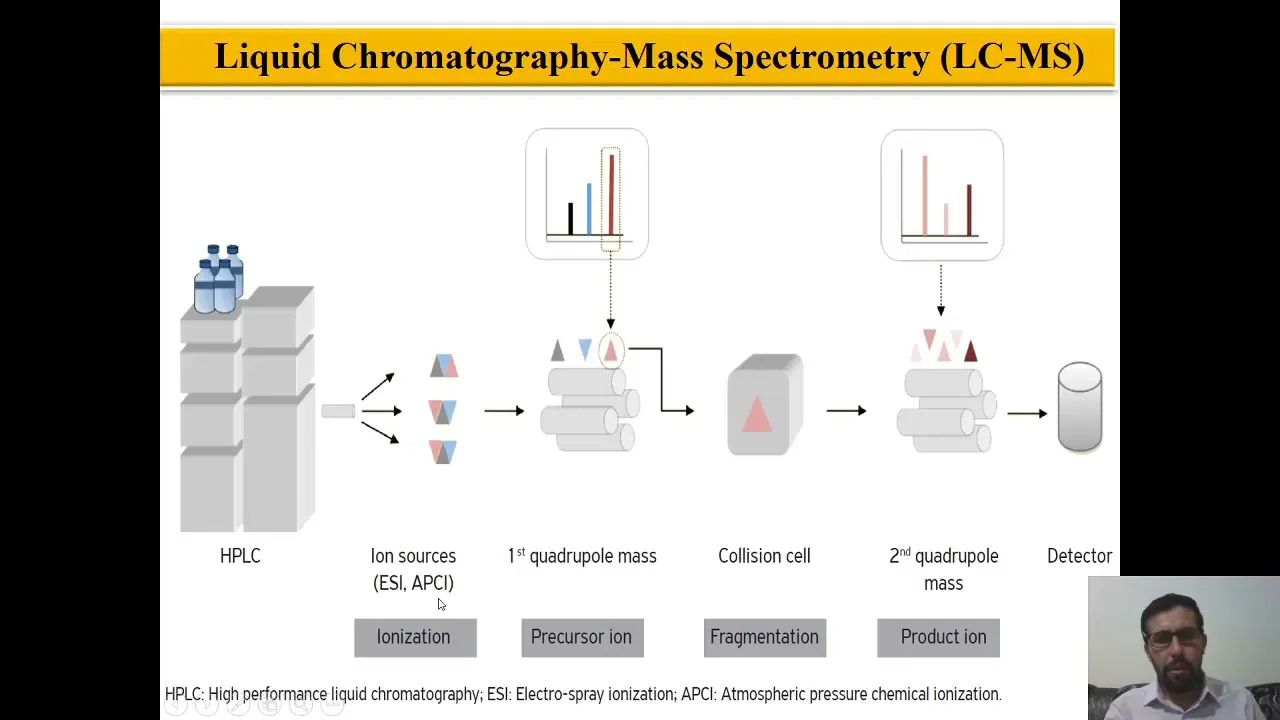


Mass spectrometry requires ionization to convert neutral molecules into charged species that can be manipulated by electric and magnetic fields. There are two main types of ionization: hard ionization (electron ionization and chemical ionization) which produces unstable molecular ions that fragment readily, and soft ionization (atomic fast bombardment) which generates more stable molecular ions with minimal fragmentation. Electron ionization uses high-speed electrons to eject one electron from molecules, creating M+ ions. Chemical ionization uses reactive gas ions like NH4+ or CH5+ as proton donors to convert neutral molecules into stable molecular ions. Soft ionization bombards atoms onto a liquid matrix containing the sample to generate molecular ions without extensive heating or fragmentation, making it suitable for heat-labile samples.
Mass Spectrometry Part 6: Ionization in Mass Spec (Hard & Soft)
Added:[music] Hello and welcome back friends. We have discussed several aspects of masspec.
Now we have missed uh some few important parts which are the chemical and physical ionization which is a very very important step of masspec at the very first level. Remember if you uh if you remember the model of the masspec instrument what we have designed in major three different uh place of it.
one is the source region then the analyzer then finally the detector or the computation uh thing. So, so if you draw the uh region, so what we can have, we are having this source region.
Remember, after the source region, we are having the analyzer. After the analyzer region, at the end of the analyzer, we are having the detector.
So, this is uh the schematic presentation of the masspec instrument.
So at the beginning this is the source and this is the region where every uh so this in this source region the the particles are generated. Now the important part about the massspec uh analysis that whatever sample we are taking we need to fragment that sample and that sample is become unstable by heating that sample using electrons and we call it a molecular ionization. Now using this molecular ionization. So molecular ionization. Now this molecular ionization is very important which is to be happen during in this source region.
Okay. So sample is prepared in the source region and the sample holder along with this ionization technique are coupled in many masspec instruments. Now after they generate the molecular ion.
So what happens actually the basic thing is that we are having the molecular ion at the beginning molecular uh and we at the beginning we are just having the sample it is a molecule in the source region this is getting fragmentalized.
So we we produce the molecular ion. It is produced into this molecular ion.
How? By leaving two electrons and we give them one electron. We hit this molecular molecule with one electron and it will generate M plus and lone lonely electron with two electrons will be released. So this is a type of thing which we are required. This is called the molecular ion or parent ion.
Now this parent ion or molecular ion will further going to divide into fragment ions right. So they are going to divide further into so let us take them and they can divide into say this parts they can divide into further small fragments. They are called fragment ion.
Now in this video we are focused on uh the fragmentization not only fragmentation but this total ionization process. Now the ionization which are required for the masspec are of two different type. Okay. So let's consider the ionization in masspec is of two different type. One is hard ionization.
Another one is soft ionization. There are two types of ionization. Now we can further divide this hard ionization into two different part. One is called the electron ionization and second one is called chemical ionization. So these are the distribution and the classification of ionization. Now this ionization as we know is very very important otherwise if we can't ionize the molecule of our interest we cannot push it forward through the analyzer because the the mechanism that uh this analyzer is dealing with it is giving the magnetic field right so the magnetic field and it is a charge field. Now any kind of electric or magnetic field we need charge molecule to work with because none of the neutral molecule is going to react under the field of magnet or field of electric. Okay. So we need to make them charged and this charge is also ensuring us that it is broken down into smaller fragments and it is also driven forward to the direction the direction of the detector. So we can utilize this charge pattern which is generated plus one charge which is generated most of the time uh to to push it forward towards the detector which is also important. So it is giving us a twoin one advantage. We have also discussed about it. Now especially we'll be discussing about this type of ionization. In the very first case what is hard ionization? Hard ionization is the basic ionization we have talked about so far. It means simply we are having an electron gun. So in hard ionization what happens? Uh let's consider here. So here here we are having the electron gun.
Say this is the electron gun.
Using this electron gun, electrons are fired and these electrons will move and it will hit the molecule of our interest or the sample which we prepared. It will hit the sample and as it hits the sample, it will generate this type of parent ions. Okay? And this electron will hit this molecule, it will kick one electron out from the outer orbital. And what it generates is m plus and one uh star which is denoting one electron. So one electron is kicked out and this electron is also released. So ultimately we are having two electrons released and a production of this parent ion. Okay.
Parent molecular ion. It is also called molecular ion. Okay. So this is a process is called we call it the hard ionization. And among them we call it the electron ionization. Okay. So the ionization we achieved utilizing electrons and we are utilizing the electron gun to use it to to make it a point. Okay. And another type of electron ionization also be obtained and that is in this particular kind of ionization using electron gun we don't require heat. We don't require heat. We just use this gun. And this in this case which is important is speed.
Speed of this electron is very important. So we are throwing the electron in high speed into this particular source and this source is also is vacuumed. This is vacuum condition is maintained. A vacuum condition is maintained for this electron to go and hit this molecular ion. Hit this molecule to generate the molecular ion. Now in other hand so we can look for it without any kind of heating.
So just no heating and with heat is also there we can use heat treatment in this electron ionization and utilizing tungsten filament instead of electron gun. Okay.
So in this case in case of this heat conditions what we use tungsten filament.
We can utilize tungsten filament. We can heat the source region in high temperature. And we heat it in high temperature. Tungsten filament is getting very much super hot. It will release electron and that electron is going to go and heat the molecule to produce a molecular ion. The mechanism remains the same but utilizing heat. So in this case of electron ionization, we can utilize heat as well as no heat to produce the molecular ion from our sample. Okay. uh but uh the utilization of this hard ionization and uh is that that we can utilize this uh type of ionization in case of the molecules which are chemical compounds mostly not biological compounds. Actually this this hard ionization are utilized for many different chemical compounds to and large compounds which are which can be divided into parental ions and the parent uh molecular ion that are generated utilizing this electron ionization technique are not that much stable. I'm emphasizing they're not that much stable. They are pretty unstable.
So as we are producing this parental ions they'll sooner be fragmentalized into the fragment ions. That's the true part. Now let's come to the chemical ionization which is also part of the hard ionization process but the chemical ionization is little bit different. So let's discuss about the chemical ionization here.
So chemical ionization.
Now in the chemical ionization what happens?
We are creating an environment to produce the reactive chemical species which is going to produce this molecular ion from the sample. Now how there are chemicals like ammonium ammonia and also methane. These are some of the gases that we can utilize in the source region and when we utilize these gases in the source region. So what we are utilizing here so let let me write it here. We can utilize ammonia we can utilize methane.
The utilization of these gases in the source region what it can do under heating. So we need to have these things. We need to have ammonia or methane in the source region and we heat it.
As a result of that this ammonia and methane or these gases we either use ammonia or methane. We don't use both of them at the same time but utilization of heat will convert them into the reactive ions or gaseous ion or reactive ion species or reactive chemical species like say so we can generate something like that okay you can generate things like that. So after the generation of this reactive chemical species of ammonia and methane what we can have we can they can interact with themselves because the environment is filled with this ammonia or methane. So what will happen this ammonia going to react with another and it will produce this thing. So again they are fragmentalized into these parts and this in case of methane if I draw again it reacts with another methane and what it can produce this thing. Now when they are producing these things when they're producing this uh this cations these gaseous cations or chemical cations and also some reactive ion species of gases then they can go and interact with the chemical species or the chemical sample that we're utilizing. Okay. And they will interact with the sample. So now in this case this NH4 plus and CH5+ these are the cations. Now these are very very potential proton donors because remember they are having lot of protons because that's why the sign is plus in all the cases because they uh release one electron and produce NH2 and CH3 and all these things. So we don't bother about this part but this NH4 plus and CH5 plus they are potential proton donors. So they can act as potential proton donors and they can provide their protons to our sample to pro to convert the sample into a positively charged molecular ion.
Now that's how they can generate molecular ions. So in further step of this reaction what we can uh go we can look for uh this let me erase this and we can look for the process like that.
So we are having this and then we are having the CH5 plus. So then what it will generates it will generate are CH2 CH3 plus H+ plus CH4.
So they'll produce this. So after so these are the steps. So after this particular step what it will do it will go and this is our sample for example it will convert our sample into a molecular ion. So this is the molecular ion of our interest. Now very important thing is that this chemical in case of this chemical ionization the ionized molecules or the production of the molecular ion biochemical ionization they are much more stable.
they are much more stable than uh those molecular ions produced via the electron ionization. Okay, these these species are much more stable. So we can utilize it when to generate much more stable parental ions. But we can utilize the electron ionization to generate uh unstable parental ions. Okay. So this is all about the hard ionization process.
Now let's talk about the soft ionization process. Now the soft ionization process in case of soft ionization process we cannot utilize any electron or we we don't utilize any kind of electron or chemical molecules to deal with the situation instead what we can utilize we can utilize an atom. So we call it the atomic uh bombardment process. Okay. So it is called the atomic fast bombardment or atomic fast bombardment or fab. It is called atomic fast bombardment or AFB. Utilization of the AFB is required for the soft ionization process. Now what we do in case of soft ionization process the the idea is again the same. So we're having the sample the sample is dissolved into a liquid medium a liquid matrix. Then what we do we utilize atom and we bombard the atom in high speed onto that particular sample along with this water or along with the liquid conditions or liquid matrix. Now we bombard it to the matrix along with sample and then what will it will generate? It will produce the molecular ion of it and then the solvent will be released from the from the place and it will provide us uh the molecular ion. So this is about the soft ionization. Soft ionization is not that much utilized. Most of the time hard ionizations are utilized but those soft ionization are required in very few cases where our sample is much more heat labile. In those case we need to use soft ionization because here we don't need heating we are having and and if our sample is much more fragile it is much more vulnerable to the breaking and also much more vulnerable to breakage into other fragments. We can utilize soft ionization and atomic fast bombardment to bombard atoms into the liquid matrix condition of the sample and it will generate the molecular of it. Now that is the difference between hard and soft ionization. That's why the name suggests hard ionization means we are utilizing the core particles like electrons. We are utilizing the some of the chemical reactive specieses uh to generate the molecular parent ion. But in case of soft ionization we don't require these things. we simply utilizing uh the atoms and we force the atoms to go and bombard it. Okay. So they are different in this ways and I hope this video is helping you to understand what type of ionizations we are doing and the requirements of ionization we have already discussed. So that's it. I hope this will help you. Thank you.
Up Next

Time of Flight Mass Spectrometry Explained | TOF-MS Principles
@shortchemistry7927
23.3K views•2020-10-04
Biocatalysis and Catalysis in Islatravir Synthesis | Merck Webinar
@SCIwheresciencemeetsbusiness
675 views•2020-10-08
1H NMR: Determining Number of Peaks from Structure
@MSJChem
59.2K views•2017-04-06

Edible Water Bottles: A DIY Guide to Sodium Alginate Spherification
@ryan
10.5M views•2019-06-21
Related Study Plans & Knowledge Roadmaps
Structured learning paths in Chemistry