











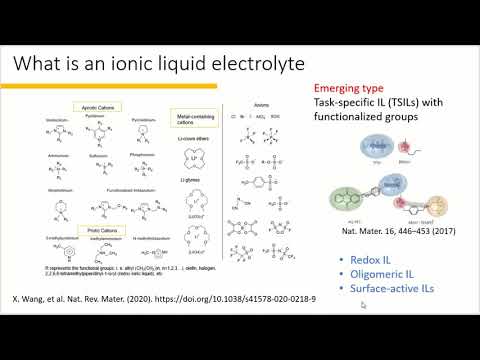







Ionic liquids are salts that remain liquid at room temperature (typically 100°C) and consist of asymmetric cations and large non-coordinating anions, giving them unique properties such as negligible vapor pressure, high thermal stability, excellent solvating power for both organic and inorganic materials, and high ionic conductivity; these properties make them valuable for applications including green solvents in organic chemistry, lubricants and additives for engines, and electrolytes in batteries and supercapacitors.
Ionic Liquids: Thermodynamics and Current Applications | TLU Chemistry Seminar
Added:Fundamental chemical bonding, specifically the distinction between ionic and covalent bonds, and intermolecular forces.
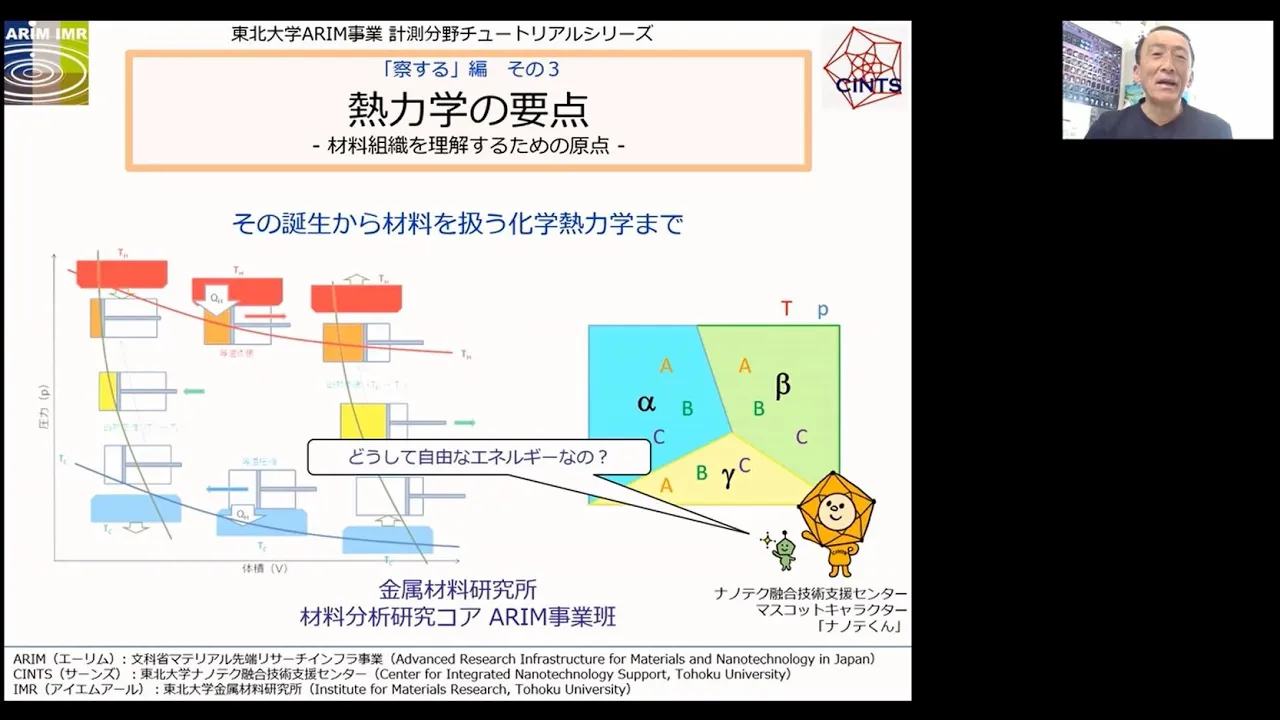
Basic chemical thermodynamics, including enthalpy, entropy, Gibbs free energy, and phase equilibria.
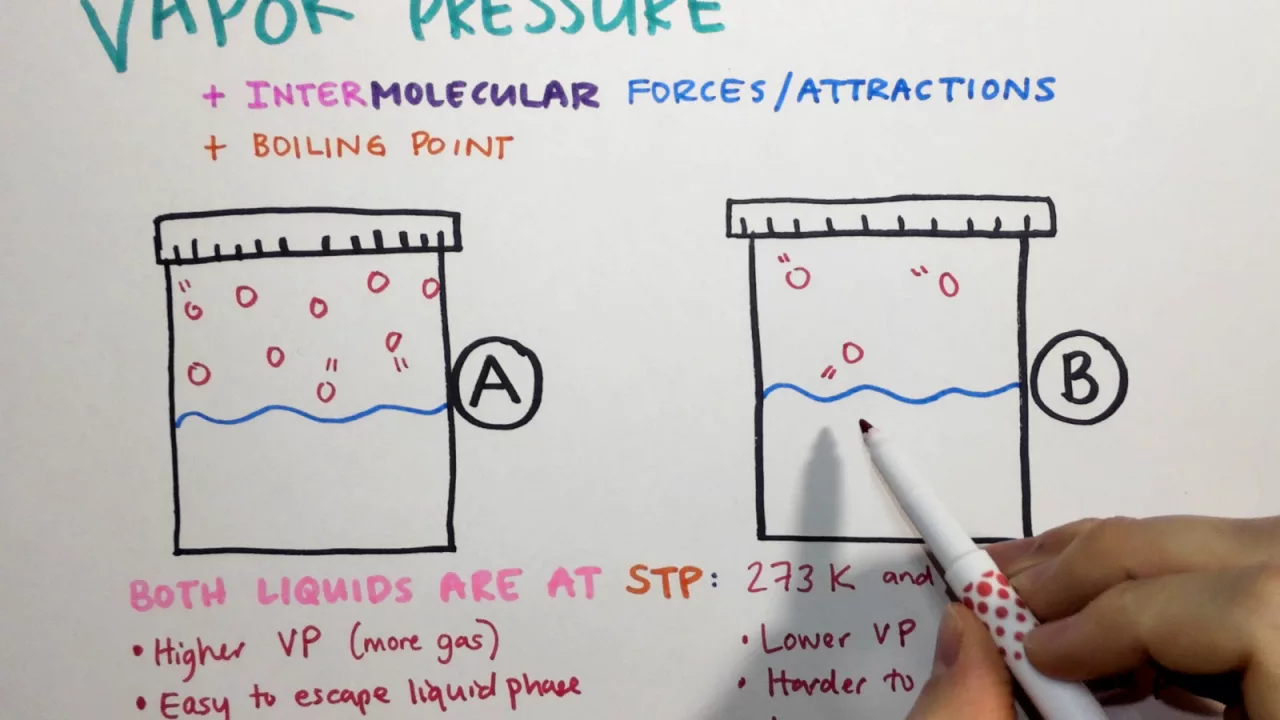
The concept of vapor pressure and how intermolecular interactions influence boiling and melting points.
Introductory electrochemistry, including the behavior of electrolytes, ion mobility, and electrical conductivity.
Advanced design of electrochemical energy storage systems (e.g., lithium-ion and next-generation batteries) using ionic liquid electrolytes.
Green chemistry principles and the synthesis of 'task-specific' ionic liquids for industrial carbon capture and biomass processing.
Tribological applications of ionic liquids, focusing on their performance as boundary lubricants under extreme temperature and pressure conditions.
Computational thermodynamic modeling (such as COSMO-RS or molecular dynamics simulations) to predict the physical properties of novel ionic liquid mixtures.
11.5K views85likes32:56Original Release: 2016-11-28
[Music] Texas Lutheran [Music] University I just want to make sure Jesus well it is our great treasure and honor and I guess that's all I got right to introduce Eddie saw it who's been here for what 7 and 1/2 years basically years right yeah a long time and he's graduating with a BS in chemistry perhaps maybe maybe and he's going to head back to bont yeah right and eventually go to Gras I'm going to come to Bowmont and find him that's a plan in organic right yes trust me that's in here talk us a little bit about ionic liquids how they work the thermodynamics of them and some current and new applications thank you thank you thank you as Dr Davis said my name is Eddie Scott here if you don't know me shame on you but if you do do know me props to you so I'll be discussing understanding thermodynamic properties of ionic liquids um in regards to current and new applications so a quick little outline I'll be discussing what ionic liquids are starting with kind of like a definition in general moving into some history and then some of the general properties and after those properties I can talk about the thermodynamic properties of ionic liquids once I finish with those towards the end I'll discuss the current applications and some brief future applications so ionic liquids what are they they're basically salts that are liquid at room temperature and that temperature is usually around 100° Cel 212 Dees fenhe whatever pleases you more and they don't really stay in 100° celius range they can vary to lower some values are negative you know 5060 deg C and some are higher generally peing at 600 700 and 800 so ionic liquids are compounds completely made up of ions so you have a cation which is positive and you have an anion which is negative and just a simple version you have sodium chloride sodium bromide or lithium iodide any of the simple ones uh discussed throughout this presentation will show up and so ionic liquids are polar but they also have non-coordinating ions which means the anion doesn't react or interact well with the cation whatsoever and that's due to the size of the anion the asymmetrical abilities of the Caton so what happens you have a delocalized charge which is one component and also an organic comp component so what happens is the electron is not attached to any bonds but it has the ability to step out of the boundary of the Le structure and this is an interesting uh situation so in order to kind of study that more you use resonance structures and I know all of you have done resonance structures multiple times maybe yeah resonant structures okay so through those you can actually study and record uh the location of the electron and so on liquids also don't have stable crystal ltis and a crystal lattice in water we'll say is very stable there's no defect effect meaning that there is no uh ion flowing around there's no charge moving around freely and so with ionic liquids that what makes them unique cuz the stochiometric properties aren't one: one the ratio is usually 2: one maybe 4:1 that's due to the size of the Anon and the asymmetric asymmetrical abilities of the cat and so here are some names you have the most common ones which all use quite a bit ionic liquids iOS and room temperature ionic liquids RTS and then one that's kind of used quite a bit are these right here molten salts and they deal with liquids that are kind of the 600 700 800 range so we talk about the sodium chlorides sodium bromides and stuff like that you also have room temperature molten salts liquid organic salts fused salts and neoteric solvents so here I want you to focus mainly on the first several here so I think the one ethyl through one hexil the one ethyl 3 methyl imidazolium uh catons those are more important because a because of their chain length which is very important and also because they're melting points you'll see some they use the peridinium but it's not as important or not used as much uh for the cations and then also anions there's a lot of bromide iodide chloride methyl sulfate and then Tetra borate is used quite a bit so now I'm moving on to some history in the mid 1800s around like 1860 uh the first ionic liquid was discovered as a red oil uh in fral crafts reaction and for yall who don't know Charles Fredo and James craft you're losing in life but basically what happens is they came with a process process where they would take a CH atom off of an aromatic ring group and replace it with an alal halide and in the process they would use a catalyst which this is where these ionic liquids come in handy so they came up with an aluminum chloride derivative so they used here as you can tell he hepto chloride dialuminate salt and it proved to be extremely useful it was useful on the fact that since they didn't know much about the physical or chemical properties they weren't really able to understand that because the NMR wasn't invented yet and NMR was invented around 1950 I believe so what they just used it for is kind of useful material they couldn't really improve on other applications so around 1860s this was kind of an important finding it kind of was a pivot point to organic chemistry uh moving on to early 1900s so they were able to synthesize the first room temperature ion liquid an ala ammonium nitrate uh in 1914 so they decided to figure out okay this is where they start using chain links uh this is one of the derivatives so we have ethyl ammonium nitrate you can see here you can see the cation and anion but it had the ability to have a melting point of 12 degrees C which is extremely important because if you were look back at molten salts they had a melting point that was extremely high and this works to uh be more beneficial in working as a catalyst in reactions so the idea was keep the anion large catons asymmetrical and so uh 1960s uh a man of by the name of La a king of the Air Force Academy he had a group of researchers and students that were there on the base with him and he decided to improve Pro on using electrolytes and thermal batteries and it's important I put an aster here to uh kind of make a highlight because in a world we use energy a lot and the idea of storing energy it's very important that this idea was U kind of used so they wanted to figure out a way to improve on the electrolytes used and this tic mixture so they had lithium chloride and pottassium chloride and the idea was to decrease the melting point while kind of keeping a high thermal stability so after understanding the batteries needed to operate at a temperature of 375 to 550° C they investigate those Chlor illuminates that I discussed previously and they were like okay let's figure out if we can use ionic liquids and see if we can decrease the amount of uh temperature needed to for these batteries to kind of perform they were able to do that they came up with a structure that was able to reduce the temperature by 200° C about 175 de cus is where they could operate now and that's kind of important to see now because there were plenty of prototypes created and once those prototypes were introduced to the thermal battery industry they were able to improve it and they still improve it today so that's very important I want you to remember this uh moving along to 1990s where most of us were born all of us were born there except for four people so discovery of ionic liquids uh that did not react with water it's important because when dealing with those thermal batteries a lot of times they would react with water and they were like okay we need to kind of fix this it doesn't it doesn't pose a real threat but it kind of hindered the ability for those applications to improve and so they had to get away from the Chlor illuminates and they discovered these alkal imidazolium ionic liquids and so after they were induced introduced they kind of had a very good melting point very average good for what their structure was and they had to use anions that kind of were fairly large in size so they came up with uh Tetra Flor borate and you have the hexa Flor borate uh they these weren't used Too Much I see a lot of these because these deal a lot with viscosity as well and later they came up with triflates meates and this other structure as well so now properties what are on what are the ionic liquid properties and these are extremely important because they have probably the most unique properties out of any liquid uh starting with great solvents for inorganic and organic materials organic carbon chain based and inorganic everything else um non-flammability there are times where they can be flammable but there's not too many cases so they kind of keep it as non-flammable because most often times they use those who have low melting points and work well with engines as lubricants and additives uh varying Miss ability their ability act as a Sol and we use that an organic chemistry again for uh engines they act as lubricants and U any type of additive uh their ability to be stored for long periods of time without decomposition and that mainly this ties in with uh the thermal stability because they have very high thermal stability so they have a ability to stay at a high temperature range and not decompose as quickly as other solvents being used and all will disc discuss this more when we get to Applications with engines uh negligible negligible vapor pressure uh dissolution recy recycles very easily and extremely high ionic conductivity and the ion conductivity happens from that defect in the lattice they the ion has the ability to free roam especially when given the temperature difference if you have a high temperature there's more collisions which the free roam isn't there but with a lower temperature there's more free roam which helps with the ion conductivity so here's just a chart you can look at the value use uh viscosity here we look a lot at and then conductivity usually less than 10 Mill semens per centimeter uh it kind of stops the lowest value I think is one uh 1.0 mement per centimeter which is really good a very conductive and then vapor pressure usually negligible so moving on to high onic conductivity like we know with water water is sorry water is conductive I took my thing off on accident but also we want to use ionic liquids because they have stronger ionic composition so we came with these values of one to sorry my bad values of 1 to 10 Mill per centimeter and then they were able to understand those properties and create something that had 20 mmen per centimeter which is extremely high very conductive which works well with a lot of reactions so you have these two compounds here you have the one ethyl three methyl imidazolium thiate and the one ethyl three methyl imidazolium diamide right here uh so looking at this circuit here you can see how the electrolyte works and we need to understand the conduct ity is directly related with the temperature as I discussed previously a decrease in temperature helps tremendously because in that lattice you have a couple vers couple defects the shocky defect and the Frankle defect and that gives the uh ion the ability to free roam and so if you look at this next picture here for the shock key defect you have two opposite oppositely charged ions and they have the ability to leave their sight vacant and roam around the lattice over on the right side you have the Franco defect which a single ion gr this positive or negative has the ability to leave its site and it'll end up leaving it vacant being not being replaced by anything and go to another site that's already being occupied and kind of move around in that area so now moving on to dissolution this is the ability for it to dissolve any application any substance so they use this a lot for cellulose and the idea with cellulose it's extremely abundant I don't know if there's biology people in here but okay there oh three four but the idea is it's extremely abundant and it's used with a lot of applications so trying to improve that a little bit better is why they use ionic liquids cuz I know with cellulose if it were to be dissolved in something else it'll actually swell up and it doesn't actually serve its purpose whatsoever so for this idea for this property they wanted to kind of compare like okay what works best is it the cation is it the anine which serves the purpose of dissolution so they used the one butal 3 methyl imidazolium cation they wanted to test that with several anions so first they use normal ones you got the chloride the fluoride bromide and iodide died but the issue was the viscosity increased tremendously and that's that poses a real threat cuz it doesn't work as uh how it should be it doesn't dissolve the uh substance as well as it possibly could so they use different ions so they tested acetate formate and phosphate and you can see this value right here 23 gram per mole of solubility which is extremely impressive and so they're like Okay cool so the Anon obviously plays a role so let's move on to the Caton let's see if the Caton kind of has more of an effect so due to the chain length they changed it up a little little bit they use the one methoxy ethyl 3 methyl imidazolium and that change it by a factor of three so you have 8 gam per mole of solubility which is a huge decrease so we're like okay obviously they both play a role so we need to understand that not only is the alal chain group important but we also need to worry about the size of the annion moving on to present day just like with the thermal batteries the idea of having mixtures of ionic liquids poses to be more of a support system than doing it by itself so they came up with weight percentages of 14.5 of one alal 3 methyl imidazolium chloride and then a 16 we percentage of the one ethyl 3 methyl imidazolium acetate and it increases the uh solvent power using these two together which also can be improved with uh diyl cyp oxide DMSO and it also reduces the reaction time which is something that we look forward to uh when running experiments so here's just a quick picture of uh applications you use a lot for fuel uh I know in clothing maybe in shelters and stuff like that cellulose is widely used uh now moving on to negligible vapor pressure and this is the idea of not having the ability to be volatile we don't want to use liquids that are volatile we don't want them evaporating into the air and we don't want any fumes to be created so using these ionic liquids I first want to point out these there are ionic liquids they use ifs here but I'm going to call these molten salts that have a melting point of 800 plus we'll say here they actually have vapor pressure above one so that's we can kind of count those count those out already but when we compare these that are kind of on the lower Trend we got three ionic liquids here at low melting points compared to the water and Benzene and I want to note here that it does increase through temp with temperature so that does make sense as the temperature rises so does the vapor pressure but you want to kind of stay in this area when in comparison of about 50 to maybe 100 degree difference in kelvin we can use these ionic liquids and they'll have no vapor pressure which is good for us because we don't want anything to be volatile so the idea was to get rid of these conditions where we had to keep them in ultra high vacuum conditions or under hoods and where to they wouldn't react with air so the idea of using these uh low melting point ontic liquids with very strong compositions was what we really wanted to do so that's why negaal vapor pressure is an important property to ionic liquids here's a quick little p picture just no vapor pressure and comparison to vapor pressure it helps a lot with factories it helps a lot with engines and stuff like that cu the heat of the engine will actually cause the liquids to kind of be more volatile uh increases safety awareness uh so ionic liquids are really good this is a very important property for Ionic liquids now moving on to thermodynamic thermodynamic properties uh which we know is the idea of understanding heat and temperature in relation to work and energy so understanding how that works we can discuss heat capacity which everybody should know who take who's taken gen cem one or two it's the idea of heat required to raise the temperature of one mole subst substance uh by one degree Celsius without a phase change but when regards to thermodynamics we want to understand the ratio of energy in that temperature so that's extremely important also glass transition temperature melting temperature which relates to that asymmetric ability of the Katon we want to keep the Symmetry very low um thermal decomposition again we have enthalpy entropy density and viscosity so talking about thermal stability and decomposition we want use applications at very high temperatures at some point so we want to find ionic liquids that work best uh at high thermal stability and which don't decompose readily at that point and so some of the uh biomass dissolution uh liquids that we use are acetate based amino acid based uh and then really focusing on the alal imidazolium based U ionic liquids because of their abilities or because of their uh ability for the anion to not readily interact well with the cat and so moving on to understanding the stability order first thing we can understand is the coordinating nature we talked about the defect in the lattice and we discussed how the free range or the ability for the free roam to happen also nucleophilicity how strong the nucleophile is hydrophilicity kind of reaction time and then focus more on these two right here because these are use a lot more as I discussed at the very beginning and there's also tetral Tetra alal ammonium and piperi oh so decomposition occurs for several reasons the main ones we want to talk about is when the Anon attacks the Caton we discussed how for iic liquids we really want that Anon to not interact well with the Caton we want to keep it as a large Anon base and an asymmetrical cation and also we want coordinating anons so any red reduction of the coordination ions that's we don't want that at all so prevent decomposition we want to keep that thermal stability high so moving on to viscosity lower viscosity is extremely important we use this a lot with engines we use it a lot with any type of lubricants we use it a lot um even in reactions as well like we discussed with the cellulose so for viscosity the anons play an important role you can see here I as I showed the Tetra borate and the hexif borate are used and actually have a very big reason for why this is viscous and so you're like okay we need to figure out can cat now so they they compared the two alal ammonium base and then the imidazol olum based and the imidazolium proved to be a little bit better in viscosity it proved to be a lower viscosity and that's what we need to use because of the chain length and what happens with the chain length if it ends up being longer it ends up uh it has the ability to be Tangled and the viscosity will increase due to that tanglement and it takes a little bit longer for it to get untangled so we want to kind of keep the chains fairly short uh here's just a table of showing you from shortest to longest dealing with lower to higher viscosities these are used quite a bit the one eth one but one hexal and now looking at this chart I really want you to focus on this left one right here because the other ones are in comparison of some that are fairly high but they use this chart to discuss the viscosity so you understand at room temperature generally right here you know the one ethyl version has a lower viscosity so that's what we want and but then we can compare okay one butal one hexal one octal it all increases at the chain length increases but as temperature increases we can also see okay the viscosity will decrease but in General we kind of want to keep with the one eth one butle because if we can start low viscosity and start with a low melting point it proves to be more efficient than okay let me start with this one octop and then I got to raise the temperature by like an extra 100 degrees we we prefer not to do that but it is possible so in comparison we want to work with these uh onic liquid groups and maybe even the one groups as well so now moving on to applications due to these uh properties that we discussed uh we can use them as lubricants and additives um any type of Separation we have solvents electrolytes and the ones I'm going to focus more on are solvents and organic chemistry for you lubricants and additives and electrolytes so as an U lubricant and additive we know when any motor vehicle what happens is due to friction there's about 15% of energy loss and in order to prevent that we use oils you know if you don't put oil in your car that's you're probably going to run into some problems so use oil and the idea is maybe even combination of ion liquids with that oil or using ionic liquids in general to replace that oil so here are the properties we'll be focusing on high thermal stability negligible vapor pressure you don't want any explosions you don't want to drive down the road and explode non-flammability and high flexibility so looking at comparing High viscosity and lower viscosity the idea was okay High viscosity is going to be great because you know it would be better wear protection it's going to sit in there it's going to be in between the ring to cylinder contacts it's going to slow it down it's not going to rub as much and it's going to be more efficient but then we look at low viscosity and the idea was better fuel economy and so they were able to kind of compose some tests they compared uh due to better wear protection thermal stability and pressure or viscosity ratio we looked at a couple oils in an ionic liquid so you have Mobile One engine oil everyone probably uses that Royal Purple engine oil never heard of this but people probably use it and then ionic liquid version 17 right off the bat you can see these three values decomposition temperature extremely important it's a factor by 200 and we all know when a vehicle is running it gets extremely hot so if the decomp decomposition temperature is low at like 230 260 it's going to decompose at a higher like a higher rate it's going to decompose a lot quicker so we want to use the ion liquid here which is at 472 extremely efficient and then moving on to the viscosities as we discussed the higher viscosity here okay better wear protection but the couple slides ago where we showed the graph higher viscosity also has a temperature increases has the ability to decrease tremendously so it's only about six more after so long than the other two so granted you want to kind of look at these two versions but then you want to come back to this decomposition temperature and you want to keep that fairly high so also as an additive now this is where we want to understand adding an ionic liquid to an already solvent to use an additive uh for engines and the idea was okay maybe if we add it to something else maybe it will help a little bit more and yeah that proved to be uh proved to be right so we have comparison of high uh viscosity oils here which starts off better better wear protection but over time you can tell the lower viscosity one prove to be better so they the the question they asked was like do we want something who's that's working better now or do we something to work better over time because this can help with future applications where maybe we can come up with straight ionic liquids that can be at lower viscosity that start off better and finish better than high viscosity oils so now moving on probably the best part of my presentation like ever made organic reactions and catalyst so we're going to deal with how they work as solvents and how they work as catalysts so first with uh the applications we'll talk about with Catalyst discussed the use of them uh to promote B leis acids take advantage of controlled acidity um RTS as neutral solvents tasp specific ionic liquids as lians um and catalysts and also the properties you really want to understand is their thermal stability kind of water solubility how readily they are be recyclable and uh melting points so now looking at fral crafts again we understand we can do the alation aculation reaction so with alation we discuss the substitution of the CH atom group on that aromatic ring we'll use Benzene as an example here and it's replaced with an alkal halide group for the acation version we replace it uh with a carboxilic acid as shown here and for these reactions ionic liquid really serves as purpose to be more efficient now that we have uh NMR we can understand its thermodynamic properties we can use it for other applications which right here for ferine and for those who don't know what ferine is this is extremely important in the medicinal field a because it has plenty of derivatives used for any medicinal reason but also for cancer research this is widely used and the idea is you have cyclop pentadine uh anions here kind of sandwich the iron um and what happens is a regular solvent has the ability for both of them to react they has the ability to give them good yields but the ionic liquid forces it to have to uh interact with both of them so it forces it to give a better yield better products and it forces it both rings to react so that's why they use uh ionic liquids in this type of situation and as a solvent we I'm going to discuss these a little bit more but you want to really look at their low viscosities and high thermal stability uh low vapor pressure great solvents for inorganic and organic materials uh extremely high polarity um because we want to keep the non-coordinating ions in check uh imiss ability has and then synthetic flexibility so dealing with hydrogenation this uh is the ability to produce a hydrocarbon and we kind of keep want to keep that hydrocarbon bond to a single Bond not a double or triple and this gives us the ability to come up with Naproxin which is an anti-inflam inflammatory drug uh noner steroid steroidal I believe right biology people okay cool and then along with that it helps with pain so if you have I don't know Burns Cuts blisters sores whatnot go ahead and pop you a couple of these bad boys and you'll feel amazing but what happens with hydrogenation you need to react a metal complex in an ionic liquid and because of ion ionic liquid's ability to serve as dissolution you can dissolve this into this ionic liquid and the reaction works perfectly the idea that the metal serves its purpose has to be done through this ionic liquid so that's why ionic liquids are used in hydrogen now moving on to Super capacitors and batteries there the best right there that battery life is what I'm about to explain to you we need to get rid of that lithium ion batteries so just like with super capacitors and batteries they generally work the same way you have stored energy you ready are we good Okay cool so they store energy and then they have the ability to release that energy but more readily super capacitors and Ultra capacitors are used for that reason they can store the energy and at any moment you can flip the switch turn it on and you can get that energy as much as you want batteries however they do store more but over time they decompose that's why they want to kind of come up with the idea of lithium ion batteries Powerhouse Dr Bray lithium yeahoo yeah awesome use it as rechargeable energy so this is what we'll talk about uh right here you can see this graph you have two metal rods kind of and use the ionic liquid for the ions they have strong ionic composition so we use the ions to create that energy and there's a separator in the middle this is where we kind of trap and we kind of hold on to that energy and we can release it discharge it at any moment which proves to be extremely useful so lithon lithian ion batteries we want to recharge batteries we want to use that because in a world where we have energy and need energy to use like almost anything this is where uh we want to be able to improve on being um more efficient when conserving our energy so using ion liquids creates a chemical reaction in the middle and this chemical reaction will go over a certain amount of time regarding on how strong it is and you can collect and store that energy and then use it throughout its decomposition State and with lithium ion their idea was to be able to charge this and if you can recharge it it's reusable so the recycling rate increases if we can keep the stability and decomposition to a low so that's why we use ionic liquids as electrolytes for batteries and super um capacitors so kind of some f future applications mainly for these engine lubricants and fuel additives we want to focus on kind of running more tests where they don't act as additives but they act as their own ionic liquid structure we want to kind of keep it to where maybe we don't have to add anything to it we can keep it low viscosity but it still proves to be better than high viscosity solvents working as a catalyst keep those chains very low who want to improve on melting point alwayss uh prove on the strength and electrolytes uh biofuel cells and also for um those lithium ion batteries so in conclusion we know ionic liquids are absolutely amazing green solvents green media they have great properties they work well with absolutely everything uh they're improving tremendously now because about 150 years ago they're like what is this like I have no clue what this salt is it tastes salty it looks salty it works salty but now it works to be better than just being salty and so future applications I discuss and then viscosity dissolution and their ther Thal stability I think are the most important things we really need to understand for Ionic liquids because if we want to improve on any type of reaction especially with cellulose especially with batteries we need to understand the viscosity dissolution and thermal stability these are my 17 references and there are no questions because everybody [Applause] understands any student or no I said there's no questions friends West going to talk about now charge here unfortunately is how much how much is everyone going to miss me when I'm gone too much student family friends questions first then the Beatdown begins after that yeah I know I'm so you have a microphone on I'm just kidding I that didn't happen I'm sorry can you edit that out question from the audience or we ask 10 you're going to leave it in there no no one asked any questions just tell me how great I did their questions aren going to be as bad as ours that's what I'm saying that's okay I already told you what's going to happen when you ask me questions did y'all enjoy it was it cool yeah cool okay awesome great ask question okay cool I'll just shut my mouth in chemistry question I got I Gotan I have a question can you get your slide about the cellulose please can you click the as soon as he finishes giving you the death stair you know Becky I don't know much about cellulose so how about you educate me let's go let's find it this one what's the purpose of like dissolve like the dissolution of cellulose in chemistry I know cuz I mean cellulose if you were to mix it with like water It'll like kind of swell up and they don't want to do that they want to be able to break it down and study it more and then they can apply it for like I know fuel they use a lot of times but I don't know I saw there was clothing they said shelter a couple times and I was like okay cool I guess you know just understanding the properties kind of fuel can you make from B what kind of fuel can you make from cellulos I don't know I know this talked about like dissolving wood don't avoid the question what kind of fuel can you make from cellul I don't know Green fuel okay what kind fuel I don't know I really don't what do you what's what's a fuel you can actually ingest that's the fuel they're trying to make okay awesome oh you can make bombs with sucr too the attention I really don't know what kind of Fu I really don't What organic compound can you inject you're talking to someone who doesn't know organic chemistry doesn't matter I bet you everybody in here doesn't know organic chemistry and they probably all right well let's hear the answers guys what does it say back of my truck oh is his truck weird I don't know what it's older I think but what kind of why do they grow a whole bunch of corn in the midwest other than eating it what's another reason they use corn call there you go what that's right okay thank you I was he was going to say corn syrup same yeah that's plant matter that's they're trying to figure out how to make awesome learn something every day yeah that's what cellulos is plant awesome mom got AE hey let's go I think his mother just got his BS hey good he's been here with his BS for a long well that's right I set that one up for you for that one later so wow tag team me huh that's cool wait other questions mom can ask a question obviously she's got some chemistry background over there yeah she's a genius I know that ski the generation did it yeah mov to that one right there all right well let's thank Eddie one more [Applause] time for more information please visit tlu.edu
Up Next

19:09
Biocatalysts in Green Chemistry: Enzymes as Catalysts for Synthesis
@KirtiPatelChem
16.2K views•2020-12-17
83:56
Biocatalysis and Catalysis in Islatravir Synthesis | Merck Webinar
@SCIwheresciencemeetsbusiness
675 views•2020-10-08
10:06
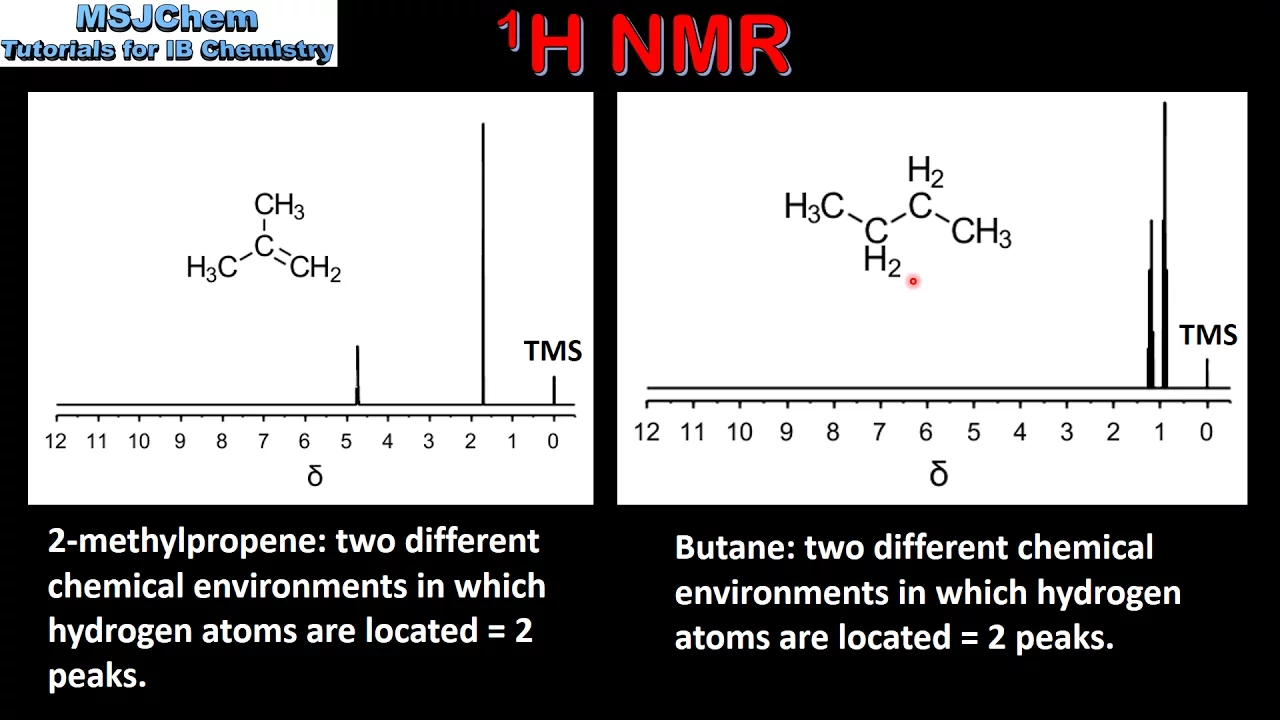
1H NMR: Determining Number of Peaks from Structure
@MSJChem
59.2K views•2017-04-06

17:31
Edible Water Bottles: A DIY Guide to Sodium Alginate Spherification
@ryan
10.5M views•2019-06-21
Related Study Plans & Knowledge Roadmaps
Structured learning paths in Chemistry
chemistry
Nuclear Chemistry: Decay, Meds & Fuel Cycle
01Introduction to Nuclear Structure and Radioactivity
02Decay Dynamics and Kinetics
03Radiation Interaction and Detection
+ 2 more learning modules
24h5 modules
Explore Roadmap
chemistry
Supramolecular Chemistry: Forces & Machines
01Foundations of Chemical Bonding and Intermolecular Forces
02Introduction to Host-Guest Chemistry
03Thermodynamics and Dynamics of Self-Assembly
+ 2 more learning modules
16h5 modules
Explore Roadmap
chemistry
Photochemistry: Excited States & Reactions
01Foundations of Light-Matter Interactions
02Molecular Orbitals and Electronic States
03Photophysical Processes and Jablonski Diagrams
+ 2 more learning modules
18h5 modules
Explore Roadmap
chemistry
Coordination Chemistry: Bonding & Properties
01Introduction to Transition Metals and Ligands
02Crystal Field Theory (CFT) and Geometry
03Magnetic Behavior and Spin States
+ 2 more learning modules
14h5 modules
Explore Roadmap