Balsa wood, recognized as the softest wood in the world, can be easily dented with a fingernail yet is surprisingly effective for engineering applications such as building bridges and cranes that can support substantial weight (50 lbs of sand) when properly designed and constructed.
Understanding Wood Strength and Structural Limitations
Added:Deep Dive
Basic tree anatomy and the biological difference between hardwoods and softwoods.

Wood anatomy (1) Hardwood and softwood structure 1
16.3K
Wood anatomy differs fundamentally between hardwoods (angiosperms) and softwoods (gymnosperms): softwoods consist primarily of tracheids—long, thin cells serving dual functions of mechanical support and water conduction through pits in their cell walls—while hardwoods contain vessels for more efficient water transport; both types include parenchyma cells arranged radially for storage and secondary conduction, and softwoods additionally feature resin ducts as protective structures that produce resin in response to injury.
Click to watch →

Wood anatomy (2) Hardwood and softwood structure 2
8.2K
Wood anatomy differs fundamentally between softwoods and hardwoods: softwoods have a simpler structure composed mainly of tracheids (vertical cells) and uniseriate ray cells (single-cell-wide horizontal rows), while hardwoods have a more complex structure with fibers (support-only cells), pores for liquid conduction, and multiseriate ray cell bundles, with pore distribution determining whether the hardwood is ring-porous or diffuse-porous.
Click to watch →

NEET: Plant Anatomy - L 6 | Secondary Growth | NEET Biology | Class 11| Unacademy NEET | Pradeep Sir
76.6K
Hardwood is produced by dicotyledonous plants (angiosperms) and contains vessels, fibers, and parenchyma cells. Vessels are tube-like structures for water conduction, while fibers provide mechanical support. Hardwood is harder, more durable, and suitable for furniture and construction. Softwood is produced by gymnosperms and consists mainly of tracheids, which serve both water conduction and support functions. Softwood is lighter, easier to work, and commonly used for matches, cricket bats, and paper production.
Click to watch →

I Made The Most Satisfying Desk
5.8M
The primary classification difference between hardwood and softwood is not based on physical hardness but rather on botanical origin. Hardwoods come from deciduous trees, which are trees that lose their leaves seasonally (not evergreen). Softwoods come from conifers, which are evergreen trees. This classification applies regardless of whether the wood feels hard or soft to the touch.
Click to watch →

Microscopic Anatomy and the Identification of Wood and Charcoal
1.7K
Softwoods (gymnosperms/conifers) and hardwoods (angiosperms/dicots) have fundamentally different cellular structures. Softwoods contain tracheids that perform both water transport and structural support functions. Hardwoods evolved separate cell types: fibers provide structural support (making oak hard and basswood soft), while vessels handle water transport. Growth rings consist of early wood (spring growth with larger cells) and late wood (summer growth with smaller, denser cells). Environmental stressors like hurricanes can dramatically reduce growth ring size by limiting photosynthetic capacity. Resin canals in pines serve as defense mechanisms against insects.
Click to watch →
Deep Dive
Fundamental physics concepts of mechanical stress, including tension, compression, shear, and bending forces.

Grundlagen mechanische Spannungen
212
Mechanical stress describes internal loading on a cross-sectional area with units of Newton per square millimeter. Five basic loading cases create different stress types: tension, compression, bending, shear, and torsion. Tensile stress (σ = F/A) occurs when forces pull away from the material, while compressive stress follows the same formula but with inward-directed forces. Bending stress combines both: the top fiber experiences tension while the bottom experiences compression, with the neutral axis in between showing zero stress. The bending moment equals force times lever arm, and the section modulus determines resistance to bending deformation.
Click to watch →
ESFUERZO, DEFORMACION y MODULO DE ELASTICIDAD FISICA (teoría y clasificación de esfuerzos)
942
Five types of mechanical stress are studied: (1) Tensile stress - forces at opposite ends cause elongation and reduced cross-section; (2) Compressive stress - reversed forces cause compression and increased diameter; (3) Shear stress - equal opposite forces cause cutting or shearing; (4) Bending stress - forces cause the body to bend; (5) Volumetric stress - fluid pressure compresses the body in all directions. All these stresses are studied under conditions where deformation is small enough that the body returns to its original shape when the force is removed.
Click to watch →
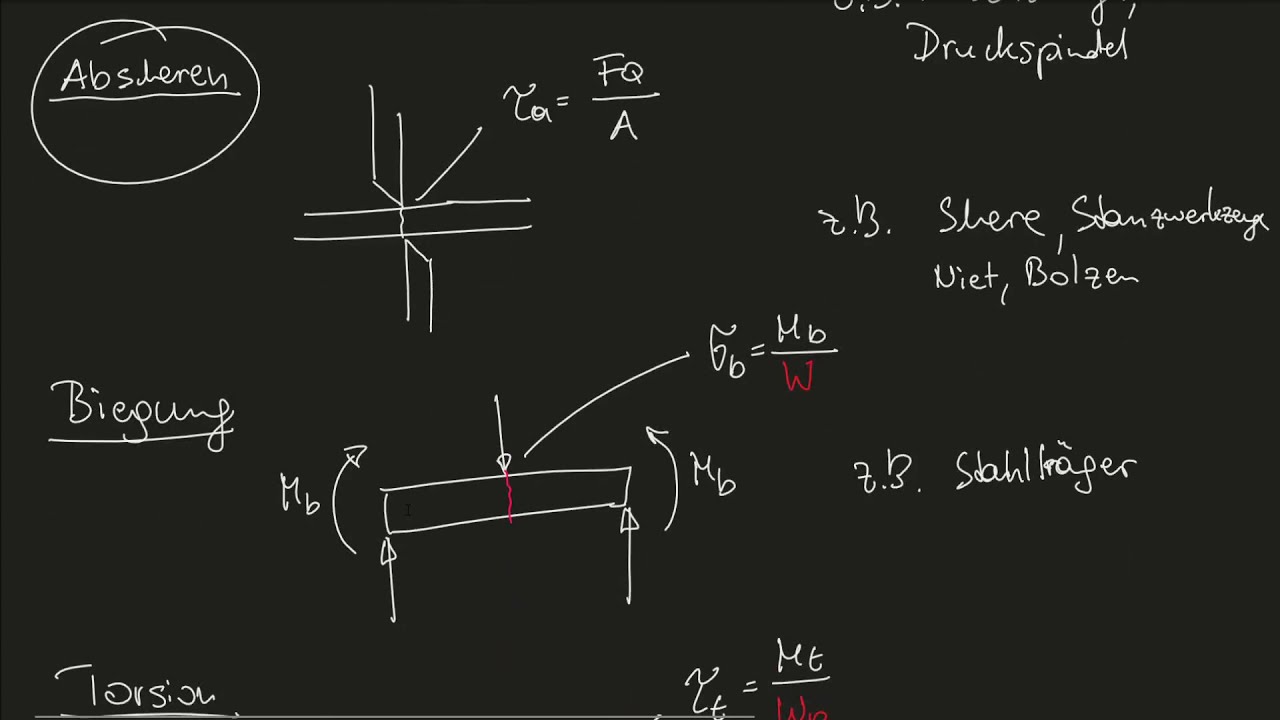
Spannungen - Die 5 Beanspruchungsarten
7.2K
The five fundamental types of mechanical stresses in engineering are: (1) Tensile stress (Zugbeanspruchung) - normal stress from pulling forces, calculated as force divided by cross-sectional area; (2) Compressive stress (Druckbeanspruchung) - normal stress from pushing forces, also force divided by cross-sectional area; (3) Shear stress (Scherbeanspruchung) - tangential stress from sliding forces, force divided by cross-sectional area; (4) Bending stress (Biegebeanspruchung) - normal stress from bending moments, calculated as moment divided by section modulus; (5) Torsional stress (Torsionsbeanspruchung) - tangential stress from twisting moments, calculated as moment divided by polar section modulus. Normal stresses (tensile, compressive, bending) act perpendicular to the cross-section, while tangential stresses (shear, torsion) act parallel to the cross-section. These stresses can be combined when they act in the same plane.
Click to watch →

RESISTENCIA DE MATERIALES en 5 Minutos: Lo Que Necesitas Saber
24.3K
Materials are subjected to five types of stress when forces are applied. Tension occurs when forces pull an element and elongate it. Compression happens when forces squeeze the element. Shear stress occurs when forces move from their line of action and cut the element. Torsion involves rotating forces applied in opposite directions. Bending occurs when a force is applied to a beam, causing it to buckle. These stresses can deform mechanical elements like car axles or building beams.
Click to watch →

垂直応力やせん断応力ってなに?材料力学の専門用語を分かりやすく説明【材料力学用語辞典】
9.7K
Stress is defined as force divided by cross-sectional area. There are two fundamental types: normal stress (σ) acts perpendicular to the cross-section, causing elongation or compression, while shear stress (τ) acts parallel to the cross-section, causing angular deformation. In three-dimensional mechanics, there are six stress components: three normal stresses (σx, σy, σz) and three shear stresses (τxy, τyz, τzx). Normal stress is positive in tension and negative in compression. Bending creates a stress distribution where stress is zero at the neutral axis, positive on the tensile side, and negative on the compressive side.
Click to watch →
Deep Dive
The relationship between wood and moisture, specifically how moisture content leads to shrinkage, swelling, and warping.
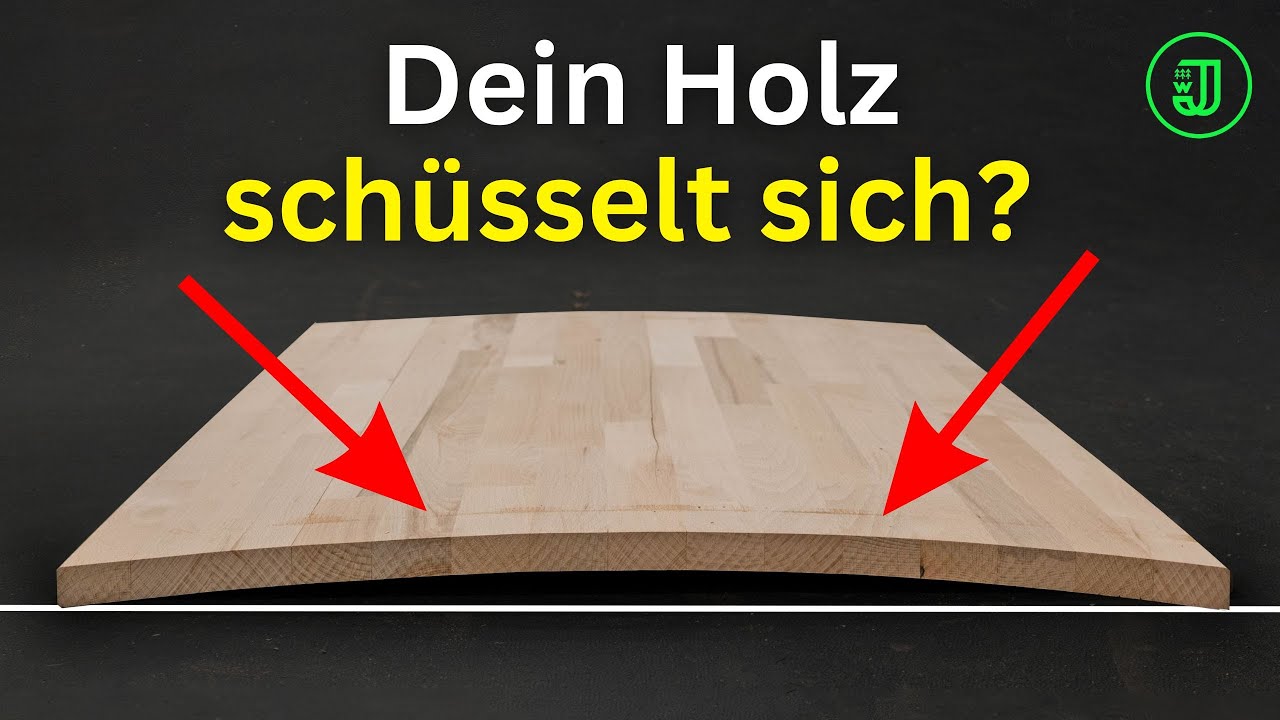
So einfach bekommst du KRUMME PLATTEN wieder GERADE! | Jonas Winkler
171.7K
Wood warping is directly related to moisture content differences between the wood and its environment. When wood absorbs or releases moisture, it expands or contracts. If the moisture content difference between the wood and the surrounding air is too high, the wood will warp significantly. This is why properly dried wood with stable moisture content is essential for dimensional stability. The greater the moisture differential, the more severe the warping will be.
Click to watch →
![Z drewnem jest pewien problem...wilgotność. [Nowa seria] Nie wiem, ale się dowiem!](https://i.ytimg.com/vi_webp/9R2O2pSWO5o/maxresdefault.webp)
Z drewnem jest pewien problem...wilgotność. [Nowa seria] Nie wiem, ale się dowiem!
39.7K
Wood exhibits two primary moisture-related problems: swelling when absorbing moisture from humid environments, and shrinkage when losing moisture, which causes cracking, joint loosening, and structural instability. Wood contains three types of water: free water (65% of total moisture) stored in cell cavities, bound water (30%) incorporated into cell walls, and a marginal third type. The fiber saturation point at approximately 30% moisture content is critical—below this point, bound water removal causes dimensional changes. Equilibrium moisture content (EMC) is determined using tables correlating relative humidity and temperature with moisture content. Wood shrinks in three directions (tangential, radial, longitudinal) with rates varying by species and direction. The shrinkage formula ΔW = W × ΔMC × SC calculates dimensional changes. Heartwood is more stable than sapwood due to radial grain patterns. Proper joint design is essential to accommodate shrinkage and prevent structural failure.
Click to watch →
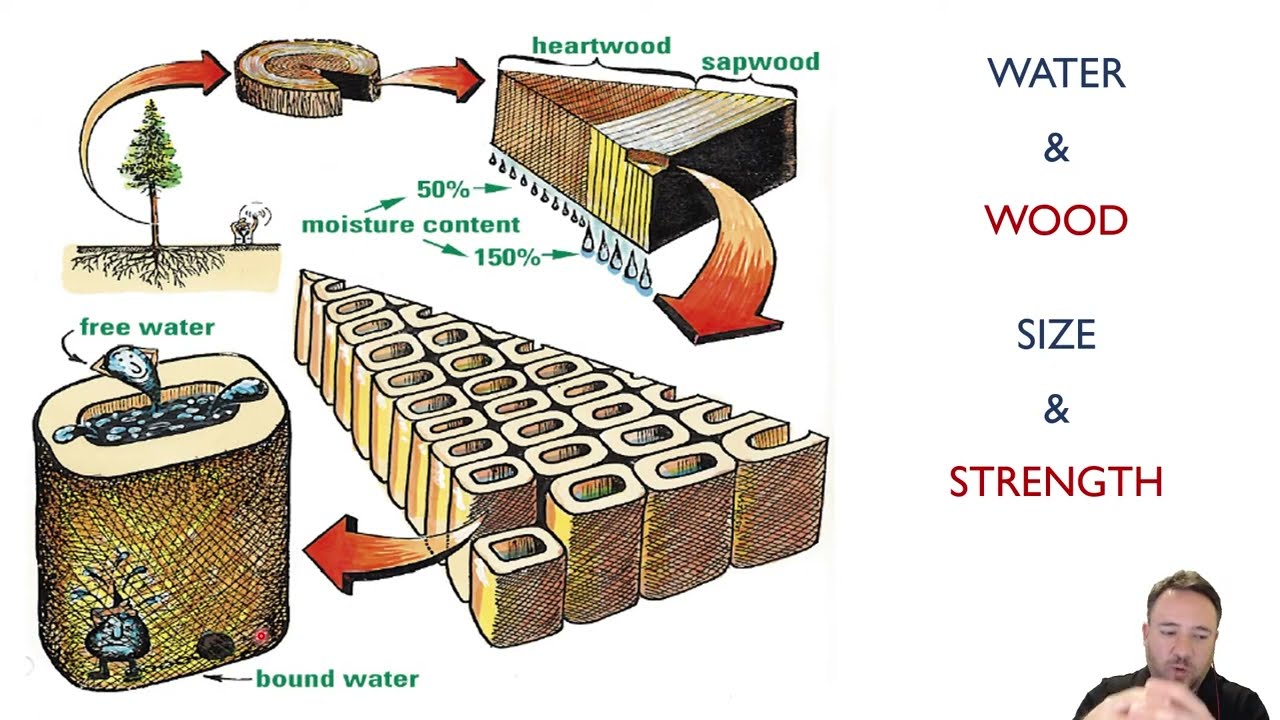
Effects of Moisture and Shrinkage of Wood
5.2K
Wood undergoes dimensional changes based on its moisture content, with shrinkage occurring primarily in the tangential and radial directions (cross-section) rather than the longitudinal direction (grain), following a fiber saturation point where bound water in cell walls causes expansion/contraction while free water in cell cavities does not affect dimensions; this anisotropic behavior creates challenges in construction, such as differential shrinkage between structural members leading to warping, gaps, and connection failures if not properly accounted for in design.
Click to watch →

What Is David Working on Today? 7/11/20 - Paint Drawers
39.9K
Wood that is freshly cut (green wood) tends to curl and warp when cut in half because it contains high moisture content, while wood that has dried over time becomes stable and maintains its shape; this explains why old wood from the 1940s remains straight and beautiful while modern wood cuts curl.
Click to watch →

Byggnadsvårdskonferens 12 december 2025
205
Wood contains bound water (in cell walls) and free water (in cell lumens). The fiber saturation point is at 25-30% moisture content. Below this point, wood shrinks as bound water evaporates. Different applications require different equilibrium moisture contents: furniture for heated rooms needs 5-7%, exterior wood needs 12-14%. Wood shrinks when drying below the fiber saturation point. In mature wood, shrinkage occurs only tangentially and radially (no longitudinal shrinkage). In young wood near the pith, shrinkage occurs in all directions because fibrils are at 45-degree angles. This causes warping and cracking. Wood exhibits hysteresis during drying and rewetting, where the absorption curve differs from the desorption curve. After multiple cycles, the curves converge. Wood strength increases as moisture content decreases: at the fiber saturation point, tensile strength is about 60 N/mm², while at 5% moisture, it doubles to about 120 N/mm².
Click to watch →
Deep Dive
An introductory understanding of natural wood defects such as knots, shakes, splits, and decay.

Defects in timber
31.4K
Timber defects are irregularities making timber unsuitable for construction, with timber being highly vulnerable to decay. Defects are classified into five categories: natural forces, fungi, insects, conversion processing, and seasoning. Natural force defects include chemical staining (chemical discoloration), ring shakes (abnormal bark swelling from improper branch cutting), knots (branch roots breaking fiber continuity), deadwood (useless dead tree wood), shakes (longitudinal cracks between annual rings including heart shakes, star shakes, cup shakes, ring shakes, and radial shakes), twisted fibers (from wind/injury during growth), upsets (crushing damage), bulls (bubble-like projections from young tree injuries), coarse grain (reduced strength from rapid growth), and drunkenness (white spots indicating early decay).
Click to watch →

acheter son bois, où, comment et les pièges à éviter
116.5K
This section covers identifying and understanding wood defects. Knot types include live knots (firmly attached), dead knots (loose), flat knots, and resin pockets that can crystallize and reopen. Heartwood coloration (coeur rouge in oak, coeur noir in beech) is a common defect. Fissures (fentes) and checks (gerçures) are caused by weather conditions and growth stress. Branch wounds (blessures d'élagage) occur when large branches are removed. Wood splitting happens when the cambium layer fails to bond new growth rings during drought periods. Understanding these defects helps select appropriate wood and predict behavior during processing.
Click to watch →

Building Materials | Quick Revision Class | Rush Hour | Civilianz
176.6K
Natural defects in timber are imperfections that occur during tree growth and development. These include knots (where branches join the trunk), shakes (separations along the grain), and checks (cracks that develop due to uneven drying). These defects affect the strength, appearance, and usability of the timber for construction purposes.
Click to watch →

Wood Defects and Deterioration
1.1K
Wood defects such as knots, shakes, and splits reduce structural strength by interrupting the grain continuity, with knots being particularly detrimental to tension strength; wood deterioration primarily occurs through fungal decay when moisture content exceeds 20%, requiring proper drying, drainage, and sometimes pressure treatment to prevent biological degradation.
Click to watch →

AE/JE BMC Imp Questions | All AE/JE Exams | Civil Engineering Classes #19 | BMC By Aditya Sir
2.6K
Wood defects include twisting (longitudinal rotation of edges), checks (cracks through limited thickness), and splits (cracks through entire thickness). Natural defects include heart shake (from pith toward sapwood), cup shake (follows annual ring path), and star shake (widest at bark). Insect-induced defects include termites (eat wood from inside), marine borers (only in salt water), and beetles (convert wood to powder). Dry rot is caused by fungus due to improper ventilation, converting wood to dry powder.
Click to watch →
Prerequisite Knowledge
- Concept 01Basic tree anatomy and the biological difference between hardwoods and softwoods.
- Concept 02Fundamental physics concepts of mechanical stress, including tension, compression, shear, and bending forces.
- Concept 03The relationship between wood and moisture, specifically how moisture content leads to shrinkage, swelling, and warping.
- Concept 04An introductory understanding of natural wood defects such as knots, shakes, splits, and decay.
Subsequent Learning
- Step 01Structural engineering design codes and load-span tables for sizing timber beams and joists.
- Step 02The mechanics of timber connections, including fasteners, bolts, and traditional wood-to-wood joinery.
- Step 03Advanced engineered wood products (such as Glulam, CLT, and LVL) and how they bypass natural structural limitations.
- Step 04Wood preservation techniques, chemical treatments, and design practices for durability against rot, pests, and fire.
Softest Wood
School Task
Bridge Result
Crane Mission
Outcome Tease
Softest Wood
0:00Playing Section
- 1
Identifies balsa as the world's softest wood.
- 2
Recalls first encountering balsa in middle school.
- 3
Notes the wood's softness by denting it with a nail.
Engineered Mass Timber and the Overcoming of Natural Wood Limitations
Traditional structural timber selection focuses on managing the natural defects, directional grain, and inherent variability of solid wood. However, the paradigm of Engineered Wood Products (EWPs)—such as Cross-Laminated Timber (CLT) and Glued Laminated Timber (Glulam)—challenges the necessity of relying on pristine, high-grade natural timber. By slicing, laminating, and bonding smaller or lower-grade wood fibers together, mass timber redistributes natural defects (like knots) and creates highly predictable, isotropic, and dimensionally stable structural elements. This alternative approach shifts the engineering focus from selecting flawless natural wood to designing composite wood systems that far exceed the structural, span, and fire-resistance limitations of traditional solid timber.
Deep Dive
Structural engineering design codes and load-span tables for sizing timber beams and joists.

2018 IRC Significant Changes to Deck Provisions
7.4K
This section covers structural member sizing for deck framing. Southern pine now includes single-ply beam options with short spans. Cantilever should not exceed one-quarter of center span length. Connections require minimum 2-inch lumber remaining after notching; splice bolts need 2.5-inch spacing between centers and 0.75-inch edge distance. Joist bearing is 1.5 inches on wood or metal connectors. Blocking at least 60% of joist depth is required when joists rest directly on beams. Joist span tables show interior spans and maximum cantilevers—the shorter of: (1) quarter of actual span length, or (2) tabular cantilever value. For example, a southern pine 2x10 at 16-inch spacing has a 14-foot span table value but only a 3-foot cantilever limit if actual span is 12 feet.
Click to watch →

Maximum beam spans based on joist cantilever length
101.1K
Deck beams differ significantly from prescriptive house design as they transfer loads to posts rather than walls. Beam spans are measured from center of bearing to center of bearing, similar to joists, and must account for tension, compression, and deflection stresses. Proper bearing requirements are 1.5 inches for wood/metal posts and 3 inches for concrete/masonry. The 2021 IRC beam span tables are based on 40 psf live load (equivalent to 40 psf snow load) with options for 50, 60, and 70 psf snow loads. Tables include various lumber species with spans in two-foot increments, allowing interpolation. Beam sizes range from single-ply 2x6 minimums to triple 2x12s. Footnotes cover dead load (10 psf), deflection, lumber grades, beam depth, incising, and measurement references.
Click to watch →

2024 IRC Significant Changes to Deck Provisions
631
This section covers beam and joist design principles. The 2024 IRC simplified beam span determination by expanding tables to show different joist span lengths with varying cantilevers (0, 1, and 2.5 feet) rather than using the effective joist span adjustment factor from previous codes. Beam spans go from center to center of posts, with connections requiring 1.5 inches bearing on wood/metal or 3 inches on concrete/masonry. Joist spacing is limited by both decking material requirements and joist span tables. Joist spans go from center of bearing to center of bearing. Lateral restraint prevents joist rotation through joist hangers, blocking between joists (minimum 60% of joist depth), or rim joists secured with three 10-penny nails or 3-inch screws. Decking must be attached with deformed shank nails or #8 wood screws.
Click to watch →

Flat Roof DIY Shed Or Garden Room Including Span Table!
7.6K
Span tables determine appropriate joist sizes based on span length. C24 timber allows larger spans than other grades. For garden rooms and sheds with height restrictions, a 6x2 (145x47mm) joist can span up to 3.47m according to tables, though practical testing shows 4m spans work well with no deflection. The table assumes 400mm joist spacing and supports permanent loads of 50kg per square meter plus imposed loads of 150kg per square meter for access and repair only. Mark joist positions starting at 377mm from the edge (not 400mm) to account for stud positioning, then mark every 400mm using a pocket square to draw straight lines.
Click to watch →
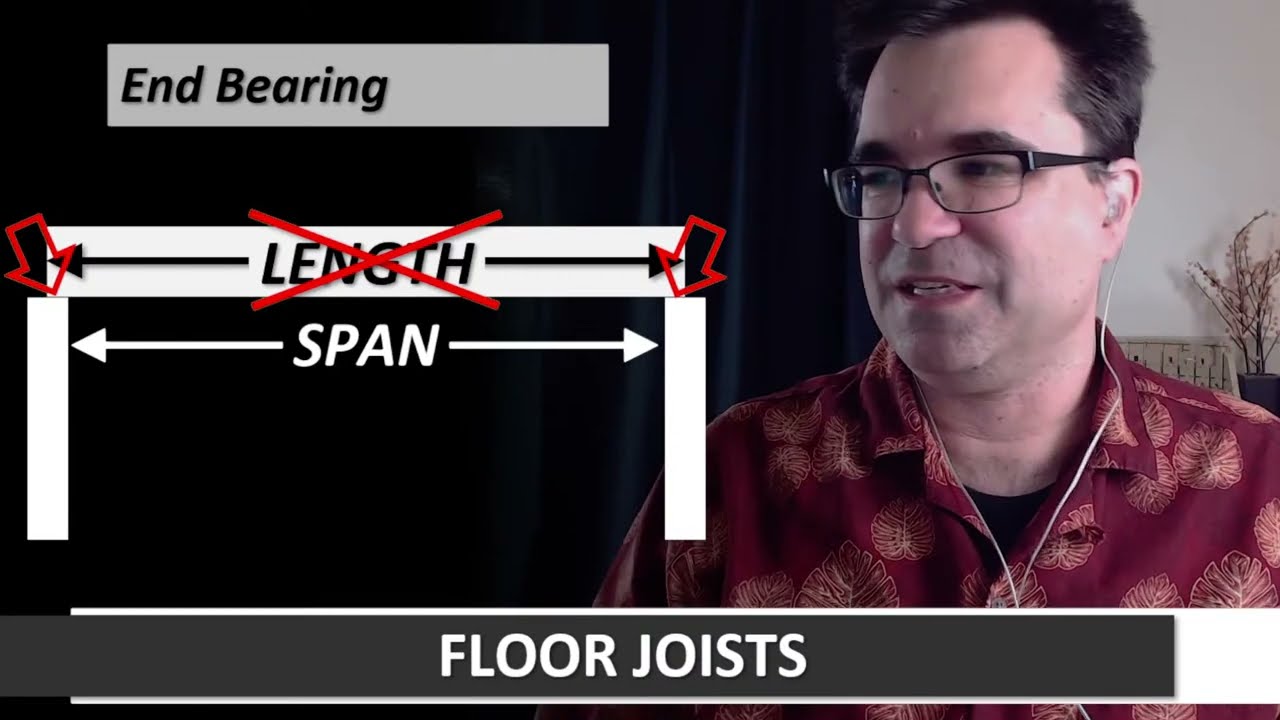
WOOD FRAME CONSTRUCTION | FLOOR vs CEILING JOISTS according to the ONTARIO BUILDING CODE
4.2K
The four commercial wood designations in order of strength/cost: Douglas fir-larch (strongest/expensive), Hemlock-fir, Spruce-pine-fir (SPF - most common residential), Northern species (weakest/cheapest). Five-grade classification: Select Structural through Standard. Lumber sizes specify cross-sectional dimensions in millimeters (width x depth). To apply OBC tables: identify commercial designation, find appropriate grade, locate joist size, determine restraint method (strapping, bridging, or both), select spacing category. The intersection gives maximum allowable span. For example, SPF #1/#2 38x235 joists at 610mm spacing with bridging yield 3.92m span per Table A1.
Click to watch →
Deep Dive
The mechanics of timber connections, including fasteners, bolts, and traditional wood-to-wood joinery.

Timber connector, concealed beam hanger for glulam by Simpson
70.8K
When assembling timber connections, the two central fasteners must be installed first and tightened completely before proceeding. This creates a stable base that maintains alignment. Remaining fasteners can then be piloted and installed while referencing the already secured central fasteners to ensure the entire connection remains dead flush on top.
Click to watch →

It's the New Year and we found a really Big mine to Explore - ask Jeff Williams
43.8K
Traditional timber support systems used multiple connection methods including lap joints, mortise and tenon joints, and hanging bolts. Lap joints join overlapping timber pieces by notching them to create interlocking connections. Mortise and tenon joints involve cutting slots (mortises) in one piece and projecting pieces (tenons) on another for secure fitting. Hanging bolts pass through these connections to hold the structure together.
Click to watch →

7 BANNED Medieval Building Methods That Engineers Now Say Were GENIUS
142.9K
Medieval timber joinery has three critical advantages over modern connections. First, flexibility: when the building moves, the wooden joint can flex slightly without breaking, while metal connections cannot. Second, durability: wood does not rust, and a properly protected timber joint can last centuries, while metal fasteners in wood begin corroding immediately. Third, replaceability: if a joint fails, a skilled carpenter can repair it with hand tools, no welding equipment or specialized hardware needed.
Click to watch →

Building a HUGE Barn... but it ain't for cows
75.6K
The timber frame assembly process involves specialized joinery techniques. Mortise and tenon joints are created by fitting wooden pieces together with wooden dowels beaten into holes, creating connections as strong as any fastener. Pine lumber requires stain and protective coating to prevent rot. Walls are assembled by fitting pieces together, then joined with dowels. The entire inner structure can be assembled within a day when properly prepared.
Click to watch →

MechMaxx SM32 Sawmill Expansion for equipment Storage Part 2 #lifeintn #mechmaxx #
171
Structural timber connections can be strengthened using large timber screws. When connecting timber members, at least three screws should be installed in the center area of the connection. This ensures that all components work together and helps distribute loads evenly across the joint. The screws provide additional stability and prevent the connection from loosening over time.
Click to watch →
Deep Dive
Advanced engineered wood products (such as Glulam, CLT, and LVL) and how they bypass natural structural limitations.
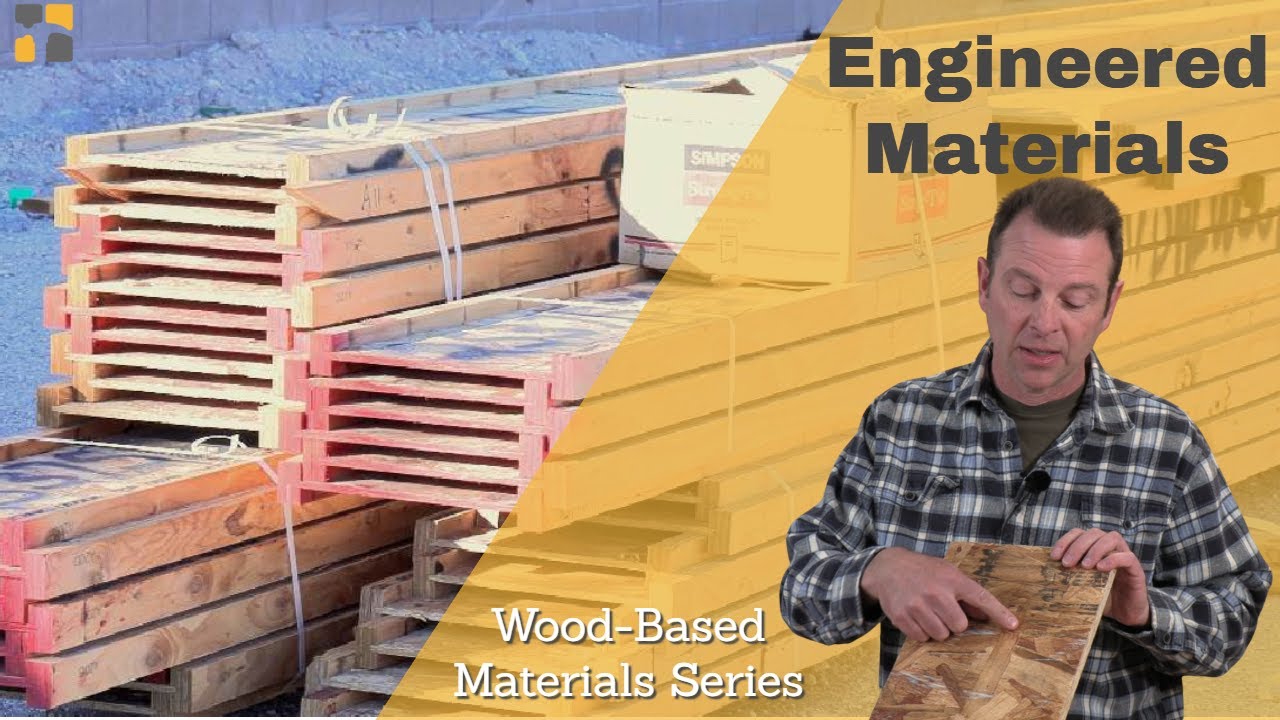
A Review of Basic Construction Engineered Materials - Intro to Wood-Based Materials Series
28.6K
Engineered wood materials are manufactured products that overcome the natural limitations of solid wood by combining small pieces of wood through gluing and pressing processes, resulting in stronger, more versatile construction materials such as OSB panels, PSL beams, plywood, LVL, glulam beams, TJI joists, and trusses, which offer improved strength, sustainability, and design flexibility compared to traditional solid wood.
Click to watch →

Como é feito: O SEGREDO DOS FREIOS QUE SALVAM VIDAS: Adeus Amianto!
1.6K
Natural wood has significant limitations: it expands and contracts with humidity, rots with water, has weak knots, and fibers run in one direction (strong in length, weak in width). Cultivating trees takes 70-100 years. Engineered wood solves these problems by organizing small wood pieces in special ways and gluing them under pressure and temperature. OSB (Oriented Strand Board) uses flakes 3-6 inches long, 1 inch wide, less than 1mm thick, arranged in layers with outer layers longitudinal and middle layer transverse. This creates a material equally strong in all directions, resistant to warping, using small trees and residues that would never become quality boards.
Click to watch →
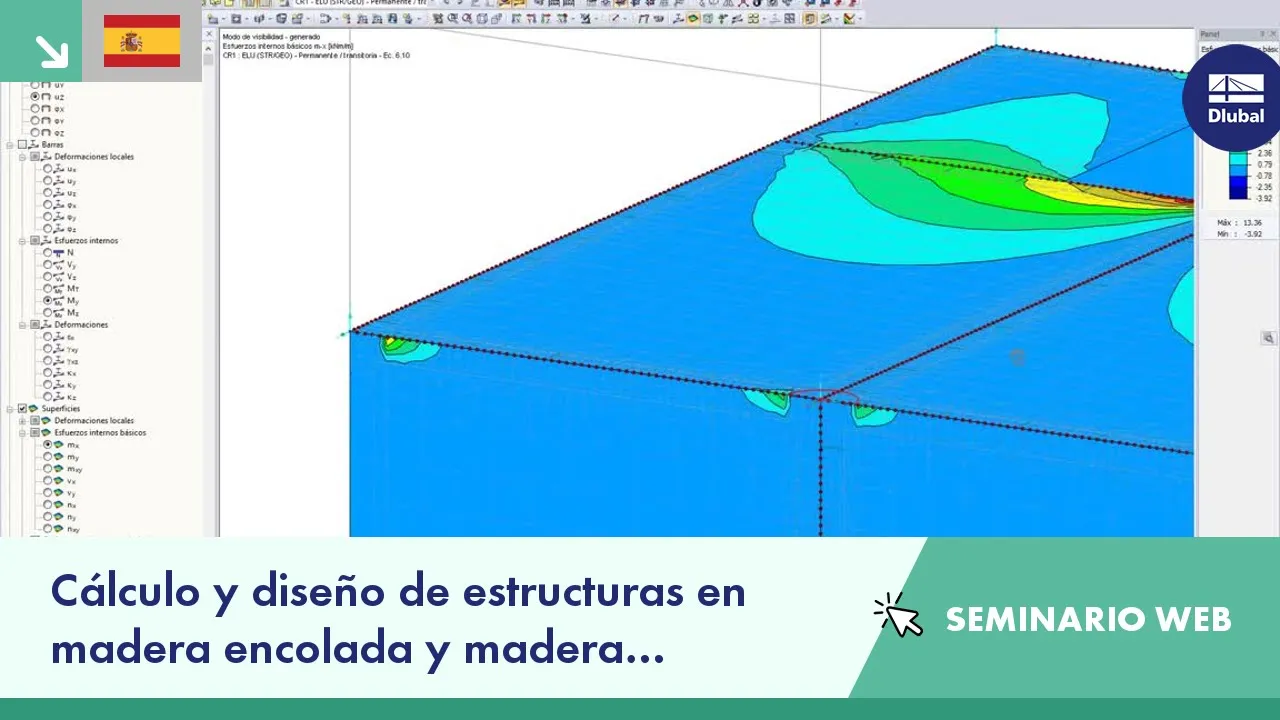
Seminario web: Cálculo y diseño de estructuras en madera encolada y madera contralaminada
17.2K
Engineered wood products address natural wood limitations: LVL places quality wood at high-stress locations and enables curved shapes; CLT provides bidirectional bending resistance through perpendicular layer orientation; composite beams optimize material placement. Dlubal software offers RFEM for FEA analysis, Timber Pro for Eurocode 5 design, RF-LAMINATE for CLT sandwich theory, and RF-JOINTS for connection design. These tools enable efficient structural analysis and design.
Click to watch →

목조,공학목재, 엔지니어링 우드에 대하여...
2.2K
Natural wood faces fundamental limitations for large-scale construction: trees cannot grow sufficiently large diameters quickly, and wood warps during drying because shrinkage varies by grain direction (arc shrinks most, diameter least). To overcome these challenges, engineers developed engineered wood products by bonding small wood pieces together. This approach creates large cross-sections from abundant, less expensive materials while maintaining structural integrity through adhesive bonding. Key products include veneer board, chipboard, plywood, glulam, PSL, and LVL. The adhesive strength must exceed wood strength for structural integrity. This evolution addresses both material limitations and economic constraints, enabling construction that would be impossible with natural wood alone.
Click to watch →

L13 Wood
223
Engineered wood products improve structural properties through reorientation and gluing. Plywood alternates grain layers for isotropic strength. OSB uses compressed wood shavings. CLT uses full lumber layers for walls and floors. Glulam allows material optimization by selecting optimal pieces and reorienting them. I-joists combine lumber with OSB webs. These products enable larger spans and better control over material properties compared to solid wood.
Click to watch →
Deep Dive
Wood preservation techniques, chemical treatments, and design practices for durability against rot, pests, and fire.

Pengantar Pengawetan Kayu
139
Wood preservation is essential because wood is an organic material susceptible to rotting from weather and destructive organisms like termites and fungi; traditional methods include river immersion (which removes resins and prevents fungal growth), swamp burial (where silica-rich mud and anaerobic conditions preserve wood for over 30 years), and surface burning (which carbonizes the outer layer to repel insects and fire), while modern chemical methods use borax and boric acid solutions that are effective against pests with relatively low human toxicity, and heat treatment (boiling or steaming) kills fungal spores and insect eggs, with all preservation methods extending wood lifespan, increasing dimensional stability, and providing long-term economic benefits despite initial costs.
Click to watch →

👉 Timber | Smart Scan Civil Engineering Complete Audiobook | SSC JE RRB JE | Engineer Rocky
409
Fire retardant treatment applies alternating sodium silicate and lime layers to create an oxygen-blocking glass-like coating, preventing combustion. CCA (Copper-Chrome-Arsenic) treatment uses pressure-infused arsenic, copper, and chromium compounds that bond chemically with wood fibers, becoming insoluble after drying. These treatments protect against insects, decay, and fire while remaining safe for human contact. The development of these technologies represents humanity's response to wood's inherent biological vulnerabilities, extending its useful life from decades to centuries.
Click to watch →

Resumen NEC-SE-MD Estructuras de Madera
702
Foundation systems require good drainage using cardboard, asphalt, polyethylene, or tar, with condensation prevention through ventilation. Rain protection requires 200mm distance from ground with 10-degree incline and sealant layers. Wood preservation increases durability through trimming, pre-drying, or chemical treatments. Chemical safety is critical: boron-based preservatives are safe while chromium-containing ones are prohibited due to carcinogenic effects. Fire protection requires avoiding heating elements, ensuring wall ventilation, non-combustible reinforcements, 1.20-meter building separations, beam oversizing by 3-5mm, avoiding fire-accelerating finishes, and electrical control. Metal joints need anti-corrosive paint.
Click to watch →
Building Materials | Quick Revision Class | Rush Hour | Civilianz
176.6K
This section explores timber preservation methods including chemical preservatives, salt treatment, and cold tar application. It also covers fire resistance properties, natural defects such as knots, shakes, and checks, and the effects of white rot and brown rot on timber durability and structural integrity.
Click to watch →

Grandpa's Wood Preservation Method Just Got An Upgrade!
60.7K
Shou Sugi Ban (Yakisugi) is an ancient Japanese wood preservation technique involving controlled charring of wood surfaces, which creates a natural, long-lasting barrier against rot, pests, and fire. This method, combined with sealing using natural finishes like teak oil, offers an effective and environmentally friendly alternative to chemical wood preservatives. The charred surface transforms the wood's properties, making it highly resistant to decay while maintaining its structural integrity.
Click to watch →
Softest Wood
School Task
Bridge Result
Crane Mission
Outcome Tease
Softest Wood
0:00- 1
Identifies balsa as the world's softest wood.
- 2
Recalls first encountering balsa in middle school.
- 3
Notes the wood's softness by denting it with a nail.
Engineered Mass Timber and the Overcoming of Natural Wood Limitations
Traditional structural timber selection focuses on managing the natural defects, directional grain, and inherent variability of solid wood. However, the paradigm of Engineered Wood Products (EWPs)—such as Cross-Laminated Timber (CLT) and Glued Laminated Timber (Glulam)—challenges the necessity of relying on pristine, high-grade natural timber. By slicing, laminating, and bonding smaller or lower-grade wood fibers together, mass timber redistributes natural defects (like knots) and creates highly predictable, isotropic, and dimensionally stable structural elements. This alternative approach shifts the engineering focus from selecting flawless natural wood to designing composite wood systems that far exceed the structural, span, and fire-resistance limitations of traditional solid timber.
Basic tree anatomy and the biological difference between hardwoods and softwoods.
Fundamental physics concepts of mechanical stress, including tension, compression, shear, and bending forces.
The relationship between wood and moisture, specifically how moisture content leads to shrinkage, swelling, and warping.
An introductory understanding of natural wood defects such as knots, shakes, splits, and decay.
Structural engineering design codes and load-span tables for sizing timber beams and joists.
The mechanics of timber connections, including fasteners, bolts, and traditional wood-to-wood joinery.
Advanced engineered wood products (such as Glulam, CLT, and LVL) and how they bypass natural structural limitations.
Wood preservation techniques, chemical treatments, and design practices for durability against rot, pests, and fire.
3.3M views37Klikes0:43@HorchataSotoOriginal Release: 2026-03-25
This is the softest wood in the world.
It's called balsa wood, and I first heard about it in middle school. They gave us these tiny sticks [music] that we had to build a bridge with. And the bridge had to hold a 50-lb bucket of sand. We'd compete in a statewide competition doing [music] this. And this wood is so soft, you can dent it with your fingernail. And I'm over here, 12 years [music] old, using super glue and my low IQ to make a bridge. And after weeks of building, this is what I came up with. And another year, we had to make a wooden crane with the same objective. Hold 50 [music] lb of sand.
Mission impossible. And how did it go for me in these statewide soft wood competitions? We'll find out by watching my longer video.
Up Next
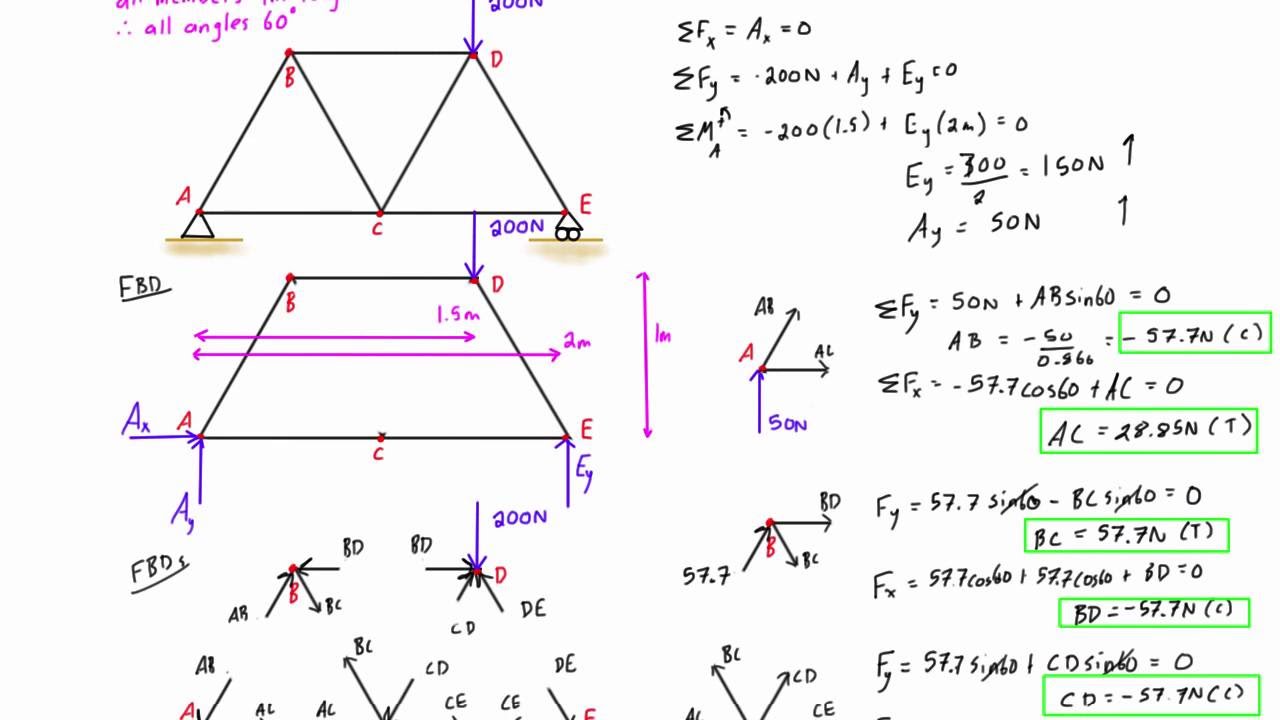
14:52
Truss Analysis Using Method of Joints | Statics Worked Example #1
@Engineer4Free
927.6K views•2016-06-19
30:32
Ultrasonic Transducers: Resonant Frequency Measurement and Horn Design
@imajeenyus42
229.9K views•2017-02-22
54:16
Polymer Environmental Degradation: Mechanisms & Stabilization
@iit
1.8K views•2012-07-10
33:39
How a Student's Question Saved a NYC Skyscraper from Collapse
@veritasium
22.8M views•2025-04-26
Related Study Plans & Knowledge Roadmaps
Structured learning paths in Engineering
engineering
Building Acoustic Levitators: Physics & Arduino
01The Physics of Sound and Standing Waves
02Piezoelectric Transducers and H-Bridge Drivers
03Arduino Programming: Generating 40 kHz Signals
+ 2 more learning modules
14h5 modules
Explore Roadmap
engineering
Building Peltier Cloud Chambers: Particle Tracks
01Cosmic Rays & Cloud Chamber Physics
02Thermoelectric Cooling (TEC) Fundamentals
03Custom Liquid-Cooling Loop Design
+ 2 more learning modules
18h5 modules
Explore Roadmap
engineering
Yagi-Uda Antennas: Modeling, Build & VNA Test
01Introduction to RF and Antenna Fundamentals
02Yagi-Uda Antenna Design Principles
03Antenna Modeling and Simulation in 4NEC2
+ 2 more learning modules
18h5 modules
Explore Roadmap
engineering
ECG Monitor Design: Op-Amps, Filters & Noise
01Electronics & Breadboard Basics
02Op-Amps and Instrumentation Amplifiers
03Bioelectricity and ECG Fundamentals
+ 2 more learning modules
18h5 modules
Explore Roadmap