







![[60] Thinking Without Words By José Luis Bermúdez](https://i.ytimg.com/vi/62A8xMMg7P4/maxresdefault.jpg)
















Language barriers significantly influence how we perceive and experience the world, as demonstrated by linguistic relativity—the theory that language shapes thought and behavior—where vocabulary, grammar, and cultural context affect everything from emotional expression to decision-making; however, children possess a remarkable innate ability to learn multiple languages before age 7, and by embracing multilingual education and exposing children to diverse languages early in life, societies can reduce these barriers and foster greater understanding and empathy across cultural lines.
How Language Shapes Thought: Multilingualism Benefits | TEDx Talk
Added:The Sapir-Whorf Hypothesis (Linguistic Relativity): The foundational theory that the structure of a language influences its speakers' worldview and cognition.
The Critical Period Hypothesis: Eric Lenneberg's theory regarding the optimal biological window (typically before age 7 to puberty) for native-like language acquisition.
Basic Cognitive Psychology: Understanding executive functions, particularly cognitive flexibility, working memory, and task-switching capabilities.
Linguistic vs. Non-Linguistic Thought: The fundamental philosophical and psychological debate over whether thought can exist independently of language.
Cognitive Reserve and Aging: Investigating how bilingualism acts as a protective buffer, delaying the onset of neurodegenerative symptoms like dementia and Alzheimer's.
The 'Bilingual Advantage' Debate: Critically analyzing the scientific controversy and replication studies surrounding the extent of cognitive benefits in bilinguals.
Sociolinguistics and Empathy: Exploring how speaking multiple languages affects perspective-taking, Theory of Mind, and the reduction of implicit cultural biases.
Applied Language Policy and Pedagogy: Examining how these cognitive insights are used to design early-childhood dual-immersion curricula and educational frameworks.
1.9M views29.8Klikes11:49Original Release: 2015-06-23
Translator: Alina Siluyanova Reviewer: Denise RQ How many of you can speak more than one language?
Now, keep your hands up if you can speak more than two.
And how about three?
Very impressive!
(Applause) But did you know that you actually could have easily learned 25 languages?
It's true.
This is a natural human phenomenon that any normal child born anywhere in the world is capable of learning any language that he or she is exposed to.
And did you know that the languages that your child is exposed to before the age of 7, which is also known as the critical age period, are the only languages that he or she will be exposed to later in life?
Leonard Bloomfield said that "acquisition of a language is doubtless the greatest intellectual feat that anyone of us is ever required to perform."
So, I asked myself and some others in the overseas student program here: why do we learn languages?
At first, we all learn language because we have to.
As humans, we're designed to learn language just like we're designed to walk.
There is simply no preventing it.
But then, there are some of us who actually do it for fun.
We go through the struggle, we put in the effort, feeling wrong all the time, but we love it because the rewards are so great.
It's awesome to speak another language, to carry it with you everywhere you go; to travel and communicate with people in their native language makes conversations so much more personal, and you actually get to enjoy more out of life because it gives you the opportunity to understand more music, and movies, and games from around the world.
So I want to ask you another question, and I want you all to think about this: if we started taking advantage of the amazing ability that children have to learn languages and the plethora of free language learning tools we have in our devices today, could we, by reducing language barriers, reduce other barriers in society?
Which begs me to ask another question: what exactly are language barriers and what do they do?
I know what some of you are thinking: you're at the dinner table, and you're between your mother, who is Russian, and your beautiful American girlfriend, and you're having a moment of realization that you've just hired yourself out as a translator.
So, you have to spend the whole evening hearing everything 3 times, and even though you thought that you could speak English and Russian perfectly, you're starting to feel confused and frustrated, and you're desperate for a couple of minutes of alone time just to think in whatever language you choose to think in.
But there is a lot more to language barriers that I want you to know.
Have you ever heard of linguistic relativity?
Linguistic relativity is the field which asks questions on the relations between language, perception, and thought.
The core theory is called the deterministic theory, it is scientifically proven, and it states that the language you speak shapes the way you think and influences your behavior.
The fathers of linguistic relativity, Benjamin Whorf and Edward Sapir, state that if a word doesn't exist in your language, you won't know the concept [behind the word].
Now, I think that those guys can be a little extreme in their theories.
I think rather that if a word doesn't exist in your language, you are a lot less likely to identify with that concept.
One of my friends here, in Israel, a native German speaker, told me a story once of how the English language changed the way that she thought about love.
She told me she still remembers the first time she heard the term "falling in love", and that she was shocked at the use of the language because she had never thought of being in love as something that happened suddenly and dramatically, and she pictured someone actually falling, and she could feel that, and then she knew that someday she will experience "falling" in love and not just "being" in love.
Also, in body language we find interesting differences among languages.
In Hebrew this means "waits".
However, this is a great insult in Italy, and I wanted you all to know that.
(Laughter) And the most obvious differences in languages that are influencing our thoughts and behaviors is in vocabulary.
One scientific experiment in linguistic relativity showed how gender association impacts people's perception.
This study used the word "key", which is in German a masculine word, and in Spanish it's feminine.
So, subjects were asked to come up with words to describe a key.
And the German speakers used words such as "heavy", "durable", "strong", "useful", "metal", but the Spanish speakers chose words such as "golden", "lovely", "little", "delicate" and "shiny" to describe the same word -- "key".
Another interesting difference we find among languages is in the perception of correctness.
I read in the study by John Myhill at University of Haifa that correctness in present day English and most European languages is based on prestige.
So, the development of these languages has actually followed the trends of its most elite speakers.
But other languages perceive correctness in a much different way.
Languages such as Arabic, and Hebrew, and Icelandic are based on textual references.
So, if a word appears in a text-- in Arabic, which is based on the Koran, and Hebrew is based on The Mishneh Torah if a word or grammar appears in this text, it is correct, and if it doesn't, it is not correct.
For these languages there is no connection between correctness and prestige.
And there are many, many words in languages that don't appear anywhere else such as "stam" [סטם] in Hebrew, which can be translated into English as "just kidding", but not really -- it is a unique word to let someone know you're not being serious.
And "khalomot paz" [חלומות פז] is how you say "sweet dreams" in Hebrew, but actually translates directly as "golden dreams".
And there is a word in German that I love called "Fernweh", which dictionaries translate as "itchy feet", and it is the opposite of "homesick".
It describes the feeling that you need to travel.
So, when my German friend taught me this word, I thought: "Wow! How I wish that this word existed in my language!"
And I wondered that if we used such a word, how my experience of feeling like the only one in my family with a strong desire to see the world may have been different.
So, a few weeks ago, after I auditioned to be up here on the TEDx stage, I reached out to my psychology professor back in New York and asked him what he thought about linguistic relativity.
And what he says explains the story of my friend and, in terms of psychology and memory, what happened when she learned a new term about love.
He said: "It is the breadth of our language, not our vast experiences, which help color our lives.
That is, in memory, the language labels that we assign events and experiences shape, indeed; limit the way that we can remember them."
For example, if the only positive emotion word we knew was "happy", all positive memories are labeled as "happy memories".
And if they all fit in that "happy" bucket together, then their shared features, which make them labeled as "happy", will be reinforced and at times amplified at the expense of their differences to allow for better access.
This is because your mind categorizes everything with language labels, so that it can reach for your memories as quickly as possible.
And everything that you say and do, every decision you make, every conversation that you have, is just a consequence of some memories, right?
So, in other words, your ability, overall, to access your memories is actually directly related to your breadth and knowledge of vocabulary.
Because our languages are constantly changing, language barriers are just growing bigger and bigger.
So, what do you think everyone?
If we started to take advantage of children's amazing ability to learn languages and the plethora of free tools that we have to learn languages today, could we, by reducing language barriers, reduce other barriers in society?
The answer to me is crystal clear.
By emphasizing foreign language studying in your community, you are seizing an opportunity to reverse the creation of gaps in the way that we think and behave.
There are so many issues in society today that are thought-based, like racism, and hate crimes, and bullying.
So, by increasing the knowledge of language, we can overcome these differences; also, by having more multilingual programs for children, of course, because it's that critical age period before age 7, where we have this opportunity.
So, one such program exists in Jaffa called the Orchard of Abraham's Children.
It was founded by a Palestinian man an a Jewish woman, who are married.
And they've established 3 kindergartens that teach in both Arabic and Hebrew, and celebrate both cultures' holidays.
So, programs, like this one, are using bilingual education to promote peace and co-existence in a humanitarian, non-political way.
And it is so effective, because our languages are a huge part of our identity.
Being born to reformed Jewish parents, gave me really early exposure to the Hebrew language, and if it wasn't for that early, early exposure, I am sure I wouldn't be here, in Israel, studying linguistics, or giving this talk to you about the power of being able to identify with more than one language.
Now, I want to leave you with this quote by Helen Keller, who was an American author, a political activist, and the first deaf-blind person ever to receive the Bachelor of Arts degree: "Suddenly I felt a misty consciousness as of something forgotten -- a thrill of returning thought; and somehow, the mystery of language was revealed to me.
Everything had a name, and each name gave birth to a new thought."
Thank you.
(Applause)
Up Next

23:01
Does Grammatical Gender Shape Thought? A Linguistic Analysis
@YuvalTheTerrible
356.2K views•2023-07-06
36:52
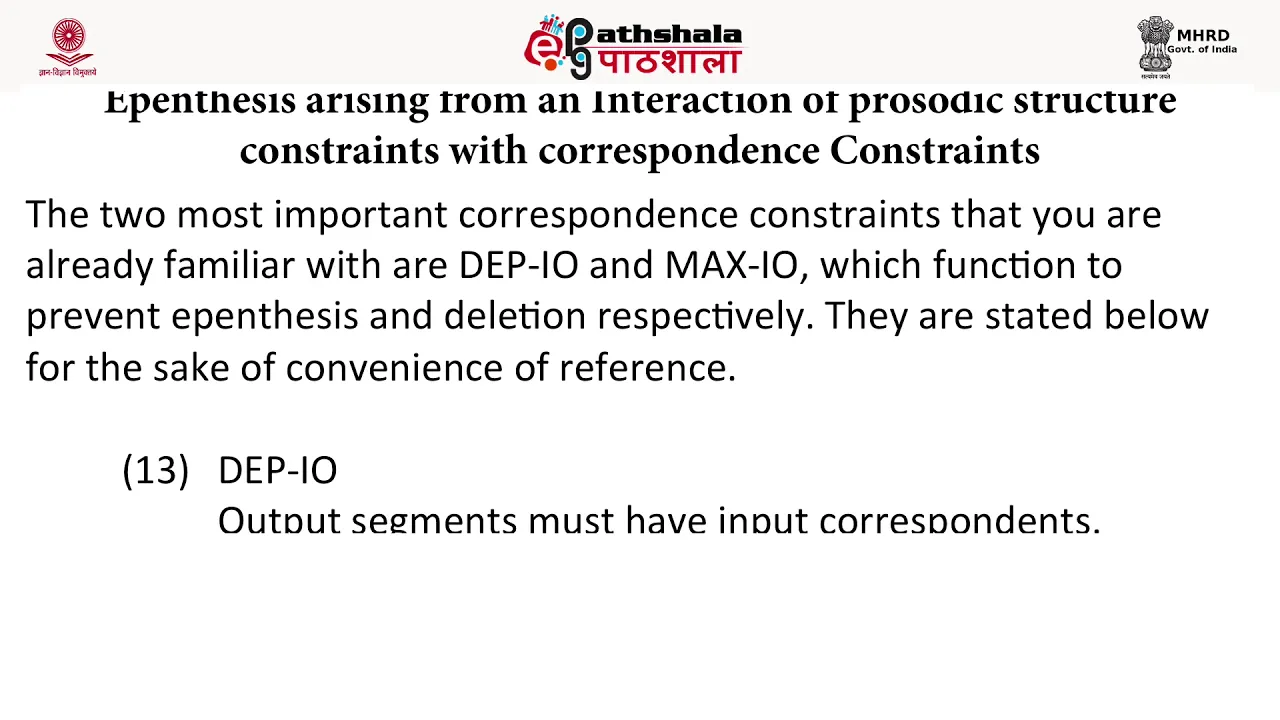
Constraint Interaction in Optimality Theory: Epenthesis & Deletion
@Vidyamitra
180 views•2018-08-20

19:08
Raising Bilingual Children: Overcoming the Monolingual Myth | Kim Potowski TEDx
@TEDx
124.6K views•2013-05-03

21:32
Accent Expert Explains U.S. Regional Dialects | Part 1
@WIRED
9.3M views•2021-01-21
Related Study Plans & Knowledge Roadmaps
Structured learning paths in Linguistics
linguistics
Optimality Theory: Tableaux & Constraints
01Phonological Basics: Sounds, Syllables & Rules
02Foundations of Optimality Theory: GEN, CON, and EVAL
03The Constraint Inventory: Markedness vs. Faithfulness
+ 2 more learning modules
15h5 modules
Explore Roadmap
linguistics
Morphosyntactic Alignment: S, A & P Systems
01Foundations of Syntax: Transitivity and Arguments
02The Linguistic Variables: Mapping S, A, and P
03Nominative-Accusative Alignment
+ 3 more learning modules
12h6 modules
Explore Roadmap
linguistics
Analyzing Sign Language: Phonology & Syntax
01Foundations of Sign Language Linguistics
02Phonology: The Five Parameters of a Sign
03Morphology: Word Formation and Classifiers
+ 2 more learning modules
14h5 modules
Explore Roadmap
linguistics
Pragmatics: Speech Acts, Grice & Politeness
01Introduction to Pragmatics: Meaning in Context
02Grice’s Cooperative Principle & Implicature
03Speech Act Theory
+ 2 more learning modules
14h5 modules
Explore Roadmap