
















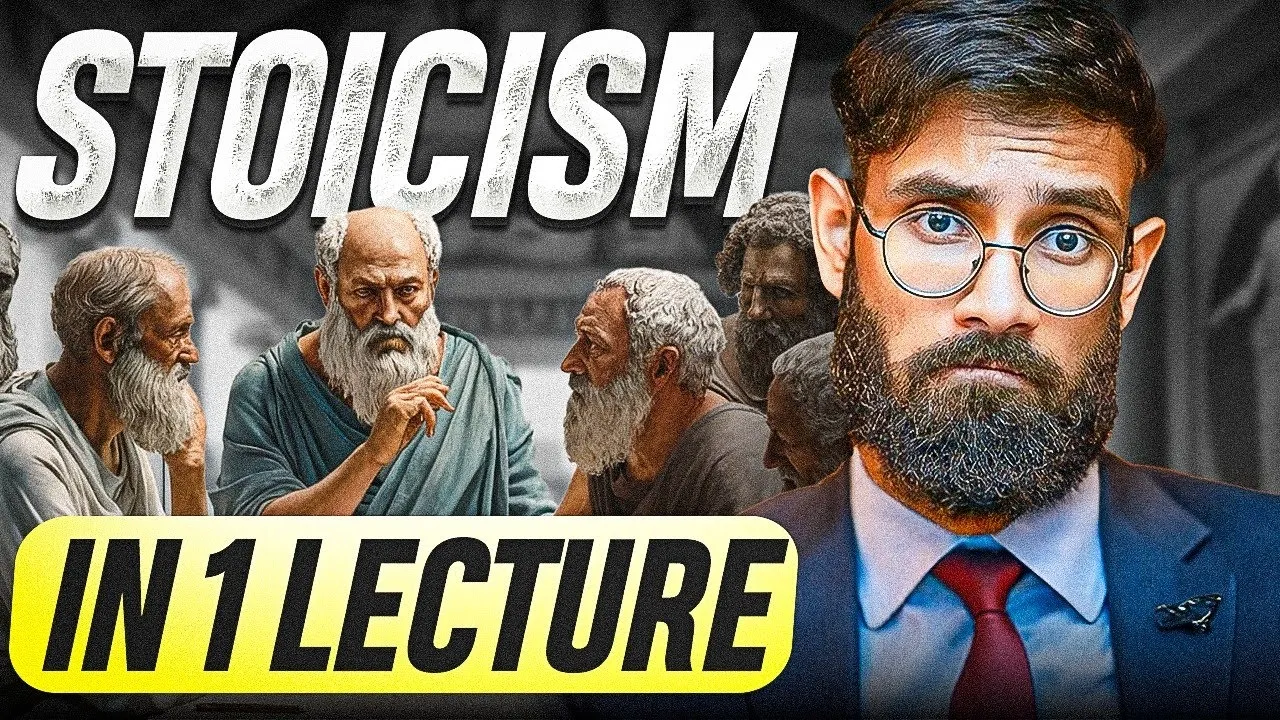




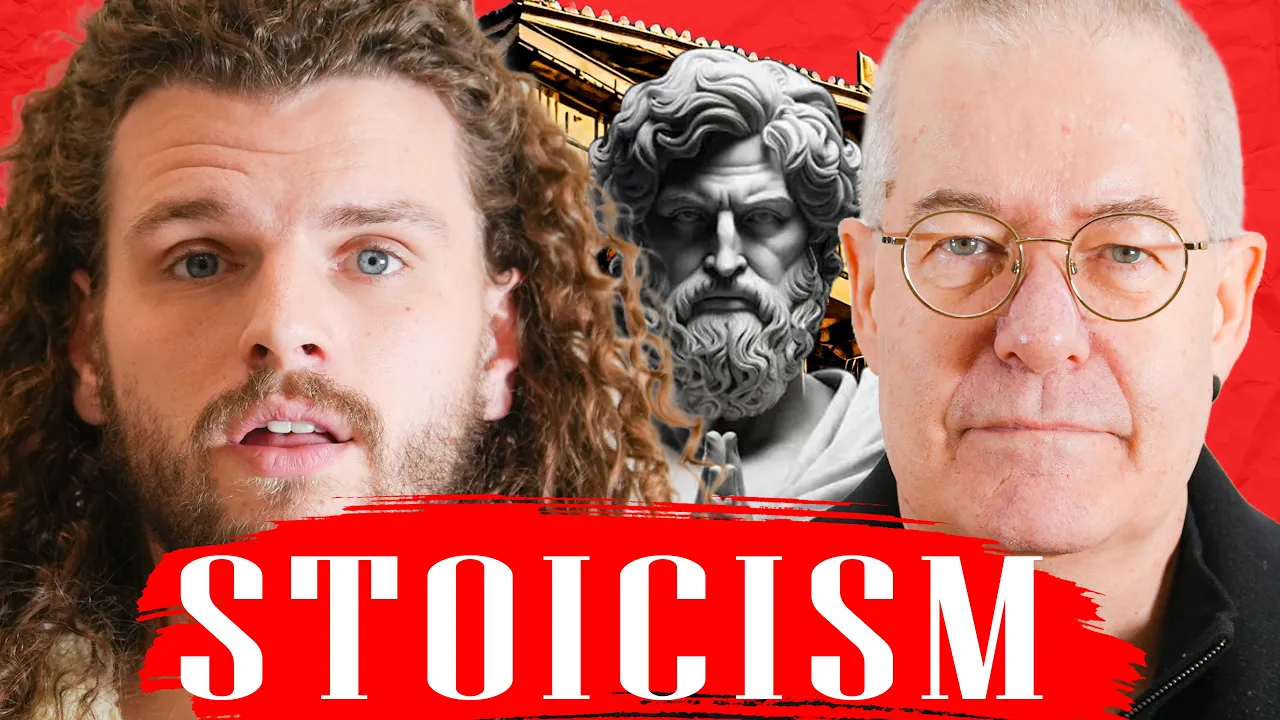






Stoicism is a practical philosophy of life that teaches we should focus on what is within our control (our actions, judgments, and responses) while accepting with equanimity what is outside our control (external events, other people's actions), thereby enabling us to live a more rational, peaceful, and fulfilling life by cultivating reason, virtue, and social cooperation.
Stoicism: A Practical Philosophy for a Better Life | Massimo Pigliucci
Added:An introductory understanding of Hellenistic philosophy and its key historical figures like Socrates, Seneca, Epictetus, and Marcus Aurelius.
The conceptual distinction between academic philosophy (theoretical study) and philosophy as a practical 'art of living' (techne biou).
A basic familiarity with virtue ethics, particularly the idea that character and moral virtue are the ultimate goods.
Awareness of modern self-help culture and the common criticisms of positive thinking or superficial self-improvement trends.
In-depth study of the 'Dichotomy of Control' and its practical application to modern decision-making and stress management.
Exploration of the historical and conceptual links between Stoicism and modern psychotherapy, specifically Cognitive Behavioral Therapy (CBT) and Rational Emotive Behavior Therapy (REBT).
Analysis of the four cardinal Stoic virtues (Wisdom, Courage, Justice, and Temperance) and how they translate to contemporary social and professional ethics.
Engagement with modern Stoic practices, such as voluntary discomfort, journaling (premeditatio malorum), and view-from-above exercises to build psychological resilience.
85.3K views2.3Klikes1:51:14Original Release: 2026-01-09
- Today you're going to learn a little bit about what the Stoics mean by being a good human being.
We'll learn to live more rationally, to conduct a life based on reason, and to deal with our emotions in the best way we can.
I am Massimo Pigliucci.
I am an evolutionary biologist and a philosopher of science.
And my latest book is called "Beyond Stoicism," co-authored with Greg Lopez and Meredith Kunz.
(dramatic music) - [Narrator] Chapter 1: What is Stoicism?
- Stoicism is a philosophy of life that suggests that the best way to live a human life is to ask yourself what kind of a living organism human beings are.
And the answer that the Stoics give to that question is that fundamentally we are highly social and capable of reason.
We're that intelligent.
It follows, according to them, that a good human life is one way you use reason in order to solve problems and you behave in a cooperative, pro-social fashion.
One of the crucial insights of the Stoics is that we should focus on what is up to us, as the ancient Stoic Epictetus put it, and try to accept with equanimity what is not up to us.
In other words, focus where your agency is active, where you are efficacious in doing things, and then accept whatever comes as it comes because you really don't have a choice.
The Stoics are nothing if not realists about life.
They try to understand how human life works and they try to live the best life possible.
One of the things that we do understand from biology, psychology, is that we have limited time and energy to do things, both physical energy and emotional energy.
And so if we insist on pursuing approaches that are likely not to work or they're not efficacious, you know, our agency doesn't really have any effect on it, then we are only making our life miserable.
And in fact, we're trading off with other things that we should be doing.
One of the interesting aspects of the particular brand of Stoicism, so to speak, that Epictetus articulated in the second century is this notion of role ethics.
We all play different roles in life, many roles, in fact.
And if we reflect on it for a minute, for instance, some of my roles include being somebody's son, being somebody's father, being somebody's husband, being a friend, being a teacher, being a colleague, being a citizen of a particular nation and of a particular city, and so on and so forth.
All of these roles need to be handled essentially simultaneously.
It's not like I can decide one day I'm gonna be just a colleague and nothing else.
I am a colleague perhaps in this particular moment when I'm at work and I'm interacting with other people, but I'm at the same time also a husband, a father, a friend, et cetera, et cetera.
And the idea here is that I need to conserve both physical, and emotional, mental energy so that I can do my best in all of these roles whenever it is that I need to do something about it.
If I'm going to waste a lot of energy and time on a particular thing, especially something that for which my efforts are in fact not efficacious, then I'm really trading off with everything else.
I am getting depressed, let's say, by just constantly reading the news about things that are not actionable, about things that I cannot do anything about.
Well, the result of that is then I'm not useful to my family, I'm not useful to my friends.
I'm not in fact useful to society in general and even to myself.
So it's about conserving energy, setting priorities.
This goes back to the the first discipline of Epictetus, the discipline of desire, setting goals.
Depending on our values, we set goals and we set priorities.
And doing so is crucial because otherwise we end up wasting a lot of time and then regretting it.
And usually, when you get to the point of regret, especially near the end of your life, it's a little too late.
Seneca points out in one of his letters to his friend Lucilius that too many people start reflecting on what they want to do and why near the end of their lives, when it's too late, when they're already done most of what they were going to do.
Stoicism is one of the Greco-Roman philosophies that evolved during the Hellenistic period, and the goal is to live a eudaemonic life.
Eudaemonia is a word that in Greek means, roughly speaking, a life worth living, a kind of life that you get to the end of it and you say, "Yeah, that was not wasted time."
Now, different Hellenistic schools, like the Epicureans, for instance, or the Skeptics, had different answers to what constitutes a eudaemonic life.
According to the Stoics, living a eudaemonic life means living intelligently, smartly, and socially.
Because one of the fundamental aspects of Stoicism is that we should live a pro-social life, that is, a life where we interact with other people, because we are naturally a social organism, then the Stoics put a lot of emphasis on relationships with people, on our roles in society, what is it that is a good thing or not thing to do with respect to other people.
In fact, they went so far as declaring themselves cosmopolitan.
Being a cosmopolitan means being a member of the human cosmopolite, the human city, the universal human city.
According to the Stoics, every human being on Earth is our brother and sister, and we should treat them accordingly.
The ancient Stoic Epictetus, who lived at the beginning of the second century, laid out three fundamental disciplines for the study and practice of Stoicism.
They're referred to normally as the discipline of desire, the discipline of action, and the discipline of assent, although I should warn you that the English terms are a little bit misleading compared to the original Greek.
Desire, for instance, doesn't mean whatever I fancy at the moment.
It means my values and also my disvalues, that is, the kinds of things that I think are important and good in life and the kind of things that are not important or bad in life.
The discipline of desire teaches us to reevaluate critically our values, to reorient ourselves according to good values, to make deliberate decisions about what those values are and why.
The second discipline, the discipline of action, has to do, as the name implies, with acting toward other people.
We live in a society.
We don't just subscribe to certain values, we enact those values every time that we do something or say something, especially to other people.
So the discipline of action is about putting into practice our values when we interact in society at large with other human beings.
Finally, the discipline of assent.
Assent means of course agreement.
But for Epictetus that means thinking carefully and rationally about the other two disciplines, about values and how to implement them.
So the discipline of assent in a sense is about making all of this flow so nicely and so smoothly that we have in fact, according to the Stoics, a smoothly flowing life.
The three disciplines are a way to implement Stoicism in practice, but Stoicism of course is a philosophy, so there's also a theory behind it.
And in order to understand Stoic theory, we need to refer to the three areas of study that were typical in any Stoic curriculum.
If you went to a Stoic school, let's say the school that was run by Epictetus in Northwestern Greece in the second century, you would actually study, before you get to the disciplines and how to live your life, you would study the three general areas that are pertinent to those disciplines.
Now, there too, the English names are a little bit misleading.
They are physics, ethics, and logic.
But what they mean exactly is something a little bit different from modern English, and so we need to be careful here.
Physics, for instance, comes from physis, which means nature.
So when I say physics, don't think quantum mechanics, or general relativity, or things like that, think science in general, so a good understanding of how the world works.
That's connected to the discipline of desire, that is, to the discipline that deals with our goals and priorities in life.
Why?
Because our goals and priorities in life depend on what kind of living organism we are.
If we were a different kind, you know, a martian, or a dog, or a lion, we would have different priorities.
So it's about understanding the world as it works.
And the best way to understand the world as it is is through science.
So you study science in order to investigate into your own goals and priorities.
These days, ethics means mostly the study of right and wrong actions.
But for the Stoics or for the ancient Greco-Romans in general, ethics had, again, a much broader meaning.
It meant literally the study of how to live your life.
So it's not just about whether a particular action is right or wrong, it's also about your motivations for carrying out a particular action.
Are they good motivations or not good motivations?
It's about your priorities in life, your goals, the way you relate to other people, and so on and so forth.
The second discipline of action is connected with ethics.
Action is about dealing with other people, ethics is about how to live a life.
Since we're a social animal, the two are very closely related.
We live a social life.
We don't live on deserted islands.
We don't do very well when we are on our own.
We can survive perhaps on our own under certain circumstances, but we only thrive in a society.
When I say logic, most people start thinking about logical puzzles, and paradoxes, and things like that.
And that's fine, that is part of it.
But logic according to the Stoics is in general the study of good thinking.
So it includes also what we would today call cognitive science, the understanding of cognitive biases and the understanding of why people's thinking can go wrong one way or the other.
So it's much broader than the technical field of logic.
Assent.
Assent is about refining our understanding and practice of the first two disciplines.
In other words, it's about using good judgment, and therefore it's about logic.
It's about understanding how human reasoning works and also how it can go wrong so that we avoid as much as possible mistakes and we're trying to think as much as we can in a rational, reasonable way, and then implement that kind of approach into daily life.
One of the obvious questions that come up with Stoicism is does it work?
Which, if you think about it, on the one hand, it's a little bit of a weird question because we're talking about a philosophy.
We're not talking about, you know, a scientific approach to life as we understand it today.
Very few people, for instance, would ask the question, well, does Christianity work or does Buddhism work?
However, they might ask, do prayers work or does meditation work?
In other words, the techniques associated with certain religions or philosophies.
In those cases, it does make sense to ask yourself, well, does it work?
Is it something that, quite independently of the theoretical part of the philosophy, does it actually have empirical evidence?
So the same question can be asked reasonably about Stoicism.
We have a series of lines of evidence that Stoic techniques, the Stoic approach to a good life, does in fact work.
The first one is that Stoicism originated what is now known as cognitive behavioral therapy back in the 1960s.
In New York, authors like Aaron Beck and Albert Ellis started to practice this type of psychotherapy, which today is one of the best evidence-based type of psychotherapies.
And they started from Stoicism.
They both read Marcus Aurelius, Epictetus, and other Stoics, and they thought, oh, these people were onto something here, that there is something that can work, that is very practical, that can actually help people.
Of course, CBT as is known today went then through a series of changes and evolution over the last several decades.
CBT is empirically based, that there is lots of studies, empirical studies, that show that it does work.
So it's not the same as asking whether Stoicism work, but it's pretty close to asking whether Stoic techniques work because a lot of the techniques that the ancient Stoics designed and developed on the basis of their intuition about human psychology and human nature, it turns out, are actually efficacious.
So that's one line of evidence that Stoicism in a sense works.
There is also an increasing number of papers out there on cognitive science in general, not just cognitive behavioral therapy, but cognitive science in general, how the brain works, how human decision making is carried out, and so on and so forth.
And my understanding is that much of that research is, if not in direct support of Stoic techniques, it certainly is compatible, highly compatible with it.
For instance, modern psychologists and currently scientists have developed a theory of the relationship between reason and emotions that is very similar to the way in which the Stoics were thinking about the connection between reason and emotion.
And then finally, there now begins to be direct studies about the efficacy of Stoic techniques.
Stoicism is popular enough that psychologists have begun to look systematically into whether specifically Stoic techniques work or don't.
For instance, one of my colleagues, Tim Lebon, who is a psychotherapist, has just published recently one of the first papers that shows at least preliminary evidence that, yes, indeed, Stoic techniques seem to have the kind of effects on behavior and on the way people think that the Stoics thought they should have.
Stoicism is a philosophy of life.
And that, if you think about it, it's a interesting concept.
What is a philosophy of life in the first place?
Do we need a philosophy of life?
I encounter people that tell me that they don't need a philosophy of life, they just live their life.
And I point out that that is a philosophy of life.
There is no way to live a life without a philosophy.
That philosophy might not be conscious, it may not be the result of deliberations that you did with yourself, you know, paying attention to what you're doing and why.
But if I observe your behavior, if I see what your choices are, your priorities, your values, and so on and so forth, I can put 'em all together and say, "Okay, this person's philosophy of life is this.
It's the result or it's whatever underpins their choices, their values, their priorities, and their behavior."
So we all have a philosophy of life.
If that's true, well, we might as well then be conscious of it, and be aware of it, and possibly, even occasionally at least, ask ourselves, well, is this a good philosophy of life or not?
Do I need to change something?
So one might be tempted then to go to the opposite extreme and say, "Oh, if I need a philosophy of life, I'm gonna pick one off the shelf.
Here's Stoicism, I heard that it's a good thing.
Let me pick Stoicism.
From now on, I'm a Stoic, and that's it, end of the of the story."
But that is also dangerous in a sense because now you are blindly following what somebody said 2,000 years ago or 2,300 years ago without necessarily thinking things through, without asking yourself, "Well, does this thing actually make sense?
Does it fit the way I want to live my life?
And if not, why not?"
So there is, on the one hand, a danger of not being aware of one's own philosophy of life.
There's also the opposite danger of sort of taking something off the shelf without questioning, without exercising one's own critical judgment about whether that thing actually makes sense, it's useful, works, et cetera.
Well, then there is a third option.
Some people say, "Oh, I'm gonna build my own philosophy of life out of bits and pieces from different choices.
So I heard that Stoicism is useful, I'm gonna take something from Stoicism.
I heard that Epicureanism is useful, I'm gonna take something from that.
Some of my friends are Buddhists.
Perhaps I could borrow something from Buddhists."
That is certainly something that can be done.
It's usually referred to as Eclecticism.
But yet it's also got its own problems because you might end up with a mishmash of things that don't make any sense when they're brought together.
There is a reason why these philosophies are internally coherent, and people have worked on them for thousands of years in order to make them internally coherent.
For instance, although the Stoics themselves acknowledged that there is something useful in Epicureanism, and they actually incorporated aspects of Epicureanism into their philosophy, at the end of the day, one cannot be simultaneously a Stoic and an Epicurean.
Why not?
Because the most important value for a Stoic is one's own virtue, meaning one's own character.
Pleasure is secondary.
The most important value for an Epicurean is pleasure.
One's character, one's virtues, are actually only instrumental to a life of pleasure.
So at the end of the day, there may be situations where you had to choose.
Is it gonna be pleasure or is it gonna be character?
And if you choose one way you're an Epicurean, and if you choose another way you're a Stoic, whether you're aware of it or not.
In my own case, I think of myself as mostly a Stoic, meaning that there are a number of things in Stoic philosophy as a whole that I think are very valuable, they're very well thought out, and I have adopted them as at least a provisional way of navigating my own life.
But I am also very much attracted by another ancient Greco-Roman philosophy, Skepticism, which has to do with the notion that we're fallible.
We don't know the truth with the capital T.
At best, we can make reasonable guesses, probabilistic guesses, about what works or what doesn't work, what is true and what is not true.
And we should therefore always be aware that no matter what we do, we may be mistaken.
No matter what we think, we might be mistaken.
So I temper my Stoicism with a little bit of Skepticism.
And in fact, I temper my Stoic Skepticism with a little bit of something that is called philosophical pessimism.
This is the notion that there are probably no grand narratives in the world.
There is no universal plan.
There is no end to history.
There is no inevitable trajectory that we go either in our lives or as society as a whole.
It's all about things happening here and now and there is no rhyme or reason to them.
So I put all these things together into what to me feels like a reasonably coherent philosophy.
It's not my invention, and yet at the same time, it's not exactly anything that you find specifically in any particular other author.
One thing that I would suggest, for instance, is certainly read the original texts.
But even that is not that simple because there are countless translations.
And sometimes if you read the same book in different translations, it almost feels like a different book.
There are versions of Marcus Aurelius's "Meditations" that really feel like a different book from some other translations.
So one needs to be careful.
The more recent translations, the more modern translations, are better.
Some of my favorite, for instance, are by a Classicist named Robin Waterfield, who has translated both Marcus Aurelius and Epictetus.
The University of Chicago Press has made a huge edition of all of the writings of Seneca.
Invest a little bit of money.
After all, if we're talking about something that you wanna pursue as a philosophy of life, it's worth investing a few bucks to actually get it right or as right as possible.
One of the advantages of these modern editions is that they have a lot of notes, and the notes will help you, will guide you, through understanding what exactly these people are saying because they're putting those notions in their philosophical, as well as historical context.
But the other thing is, I hear often, people say, "Oh, I'm just going to read the story text.
Forget all of these modern authors," including yours truly, "who are writing about Stoicism."
I think that's a mistake.
I mean, that may come across as a self-serving mistake since, as I said, I'm one of those authors.
But nevertheless, I think it is a mistake.
I myself took advantage of the writings of modern authors because again Stoicism is ancient.
It's 2,300, almost 2,400 years old.
It needs interpretation, it needs updates.
And that interpretation, those updates, need to be done carefully by people who actually know what they're talking about.
So, for instance, I would pick up a book by my friend and colleagues, Donald Robertson.
Robertson is a cognitive behavioral therapist.
That's his approach to Stoicism.
Bill Irvine is a Classicist, and so is John Sellars.
Those are some of the best modern Stoic authors that you can trust.
These are people who actually know what they're talking about.
And all of these authors have written very, very accessible books that can be used to dig deeper into Stoicism as a modern philosophy of life.
- [Narrator] Chapter 2: The Stoic toolkit.
- I'm gonna try to teach you a few basic Stoic techniques that hopefully are gonna make your life better in the long run, maybe even in the very short run because a lot of Stoic techniques tend to be efficacious almost immediately.
You can see the difference yourself after a few days or a few weeks of practice.
And perhaps there is no better way to start than with the connection between reason and emotions.
How do we deal with emotions?
Emotions are a big part, of course, of the human experience.
They are inevitable.
Even if we wanted to avoid them, we cannot.
They are an intrinsic part of our biology and our psychology.
Sometimes they're useful.
They are alarm bells, for instance.
They alert us to certain things going right or going wrong.
Sometimes they deceive us and they create problems.
They push us to react in ways that then we're later going to regret.
The Stoics thought quite a bit about emotions.
All of the major Stoic authors write about emotions, perhaps none more than Seneca, who was a Roman senator who lived in the first century.
He wrote one of the best books on emotions, I think, ever written.
It's called "On Anger."
And it focuses on that particular emotion because it's important.
We all experience anger under different conditions.
We all react in a way that is driven by anger.
And sometimes we regret the way we have acted.
So let's try to understand what the Stoics actually say about this.
The fundamental idea is that emotions are not in fact distinct or sharply distinct from reason.
A lot of people seem to think that reason is one thing and emotion's another thing, and they're sometimes in conflict with each other.
So reason might have to overcome emotions or perhaps if you are a so-called emotional person, you actually prefer the other way around.
But in reality, the two are actually highly interconnected.
And this is one insight, one intuition of the ancient Stoics, that is definitely confirmed by modern cognitive science.
We do know that the anatomical area from where human emotions, many human emotions, originate is the amygdala, which is the base of the brain.
And we do know that our reasoning faculty resides mostly in the frontal parietal lobes of the brain.
But we also know that those two areas are massively interconnected.
There are literally billions of neuronal fibers that go back and forth between the two so that there is no such a thing as an emotional response independent of the way you think, and there is no such a thing as thinking independently of your emotional reactions.
Well, if that's true, the Stoics say there is your key to a better relationship with your emotions.
What you need to do is a two or three-step process that begins with cognition.
It begins with thinking carefully before you get into any situation that might be emotionally complex about what you want to do and why.
Once you set the stage in terms of thinking, then you try to behave accordingly to that particular way of thinking.
If you think that one thing is right or wrong, then presumably you will want to behave according to that judgment.
And it's this combination of cognition and behavior repeated over and over and over that eventually affects your emotions, sinks in at the emotional level, and in fact will alter your emotions.
Let me give you an example.
Let's say that somebody insults you.
Epictetus talks a lot in his writings about insults and ways to deal with insults.
And most of us would get upset at an insult and in fact we would probably react.
We start escalating things.
You feel that rush of adrenaline, you're getting angry.
How dare this person talk to me in this way.
And then you start raising your voice and then it escalates into a confrontation, possibly even a physical confrontation.
The Stoics would say, well, before all of that, think about it this way.
What exactly is an insult?
An insult is somebody opening their mouth, saying certain words.
Those words arrive to your ears.
You interpret them in a certain way.
And because of that interpretation, you react.
In other words, it's your thinking, it's your cognition that is the first step.
If you think this is unacceptable, this is an insult, how dare the person talk to me like that, then your emotions will follow.
Then you're now fueling your anger.
You're fueling your aggressive reaction to those words.
But if instead of going that way, you say to yourself an insult is nothing, it's just air moving around.
It doesn't actually touch me.
It doesn't actually do anything to me.
If that person is saying something about me that is insulting, what does that mean?
Well, either that person is right, and maybe he's expressing his opinion in a clumsy way, but he's actually right, in which case, why am I going to be upset about it?
If somebody is right and it's setting me right, then it's a good thing for me to accept that counsel, to accept that observation and do something about it.
Or the person in question is wrong, in which case, that's his problem, not mine.
I'm not the one in wrong.
He is the one that is wrong.
He should be concerned with it, not I.
So either way, it is in my power not to react because it is in my power to reframe the situation to myself and think, this is not an insult.
This is just air bouncing off and it doesn't actually touch me.
It doesn't actually hurt me.
Once you do that, you're now deescalating your emotional response because your emotions will react, will go along, with whatever way you're thinking about the situation.
If you're thinking that you're being offended, your emotions will escalate.
If you're thinking that, oh, this is funny, this is really ridiculous.
Doesn't the person in question know that he's embarrassing himself?
Then your emotions will go in a different direction.
It will deescalate.
You're not gonna get angry.
Now, this is of course easier said than done.
This is not gonna happen on your first try.
But the key here is to constantly ask yourself, what exactly is going on here and what is a good reaction?
What might be a good reaction to what is going on?
Once you reframed whatever is happening to yourself that way, your emotions eventually will follow.
The problem in dealing with situations as they're happening is that after we're not mentally prepared.
And so we react in the moment, and then perhaps we misjudge the situation, our emotions start running away from us, and then we regret later on whatever we did or whatever we said.
So the Stoics have a very important technique to help us prepare ourselves to difficult situations, to deal with difficult situations.
That technique goes under a number of names.
Often it's referred to as philosophical journaling.
And I say philosophical because it's a particular type of journaling.
This is not a diary where you just write down, oh, today I went and did this or did that and it was fun, that sort of stuff.
It's a journal of reflection.
And perhaps the best model of that journal available to Stoic practitioners is the "Meditations" of the Emperor Marcus Aurelius.
The "Meditations" was never meant for publication.
It is in fact the Emperor's personal philosophical journal.
And if you read it, you'll see there is no particular structure.
There are 12 chapters, but the 12 chapters don't have any particular subheadings, there is no particular topic, because Marcus is going through his life and he is reflecting on whatever was happening at that moment and how he was reacting to what was happening.
And so, often, people read the "Meditations," for instance, and they come across with this notion that it's repetitive and it's a little preachy.
Both of those things are true.
It's repetitive because Marcus, just like the rest of us, kept running into the same problems over and over again.
So for instance, he had an issue with anger management.
And so you will see in the "Meditations" that there are several places where Marcus says to himself, "Why did you get upset about this today?
What is a better way to answer that situation, to react to that situation instead of getting angry?"
And it's preachy because he's preaching to himself.
He's not talking to an audience, he's talking to himself, and he says, "Look, you really need to do things this way and not that way."
So how does that work in practice?
Incidentally, this is another thing where there is very good evidence from modern cognitive behavioral therapy in particular, but also cognitive science in general, that this technique of philosophical journaling, of reflection on your actions, actually does work.
It's a very good tool for self-improvement, for ethical self-improvement.
There are different ways in which you can do philosophical journaling.
Both Seneca and Epictetus actually give you details.
There are bits in their writings where they say, "This is how you do it."
And as I said, Marcus Aurelius is a great example.
There is a whole book there where you can read it and see how it is done.
My favorite way of doing it is carving out a little bit of time at the end of the day, before you go to bed, when you're not too tired, quiet down, open up your journal, or your tablet, or however you prefer to do it.
It doesn't have to be a written exercise either.
You can just think about it.
But it's better to be done as a written exercise because then you have a record of what you've been doing and thinking over eventually a period of years, and then you can go back and check if you have improved in certain areas or if there are certain issues that are particularly problematic and recurring for you.
And you ask yourself, you pick a particular example of something that happened during the day, for instance, let's say somebody came up to me and trying to insult me, and you said something that is rude or uncalled for.
And I reacted in a certain way.
So I describe to myself in the journal the situation as objectively as I can without using emotional language, as analytically as I can.
Because the point is not to relive the experience, the point is to analyze the experience and learn from it.
In fact, if you notice, Marcus Aurelius writes his journal in the second person.
He says, "You did this and you reacted this way."
This may sound strange and it may feel a little awkward to do it that way, but again, there is very good evidence from modern studies that it does help keeping the distance from your emotional responses, which is in fact helpful in trying to learn analytically from what you did and what you perhaps didn't do.
Imagine you're just talking to a friend.
You're writing to a friend.
You say, "You did this, how come you reacted this way or that way?"
So you pick a particular instance, so something that happened, an incident that happened during the day, you briefly describe that incident to your friend, and then you ask yourself three questions.
What did I do wrong?
What did I do right?
And what could I do next time?
Why ask yourself those questions?
The first one, what did I do wrong?
The point is not to indulge in sort of regret, and self-flagellation, and things like, those are all useless according to the Stoics.
Whatever you did, it's done.
You cannot change it.
You cannot go back in time and change it.
However, you can learn from it.
The second question is, well, what did I do right?
It's essentially the same idea, only in the the flip side of that coin, that is, you don't just want to remind yourself the kinds of things that you do wrong, you also want to set goals that you're gonna achieve over and over.
Here's where I don't wanna go the next time, here's where I do want to go the next time, or here's what I wanna do less and less moving forward, and here's what I want to do more and more moving forward.
The third question is arguably the most crucial one, what could I have done differently?
Again, this is not about regret because you can't change what you did.
But it's about the fact that, you know, as much as we think of our lives as endlessly fascinating, and different, and varied, and all that sort of stuff, in fact, most of the time we tend to do the same things pretty much every day.
That's an advantage as far as the Stoics are concerned, because what that means is that whatever situation you did not handle properly today is likely going to happen again, possibly soon.
So if a colleague, for instance, came in and said something insulting, or rude, or whatever, well, you know, that person isn't gonna go away very likely anytime soon, and his behavior is not gonna change necessarily in any radical fashion.
So you can expect reasonably then, in a few days, or next week, or next month, something close to that will happen again.
But now you're ready.
You may not have been ready today when it happened, that's why you're doing this self-analysis in your philosophical journal, but you're gonna be ready next time.
You're telling yourself, "Okay, well if this happens again, here is a better way to respond."
That way you're prepared.
And Seneca says a prepared mind handles difficulties, handles delicate situations much better.
Perhaps not perfectly, but the goal is not perfection necessarily, but better.
You may have heard of something called the Serenity Prayer, which is not exactly the same thing that comes to mind when we talk about Stoicism.
But bear with me for a second, there is a connection.
The Serenity Prayer, which is often recited at the beginning of meetings of 12-step organizations such as Alcoholic Anonymous goes something like this.
It asks God to have the wisdom to tell the difference between what we can change and what we cannot change, the courage to change what we can, and the serenity to accept what we cannot.
That notion, that Serenity Prayer, was written at the beginning of the 20th century by an American theologian, but in fact it's a rephrasing of a fundamental insight by the Stoic Epictetus that goes back to the beginning of the second century.
The two are in fact connected historically because it turns out that Epictetus's manual for a good life was used throughout the middle ages by Christian monks as a source of spiritual exercises.
Now, Epictetus doesn't quite phrase it that way, but the same idea holds, and it's one of the most interesting and most useful ideas in Stoicism.
Epictetus talks about some things are up to us, and some things are not up to us, and we should focus on the things that are up to us and act on them because that is where our agency is efficacious, and we should develop an attitude of acceptance and equanimity toward the things that are not up to us.
Now, we all live in a complex world where there are all sorts of things that we don't necessarily control, both at a macroscopic level, let's say political change, social change, things like that, and at a personal level.
You know, things happen in our life that we don't necessarily have much to say or do about because they depend on a number of factors that we do not control.
So how do the Stoics deal with those kinds of uncertainties and that kind of limited agency that, at the end of the day, we all have.
Let's pick an example, a specific example.
Let's say that tomorrow morning I'm going to have a job interview.
And it's a job that I really want.
It's important for me to do well in that interview,.
Epictetus would say, well, the best way you can prepare yourself for that challenge is the day before, let's say, to ask yourself, what under these circumstances is up to me and what is not up to me?
And you can do this literally by making two lists.
You can do it in your mind, or better yet, you can write down a table.
You can draw a table with two columns and say up to me, not up to me.
It's surprising, once you start paying attention to the question, how many things you actually will be able to list.
For instance, actually getting the job, not up to me.
It depends on the competition, it depends on who's doing the interview and how they're feeling that day, and on a number of other things that are really not under my control, which means, according to Epictetus, that I have to be ready to accept the possibility that things will not go my way and accept that with serenity, with equanimity, because that's the way the world works.
Sometimes job interviews are successful and other times they're not.
And we're adults.
We don't throw a tantrum when things don't go our way.
What is up to me?
Well, clearly to prepare myself as much as possible and as carefully as possible for the job interview.
What else is up to me?
Well, try to get a good night's sleep because we know that being rested and all that helps.
But notice that I said to try to get a good night's sleep, not to actually get a good night's sleep, because it's possible that my neighbor, you know, in the next apartment is throwing a party into the late night and I will not be able to sleep as many hours as I should or want to because there are, again, circumstances that are outside of my control that are gonna interfere with it, with my intentions.
So the intention is mine, but the outcome is not under my control.
What else?
Well, it's certainly a good idea to show up on time for the job interview.
That means that you care, that you are a professional, and so on and so forth.
But again, there, what is up to me is to try to show up on time.
I live in New York.
That's not a guarantee.
I can get on the subway and the subway all of a sudden stops in the middle of the tracks and it's not gonna move, or I may take a taxi and there's a lot of traffic and I may actually get there late.
So to try to have the intention to do my best in order to get there on time is up to me, actually getting there on time is not up to me, and so on and so forth.
So we can come up with these lists that are actually fairly detailed.
The more detailed, the better.
And the idea is that once you have these lists of things that are up to me and things that are not up to me, you focus only on the one to the left side, the things that are up to me.
Those are the ones that I want to rehearse, think carefully about, be as prepared as possible because my agency lies in that direction.
All of the other ones, I can still be aware of them and I can mentally prepare myself for the possibility that they are or they're not going to go in my preferred direction.
But that's all I can do about it.
The result is that you're much more efficacious in the things you do because your agency is in fact at play there.
But it's also true that you accept things in a way that maintains calm, tranquility, serenity.
You don't upset yourself over things for which frankly there is no point in getting upset.
The same approach of focusing on things that are up to us and accepting with equanimity things that are not up to us can be applied to pretty much every situation and every challenge or potential setback we might suffer, not just at an individual level, at a personal level, but also at a societal level or a political level.
And the Stoics themselves lived in really turbulent times.
The Hellenistic period, which went from the death of Alexander the Great and the collapse of the Macedonian Empire to the Battle of Actium in 31 BCE, which basically marked the beginning of the Roman Empire, was in fact a period of major turmoil where things were changing very rapidly, seemingly completely outside the control of most individuals.
Well, we might live in a similar situation.
We're facing major challenges that all of us, most of us, feel unprepared and not particularly able to do anything about.
You know, there's political change, there's social change, we're facing the possibility of climate catastrophe.
We are still facing the possibility of, you know, a nuclear war, for instance, and things like that.
How does a Stoic deal with those kinds of situations?
It's exactly the same approach.
Again, you ask yourself, what here is up to me and what is not up to me?
You make the two lists, you focus on the first one, and then you try to do your best to accept with serenity the second.
For instance, let's say that I'm concerned about climate change, as I should be.
Well, I can't change anything dramatically at that level for that kind of problem on my own.
And this is not an individual level.
Arguably, it's not even a problem that can be solved by an individual society.
It requires literally global actions.
But that doesn't mean that I cannot do anything about it.
So if I start writing down the things that are up to me, I can come up, for instance, with the following partial list.
Well, I can inform myself.
The first basis for rational decisions is to get informed.
I can also donate to organizations that actively work in that direction.
I can vote.
I can talk to people.
I can go in the streets and join other people that are vocal about these kind of things.
All of these approaches are in fact up to me.
They're under my agency.
And doing them by themselves of course will not solve the problem, but it will contribute toward the solution of the problem, and just as importantly, at a personal level, will make me feel better because I'm doing something about it.
But by the same token, there's the second column, the things that are not up to me.
Actually solving the problem of climate change is certainly not up to me.
Actually even getting a particular politician that might contribute to the solution elected is not up to me.
Actually achieving in fact all of those things that I just mentioned is not really up to me.
And therefore, although I hope that things are gonna go in a certain direction, I have to be ready for the possibility that they won't.
And that's okay because, again, not everything in life goes the way we prefer, and we need to accept as rational, reasonable adults that we may not have a choice, and we need to be okay with the notion that we don't have a choice on everything.
We cannot act on everything.
We cannot solve everything.
I'm sure you noticed that one of the things in life is that sometimes we have to make tough decisions.
And we second guess ourselves.
We tend to go one way and then think, maybe I should have gone the other way.
We tend to think in a dichotomous fashion.
We tend to think that it's either black or white, either this or that.
The Stoics thought a lot about decision making.
In fact, Epictetus thought that our most important faculty was something that he called prohairesis, which is Greek for will, the decision, the ability to actually arrive at a judgment and an assessment of a situation and then try to act on it, do your best to act on it.
The problem is of course that life sometimes is complicated.
There are multiple choices.
We have a tendency to want to simplify things and go for something that it's stark, that it's clear, that it's obvious.
That's just not the way the world works.
And according to the Stoics, it's much better to try to understand how the world works and then act accordingly rather than trying to impose on the world the way we want to think or the way we prefer things to be.
There are several passages in Epictetus's discourses where he talks to his students and he reminds them, to design the world in a certain way that it's convenient for you is not up to you.
At one point, in fact, it gets even pretty funny.
One of the students apparently complained of having a cold and a running nose.
And Epictetus looks at him and says, "So what do you think?
The universe should rearrange yourself so that you don't have a running nose?
Why don't you just get a handkerchief and wipe it off?"
So sometimes it's about obvious things, sometimes it's about things that are complicated.
And there is no sure way to make right decisions.
The only thing that we can do is to make sure that we fine-tune as much as possible our prohairesis, that is, our faculty of judgment.
That is what the third discipline of Epictetus is about, right?
The discipline of assent.
Assent means to agree to something.
According to the Stoics, we are constantly bombarded by impressions, what they call impressions.
An impression is essentially a combination of a sensorial experience and an immediate, usually instinctive judgment.
For instance, I might walk down the street and I have the impression that it's good to go buy and eat that gelato that I just saw displayed.
Because it tastes good, it looks good, it's attractive, I should do it.
That's an impression.
It's a combination of, I am seeing something and I'm immediately arriving at a judgment that doing something about that object is a good thing.
Epictetus says that's the time when you wanna stop and think.
Ask yourself.
In fact, talk to your impression.
Say, "Well, wait a minute, is this really a good thing?
Should I actually go on and get the gelato and eat it right now?
Well, maybe not because I'm on my way to dinner.
Eating a gelato will spoil my appetite.
Also, frankly, my waistline is not exactly in the best shape possible, so that's not gonna help either.
No, on second thought, a better decision is to ignore the gelato, keep walking, and go home.
That's a simple situation.
But we face constantly these kinds of decision making opportunities, so to speak.
And we also constantly second guess ourselves.
"Oh, I should have done this.
I should have done this other thing."
The Stoics think that what is up to you is your intentions, not the outcomes of those intentions.
So what you need to do is to work on why are you trying to do certain things more than on, will I succeed in doing these things?
And that might simplify our decision making problems.
For instance, let's say that I go and volunteer in my soup kitchen around the corner from my apartment.
Is this a good thing to do or is it not a good thing to do?
Well, most people probably would say it's a good thing because I'm helping other people, I'm spending my time in a way that it's helpful to others, and so on and so forth.
But a Stoic would actually frame the question differently.
The question would be not necessarily, is the action itself good or not, but are your motivations virtues or not?
Why am I doing this?
If it turns out that I generally want to help people, then that is in fact a virtuous action, whether I succeed or not.
However, it's also possible that I decided to do that because I need a new line on my resume to look good the next time that I apply for a job so that I can show that I also volunteer for social causes.
Well, that's not virtuous, because now I'm using other people as a means to an end, to my own end, to self aggrandize, to get my own benefit out of this thing, right?
So it's not virtuous.
Even though it might still be useful to others, I might still be helpful to others, this is not really the right thing to do because it actually undermines my character.
So to shift perspective from the outcome, is this a good thing or a bad thing, to my intentions and therefore my character, is this good for me, does this make me a better person or does it actually undermine my character, it makes me a worse person, very often will simplify our decision making because it turns out that the answer to why am I doing this is often much simpler than the answer to, is this really truly a good thing to do or not a good thing to do?
The very goal of Stoic philosophy, of Stoicism, is to make us into better human beings, into the kind of human beings that lives a life that is worth living.
But what does that mean in practice?
Well, it means a number of things, but one way in which the Stoics answered that question, you know, what sort of life we should live, is that they say we should live according to nature.
Now, to live according to nature doesn't mean running naked into the forest and hugging trees, although of course there is nothing wrong with that necessarily.
It means to look at the kind of living being, of organism, that a human is and what actually makes that organism flourish, makes it do good things, better things, have a happier life, as opposed to the kinds of things that get in the way of human flourishing.
This turns ethics, remember that for the Stoics, ethics is the study of how to live a good life, into essentially an empirical discipline, because it's about human nature.
You have to observe things about what makes human beings better or worse, what makes a human life better or worse.
The Stoics drew an interesting analogy.
They thought that ethics is like medicine.
You know, medicine of course being concerned with the body, ethics being concerned with the mind, with our psyche.
Now, there are some things, some behaviors, that are natural for us, but they're not good from a medical perspective.
For instance, we have a natural attraction to sugar and to fatty foods.
That probably evolved by natural selection in a period of human evolution where there wasn't a lot of food around.
And so every time that we run into a source of fat or sugar, we were better served by actually taking advantage of it, right?
But we don't live in that kind of environment anymore.
We don't live in the Pleistocene anymore.
We live in cities where you can find food 24 hours a day, seven days a week.
And so having these natural craving, because it's natural, for fat and sugar is actually not good for us.
It undermines our physical health.
It causes all sorts of problems, diabetes and so on, heart attacks, et cetera.
So a doctor will look at this and say, "Look, this is in fact a natural craving, but the healthy thing to do would be to resist that craving, to reorient your priorities elsewhere."
The Stoics make exactly the same argument in terms of the human psyche.
There are some things that come natural to human beings in terms of behavior, for instance, anger.
Anger is a natural response to a perceived injustice.
But the Stoics argue anger is the psychological equivalent of a fatty food or a lot of sugar.
It's just not good for you mentally.
It doesn't lead to a good life.
Then what is good for you at a mental level, at a psychical level?
Two things.
To reason your way through your problems instead of bulldozing things or just reacting in the moment, and most importantly, to be social, to cooperate with other people, because we are, of course, social animals and we thrive in a society, in a social group.
Now, from there, the step is not very far to realizing that it's not just my immediate group, it's not just my family, my friends, or perhaps the people that live in my city.
It makes sense to cooperate, to be good, to be positive about any human being that lives anywhere because after all, we live in an interconnected world.
Now, one of those early Stoics, a guy named Hierocles, in the second century, wrote a book called "Principles of Ethics."
Hierocles says what we should try to do is to metaphorically bring people, all the people, closer and closer to us.
Imagine that you are the center of your own world.
As soon as you do that, you immediately realize that you depend on other people, your parents, for instance, your siblings.
And then eventually you realize that you depend on other people that you start calling your friends.
And then you depend on further larger group of people, outside, you know, acquaintances, or people that you don't necessarily directly come in contact with but that indirectly affect your life.
Well, what Hierocles said was what you need to do is to bring all those circles, which extend eventually all the way to the entirety of humanity, closer and closer to yourself.
You should think of your friends as if they were your family.
You should think of your acquaintances as if they were your friends.
You should think of strangers as if they were your acquaintances, and so on and so forth.
Bring them closer.
Your circles of concern should shrink and your concern should expand to all of these people.
And Hierocles actually goes so far as giving practical advice of how to do that.
It's not just a way of thinking about stuff, you actually can behave in a way that is cosmopolitan, because that's ultimately the word that the Stoics used.
And the way you do that is, Hierocles says just go around, and when you meet strangers, address them as brother and sister, or perhaps uncle and aunt, depending on their age, and their gender, and so on.
In other words, remind yourself and others that we are in fact all on the same boat together and that we depend on each other for a good navigation.
Now, at this point, you might be tempted to think, this is just too simple.
Some things are up to me, other things are not up to me.
Yeah, sure, everybody knows that.
So what?
How is that gonna make a difference in my life?
Well, but the issue is not that things are simple or not, the issue is, are you going to act on those things?
Are you actually going to practice those things?
Ethics, after all, is not rocket science.
You're not gonna have to build a rocket that goes to the moon.
You just have to improve your life bit by bit, action by action, thought by thought.
Here's an analogy that the Stoics themselves made very often with athletics.
They thought, well, you know, if you go into a gym and somebody's gonna show you, a trainer is gonna show you how to lift weights, for instance, you might be tempted to say, "Oh, is that all there is to it?"
It's a simple action.
I, you know, pick up the weights in a certain way, I make sure that my posture in a certain, and then that's it, I'm done.
Yes, the action is conceptually simple, but the difference is going to come only if, every day or several times a week, you come to the gym and you actually do that action.
That's how you're gonna get your muscles.
That's how you're gonna get your physical ability improved, not by the fact that you understand something that is simple to do, but by the fact that once you understood it, you actually practice it over and over and over.
The same goes for the kind of Stoic advice that we've heard so far.
Yes, it's very simple to say that, you know, some things are up to me and other things are not up to me.
What is difficult is to actually follow through.
Every time that you face a challenge, every time that you face a difficult situation, you go through that exercise and then you focus your attention on what is up to you and trying to develop a good attitude of acceptance and equanimity toward that that is not up to you.
That is the difficult part.
It's not the conceptual understanding, it's the actual practice.
I did not start my life or my career as a Stoic or a Stoic practitioner.
In fact, I was something quite different.
I began my academic career as an evolutionary biologist.
I've always been interested in science ever since I was a kid.
I decided that biology was my passion and I went through all of the steps, formal and otherwise, that eventually build a career in that field.
But then, like many people, at some point I got to a moment of crisis.
Call it a midlife crisis, if you will.
So you get to a point where you say, "Well, this was fun, this was interesting.
I've been doing this for, let's say 20 years, 25 years.
Do I really wanna do this same thing for another 25, 30, or however much time I have?"
And my answer was no.
I need to do something different.
When I was back in high school, in Rome, in Italy, I had a wonderful teacher of philosophy for three years, really made the field come alive, and it really developed a passion for philosophy in me.
So when the crisis came, the answer was almost immediately obvious.
It's like, oh, well I need to go into philosophy then, 'cause that is the other thing that I'm passionate about.
So I went back to school, and I got my degree, graduate degree in philosophy, and I moved, I switched career to philosophy of science.
But, you know, the midlife crisis was still going, and it wasn't concerned just with the academic career, just with the job aspect of things, right?
A number of things happened more or less at the same time in my life.
My father died, for instance.
I knew that this was gonna happen, but when it did happen, it hurt.
It really hit very hard.
I was hit by an unexpected divorce, for instance.
I moved across country because of my career change.
Now, any psychologist would tell you that one of those things is pretty stressful.
If three or four happened, as they did to me in the span of a few months, that can actually trigger a crisis.
That can make you really reconsider your priorities.
And that is exactly what happened to me.
So I thought, well, I'm studying philosophy.
I'm becoming a professional philosopher.
Philosophy means love of wisdom, literally.
Surely if there is an answer to my current predicament, surely if there are tools that will allow me to overcome these challenges and to move forward, they're gonna come from philosophy.
Yes, but where from philosophy?
Which part of philosophy?
Philosophy is a huge field.
So I studied more or less systematically.
I looked into Buddhism, for instance, because several friends told me that Buddhism was a good approach if you're looking for a philosophy of life.
It didn't quite click, however.
It didn't speak to me at a deep level as I was hoping and expecting.
So eventually I figured out that the answer, whatever it was going to be, was gonna come from virtue ethics.
Virtue ethics is the general Greco-Roman tradition that has to do with self-improvement understood as improvement of your character.
But even that is a large field.
We have Aristotle, we have Epicurus, we have all sorts of ancient authors, all of whom have something interesting to say.
And I did read some of these, but again, nothing clicked.
Then one day, I was scrolling on my phone on the thing that at the time was called Twitter and now called X, and I saw a tweet that said, "Help us celebrate Stoic Week."
And I thought, that's odd.
Why would anybody want to celebrate the Stoics?
Because of course I thought, like many people, of the Stoics as, you know, stiff upper lip and suppression of emotion kind of people, sort of a Mr. Spock from "Star Trek."
But then I realized, I thought, wait a minute, hold on, the Stoics, Stoicism also was a type of virtue ethics, so it was in the general ballpark of what I was already interested in pursuing.
Then I remember one of the Stoics was Marcus Aurelius, and I read the "Meditations" when I was in college, and I found it an interesting, provocative book.
I also remembered that Seneca was another Stoic, and I translated Seneca from Latin when I was in high school.
So I thought, okay, maybe there is something here that might be worth investigating.
So I signed up for Stoic Week, which by the way is something that happens every year, usually in October or November.
In fact, now I'm on the board of the organization called Modern Stoicism that actually organizes Stoic Week.
But at the time, I signed up and I downloaded their guide, and their material, their readings.
And the first thing that I read was by a guy who I never heard of before, named Epictetus.
And one of his students said, you know, "Wouldn't it be good for me to become rich and powerful?
That way, I can help my family, my friends.
I can even perhaps do something good for my country."
And Epictetus' answer was interesting.
He said, well, who is gonna tell you what the right thing to do is for your family, for your friends, and for your country?
The money or the power are not gonna tell you.
Your faculty of judgment is going to tell you, your prohairesis in Greek, your ability to think carefully and rationally about things, which is the very thing that Stoics tend to cultivate and trying to improve throughout their lives.
That did it.
I almost heard the click at the back of my mind.
I said, "This is my guy."
Epictetus talks in a way that is no nonsense.
It's very clear what he says and what he means.
He doesn't suffer fools easily.
He has a sense of humor that borders onto sarcasm perhaps, and I respond to that kind of approach.
And so I started devouring everything that I could possibly find by Epictetus and about Epictetus.
And here we are now, a dozen years later, we're still talking about Stoicism.
The decision to start studying and, most importantly, practicing Stoicism had an immediate effect on my life.
Like, in a matter of days, I was thinking about certain issues that had plagued me for a long time in a very different way, and I was beginning to act differently about those issues.
For instance, ever since I was a kid, I struggled with weight.
You know, it's never exactly what I wanted or in fact even close to where I wanted it.
But, you know, as a biologist, I understand that weight is a complex matter.
It depends on a large number of causes, some of which I can influence and some of which I don't.
My genetic background and my early development are certainly not up to me.
That means that there are limits to what I can do, 40 years later, 50 years later, about that particular problem.
So I accept those limits.
At the same time, however, there are things that I can do.
I can and certainly do now eat a much more healthy diet.
I go and exercise more often and so on and so forth.
Those are things that are up to me.
Now, these are not earth-shattering things, but the important difference is that they sunk inside me in a way that it never did before.
It's not that I never heard before of exercise, or healthy lifestyle, or genetics.
I'm a biologist after all.
But I never really incorporated those things deep into my thinking, and therefore they were not reflected into my actions.
Another thing that my friends and family noticed immediately was that I was getting much less angry and upset about things.
Just like Marcus Aurelius, I did have an anger problem.
I was sometimes stupefied by how people can say or do certain things without considering the effect that they have on others.
And I would get upset.
I would get angry at the perceived injustice, either toward me or toward people I cared.
But Stoicism made me realize that that's just the way the world works.
That doesn't mean you cannot do anything about it.
You can certainly talk to people about certain things.
You can certainly reframe things in your own mind so that they will not upset you.
But as Marcus Aurelius says, to expect that people are not gonna do stupid things or that people are not gonna say things that are hurtful is just to expect that the world is gonna be completely different from the way it is.
And if there is anything about the Stoics, it's that they're very realistic about the world.
They accept the world the way it actually is, not the way you would want it to be.
Again, let's be clear here.
This is not a counsel for being a doormat and just take whatever comes your way without reacting.
Actions and reactions are important.
It's the fabric of human life.
But those actions and reactions need to be thought carefully so that they're most efficacious and they need to be carried out in a way that is realistic.
You do not expect miracles to happen because unfortunately that's not the way the world works.
- [Narrator] Chapter 3: Debunking misconceptions about Stoicism.
- Perhaps predictably, there is a lot of discussion and even a little bit of confusion about what Stoicism is and is not.
If you read a random writing about Stoicism or you listen to a random podcast about Stoicism, you will hear things like, "Oh, don't go that way because that's not really Stoicism."
In fact, to some extent, I've done this as well.
I think I have arguments for it.
These arguments, I think, are based on a good understanding of the philosophy, as well as on the original texts.
But I admit there are different opinions about the nature of Stoicism.
This is not surprising.
We see the same thing in other philosophies and religion.
There are different opinions about what Christianity is.
There are different opinions about what Buddhism is.
And in fact, arguably, there are different Christianities and different Buddhisms, meaning that there are different ways to interpret what the ancient texts say and also different ways to update those texts and those philosophies to the 21st century.
So the same goes for Stoicism.
In fact, to some extent, this has happened from the beginning.
One of the students of Zeno of Citium, who was the originator of Stoicism, he was the guy who actually started the store.
One of his students is on record disagreeing about some of the things that Zeno was saying and starting his own thing.
And he went in a different direction, and he started his own school.
So this has happened since the beginning.
Disagreement is the nature of philosophy and possibly the nature of the human condition.
Nevertheless, one needs to be cautious about what we read and how we think about things because we need to make at least a honest, concerted effort, if we're interested in a particular philosophy or religion, to get to the bottom of what the thing is actually about and not what necessarily some people claim it is about.
Stoicism at the moment is in resurgence.
It's very popular for number of years now.
You will easily find new books, and new articles, and new podcasts, and new essays on Stoicism as a practical philosophy.
And one might ask reasonably, why Stoicism all of a sudden?
Well, on the one hand, Stoicism really never went away.
It is true that all of the Hellenistic philosophies gradually disappeared from view between the third and the fourth century, essentially contemporaneously with the rise of Christianity.
And the two things are in fact more or less related.
But it's also true that a lot of Stoic ideas were in fact incorporated into Christianity, and they were transmitted by the church, the early church fathers, into the Middle Ages.
Eventually, they reemerged as Stoic ideas into the Renaissance and later on into the enlightenment.
And so the fact that today we are talking about Stoicism and people are practicing Stoicism isn't really that surprising.
On the other hand, it is certainly the case that the number of people who are interested in Stoicism has surged dramatically over the last 10 to 15 years.
And so it makes sense to ask ourselves, well, why?
Possibly one of the answers is that we live in turbulent times, which are essentially the same kinds of times that led to the initial flourishing of Stoicism.
Stoicism flourished during the Hellenistic period, which was a major period, lasting two or three centuries, of political change, social change.
In fact, all of the so-called Hellenistic philosophies, not just Stoicism, but also Epicureanism, to different forms of Skepticism, and a number of others, were very popular or arose at that time precisely because people were looking for answers.
People were looking for ways to navigate a rapidly changing world that was difficult to make sense of and was even more difficult to cope with.
Today, arguably, since, I would say, at least the 20th century and then certainly into the 21st century, we live in a similar world.
Last century, we went through two world wars.
Then we developed enough nuclear weapons to destroy the planet many times over.
Then, near the end of the 20th century and beginning of the 21st, we started being more aware of yet another major challenge, which we refer to as climate change.
Not to mention, of course, more local, at a national level or at a regional level, political change, social change that keeps happening at a very high pace.
And a lot of people are distraught by this.
They don't know how to process this.
They don't know what their place is going to be in a society that looks very different from not only the society of their parents and grandparents, but even the society that they experienced as younger selves.
So it's no surprise that Stoicism in particular, which is a philosophy after all of resilience and of coping with potential challenges and potential drawbacks, is having a moment of resurgence.
I think it's perfectly reasonable.
And in fact, it's perfectly useful.
However, that does bring people to a misunderstanding.
A lot of people seem to think that's all that Stoicism is, that is, that Stoicism is good only as a remedy toward setbacks and challenges.
For instance, during the recent COVID pandemic, I personally got a lot of calls from people asking me about Stoicism, and say, you know, "Can I use Stoicism to deal with the situation?"
And the answer was of course you can.
But you also don't wanna forget that we make decisions all the time in life, throughout our lives, whether it's good times or bad times.
Whether it's a challenge or an opportunity, it doesn't matter.
We still have to make the best decisions we can.
And Stoicism, in a sense, is a philosophy about decision making, about the best way to approach decision making.
So it's just as useful in good times, so to speak, as it is in bad times.
It's just that people tend to reach for it only when they're in distress, and then they become sort of a little bit relaxed, probably inappropriately relaxed, I should say, when it comes to the good times.
We don't think that if we are going through things that are positive, let's say we come into, we have a good moment in our career, or we come into some money, or something like that, that those are problems.
But in fact, they are problems because they also carry the necessity of decision making.
If you came into some money, what are you gonna do with that money?
How are you gonna invest it?
How is that gonna change your life for the better?
The answer to those questions may not be that obvious.
And so good decision making is always useful no matter what the situation, positive or negative.
Whenever a philosophy or in fact even a religion becomes popular, inevitably there are people who are going to use it in a way that essentially is a misunderstanding of the original idea or a significant distortion of the original idea.
This is happening, not surprisingly, also with Stoicism.
There's a number of people, especially certain kinds of young men who are attracted to what they think of as Stoicism because it validates their notion that a good person, a strong person, particularly a strong man, is somebody who is silent, who controls their emotions, and so on and so forth.
But that's the stoicism with the little "s."
It's the stoic attitude, the stiff upper lip, the suppression of emotion, the Spock approach to life, which is not in fact what real Stoicism with a capital "S," the Stoicism the philosophy, is about.
Of course, like any misconception, there's a grain of truth.
The stiff upper lip, for instance, comes from the fact that endurance is in fact a Stoic value.
The Stoics would say, "Look, if something is going to happen to you that you cannot do anything about, then your only choice is really, your only rational choice is to endure it."
What are you gonna do?
You're either gonna endure it or you're gonna endure it and then complain about it.
Complaining doesn't really add anything.
It only makes you feel worse.
So just deal with it.
Just endure it.
But that's not the same as a stiff upper lip because it's only a minor component of what Stoic philosophy is about.
The misguiding notion that Stoicism is about suppressing the emotions also comes from a distortion of a real aspect of Stoic philosophy.
The Stoics make a big deal about the notion of talking to your emotions, modulating your emotions through reason.
For instance, dealing with your anger in a way that it's not anger anymore, but it becomes something healthy, something positive.
For instance, it's a sense of justice that you want to pursue instead of a destructive sense of anger.
That can also easily be misconstrued as suppressing emotion.
There is no such thing as suppressing emotions.
We cannot suppress emotions because emotions are part and parcel the way our brain works.
The only way to suppress your emotions is to literally cut off a part of your brain, and that will turn you into a psychopath or otherwise somebody who has serious mental issues.
You don't wanna do that.
However, there is a danger of what I sometimes refer to as the broification, as in bro, of Stoicism, of this interpretation of Stoicism that tends to be on the darker side of things, tends to emphasize masculinity, tends to emphasize this view of, mythical view almost, of the man who doesn't really react in any external way to things and just takes it and then is stronger because of that.
One of the arguments that these people make, for instance, is that Stoicism is a type of virtue ethics and that the word virtue comes from the Latin vir, V-I-R, which in fact means men.
So there you go, right?
Even the etymology tells you that it's about being a manly man and that sort of stuff.
But that argument misses an important, crucial point, which is the word vir itself, virtue in Latin, is actually a translation of the original.
The original was Greek, because Stoicism ultimately is a Greek philosophy, not a Roman one.
And the original word in Greek is arete, A-R-E-T-E, which just means excellence.
It doesn't mean manly anything.
It just means do the best that you can.
And it's gender neutral.
It's not a masculine, you know, word at all.
So even at that level, we see sort of a superficial understanding.
Even at a etymological level and certainly at a historical level, we see a superficial misunderstanding, which turns into what I think is a counterproductive and potentially even dangerous kind of attitude.
Stoicism certainly does not condone a manly man approach to things.
The ancient Stoics themselves actually were unusual among Greco-Roman philosophers because they explicitly said in writing that women are rational human beings, just like men, and they're just as capable of understanding and practicing philosophy.
It's right there in, you know, black and white.
It's in the writings.
It doesn't need any interpretation.
Both Epictetus and Seneca explicitly say that in multiple points.
So to pretend that somehow this is a manly thing and that women need to be treated differently is just not Stoicism, demonstrably not the case.
Also, if we're talking about virtue, well, the Stoics try to practice multiple virtues.
One of these is justice.
And justice is interpreted by the Stoics as treating other people, any other people, regardless of gender, race, nationality, ethnicity, religion, or anything else, any other people, with dignity, with respect, in the way in which you yourself will want to be treated.
So it's clearly nothing to do with a manly approach to things, whatever that means.
Perhaps not surprisingly, many people approach Stoicism in a way that oversimplifies the philosophy.
They want immediate results.
They don't care about the historical background.
They don't care as much about the complexities and the nuance of the philosophy.
They just want something to work.
And I understand that sort of need.
At the same time, however, there's a danger in oversimplifying things.
You may misconstrue things and you might act in a way that it's actually not at all in line with the philosophy itself.
There are, for instance, two ways, two common ways, to misconstrue Stoicism.
One is to do Stoicism by quotations.
So you find all over the internet snippets of Stoic quotes.
Sometimes they're misattributed.
They're actually not from a Stoic but let's say from an Epicurean.
One of the most amusing mistakes that you find on the internet, for instance, is that often people quote the Stoic Epictetus, but they accompany the quote with a picture of Epicurus, who was most definitely not a Stoic.
And Epictetus would've been seriously disturbed by being mistaken for Epicurus.
But these issue of quoting things is problematic because these quotation makes, the Stoics are eminently quotable, that is true.
There is a lot of memorable phrases, sentences, that you find in the Stoic text.
But when you abstract them completely from the background, they not only begin to make less sense, they actually might lead people to think in a way that it's contrary to Stoic philosophy.
In fact, apparently this was happening already 2,000 years ago.
Because the Stoic Seneca, who lived in the first century, warns one of his friends, Lucilius, and he says don't fall into the temptation of just quoting bits and pieces of our authors because that will lead you to misunderstanding the philosophy.
You have to read the whole thing.
You have to read what Zeno was writing or what Chrysippus was writing, not just the bits and pieces, because otherwise you're not gonna understand what's going on, and you are therefore going to act in a way that it's not in alignment with the philosophy.
The other way to oversimplify Stoicism is to approach it as a series of life hacks as opposed to a coherent philosophy of life.
And perhaps one way to understand what I'm getting at here is to make an analogy with another very famous and useful philosophy of life, which is Buddhism.
Most people associate Buddhism with meditation.
And in fact, Buddhism does come with a series of meditation.
There are different kinds of meditations that you can do for different purposes within Buddhist philosophy.
However, it turns out that empirically speaking, a lot of Buddhist practitioners do not actually meditate.
And just because you meditate, that doesn't make you a Buddhist.
What makes you a Buddhist is, for instance, to accept the Four Noble Truths or to try to follow the Eightfold Path to enlightenment.
That is the philosophy.
That is what makes you a Buddhist.
Whether you meditate or not is a different thing.
Meditation is supposed to be an aid, a technical aid, for doing the things that the philosophy says you should be doing.
But people can achieve the same result without actually meditating.
Now that said, meditation is in fact, a standalone meditation is in fact useful, and we have empirical evidence from modern medicine and modern psychology that meditation does certain things.
It allows you, for instance, to deal better with chronic pain.
It certainly reduces your anxiety and things like that under certain conditions.
But those are not the goals of Buddhism the philosophy.
Buddhism the philosophy is not about anxiety or pain.
It's about how to live your life.
The same thing goes for Stoicism.
Stoic techniques are in fact very useful even when they are abstracted from Stoic philosophy.
And proof of that is that cognitive behavioral therapy, the most popular evidence-based type of psychotherapy that we use in the 21st century, did originate from an inspiration from Stoicism.
And it does use still today a number of techniques that are found in Stoic texts.
But cognitive behavioral therapy is not a philosophy of life.
You can be a very efficient practitioner of cognitive behavioral therapy, you can solve your day-to-day problems, and still be a psychopath or behave very badly toward other people.
That would not make you a Stoic.
What makes you a Stoic is if you try to live your life in a reason-based, pro-social fashion, if you try to remind yourself that everybody on Earth, every human being on Earth, is your brother or sister.
That is what makes you a Stoic.
Whether you actually do your evening meditation in the way in which Marcus Aurelius did or not, that's a practical aspect of it, it's a useful aspect of it, but that isn't what makes you a Stoic.
One common assumption is that Stoicism is the antithesis of pleasure.
In fact, often, if we're talking about Greco-Roman philosophies, Stoicism is opposed to Epicureanism.
Most people think of Epicureanism as the sex, drugs, and rock and roll of ancient philosophy even though that description definitely would've been surprising to any ancient Epicurean.
It is true that Epicureanism is a hedonistic philosophy, that is, it's a philosophy that puts pleasure and specifically in fact reduction of pain at the center of their philosophizing, at the center of their life.
And it's true that Stoicism is not a hedonistic philosophy, it's a virtue ethics philosophy.
It's based on character.
The notion is to improve your character to become a better human being.
However, the ancient Stoic Seneca himself says, I'm not stupid.
I prefer pleasure to pain.
I prefer to be healthy to sick.
I prefer even to be wealthy to poor if possible.
It's just that those are not my priorities, that is, my life doesn't depend, the worthiness of my life does not depend on being rich, it does not depend on being healthy even, and it certainly doesn't depend on feeling pleasure.
If I do have all of those things, sure, I'll welcome them.
But those are not crucial.
The most important part of life for a Stoic is to be a decent human being, a human being that acts reasonably and pro-socially.
So, for instance, when I see articles that say such and such billionaire got his success by being a Stoic, I internally laugh or cringe depending on the situation because that's not what Stoicism is about.
It's not about becoming rich or famous.
Wealth, reputation, you know, even health are what the Stoics call preferred indifferents.
An indifferent isn't, in the Stoic parlance, something that you don't care about, as in the modern English word.
It's something that literally does not make a difference.
Does not make a difference to what?
To your character, to who you are as a person.
Again, the Stoics are very explicit about it.
Epictetus at some point tells some of his students, he says he is a non-sequitur.
A non-sequitur is something that doesn't follow in logic, right?
He is a non-sequitur.
I am rich.
I am richer than you are.
Therefore, I'm a better person than you are.
He says that doesn't follow.
What follows from the fact that you're richer than I am is that you have more money, you have more wealth.
That's the definition of being richer.
It does not follow that you're a better person because being rich or being poor doesn't make you a good person or a bad person.
The two things are completely independent.
You know, the misconception about Stoicism is that it's about cultivating an attitude of detachment from things and people, kind of like Buddhism.
Often, Stoicism is presented as the Western alternative to Buddhism.
But there too, things are not quite that simple.
For the Stoics, there is nothing wrong with caring about things and caring about people.
We're human beings.
That's what we do.
It's just that those things do not define who you are, which for a Stoic is the most important thing.
In other words, they don't actually define your character, the way in which you behave.
The Stoic Epictetus puts it very nicely in an analogy that he uses with his students.
He says you should try to go through life as if you were visiting an inn or a hotel.
While you are in the inn, that's your room.
Nobody's gonna come in just all of a sudden, barge in.
It's your room.
The lamp on the table is your lamp.
That's your table, that's your bed, and so on and so forth.
So those things are in a sense yours.
But you don't wanna get attached to them, too attached to them, because you know that you are only passing through.
At some point, you will be checking out and moving on to something else.
And when you do that, you wanna leave all of those things, the table, the bed, the lamp, in as good a shape as you found them, if not even better, because somebody else is gonna use them next.
The same goes with things and people in life.
It's not that they're not yours in that limited sense.
Absolutely, enjoy your friends, your loved ones.
Enjoy the material possessions that you have.
But the notion of not developing too much of an attachment is in that particular sense, treat everybody and everything as if you were passing through, because you are passing through.
Absolutely, take advantage of what's there, but then be ready to let go because at some point you will have to let go, and your only two choices are you're gonna let go graciously or ungraciously.
Those are your only choices.
Eventually, things are gonna go because you are going to go.
One of my favorite metaphors by Epictetus that is related to this concept is the notion of figs in winter.
At some point, one of his students is complaining because a friend of that student has just left, he went overseas, and so he's not gonna see him possibly for years, maybe ever, and he is very sad and all that.
And Epictetus says, well, what you're doing now is pining for figs in winter.
You want, in other words, something that is not possible because it's not the right season.
And Epictetus says not only you should accept that right now it's winter and therefore you're not gonna have your fig, but this should be a lesson to you to cultivate the notion that you should be enjoying the figs during the proper season, during the summer.
And that's a great lesson because very often we don't pay attention.
We take people and things for granted until they're gone.
I mean, this has happened to me as well.
You know, one of the things that triggered my midlife crisis that eventually brought me to Stoicism was the death of my father.
And even though I knew that my father was suffering from cancer, in fact he had been suffering from multiple cancers over a period of years.
And as a biologist, I understand what cancer is.
So I had a knowledge of what was happening.
And yet, I still went on my life as if my father was going to be there forever.
And then something happened, he died, and I was not there.
I was not present.
So I regret that, but I learned the lesson.
And so I've lost other people since, and I internalized the figs in winter lesson, and I've been making, and I'm still making, a concerted effort with relatives and friends, to actually be there and to savor that experience, to savor those fruits of life, so to speak, because I know that the summer is gonna go eventually and it's gonna turn into winter.
And that way, I will be happy.
I will not be complaining about opportunities missed because I will not have missed them.
One baffling misconception for me about Stoicism is that it turns people into doormats.
It's a quietist philosophy.
It's about not reacting.
It's about not doing things, just trying to retreat into yourself and sort of isolate yourself from the rest of the world.
I'm not sure exactly where that particular misconception come from, if not, again, as a byproduct of the notion that Stoicism values endurance.
But it's clearly contradicted by both the letter of the philosophy, by what you read from the Stoics themselves, and more importantly perhaps by the actions that we know those philosophers actually took in their life.
In "The Discourses," Epictetus gives us several examples of Stoics who, as we would put it today, spoke truth to power.
In fact, there was a whole group of Stoic philosophers and Roman senators during the reigns of the Emperors Nero, Vespasian, and Domitian who were known as the Stoic Opposition.
These were people who were actually going to object to the dictates of Nero, Domitian, and Vespasian because they saw them as tyrants.
And liberty, freedom, independence, those are actual Stoic values.
And a Stoic could not abide by a tyrant.
So these people risked their lives.
In fact, some of them lost their lives as a result of a direct opposition to tyranny.
There are other examples as well.
Seneca talks a lot about a guy named Cato the Younger, who was a contemporary of Julius Caesar.
Cato opposed Caesar on the floor of the senate.
They were both senators at one point in their political career.
And Cato saw Caesar as increasingly developing sort of tyrannical aspects to his way of doing things, and so he opposed him on the senate floor for many years.
Then at some point, famously, Julius Caesar picked up arms and moved to war against the Roman republic.
He crossed the Rubicon River, famously saying, you know, "The die is cast."
In other words, I am now cognizant of the fact that this is irreversible action.
Well, what did Cato do?
He thought, okay, the time of debate is over.
I need to pick up arms as well.
And so he organized an army and he led an army against Julius Caesar.
So both Julius Caesar and Cato the Younger pick up arms.
There is a civil war.
It's a horrible thing and there's nothing civil about it.
Lots of people died on both sides.
Eventually, Julius Caesar prevails.
He was an excellent general.
And he defeats the republican army.
So now Caesar is after Cato.
He wants to capture Cato alive because he wants to use him as a political piece.
He wants to essentially show his magnanimity by saying, "Here is my enemy.
He actually picked up arms against me, but I'm okay with that.
I'm gonna forgive him."
But Cato was a man of principle and he was not about to let Caesar take advantage of the situation that way.
So Cato decides that the only way to avoid that is to take his own life, to commit suicide.
The Stoics have a whole literature about suicide.
They take the issue very, very seriously.
They say that it ought to be the last resort only under extreme circumstances.
But Cato finds himself in the last resort under extreme circumstances.
So he very calmly prepares himself.
He sends away his friends and his loved ones, picks up a book.
We know actually which book he read.
He read one of Plato's dialogues about the nature of the soul.
He has his dagger nearby.
He picks up the dagger and he stabs himself, as the Roman did, in his stomach.
However, he had been injured in battle, particularly in his hand, and his hand was not strong enough.
So he falls down, makes noise therefore, and so everybody rushes in from the other room.
And a doctor sees what's happening.
He realizes that no vital organ has been punctured even though there is a mess around, the blood all over.
And so the doctor tries to stitch the wound, to put back things, and then try to save Cato's life.
Cato in the meantime comes back.
He had lost consciousness.
He sees what the doctor is trying to do, pushes the doctor away, reaches with his hand inside his own guts, tears them away, and throws them on the floor, thus dying.
It takes a lot of courage and determination to do that sort of thing.
I mean, I think that even the first part, taking your dagger in your hand and stabbing yourself, that takes courage and determination.
But going as far in the second bit as Cato did means that this was a man who had a high sense of honor, a high sense of his own virtue, and a high sense of the meaning of his existence.
Caesar realized what had happened and he was really upset about it.
He admitted that Cato had bested him at this.
And in fact, Cato became a hero of the republican cause for many, many years afterwards.
So here we have an example of a Stoic who actually was fighting and eventually died as a result of understanding what the right thing to do was and wanted to do the right thing, not endorsing injustice, not retreating into a passive, you know, inactive situation.
So that should be inspiration to modern Stoics, not necessarily in the sense that we're gonna have to pick up weapons, hopefully, against anybody, but certainly it is about speaking out.
Certainly it is about defending one's own liberty and other people's liberty.
It's about personal autonomy and the autonomy of other people.
And whenever you see, as a Stoic, as a Stoic practitioner, you see those things threatened, you really ought to speak out.
It's your duty as a Stoic practitioner to do so.
And then face the consequences, which may not be pleasant of course.
One of the features of Stoicism that I find most attractive is that built into the system, there is an openness to new ideas and to adjust the philosophy internally so that it adapts to whatever it is that we may discover moving forward.
In fact, one of the ancient Stoics, Seneca, writes at one point that, look, the people that came before us are not our masters, they're just our teachers.
They knew a lot of things, and some of those things were very useful and that's why we adopt them.
But that doesn't mean that they discovered everything.
That doesn't mean that there are no new things to be discovered.
And if we do find new ways and better ways of doing things, Seneca says the only rational thing to do is to adjust our philosophy accordingly and move in a different direction.
Stoicism of course is a philosophy that is over 2,000 years old.
It started out in the fourth century BC in Athens.
You might expect that some things that we've learned in the meantime might be problematic in that respect, that is, the Stoics didn't know everything that science and even philosophy have achieved over the intervening almost two and a half millennia.
That means that if you're a practitioner of Stoicism today in the 21st century, you cannot simply take everything that the ancient Stoics said and go with it, pretty much in the same way in which nobody today is a practitioner of say Buddhism or Christianity in exactly the same way in which people were practicing Buddhism or Christianity two millennia or two and a half millennia ago.
For instance, the historic concept of providence is both interesting and beautiful on the one hand and yet I think deeply flawed and needs to be rejected on the other.
And this is going to have practical consequences.
Let me back up for a second and explain what this is about.
The ancient Stoics were Pantheists, that is, they believed that God is the same thing as the universe.
It's coincident with the universe.
And therefore they thought of the universe itself as a living organism endowed with reason, right?
The universe is God.
Nature is God.
God is thinking.
And therefore, everything that happens in the universe is the result of the thinking and doing of God the cosmos or God the universe.
Now, I find this a very beautiful idea, if only I could believe it.
As a modern biologist and as somebody who does a little bit, knows a little bit about physics, I don't think of the cosmos as a living organism.
I cannot imagine that sort of connection.
Now you might say, "Well, so what?
This is just a metaphysical dispute, right?
The ancient Stoics thought about God and the universe that way.
You don't think of it that way.
What difference does that make in practice?"
It turns out it does make a big practical difference.
There are a few passages in the discourses of Epictetus, as well as in his manual, where he says something really surprising, really interesting, and at the same time disturbing.
He says, remember, when you go to sleep, kiss goodnight to your wife and your child because they're mortal and they might not be alive tomorrow morning.
That way, you will not be disturbed.
Now, the first time I read that passage, I thought, what kind of a psychopath is this guy?
He's telling me that I should realize that my loved ones are mortal.
I'm okay with that.
Yes, we are, we're all mortal.
And therefore that means that someday, I or them will die.
But to say that I should remind myself of this so that I'm not gonna be disturbed, are you kidding?
Of course I'm gonna be disturbed if my daughter or my wife were to die.
But then I understood where he was coming from.
In fact, Epictetus himself clearly makes an analogy, an interesting analogy, that shows where he's coming from.
He says, look, you are like a foot that is part of an organism.
Let's say that the organism, the body, has to get home, and in order to get home, it has to cross a muddy path.
It is up to you as the foot to step into the mud.
Now, if you think of that only from the point of view of a foot, without remembering that you're connected to a body, that's disgusting.
Why would I wanna step into the mud?
This is not a pleasant thing.
But if you remembered that you are connected to a body and that in fact your entire purpose in life is to bring that body wherever it needs to go, including stepping into the mud, then not only you're going to do it, but you're gonna do it politely.
You're gonna embrace, not just accept your fate, so to speak, but embrace your fate.
So what Epictetus is saying there is not as being psychopathic, as far as we can tell.
He's just being realistic in the way he understood the world.
He said, look, we're all literally bits and pieces of the god universe.
And whatever happens to us, including the unpleasant bits, is actually for the good of the god universe.
So if you understand things that way, not only you're gonna accept what happens, you're actually gonna embrace it.
Now it makes sense when he says, you know, if your loved ones die, you should not be upset, you should not be disturbed, because you realize that, well, whatever is happening, even though you may only get a small portion of that picture, but whatever is happening is part of this universal cosmic plan, and you should feel good about it, not distraught.
It's a beautiful way of looking at life.
Unfortunately, I don't think it's the right way to look at life.
I wish I could bring myself to being a pantheist in the way in which the ancient Stoics were.
That would definitely provide me with a lot of comfort whenever something bad happens to me or to my loved ones.
But I don't believe in the cosmic god, and therefore I think that whatever happens to us is the result of neutral forces.
The universe doesn't care one way or the other.
That means that I cannot avail myself of the Stoic concept of providence.
So what do I replace it with?
Well, acceptance is still part of it, right?
I have to accept the reality of things.
I'm a biologist.
I understand that people die.
In fact, I understand that death is a natural part of the process of being alive or the process of life on Earth.
If other people had not died, I would not be here because I would not have been born.
And so my death, the death of other people, it's natural.
And as such, it's reasonable to accept it as much as one can at a rational level.
But at an emotional level, I'm still not gonna be happy about it, and I think that's okay, not to be happy about it.
So that's one example of something that the ancient Stoics thought at a metaphysical level and had consequences in terms of their day-to-day life, their ethics, and modern Stoics have to modify, I think, because in the meantime, both philosophy and science have progressed to a point that makes the original idea untenable.
In fact, if you're still not convinced, let me give you one more bit of evidence that things work pretty much in the way I just described it.
If one asks, "Well, what was Epictetus's argument for thinking that the universe is a living god?"
He does actually provide us with an argument.
In fact, several of the Stoics do.
Seneca does as well and some of the other earlier Stoics.
People like Zeno, who was the founder of the Stoic approach in the first place, does the same thing.
They all use an argument from design.
They say, just like the sword perfectly fits the scabbard, and that tells you that somebody designed both of those objects to actually fit together in a functional way, in a way that works, if you look around, you'll see that the universe is built in the same way.
And frankly, if I lived 2,000 years ago, I would probably buy into that argument.
It's a really cogent argument.
You look around the complexity of the world and you say, "Yeah, that makes sense."
But I don't live 2,000 years ago, I live in the 21st century, which means that I live after two major objections were raised to that way of looking at things, to the design argument specifically.
The philosopher David Hume in the 18th century criticized the design argument on philosophical-logical basis and showed that it's not really coherent.
And then about a century later, Charles Darwin, a biologist, actually proposed an alternative mechanism, we call it evolution by natural selection, for why things seem to be designed in a certain way.
Given that knowledge, I have to reject the argument from design, as pretty much every biologist does.
And if I reject that, then I also reject the Stoic view of pantheism.
And if I reject that, I have to revise my notions of ethics and providence.
So this is a good example, I think, of how all of these things work together.
Scientific advancements will question our philosophical views, and it's a good thing if the philosophical views are able to adapt to what comes out of the new science.
Of course, science in another century, or five centuries, or 10 centuries may tell us something different.
And if there are Stoics 10 centuries down the road, they will themselves face the same problem and have to adapt somehow.
I find that very refreshing because unlike other philosophical or religious systems, which tend to be much more rigid, resistant to change, this notion that change is inherent in the way in which we do Stoic philosophy is very useful, very reasonable, and very refreshing.
- [Narrator] Wanna support the channel?
Join the Big Think Members Community, where you get access to videos early ad-free.
Up Next

10:33
Stoic Philosophy: 9 Timeless Rules from Marcus Aurelius
@DailyStoic
3.3M views•2021-11-05

164:01
John of Damascus on Holy Images: A Theological Defense
@BannedBooks
139 views•2026-04-25

68:32
Should We Destroy the Machines? Big Tech Surveillance Critique
@TheStoriesWeTell303
167.9K views•2025-11-30
4:57
The Myth of Sisyphus: A Greek Legend of Eternal Punishment
@TEDEd
8.6M views•2018-11-13
Related Study Plans & Knowledge Roadmaps
Structured learning paths in Philosophy
philosophy
Frankfurt School: Critical Theory & Culture
01Foundations of the Frankfurt School and Critical Theory
02Horkheimer & Adorno: The Critique of Instrumental Reason
03The Culture Industry and Mass Deception
+ 2 more learning modules
12h5 modules
Explore Roadmap
philosophy
Philosophy of Language: From Frege to Austin
01The Linguistic Turn: An Introduction to Language in Philosophy
02Gottlob Frege: Sense and Reference
03Early Wittgenstein: The Picture Theory of Meaning
+ 3 more learning modules
15h6 modules
Explore Roadmap
philosophy
Feminist Epistemology: Standpoint & Injustice
01Introduction to Epistemology and Feminist Critiques
02Sandra Harding and Standpoint Theory
03Donna Haraway and Situated Knowledges
+ 2 more learning modules
12h5 modules
Explore Roadmap
philosophy
Environmental Philosophy: Ethics & Deep Ecology
01Foundations of Environmental Ethics & Anthropocentrism
02Biocentric Individualism and Animal Liberation
03Ecocentric Holism and Deep Ecology
+ 1 more learning modules
10h4 modules
Explore Roadmap