












![Taylor Flow 1 [Week 02 Lec 02]](https://i.ytimg.com/vi_webp/Uc1a9f7eu2E/maxresdefault.webp)





In ultra-laminar (low Reynolds number) Taylor-Couette Flow, where an inner cylinder rotates within a viscous fluid inside an outer cylinder, the flow exhibits remarkable reversibility—when the rotation is stopped and reversed, the fluid returns to its original state, demonstrating that what appears to be permanent mixing is actually just a complex but reversible rearrangement of fluid elements.
Taylor-Couette Flow: Unmixing Colors with Reversible Laminar Flow
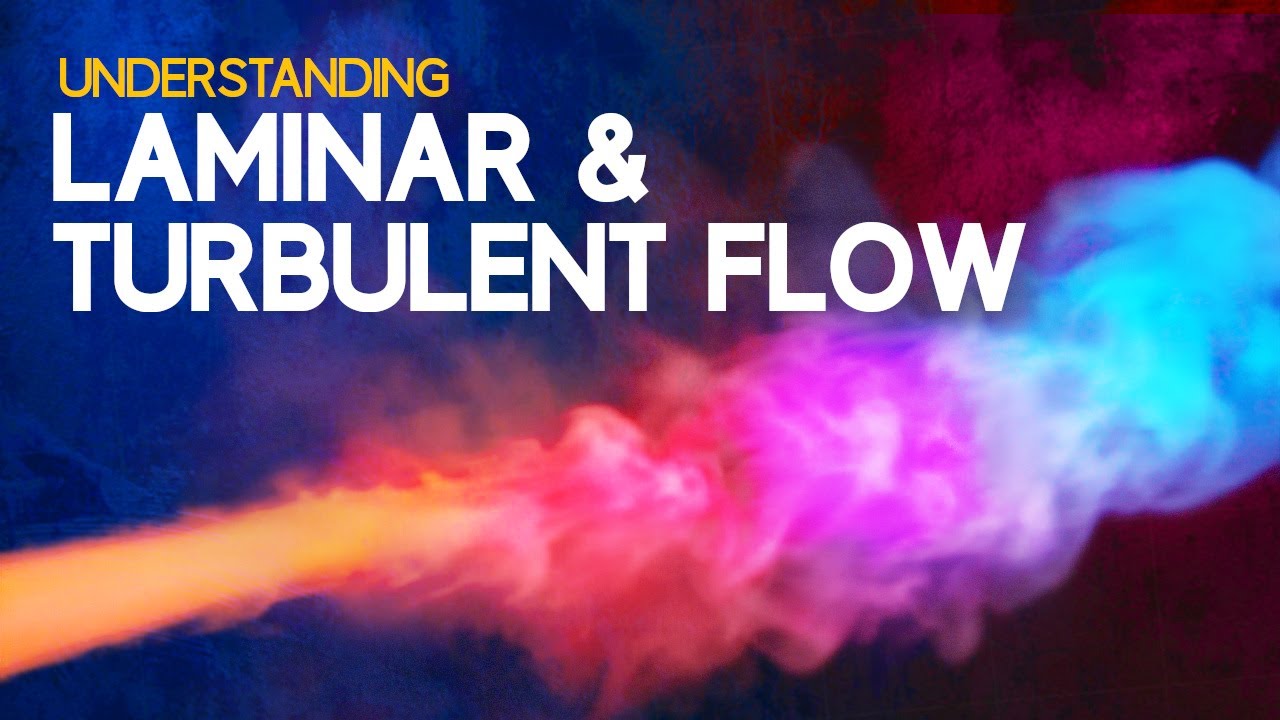
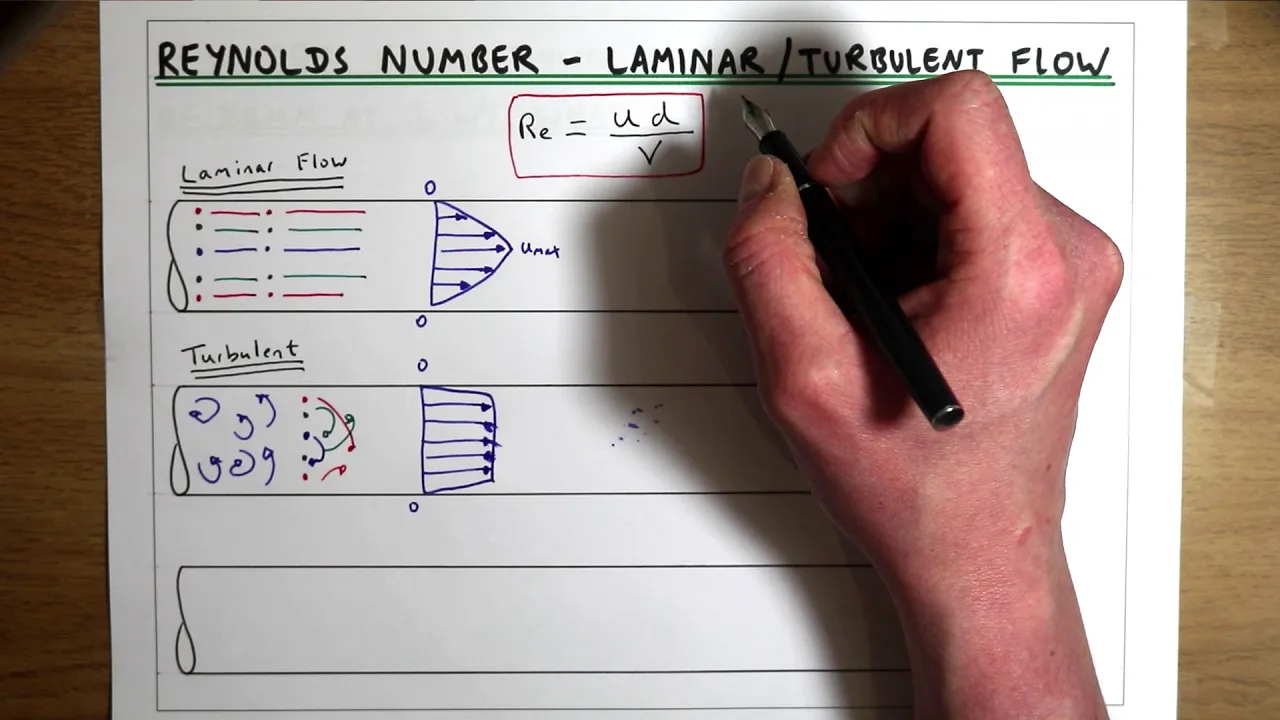
Added:The fundamental distinction between laminar and turbulent fluid flows, characterized by the Reynolds number.
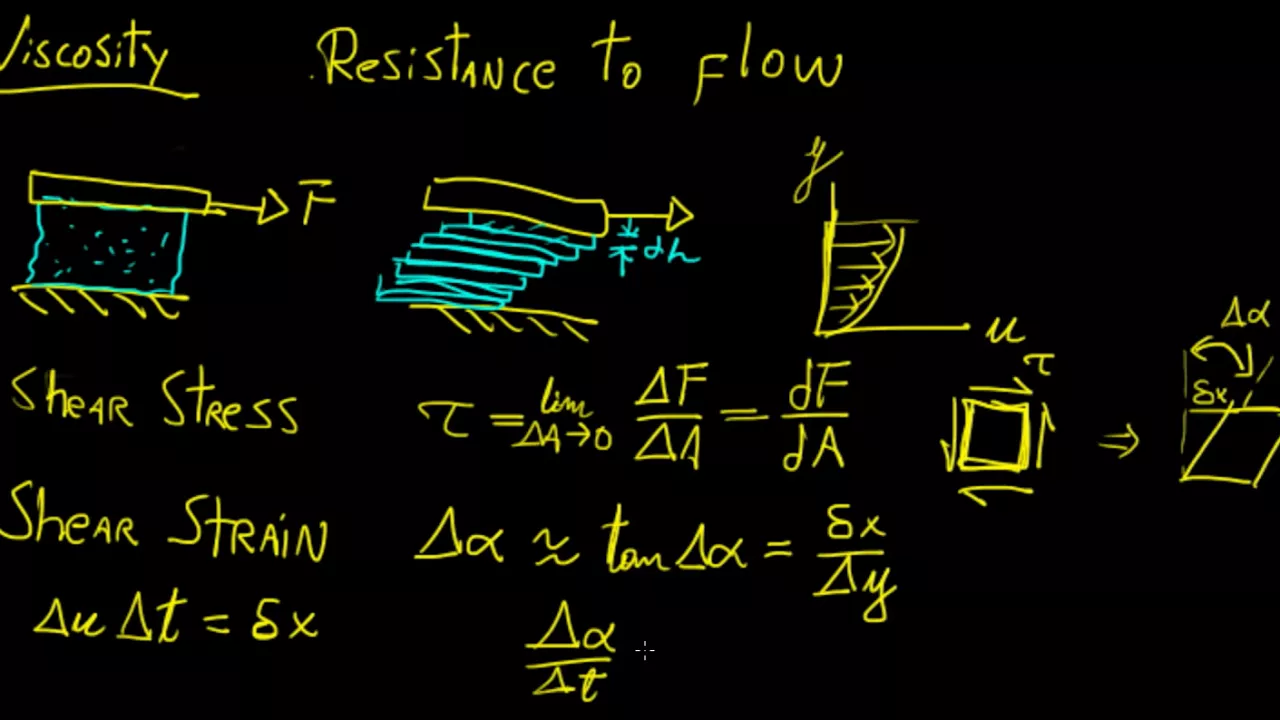
The concept of fluid viscosity and how shear stress behaves between moving parallel or concentric surfaces.
Kinematic reversibility in low Reynolds number flows (Stokes flow), where viscous forces dominate over inertial forces.
The difference between advection (transport by fluid bulk motion) and molecular diffusion (random thermal motion).
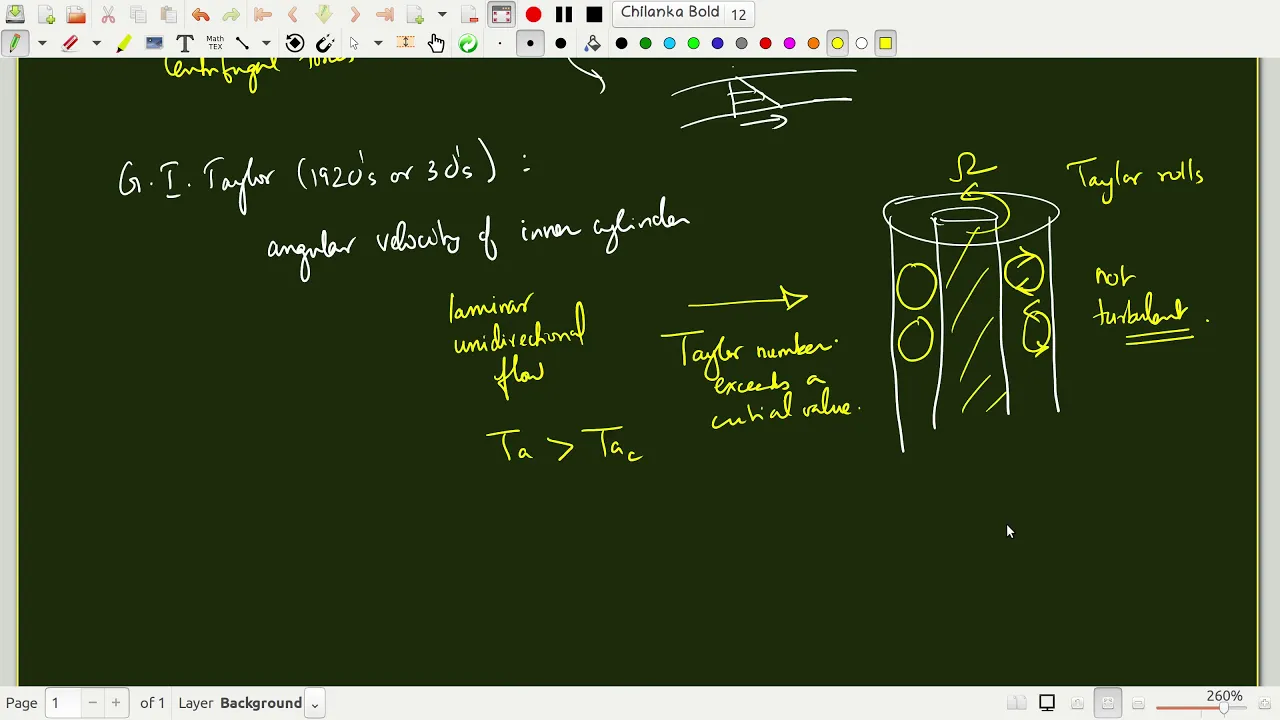
Hydrodynamic stability theory, specifically analyzing how laminar Taylor-Couette flow transitions to Taylor vortices.
The study of chaotic advection and how non-reversible mixing is achieved in low Reynolds number systems.
Practical applications of Taylor-Couette configurations in chemical engineering, such as in filtration and polymerization reactors.
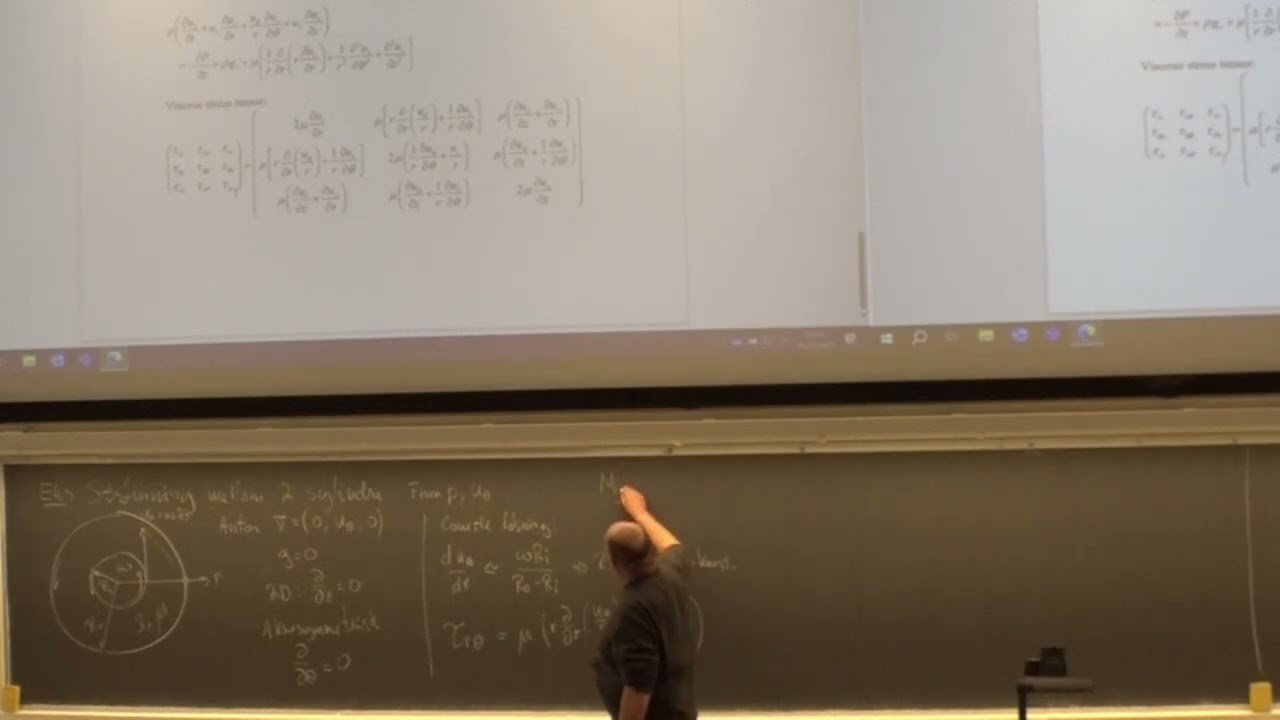
Mathematical modeling of the Navier-Stokes equations in cylindrical coordinates to solve for Couette flow profiles.
5.4M views172.7Klikes9:35Original Release: 2019-05-22
- It is Laminar Flow day and you know this about me, I love Laminar Flow.
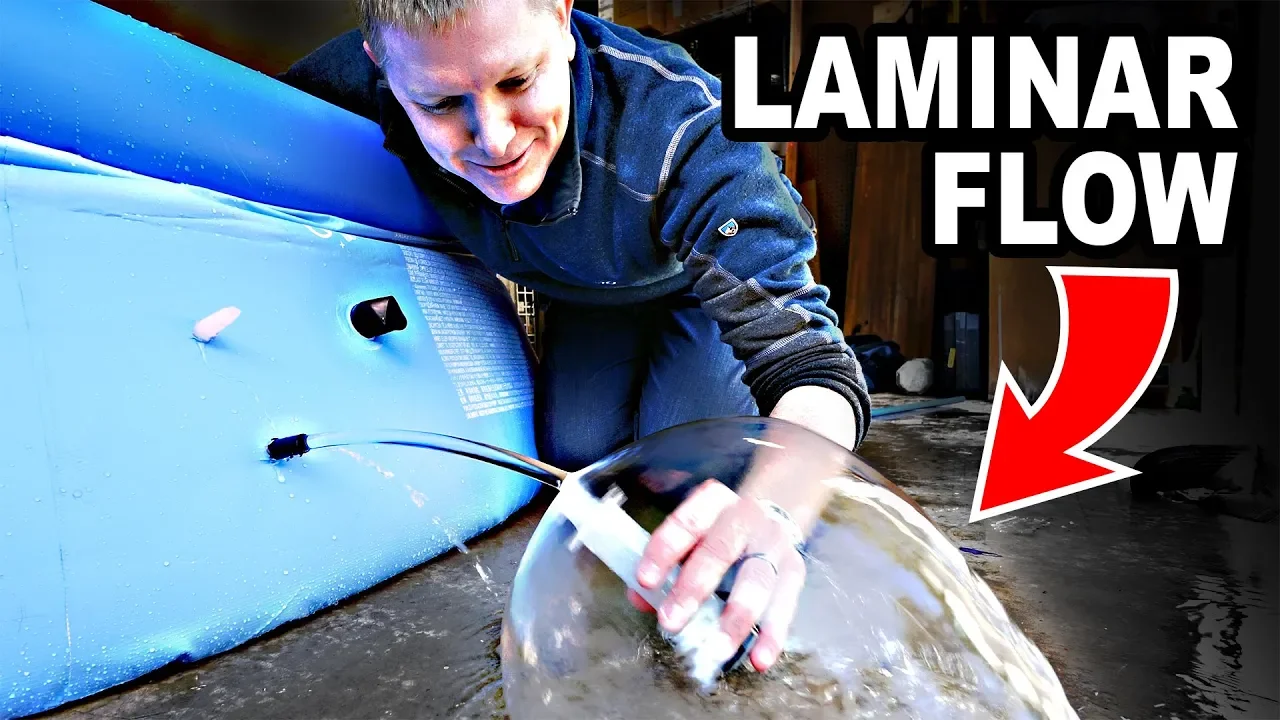
There's a cool video on Smarter Every Day that talks about how Laminar Flow works but we're doing what I call today, Ultra Laminar Flow!
It's not really called that, I just made this sign to try to make it a thing.
But, check this out!
We're gonna look at something called Taylor-Couette Flow.
My man here, Maurice Couette, French guy.
He came up with a device, so you could quantify the viscosity of a fluid, by a cylinder rotating on the inside of another cylinder, it's really cool work.
My dude here, Sir Taylor, he expanded on Couette's work and he measured stability inside Couette Flow.
So you combine the two, you get Taylor-Couette Flow.
What we're gonna look at today, if it works, I really want this to work, I've been wanting to do this experiment for a long time, we're gonna look at ultra low Reynolds Number's Flow, and hopefully, hopefully, we get reversible flow.
Let's do this.
First things first, we've gotta fill up the tank.
This is corn syrup, which is a very viscous fluid.
Here we go, it's gonna take quite a while, this is a lot of corn syrup.
Liquid rope coiling effect.
We should revisit that.
That's a topic for another video.
Okay, here's the magic of Taylor-Couette Flow.
You have something called a no slip boundary condition.
So on this inner cylinder here, the corn syrup wants to stick to it, and on the outer cylinder, it also wants to stick there.
So, if I'm rotating that inner cylinder, what's happening is it will try to move along with it.
So if we were to draw a line across the gap there and we were to rotate it, the inner cylinder would pull (bright guitar music) along the inner corn syrup, and the outer corn syrup would stay there.
And so what would happen is, you would create this spiral pattern.
In fact, if you look down through there, you can kinda see it happening in the clear fluid.
So what we're gonna do is, we're gonna put this colored corn syrup in there, and because we have so such a low Reynolds Number here, that's Laminar Flow, and it should, should, be reversible.
Okay, so as I put this color in here, I wanna recommend something.
What you're about to see is absolutely incredible and you're only gonna get to unwrap this present once.
So if you would, please trust me and don't fast forward this video.
In order to fully appreciate what you're about to see, you need to watch it unfold in real time.
Okay, here we go.
We're gonna go for seven rotations, everything I've seen on the internet does five.
And, go.
So you should see the spiral start to happen.
(bright guitar music) One.
Two.
I see the spirals.
Three.
Is your heart pounding?
- [Trent] That is amazing.
- Can you see the spirals in there?
- [Trent] Yeah.
Four, it's like making candy cane lookin' things.
I don't think it's linear.
Like, I think the gradient of the flow across the entire thing.
- [Trent] Dude, that is beautiful man.
- Is this six?
- I think it's seven. - I think it's six, I don't know. (laughs) Got so excited!
Oh dude.
Look at that.
It's like a marble.
Can you see it?
Focus further down in there, seven!
Okay, here we go.
Seven, it looks like it's completely just all mixed up.
Oh man, it looks like you could never get that back together.
Okay, here we go.
This should work.
Reversible Flow.
Ultra Laminar Flow, Taylor-Couette.
We'll see what you got boys.
You ready?
Here we go. (upbeat music) I'm nervous it's not gonna work.
Oh golly.
(video fast forwarding tone) We should have four spirals after this.
(video fast forwarding tone) I have lost count because (laughs) I'm so excited.
I think it's coming up on five.
That's five.
Get in there tight, it's about to start getting crazy.
We got two more.
Come on baby, I'm so worried that the red and the blue are gonna mix because they were very, very close to each other, like radially.
Six, okay.
This should be it.
Please work.
I want you to work so bad.
Is it working?
Did it work?
- [Trent] I think so.
- Yes!
(laughs) That's awesome.
So it worked.
Oh, you can see shear thinning in there.
Okay, look, the, can I see that?
So the, the different levels of, look at that.
So if you get way down in there, look.
You see all those striations, that happens because of the way we were mixing it.
It looks like different layers sheared at different rates.
So we had different viscosities at different times and so we get this striated pattern.
But we did it!
My boys!
My boys, what ya got?
Taylor and Couette.
Hi-five, yeah, yeah!
What do you do when you do the thing you've always wanted to do?
I don't know what to do.
Do we go the other way?
Let's do it. (bright guitar music) Okay, so this is an awesome fluid mechanics demonstration.
But for me, there's a metaphor to all this.
Sometimes it feels like life is turbulent, like everything is jumbled up and there's no way you're ever gonna get things set straight.
But I believe, if you slowly and methodically think about the way you got yourself into the situation and start thinking about how to get out of that situation, and take slow, deliberate steps, hopefully, hopefully, I know it's not possible for everyone, something that looks like, is a complete mess and it'll never be set straight, hopefully, one day, you will actually be able to get out of the situation.
But, it requires patience and deliberate thinking to get it all straightened out.
Anyway, I wanted to tell you about a book that makes me think about this principal for life.
I'll do that now. (beep) Okay, this episode of Smarter Every Day, was sponsored by Audible.
As you know, Audible is a great way to listen to audio books and I spend the bulk of my time on the go and it is a way for me to reclaim that time in order to learn.
So you can get an audio book by going to audible.com/smarter, or texting the word, Smarter, to 500-500.
The book I wanna talk to you today about is called the Sun Does Shine, by Anthony Ray Hinton, who was wrongly convicted of murder and served on death row for decades.
Anthony Ray Hinton is an amazing writer and it's told from his perspective from many years living on death row.
This has changed the way I look at the world and I want you to listen to this book.
I gotta go to the airport.
(thudding) All right, let's go.
My wife books my seats.
Thank you very much wife.
(engine roaring) - [Anthony Ray Hinton] If I could put my heart in the judges heart, he would know I didn't do it.
- So one thing I really like about the app is you can click this little Clip button right here and you can add a note in the book and you can go back and listen to it later and you can bring back all those thoughts and memories and think more deeply about the subject at hand.
It's a really cool feature.
(engine humming) You can get a free audio book and two Audible originals by going to audible.com/smarter or texting the word, Smarter, to 500-500.
You're gonna enjoy audio books.
I get smarter when I travel.
This is time that feels that I'm kinda wasting it, but when you're listening to audio books, you get smarter.
So, again, text Smarter to 500-500 or go to audible.com/smarter. (beep) If you wanna see just the tripod shot, and that being sped up, go check out that video I'm putting over on the second channel.
I think you'll like that.
Thank you if you decided to actually watch this video and learn about these principals with me, instead of just watching a GIF on the internet and not, like, diving into the science of what's going on.
So thank you.
If you're interested in subscribing to Smarter Every Day, like if you feel like this kinda content earns it, then thanks, that'd be awesome.
Feel free to ring the bell, if that's what you're into.
If you're not into that, no big deal, but I'm just happy that you're here.
Thanks for doing this with me.
Let's do it one more time, and, boom, (laughs) that's awesome.
Dude, that works well!
Up Next

32:59
Low-Reynolds-Number Flows: Fluid Mechanics Fundamentals
@BarryBelmont
114.8K views•2011-04-28

12:53
21cm Hyperfine Transition in Neutral Hydrogen: Radio Astronomy Basics
@AaronRobertParsons
12.4K views•2011-10-13
14:03
Laminar Flow and the Reynolds Number: A Fluid Dynamics Overview
@smartereveryday
8.4M views•2019-01-27

27:14
Entropy and the Second Law of Thermodynamics Explained
@veritasium
27.5M views•2023-07-01
Related Study Plans & Knowledge Roadmaps
Structured learning paths in Physics
physics
Nuclear Physics (Decay, Fission & Reactors)
01Atomic Structure and the Binding Force
02Radioactive Decay and Half-Life
03Nuclear Fission Mechanics and Chain Reactions
+ 2 more learning modules
12h5 modules
Explore Roadmap
physics
Soft Matter (Polymers, Colloids & Rheology)
01Foundations of Soft Matter & Thermal Forces
02Polymer Physics and Macromolecules
03Colloids, Surfactants, and Self-Assembly
+ 2 more learning modules
38h5 modules
Explore Roadmap
physics
Analytical Mechanics: Lagrangian & Hamiltonian
01Mathematical Foundations: Calculus of Variations
02From Newtonian Mechanics to Constraint Dynamics
03The Principle of Least Action & Lagrangian Mechanics
+ 3 more learning modules
28h6 modules
Explore Roadmap
physics
General Relativity (Spacetime & Cosmology)
01Foundations of Relativity: Special Relativity
02The Geometry of Spacetime: Equivalence Principle & Curvature
03Einstein's Field Equations: The Mathematics of Gravity
+ 2 more learning modules
55h5 modules
Explore Roadmap