Intellectual Property (IP) is a suite of legal rights that protect investments in innovation and creativity, granting creators the ability to control how their original works are used, shared, or monetized; specifically, copyright automatically protects literary, artistic, and dramatic works such as novels, songs, and videos without requiring registration or payment.
Intellectual Property Basics: Legal Rights for Innovation
Added:Deep Dive
The distinction between tangible and intangible assets (physical goods vs. conceptual ideas).

UPSC Prelims 2023 Paper Discussion || Economics || By Dr. Bharat Sir
111.7K
Assets are classified into tangible and intangible categories. Tangible assets are physical items that can be seen and touched, such as cameras, digital boards, inventory, and machinery. Intangible assets are non-physical assets that cannot be physically seen or touched, such as brand recognition, intellectual property (trademarks, patents), and customer databases. The distinction is important for business accounting, valuation, and investment analysis.
Click to watch →

All Accounting Terms | One Shot | Class 11 Accountancy | Simplest explanation ever. MUST WATCH
71.6K
Tangible assets are physical properties that can be touched and seen, such as land, buildings, computers, furniture, and machines. Intangible assets are non-physical properties that cannot be touched or seen, such as goodwill, reputation, patents, trademarks, copyrights, and licenses. Both types contribute to business operations but differ in their physical nature.
Click to watch →

Types and Rules of Accounts
506.4K
Real Accounts are classified into Tangible and Intangible Assets. Tangible Assets can be touched, felt, measured, and seen (e.g., Land, Building, Plant, Machinery, Furniture, Fixtures like tube lights and fans). Intangible Assets cannot be touched or seen but can be measured (e.g., Goodwill, Patent, Copyright, Trademark, Know-How). The key distinction is that tangible assets are physical and perceptible, while intangible assets are non-physical but quantifiable.
Click to watch →

Basic Accounting Terms Full Chapter & NCERT Solutions 2022-23 | Class 11 Accounts Chapter 2
511.8K
Tangible assets are physical assets that can be seen and touched, such as buildings, machinery, and furniture. Intangible assets are non-physical assets that cannot be seen or touched, such as patents, trademarks, goodwill, and software. Goodwill is an intangible asset representing the reputation, brand value, and customer relationships of a business. It cannot be seen or touched but has significant value.
Click to watch →

TANGIBLE & INTANGIBLE ASSETS Class -11accounts
704
Tangible assets are physical items that can be seen and touched (e.g., cash, machines, buildings, furniture), while intangible assets are non-physical items that cannot be seen or touched (e.g., goodwill, patents, copyright, software). Key differences include: tangible assets include both current and fixed assets, whereas intangible assets only include fixed assets; tangible assets can be used as loan collateral but intangible assets generally cannot; tangible assets are subject to depreciation while intangible assets undergo amortization; and tangible assets carry fire risk while intangible assets do not.
Click to watch →
Deep Dive
Basic business principles, including how innovation and brand identity drive competitive advantage.

EUD Wrocław, spotkanie VI - Wykład: Podziwiane firmy świata (30.05.2016)
110
Southwest Airlines pioneered low-cost flying by competing with cars rather than other airlines, using small aircraft, single-class service, and simple pricing. FedEx provides global express delivery with same-day capabilities and online tracking technology. Nike, founded by Phil Knight and Bill Bowerman, initially imported Japanese shoes before inventing the famous swoosh logo accidentally while making waffles. The company changed its name to Nike (Greek goddess of victory) in 1978 and uses the 'Just Do It' slogan. General Electric, founded over a century ago, invented the light bulb and remains a leader in electrical and industrial manufacturing, producing motors, medical equipment, and electronics. Each company demonstrates how innovation, brand identity, and operational excellence create competitive advantages in their respective industries.
Click to watch →

Chương trình thời sự Yên Bái ngày 13 10 2020
246
Business innovation involves: (1) investing in technology and modernization, (2) developing unique value propositions, (3) building strong brand identity, (4) maintaining quality standards and customer satisfaction, and (5) continuously seeking competitive advantages through innovation and efficiency improvements.
Click to watch →
Lesson 2B - 10 Types of Innovation: How to Innovate and Differentiate Your Product
106
Brand innovation uses brand identity as a source of competitive advantage. Virgin, led by Richard Branson, represents being different and fun across diverse industries (airlines, music, trains, space travel). Intel's branding made computer components so valuable that having 'Intel Inside' elevated entire product values. Apple's brand represents innovation, design excellence, and customer loyalty, demonstrating how brand positioning itself can drive innovation.
Click to watch →

Christian Guzman on Balancing Life, Love, and Business - DON'T BE SOUR EP. 71
54.9K
Innovation can create significant competitive advantages that are difficult for competitors to replicate. When brands create genuinely innovative products, they can command premium prices and build loyal customer bases. The key is to focus on innovation that creates real value for customers rather than superficial changes.
Click to watch →

Sharks Tank ft. YourKickstarterSucks & Luke Taylor || 5.4.24
2.3K
Sustainable competitive advantage comes from: (1) proprietary technology or intellectual property, (2) strong brand positioning, (3) superior customer service, (4) network effects, or (5) economies of scale. The advantage must be difficult for competitors to replicate and provide ongoing value to customers.
Click to watch →
Deep Dive
Fundamental legal concepts, such as ownership rights, liability, and government-enforced regulations.

JURISPRUDENCE /LEGAL THEORY FOR LL. B STUDENTS
126
Jurisprudence examines fundamental legal concepts including: (1) Rights - what individuals are entitled to; (2) Duties - obligations that individuals must fulfill; (3) Possession - the holding or control of property; (4) Ownership - legal title to property; (5) Property - movable and immovable assets; (6) Liability - legal responsibility for actions; (7) Obligation - binding requirements; (8) Restriction - limitations placed on conduct.
Click to watch →

BCJS. Introducción al Derecho. Módulo 4
2.5K
Fundamental legal concepts are those that cannot be absent from any possible legal system. These include: (1) Legal norm - the basic unit of law; (2) Legal fact and legal act - events and actions with legal significance; (3) Subjective right - rights held by individuals; (4) Subject of law - the entity to whom rights and duties belong; (5) Sanction - the consequence of violating legal norms. No positive legal system can exist without these concepts.
Click to watch →

Konsep Hukum
568
Legal rights consist of five elements: subject (owner), object (thing concerned), content (required action), correlation (relationship with obligations), and title (legal basis). Obligations are classified as public (correlating with public rights), civil (from contracts), universal (applying to all citizens), general (applying to specific groups), and special (applying to specific legal fields). Ownership rights include possession, use and enjoyment, consumption or transfer, and indefinite duration. Legal terminology must avoid multiple meanings and abstraction to prevent injustice. Fundamental legal concepts are universal, not tied to specific positive legal systems, enabling application across different legal contexts.
Click to watch →

1. Ders. Hukukun Temel Kavramları
947
The course begins with fundamental legal concepts including: What is law? What are rights? What is the constitution? What is a regulation? What is legislation? Students will learn which laws and regulations they must follow when practicing their profession.
Click to watch →

Concept of Ownership in jurisprudence / Types of Ownership / Modes of Acquisition of Ownership
490
Ownership is a comprehensive legal concept representing the highest form of rights over property. It is defined as a 'bundle of rights' including the right to use, prevent others from using, dispose of, and destroy property. John Austin described ownership as the right an owner has against all the world, subject to duties of conferring rights to others. The term derives from Latin 'dominium' meaning absolute right. Ownership contains elements of indefinite use, unrestricted control, and the ability to transfer or destroy property. It represents a relationship between persons with corresponding rights and duties.
Click to watch →
Deep Dive
An introductory understanding of the European Union's regulatory framework and its unified market.
Cepi's Paper & Beyond 2022 - High level session with Metsä Group & Sappi CEOs, EU Commission DG GROW
155
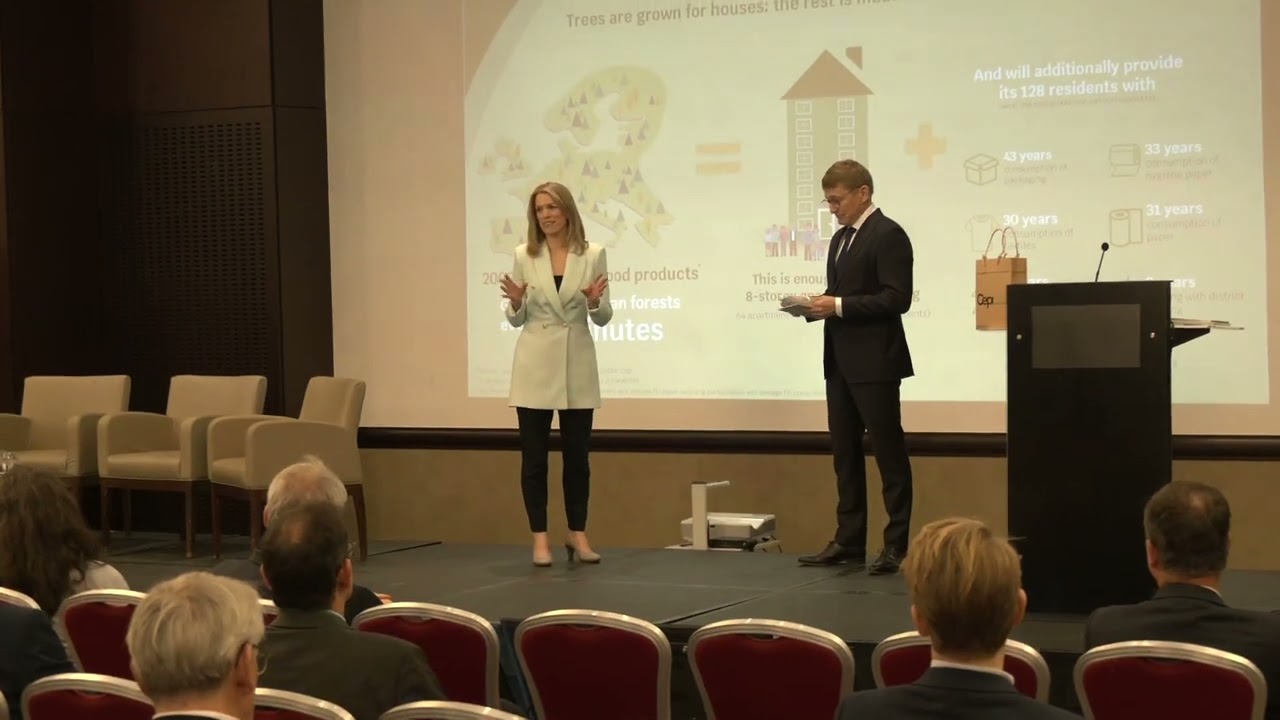
The EU's regulatory framework creates a single market by replacing 27 different sets of rules with one unified framework. This prevents member states from creating barriers that would fragment the market. The regulatory approach is meant to create a level playing field across the entire single market.
Click to watch →

21 IANUARIE 2025. Liderii PSD, „de principiu” pentru Crin Antonescu
65.9K
The European Union is working to reduce national barriers within the single market. President Ursula von der Leyen announced plans to create a unified capital market to encourage startup investments, and to harmonize legislation across member states including corporate law, insolvency law, labor law, and taxation. The goal is to establish a single, simple regulatory framework across the entire EU, enabling businesses to operate under one set of rules throughout the union.
Click to watch →

Waarom beslist Europa hoe een Kinder Surprise eruit moet zien?
11.3K
The European Union regulates not just trade but also the physical design of products, as demonstrated by the Kinder Surprise egg where EU law specifies exact dimensions for the inner egg and mandates that the two halves cannot be separated. The EU also regulates tobacco warning labels with specific dimensions, agricultural machinery safety, and animal welfare standards. The EU was founded to create a single market where barriers between member states are eliminated, allowing people to travel easily, consumers to shop across borders, and businesses to operate throughout the EU. Historically, European countries maintained significant trade barriers until the late 1960s. EU regulations have eliminated national monopolies and opened markets to competition. When member states implement different regulations, it creates market distortions, so EU regulation ensures all member states follow the same standards to maintain a level playing field. The EU addresses regulatory coordination by establishing common regulations to ensure minimum standards across member states, including environmental protection, animal welfare, food safety, consumer protection, and product safety.
Click to watch →

Power Ledger to Migrate to Solana. US Bill To Provide Crypto Regulatory Clarity. EU crypto Regs
137
The video explains that the European Union functions as a unified market with one currency (the euro) and one overriding body (the European Commission). The presenter argues that this makes the EU similar to a single country, which is why EU-wide regulation is necessary rather than individual national regulations.
Click to watch →
The ins and outs of the Single Market
23.6K
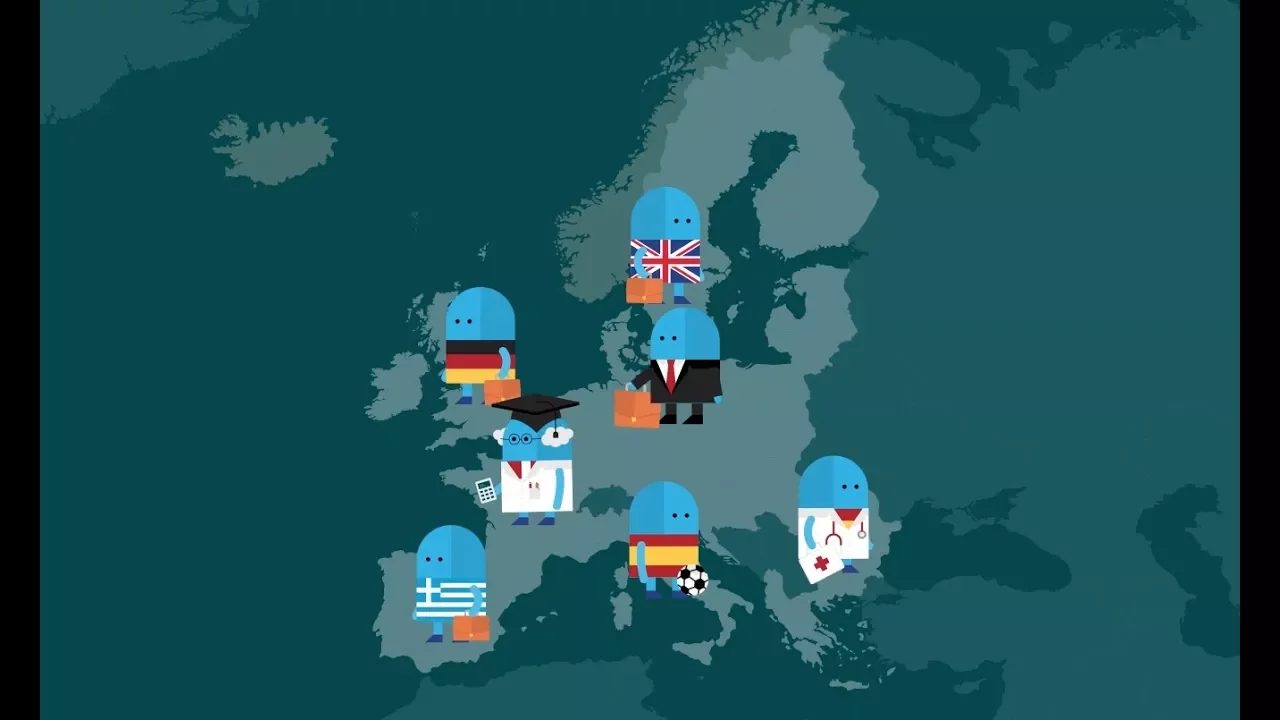
The EU Single Market is a regulatory union comprising EU members plus Iceland, Liechtenstein, and Norway, serving over 500 million people as the world's largest market; it eliminates trade barriers by harmonizing regulations and standards across goods, services, environment, health, and employment, enabling free movement of goods, services, and labor while requiring member states to accept common rules in exchange for market access, with enforcement through the European Court of Justice ensuring all parties comply equally.
Click to watch →
Prerequisite Knowledge
- Concept 01The distinction between tangible and intangible assets (physical goods vs. conceptual ideas).
- Concept 02Basic business principles, including how innovation and brand identity drive competitive advantage.
- Concept 03Fundamental legal concepts, such as ownership rights, liability, and government-enforced regulations.
- Concept 04An introductory understanding of the European Union's regulatory framework and its unified market.
Subsequent Learning
- Step 01In-depth study of specific IP registration processes, such as patent filing criteria, trademark searches, and copyright registration.
- Step 02IP enforcement strategies, including litigation, dispute resolution, and addressing counterfeiting or infringement.
- Step 03International IP frameworks and treaties, such as the World Intellectual Property Organization (WIPO), the Madrid System, and the Patent Cooperation Treaty (PCT).
- Step 04Strategic IP management for businesses, covering asset valuation, licensing agreements, and the commercialization of R&D.
IP Basics
IP Basics
0:00Playing Section
- 1
Defines intellectual property as legal rights protecting innovations.
- 2
Explains creators' control over use, licensing, or sharing.
- 3
Notes automatic copyright for creative works without registration.
The Critique of Intellectual Monopoly and the Free Culture Movement
While traditional frameworks view intellectual property (IP) as essential for fostering innovation, critics argue that aggressive IP enforcement actually stifles creativity and technological progress. Proponents of the 'Free Culture' and open-source movements suggest that IP laws create artificial scarcity and legal barriers, leading to 'patent thickets' that block new creators from building on existing ideas. Economists and theorists argue that IP rights often protect monopolies, disproportionately benefit large corporations over individual innovators, and restrict public access to crucial knowledge, medicine, and technology. Alternative models, such as open-source licensing, Creative Commons, and open science, demonstrate that innovation can thrive through collaboration and shared knowledge rather than restrictive legal ownership.
Deep Dive
In-depth study of specific IP registration processes, such as patent filing criteria, trademark searches, and copyright registration.

RM & IPR Model Paper Soln-2 Module 3,4 5th Sem Research Methodology Common for all CSE,ECE,ME VTU
1.2K
Copyright registration protects original works of authorship through a formal process: (1) Eligibility verification ensuring originality, tangible fixation, minimal creativity, authorship, and non-public domain status; (2) Application form submission with author details and work title; (3) Submission of work copy; (4) Fee payment; (5) Office examination; (6) Certificate issuance; (7) Public record keeping. Trademark registration protects brand identifiers through: (1) Trademark search for availability; (2) Application preparation with mark details; (3) Filing with the trademark office; (4) Examination for errors; (5) Examination report issuance; (6) Publication in trademark journal; (7) Opposition period for public challenges; (8) Acceptance and registration upon successful completion.
Click to watch →

Let's Talk it Over: Focus on Intellectual Property Rights and Management
205
IP registration processes vary by type but share common elements. Trademarks undergo examination by approximately 25 examiners handling 45,000+ annual filings, with publication, opposition periods, and certificate issuance. Patents require formal and substantive examination stages, taking 18 months for first publication and additional time for grant. Copyright provides automatic protection but registration establishes public record of ownership. Online systems enable 24/7 filing with multiple payment options. These procedures ensure proper documentation, examination, and legal recognition of IP rights, though the complexity varies significantly across different IP categories.
Click to watch →
CA Final SPOM Set D | Paper 3 | Chapter 7 | Exam Oriented Batch | CA Himanshu Adlakha (AIR 35 & 48)
8.7K
This section covers intellectual property protection and patent registration. Types of IP protection include: (1) Patents - legal protection for unique inventions or software, valid for 20 years from filing date, renewable; (2) Copyrights - legal protection for original creative works (literary, artistic, musical), valid for 70+ years; (3) Trademarks - legal protection for brand names, logos, and symbols, valid indefinitely with renewal. The patent registration process involves: (1) Eligibility check - verify the invention is patentable and not already patented; (2) Patent research - confirm the invention is unique; (3) Patent application - prepare and file the application describing the invention; (4) Examination - the Indian Patent Office examines the application; (5) Publication - successful applications are published in the Indian Patent Journal; (6) Grant - patents are granted for 20 years; (7) Maintenance and renewal - patents must be maintained and renewed after 20 years; (8) Enforcement - legal action can be taken against unauthorized use.
Click to watch →

Cómo Elegir un Buen Nombre para una Marca | Negocio | Empresa | Página
105.8K
To register a brand, the speaker searches trademark databases in the country where the brand will be registered. For example, the US Patent and Trademark Office database shows if a brand is already registered. If no records appear, the brand is available. The speaker also searches databases for other countries like Spain or Mexico.
Click to watch →

Makyajsız E-TİCARET Kampı (13.GÜN)
1.1K
To search for existing trademarks: (1) go to USPTO.gov, (2) navigate to the Trademarks section, (3) enter your proposed brand name. Status indicators: 'dead' or 'cancelled' means the trademark is expired, 'live' means it's active, 'registered' means it's approved. Trademarks must be renewed every 5 years. Similar trademarks to well-known brands (like Apple) will likely be rejected. The registration process involves: (1) initial application, (2) potential opposition from other trademark holders, (3) final approval. Turkey takes about 4 months, US takes about 6 months. The instructor recommends working with professional services for brand registration.
Click to watch →
Deep Dive
IP enforcement strategies, including litigation, dispute resolution, and addressing counterfeiting or infringement.
![[NZ] Protecting Your Business' Most Valuable Asset: Your IP | LegalVision](https://i.ytimg.com/vi/phW8G3ufdRI/maxresdefault.jpg)
[NZ] Protecting Your Business' Most Valuable Asset: Your IP | LegalVision
156
IP enforcement ranges from informal contact requesting cessation to formal court remedies. Initial steps include evidence collection and legal consultation. Informal options work for low-value or accidental infringements. Platforms like social media and marketplaces offer takedown mechanisms. Formal alternatives include domain dispute resolution. Court action alleges misleading conduct or passing off, potentially seeking injunctions, damages, or account of profits. Litigation carries costs and reputational risks, requiring careful evaluation. Trademarks protect brand identity while patents protect inventions—distinct IP categories requiring different strategies. Ideas lack protection, but associated brands, publications, and trademarks do. International protection requires country-by-country registration or Madrid Protocol applications. Costs escalate significantly overseas. Dual protection through trademarks and copyright strengthens enforcement against counterfeit products.
Click to watch →

In-house in Focus: Intellectual property
147
A comprehensive IP enforcement strategy includes: (1) ensuring key rights are registered (registered rights are easier to enforce than unregistered rights), (2) implementing monitoring policies (internal or external services), (3) obtaining evidence before contacting defendants, (4) using domain name registries for takedowns, (5) working with platform providers (eBay, Amazon) for infringement on their sites, (6) engaging payment providers to discontinue payments to infringing websites, and (7) involving police, trading standards, or customs for physical goods. Success varies based on investigator engagement.
Click to watch →
Anti-Counterfeiting Litigation Strategies
168
Anti-counterfeiting litigation differs fundamentally from standard IP cases because counterfeiters typically hide their identities, requiring plaintiffs to treat litigation as a sleuthing expedition focused on gathering information and rolling up the supply chain rather than seeking monetary damages; effective strategies include using marketplace reporting tools to obtain defendant email addresses, filing John Doe lawsuits to initiate discovery, and leveraging court orders to secure injunctions against platforms like Amazon and eBay, which can then be used to remove infringing products even when monetary recovery from foreign counterfeiters is unlikely.
Click to watch →

Doradztwo w zakresie strategii IP: Strategia ochrony własności intelektualnej
145
IP enforcement remedies include cessation of infringement, withdrawal of goods, damages, and destruction of infringing tools. Registered rights provide stronger enforcement evidence than unregistered claims. Three strategic approaches exist: passive (no formal protection, relying on trade secrets), defensive (registration and monitoring with selective enforcement), and active (proactive IP exploitation through licensing, monetization, and early infringement response). Startups typically progress from passive to defensive to active strategies. Strategy selection depends on business objectives, territory, product lifespan, industry specificity, and budget.
Click to watch →

Seminārs "Intelektuālā īpašuma tiesību aizsardzība. Padziļināti."
223
Identifying infringement requires: (1) Monitoring the market; (2) Analyzing competitor products; (3) Using patent databases; (4) Consulting industry contacts. IP infringement impacts organizations through lost sales, brand damage, quality concerns, and customer confusion. IP disputes can be resolved through: (1) Negotiation; (2) Mediation - non-binding negotiation with a neutral third party; (3) Arbitration - binding decision by a neutral third party; (4) Litigation. ADR is often cheaper and faster than litigation and can preserve business relationships. Organizations can choose arbitration centers that support multiple languages, which is important for international disputes. Patent translation issues cause many disputes, with at least 20% of court actions involving translation problems. IP rights are territorial: protection exists only in countries where it is registered, enforcement must be pursued country by country, and different countries have different laws and procedures. IP infringement damages include: lost profits, infringer's profits, reasonable royalties, and attorney fees.
Click to watch →
Deep Dive
International IP frameworks and treaties, such as the World Intellectual Property Organization (WIPO), the Madrid System, and the Patent Cooperation Treaty (PCT).
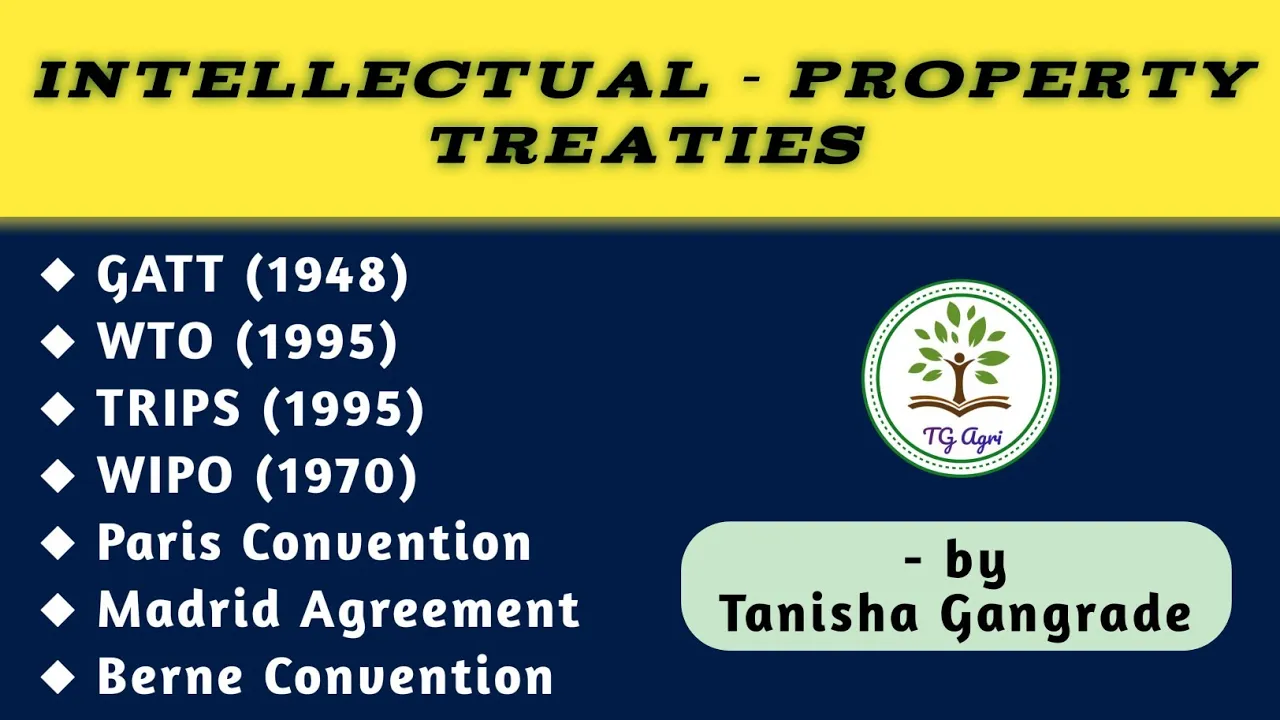
GATT | WTO | TRIPS | WIPO | Paris Convention | Madrid Agreement | IPR Treaties by Tanisha Gangrade
240.2K
This lecture by Tanisha Gangrade from TG Agri explains key international frameworks governing intellectual property rights, including the Paris Convention (1883) for industrial property protection, Berne Convention (1886) for copyright, Madrid Agreement/Protocol for trademark registration, WIPO (founded 1967) as the UN specialized agency for IP, GATT (established 1947) and WTO (established 1995) for trade-related IP, TRIPS Agreement (1994) under WTO setting minimum IP standards, and the European Patent Convention (EPC) for unified patent protection in Europe.
Click to watch →

WIPO-AIPPI Joint Webinar - April 2020
449
WIPO manages three major international IP protection systems serving global innovation. The PCT system (153 member states) enables unified patent filings, with China surpassing the US in 2019 with 22% of applications. Computer technology dominated filings at nearly 9%. The Hague System achieved 10% growth in 2019 with nearly 22,000 designs, driven by China, Korea, Italy, and UK, with Class 14 (GUIs) leading filings. The Madrid System achieved record 64,000+ applications in 2019, with China and India entering the top five applicants for the first time. Recent accessions include Israel, Mexico, Samoa, Vietnam, completing North American coverage. All systems implemented electronic communication during pandemic, with suspended postal services requiring email addresses for procedural timelines.
Click to watch →

Tratados de la OMPI (Organización Mundial de la propiedad Intelectual)
247
The World Intellectual Property Organization (WIPO) administers multiple international treaties that establish standardized frameworks for protecting intellectual property across different domains, including copyright (Berne Convention, Marrakech Treaty), industrial property (Paris Convention, Madrid System), performers' rights (Rome Convention), and patent procedures (PCT, Budapest Treaty), with most treaties providing minimum protection periods of 20-50 years and establishing principles like national treatment and right of priority.
Click to watch →

IPR | Practice with MCQs | Part 5 | UGC NET 2025 | By Ishita Ma’am
568
This comprehensive segment covers the foundational international intellectual property treaties. The Paris Convention (1883) is the first international IP treaty with 177 member states, providing national treatment and priority rights for patents, trademarks, and industrial designs. The Patent Cooperation Treaty (PCT), signed in 1970 and effective from 1978, facilitates international patent grants through unified applications with 36 signatory states. The Madrid System, governed by WIPO with 1330 member countries, provides international trademark registration through the Madrid Agreement (1891) and Protocol (1989), effective from 1996. These treaties form the backbone of international IP protection and are essential for UGC NET examinations.
Click to watch →
WIPO – World Intellectual Property Organization – Intellectual Property Basics #rolfclaessen
43.8K
The World Intellectual Property Organization (WIPO), established in 1967, administers three major international treaties that simplify global intellectual property protection: the Patent Cooperation Treaty (PCT) allows inventors to file one patent application valid in 148 countries, giving them 30 months to decide where to seek protection; the Madrid System enables trademark owners to file one application to get protection in 97 member countries after first registering in their home country; and the Hague Agreement lets designers file one application to protect up to 100 designs in 65 member countries. These systems help creators navigate complex international IP protection while supporting developing countries in establishing IP frameworks and harmonizing global IP laws.
Click to watch →
Deep Dive
Strategic IP management for businesses, covering asset valuation, licensing agreements, and the commercialization of R&D.

04 Commercializing IP
234
Strategic IP management encompasses multiple interconnected approaches: internal freedom to operate ensures companies can develop products without infringement risks; licensing decisions between buy or rent determine competitive positioning; royalty income from licensed technology creates ongoing revenue streams; external commercialization through sales and partnerships monetizes IP assets; patent donation to research consortia enables treatments for rare diseases with limited market appeal; and ethical considerations balance investment protection with societal responsibility. Companies must document IP properly, conduct thorough analysis, and develop comprehensive strategies that protect investments while creating value for stakeholders.
Click to watch →

The True Value of Intellectual Property with Alec Sorensen | SVIC Interview
116
Different commercialization strategies (startup spin-outs, co-development partnerships, licensing to established or growing companies) suit different technology-market combinations. Fast-growing markets with immature technologies benefit from startup spin-outs, while mature technologies in stable markets commercialize best through licensing. Data-driven approaches help parties reach consensus on appropriate strategies. Regardless of IP volume, the ability to navigate the IP landscape and think critically about internal and competitor IP holdings becomes a make-or-break factor for company success. Strategic IP management—including understanding, protecting, and leveraging intellectual assets—is essential for competitiveness in the knowledge economy.
Click to watch →

IP Talks Session 2: Using intellectual property in business
1.3K
Intellectual property (IP) serves as a critical strategic asset for businesses, representing over 90% of company value in many industries; effective IP management requires a comprehensive six-step strategy including internal and external audits, gap analysis, and ongoing reassessment, supported by proper contracts like assignments and NDAs, while IP searches (trademark and patent) are essential tools for competitive intelligence and risk mitigation, and IP valuation differs fundamentally from business valuation in its focus on protecting competitive advantages through strategic combinations of patents, trademarks, and trade secrets.
Click to watch →

Introducción a la Propiedad Intelectual | Propiedad Intelectual en las Universidades
312
Patent databases are valuable research tools containing millions of documents available online, saving time and preventing duplication of existing work. Licensing is the most basic commercialization method, where owners grant permission for use under conditions, usually for royalties. Intellectual property can create spin-off companies, joint ventures, and cross-licensing agreements. It can also serve as collateral for financing, though banks traditionally only accept real estate. Intellectual property management is a group of strategic activities transforming intellectual property rights into intellectual assets that generate value. Organizations that effectively manage intellectual property should have: clear intellectual property policies and regulations, a designated department or person responsible for IP, incentives for creativity and innovation, ongoing training in IP and technology transfer, requirements for researchers to report inventions, protection of intellectual assets through IP rights, negotiation of IP terms before collaborative projects, and written contracts for joint projects.
Click to watch →
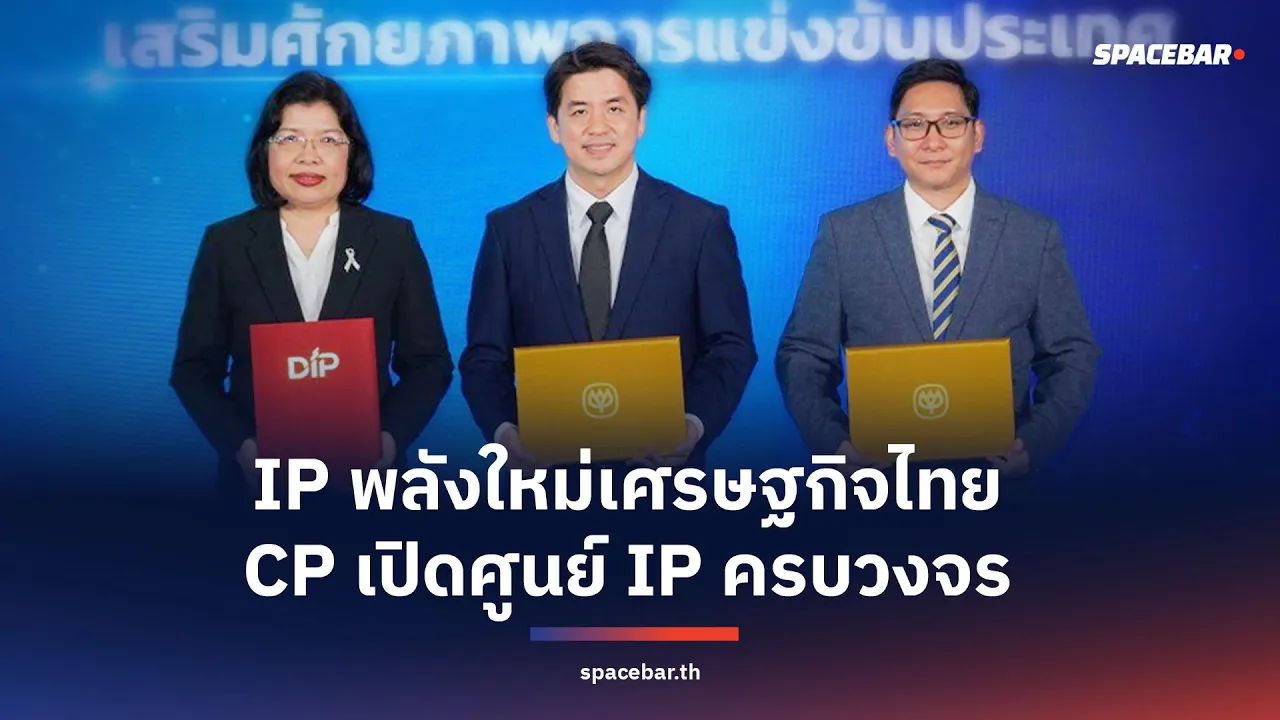
IP พลังใหม่เศรษฐกิจไทย CP เปิดศูนย์ IP ครบวงจร | SPACEBAR
308.3K
Intellectual property (IP) serves as a strategic business asset that transforms ideas, research, and innovations into tangible economic value, creating revenue, reducing costs, and enhancing competitiveness; effective IP management requires comprehensive services covering registration, strategic planning, and commercialization to maximize business potential and contribute to national economic growth.
Click to watch →
IP Basics
IP Basics
0:00- 1
Defines intellectual property as legal rights protecting innovations.
- 2
Explains creators' control over use, licensing, or sharing.
- 3
Notes automatic copyright for creative works without registration.
The Critique of Intellectual Monopoly and the Free Culture Movement
While traditional frameworks view intellectual property (IP) as essential for fostering innovation, critics argue that aggressive IP enforcement actually stifles creativity and technological progress. Proponents of the 'Free Culture' and open-source movements suggest that IP laws create artificial scarcity and legal barriers, leading to 'patent thickets' that block new creators from building on existing ideas. Economists and theorists argue that IP rights often protect monopolies, disproportionately benefit large corporations over individual innovators, and restrict public access to crucial knowledge, medicine, and technology. Alternative models, such as open-source licensing, Creative Commons, and open science, demonstrate that innovation can thrive through collaboration and shared knowledge rather than restrictive legal ownership.
The distinction between tangible and intangible assets (physical goods vs. conceptual ideas).
Basic business principles, including how innovation and brand identity drive competitive advantage.
Fundamental legal concepts, such as ownership rights, liability, and government-enforced regulations.
An introductory understanding of the European Union's regulatory framework and its unified market.
In-depth study of specific IP registration processes, such as patent filing criteria, trademark searches, and copyright registration.
IP enforcement strategies, including litigation, dispute resolution, and addressing counterfeiting or infringement.
International IP frameworks and treaties, such as the World Intellectual Property Organization (WIPO), the Madrid System, and the Patent Cooperation Treaty (PCT).
Strategic IP management for businesses, covering asset valuation, licensing agreements, and the commercialization of R&D.
1.1K views1likes1:59@ideaspowered611Original Release: 2023-01-23
foreign hello my name is Camilla together with some of my colleagues here at the euipo we are going to explain to you what intellectual property is on short IP this is something you may have heard of in the news or on TV when it comes to talking about large businesses or creative people like musicians and artists by the end of this course hopefully you will have a good idea about why this subject is important for you both professionally and personally so what exactly is IP watch out here comes the definition intellectual property is a suite of legal rights to protect investments in Innovation and creativity this means that if someone chooses to invest their time effort and money into creating something new they should have the right to do what they want with it within reason of course whether this is to keep it to themselves so only they can make money from it or to license it to others so anybody else can make money from it too alternatively it could be a case of allowing others to use the technology or the creation to help Society I'll now introduce you to my colleagues who will explain the different intellectual property rights firstly we'll have Vero explaining about copyright that protects literary artistic dramatic works and so on so if you were to write a novel record a song or produce a video they are automatically protected by copyright free of charge and without having to register the work this protection covers the content you produce for your online platforms [Music]
Up Next
10:00
International IP Law Explained: Berne, Paris & TRIPS
@crashcourse
235.2K views•2015-06-03

4:27
US Secondary Sanctions Impact on EU Businesses and Blocking Legislation
@Bureauvandijk
1.6K views•2019-03-20

5:27
Forensic Phonetics: Speaker Identification in Legal Cases
@nptel-nociitm9240
539 views•2025-03-19

24:42
Police Interrogation Tactics: False Confessions & Legal Reform
@LastWeekTonight
7M views•2022-04-18
Related Study Plans & Knowledge Roadmaps
Structured learning paths in Law
law
Self-Defense Law: Imminence & Castle Doctrine
01Foundations of Self-Defense Law
02Imminent Threat & Reasonable Belief
03The Principle of Proportionality
+ 3 more learning modules
12h6 modules
Explore Roadmap
law
Defamation Law: First Amendment & Actual Malice
01Introduction to civil torts and the First Amendment
02Elements of Defamation: Libel and Slander
03Public Figures vs. Private Individuals
+ 2 more learning modules
8h5 modules
Explore Roadmap
law
Hearsay Rule: Trial Evidence & Exceptions
01Introduction to Trial Evidence & Courtroom Basics
02Demystifying Hearsay: The Core Definition
03Non-Hearsay: Exclusions Under FRE 801(d)
+ 3 more learning modules
14h6 modules
Explore Roadmap
law
Medical Malpractice: Law, Liability & Care
01Foundations of Tort Law and Civil Liability
02The Four Elements of Medical Malpractice
03Defining and Proving the Standard of Care
+ 2 more learning modules
12h5 modules
Explore Roadmap