






















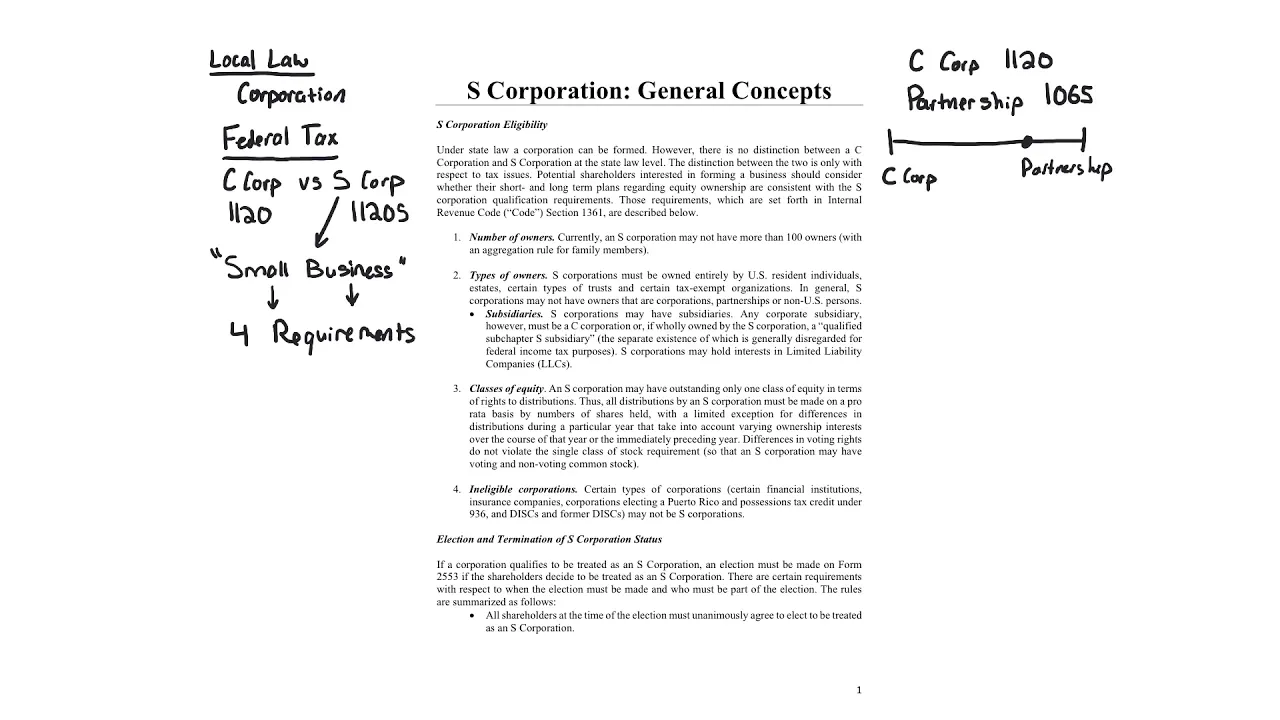



To elect S corporation status using IRS Form 2553, a corporation must meet eight eligibility tests: (1) be a domestic corporation, (2) have no more than 100 shareholders (with family members treated as one shareholder), (3) have only individuals, estates, exempt organizations, or certain trusts as shareholders, (4) have no non-resident alien shareholders except potential beneficiaries of an electing small business trust, (5) have only one class of stock with identical distribution rights, (6) not be a bank using the reserve method, insurance company, or DISC, (7) adopt a qualifying tax year (calendar year, natural business year, ownership tax year, or 52/53-week year ending in December), and (8) obtain shareholder consent. The election must be filed by the tax year start or within two months and 15 days of the tax year beginning, with relief available for late filings if reasonable cause exists.
IRS Form 2553 Guide: S-Corp Election Walkthrough
Added:over iOS form 2553 election by a small business Corporation under Section 1362 of the Internal Revenue code this is an election form to be treated as an S corporation and it can only be accepted if the corporate entity meets all of the tests outlined in the form instructions so before we get through this form we're going to cover who may elect to be treated as an S corporation and a couple of other things like when to make the election and relief for late elections so this is important information because it does guide you through processing this form so according to the IRS a corporation or other eligible entity to be to elect to be treated as a corporation may elect to be an S corporation only if it meets the following tests and there are eight tests test one it is a domestic Corporation or it is a domestic entity eligible to be treated as a corporation the fact that timely files form 2553 and meets all of the other outline tests if it's not time timely filed there is relief for late elections which will cover momentarily test two The Entity has no more than 100 shareholders you can treat an individual and his or her spouse and their Estates as a single shareholder for this test you can also elect to treat all members of a family and their Estates as one shareholder for this task there is additional guidance in Treasury regulations outside the scope of this video but basically an S corporation has to be a domestic Corporation and it cannot have more than 100 shareholders test three the only shareholders include individuals Estates exempt organizations as described in either section 401a or 501c3 or certain trusts test four has no non-resident alien shareholders other than a potential current beneficiary of an espt if that does not apply to you then then I would not worry that about that so an esbt is uh electing small business trust so it's a special kind of trust that elects as an esbt so a potential current beneficiaries may be non-resident alien shareholders but all other shareholders have to be either U.S citizens or residents test five it only has one class of stock so if you are familiar with you know certain companies might have a preferred stocks or common stock and S corporation can only have one share of a class of stock and the corporation is treated as having only one class of stock if all outstanding shares of the stock have identical rights when it comes to distribution and liquidation proceeds uh test six it is not one of the following ineligible corporations cannot be a bank that uses the or a thrift institution that uses the reserve method of accounting for bad debts it cannot be an insurance company that's subject to tax under sub chapter L of the Internal Revenue code and it cannot be a domestic International Sales Corporation also known as a desk or a former disk test seven it has or will adopt a change to one of the following tax years a tax year ending in uh December 31st just like a calendar year a natural business year as defined by the IRS an ownership tax year as defined by the owner IRS a tax year elected under Internal Revenue code section 444 52 or 53-week tax year ending with a reference to one of the previously listed years or any other tax year for which the corporation establishes a business purpose that this business purpose has to be justified and agreed upon by the IRS so there is an approval process for making that kind of an election and then finally test eight every listed shareholder consents to the election so uh when to make the election so you can make the election to be treated as an S corporation at any time before the tax year is to start so if we're in 2023 and I wanted to file this form to be elected as an S corporation or for my company to be elected as an S corporation starting in 2024 I can file this at any time in calendar year 2023.
if you are already in the middle of the tax year and you want to elect for that current year to be traded as an S corporation as well as future years then you have to file no more than two months and 15 days after the beginning of the tax year so for most taxpayers this would be a deadline of March 15th most taxpayers being calendar year file or so two months and 15 days would bring you to March 15th of the given tax year there are a couple of Provisions for for late election relief and they are outlined in the form instructions we'll cover them a little bit as we get through this forum so there are four parts of this tax form in part one we'll go over the election information this is the tax treatment that the corporation is seeking on the back part of part one it will be the shareholder information and their consent statements part two is the selection of the actual fiscal tax year in uh part three is qualified sub chapter S trust election under Internal Revenue code section 1361 D2 if you're making more than one election you'll need additional copies of this of part three and then part four does not contain any verbiage or any boxes that you'll check these are representations that you will be making if you happen to be filing at a late election so we'll go over that in a little bit let's start with part one at the top of part one you'll see the election information we're going to pretend that we are Acme business Corporation and the import and the address is one two three any road so we'll put down our employer number as and we'll say that this company was incorporated two months ago so we'll list and we'll say that it was incorporated in the state of Texas so that takes care of the top portion at a B and C if after applying so if you do not have an employer identification number then you will need to apply for one either concurrently or you can file it either on the IRS website or you can actually file form ss4 which is the application for an employer identification number so once you have your EIN then you can enter that here in part D check the applicable box if the entity has either changed its name or address after applying for the Ein I will assume that in this case it did not change its name or its address and the election is to be effective for the tax year beginning in we'll say the current tax year however specifically there are some points of guidance that you'll need to be familiar with so the effective date of election should be the earliest of one of the following three dates either the date that the company or the entity first had shareholders or owners when it first had assets or when it first began doing business so since we made this elective for the for the current tax year we're going to Simply put the date that the company became a business entity so and the form itself even says that for a first tax year you'll usually enter the beginning date of a Shore tax year as something other than January 1st so unless your date of incorporation happens to be on New Year's Day then you should probably enter the date of incorporation if this is a new entity in section F most taxpayers will probably check one which is the calendar year you can also check three if you have a 52 53 week tax year as long as it ends in the month of December that's basically the same as a calendar year if you decide to have a fiscal year either because you know maybe you're a government contractor and it's easier accounting for you when all of your contracts line up at the same time as the federal government which would be which would run from October 1st to September 30th of a given year if you're a if there is another natural business year that takes place where most of your receipts are really bundled up at the end of the tax year then then you could select a fiscal year ending you know on a date other than December 31st so that would be either two or four depending on how long your uh your work here is if you do select either box two or four you're going to need to complete part two which we'll get to momentarily if you're if your entity contains more than 100 shareholders then if you treat members of a family as one shareholder does this result in a hundred shareholders or fewer and meet the requirement for S corporation status if so then check this box if you have less than 100 shareholders or if treating members of a family does not change you know the fact that you still have more than 100 shareholders that do not check this box we'll assume that we do not have more than a hundred shareholders as owners of this Corporation if you have a legal representative or an officer then you put that person's name in here will put that person's name in contact information as John Smith and we'll list this phone number there for the IRS if this is not a late filing you can skip item I but itemi is your way to explain uh a couple of things about your late election filing that you had reasonable cause for not filing this in a timely manner and if if this is an election being made by an eligible entity then you had reasonable cause for not filing your entity classification in a timely manner and that all of the representations in part four are true this is where you're going to provide a written narrative or an explanation of you know a the reasons that the election was not made on time and then b a list of things that you did to correct the mistake once you discovered it so this is pretty important because this will actually be part of the consideration process when you submit this to the IRS now you'll sign or an officer or someone that's authorized to represent the corporate entity will sign put their title and date this form here uh however we've we still have three more pages to go so we'll Circle back and sign all of this when this is uh ready to go now um part one on the second page this is where we're going to list all of the shareholders and then outline their consent statements right so um let's start with column J this is going to be the name and address of every shareholder or former shareholder that's still required to consent so there's a little bit more detail on how you make that determination in the form instructions for right now we'll we'll operate under the assumption that John Smith is a shareholder and his partner Matt Jones is the other partner and Imagine John are neighbors so we listed their addresses here uh we'll pretend sign here but this basically is saying that under penalty of perjury the listed shareholder uh consents to the election that they've examined a consent document and all accompanying documents they believe that the facts are true to the best of their knowledge if they're seeking relief from a late filed election then they're also declaring under penalties of perjury that all income is properly reported uh for previous tax years and for the current year and so that's basically what K is saying as the shareholders consent statement so we'll date this since we can do that and then we'll just make them 50 50 owners you can put percentage of ownership you can also list in shares of stock so let's imagine that there's five thousand or ten thousand shares of stock outstanding each person has 50 percent of the shares five thousand each and we'll say that the data acquiring these happens to coincide with the date that the company was created and then we'll put each person's uh social security number on there and then we're going to put the date that each shareholders tax year ends the month and day there's no funky tax here for either of these people their regular calendar year tax filers so that's what the last part of part one columns J through n look like so the primary thing that you would have to do is do this for all required shareholders and if you need more than one page you can simply print off copies of page two and attach them to the to the form 2553 oh so I guess we should take the name of the company and the Ein and make sure that it's populated at the top of each form uh normally tax preparation software will Auto populate a lot of this stuff and while we're at it we'll just go ahead and do this for the entire form all right one last one all right so now we're on to part two part two uh only is required for companies or entities that elected a fiscal year so if we elected a calendar year which I forgot to check then you would not you could skip part two go to part three for purpose of this let's just imagine that we decided to elect a fiscal year ending in September 30th then we would have to go down here and we would you know first in item o we would determine you know which block to check so it's either a new Corporation adopting the tax year that we just entered it's an existing Corporation that's retaining the tax year that we entered or it's an existing Corporation changing to the tax year that we entered so it is we're going to say that uh we are a new Corporation adopting the tax year entered in item f so we are a new company that is adopting this September 30th as our fiscal year now it's important to note that if you are under examination if you're before an appeals office or if you're in Tax Court then you cannot obtain automatic approval of a fiscal year under the natural business year or ownership tax year Provisions without meeting certain conditions and there's additional detail in IRS Revenue procedure 2006-46 which you can find on the IRS website so so we are about to get into box P which is why I kind of outline that so if you're using the automatic approval Provisions outlined in this Revenue procedure then you would have checked the applicable box so a natural business year has to pass what is known as the 25 gross receipts test so I as I've previously mentioned a natural business year might be different from a calendar uh tax year for a company who does a significant amount of business towards the close of a year which might be you know for example September 30th right so in a natural business year uh more than 25 percent of that company's gross revenue has to be has to be uh occur within the last two months of that preceding 12 month period so there are three things that he that that the company must three criteria that the company must meet in order to adopt a natural business year one it has to be able to quantify that the last two months of a period consisting of 12 months so that requests a tax year the last two months gross receipts exceeded 25 percent uh two has to be able to go back several tax years to do that it has to be able to do that for the three previous tax years so by definition the IRS instructions saying if this company has not existed for at least 47 months and had gross receipts then it cannot naturally it cannot file a natural business fear so it cannot automatically establish a natural business here if it does not have at least 47 months of gross receipts and then three there has to be no other 12-month period that would result in a higher level of gross receipts for example if the IRS came back after looking at our books and determined that a year ending in September or June 30th I actually had higher gross receipts in the last two months of the year than a year ending at September 30th then you cannot adopt September 30th as that natural business year you would either have to adopt the calendar year or you would have to adopt the June 30th natural business year as an automatic provision uh under part two uh P2 the ownership tax year um there's additional guidance that uh discusses uh representation that or that you're at least representing shareholders holding more than half of the shares of the stock so you could do that if you're representing you know for example both of these two individuals say that they're representing more than half of the shares of stock they could do that but if you do not use item P for either one of these ownership tax year or the natural business year and you want to have a fiscal tax year then you need to complete either item Q or item R below so item q1 is basically you're applying to the IRS and you're having someone manually evaluate your business and you're requesting a fiscal tax or based on that business purpose so if you check one you're going to be paying a user fee for the IRS to make that determination and at the time of this recording that user fee is six thousand two hundred dollars so you won't make that payment when you file the IRS service center that receives your completed form will send the form to the IRS office in Washington DC they will turn around and notify you when the payment is due so if you do check this you'll have to attach a statement that describes all of the relevant facts and circumstances gross receipts for your sales and services that were necessary to establish a business purpose you're going to need to dig into the form instructions about details for the gross receipts and things of that nature and then if the IRS proposes to disapprove the request of fiscal year then you need to check whether or not you want a conference with the IRS national office immediately after the denial inbox Q2 you'll check this to show that the corporation intends to make up make a backup section 44 Force election if the business purpose request is not approved so in some cases the tax year requested under the backup section might be different from the tax year that's requested under the business purpose so you're going to need to check the form instructions to make sure you understand what that means should you check that box and then in Q3 you would check this to show that the corporation will agree to adopt or change to a tax year ending in September or December 31st if that is a requirement for the IRS to accept this election and remember you know probably your primary goal is to be accepted as an S corporation and then your second get Dairy goal might be to change your tax year to something that more fits the majority of your shareholders but you would check this box if you're willing to go back to the to the default December 31st tax year don't check it if you're not okay with that but that might mean that the IRS doesn't give us Corporation a status so in item R you're going to make the 444 election if you check box one you can also check box R2 so if you check box uh R1 you're going to need to complete form 8716 which is the election to have a tax year other than a required tax year you can either mail that separately or you can attach it to this form I might recommend that you attach it to this form so that it's all in one place under R2 this shows that if the IRS deems your corporation is not qualified to make a section 444 election box R2 if you check it simply means that you're willing to accept a December 31st tax year at under part three uh you would only make uh the election as a qualified sub chapter as trust if you made the election in part one you cannot file this with just part three completed so for most taxpayers this probably will not apply part three may be used to make the qsst election only if the corporate stock has been transferred to the trust either on or before the date that the corporation makes its election to be treated as an S corp you can use a statement instead of filing part 3 to make the election as long as that separate statement has all of the required information which is the income beneficiary's name and address this could be Jane Doe um and then you would list the the trust name does qsst and we'll just put that as the same address here and then there's an EIN for the trust we'll just and then the date on which the stock of the corporations transferred to the trust you know you can put whatever date you want I'm just using this as an example because it does not meet the facts that we've already laid out in this form this is simply for you to visualize and then you'd have the income beneficiary or the legal representative sign and date this form here under part four there's nothing for you to feel fill out here this simply is what you're attesting to if you are filing late uh you are basically saying that you meet the requirements for relief um for a late election that was filed by a eligible entity so uh five criteria right so first The Entity has to be eligible as defined in the Treasury regulations two it has to have intended to be classified so I had to actually um have the intent to be treated like an S corporation uh under three it has to only have failed because uh filing 80 form 8832 was not timely or the IRS deemed to have not Timeless time it deems to did not deem that this form had been filed so it was either filed late or the IRS didn't accept the first form in uh four uh fails to qualify as an S corporation solely because it was not a timely filed and then five it either has filed all required tax returns and it's current on its tax obligations up to the current year or it's a new company that has not had to file a tax return yet because the due date is not passed so basically as long as it's an eligible entity it's intended to be classified the only timely or the only reason it wasn't filed in a timely manner was uh acceptable under Treasury regulations and it's a current on all of its tax and information returns so when you complete this full this part right here and sign here that's what you're attesting to so now where to file the form itself actually contains the filing locations you'll either be filing with the Kansas City office or with the Ogden Utah office there's a fax number for each there's mailing instructions so if you're in Connecticut Delaware District of Columbia Georgia Illinois Indiana Kentucky Maine Maryland Massachusetts Michigan New Hampshire New Jersey New York North Carolina Ohio Pennsylvania Rhode Island South Carolina Tennessee Vermont Virginia West Virginia or Wisconsin you'll send it to Department of Treasury Internal Revenue Service Kansas City Missouri 6499 or you can fax it to 855-887-7734 for all other states you'll send this to Department of the Treasury Internal Revenue Service Ogden Utah 84201 fax number is 855-214-7520 you'll notice that there are no overseas locations no U.S territories listed and that's because you cannot be an S corporation if you're if you're not a domestic company so that is all we have for IRS form 2553 if you want more detail we've written an article which you can find on our website simply go to teach me personal finance.com type in IRS form 2553 and you should see our article which walks you step by step through everything we just discussed if you like our news if you like our articles please subscribe to our newsletter which you can find on any article on our website you can simply opt in with your first name and email and you'll get emails as as we send them out if you like our YouTube videos please subscribe to our YouTube channel and as always if you have any questions comments or concerns please post them in the comment section or send me an email directly thank you very much and have a good day
Up Next

NAGPRA Basics Training: Native American Graves Protection Act
@NationalNAGPRA
7.4K views•2023-05-09

US Secondary Sanctions Impact on EU Businesses and Blocking Legislation
@Bureauvandijk
1.6K views•2019-03-20

Forensic Phonetics: Speaker Identification in Legal Cases
@nptel-nociitm9240
539 views•2025-03-19

Police Interrogation Tactics: False Confessions & Legal Reform
@LastWeekTonight
7M views•2022-04-18
Related Study Plans & Knowledge Roadmaps
Structured learning paths in Law