
























The Great Stink of 1858, a severe pollution crisis in London caused by untreated sewage flowing into the Thames, prompted the construction of an advanced sewer system by engineer Joseph Bazalgette that not only solved the immediate sanitation problem but also provided crucial evidence supporting the germ theory of disease over the prevailing miasma theory, fundamentally changing public health approaches worldwide.
The Great Stink of 1858: London's Sanitation Crisis and Sewer Reform
Added:The rapid urbanization of London during the Industrial Revolution and its resulting strain on municipal infrastructure.
The 'Miasma Theory' of disease, which held that epidemics were caused by noxious odors or 'bad air' rather than pathogens.
The history of waterborne diseases in the 19th century, particularly the devastating cholera outbreaks in Victorian London.
The ecological and biological state of the River Thames prior to 1858, serving simultaneously as an open sewer and a primary drinking water source.
The engineering achievements of Sir Joseph Bazalgette and the design of London's revolutionary Victorian sewer network.
The scientific transition to Germ Theory and the birth of modern epidemiology, heavily influenced by John Snow's research on cholera transmission.
The evolution of public health legislation and the creation of centralized municipal authorities to manage urban infrastructure.
Contemporary global sanitation crises and the modern sustainable development goals (SDGs) regarding clean water and sanitation.
689.8K views23.8Klikes11:43Original Release: 2018-08-14
History doesn't always smell like roses, in fact sometimes it stinks, quite literally. Because if you want to have a human civilization then you have to deal with the problem of human waste.
The history of sanitation doesn't sound very exciting, but it is a key technology for humans to thrive. In the middle of the 19th century the problem of accumulated human waste became particularly acute in one of the world's greatest cities. And the answer didn't just transform the field of sanitation engineering, it changed the way that we understand the nature of disease, and how it is spread, saving countless lives. The Great Stink of 1858 deserves to be remembered.
The historic foundations of the City of London go back at least to the Stone Age as foundations for Mesolithic structures dating back to 5000 BCE have been unearthed near where the river Ephraim meets the River Thames. An 11th century history written by a cleric named Geoffrey of Monmouth, suggests that the name London was derived from the pre-roman King Ludd, although his work is considered unreliable and modern scholars more often attribute the name to a Celtic origin. Perhaps Llan Dian, meaning lake fort. However there is a lack of evidence of significant settlement before Roman times, and scholars today generally agree that the settlement was originated by the Romans, sometime after the Roman invasion of Britain in 43 AD, and was called Londinium. Remains of Roman walls can still be seen in London today.
At some 215 miles long, the River Thames is the longest river entirely in England. The river was named by Britannic Celts, and might mean dark, possibly because the river is muddy. From the start the importance of the settlement of Londinium depended upon the River Thames, as the Roman built bridge over the river turned the settlement into a major road nexus, and port. The settlement was located in a spot where the river was narrow enough to build a bridge, but still deep enough for seagoing ships at the time. It was along the tide way, the part of the river still affected by ocean tides, which would help ships trying to move upriver. Several bridges had been built on the approximate side of the original Roman timber bridge with the most current being a box girder bridge that opened in 1973. The location along the Thames continued to make the city important, and it has often been the center of struggle, beginning with the Boudican revolt in 60 AD, which left the settlement temporarily deserted.
The city has withstood invasions, plagues, the devastating fire of 1666, numerous riots, revolts and protests, as well as the terrible aerial bombardment of the Blitz during World War Two. And through it all, the very heart of the city has always been the River Thames.
The city went through a period of particular growth during the 19th century. In 1801, less than a million people lived in London. By 1901, the population had grown to more than six and a half million. During the nineteenth century, London became the largest city in the world, the capital of the British Empire. At its height, the largest empire in the history of the world.
The population of the city of London roughly doubled just in the four decades between 1851 and 1891, and that raised enormous challenges to provide that population with clean water, and deal with their accumulated waste.
The city's sewer system had been growing since the 1600s, with entire rivers encased in brick sewers. Multiple water projects occurred around London in the 18th and early 19th century to bring water to the city, establishing a number of reservoirs, and medieval wooden pipes were replaced by modern iron pipes to carry water to the city. More than 100 sewers were constructed between the 1750s, and the 1850s, along with hundreds of thousands of cesspits. Cesspits are essentially just a holding cistern and where waste is supposed to break down. Flush toilets, made practical by the invention of the S trap by Scottish mechanic Alexander Cumming in 1775, started to be industrially manufactured and widely available by the middle of the 19th century. You might think all that work and clean water would improve the city sanitation, but what it really meant is that the city's sewer system was often overwhelmed and overflowed, and much of the accumulated human and industrial waste washed directly into the Thames. What's more, much of the city's water supply was taken from the same river that they were polluting.
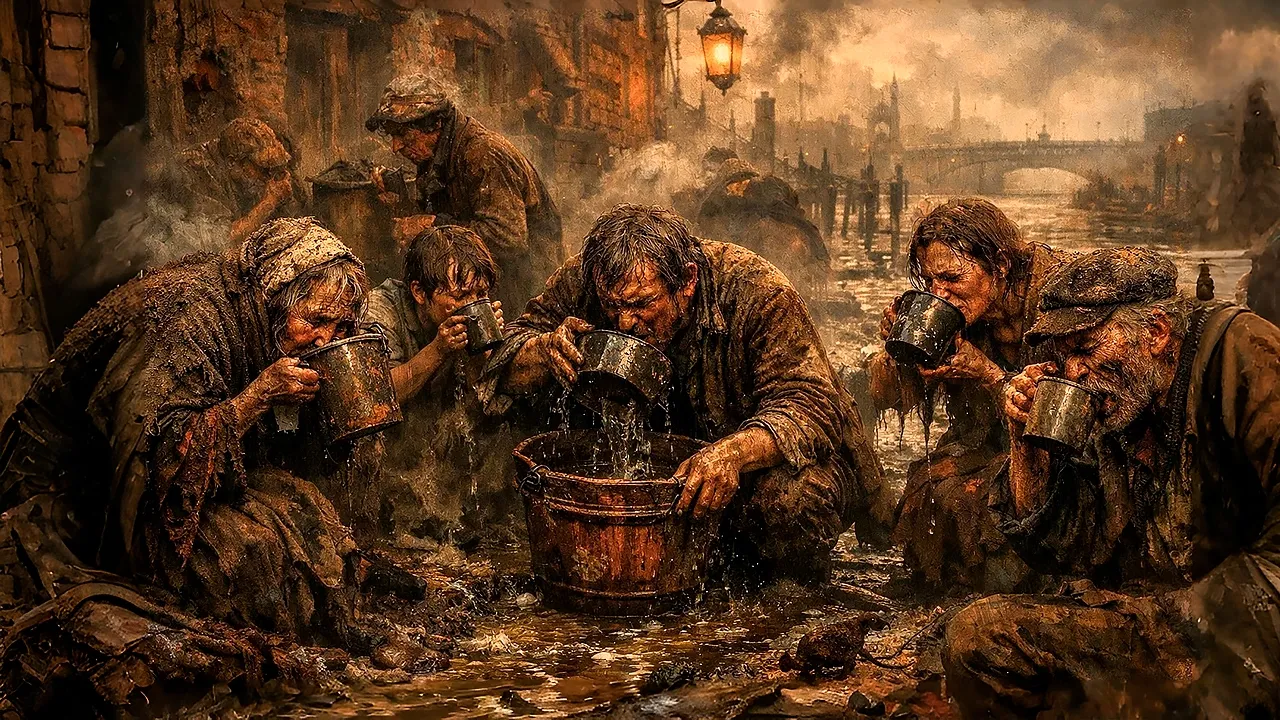
In fact, attempts to improve sanitation made the problem worse. The 1846 Nuisances Removal and Disease Prevention Act had forced the filling and enclosure of old cesspits, and the joining of house waste systems to the sewers. While this was supposed to remove waste from the city, what it actually did was dumped untreated human waste down sewers originally intended for storm drainage, directly into the Thames. And along with that human waste went the rotting carcasses of dead animals, the offal from hundreds of slaughterhouses, the chemical and industrial wastes from factories and businesses, and all the accumulated filth of a major city.
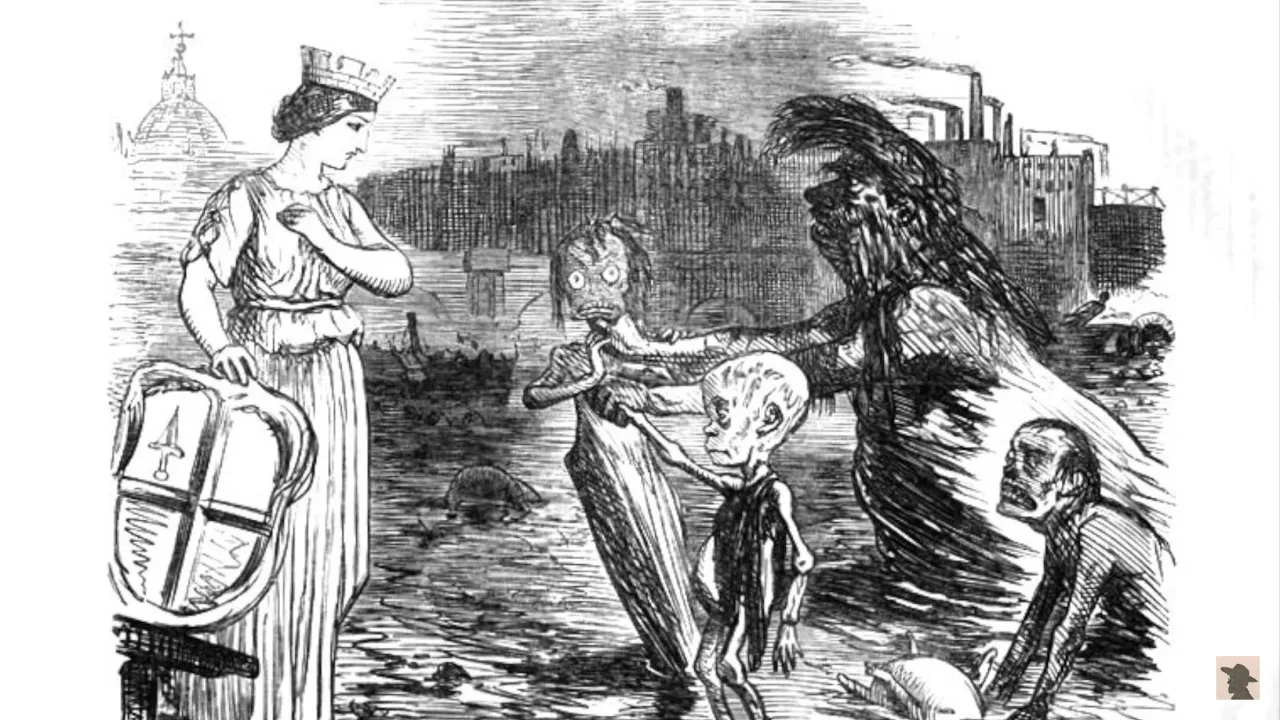
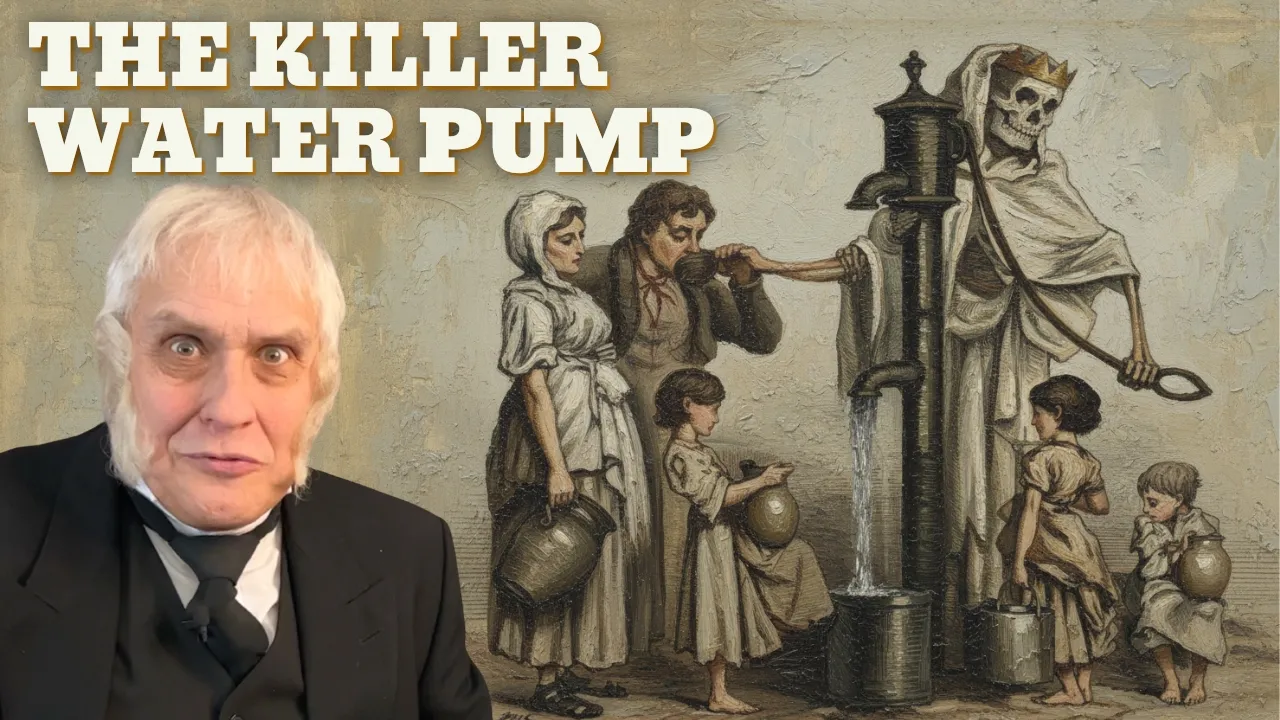
The Thames became a giant cesspool. A poem in Punch magazine in 1848 read, “Filthy river, filthy river, fowl from London to the Knorr. What art thou but one vast gutter. One tremendous common shore.” The most devastating result of the drainage into the Thames was the dreaded disease cholera. An infection of the small intestine by the bacteria Vibrio cholerae, cholera has existed for centuries on the Indian subcontinent, but cholera pandemics became common throughout the world in the 19th century, as the disease was able to disperse via trade and the movement of military troops. Cholera outbreaks in London in 1831, 1848-49 and 1853-54 had killed more than 31,000 Londoners. In July of 1855, Michael Faraday, one of the most famous and influential scientists in the world, wrote a letter to the London newspaper at the times saying, “Of the Thames, surely the river which flows for so many miles through London, ought not be allowed to become a fermenting sewer.” Then came June of 1858. The summer was unusually hot, by some accounts 15 degrees above average for that time of year. The 16th of June was the hottest recorded day up to that point in history in London, 94.5 degrees fahrenheit, in the shade. A drought hit the countryside, and the level of the Thames sunk. The great mounds of waste that once floated around the Thames now settled on the shore and fermented, and decomposed, creating such a stench that the people could scarcely move within the city. The press called it, The Great Stink.
While this had a dreadful effect on London, the government was still loath to act because of the costs of changing the city's sewer system. But perhaps the greatest driver for the government to act was the location of a very famous building.
The Palace of Westminster had been built in the 11th century, when its location along the Thames was of strategic importance. Although technically a royal residence, it is the home of the Parliament of the United Kingdom. The so-called Old Palace had gradually grown, and had been significantly remodeled between 1824 and 1827. But a fire in 1834 had destroyed most of the palace. The Gothic structure that we know today was the work of British architect Sir Charles Barry. Construction of the new palace began in 1840, and the House of Commons chamber had only been completed in 1852. Aside from being one of the most recognizable buildings in the world, the lovely new building was still right next to the Thames, and The Great Stink.
The smell made business impossible. MPs flooded the meeting rooms holding handkerchiefs to their noses, and Parliament faced a choice. Move the seat of government or address the pollution of the Thames. After soaking the curtains of Parliament in lime chloride to hide the smell, Parliament took just 18 days to pass a law allowing the Metropolitan Board of Works to borrow 3 million pounds, to fund the construction of sewers that would deposit waste outside the metropolitan area.
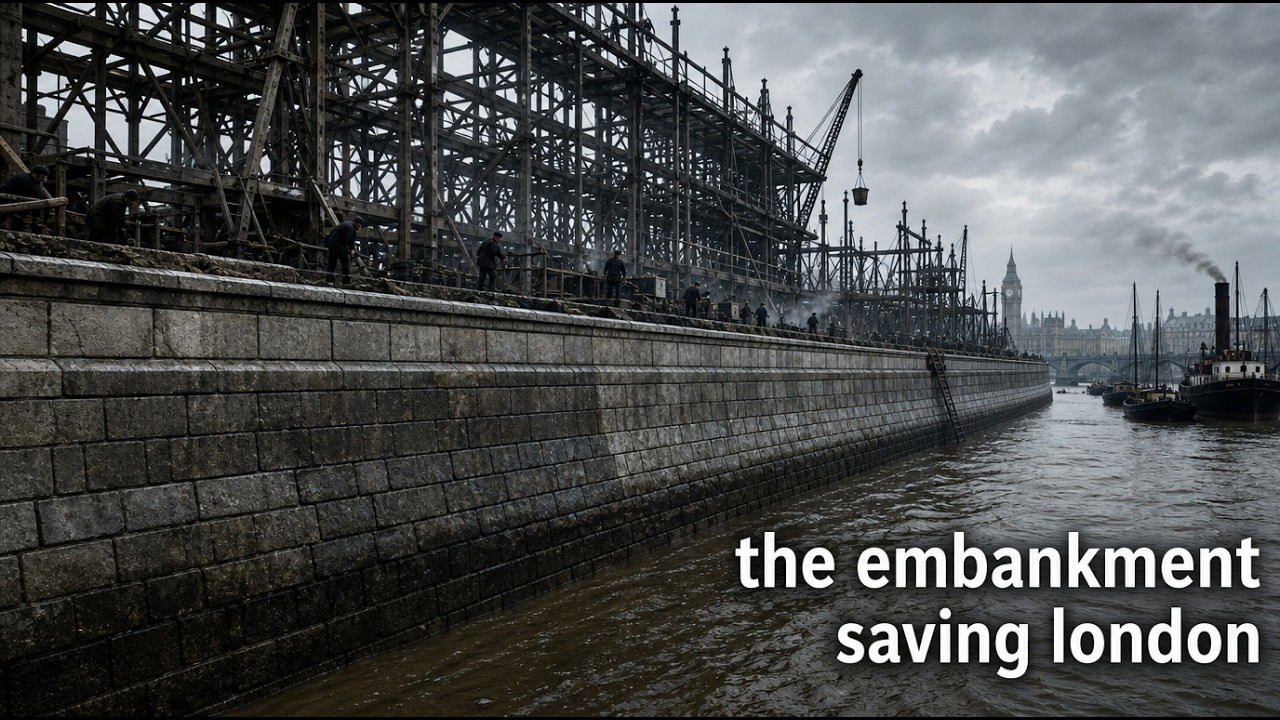
The task fell to Joseph Bazalgette, the chief engineer of the Metropolitan Board of Works, who had been working on a more systematic plan for the city sewers since 1849, but had never gotten funding. The plan included more than 1100 miles of new street sewers, and 85 miles of interconnecting sewers that had a minimum drop of two feet per mile. Using gravity as well as pumping stations to carry the waste to the east, outside the city to open sewers, that will allow it to more easily reach the ocean. In order to carry all of London's sewage many miles downstream, Bazalgette had to build a huge main, running parallel to the Thames. This involved building embankments that created 52 acres of dry land. The project, completed between 1859 and 1871, was described by the newspaper The Observer as, “The most expensive, and wonderful work of modern times.” The Great Stink actually mitigated with the weather. In July cooler weather came, and there were rains, and that washed the putrescent filth that had been laying on the shore sometimes 100 feet long and 6 feet deep, back into the river. But The Great Stink paid London, and the rest of the world a great service, because at the time, the transmission of the disease cholera was not well understood. The population of most scientists of the era believed in the theory called The Miasma Theory, which suggests that cholera was passed by unclean air and bad smells.
And that led to all sorts of medical advice, and public procedures to try to prevent cholera that actually didn't prevent it in the least. In fact, cholera is caused by drinking contaminated water.
The reason that Parliament came up with the money to address The Great Stink wasn't just because the smell was intolerable, but because people believed that the smell itself was causing disease. It wasn't, but by addressing the smell, the city addressed the real reason that they were having cholera epidemics. The fact that they were drawing their drinking water from a river that had been polluted with human feces. And that fact was all brought home in 1866, when there was a further cholera outbreak in London that killed 5,500 Londoners in the only part of the city that hadn't yet been hooked up to the new sewer system. London has not had a major cholera outbreak ever since.
This proof that cholera was caused by polluted water, and not from Miasma, has led to mitigation measures that might have saved millions of lives. Although cholera still causes as many as a hundred thirty thousand deaths a year, mostly in the third world.
Originally Bazalgette’s sewers just dumped the waste into the ocean outside the city of London, but people eventually thought that that was filthy too, and so the waste was collected on barges and dumped out in the North Sea, and finally they stopped dumping it in the ocean all together, and started incinerating the waste. Bazalgette's sewers are still in use today, but 150 years later, London is starting to face the same problems that it had back in the 1850s. Bazalgette had designed his system for about 4 million users, and today there are about 8 million users. The system had a built-in overflow that was intended for extreme weather, that was intended to keep the sewers from backing up and flooding the streets and cisterns with sewage. But with so many people using the system that happens frequently today as many as 50 times a year London is again dumping human waste into the Thames. And so today there is another massive works project in the spirit of Bazalgette called, The Thames Tideway Tunnel, described as a super sewer that is under construction, and intended for completion in 2023.
I'm the History Guy. I hope you enjoyed this edition of my series of short snippets of forgotten history about 10 minutes long. And if you did enjoy it, please go ahead and click that thumbs up button which is there on your left. If you have any questions, or comments, feel free to write those in the comment section, I will be happy to personally respond. And if you'd like more snippets of forgotten history, all you need to do is subscribe.
Up Next
10:38
John Snow's Cholera Map: How One Man Stopped an Epidemic
@WeirdHistory
166.9K views•2021-06-25

33:02
The Great Schism of 1054: Causes and Consequences
@SacredCathedrals
113.5K views•2026-02-19

15:08
The Evolution of Elevators: From Ancient Lifts to Skyscrapers
@TheHistoryGuyChannel
436.7K views•2020-01-08

17:05
Understanding the Cold War: Superpower Conflicts and the Road to Détente
@OverSimplified
46.1M views•2019-01-24
Related Study Plans & Knowledge Roadmaps
Structured learning paths in History
history
Byzantine Iconoclasm: Theology, Art & Politics
01Foundations of Byzantium and Early Christian Images
02The First Iconoclasm: Leo III and the Crisis of Images
03Empress Irene, Nicaea II, and the Second Iconoclasm
+ 2 more learning modules
9h5 modules
Explore Roadmap
history
Iranian Revolution (Causes, Events & Legacy)
01The Pahlavi Dynasty and the Roots of Discontent
02The Spark of Rebellion and the Rise of Khomeini
031979: The Fall of the Shah and the Climax of the Revolution
+ 2 more learning modules
8h5 modules
Explore Roadmap
history
Mali Empire: Mansa Musa, Trade & Timbuktu
01Foundations of the Mali Empire
02The Trans-Saharan Gold and Salt Trade
03The Reign and Pilgrimage of Mansa Musa
+ 1 more learning modules
6h4 modules
Explore Roadmap
history
1947 Partition: Politics, Borders & Legacies
01Foundations of British India and the Divide
02The Political Negotiations and the Mountbatten Plan
03Drawing the Boundary: The Radcliffe Line
+ 2 more learning modules
8h5 modules
Explore Roadmap