

















Dr. John Snow, often called the 'Father of Modern Epidemiology,' created a groundbreaking map during the 1854 London cholera outbreak that revolutionized disease understanding by proving cholera was waterborne rather than airborne (contrary to the prevailing miasma theory), thereby saving countless lives and establishing the foundation for modern epidemiological methods.
John Snow's Cholera Map: How One Man Stopped an Epidemic
Added:The basic tenets of Miasma Theory, the prevailing 19th-century belief that diseases like cholera were spread by noxious odors or 'bad air'.
The historical context of Victorian London, including rapid urbanization, extreme overcrowding, and the lack of centralized waste management infrastructure.
Basic concepts of infectious disease transmission and how early medical practitioners categorized illnesses before the discovery of microscopic pathogens.
The development of Germ Theory by scientists like Louis Pasteur and Robert Koch, which provided the biological proof for Snow's empirical observations.
The evolution of modern Geographic Information Systems (GIS) and spatial analysis techniques used in public health to track and contain contemporary disease outbreaks.
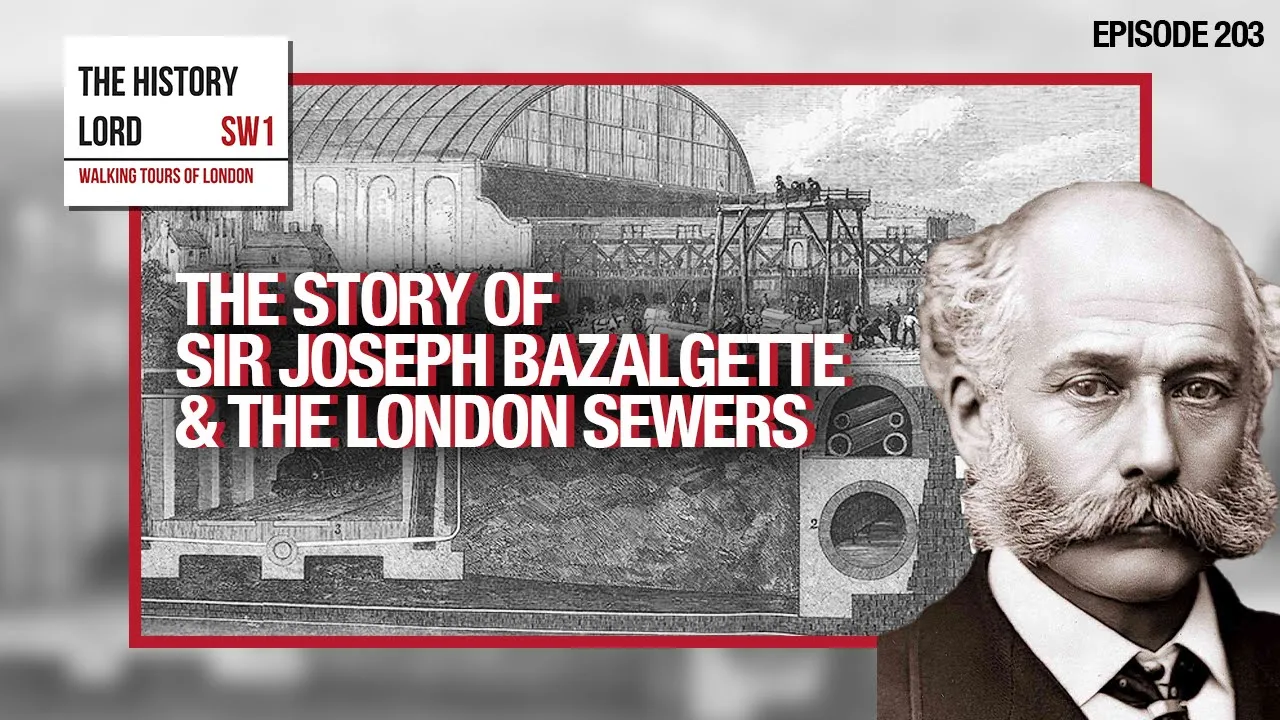
The history of urban planning and sanitary engineering, specifically Joseph Bazalgette's design of the London sewerage system in response to the Great Stink.
Foundational methodology in modern epidemiology, including outbreak investigation protocols, contact tracing, and calculating relative risk.
166.9K views5.9Klikes10:38Original Release: 2021-06-25
When most people hear the name John Snow they think of the Night's Watch Lord Commander from HBO'S Game of Thrones.
But actually, more impressive, is the real life Dr. John Snow, who combined investigative reporting and medical analysis in his cholera map, saving lives, and earning himself the title of "Father of Modern Epidemiology."
Today, we're going to take a look at how one man's map single-handedly stopped an epidemic and saved millions of lives.
But before we get started, be sure to subscribe to the Weird History channel, and let us know in the comments below what other medical stories you would like to hear about.
OK, time to chart a course through this strange and confounding tale.
[MUSIC PLAYING] Cholera is believed to have originated in India.
Trade routes carried it throughout Asia, and eventually via Southern Russia to Europe.
Authorities in the United Kingdom watched the spread of the disease with great concern, and they attempted to prevent its arrival on their own shores by quarantining ships.
Despite their efforts, in 1831 a keelman named William Sproat of Sunderland became the first confirmed case of cholera in England.
Sproat first became sick on the 23 of October, and within three days he was gone.
A local board of health imposed stricter quarantine rules on ships.
But when the measures had a negative impact on trade in the area an anti cholera political party was formed.
And doctors were pressured into retracting their diagnoses.
Over the following two months, cholera would be the end of another 215 people in Sunderland.
By December, the disease had spread to Gateshead and 50 more met their demise.
Doctors were confounded.
They couldn't agree on almost anything.
Not the disease's cause, its cure, or even if it was infectious.
But the one thing everyone knew was that it was extremely deadly.
Cholera was particularly dangerous because it quickly dehydrated victims who were struck with uncontrollable vomiting and diarrhea.
As the London Gazette reported in 1831, an infected person had the look of terror and wildness.
The skin was deadly cold and often damp, and the tongue was flabby and chilled like a piece of dead flesh.
[MUSIC PLAYING] Between 1831 and 1866 cholera decimated tens of thousands in England, particularly in London slums.
Many believe the disease was spread by poisonous air and rotting organic matter, which was known as the miasma theory of disease.
If you watch Weird History regularly, like you should, then that the miasma theory was nothing new.
In fact, it went all the way back to the ancient Greek physician, Hippocrates, who came up with the idea in the fourth century BCE.
Wealthy Londoners for their part did what rich people often do, blame the poor.
They saw the disease's deadly effects and chalked it up to the pollution and overcrowding in the slums.
London sanitation commissioner, Edwin Chadwick, who believed in a miasma theory and argued that all smell is disease and bad smells spread infections, also blamed the poor for the problem.
He concluded that it was more important to air out the slums than purify the drinking water.
In fact, blaming the poor became a pretty popular take all around.
In 1831, board of health report in the London Gazette even attributed cholera to the poor.
Especially those who have been addicted to the drinking of spiritist liquors and indulgence in irregular habits.
Those darn irregular habits.
They cause disease.
[MUSIC PLAYING] John Snow was born in York, England on March 15, 1813.
He was the son of a coal yard laborer and grew up in one of the poorest neighborhoods in the city.
However, he also seemed to have a knack for academics.
And by the age of 14, he had a medical apprenticeship.
In 1832, he first witnessed the horrors of a cholera outbreak in a place unironically called Killingworth.
There he saw sick men hauled up from the coal pits after having had profuse discharges from the stomach and bowels.
And went fast approaching to a state of collapse.
It must have left an impression on young John because he would spend much of the rest of his life fighting that very disease.
In 1836, Snow started medical school at the Hunterian School of Medicine in the Southern part of the Soho region of London.
We can tell he really wanted to go because he got there by literally walking the entire distance from York to London.
Even threw in a few extra stops along the way.
All told, it was a journey of 200 miles entirely on foot.
After training to become a medical doctor, Snow lived through another cholera outbreak in 1848 that wiped out between 50,000 and 70,000 people in England and Wales.
Snow used new citywide statistics on death rates to destroy the miasma theory of cholera transmission.
[MUSIC PLAYING] Luckily for the people of the United Kingdom John Snow was a lot more than just an avid walking enthusiast.
He was also extremely smart.
Snow reason that if the miasma theory was right, then one particular group should have the highest cholera related mortality rate.
The night soil men.
Night soil men literally shoveled human feces for a living, which was an odious but relatively well-paying Victorian occupation.
And yet, Snow's research showed that their death rate was actually low.
He began to chart the neighborhoods where the highest numbers of people were dying.
To his surprise, he saw that the rate of infection was three times higher on the South banks of the Thames versus the northern banks.
This observation would eventually prove to be the key to stopping cholera in its tracks.
Snow investigated, and eventually uncovered the differences between these areas.
South of the Thames, the water company drew its drinking water down river from London sewage dumping.
That convinced Snow that cholera was transmitted through infected water rather than miasma in the air.
[MUSIC PLAYING] In the first five days of the 1854 cholera outbreak, 500 people in London's Soho neighborhood died.
Snow, who lived in Soho, leapt into action to test his theory that water spread cholera.
He used a list of 83 deaths reported by London's register of deaths to chart the disease.
And since he lived only a few blocks East of the outbreak, Snow knocked on doors to ask dozens of people where they got their drinking water.
Within 24 hours Snow determined that the deaths were clustered around the Broad Street pump.
Right in the same neighborhood where Snow attended medical school.
150 years before House MD would hit the airwaves, John Snow was treating the cholera epidemic as a medical mystery.
And he was going to crack that case.
[MUSIC PLAYING] The Broad Street pump stood just outside the Lyon Brewery, but strangely not a single worker in the brewery fell ill with cholera.
John Snow visited the brewery to confirm his theory that the Broad Street pump was contaminated.
And sure enough, the owners told him that the workers never drank water.
They only drank a daily ration of malt liquor.
Similarly, the nearby St. James workhouse had 535 residents, but only two had died.
Snow tested his theory by asking questions, and figured out that the workhouse had a private water supply and did not use the public pump.
Snow was also able to link seemingly disconnected deaths to the Broad Street pump by showing, for example, that three school children had stopped at the pump on their way to school and then died from cholera.
Snow took his evidence to London's sanitation board, pleading with them to shut down the deadly water pump.
When they did the epidemic stopped.
Inspectors then dug into the foundation and found a crack in the wall between the pump cistern and a neighboring basement cesspool, which had been leaking sewage directly into the water.
Even with this clear and convincing evidence in hand, the sanitation board refused to believe that water spread cholera.
In their final report they stated, we do not find it established that the water was contaminated in the manner alleged.
I also found that there was insufficient evidence to show that the inhabitants of the district who drank from the Broad Street pump suffered more than those who drank from other water sources.
Despite the fact that shutting down the pumps stopped the epidemic the board ultimately concluded that there was no reason to adopt Dr. Snow's beliefs.
[MUSIC PLAYING] The sanitation board didn't just disagree with Snow.
No.
In what has to be one of the most medically cringe inducing moves of all time, they outright contradicted him and continued to promote dumping raw sewage into the Thames.
They believed that the river's currents would purify the sewage, which of course is not what was happening.
Luckily for everyone, John Snow wasn't the type who gave up easily.
And he pretty much spent the rest of his life trying to convince the city to stop dumping sewage into its drinking water.
His map was proof that cholera could be prevented, but it would only work if the city would listen.
In his 1855 book on the Mode of Communication of Cholera, Snow made a forceful case.
Saying when the water of a river becomes infected with the cholera evacuations emptied from on board ship or passing down drains and sewers, the communication of the disease, though generally less sudden and violent, is much more widely extended.
Despite the fact that Snow's map made the truth relatively easy for anyone to see, the city still refuse to listen for years.
Eventually, Londoners saw the truth in Snow's theories, and rerouted the sewage South of the city.
Snow's map not only convinced people that cholera was transmitted by water, but it also marked the end of the miasma theory and the birth of the germ theory of disease.
John Snow's map saved countless lives by promoting cleaner drinking water and better sanitation methods.
Though he never actually identified the cholera bacteria, Snow used medical, statistical, and mapping techniques to solve a public health crisis.
John Snow's map of the 1854 cholera outbreak was a new way of combining medicine and maps.
Rather than simply mapping disease with the broadest strokes, as with earlier maps, such as a map of the 1849 cholera outbreak that showed how the disease clustered in cities.
Snow's map was a call to action.
It convinced the sanitation commission to shut down the pump, even if they did doubt Snow's explanation.
And it made a strong case for the link between cholera and the water.
Snow spent years fighting against the ancient miasma theory, and his map was a powerful weapon.
The map was a breakthrough for epidemiology, cartography, and public health.
It changed minds and in the end it saved countless lives.
So what do you think?
Do you know something about John Snow?
Let us know in the comments below.
And while you're at it, check out some of these other videos from our Weird History.
[MUSIC PLAYING]
Up Next

57:37
Redlining and Housing Segregation in Minnesota Explained
@TwinCitiesPBS
3.8M views•2019-02-26

93:30
Zola, Baudelaire, Maupassant & the Transformation of Paris, 1852-1900
@SylviaSagona
5.6K views•2015-05-31

91:57
The Geopolitics of the Ukraine War and the Rise of Global Autocracy
@JordanHarbingerShow
468K views•2025-04-19

17:05
Understanding the Cold War: Superpower Conflicts and the Road to Détente
@OverSimplified
46.1M views•2019-01-24
Related Study Plans & Knowledge Roadmaps
Structured learning paths in History
history
Byzantine Iconoclasm: Theology, Art & Politics
01Foundations of Byzantium and Early Christian Images
02The First Iconoclasm: Leo III and the Crisis of Images
03Empress Irene, Nicaea II, and the Second Iconoclasm
+ 2 more learning modules
9h5 modules
Explore Roadmap
history
Iranian Revolution (Causes, Events & Legacy)
01The Pahlavi Dynasty and the Roots of Discontent
02The Spark of Rebellion and the Rise of Khomeini
031979: The Fall of the Shah and the Climax of the Revolution
+ 2 more learning modules
8h5 modules
Explore Roadmap
history
Mali Empire: Mansa Musa, Trade & Timbuktu
01Foundations of the Mali Empire
02The Trans-Saharan Gold and Salt Trade
03The Reign and Pilgrimage of Mansa Musa
+ 1 more learning modules
6h4 modules
Explore Roadmap
history
1947 Partition: Politics, Borders & Legacies
01Foundations of British India and the Divide
02The Political Negotiations and the Mountbatten Plan
03Drawing the Boundary: The Radcliffe Line
+ 2 more learning modules
8h5 modules
Explore Roadmap