










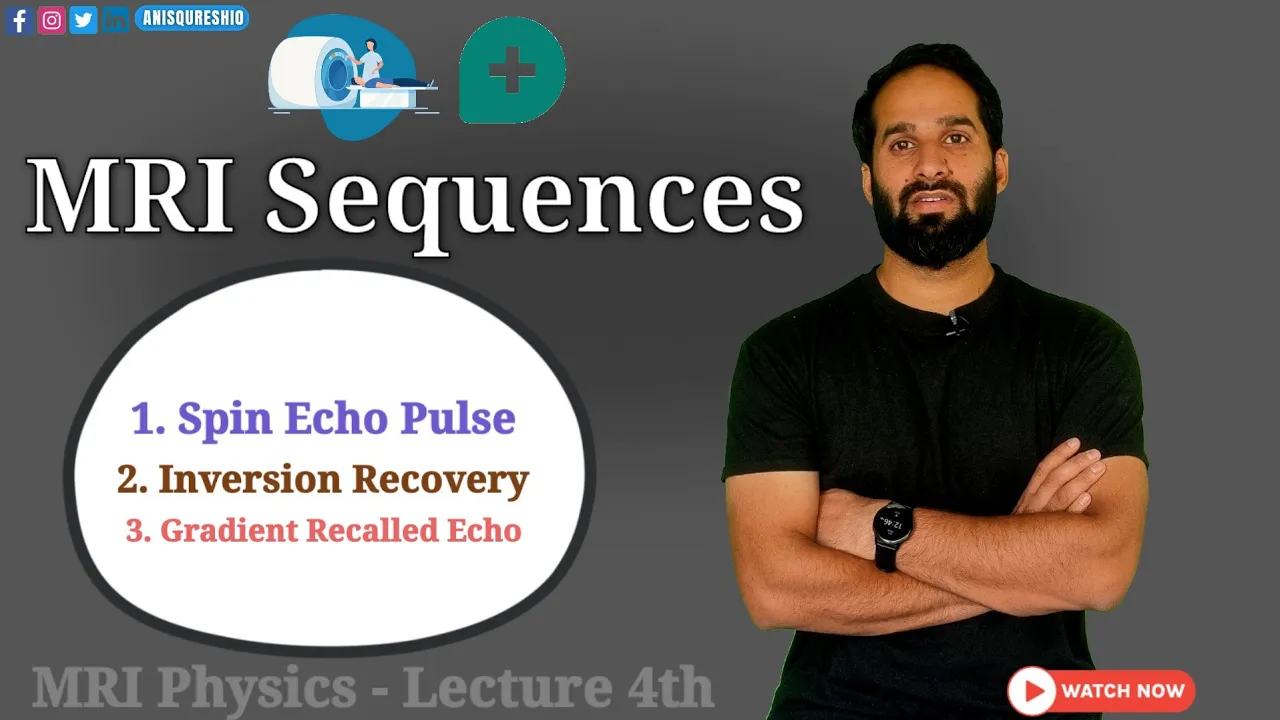
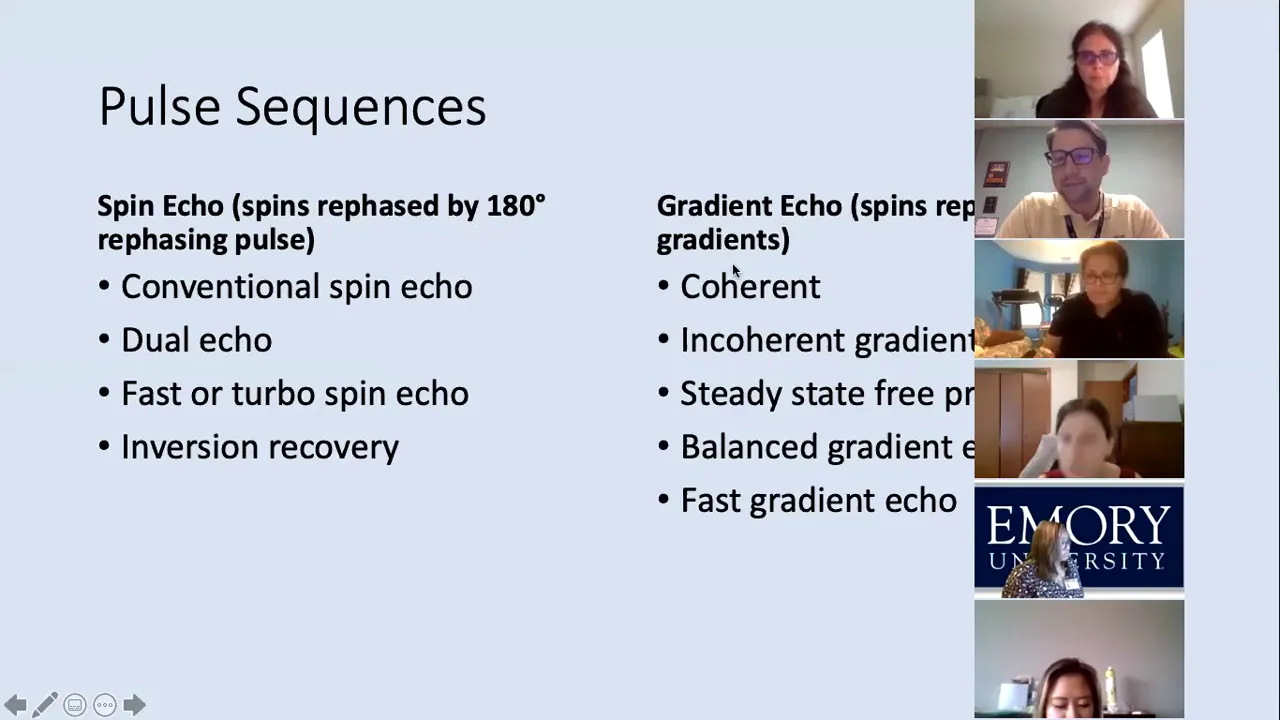





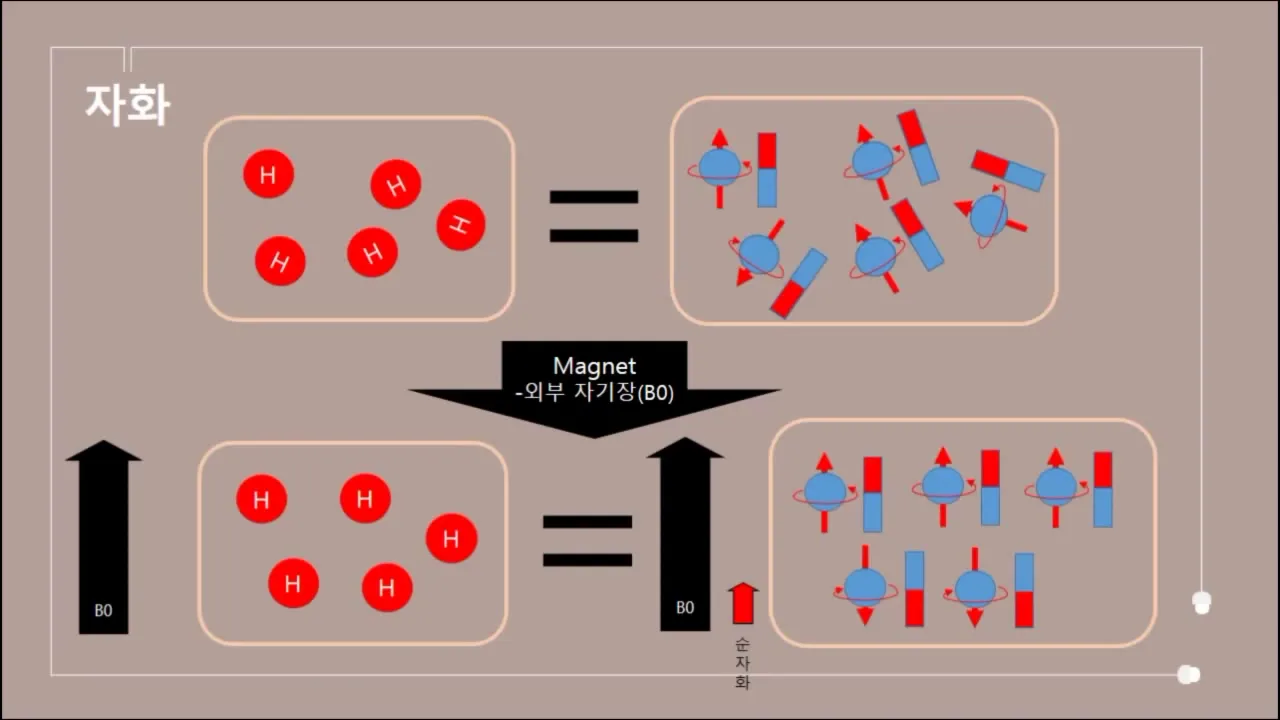



In MRI, hydrogen protons in the body act as tiny bar magnets that align with the scanner's magnetic field (B0), precessing at frequencies determined by the Larmor equation; a 90-degree RF pulse flips protons to create transverse magnetization, which generates signals through free induction decay but rapidly loses coherence due to T2* effects from magnetic field inhomogeneity; a subsequent 180-degree refocusing pulse reverses proton precession, temporarily rephasing them to produce a detectable echo that enables image formation in spin echo sequences.
MRI Physics Explained: Magnetic Resonance and Spin Echo Sequences
Added:Basic concepts of electromagnetism, including magnetic fields, magnetic dipoles, and electromagnetic induction.
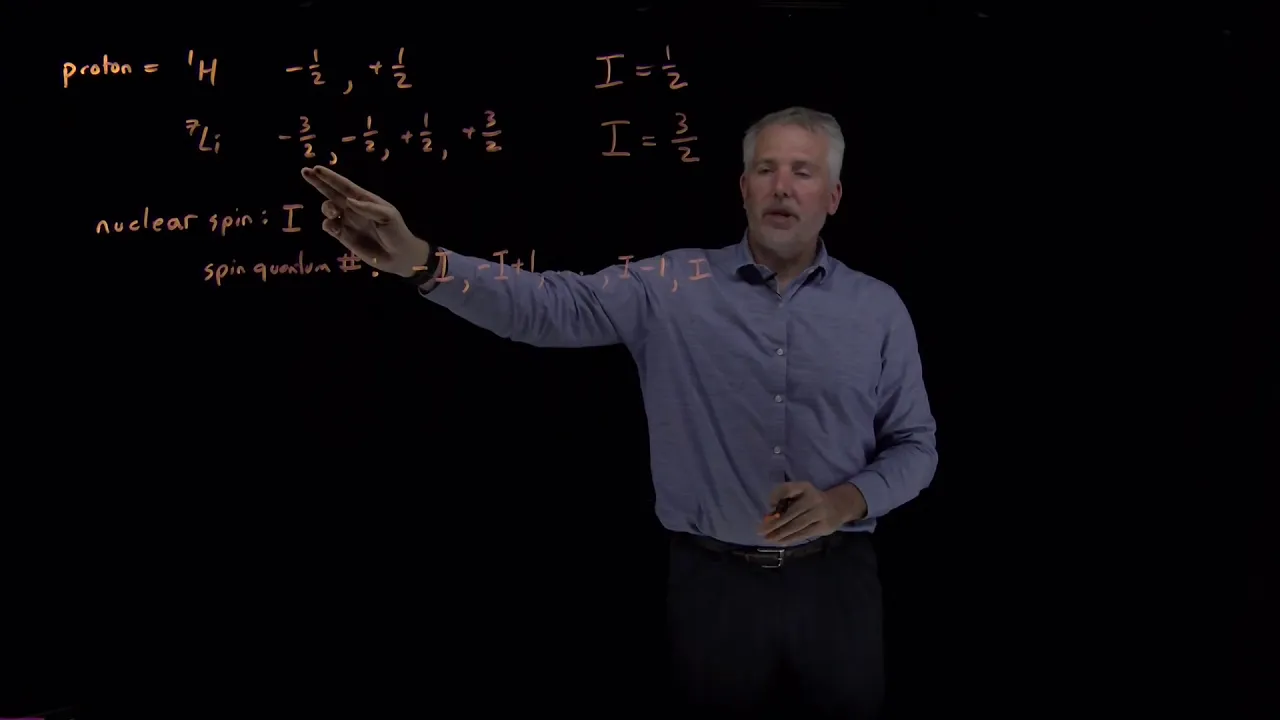
Atomic structure, specifically the properties of protons, hydrogen atoms, and the quantum mechanical concept of nuclear spin.
The physical phenomenon of resonance, explaining how energy is transferred between systems at matching frequencies.
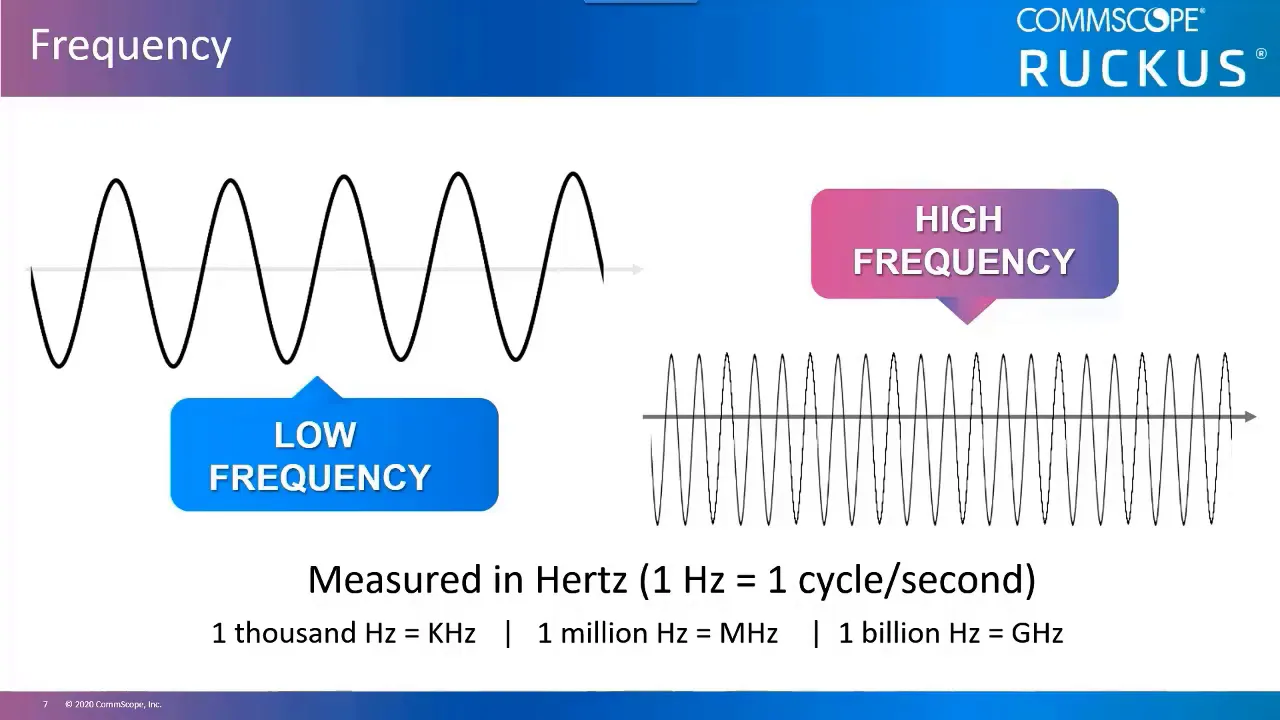
An understanding of basic wave mechanics, specifically radiofrequency (RF) radiation and frequency domains.
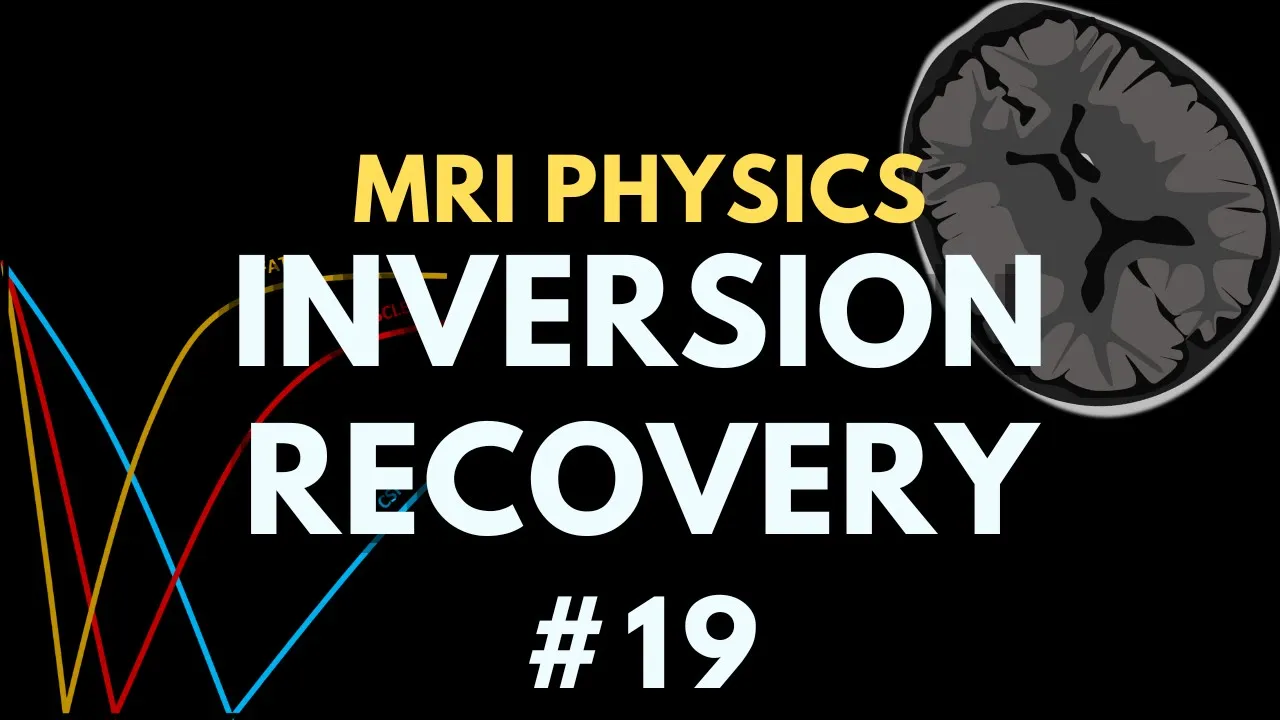
Advanced MRI pulse sequences, such as Gradient Recalled Echo (GRE), Inversion Recovery (FLAIR, STIR), and Echo Planar Imaging (EPI).
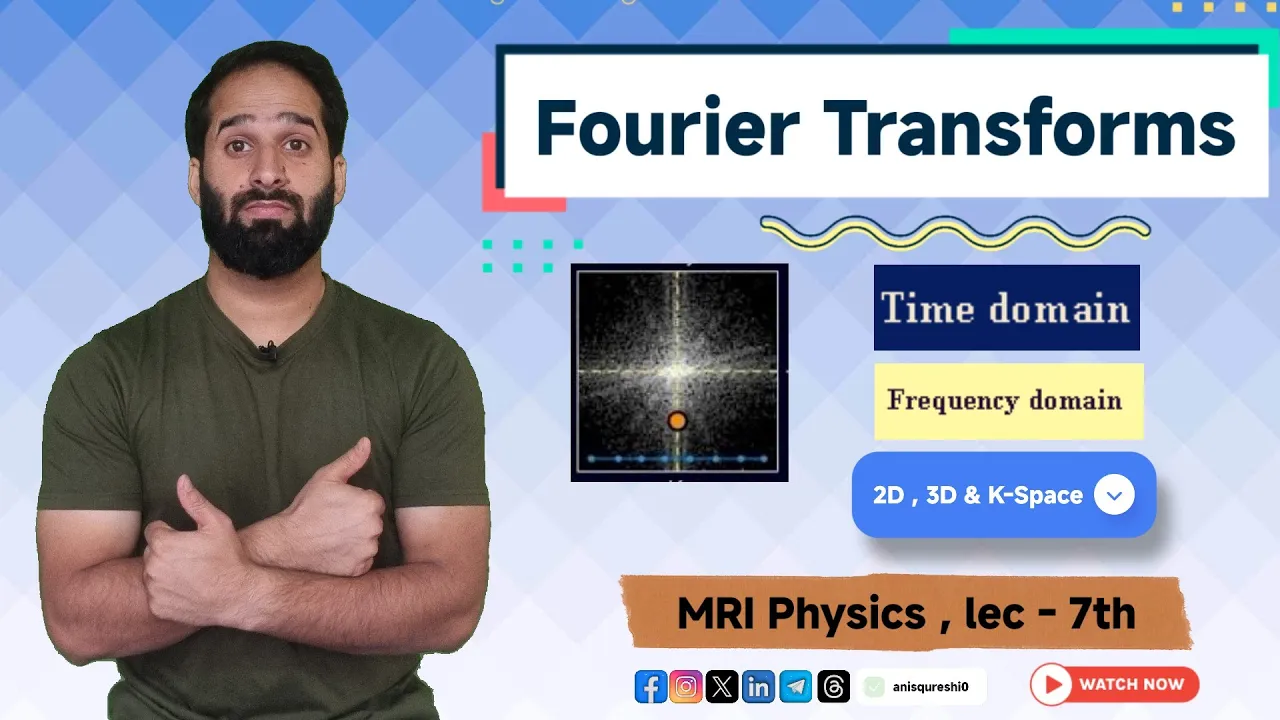
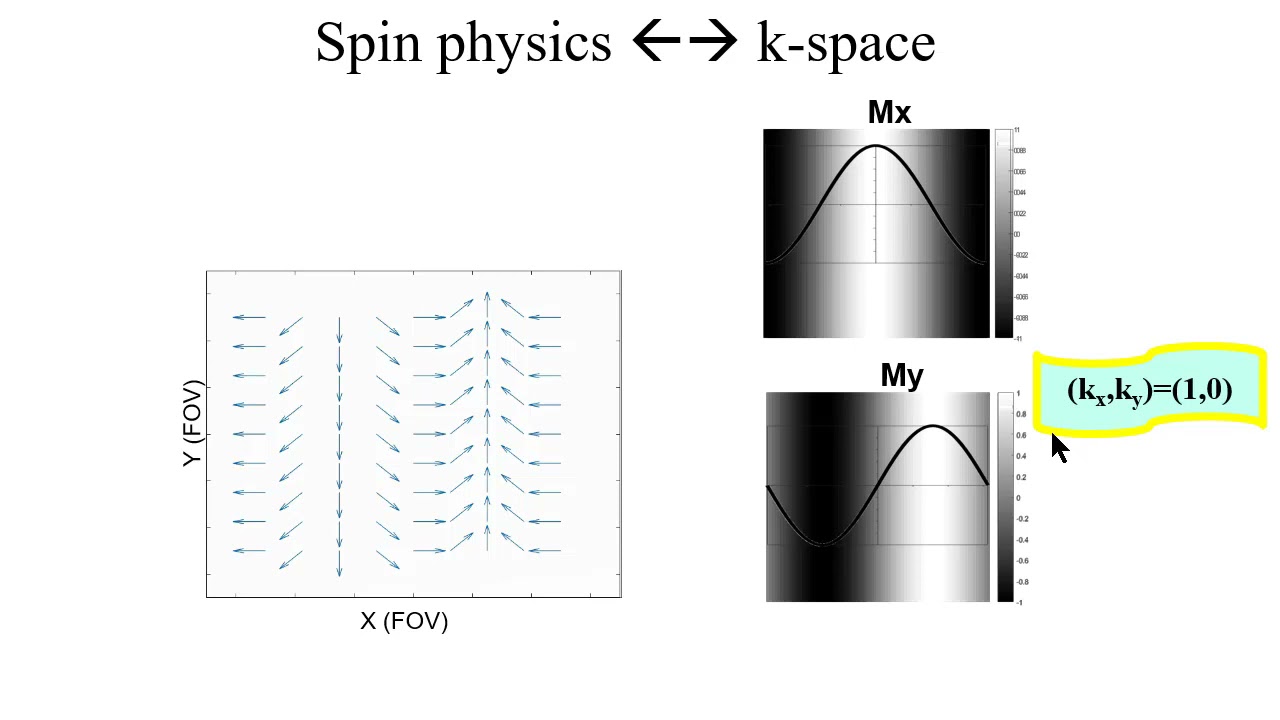
The mathematical principles of image reconstruction, focusing on K-space, spatial encoding (gradients), and the 2D Fourier Transform.
The physical basis of MRI tissue contrast, differentiating between T1-weighted, T2-weighted, and Proton Density (PD) diagnostic imaging.
MRI safety protocols and hardware components, including the function of superconducting magnets, gradient coils, and RF transceiver coils.
445.8K views10.7Klikes10:33Original Release: 2022-07-05
hello my name is dr erin gomez and this is a brief overview of magnetic resonance and a basic mri spin echo sequence let's talk about protons we have protons in the fat muscle and sugars within our body and of course within water remember that a significant portion of our bodies consists of water and that a hydrogen atom is just a proton one positron and one electron with a positive and a negative pole because of this each of these protons is capable of acting like a bar magnet usually the orientation of these protons is random but they can be influenced by an external magnetic field at the most basic level an mri scanner is a giant magnet and generates its own magnetic field which we can call b0 when protons are placed within this magnetic field they'll line up parallel or anti-parallel to the primary magnetic field with a small majority aligning with the direction of the primary magnetic field just going with the flow this generates what is referred to as the net magnetization vector we can imagine this net magnetization along the z axis the long axis or length of the patient's body in addition to aligning with the magnetic field produced by the mri scanner the protons in your body are also spinning along their axes like little tops or globes this is called precession or nuclear spin the speed or frequency of this axial spin depends on the strength of the applied magnetic field and can be expressed by the larmor equation simply put this equation states that the precession frequency of a particle is equal to the strength of the magnetic field applied and the gyromagnetic ratio which is a constant that is unique to each specific nucleus or element with the protons aligned with the main magnetic field we can influence them using externally applied radio frequency or rf pulses when this happens the protons are knocked down into an alternate plane and also precessed together in phase the angle depends on the strength and duration of the rf pulse knocking the protons down into another plane is a change in their longitudinal magnetization normally the majority of protons are going with the flow and following the direction of the external magnetic field but with a little extra energy which we can call excitation protons have the ability to go against the current and instead orient themselves in the opposite direction against that of the magnetic field this is called anti-parallel that's not all that happens with some energy applied in the form of the rf pulse the protons will also process together in phase we can think of this brief synchronization as the transverse magnetization of the protons to recap we've put some energy into the system and temporarily convinced each of these protons to sit down and get it together this doesn't last long much as if you were knocked off of your feet or if i yelled at my wild little children as they ran haphazardly around their playroom recovery is imminent they'll behave for a short time but they'll soon return my energy back to me as the baseline state of disorder is restored much like my children the protons will recover or return to their original state of orientation with the magnetic field and asynchronous procession now that we've gone over what can happen when we administer an rf pulse let's talk specifically about what happens during a typical spin echo sequence remember the flip angle induced by an rf pulse depends on the strength and duration of the pulse the thing being flipped is the net magnetization vector at the beginning of a standard spin echo sequence we apply a 90 degree pulse this means that after the rf pulse has been applied the net magnetization vector is perpendicular to its original orientation this orientation is achieved by eliminating longitudinal magnetization and generating a transverse magnetization vector by synchronizing proton precession during recovery longitudinal magnetization increases and transverse magnetization decreases the protons d phase this looks like a spiraling of the net magnetic vector along the z axis this spiraling of the net magnetization vector induces an electrical signal by a process called free induction decay which is really just a throwback to the high school physics principle of inducing a current by rotating a magnetic field search the depths of your mind for the right hand rule a few additional terms to note the recovery of the longitudinal magnetization of a proton occurs exponentially the point at which 63 percent of the longitudinal magnetization has been recovered is called the t1 time the time at which 63 percent of the transverse magnetization has been lost is called the t2 time the t1 and t2 time is unique to each tissue type image think about a class of children running a foot race each will recover to their baseline heart rate at a slightly different time depending on their physical fitness we can take advantage of these unique tissue properties and alter the mri sequences to highlight them this is called waiting and discussion of this is for another time that wasn't so bad was it seemed too good to be true in a way it is there are a few caveats and drawbacks to the concept of free induction decay number one it only applies to 90 degree pulses number two the signal decays very rapidly and requires a very fast scanner to detect number three the dephasing of protons occurs at a speed known as the t2 star constant this exponential decay in the synchronization of proton spins is due to the fact that each proton experiences the magnetic field at a slightly different strength meaning there is never true uniformity in precession these differences in precession end up compiling leading to increasingly asynchronous spins because each proton already experiences the magnetic field differently than its neighbors any in homogeneity in the magnetic field makes de-phasing and thus signal drop out even worse these are called t2 star effects on mr imaging these t2 star effects can appear as diffuse loss of signal or black holes in areas where the magnetic field is particularly distorted because these effects are due to an inhomogeneous magnetic field we can liken them to distractions in a child's environment t2 star effects seem terrible isn't there any way to fight them fret not the answer is yes the good news is that we can combat t2 star effects and their resulting signal decay with the addition of another rf pulse to understand this we must remember that although magnetic field in homogeneity is inconvenient it is manageable in the sense the differences in precession speed that they cause are fixed and predictable as some protons lag behind their faster counterparts we can apply a 180 degree refocusing rf pulse that instructs all of the protons to turn around and process in the opposite direction much like the classic tail of the tortoise and the hair though the tortoise is far behind the rabbit if we ask both to turn around and head back to the starting line of the race they'll catch up to each other and arrive at the same time due to the differences in their speeds the crowd goes wild it's a tie when the proton procession sinks up following the 180 degree pulse more energy is released back into the system this is called an echo and it is the information collected by the mr scanner which will eventually generate a medical image we can liken the 180 degree refocusing pulse and the synchronous procession it creates to an elementary school class photo shoot the teacher may need to raise her voice in order to get the class to focus its attention on the photographer and achieve a yearbook worthy shot the echo we can apply additional 180 degree pulses to achieve multiple echoes photo after photo after photo to continue decreasing the t2 star effects eventually however the students have nothing left to give less and less energy is yielded back with each echo eventually dephasing occurs completely and the echo dies out once that happens the sequence must be restarted again with another 90 degree pulse imaging in this manner is called spin echo or fast spin echo imaging we can use universal diagrams to depict what happens with specific mr sequences let's use one to recap the basic spin echo sequence that we've just discussed protons are aligned with the main magnetic field b0 and are processing randomly a 90 degree rf pulse is applied eliminating longitudinal magnetization and producing a transverse magnetization vector as protons process in phase longitudinal recovery and transverse decay occur producing a signal by a free induction decay which is susceptible to t2 star effects a 180 degree refocusing pulse temporarily rephases proton precession producing an echo which can be read out by the mr scanner the moment that the echo is produced is called the te or time to echo we can apply multiple refocusing pulses in an attempt to capture as many echoes as possible the echoes become successively weaker until the signal dies out completely and the sequence must be restarted the time between repetition of sequences is called the tr or time to repetition that's all for now this concludes our overview of magnetic resonance and the basic mri spin echo sequence
Up Next
38:00
Phase Encoding Gradient MRI | MRI Signal Localisation | MRI Physics Course #9
@radiologytutorials
74K views•2023-07-06

12:53
21cm Hyperfine Transition in Neutral Hydrogen: Radio Astronomy Basics
@AaronRobertParsons
12.4K views•2011-10-13

32:32
NMR Spin Physics I: Zeeman Effect, Resonance Condition & Larmor Frequency
@nptel-indianinstituteofsci8064
2.3K views•2024-01-17

27:14
Entropy and the Second Law of Thermodynamics Explained
@veritasium
27.5M views•2023-07-01
Related Study Plans & Knowledge Roadmaps
Structured learning paths in Physics
physics
Nuclear Physics (Decay, Fission & Reactors)
01Atomic Structure and the Binding Force
02Radioactive Decay and Half-Life
03Nuclear Fission Mechanics and Chain Reactions
+ 2 more learning modules
12h5 modules
Explore Roadmap
physics
Soft Matter (Polymers, Colloids & Rheology)
01Foundations of Soft Matter & Thermal Forces
02Polymer Physics and Macromolecules
03Colloids, Surfactants, and Self-Assembly
+ 2 more learning modules
38h5 modules
Explore Roadmap
physics
Analytical Mechanics: Lagrangian & Hamiltonian
01Mathematical Foundations: Calculus of Variations
02From Newtonian Mechanics to Constraint Dynamics
03The Principle of Least Action & Lagrangian Mechanics
+ 3 more learning modules
28h6 modules
Explore Roadmap
physics
General Relativity (Spacetime & Cosmology)
01Foundations of Relativity: Special Relativity
02The Geometry of Spacetime: Equivalence Principle & Curvature
03Einstein's Field Equations: The Mathematics of Gravity
+ 2 more learning modules
55h5 modules
Explore Roadmap