Magnetic reconnection, while commonly used to qualitatively describe explosive energy release in cosmic plasma, faces significant theoretical limitations; the 'frozen-in field lines' concept that dominates space plasma physics is only valid in specific situations and fails in the outer magnetosphere and interplanetary space, suggesting that mainstream physics may need to reconsider fundamental characterizations of energy transfer in these environments.
Magnetic Reconnection vs. Cosmic Plasma: Alfvén's Critique
Added:Deep Dive
Fundamental concepts of Plasma Physics and Magnetohydrodynamics (MHD), specifically Alfvén's 'frozen-in' flux theorem.

A. Bhattacharjee - Fast Magnetic Reconnection in Space and Astrophysical Plasmas
3.8K
Hannes Alfvén proved that in ideal MHD (where E + v×B = 0), magnetic field lines are 'frozen' into the plasma—they move with the fluid elements attached to them. If you imagine field lines as ribbons with fluid particles like beads on a wire, these particles remain on their respective field lines for all time. This creates powerful topological constraints: whatever magnetic topology you create initially, you cannot change it without dissipation (resistivity). Nature may have many minimum energy states available, but ideal behavior prevents relaxation to them.
Click to watch →

06 04 - Космическая погода и радиационная безопасность в космосе - Андрей Малыхин
380
In the presence of perpendicular electric and magnetic fields, charged particles experience drift velocity v = E × B / B², independent of charge and mass. In ideal magnetohydrodynamics (infinite conductivity), magnetic field lines are 'frozen' into the plasma, meaning plasma particles and magnetic field lines move together. This frozen-in flux theorem is fundamental to understanding plasma behavior and is essential for analyzing solar and astrophysical plasmas.
Click to watch →

Alfven theorem
3.5K
Alfvén's theorem states that in a perfectly electrically conducting fluid (where electrical conductivity approaches infinity), magnetic field lines are 'frozen' into the fluid and move with it, meaning the magnetic flux through any material surface remains constant as the fluid moves. This fundamental principle in magnetohydrodynamics explains how magnetic fields are transported and deformed by conducting fluids like plasmas.
Click to watch →

The Physics and Chemistry of the Interstellar Medium - Lecture 3 - Part 3/3
151
In ideal magnetohydrodynamics (MHD), when the magnetic Reynolds number is much greater than 1, magnetic field lines become 'frozen' into the plasma and move with the fluid elements, meaning the magnetic flux through any material surface remains constant as the fluid evolves. This frozen flux theorem is a fundamental consequence of the induction equation in the ideal limit, where electrical resistivity is negligible, and it has profound implications for the dynamics of the interstellar medium, including star formation efficiency and magnetic field evolution in astrophysical plasmas.
Click to watch →

Introduction to Plasma Physics: Magnetohydrodynamics Basics
98.5K
Magnetohydrodynamics (MHD) is a fluid theory for describing plasmas where magnetic fields are frozen into the plasma and evolve with it, governed by four fundamental equations: continuity (mass conservation), momentum (Newton's second law with Lorentz force), energy (entropy conservation), and induction (magnetic flux freezing). MHD applies when the mean-free path is small compared to system scales, enabling treatment as a fluid rather than tracking individual particles. Key concepts include the plasma beta (ratio of thermal to magnetic pressure energy), Alfvén waves (transverse waves along magnetic field lines), and the distinction between ideal MHD (perfect conductor, negligible resistivity) and non-ideal MHD (including effects like ambipolar diffusion and Hall effect in weakly ionized plasmas).
Click to watch →
Deep Dive
The mainstream mechanism of Magnetic Reconnection, including how magnetic topology changes to release energy.
Magnetic reconnection and the structure of the magnetopause - Jim Drake
2.7K
Magnetic reconnection occurs when oppositely directed magnetic fields annihilate each other, releasing stored magnetic energy. The process involves breaking and reconnecting field lines, creating bent magnetic field lines with magnetic tension that act like a giant slingshot ejecting plasma frozen onto those field lines at the Alfvén speed. Oppositely directed flows create a pressure drop in the center that pulls plasma inward from above and below, driving the reconnection process self-sustainably without requiring external forcing. The breaking of field lines requires dissipation processes that occur at small spatial scales because dissipation tends to be weak.
Click to watch →

Magnetic Reconnection | Amitava Bhattacharjee
809
Magnetic reconnection is fundamentally impossible in ideal MHD due to the alpha theorem, which states that magnetic field lines are frozen in the plasma and cannot break or reconnect. This theorem has two equivalent formulations: magnetic flux through any circuit moving with the plasma remains constant, and plasma elements initially on the same field line remain together forever. Reconnection requires two conditions: (1) a non-zero term on Ohm's law right-hand side with non-vanishing curl (resistivity, electron inertia, or pressure gradients), and (2) a specific topological configuration where field lines point in opposite directions, creating neutral lines where B=0. Topological change involves breaking neutral lines into magnetic islands separated by separatrices, liberating magnetic free energy and enabling eruptive phenomena like solar flares and geomagnetic substorms. This process is crucial for understanding the universe's magnetization through astrophysical dynamos that sustain large-scale magnetic fields against resistive decay.
Click to watch →

9th Aditya-L1 Support Cell Workshop Day 1 Session 3
212
Magnetic reconnection fundamentally changes how we understand solar flare energy release. The induction equation shows that magnetic fields can either be advected with plasma or diffuse due to gradients. When oppositely directed magnetic fields approach each other, current sheets form where magnetic topology changes. In ideal MHD, field lines are frozen to plasma, but in current sheets with extreme gradients, diffusion dominates and field lines reconnect, releasing stored magnetic energy. This process creates neutral points and polarity inversion lines where magnetic field direction suddenly changes, representing critical sites for flare energy conversion.
Click to watch →

Magnetic Multiscale Science previewed
3.9K
Magnetic reconnection is fundamentally simple yet mysterious: when magnetic fields pointing in opposite directions are squeezed together by plasma flows (which could be solar wind, stellar wind, or magnetospheric flows), the magnetic fields interconnect and release energy. Jets of high-energy particles are produced as magnetic energy is destroyed and converted to particle energy. While previous missions and theoretical work have revealed what happens around the 'diffusion region' where reconnection occurs, they have provided no information about what happens inside this critical region itself. MMS is specifically designed to investigate the physics occurring within this diffusion region.
Click to watch →

Magnetar Giant Flares: How Magnetic Reconnection Releases Enormous Energy in Seconds
123
Topology means the pattern of connections in a field. When topology changes, lines that were separate become linked differently. A braid looks complex because strands cross and link. If strands are rooed, the braid relaxes and straightens. Reconnection is a topological change that releases magnetic stress quickly. It resembles a knitted fabric with one tight snag that slips and a whole row loosens at once.
Click to watch →
Deep Dive
The basic characteristics and observational features of solar flares and Coronal Mass Ejections (CMEs).

รวมเรื่องราวอวกาศ ดาราศาสตร์ PART II (ฟังก่อนนอนสบายๆ 1 ชั่วโมง) | Grandever.p
48.5K
Solar flares are sudden bright flashes in the corona and chromosphere, releasing energy equivalent to 100 million tons of hydrogen bombs. They heat plasma to over 10 million°C and accelerate particles near light speed. Coronal mass ejections (CMEs) are massive plasma eruptions from the corona, containing at least 1.6 billion tons and traveling at 20-2,700 km per second. CMEs form when magnetic field lines reconnect, releasing trapped plasma. Both phenomena are more frequent during solar maximum.
Click to watch →

Solar Flare and CME, Eruption Watch, Galactic Fields | S0 News Feb.6.2024
46.3K
Solar flares and coronal mass ejections (CMEs) are major space weather phenomena where magnetic energy release from sunspots produces plasma eruptions that can impact Earth; the video describes an M-class flare with a double-release CME that has a 50/50 chance of clipping Earth, while also explaining how solar polar magnetic fields predict sunspot cycles and how galactic magnetic fields shape cosmic structures.
Click to watch →

3I/ATLAS Just Took Three Massive Hits, and the Result Is Shocking
53K
A coronal mass ejection (CME) is not a solar flare, though they often occur together. A solar flare is a sudden brightening, an intense burst of electromagnetic radiation across the spectrum from radio waves to X-rays, caused by magnetic reconnection in the Sun's atmosphere. It travels at the speed of light and reaches Earth in about 8 minutes. A CME is a physical eruption of plasma, a chunk of the Sun's corona being violently expelled into space, carrying with it tangled magnetic field lines embedded in that plasma.
Click to watch →

Big Solar Eruption, Triple Alignment, Last Live Show | S0 News Sep.7.2024
49.7K
Long-duration solar flares, unlike impulsive events, almost always produce coronal mass ejections (CMEs), which can be identified by observing the sequence of plasma breakout events followed by flare brightness.
Click to watch →

CRESENT SUN/X Flare Impact Time Update
20.8K
Solar flares are classified by intensity using the X, M, and C scale, with X being the strongest. An X 2.8 solar flare can propel Coronal Mass Ejections (CMEs) into space. A 'Halo' CME appears to emanate from many angles around the Sun, indicating wider impact potential. Solar wind speed (measured in km/s) and plasma density (particles per cubic centimeter) are key indicators of event intensity. Normal solar wind speeds are 400-500 km/s, but during events they can reach 700 km/s. Plasma density can jump from normal 3-5 cm³ to 60 cm³ or higher. The impact time for the X 2.8 flare was predicted for December 16th at 0500 Universal Time (10:00 AM Eastern Time), with the US being sun-facing and thus most affected.
Click to watch →
Deep Dive
The distinction between field-line-based descriptions of plasma and current-carrying (Birkeland current) descriptions.

“The Philosopher’s Stone & the Great Red Work: Plasma, Perception, and the Generator of Dimensions”
853
Birkeland currents are field-aligned electric currents that flow through plasma along magnetic field lines. They filament, braid, twist into helixes, rotate, and form cylindrical columns. When they intensify, they pinch along the z-axis and create luminous nodes where fields overlap. These currents produce braided filament-like helical spirals that resemble wheels within wheels. The Lamont symbol represents four rotating currents that pinch into a diamond or X shape. As they rotate, different angles reveal different luminous geometries—a lion, an ox, an eagle, and a man.
Click to watch →

Episode 136 - Walt Thornhill: Awakening to The Electric Universe Part 2
2K
The movement of charged particles in space forms a current that generates a magnetic field, causing positive and negative particles to move in spirals and form Birkeland current filaments. These are named after the Norwegian scientist who studied auroras and found they were electrical currents coming from the sun. These Birkeland currents are the 'space wires' - auroras are examples of Birkeland currents from the sun following magnetic field lines down from space into the upper atmosphere. Plasma is the conductor for electrical currents in space - 1 in 10,000 atoms losing its electrons are sufficient in space to call it plasma because the electrical force is so powerful that its influence overrides that of anything else. This is why we can talk about galaxies being an electromagnetic phenomenon - they are one giant plasma circuit. Different forces dominate at different scales: at the scale of the solar system, gravity dominates; at the scale of the galaxy, electromagnetic forces operate; at the tiny scale of the atom, the electric force dominates.
Click to watch →
Magnetospheric Currents - Ramon Lopez
2.2K
Space plasma physics fundamentally differs from laboratory conditions: currents derive from plasma velocity and magnetic field rather than simple Ohm's law. The magnetic field is frozen into the plasma, moving with it, while current density J = ∇ × B follows Ampere's law. In isotropic plasma under force balance, pressure gradients drive currents via J = (B × ∇P)/B². The Chapman-Ferraro current, proposed by Chapman and Ferraro in 1931, shields Earth's magnetic field by forming a boundary current along the magnetopause. The Birkeland current system comprises Region 1 (downward dawn, upward dusk), Region 2 (reversed polarity at lower latitudes), and Region 0/NBZ (high-latitude restricted) currents connecting to the ionosphere. Dungey introduced magnetic merging and reconnection as the primary mechanism for transferring stress across the magnetopause during southward IMF. Astrid and Hines proposed viscous interaction where boundary layer plasma becomes entrained by solar wind flow. For southward IMF, viscous and merging patterns reinforce each other, producing two-cell convection. Region 2 currents at lower latitudes are driven by pressure gradients in the inner magnetosphere, becoming visible during storms when plasma pressure peaks near the tail center.
Click to watch →
Michael Armstrong: Big Bang NEVER Made Sense | Thunderbolts
54.4K
In the Electric Universe paradigm, the three-dimensional web of shining helical filaments observed by the James Webb Telescope represents intergalactic and/or interstellar Birkeland currents that deliver power to astronomical structures. This plasma-based model was developed by Nobel prize-winning Hannes Alfven and his protege Anthony Peratt, who called it the Plasma Universe. Unlike gravity-only models, this approach incorporates electromagnetic forces as fundamental drivers of cosmic structure and evolution.
Click to watch →
Eugene Bagashov: Birkeland Currents in Space – An Analysis | Space News
22.7K
Birkeland currents are cylindrical plasma structures where electric current and magnetic field are parallel at every point, forming stable minimal energy configurations with alternating current directions in concentric cylindrical shells; these structures, ranging from interstellar chimneys to galactic-scale formations like the Double Helix Nebula, may explain star formation along interstellar filaments and represent fundamental electrical circuitry connecting celestial objects throughout the cosmos.
Click to watch →
Prerequisite Knowledge
- Concept 01Fundamental concepts of Plasma Physics and Magnetohydrodynamics (MHD), specifically Alfvén's 'frozen-in' flux theorem.
- Concept 02The mainstream mechanism of Magnetic Reconnection, including how magnetic topology changes to release energy.
- Concept 03The basic characteristics and observational features of solar flares and Coronal Mass Ejections (CMEs).
- Concept 04The distinction between field-line-based descriptions of plasma and current-carrying (Birkeland current) descriptions.
Subsequent Learning
- Step 01In-depth study of Alfvén's 'circuit model' of solar flares and the physics of electrostatic double layers in space plasmas.
- Step 02Analysis of observational data from modern solar missions (such as the Parker Solar Probe and Magnetospheric Multiscale Mission) to evaluate competing theories.
- Step 03Exploration of laboratory plasma astrophysics experiments designed to simulate and test reconnection versus current-driven models.
- Step 04Critical comparison of mainstream astrophysical cosmology with Plasma Cosmology paradigms regarding large-scale cosmic structures.
Reconnection Critique
Foundation Rethink
Reconnection Critique
0:00Playing Section
- 1
Examines magnetic reconnection versus circuit energy models.
- 2
Highlights Alfvén's challenge to frozen-in field line validity.
- 3
Notes mismatch between theory and space plasma conditions.
Mainstream Observational and Computational Validation of Magnetic Reconnection
While Hannes Alfvén historically criticized magnetic reconnection as a mathematical fiction—favoring electric current circuit models—modern space physics has overwhelmingly validated reconnection as a fundamental physical process. Advanced magnetohydrodynamic (MHD) and particle-in-cell (PIC) simulations demonstrate that magnetic field lines do break and reconnect in thin current sheets, rapidly converting magnetic energy into kinetic and thermal energy. Furthermore, high-resolution observations from missions like NASA's Magnetospheric Multiscale (MMS) and the Solar Dynamics Observatory (SDO) have directly detected the microscopic 'diffusion regions' where reconnection occurs, measuring the predicted particle acceleration and magnetic topology changes in real time. Rather than treating magnetic reconnection and Alfvén’s current-carrying plasma models as mutually exclusive, mainstream astrophysicists now view them as complementary, dual descriptions of the same electromagnetic phenomena. Reconnection remains the dominant, highly successful framework for explaining the rapid energy release observed in solar flares and coronal mass ejections (CMEs).
Deep Dive
In-depth study of Alfvén's 'circuit model' of solar flares and the physics of electrostatic double layers in space plasmas.

Electric universe
268
Hannes Alfvén discovered Alfvén waves, which are plasma waves where ions oscillate in response to restoring force provided by effective tension on magnetic field lines. He won the 1970 Nobel Prize in Physics for his work on magnetohydrodynamics. He proposed that the galactic circuit is not much different from the solar circuit—in fact, they are identical. The circuit involves current leaving the poles, going around, and returning via the equatorial plane, with double layers accelerating ions and electrons.
Click to watch →
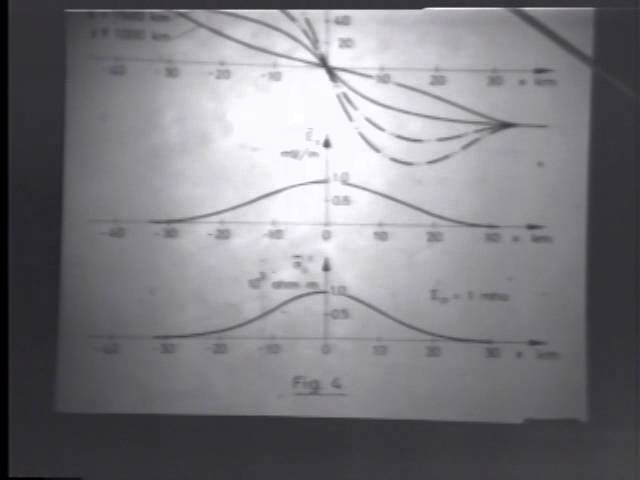
Lars Block - Electrostatic Double Layers
119
Electrostatic double layers are thin regions of space charge separation in plasma that form when electron drift velocity approaches electron thermal velocity, characterized by opposite space charges at each end, typical thickness of ~100 Debye lengths, and potential drops of 5-10 kT/e; they are transient structures that form and disappear repeatedly, occur at pressure minima between electrodes, and can be detected through electric field spikes, pitch angle distributions, and density depressions in low-density regions where field-aligned currents flow.
Click to watch →

Understanding Double Layers: Part 2 Exploding Double Layers & Plasma Circuit Theory
6.1K
Double layers in plasma behave as explosive circuit elements that can release enormous amounts of stored electromagnetic energy when current flow is interrupted; this phenomenon, first observed in industrial mercury arc rectifiers where exploding double layers caused destructive overvoltages, has been extrapolated to explain cosmic phenomena like solar flares and galactic-scale events, demonstrating that every inductive circuit carrying current is intrinsically explosive and requires global theoretical treatment rather than local analysis.
Click to watch →

BREAKING 💥 We Haven't Seen A Solar Storm Like This in Decades...
396.8K
Solar storms involve not just magnetic fields but also electric fields and electrostatic double layers within the plasma body. These are regions with very steep voltage gradients that can accelerate charged particles to near-light speeds. As the solar storm plasma sweeps through space, particles get picked up by these double layers and accelerated, then pepper Earth's atmosphere. This mechanism explains how solar storms can produce S4 radiation storms even from moderate flares.
Click to watch →

Plasma Universe & Electric Universe, What's the Difference?
31K
Christian Birkeland investigated auroras and found they were caused by electric currents. Hannes Alfvén used laboratory research to explain auroras using the concept of double layers, which accelerate electrons to cause the aurora. Solar flares can also be explained this way. If the Sun is a rotating ball of plasma with a strong magnetic field, this moving magnetic field creates a dynamo effect, causing current to flow—this is the concept of the solar electric circuit.
Click to watch →
Deep Dive
Analysis of observational data from modern solar missions (such as the Parker Solar Probe and Magnetospheric Multiscale Mission) to evaluate competing theories.

Gary Zank Adriaan van Ballegooijen Lecture
552
Parker Solar Probe and Solar Orbiter enable unprecedented validation of coronal heating theories through radial conjunctions. When orbits align, Parker measures in-situ plasma properties while Solar Orbiter's METIS instrument makes remote observations of the same plasma parcels. Multi-spacecraft observations from MMS reveal quasi-2D magnetic islands and flux ropes throughout the solar wind. These observations confirm that structures identified in theoretical models actually exist in situ, validating the structure-based turbulence framework for understanding coronal heating and solar wind acceleration.
Click to watch →

AAS Journal Author Series: Nahuel Andrés on 2021ApJ...919...19A
111
Understanding solar wind evolution requires combining data from multiple spacecraft at different heliocentric distances. Parker Solar Probe measures near the Sun (0.2 AU), THEMIS observes at 1 AU, and MAVEN provides measurements at Mars (1.5-1.6 AU). Each mission offers unique perspectives: PSP captures solar wind origins, THEMIS monitors conditions at Earth's orbit, and MAVEN extends observations to outer heliosphere. The energy cascade rate was computed for the MHD scale (100-1500 seconds) using mean values from statistical analysis of spacecraft data. Results show that compressible and incompressible models yield similar energy cascade rates despite increased compressibility near the Sun. The compressible term shows competition with the incompressible term as compressibility increases, with both contributing significantly at high compressibility levels.
Click to watch →
Touch the Sun
1.5K
The Parker Solar Probe aims to accomplish several key scientific objectives: cross below the Alfvén point to directly observe corona heating, determine what is heating the solar wind, identify different source regions on the Sun that form different types of solar wind, and observe solar eruptions that produce radiation to determine where that radiation is produced. The probe will collect data that can help scientists understand why the strange heating occurs in the corona, where temperatures rise to a million degrees instead of cooling as expected. The data from the first two encounters is being made public, allowing the entire scientific community to analyze the observations. The mission is expected to produce 30-40 papers from just the first two orbits, with at least twice as many papers expected from the whole project.
Click to watch →
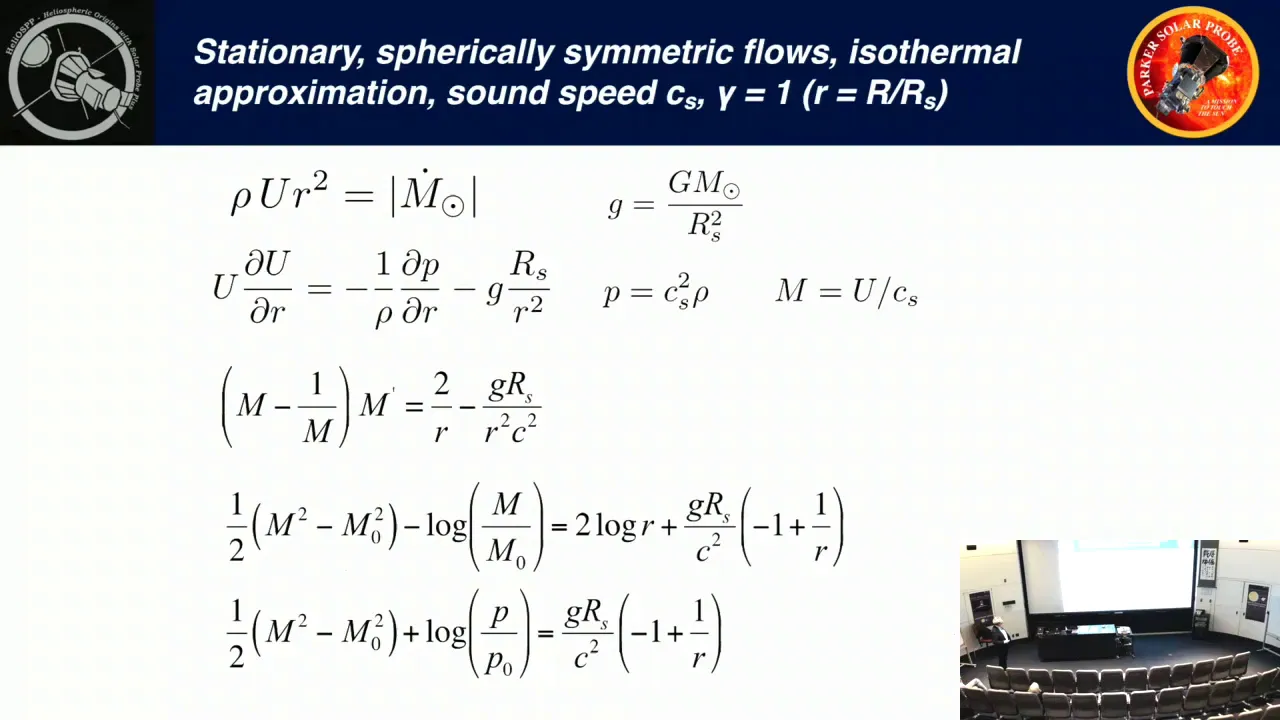
Parker Solar Probe: Understanding Coronal Heating and Solar Wind Acceleration - Dr. Marco Velli
1.1K
Very small coronal holes with huge magnetic field expansion factors can produce slow solar wind permeated by large Alfvén waves. Three mechanisms generate switchbacks: reconnection between closed and open field lines, stream shear from different wind speeds dragging field lines, and independent generation of jets and waves. Composition variations suggest reconnection or shear scenarios. Parker Solar Probe measured magnetic field intensities (~-90 nT) stronger than expected models predicted. Two explanations exist: magnetic field opens up closer to the Sun (~1.2-1.8 solar radii) or large amplitude Alfvén waves oscillate the radial field, changing its decay properties. Solar Orbiter complements Parker Solar Probe with remote sensing capabilities including ultraviolet imaging, coronagraphy, magnetography, and X-ray telescopes. Combined with Probe's in-situ measurements, their orbits enable tracking plasma parcels from tens of solar radii out to the heliosphere, reconstructing plasma evolution from the Sun to 1 AU.
Click to watch →
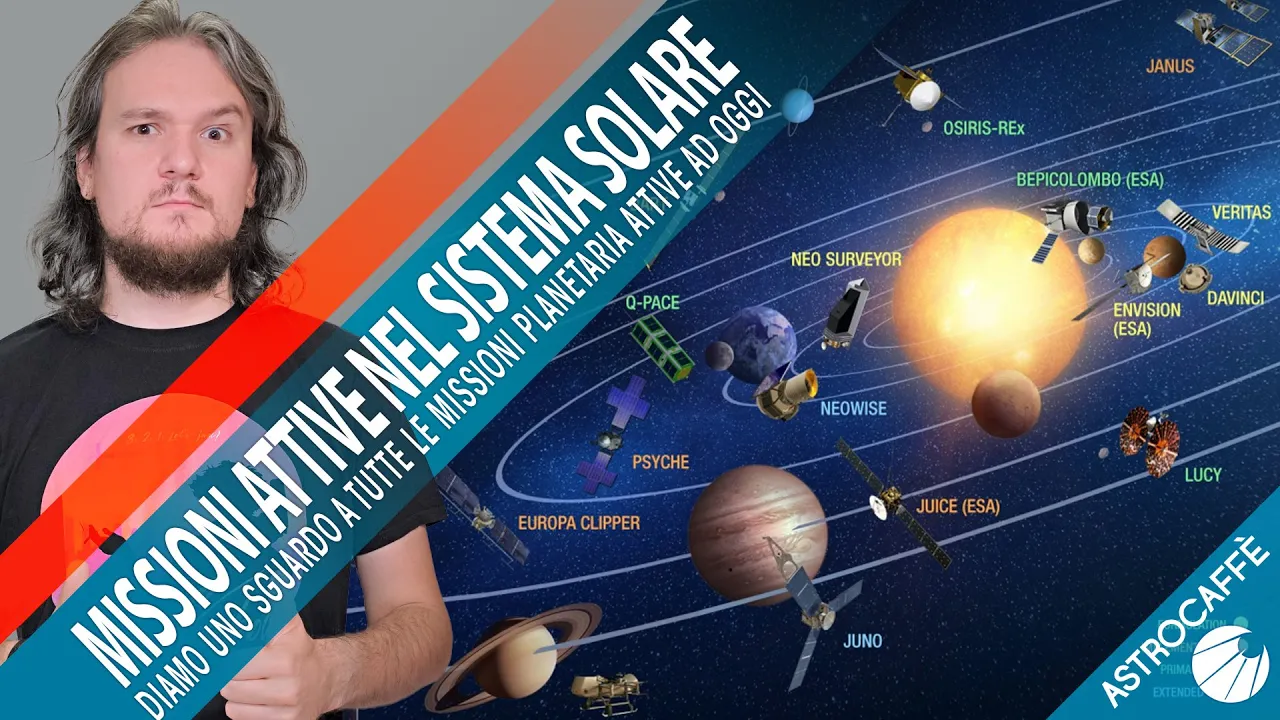
TUTTE le MISSIONI ATTIVE attorno ai PIANETI del sistema solare
58.1K
The Parker Solar Probe (launched by NASA in 2018) and Solar Orbiter (launched by ESA in 2020) are the most recent missions studying the Sun in detail. Parker Solar Probe approaches within 9 million kilometers of the Sun, making it the fastest spacecraft ever launched. Solar Orbiter operates at 30-40 million kilometers. Both missions study the Sun's corona and solar storms more closely than ever before.
Click to watch →
Deep Dive
Exploration of laboratory plasma astrophysics experiments designed to simulate and test reconnection versus current-driven models.

Virtual Tour: Facility for Laboratory Reconnection Experiments (FLARE)
1.1K
Magnetic reconnection is a fundamental astrophysical process where magnetic field lines break and reconnect, releasing enormous amounts of energy that powers solar flares, auroras, and can disrupt satellite communications and power grids; the Facility for Laboratory Reconnection Experiments (FLARE) at Princeton Plasma Physics Laboratory enables scientists to study this phenomenon in a controlled laboratory setting, producing larger, more relevant plasma conditions than previous experiments to advance understanding of both space weather effects and fusion plasma behavior.
Click to watch →

Donald E. Scott: Indeed, Our Sun is Electric! | Thunderbolts
62.2K
Great advances in astronomy and astrophysics are being made by investigators who learn about and apply tools and discoveries from experimental plasma science and engineering. In contrast, those who continually discuss hot gas, bow shocks, black holes, magnetic reconnection, dark matter, dark energy, and neutron stars while rejecting over 120 years of experimentally verified electric scientific progress remain limited in their understanding. There is clear correspondence between features of the Sun's plasma atmosphere and identical behavior of plasma in well-instrumented laboratories like SAFIRE, with no fundamental difference except scale.
Click to watch →

Laboratory Astrophysics: Studying the Stuff of Stars
674
The Crab Nebula jet exhibits observable kink behavior where direction changes over years, resulting from magnetic field configurations and current-driven MHD instabilities. Laboratory experiments at OMEGA use cone-shaped targets illuminated by kilojoule laser pulses to launch plasma jets with strong azimuthal magnetic fields. Proton radiography reveals clumping and directional changes matching Crab Nebula observations. The m=1 kink mode dominates with growth rates comparable to Alfvén wave crossing times. Weaker toroidal fields prevent instability growth, confirming MHD instabilities cause observed kink behavior. For magnetic reconnection, the classical Sweet-Parker model predicts reconnection times of months for astrophysical plasmas, conflicting with observed solar flare durations of ~30 minutes. At high Lundquist numbers, current sheets fragment into plasmoids via tearing instabilities, dramatically enhancing reconnection rates. OMEGA experiments achieve Lundquist numbers 2,500-4,500 using laser-driven plasma bubbles. Proton radiography with sophisticated reconstruction algorithms reveals current sheet breakup patterns, enabling measurement of instability growth rates and discrimination between competing theoretical predictions for fast reconnection physics.
Click to watch →

The Filament Mystery at All Scales: A Problem for Modern Cosmology
19.8K
Cosmic filaments observed at all scales—from star-forming regions to the cosmic web—share strikingly similar properties (consistent width, coherence, resilience) that standard cosmology struggles to explain using gravity alone; laboratory plasma experiments demonstrate that plasma naturally self-organizes into stable, interconnected filament networks through current-driven processes, suggesting these cosmic structures may be manifestations of the same underlying plasma physics operating across vastly different scales in the universe.
Click to watch →

Bliżej Nauki: Plazma, czyli od wnętrza gwiazd po blastery ze Star Wars – dr Witold Zawadzki
3.7K
Laboratory plasma experiments can simulate conditions in stars and interstellar space. By creating plasmas with controlled densities and temperatures, researchers can measure how spectral lines change under different conditions. These measurements can then be compared with astronomical observations to determine the physical conditions of distant stars and nebulae. The Sun's core reaches 15 million°C, while the corona reaches about 1 million°C. By studying plasma in controlled laboratory conditions, scientists can understand the behavior of matter under extreme conditions found throughout the universe, from the early universe to the surfaces of stars.
Click to watch →
Deep Dive
Critical comparison of mainstream astrophysical cosmology with Plasma Cosmology paradigms regarding large-scale cosmic structures.
Plasma Universe & Electric Universe, What's the Difference?
31K
Mainstream cosmology holds that gravity dominates at large scales, the universe began with the Big Bang, stars form by gravitational collapse, galaxies form similarly, dark matter explains galactic rotation problems and filament structures, stars eventually collapse into black holes, and supermassive black holes exist at galaxy centers. The plasma universe holds that the universe is filled with plasma forming vast filament networks, galaxies form along these filaments due to filament interactions, and galaxies are also filled with plasma filaments along which stars form.
Click to watch →

The Big Bang Never Happened--The Science of the Censored Papers
41.2K
Without the Big Bang paradigm, cosmic evolution can be understood through laboratory-tested plasma physics. The universe consists primarily of plasmas where electromagnetic forces dominate. The pinch effect causes parallel currents to attract, organizing into force-free magnetic vortex filaments. Gravitational contraction is limited by angular momentum conservation, but the homopolar generator process transfers angular momentum outward, enabling hierarchical structure formation. Observations confirm similar filamentary structures at all scales from star-forming clouds to galaxy superclusters. A plasma cosmology model successfully predicts correct abundances for deuterium, helium, lithium, beryllium, and boron, resolving the light element problems that plague Big Bang nucleosynthesis.
Click to watch →

Oxford University Space & Astronomy Society Talk -- Eric Lerner
5.8K
Observations reveal large-scale structures extending hundreds of megaparsecs, far exceeding the 50-70 Mpc formation limit predicted by Big Bang cosmology. Combining plasma physics (filamentation tendency) with gravitation produces predictions for structure formation that match observations without free parameters. Structures from galaxy clusters down to individual stars fall along predicted lines based on gravitational velocity and spacing-density relationships. These very large objects would require hundreds of billions of years to form in an expanding universe, but pose no problem in a non-expanding universe without a temporal origin.
Click to watch →

James Webb Proved the Big Bang Theory Is Wrong | Science For Sleep
402
Plasma cosmology, based on Hannes Alfvén's Nobel Prize-winning work in magneto-hydrodynamics, proposes that the universe is dominated by plasma (ionized gas, comprising 99.9% of visible matter) rather than neutral atoms. Unlike Big Bang cosmology which assumes only gravity matters, plasma cosmology emphasizes electromagnetic forces, which are 10^39 times stronger than gravity. Key predictions include: no beginning (eternal universe), no expansion (redshift from tired light mechanism where light loses energy traveling through plasma), no dark matter (electromagnetic forces explain rotation curves), no dark energy (apparent acceleration is observational artifact), no inflation (uniformity explained by electromagnetic connectivity), and galaxies forming along plasma filaments like beads on a string. This framework explains filamentary structures observed in the universe. Despite being marginalized for decades, plasma cosmology gained attention when JWST observations couldn't be explained by Big Bang. Dr. Eric Lerner's paper was controversially accepted by the Astrophysical Journal after recruiting 47 mainstream cosmologists who acknowledged Big Bang problems but agreed current models fail observations and need radical rethinking.
Click to watch →
![PLASMA COSMOLOGY [Full Infomentary]](https://i.ytimg.com/vi/E4pWZGBpWP0/hqdefault.jpg)
PLASMA COSMOLOGY [Full Infomentary]
261.4K
Plasma Cosmology proposes that the universe is dominated by electromagnetic forces and plasma dynamics rather than dark matter, with cosmic filaments and currents carrying matter through the universe, potentially explaining phenomena like galaxy rotation curves and the cosmic microwave background without requiring invisible dark matter particles.
Click to watch →
Reconnection Critique
Foundation Rethink
Reconnection Critique
0:00- 1
Examines magnetic reconnection versus circuit energy models.
- 2
Highlights Alfvén's challenge to frozen-in field line validity.
- 3
Notes mismatch between theory and space plasma conditions.
Mainstream Observational and Computational Validation of Magnetic Reconnection
While Hannes Alfvén historically criticized magnetic reconnection as a mathematical fiction—favoring electric current circuit models—modern space physics has overwhelmingly validated reconnection as a fundamental physical process. Advanced magnetohydrodynamic (MHD) and particle-in-cell (PIC) simulations demonstrate that magnetic field lines do break and reconnect in thin current sheets, rapidly converting magnetic energy into kinetic and thermal energy. Furthermore, high-resolution observations from missions like NASA's Magnetospheric Multiscale (MMS) and the Solar Dynamics Observatory (SDO) have directly detected the microscopic 'diffusion regions' where reconnection occurs, measuring the predicted particle acceleration and magnetic topology changes in real time. Rather than treating magnetic reconnection and Alfvén’s current-carrying plasma models as mutually exclusive, mainstream astrophysicists now view them as complementary, dual descriptions of the same electromagnetic phenomena. Reconnection remains the dominant, highly successful framework for explaining the rapid energy release observed in solar flares and coronal mass ejections (CMEs).
Fundamental concepts of Plasma Physics and Magnetohydrodynamics (MHD), specifically Alfvén's 'frozen-in' flux theorem.
The mainstream mechanism of Magnetic Reconnection, including how magnetic topology changes to release energy.
The basic characteristics and observational features of solar flares and Coronal Mass Ejections (CMEs).
The distinction between field-line-based descriptions of plasma and current-carrying (Birkeland current) descriptions.
In-depth study of Alfvén's 'circuit model' of solar flares and the physics of electrostatic double layers in space plasmas.
Analysis of observational data from modern solar missions (such as the Parker Solar Probe and Magnetospheric Multiscale Mission) to evaluate competing theories.
Exploration of laboratory plasma astrophysics experiments designed to simulate and test reconnection versus current-driven models.
Critical comparison of mainstream astrophysical cosmology with Plasma Cosmology paradigms regarding large-scale cosmic structures.
27.2K views1Klikes2:20@SpaceWeatherNewsS0sOriginal Release: 2017-08-18
who among you fully understands the mainstream physics of magnetic reconnection and potential conflicts with Alison's words in the classic work cosmic plasma it isn't the easiest concept to get one's head around even if it can be represented conceptually in a very simple way while not always in this configuration the concept is that magnetic current brakes and reconnects with another field transferring energy that is stored in the magnetic fields problem is when you bring two magnets together it doesn't work apologies for the yellow but I knew what I was looking for in the book and didn't want to waste a lot of time finding it every electric circuit is explosive in that if disrupted it will release the whole energy of the system at the point of disruption this sounds a lot like the magnetic reconnection in mainstream science looks so without then discussing current circuit energy and mainstream describing energy stored in the magnetic fields how do we connect the dots or is there a disconnect let's continue reading Alphin cautions against the concept of frozen in magnetic field lines a concept which dominates space plasma physics especially because it is only valid as a relative descriptor in some situations and offers the impression of understanding where it is in fact lacking clearly on the very next page we see that space plasma rarely satisfies the requirements of modeling frozen in lines and further it is not valid to use the concept in the outer magnetosphere or interplanetary space this is why we keep seeing serious scientists demanding a rewrite or at least a reconsideration of the characterization of the energy behind these explosive events even if a magnetic field reconnection is a very adequate way of qualitatively describing what effects result in the aftermath so since we've got three us-based scientists here looking into reconnection based conundrums perhaps they will see this video and since alpha is cosmic plasma is not cited among their references I'd suggest they go looking for cracks from the foundation rather than trying to figure out which coat of paint looks best
Up Next

6:32
Superconductivity Explained: The Meissner Effect and BCS Theory
@NoOne3234
109.5K views•2015-01-12

12:53
21cm Hyperfine Transition in Neutral Hydrogen: Radio Astronomy Basics
@AaronRobertParsons
12.4K views•2011-10-13

32:32
NMR Spin Physics I: Zeeman Effect, Resonance Condition & Larmor Frequency
@nptel-indianinstituteofsci8064
2.3K views•2024-01-17

27:14
Entropy and the Second Law of Thermodynamics Explained
@veritasium
27.5M views•2023-07-01
Related Study Plans & Knowledge Roadmaps
Structured learning paths in Physics
physics
Nuclear Physics (Decay, Fission & Reactors)
01Atomic Structure and the Binding Force
02Radioactive Decay and Half-Life
03Nuclear Fission Mechanics and Chain Reactions
+ 2 more learning modules
12h5 modules
Explore Roadmap
physics
Soft Matter (Polymers, Colloids & Rheology)
01Foundations of Soft Matter & Thermal Forces
02Polymer Physics and Macromolecules
03Colloids, Surfactants, and Self-Assembly
+ 2 more learning modules
38h5 modules
Explore Roadmap
physics
Analytical Mechanics: Lagrangian & Hamiltonian
01Mathematical Foundations: Calculus of Variations
02From Newtonian Mechanics to Constraint Dynamics
03The Principle of Least Action & Lagrangian Mechanics
+ 3 more learning modules
28h6 modules
Explore Roadmap
physics
General Relativity (Spacetime & Cosmology)
01Foundations of Relativity: Special Relativity
02The Geometry of Spacetime: Equivalence Principle & Curvature
03Einstein's Field Equations: The Mathematics of Gravity
+ 2 more learning modules
55h5 modules
Explore Roadmap