
















Descartes' Cartesian Dualism proposes that mind (res cogitans) and body (res extensa) are two fundamentally different substances, with Descartes arguing they must be separate because he could doubt his body's existence but not his mind's existence; however, this argument commits the masked man fallacy by confusing what one knows about something with what the thing itself actually is, as demonstrated by examples like Lois Lane believing Superman can fly but not Clark Kent, which doesn't prove they are separate entities.
Cartesian Dualism: Descartes' Mind-Body Separation Explained
Added:Descartes' Method of Doubt and the 'Cogito': Understanding how Descartes arrived at the certainty of his own existence ('I think, therefore I am') as a thinking thing.
Leibniz's Law (The Indiscernibility of Identicals): The logical principle that if two things are identical, they must share all the same properties.
The Philosophical Concept of 'Substance': Understanding what metaphysical 'substance' means, specifically how Descartes distinguishes between 'res cogitans' (thinking substance) and 'res extensa' (extended substance).
Basic Introduction to the Mind-Body Problem: The fundamental question of how mental states (consciousness, thoughts) relate to physical states (the brain, the body).
The Problem of Interaction: Exploring how an immaterial mind can causally affect a physical body, a major challenge famously raised by Princess Elisabeth of Bohemia.
Physicalism and Mind-Body Monism: Investigating alternative theories that argue mind and body are not separate, such as physicalism, behaviorism, and identity theory.
Property Dualism and the Hard Problem of Consciousness: Studying modern dualist perspectives (like David Chalmers') that focus on subjective experience (qualia) rather than separate substances.
Intensional Contexts in Logic: Delving deeper into why Leibniz's Law fails in contexts of belief, knowledge, or doubt, which explains the mechanics of the masked man fallacy.
312K views6.5Klikes8:28Original Release: 2014-02-07
This episode is about a link between descartes Keanu reeves and Yugioh [Music plays with simpson russell] You have probably heard of the work of rene descartes famous French philosopher and Captain hook look-alike who wrote I think therefore I am, which episode one of Philosophy Tube was about.All the way back in the distant past while poorly shot and edited past But descartes was famous for holding another view as well called Dualism In his meditations, Descartes supposed that there were two Fundamentally different sorts of substances in the universe there's physical stuff which bodies and computers [and] chairs are made up of which is extended in space hence he called it Ray's extensor But there's also [mind] stuff Which isn't in time and space at all?
Thinking stuff or Ray's Kaja tans.
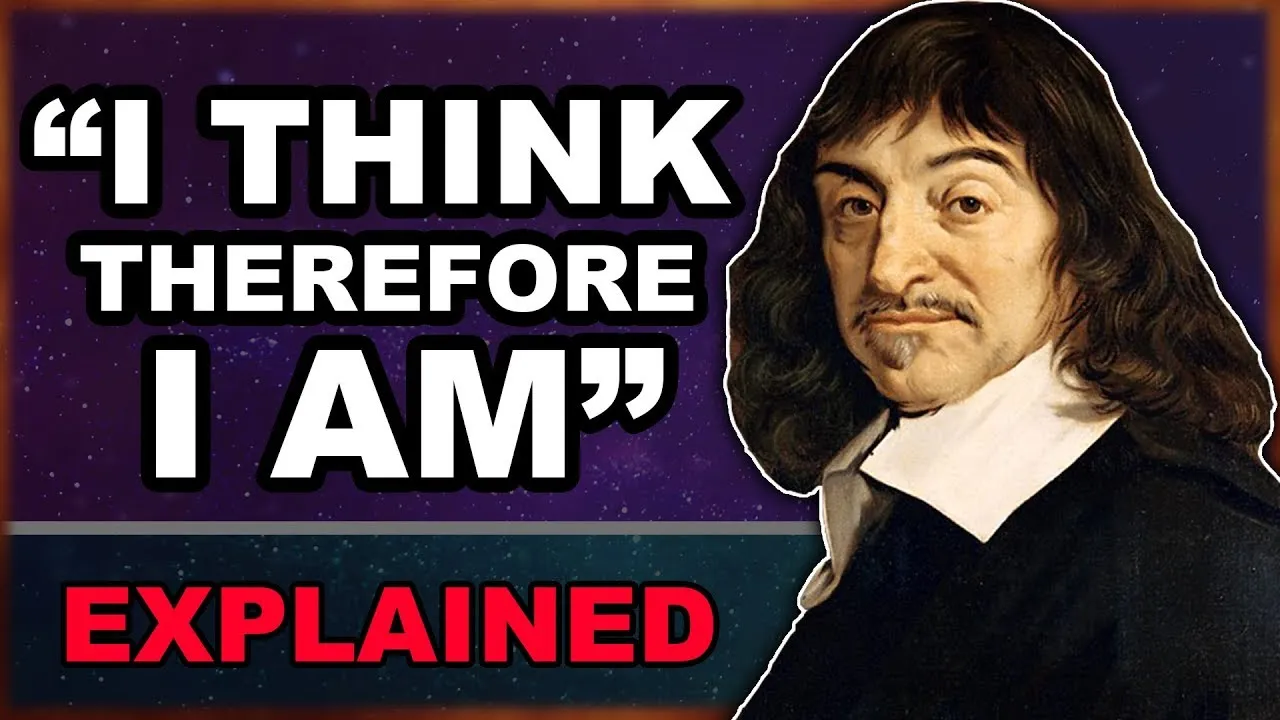
By the way that is Kaga tans with a hard "g" Not Kaja tans from a latin verb [Co] guitar a meaning to think Bodies are made of red extensor, minds are made of [Ray's] Kaga tans and the two are seperate To understand why Descartes formed this, we need to go back to his mission statement Which you may remember was to doubt absolutely everything he could in order to find something indubitable which he thought would be certain knowledge He found that he could doubt everything except that he was thinking since doubting is a kind of thinking and since thinking Requires a thinker he knew that he must exist, hence the famous "I think therefore I am" syllogism also called the cogito Descartes goes on to say that he can doubt the existence of his body and indeed all physical things, but because of the cogito he cannot doubt that his mind exists In philosophy there was a notion called Leibnitz's law,which descartes kind of leans on here even though live [nets] didn't write it down until after descartes did his work libel [it] [says] law is the identity that is sameness of Indiscernibles if you think you have two things and they have all the same properties well Then you don't really have two things you only have one thing to take an example this pen suppose I were to say [that]. I really have two pens here, but they have all the same properties including their position in space well That's just kind of silly that's the same as having one thing if you think you have two things and they have all the same properties, they are identical by the same token if two things have different properties then they must be separate for descartes the Existence of the body can be doubted but the existence of the mind can't be doubted so they must have different properties So they must be separate things The separation of mind and body has actually been quite a pervasive idea it crops up a lot in popular culture see for instance the Matrix [and] ghost and ukyo it's time to Go to the door But whoa?
Hold on there monsieur. There is a big problem with this and that problem is called the masked Man Fallacy It goes like this suppose. You are at a masquerade ball, and there is an enigmatic and charming figure there But they're wearing a mask so you don't know who it is Somebody comes up to you and says. I think the masked man might be your dad, and you say that's impossible [I] know who my dad is [I] do not know who the masked man is therefore their properties are different therefore. They must be different [what] do you think about something is not a property of the thing itself it is a property of you Conflating the two is the masked man Fallacy and this is the mistake that descartes makes he can't doubt his body And he can't doubt his mind, but that is something to do with him He hasn't actually established that the things [themselves] have different properties to [give] another example Lois lane believes superman can fly Lois lane does not believe Clark Kent can fly therefore Clark Kent and Superman are separate No what you think [about] something is not a property of the thing itself Furthermore even if descartes had established that mind and body was separate that wouldn't necessarily Mean that they are two different substances [Ray's] [Kaga] [Tans] and Res extensors It could be that mind and body are separate but the mind is still [nevertheless] Very much part of the physical world and even if descartes was totally right his dualism throws up a whole bunch of questions For instance we know that what goes on in our bodies is affected by our brains and we think the brain has something to do with the mind so how does a non-Physical mind affect a Physical Brain how does Res cogitans wrap itself around the neurons of Res extensa?
How can a non-physical thing Causally impact a physical thing and why do people's minds change depending on what you do to their brains?
And I know that your body is separate from mine because they inhabit [different] bits of space But my mind seems to go where my body goes. But if it's Res cogitans, and it does have a location in space it's no more in my body that it is in yours So how come I the subjective seat of my experience [seemed] to go wherever my body goes?
For these reasons Cartesian Dualism is not so popular nowadays But what do you guys think was descartes on to something here? Are the mind and body separate and if they are are they totally Separate substances?
send me your questions comments queries and [comebacks], underneath the video on Twitter Facebook or by Email you can also let me know whether these like the next episode to be about plato's republic Or do we have?
Individual duties to the environment need like if you enjoy the video and you can subscribe to philosophy Tube using your body to stimulate your mind our last episode mixed 18th century Scottish enlightenment philosophy with Metallica let's see what the plaza fans had to say about hume on Miracles Hands question said but all you need to do to prove a miracle is to verify that the effects have happened mmM I would want to also insist that there be some evidence for a supernatural Explanation of those effects you mentioned the bodies of Saints not rotting as a miracle and whilst a body not rotting can be clearly observed Before I call that a miracle I'd want to make sure first of all that it was really happening and second of all [that] there was no ordinary Natural explanation for it also even if there is no evidence for a natural explanation That still leaves the question open you'd then need to have some evidence for a supernatural explanation before you call that a miracle whatever form that supernatural evidence might take Austin Labonte said that hugh might be throwing the baby out with the bathwater here and saying that certain unlikely But natural events shouldn't be believed in and gave the example of getting a hole-in-one in the masters golf tournament Remember though hume was an empiricist. I think in the case of the golf tournament [he] would say it's more [likely] that the hole-in-one happened than all the camera Crews and witnesses were lying Crucially because a hole-in-one is a natural event and it's part of the nature of unlikely natural events that they do occasionally happen Whereas in the case of a miracle [every] second of every day counts as evidence for assuming that the laws of Nature are uniform So you're always going to have more evidence for supposing [that] a miracle story is False then the miracle story itself will ever have for assuming that the laws of Nature are not uniform Joshua Pearson left a really really good comment underneath the humor said on this which explained it all go and read that he really knows What [he's] talking about Bronto music said that hume is right But because Miracles aren't real in one sense doesn't mean they're not real in another do you Want to explain that at all?
[I] mean It seems like if something doesn't exist that's incompatible with it existing surely things don't exist [more] or [less] you either exist Or you don't Dominic steen can asked how can we have evidence for the permanence of the laws of [Nature]?
remember hume Wasn't saying that we have evidence for assuming that they're permanent only that we will always have more evidence for supposing [that] they are Uniform than any miracle story could ever have for supposing that they are Non-uniform he wasn't saying that one idea is definitely conclusive He's saying that we need to weigh the [evidence] the weighing of the [evidence] is the crucial thing [Ibaka] to [say] that we could define miracles as natural events, but ones which Defy all rational probabilistic interpretation [I] was waiting for somebody to fall into that trap. I'm afraid [the] problem Is that it's part of the nature of unlikely event that they do occasionally happen?
so if you say that a miracle is an unlikely event which happens you're not going to have any way [of] telling the difference between a genuine miracle and an unlikely event that just Happened, so whilst you may have won a small victory by defining Miracles as possible you will never be able to definitively point to a particular event and say for sure that it was a miracle, so Kind of a pyrrhic victory that's why I've got time for this week Thank you very much for watching and I'll see you in the next episode. Bye
Up Next
0:54
Philosophical Zombies: The Hard Problem of Consciousness
@thomasmulligan
779.4K views•2025-06-05

164:01
John of Damascus on Holy Images: A Theological Defense
@BannedBooks
139 views•2026-04-25

36:39
Queer Theory Explained: History, Language, and Identity in Philosophy
@PhilosophyTube
1.6M views•2019-10-28
4:57
The Myth of Sisyphus: A Greek Legend of Eternal Punishment
@TEDEd
8.6M views•2018-11-13
Related Study Plans & Knowledge Roadmaps
Structured learning paths in Philosophy
philosophy
Frankfurt School: Critical Theory & Culture
01Foundations of the Frankfurt School and Critical Theory
02Horkheimer & Adorno: The Critique of Instrumental Reason
03The Culture Industry and Mass Deception
+ 2 more learning modules
12h5 modules
Explore Roadmap
philosophy
Philosophy of Language: From Frege to Austin
01The Linguistic Turn: An Introduction to Language in Philosophy
02Gottlob Frege: Sense and Reference
03Early Wittgenstein: The Picture Theory of Meaning
+ 3 more learning modules
15h6 modules
Explore Roadmap
philosophy
Feminist Epistemology: Standpoint & Injustice
01Introduction to Epistemology and Feminist Critiques
02Sandra Harding and Standpoint Theory
03Donna Haraway and Situated Knowledges
+ 2 more learning modules
12h5 modules
Explore Roadmap
philosophy
Environmental Philosophy: Ethics & Deep Ecology
01Foundations of Environmental Ethics & Anthropocentrism
02Biocentric Individualism and Animal Liberation
03Ecocentric Holism and Deep Ecology
+ 1 more learning modules
10h4 modules
Explore Roadmap