










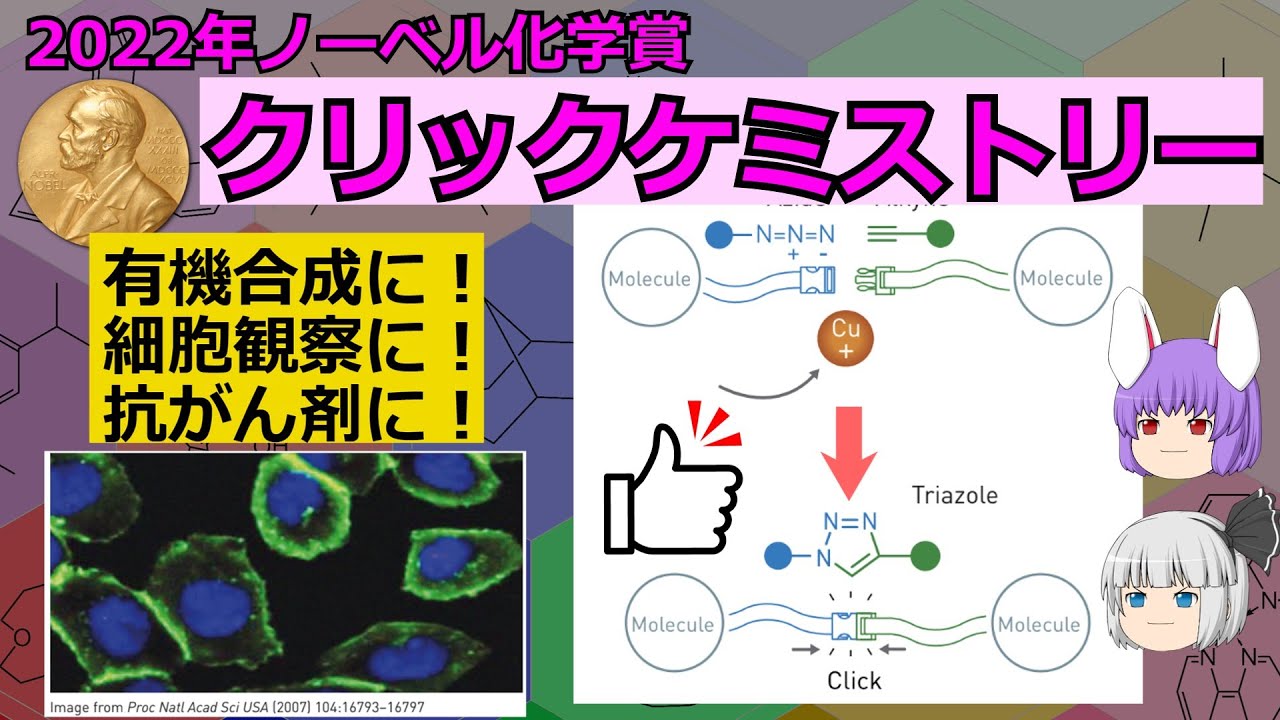



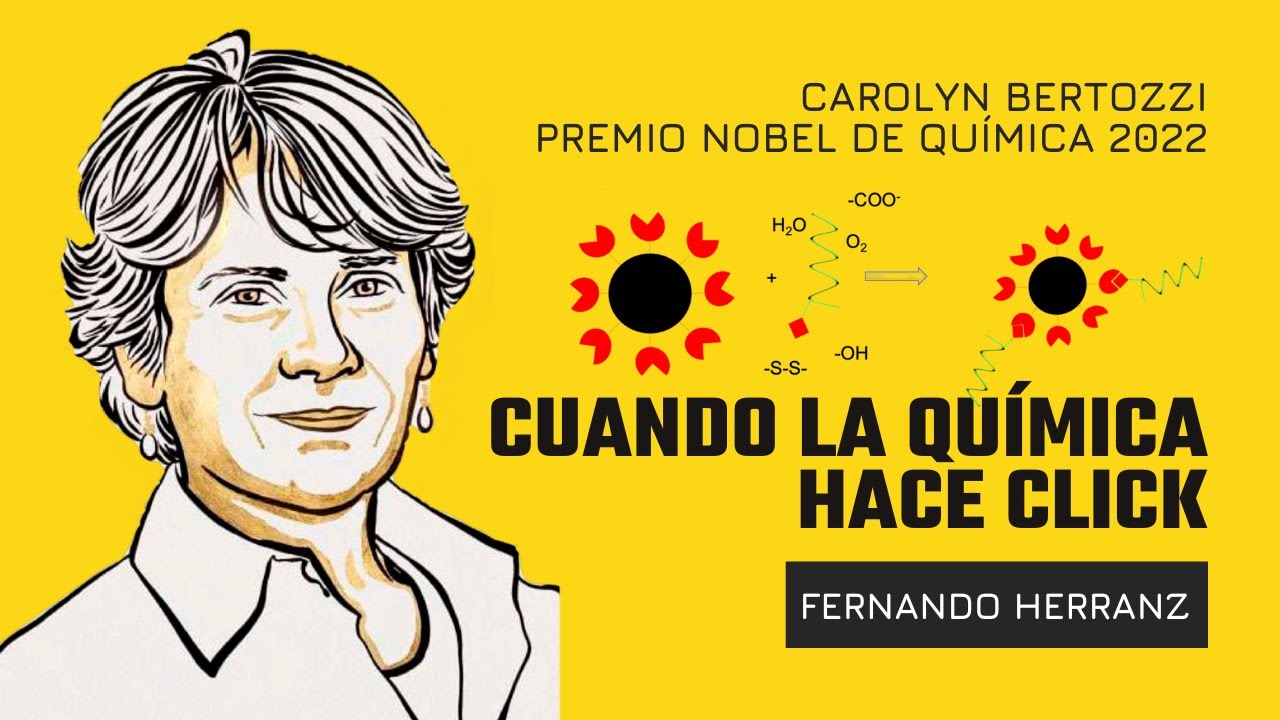




Click chemistry is a method of performing chemical reactions between specially designed molecules that react rapidly and efficiently without generating waste, often in water; the 2022 Nobel Prize in Chemistry was awarded to Carolyn Bertozzi, Morten Meldal, and K. Barry Sharpless for pioneering this technique, which has revolutionized fields like bioorthogonal chemistry by enabling precise molecular assembly in biological systems without disrupting cellular processes.
Click Chemistry (2022 Nobel Prize) – Periodic Table of Videos
Added:Fundamental organic chemistry concepts, specifically functional groups such as azides and alkynes.
The role of catalysts in chemical reactions, particularly how transition metals like copper accelerate reaction rates.
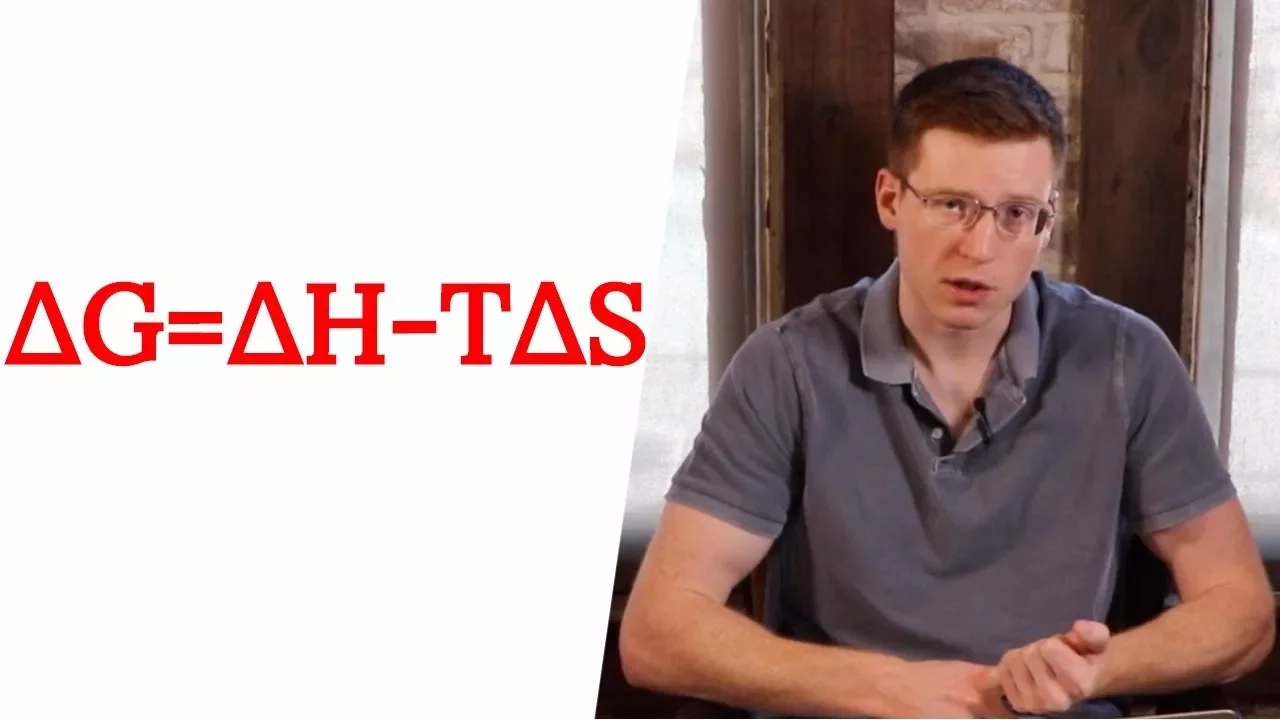
Basic principles of chemical thermodynamics, including Gibbs free energy and reaction spontaneity.
An introductory understanding of biomolecules (proteins, glycans, and nucleic acids) and cellular environments.
The mechanism and development of copper-free click chemistry (such as strain-promoted azide-alkyne cycloaddition or SPAAC) for living systems.
Applications of bioorthogonal chemistry in clinical medicine, including targeted drug delivery and antibody-drug conjugates (ADCs).
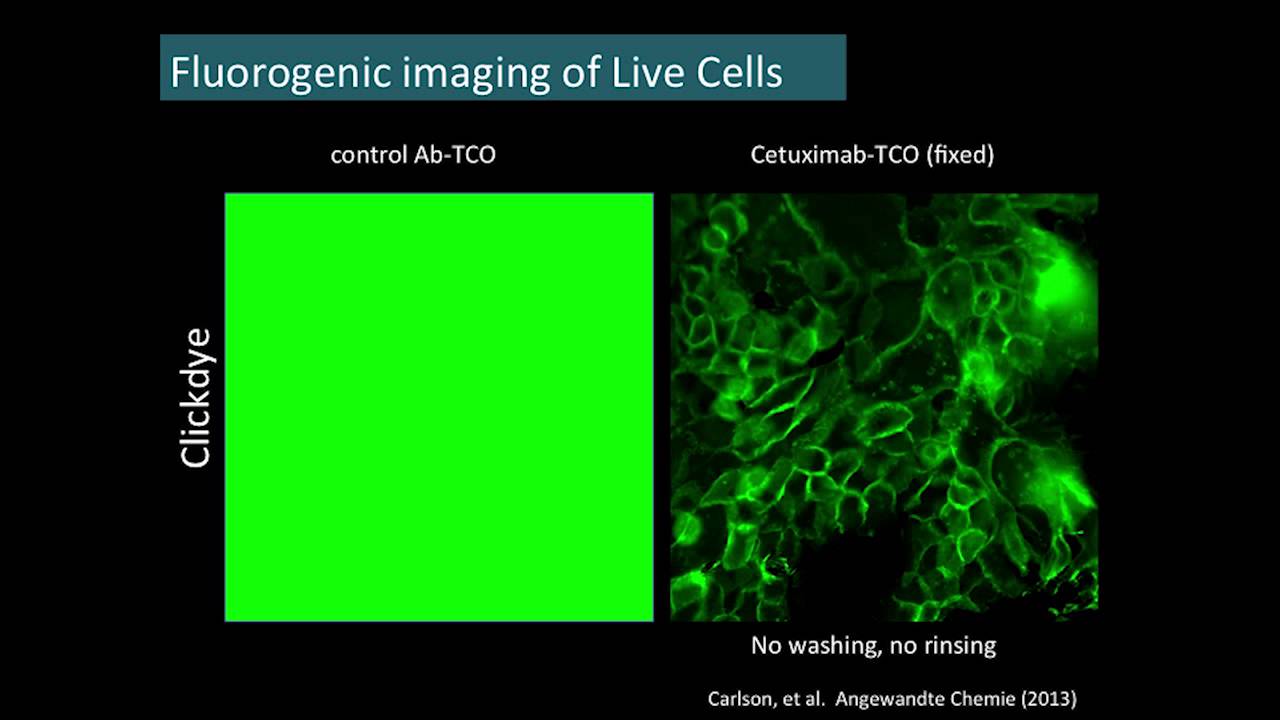
In vivo molecular imaging techniques that use click chemistry to visualize biological processes in real-time.
The synthesis of advanced materials, such as biocompatible hydrogels and functionalized polymers, using click reactions.
157.2K views6.5Klikes13:30Original Release: 2022-10-14
the 2022 Nobel Prize for chemistry has been announced it's quite exciting and also removes the pressure from all the other chemists who thought they might win it and haven't did you think you were going to win it no they were as usual three winners they were awarded the prize for so-called click chemistry and a variation of it which is called bio-orthogonal chemistry in Click chemistry you take two spring-loaded molecules and you react them with each other very very efficiently without generating any waste it's a little bit like taking a safety belt in your car and just clicking the two bits together so that's how how efficient and and great these reactions were there are no traditional demonstrations of Click chemistry and our students Chris a PhD student working with my colleague Neil Thomas has devised especially for you a new click chemistry demonstration um so we're going to be doing a click reaction today and this is a particular type click correction or special type of Click reaction and the azide we're using will actually only fluoresce once the click reaction has actually proceeded the three winners were Carolyn bertozzi who's in America Morton meldale in Denmark and Barry sharpless who is also in America barrier sharplist is really quite special because he's only the second person ever to win the Nobel Prize for chemistry twice initially I'm just going to add into this tube here the copper sulfate so this is going to be our Catalyst for the reaction click chemistry is an area of organ organic chemistry it is slightly ill-defined but what it is is a way of doing chemical reactions very efficiently and very rapidly because it means you can even do these reactions in water which for us climate chemists is often very very difficult because water is is quite reactive itself so you can do these reactions in water they're very efficient you get very good reaction outcomes and as I said you you generate no waste which is great because we're interested in sustainable sustainable reactions that don't generate a lot of waste so he's 1.25 microliters into there organic chemists often construct the most beautiful molecules by a whole series of reactions which are quite slow the reactions and between each reaction you have to purify everything because each step just produ may produce a mixture of products and you have to separate the one you want so in this experiment we're just using the unnatural amino acid homo propagile glycine have to write that down for me yes it's usually just abbreviated to hpg so battery sharpless's idea was perhaps one could do reactions more like nature where they went real in the blue fast in water because nature does most of its chemistry in water reactions which would produce just one product rather than a mixture and so the key to this was to find reactions that between molecules that have quite a lot of stored energy you can imagine the bits like a compressed spring and they release the energy and the first problem was to find suitable pairs of molecules that would react that had this stalled energy and both sharpless and meldal independently discovered that you could use so-called azides and then now we're going to be adding the azide and this azide probe was developed by the betosi group and as I said earlier this is a fluorogenic probe that will only fluoresce once the reaction has preceded so you have a carbon atom here and the azide group is three nitrogen atoms joined together and this is very reactive azides are used in detonators for explosives things like that and they discovered that if you used a copper catalyst you could get reactions to go very well it is not the usual copper the copper two plus like copper sulfate but it is copper one which is not very soluble in water but these reactions go very well in water and there's a whole range of them we're then going to add 7.5 microliters of this compound called thpta which is just going to act as a copper accelerating ligand so it is a chelating ligand it's just a Telltale sign really if you're doing kind of these reactions in a living system for example or you want to test the um uh yeah test the reaction completion in ways for example in my research I might use this to test whether a reaction has gone to completion when I can't use standard chemical analytical techniques such as NMR Mass Spec and things like that Carolyn bertozi was particularly interested in biological systems if you've been watching for a long time you will have seen a 2008 Nobel Prize video talked about the green fluorescent protein which can be used to label organisms the problem is what bertozi did was to find a way of using the click chemistry to join fluorescent molecules to the outside of cells the problem with sharpless is chemistry was that the copper catalyst could poison the organism you could join the molecule on but the organism was dead so you couldn't study Its Behavior so if you think of the cells in our body our human cells they're a little bit like Eminem's I couldn't find any M M's so imagine them like maltesers you've got the core of your m m or malteser and that is surrounded by a layer of sugar and the cells in our body look like this as well you've got the core and then the cell core is surrounded by a layer of sugar and this layer of sugars is very important in how the cell interacts with the things around it so for example how it recognizes friends and falls for example our immune system recognizes our own cells because of the sugar layer around them and similarly pathogens that that create disease in our body recognize and invade cells because of the sugar layer so it would be really interesting for us to find out more about the sugar layer to understand more about the immune system and diseases and this is where Caroline bertozi became really interested in Click chemistry because she wanted to be able to image the sugar layer around our cells and at the time you could only do this very destructively so imagine taking a cell throwing it into a blender and then looking at the bits of sugar floating floating around in your smoothie that obviously is very destructive so what she wanted to do was take chemistry take chemical tools and be able to look at the sugar layer around cells without destroying them so that's all nicely mixed in there and so even though we've got all of the ingredients as well the reagents in there the copper is actually in the incorrect oxidation state to actually act as a catalyst and so I've pre-populated this um 384 uh well plate here some have water in and some have ascorbic acid or sodium ascorbate and that sodium ascorbate is going to act as the reducing agent to reduce the oxidation state of our Copper from copper 2 to Copper one and therefore the catalytic M action should be able to proceed I met Barry sharplist once in a at a conference we had tea together and he produced a huge stream of ideas some of which were really good but others we haven't really followed up he's an enormously inspiring character our former colleague John Moses who has done videos early on in periodic videos on aspirin for example is now a professor of Click chemistry and used to work with Barry sharpless so we've got um 10 microliters so in some of these Wells we've got 10 microliters of water already and in some of them we've got 10 microliters of a solution of ascorbic acid so I'm just going to fill up the wells with another 30 microliters this is a really nice example of excellent chemistry but chemistry which is useful to humanity because it accelerates the rate at which organic chemists can potentially discover new medicines new pharmaceutical products and so it is really in the spirit of the Nobel Prize which is to do science for the benefit of humanity so this is just a UV light box and this is just going to um we're going to put it under long wave radiation and it's just going to shine ultraviolet light onto the top of the well plate so obviously in the wells I've populated with the Sodium ascorbate conveniently spell the word click and the ones that I've just populated with water obviously don't catalyze the reaction and therefore um don't fluoresce so yeah so the good thing is I can actually spell yeah this is supervisor Neil Thomas uses click chemistry to activate spider's silk you know the fibers that are made by spiders what Neil does is to activate the surface of the spider's silk to put on either fluorescent probes or to put on drug molecules so that it can be used for wound treatment and he's produced some really nice examples of fluorescent spider silk and he sent me some nice pictures Caroline batozi is only the eighth woman to win the Nobel Prize in chemistry and as far as I'm aware she's the first member of the LGBT community to to win a Nobel Prize in chemistry and this is obviously very important for representation she explains herself that as an undergraduate and PhD student she faced ridicule and sometimes even exclusion because of sexism and homophobia so it's really important to to have a strong role model to to inspire and support the community and raise awareness for for some of these issues so bertozi also discovered that the molecule cyclooctane this is an alkene in an eight-membered ring is so strained has such a lot of energy that it can do click chemistry without the copper catalyst and she also coined this phrase bioconjugate chemistry which is now very widely used there are even journals of it so she's created a whole new field of chemistry I think the Nobel Prize definitely is still still a big deal um it is very inspirational to see how far you can get with your research especially finding applications for your research and in a way in in the sciences and in chemistry Nobel Prize winners are a little bit like Superstars very selfless in 1970 that's more than 50 years ago had the serious lab accident when a glass tube exploded in front of him and he wasn't wearing safety glasses and he lost the sight of one eye and ever since he has said there is absolutely no excuse for not wearing safety glasses in the lab so if there is one message that you get from this video wear safety glasses in the lab and if you're not convinced watch our video where Neil shows the way safety glasses are important in my pocket I've got this and this is a real Nobel Prize medal it's a real Nobel Prize medal made of gold
Up Next
38:38
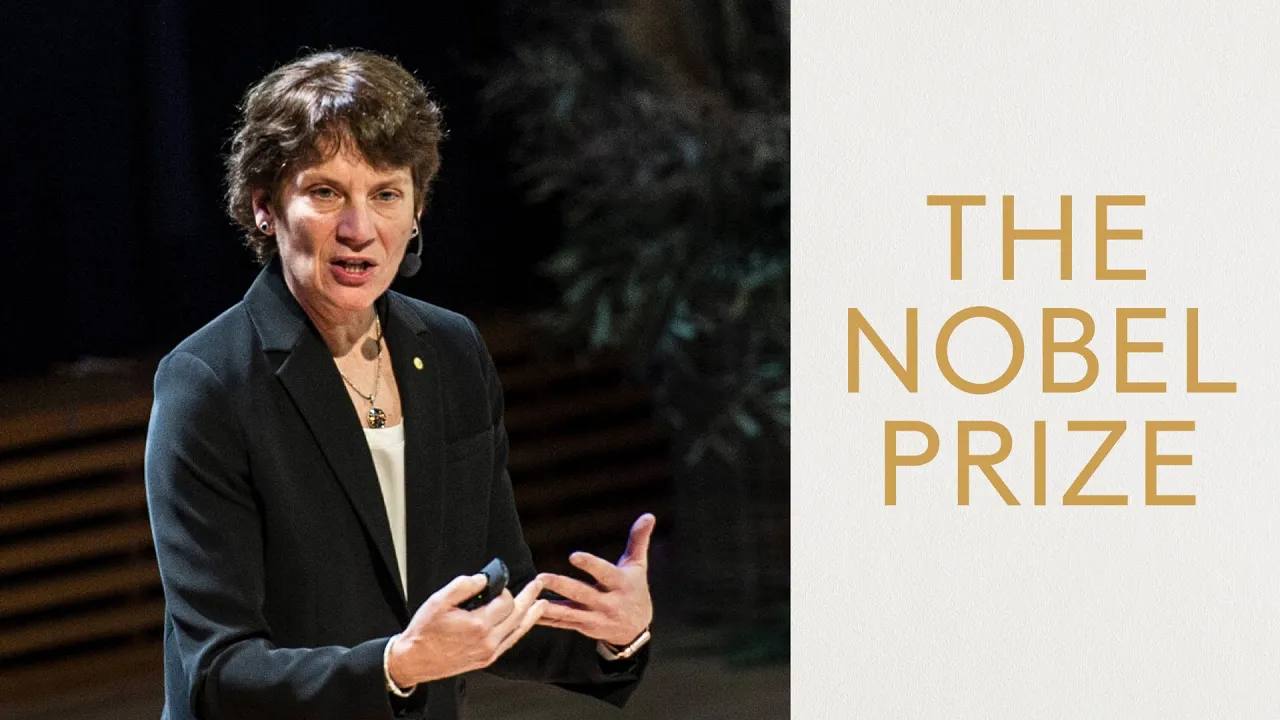
Nobel Lecture: Carolyn Bertozzi on Bioorthogonal Chemistry (2022)
@NobelPrize
148.7K views•2022-12-08
83:56
Biocatalysis and Catalysis in Islatravir Synthesis | Merck Webinar
@SCIwheresciencemeetsbusiness
675 views•2020-10-08
10:06
1H NMR: Determining Number of Peaks from Structure
@MSJChem
59.2K views•2017-04-06
17:31
Edible Water Bottles: A DIY Guide to Sodium Alginate Spherification
@ryan
10.5M views•2019-06-21
Related Study Plans & Knowledge Roadmaps
Structured learning paths in Chemistry
chemistry
Nuclear Chemistry: Decay, Meds & Fuel Cycle
01Introduction to Nuclear Structure and Radioactivity
02Decay Dynamics and Kinetics
03Radiation Interaction and Detection
+ 2 more learning modules
24h5 modules
Explore Roadmap
chemistry
Supramolecular Chemistry: Forces & Machines
01Foundations of Chemical Bonding and Intermolecular Forces
02Introduction to Host-Guest Chemistry
03Thermodynamics and Dynamics of Self-Assembly
+ 2 more learning modules
16h5 modules
Explore Roadmap
chemistry
Photochemistry: Excited States & Reactions
01Foundations of Light-Matter Interactions
02Molecular Orbitals and Electronic States
03Photophysical Processes and Jablonski Diagrams
+ 2 more learning modules
18h5 modules
Explore Roadmap
chemistry
Coordination Chemistry: Bonding & Properties
01Introduction to Transition Metals and Ligands
02Crystal Field Theory (CFT) and Geometry
03Magnetic Behavior and Spin States
+ 2 more learning modules
14h5 modules
Explore Roadmap