






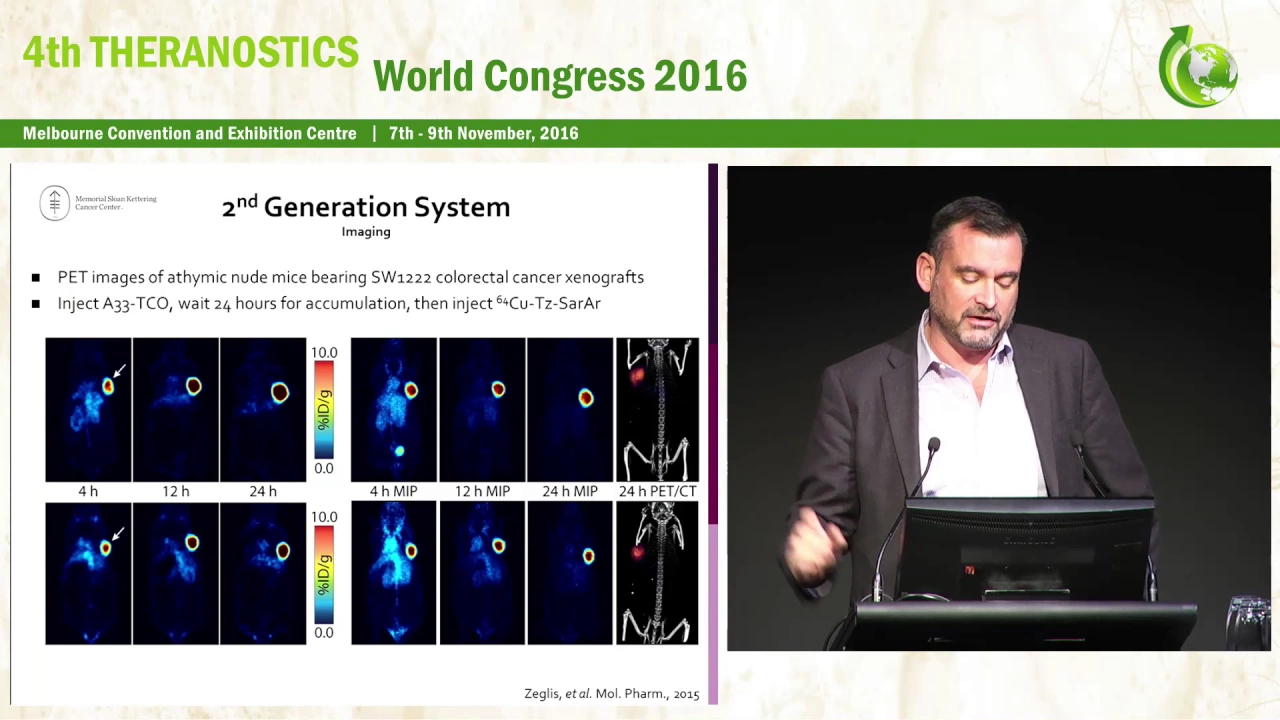




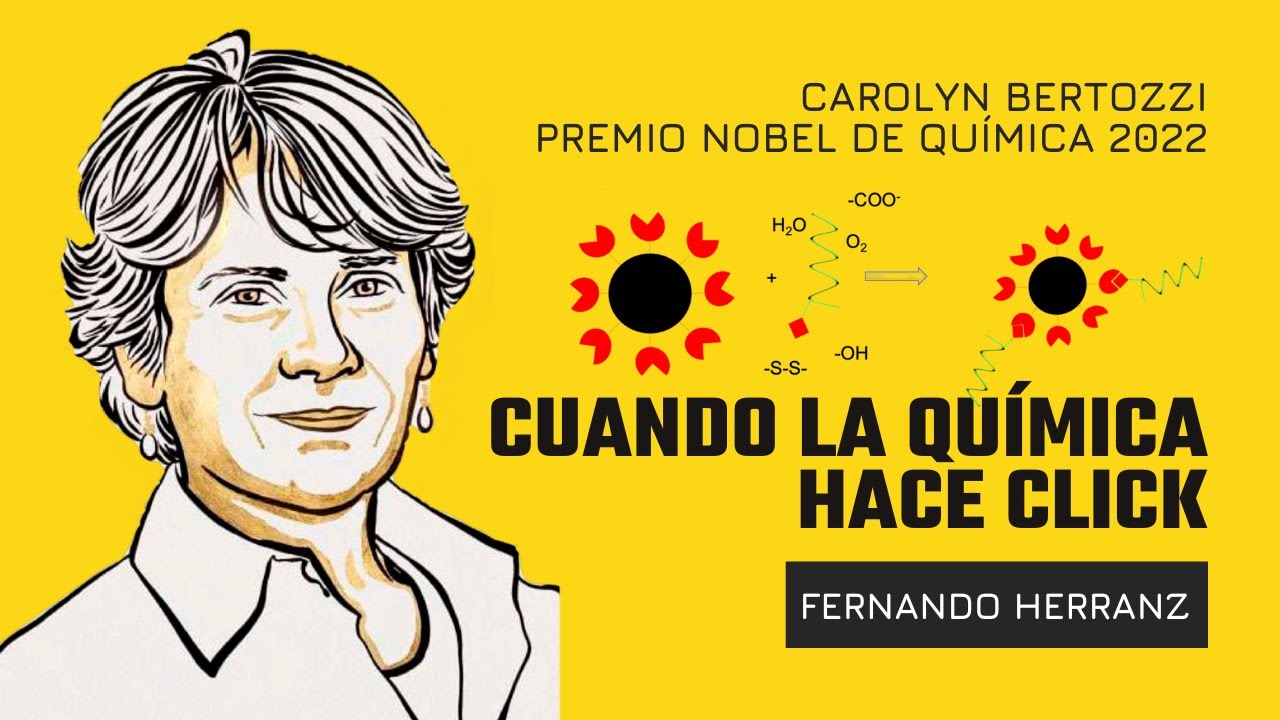



Click chemistry, specifically the tetrazine-TCO (trans-cyclooctene) reaction pair, enables highly specific and efficient molecular imaging by providing orthogonal chemical reactions that work in vivo without interfering with biological processes; this technology allows for fluorogenic probes that become over 1,500 times brighter upon target binding, significantly reducing background signal and enabling visualization of molecular targets in living organisms with high specificity and sensitivity.
In Vivo Click Chemistry: Molecular Imaging Tools for Cancer Detection
Added:Principles of Bioorthogonal Chemistry: Understanding chemical reactions that can occur inside living systems without interfering with native biological processes.
Fundamentals of Click Chemistry: Familiarity with high-yield, highly selective reactions, particularly copper-free click chemistry.
Basics of Molecular Imaging: Knowledge of imaging modalities (such as PET, SPECT, and optical imaging) and the role of targeted probes.
Organic Chemistry Kinetics: Understanding rapid reaction kinetics, specifically the inverse electron-demand Diels-Alder (iEDDA) reaction between tetrazines and trans-cyclooctenes (TCO).
Pre-targeted Radioimmunotherapy (Theranostics): Investigating how click chemistry can be used to deliver localized therapeutic radiation to tumors after diagnostic imaging.
Clinical Translation Hurdles: Analyzing the pharmacokinetic, toxicological, and regulatory challenges in transitioning in vivo click chemistry probes from animal models to human clinical trials.
Advanced Bioorthogonal Reaction Pairs: Comparing tetrazine-TCO ligation with other emerging fast reactions, such as strain-promoted azide-alkyne cycloaddition (SPAAC).
In Vivo Nanoparticle Functionalization: Studying how click chemistry is applied to construct or modify drug-delivery nanoparticles directly at the disease site.
204 views4likes22:24Original Release: 2019-01-29
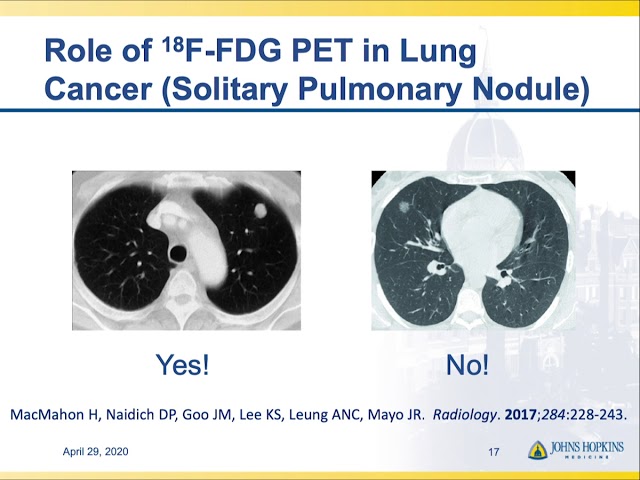
afternoon everyone thanks for sticking around Dirch Abner for the invitation taking a step back from the front lines of infectious diseases in bone marrow transplant from pediatric al out to the underpinning of all of this science and the chemistry's where I hang my head and where I do my work and nothing to disclose now molecular imaging something that was on my mind this morning is we heard about the fascinating and complex transformations that are underlying our treatment of lung cancer and the more we know about cancer biology the more intricacies there are that are really playing out below our radar and we do biopsies Jeff and Lisa and Alice have been following up at discrete time points but on a day to day basis our clinical tools are really pretty primitive and we use x-rays and CT scans to take initial stock of our patients and follow our progress with treatment and at our best we can go to the fourth dimension by adding in metabolism and really a PET scans give us color in our own visual interpretation but it's a four dimensional scan in a way it's not a time series but it's an added layer about the glucose utilization and a tumor and so you might imagine if I can hit the laser here without hitting the back button that the underpinnings of aliança logic signaling the chromatin remodelling the immuno biology are all happening on a day to day basis and we might learn a tremendous amount if we had better tools for seeing them happen not just snapshots at the time of relapse not just wondering how the cocktail of therapy that we were inventing this morning for lung cancer is playing out but actually tuning it in real time so although that's impossible right now because molecular imaging is really hard and so I could give a an hour-long talk on why it's difficult to develop probes that have contrast that have signal that have specific targeting of the pathology that you can see on the outside of the body that work in a human not a mouse and superficial versus deep detection as an example macroscopic versus microscopic scale how many positrons do you really need and how small an object can you see them when they're coming from a CT scan representation of a body background is really a simpler thing to imagine than all of the physics of these other topics that I'm glassing over which is basically that our probes their best accumulate where we want them to but to a lesser degree everywhere else and so we've seen PET scans in a variety of clinical series today and they all have a lovely pinkish sunset glow with a brighter yellow spot superimposed on it and so pushing the boundaries of molecular imaging we need to get rid of the sunset glow so we can see tiny or yellow spots we need to get rid of the background in order to be able to see or to imagine since this is a prospective methodology development kind of a chemistry talk I in order to be able to imagine that smaller scale the sunset has to go away and and so I here are those PET scan images I've just been describing and here's a big lung tumor yeah which we can pick out right next to the heart the hearts brighter than the tumor and wouldn't it be great if PET scan were really only the beginning so in order to do that we can't do it right now with the drugs we have with the proteins we have with the antibodies we have but there's some hope that I'm gonna tell you about my own daydreaming in this for this regard today that some of the novel chemical tools the click chemistry that got apostrophes in the title of my talk could be used at a beginning step in devising nano machinery that can go into a living organism and specifically isolate an underlying biological process of interest to transplant to treatment to all of these fascinating quemic topics so what the devil is click chemistry it's a field that was invented by a chemist after he won his Nobel Prize and he said what else am I going to do next and his daydream was that instead of needing solvents and glassware and carefully controlled conditions that you could sit down ab initio and design reagents that were so good that if the two pieces came together anytime anywhere you'd get the product you wanted and it was widely reviled by serious chemists because that's too easy you won't be able to make interesting molecules with such simplistic chemical concepts but where that criticism may be missed the mark is that you're not going to synthesize the new lead compound it have design with chemistry but you might be able to make a toolkit that can do chemistry in spite of everything else that's happening so you won't make the stereocenters you won't make the exquisite SAR defined structures for sub Manimal or potency but you might be able to take pieces and them do interesting things so I've just put together a quick schematic here so a plus B they should stick and they should do it anytime anywhere no matter what else is around so this chemical toolkit shouldn't care about protein salts DNA RNA struggles the entire biological milieu should be transparent and you should be able to do it with these pieces attached to biomolecules and this is really the power of the idea that I've been hypothesizing about and spending my time in the lab working on is that if we're smart enough about what we attach these post Nobel reagents to now we should be able to make the big things do interesting tricks for us even if the chemistry that's at the core of the reaction is just a one-trick pony or whatever the serious organic chemists might have described it at after the talk so the particular click chemistry that I use it's a bi-orthogonal chemistry remembering my own slides I put this definition at the top by orthogonal is another phrase that you might come across in the decade ahead if we have any luck is another phrase to describe click chemistry which is to say that all of these reactions are perpendicular to the chemistry that biology uses the reagents don't care about the biological molecules and the biological molecules ignore the reagents the green and the blue molecules that I labeled as a and B so if we're going to do synthetic chemistry and living systems take advantage of your slide I you'd want a pair that did all of this really effectively you'd want it to be able to work at the nanomolar concentrations you'd want it to be able to function without catalysts we can't deliver copper or palladium or microwaves any kind of chemical tools into a living organism or into a living cell and and so it should happen quickly it should happen in all these technical ways with minimal intervention and so Tetrazzini and TCO is so if you hear me say T Z or T ZD TCO that's the pair that I've been working with in the Y Slater lab here in systems biology so Tetrazzini is a really cool molecule and the my mentor caused these spring-loaded weapons that's his synopsis for how these work and I'll gloss over all of the fascinating chemical physics of why it happens and just stick to the basics which are that this is the Tetrazzini in the box and that we've got a handle on it that we can use to attach to recen takes two nanoparticles to other drugs to radio labels and so it really is the delivery vehicle that that initial hemispherical cartoon might have indicated and its partner TCL is an eight membered ring that's been wrapped in a corset the bond is kinked it puts all this spring-loaded strain into the ring and that's you know the easiest way to just analogize the magic trick of what makes this particular pair so effective at finding each other and reacting so spectacularly quickly and with facility and so TCL also has a handle on it we can attach it to DNA RNA nanoparticles you name it and this is a two scale drawing of what a TCR tag looks like on an antibody and so again this is a schematic background for you but a TCO tag is tiny relative to the scale of a biomolecule and the two things I wanted to point out here is that you can imagine that this is a relatively small footprint the tag needs to be as small as or smaller than whatever it is you're using it to label and that this is color coded in yellow to show all of the lysines that are on this particular antibody crystal structure there are tons of them and so because it's so tiny you can imagine that there's an inherent amplification capability here that we can put lots of these tiny tags onto something like an antibody and amplify the signal so think about the way we do that traditionally primary antibody secondary antibody so there's a chemical amplification strategy so when you put these two pieces together I've got a rotating video here so you can see the the corseted TCO and then the product when the two pieces have stuck together they reliably do just that hypothesized a plus B goes to a covalently linked chemically stable it's not a non-covalent interaction this is just permanent connection between the two pair so tiny tags I alluded to that when I had my antibody scale drawing up there you could tag a drug molecule with a TCO it's smaller than a drug molecule this chemistry works in vivo it satisfies all the criteria of chemical orthogonality doesn't care about DNA care about proteins or water or salt you can imagine schemes that I won't take time to talk about today in which we can label things in one step let them do their thing that the kinetic process play out and then detect them in a separate step because the chemical reaction can go find its partner wherever that is hiding in cells hiding in the nucleus hiding in the probe in the proteome and you can do it in vivo so you can imagine a whole new generation of assays where instead of extracting and western blotting northern blotting southern blotting sequencing with this kind of parent you can do chemically amplified covalently tagged magic tricks in situ at its best in our prospective vision of it and coming back to molecular imaging you can imagine that if you have the right scheme you can use this to reduce background signal you can let clearance processes play out and then detect the result you can and I'll go into this more as we go forward so background signal which I started with this that sunset analogy and the PET scan is this quintessential challenge of molecular imaging so starting the story of the work that happened in the lab upstairs here on the fifth floor it was noted a couple years ago by one of my predecessors that fluorescent molecules can be quenched they can be turned off so that they don't emit light anymore by attaching tetras into it and you'll see that I've color-coded Tetrazzini here it's blue through all these slides and so if you just tagged a flora for oysters I've given the ghostly white color here with the tetra seeing an energy transfer process the physics of which all glass over makes that molecule non-fluorescent and happily if you take away the Tetrazzini by reacting it with TCO which it's so eager to do the flora for becomes fluorescent again and so this is a signal amplification strategy a flora genic process or flora genic ligand where we've taken advantage of the teeth the tetrazini's reactivity and we've given a visual readout or a fluorescent readout to it and so this particular pair in the work from a few years ago the molecules became twenty times brighter after they reacted and with a twenty times signal amplification of the bright molecule after stuck to its target in this case tax all on microtubules in a cell you can see an image of something hazy resembling microtubules emerge from the background so look what I set out to do was to figure out a way to make this work better because I was interested in this clip chemistry tools and the bi-orthogonal imaging and having molecules that you can send off on their way to find their target and so I explored a series with a colleague of mine another chemist in the lab of ways to connect a tetra xenon to a fluorescent molecule to make this light switch effect work a lot better and so there's another theoretical underpinning of which the data was too difficult to summarize and encapsulate for general interest and so I've happily emitted it for all of us but by wiring the molecules together and I've just represented it in a slightly different space-filling form here but by wiring them the pieces together a fluorescent dye with a Tetrazzini right you can propose exceptionally efficient energy transfer exceptionally efficient switching and it turns out that this hypothesis worked pretty well the molecules actually get 1500 times brighter when the Tetrazzini reacts instead of just twenty times brighter so what does that look like so if you start out one of these two vials has the fluorophore in it under UV irradiation and the other ones just water and you know it's my own eyes I can't see the difference between the two although beforehand there's absolutely no detectable fluorescence it's just a clear solution afterwards it becomes intensely brightly greenly fluorescent like the dye should have been all along so immunohistochemistry immunofluorescence all of the images you can imagine microscopically this is the same sort of switching on effect instead of always being bright this molecules only bright after the Tetrazzini is clicked to its TCO counterpart so here's just a data point the fluorescence spectrum before and after it's more than a thousand times brighter than it was before so now what about imaging this isn't a physics seminar right we need our back to our cancer cells back to an application and so starting with an over x and g FR over expressing cell line and say let's set out to image this by adding Tetrazzini dye to a TCL labeled field you can imagine making so tuck some app with TCO well known to everyone here and whereas if you add the click dye to a control antibody you see nothing and this is just that a high concentration of diet should look like this green square if it weren't so beautifully quenched by the magic trick that I've elided if you add that same dye the same amount of dye to fixed cells that have EGFR TCO on them anti EGFR TC RS at Exxon of TCO with no washing and no rinsing it shows that better on our side flanking monitors I think that it does on the big central screen an image emerges from the background which corresponds beautifully to just where we'd have expected the EGFR to be have you added to live cells happily the exact same thing happens the dye is sitting there at full test full strength but only where it binds to its targets that we've pre parked onto the surface of those receptors does the fluorescent signal emerge and so if you say well how does this compare to scrambled here as well I'm sorry to see that how does this compare to the first generation probe the twenty and the thousand are still working for an intracellular target you can see that the nanoparticles that these macrophages have ingested are pre labeled in red and click dye as we labeled as we've dubbed these things recapitulates the location the nanoparticles beautifully I get point over to the TV spinach shows up even better and the traditional first generation molecule does the same thing but with this very high background prevent you from doing any subtle uncle biology analyses and if you merge those two images you can see a beautiful yellow image showing the co-registration that the dye has found the TCO target where we left it so you can look at other things you can look at actin labeled with probes that Floyd and flight like Floyd and TCO a small molecule that binds to actin and adding the dye out of the darkness once again a specific high signal-to-noise ratio image emerges you can zoom in further and you can see the sub cellular structure of those filaments and no washing no rinsing and I might have pointed out that labeling things in vivo of course we can't wash them we can't then we can't do the pathology labs rigorous - - for our washing steps that they do for every IHC that they report back to us on our biopsies and so this kind of a labeling routine although complicated and construction opens the doorway to imagination about how you can deploy these same chemical tools and model organisms and living cells and eventually as the stars align and as technology marches onward possibly in people so intravital II I've lost track of exactly how much time I have but you can deploy these same tools into a mouse and in the lab before I started there have been a whole host of Tetrazzini TCO experiments done for in vivo Diagnostics analytics and so here in the pre ejection state we can see that a mouse that's been injected with subtext amending bur tumor model here at the top right there's no fluorescence in in the window chamber and after we add the dye lo and behold the same cell line that we could do in a trivial format in a glass where we can generate the same sort of relatively high signal-to-noise target specific imaging and we've gone on to characterize that further and some other model systems we've had we've taken advantage of endogenous labeling to pre label the target so here the the membrane of the cancer cells has been pre labeled with red fluorescent protein and again on addition of the dye intravenously the molecules diffuse they transfer transmitted through the bloodstream pharmacology happens they find their target and out of the background emerges a threatened image we've extended that to blue so we've got a whole host of new probes that we're working on multicolor being the name of the game and flow cytometry and immunopathology multiple targets multiple colors and historical approaches to try to turn coumarin dyes or blue dyes on and off can achieve three fold or 60 fold turn on and our new results exciting we can hit numbers like seven thousand fold brighter which is almost ratio that's too big to conceptualize what that means exactly for a molecule to turn from that dark to that bright and we've shown that these new blue probe can be used to generate the same sorts of click images that that we've done with the green dice that we started this offline so going forward I've told you a little bit about the concept of click chemistry by orthogonal chemistry in this particular pair Tetrazzini and TCO that works so well to pull off the original vision of anytime anywhere reactivity and obviously this flora genic molecule that we've discovered and spent a lot of time working out the chemistry and the photo physics up suggests to us some applications for cancer imaging for molecular imaging as I've introduced in just our simple demonstration proof-of-concept experiments so we're working actively we're working actively on taking this methodology and turning it into a well-honed data set and well-honed set of tools i've talked about how this can be used for small molecule labeling and a proof-of-concept with an antibody is just the beginning so irreversible EGFR inhibitors we can attach TCO BTK inhibitors attach TCO and in this two-step labeling system you can imagine deploying these molecules into a whole host of biological contexts and mouse models will be the next step as these projects continue to succeed with a bit of good fortune so we're working in the lab my colleagues and I on a whole host of projects that apply these this molecular pair of Tetrazzini and TCO and click chemistry I think is increasingly capable unlikely to rear its head in oncology going forward which is part of the rationale I had for introducing you to a bit of it so we're working on second-generation dyes that are brighter in vivo and and the aqueous systems than what we've started with we're working on super resolution imaging and on tools to actually do serious biology that would be useful for the click chemistry as a probe of biomolecular interactions in situ not just labeling experiments with dark to bright so thanks to everyone and I'm happy to take any questions one of your first you had two proteins or two a and B and they were your two small molecules and and then they can't click together has that been implemented to visualize molecular interactions between proteins or could there be some problems with steric relationships where the proteins had to come together in the right way to allow those two molecules to click other other work in the field has shown unnatural amino acid applications with these where model organisms can synthesize proteins that have specifically incorporated tags at the right places so when George church finishes editing the genome for everyone to be able to do this with greater facility you can totally imagine encoding proteins for two hybrid assays three hybrid assays with a covalent readout like this or even having the organism incorporate just one of the tags and then using by molecular or bivalent Tetrazzini chemistry to tie them together with a staple so to speak [Music] giving the antibody first letting it wash out from every place but where it's you know type binding and then giving a ligand with a radio label or you know we're ready to radio nuclide on it yeah absolutely one of the challenge yeah absolutely so FDG is tricky to work with because it has to be imaged quickly and antibodies and FDG don't mix well for just that reason so one of the applications that we can certainly imagine is the two-step approach of slow phase of targeting and a second phase of readout or therapeutic delivery that's a click chemistry application waiting to happen have you done any in vivo studies or one setting in vitro so far so we've done the the mouse imaging experiments where the two two-step labeling process works in the window chamber models of human tumor cells implanted into the mice we haven't yet done imaging of endogenous mouse targets for example but I think that's just around the corner and would actually make for a better system than the somewhat labor-intensive process of implanting the hardware and waiting for the human cells to grow we have to actually look at the Mouse biology for okay thank you very much
Up Next
53:22
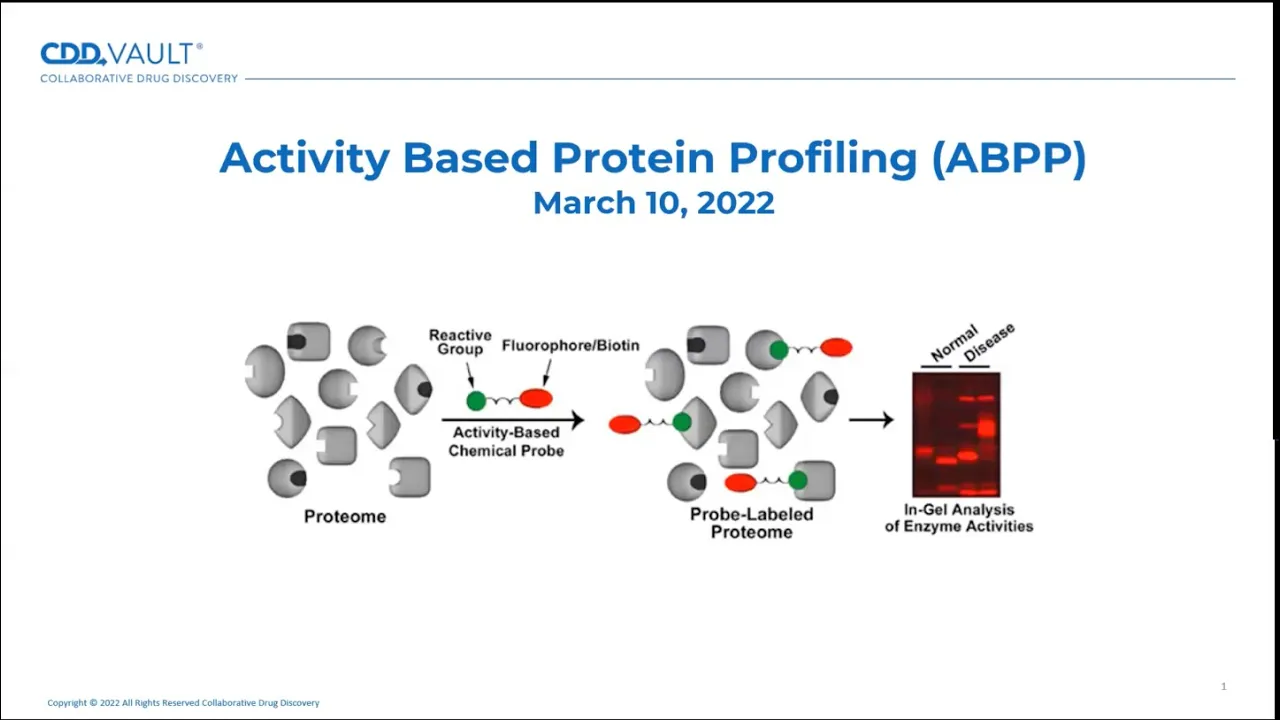
Activity-Based Protein Profiling for Drug Discovery | ABPP Webinar
@collaborativedrugdiscovery8352
6.1K views•2022-05-06
14:12
Quantitative Real-Time PCR (qPCR): Principle, Method & Data Analysis
@animatedbiologywitharpan
129.2K views•2023-09-06
23:33
Microbial Degradation of Plastics: Biodegradation Pathways & Sustainability
@majeedhammad
2.9K views•2021-04-11
16:04
CRISPR and Genetic Engineering: How Gene Editing Works and Why It Matters
@kurzgesagt
30.5M views•2016-08-10
Related Study Plans & Knowledge Roadmaps
Structured learning paths in Biotechnology
biotechnology
AAV Production: Transfection, Prep & qPCR
01Introduction to Gene Therapy and AAV Biology
02Mammalian Cell Culture: Suspension HEK293 Cells
03Upstream Bioprocessing: Triple-Transfection Optimization
+ 2 more learning modules
18h5 modules
Explore Roadmap
biotechnology
Building Gut-on-a-Chip: PDMS, Cells & TEER
01Foundations of Microfluidics and Gut Anatomy
02Cleanroom Fabrication & PDMS Soft Lithography
03Epithelial Cell Culture and On-Chip Seeding
+ 2 more learning modules
26h5 modules
Explore Roadmap
biotechnology
Optimizing CFPS: E. coli Extract & Yield
01Fundamentals of Molecular Biology and Translation
02Introduction to Cell-Free Protein Synthesis (CFPS)
03Preparing E. coli Crude Lysate (The Extract)
+ 2 more learning modules
19h5 modules
Explore Roadmap
biotechnology
Haematococcus PBR: Design, Stress & Astaxanthin
01Biology and Life Cycle of Haematococcus pluvialis
02Bench-Scale Photobioreactor (PBR) Design and Engineering
03Culture Media Formulation and Inoculation
+ 2 more learning modules
15h5 modules
Explore Roadmap