

















Glasses are amorphous solids characterized by short-range atomic order but no long-range periodicity, formed when liquids cool too rapidly for atoms to arrange into crystalline structures; key factors promoting glass formation include low atom mobility (high viscosity), complex crystal structures, and rapid cooling rates, as exemplified by silicate glasses (SiO2-based) which form three-dimensional networks of bridging oxygens, and metallic glasses (80% metal + 20% metalloid) created through rapid solidification techniques.
Solid State Chemistry: Glass Formation &amorphous Solids | MIT 3.091SC
Added:Basic concepts of crystalline structures, including lattices, unit cells, and long-range order.
Chemical bonding types, particularly covalent and ionic networks in oxides like silica (SiO2).
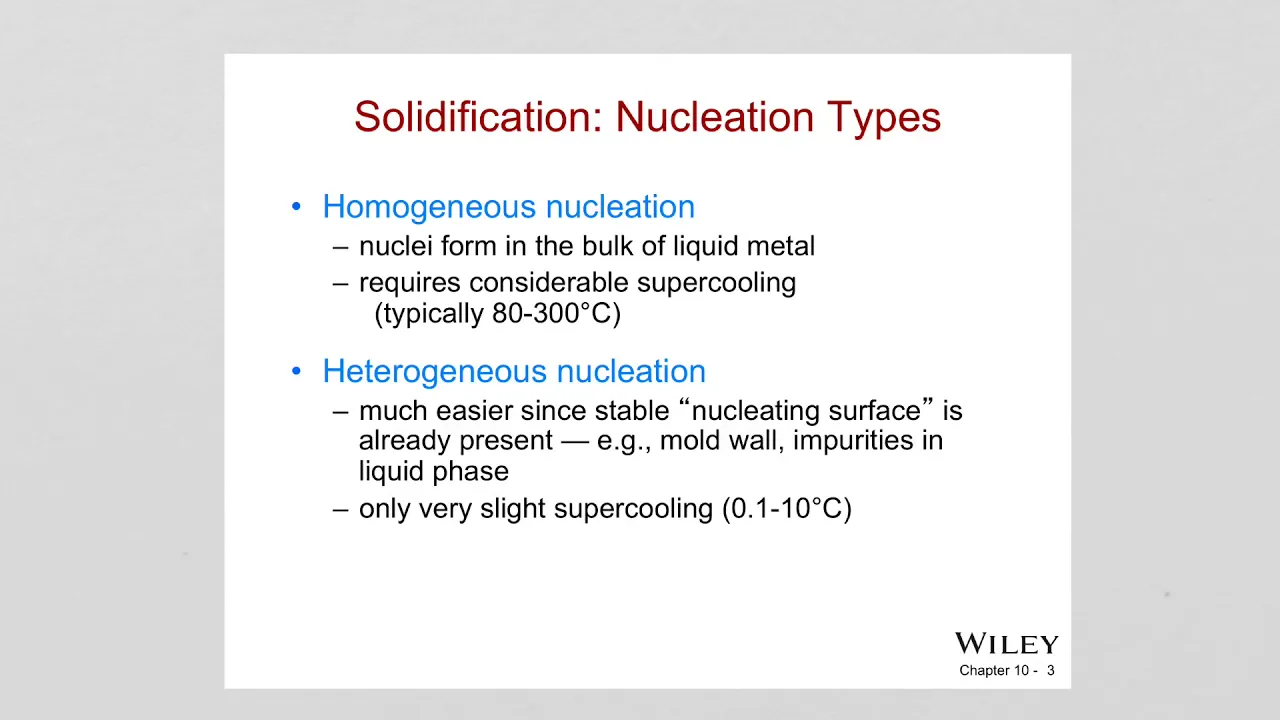
Fundamentals of thermodynamics and kinetics, specifically phase transitions, melting, and crystallization (nucleation and growth).
The concept of viscosity and how it changes with temperature in liquids.
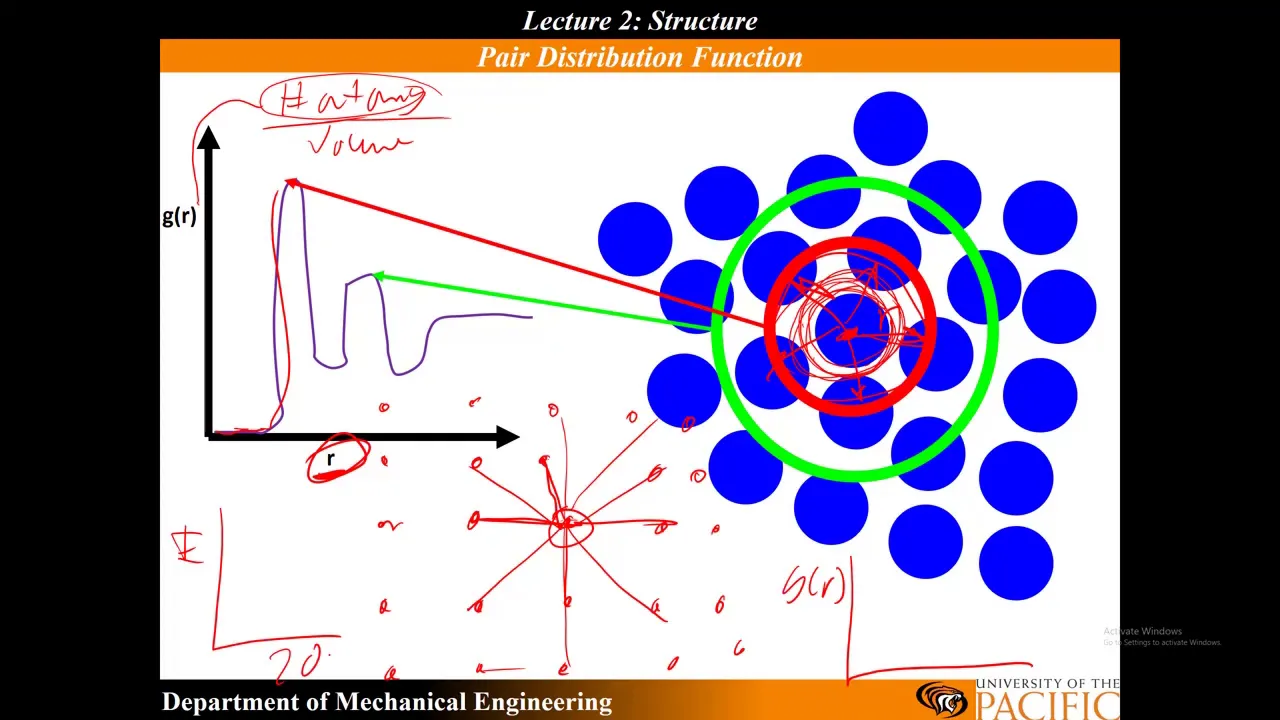
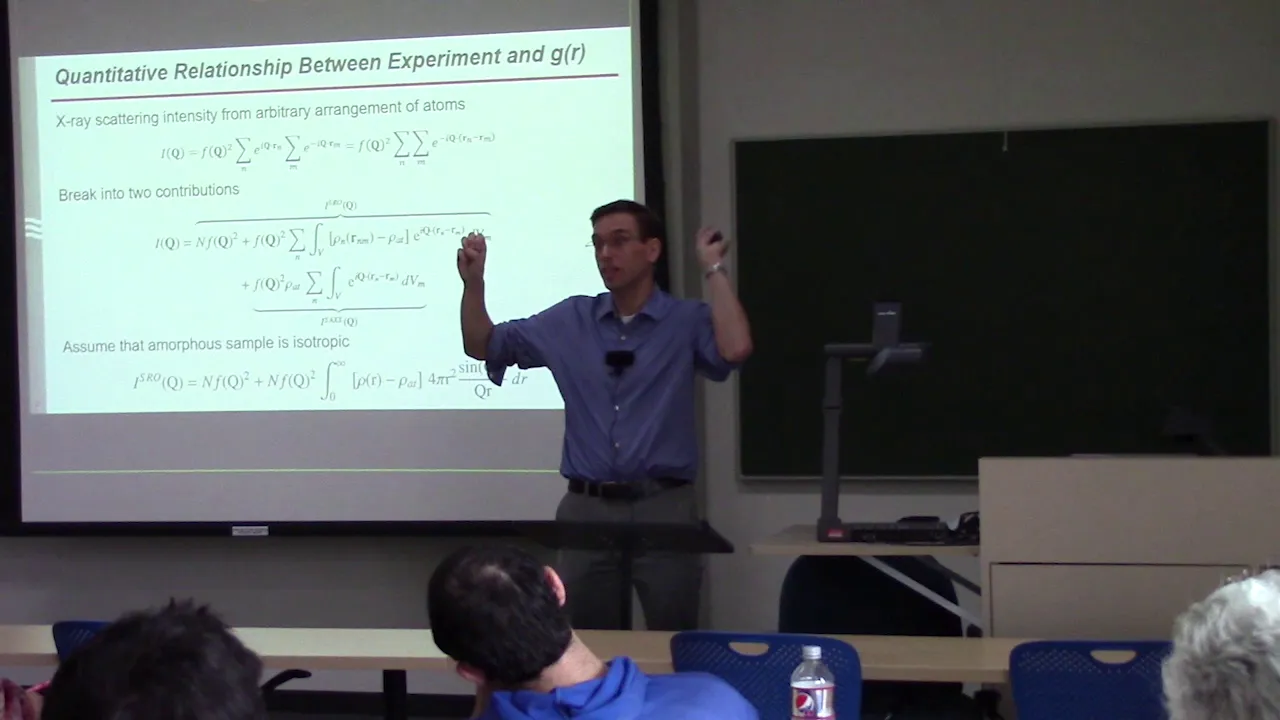
Characterization techniques for amorphous materials, such as Radial Distribution Functions (RDF) obtained via X-ray or neutron diffraction.
The role and chemistry of network formers, network modifiers, and intermediates in engineering specific glass properties (e.g., thermal shock resistance in borosilicate glass).
Advanced thermodynamics of the glass transition (Tg), including relaxation behavior, structural recovery, and the Kauzmann paradox.
Applications of amorphous metals (metallic glasses) and their unique mechanical and magnetic properties compared to crystalline metals.
Sol-gel processing and other non-traditional synthesis pathways for producing advanced optical and bioactive glasses.
33.1K views170likes47:51Original Release: 2010-12-18
The following content is provided under a Creative Commons license.
Your support will help MIT OpenCourseWare continue to offer high-quality educational resources for free.
To make a donation or view additional materials from hundreds of MIT courses, visit MIT OpenCourseWare at ocw.mit.edu.
PROFESSOR: So these are the scores from test number two.
The celebration.
And as you can see, the average has gone down.
So as I've said in the past, I think everybody in this room has the intellectual capacity to be here.
Some people choose to be there.
I don't know why they choose to be there, why they choose not to go to recitation, why they choose not to try the homework, why they choose not to go to office hours, why they choose not to read.
But I guarantee you, when you make that choice you will be here.
And I have no requirements whatsoever to pass a certain number of people.
I can give everybody A's if I want.
And I can take a large number of people-- you know, look at this.
The way this is right now, the failure rate will be abnormally high.
So I would warmly recommend that if you're down here, that you look in the mirror and ask yourself a few questions.
OK.
Let's get to the lesson.
We're going to start a new unit today.
The new unit is going to be the second half of the classification of solids.
We looked at solids and we reasoned that there were ordered solids and we've looked at crystals and their arrangements and so on.
And today, we're going to start talking about disordered solids.
And they're characterized by no long-range order.
They have short-range order.
You might know who your next nearest neighbor is, or your second next nearest neighbor, but you certainly don't know who your 10th nearest neighbor is or who your 100th nearest neighbor is.
And these solids are called amorphous solids.
And there's a simple one salable Angle-Saxon word for this.
It's called glass.
So we're going to talk about glasses.
What kind of materials can form glasses?
Well, obviously, materials that have trouble crystallizing.
And they come from a variety of walks of life.
So we have in organic compounds.
Some inorganic compounds can form disordered solids.
And a good example is silicates.
And this is what you know as window glass, glass that's used in bottles, cookware, and so on.
There are organic compounds that can form disordered solids and a variety of polymers.
Things like food wrap and so on, are also prone to forming disordered solids.
Some elements.
Some simple elements can form disordered solids.
A good example is sulfur.
Sulfur can form solid in crystalline form, but more often than not, it can form disordered solids.
And what I'm going to show you towards the end of the lecture is metal alloys.
Metal alloys can form disordered solids, and you're going to see metallic glasses.
And they're typically 80% metal and 20% metalloid.
That is somewhere along that red staircase on your Periodic Table that divides the metals from the nonmetals.
So a good example here is iron 80-- this is on mole basis-- and boron 20, boron being the metalloid.
And some, some do both.
Some compounds can form both crystal and amorphous.
So one example of that is SiO2, silica.
When it forms crystalline solid, we call it quartz.
Crystalline SiO2 is quartz, and amorphous SiO2 is the silicate glass that we know for windows and bottles.
And so as I've said many times, the term "glass" is related to atomic arrangement.
It has nothing to do with the ability to see through something.
Transparency has no place here.
So what are the conditions?
I mean, if you have silica and it can form crystalline or amorphous forms, how does it decide which to do?
And so I'm going to look at conditions promoting glass formation.
And I'm going to form glasses on the basis of solidification.
So I'm going to start from the liquid and go to the solid.
So I'm asking the question, why, on some occasions, does the liquid go to a solid that's amorphous and in other occasions it will go to a solid that is crystalline?
As in the case of quartz.
So there are primarily three factors that it boils down to.
And I like to make the analogy to the game of musical chairs.
So imagine I've got chairs placed around this central table.
You know how the game goes.
There are more people than chairs.
And the music starts and you walk around, and then at some point the music stops and people race for the chairs.
And some people are going to get a seat and they get booted out of the game.
And then one of the chairs is removed and then so it goes.
You know this game.
I know you don't want to admit to playing it, but your little siblings play it.
But of course, you don't play it.
But imagine if you were to play it.
The same situation here.
I've got silicate floating around in the liquid state, and the chairs are the crystal lattice sites.
So the question is, what promotes the ability to get to the lattice sites or not?
So obviously, one of the first things we think about is atom mobility.
Atom or compound mobility.
This is in the liquid phase.
And the way I want to write this, I want to talk about promoting glass formation.
So obviously, high mobility is going to enhanced crystal formation, isn't it?
If you've got high mobility, you're going to be able to find the right lattice site.
So I'm going to talk about if atom mobility promotes crystallization, the reciprocal of atom mobility will promote glass formation.
The second thing is the arrangement of the chairs.
If the chairs are in a simple line, it's easy to get to the chairs.
All other things being equal.
But if the chairs are arranged in some complex formation, it's harder to get to the chairs.
So that has an analogy and that's the complexity of the crystal structure.
The more complex, the more likely you are to form glasses.
And then the last thing, an analogy to the musical chairs, is the rate at which the music stops.
If the music stops suddenly you could get trapped in the liquid state.
If I gradually turn down the volume, you know, OK, wait a minute.
The music's going to stop.
You start moving towards the seat.
So that's the analogy.
Here is the cooling rate.
So a high cooling rate is going to make it more difficult for the system to find the crystal structure because as the cooling starts, the atoms start thinking, gee, it's time to form the solid.
But the thermal energy is removed from the system before the atoms have had a chance to find a crystal structure.
So the reciprocal of atom mobility, we write in a positive term and call that the viscosity.
Something, a fluid, a liquid, that has low atom mobility has high viscosity.
So I'll take this out and instead represent it this way.
This is the way to think about the formation of the amorphous state.
And why are we studying glasses?
Well, in the old days it was bottles and food and cook ware and so on.
Today, fiber optics.
Fiber optics is based on silicate chemistry.
Very important.
So understanding silicate chemistry has high-tech implications.
So let's look at, for the first study, the silicates.
The silicates for their value in fiberoptic technology.
So these are based on SiO2.
And some nomenclature.
This is called silica.
So the oxide of an atom is named by adding the term "a."
So silicon gives us silica as the oxide.
So here's the atom silicon, the basic element.
And if we fully oxidize-- see, here I've taken silicon, I put two oxygens, so I made a neutral compound-- that's silica.
And then if I fully oxidize-- the maximum number of oxygens I can put around is four-- and this is going to have a net charge of 4 minus.
And this fully oxidized anion is called the silicate.
And that's where we get the name of the family of glasses.
So this is fully oxidized.
So now let's look at the structure.
Silicate glasses.
sp3 hybridized.
Just like carbon above it.
sp3 hybridized.
So that gives us the four struts off of the central silicon at 109 degree angles to one another.
And let's put some flesh on the bones here.
So I'll put a silicon here in the center.
One, two, three, four.
But instead of putting silicons everywhere, I'll put oxygens at the end of the struts.
And then I'll put the second silicon, and you can see the oxygen is acting as a bridge between the two silicons.
One, two, three, four.
Let's do one more.
Another silicon.
One, two, three, four.
So again, you can see the oxygen acts as a bridge between the two silicons.
So you see four oxygens per silicon, but I've got two silicons per oxygen.
Hence, the structure looks like SiO4, but the stoichiometry of the compound is SiO2 because the oxygens bridge.
So this doesn't give you any clue as to what the structure should be, does it?
You really have to write this thing out.
Now, here's where the thing gets interesting.
This is a three-dimensional network.
All of these oxygens bridge to silicons.
And I was talking here about viscosity.
You can see that this thing in the liquid state is huge.
It's like a giant battleship, and this is just one.
So now we can have another silicate.
It can form chains.
It can form meshes.
And these meshes entangle.
So viscosity very high.
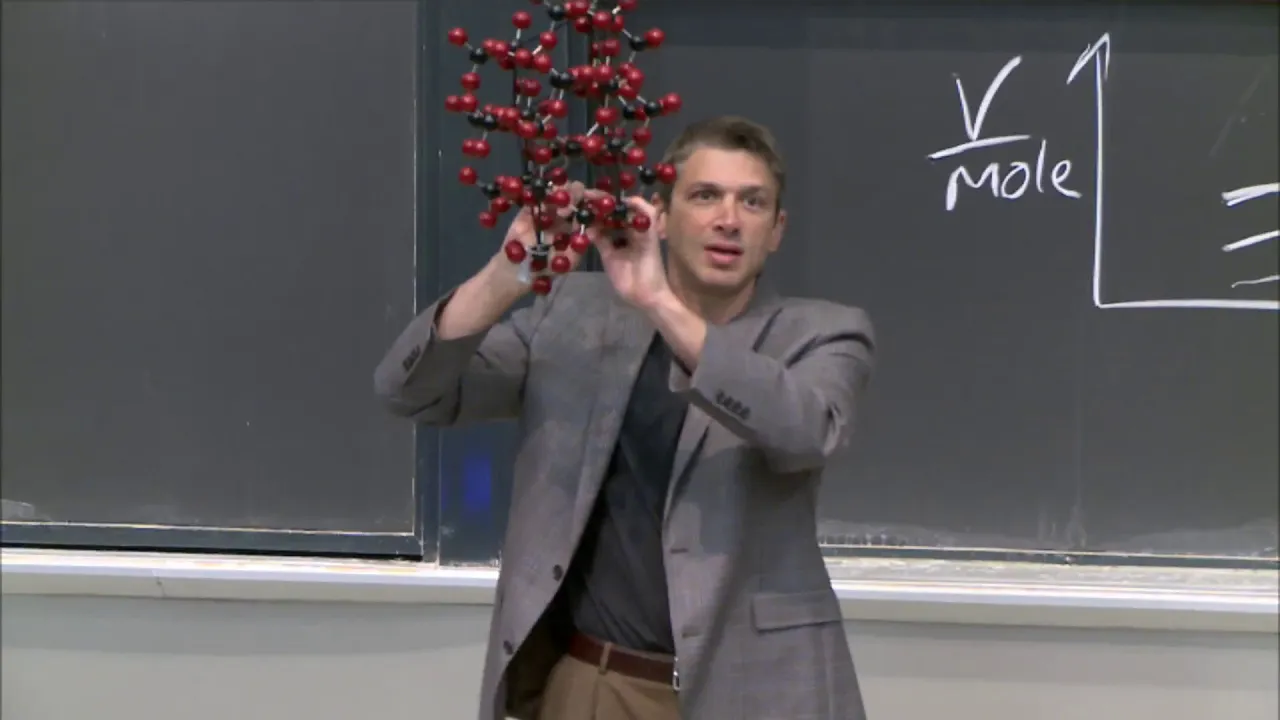
So when it goes to solidify-- David, if we can go to the document camera, please-- so here you see the silicate.
So the yellows represent silicon.
And you can see the oxygens, here, are at 109 degree angles.
So this is the SiO4.
We'll do some nanotechnology here.
So here's the SiO4.
One, two, three, four.
And now I'm going to make the bridge.
But look.
The bond between the oxygens and the silicon is defined in three dimensions.
It's a 109 degree angle.
But the bond between the two oxygens is not defined.
It's only defined in two dimensions.
So you can see that if I put all of these oxygens on the same plane-- so somebody borrowed this and look, they lost an oxygen for me.
Got a missing oxygen, here.
If you find this thing, please bring it to my office.
So now all five oxygens are on the same plane.
One, two, three, four, and five.
And then up here are the two silicons.
They're in the same plane.
The oxygens are in the same plane.
What I'm showing you here is the beginning of crystalline quartz.
Crystalline quartz, this stuff.
But now what happens if we cool quickly?
This bond is only specified in two dimensions, which means I can hold this bond at the proper value and this is free to rotate.
This is free to rotate.
Look at the autofocus on this thing.
Who designed this?
Boy, what a stupid machine.
So anyway, so here we are.
Here is the point.
This bond is free to rotate, and when it rotates, look-- now this oxygen is no longer in the plane with this oxygen.
And as a result of that freedom to rotate, we can end up running out of thermal energy.
And this is nowhere near its regular crystalline array.
So this gives you the indications of the high viscosity, moderate cooling rate will end up giving you the amorphous silica.
But in all cases, this bond is the linkage through.
So we end up with this three-dimensional network.
So what do we do with to show that we have some evidence for this?
David, may we cut back to the slides, please?
So how do you characterize?
I'm going to use x-rays.
So here's an x-ray diffraction pattern of the-- the upper one is cristobalite, which is one of the polymorphs of crystalline SiO2.
And you can see you have distinct peaks indicative of satisfying Bragg's Law.
There's some width to them, but that's because it's a real crystal.
Down here, this is the amorphous silica.
You don't see all of these features.
You see only one very broad peak.
Now if I said it's crystal-- pardon me-- if it's glass, you'd say, well, it has no long-range order.
So why do we have even this one feature?
What's this one feature indicative of?
Doesn't matter how much disorder there is, I still know that no matter what, I'm always going to have these four oxygens as my nearest neighbors.
So these four oxygens minus any long-range order gives us this one line here.
So we have evidence for it.
Now let's look at the energetics, because clearly, these are two different states.
One of these is lower energy than the other.
Which one is it?
How to think about the problem?
There's a simple way to do it with the tools we have in 3.091.
Energetics can be given by bond formation.
Energetics via bond density.
When things form bonds the energy of the system decreases.
So which one is going to have higher bond density?
Well, the higher bond density clearly is going to be exhibited by the one that has the tighter packing.
And which one has tighter packing?
The disordered solid or the ordered solid?
The ordered solid has much more dense packing.
So the ordered crystal exhibits tighter packing, therefore, this means more bonds per unit volume.
So that means, to me, that the energy of the crystalline state must be more negative than the energy of the glassy state.
That makes sense so far.
But now I want to show you one other thing that we've just inferred from this little exercise.
If we get more bonds per unit volume, then can you see that we've made an association between the binding energy of any arbitrary ensemble and it's molar volume?
So volume now, is a very easy thing to measure, isn't it?
You can see it with the naked eye.
So the volume of something with a given composition-- and we're talking about a mole, we're talking about equal numbers of atoms-- so the molar volume is indicative of binding energy.
It's a one-to-one correspondence.
If you like, the Vmolar is a measure of disorder, meaning the higher the molar volume, the greater the disorder.
Or put the other way, the smallest molar volume is that exhibited by the crystal.
So we have some traces here that come from the reading.
So this comes from the archival lecture notes that were written by my predecessor, Professor Witt.
There's a little typo here that obviously heating means increasing temperature, not decreasing temperature.
Make a little correction here.
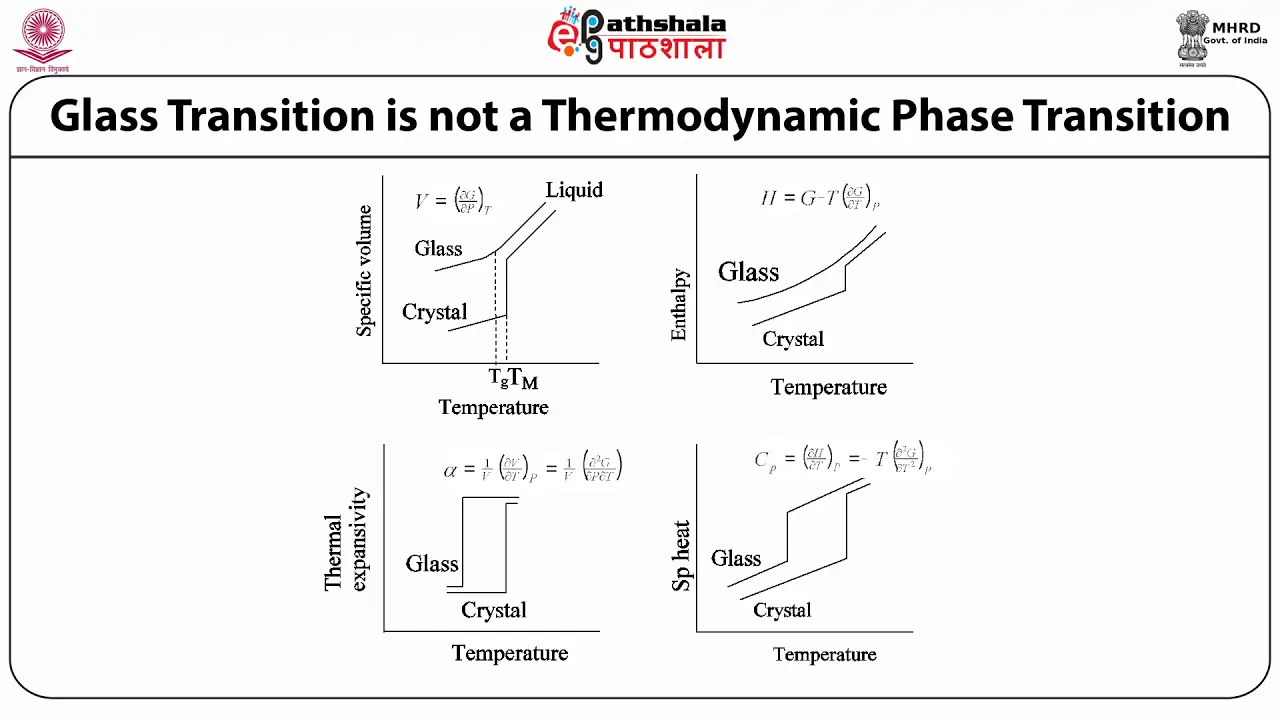
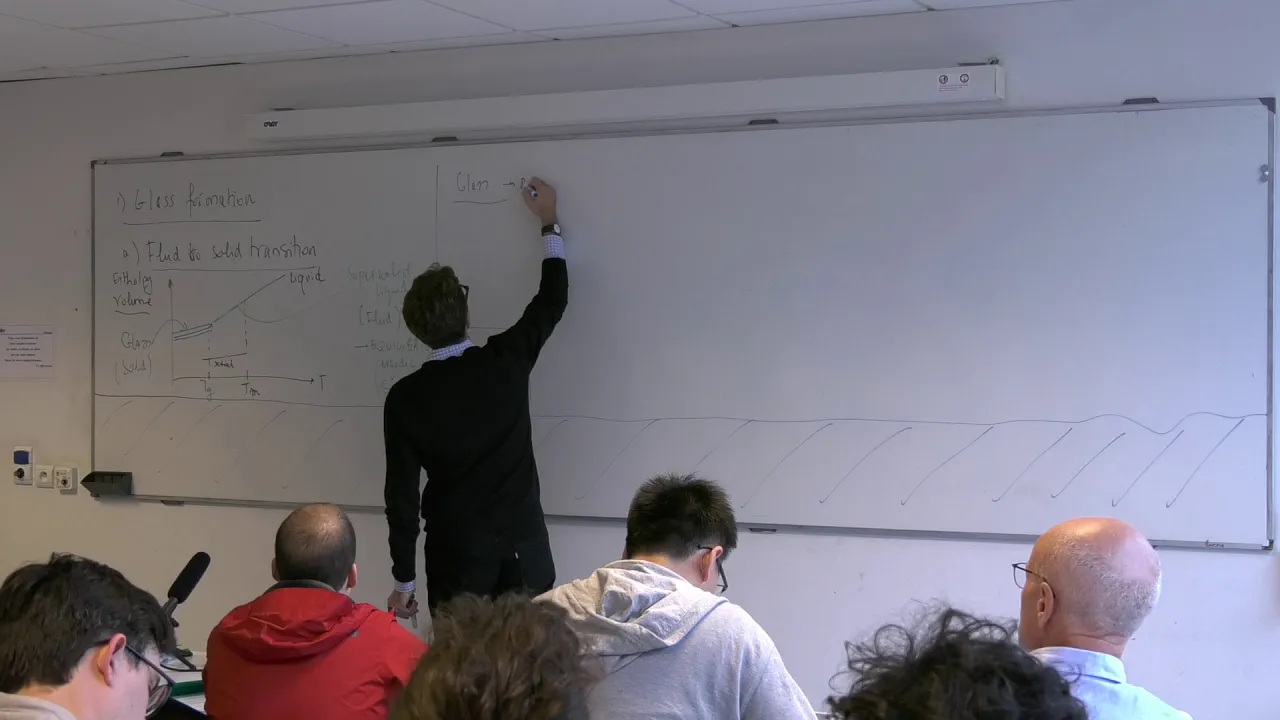
So what we're plotting is the volume, the molar volume of silicate glass as a function of temperature.
And imagine we start with some blob of glass-- of some known mass-- so we can divide and figure out what the molar volume is, and we started cooling it.
We cool down until we get to the crystallization temperature of quartz.
And when we get to that temperature crystalline quartz forms and along with it, a tremendous decrease in the volume.
Unlike water ice, which is a rare exception, where the ice occupies a larger volume than the liquid, for most systems, the solid is more compact than the liquid.
And that's what you see here.
There's an abrupt drop here at the melting point.
And then when we continue to cool, there's some thermal contraction.
And as you can imagine a hot solid occupies a greater volume than a cold solid.
And so this is the cooling curve and you can retrace it, heat up, and when we get to the melting point, there's a tremendous expansion and then off we go.
So that's the classical form of the crystallization of a material that is undergoing the normal process of liquid to solid transformation.
I'm going to use some tea colors today.
So we went down the red line.
Now let's go down the green line.
So we're going to go down the green line.
We go down the green line, we're going to use the same stuff, this silicate network, only we're going to cool a little bit faster.
And we cool a little bit faster, we can zoom right on past the normal melting point and create a supercooled liquid.
And that supercooled liquid gets lower and lower in temperature and all the while the volume is shrinking.
Again, a hot liquid what occupies a smaller volume than cold liquid.
You know this from a mercury-- the old days, you remember these old thermometers?
You probably have never seen one of these things.
It's all done digitally.
But we used to have these liquid and bulb thermometers.
You'd have numbers on here, and what happens is the temperature goes up, the liquid in here rises to a higher temperature.
And at a lower temperature this contracts.
Isn't the solid expanding, too?
Uh-huh.
So what's the other thing you learned from this?
It must mean that coefficient of thermal expansion, which we affectionately will call CTE, the coefficient of thermal expansion of the liquid, must be much greater than the coefficient of the thermal expansion of a solid.
Otherwise, the two would expand and you wouldn't get any sensible measurement out of this, right?
Well, we see that on a curve.
We see that on a curve, because when we plot volume versus temperature, when we're up here in the liquid regime we have a steep slope.
This slope here is dv by dt.
And when we get down on the solid regime, it's a gradual slope.
It's still a slope, but it's a gradual because the coefficient of thermal expansion down here is very low.
And that's what you're seeing here.
So at some temperature the system changes from a supercooled liquid to a solid.
But it's a disordered solid because we've quenched in all of that remaining liquid disorder.
And take a look at this-- you've changed from the slope that's characteristic of the coefficient of thermal expansion of a liquid down here to the gentle slope coefficient of thermal expansion of solid.
You know what this proves?
This proves that glass is a solid.
There are many people out there, even in the popular press, who will say, glass is just a very, very viscous liquid.
Nonsense.
Look at this.
It has this coefficient of thermal expansion.
And don't fall for any of that nonsense they tell you when you go to the cathedrals in Europe and the glass is thicker at the bottom because it's been dripping for 400 years, and that proves-- you know why the glass is thicker at the bottom?
Because they made it by spinning.
And when they spun it, it was graded in thickness from the center out.
And now, if you're the glazier and you're putting the glass in a window, which way would you put a pane of glass that had variable thickness?
Would you put the thickest part up or the thickest part down?
It's thicker on the bottom because that's the way it was made.
Lord help the tour guide when there's an MIT student taking 3.091 on that tour.
All right, so here we are.
Look at what you have here?
You see this?
At this temperature-- let's say down here where the lines end, it's room temperature.
At room temperature the volume of the crystalline solid is low.
The volume of the amorphous solid is higher.
That's proving this.
Vmolar is a measure of the disorder.
And sure enough, the glass that was cooled quickly ends up quenching in more of the liquid state disorder, and you see that in terms of what I call the excess volume.
The excess volume is a measure disorder because the crystalline solid non-zero volume.
So we can define, we can go from this directly over and say that v, that's the excess-- that's a pun.
You know, instead of writing this?
This is the way they do in high school.
This is the excess volume.
Bologna.
We don't write like that.
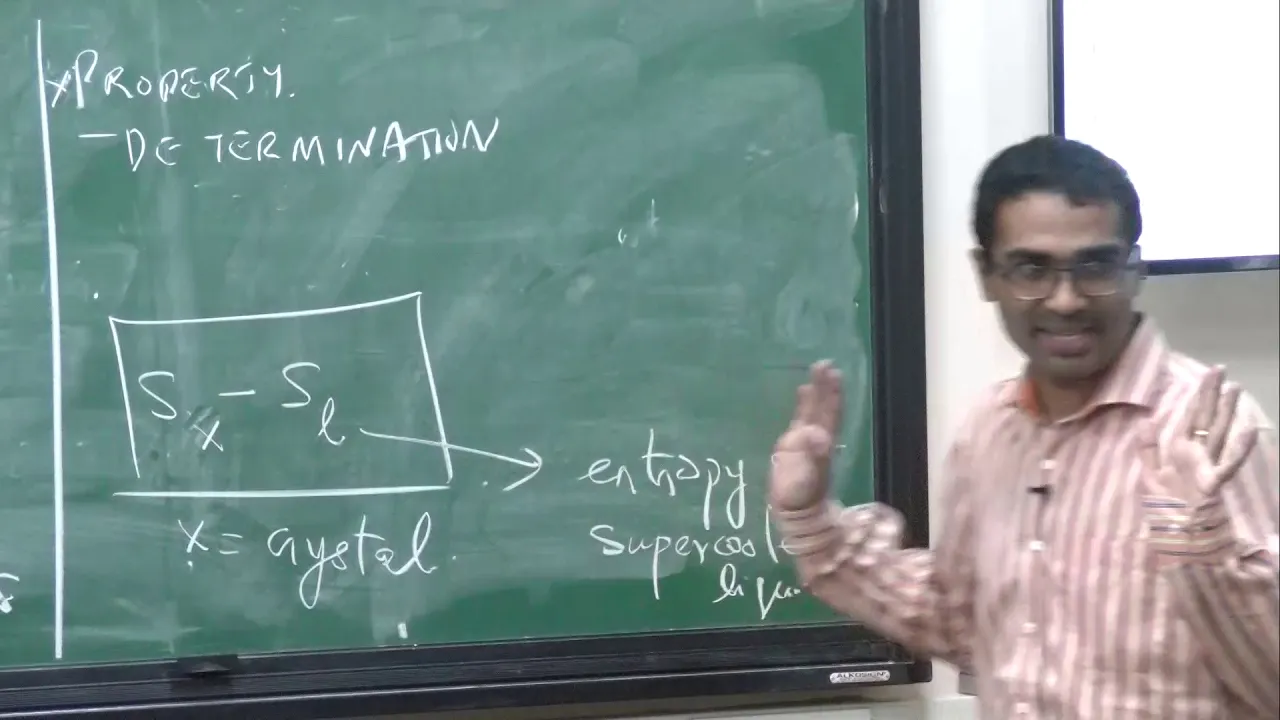
Excess volume is equal to v of the glass minus v of the crystal.
And the greater the excess volume, the greater the degree of disorder.
So let's do one more.
Let's go down the orange line.
The projector isn't giving us a good yellow component, here.
OK, so this is the orange line.
And what's the difference between the orange line and the green line?
The difference between the orange line and the green line is that in the orange line we're going to cool more slowly than we did on the green line.
Because green means go.
So that's the fast one, right?
So here we are.
We still get supercooled liquid, but we get down to a lower temperature before we have ceased to have higher and higher viscous liquid and have formed the solid.
The knee in that curve occurs at a lower temperature.
And that value is called the glass transition temperature.
Why do we call it the glass transition temperature instead of just saying it's a solidification temperature?
Because when I say solidification, before today you would say, OK, liquid became a solid.
But after today, if someone says to you, solidification, you say, do mean ordered solid or disordered solid?
So we distinguish.
So every crystallization is a solidification, but every solidification is not a crystallization.
So here we are.
Look at this-- this has a smaller excess volume.
Because if it was a slower cooling, that meant that's the equivalent of giving more time, more thermal energy, for things to find their crystalline position, which means there's less excess volume quenched in.
OK.
So let's just get that down, define these things.
So this is a measure of disorder.
Or glassiness, if you like.
OK.
So now let's define these two different temperatures so that we have the distinction.
So we have, first of all, the classical one, which is crystallization.
And crystallization represents the reactions of liquid.
In both cases, we're going to convert a liquid to a solid, but a liquid goes to a crystalline solid.
And that occurs at a unique temperature called the melting point.
Imagine if I talked to you about the freezing point of water.
Freezing point of water at atmospheric pressure is 0 degrees centigrade.
If I asked you, well, if I cool the water really quickly or if I cool it slowly, does it make any difference to the freezing point of water?
No.
Why not?
Why isn't all this happening?
Because water is a tiny molecule and so cooling rate has no impact on the temperature of conversion.
Those water molecules will always find their lattice sites.
So this is a function only of composition.
If I put something in the water and I make it impure, I know I can change its freezing point.
If I put salt in water, I will depress its freezing point.
But if I put pure water, it will free at 0 degrees centigrade.
Later on, we'll learn that there are some pressure effects, but today that's not going to elucidate anything.
It'll just be a distraction.
So pure water, always the same thing.
But now if you go to something like silica, which has the capability of forming a glass, the glass formation is a different reaction.
Glass formation is written in this manner.
We will start with supercooled liquid.
It's liquid, but I'm already going to stipulate that it's liquid that's been cooled below the melting point.
Supercooled means it's cooled below the normal melting point.
So a supercooled liquid is going to form a glassy solid, and this occurs at tg.
tg, which is the glass transition temperature.
And that is very much a function of cooling rate.
And, of course, the function of composition.
Obviously, if we change the composition from SiO2, we're no longer comparing apples to apples.
So composition is important in both instances, but only in the case of supercooled liquid do we form the glassy solid.
And the degree of disorder is a function of the cooling rate.
And how is it a function of the cooling rate?
As the dt by dt, right?
Change in temperature with time as dt by dt goes up, the degree of disorder goes up.
So if I want to quench in the liquid state, can you imagine if I had liquid and I could instantaneously cool it?
I would quench in all of the liquid disorder.
If I quench it less rapidly, there will be some time for the atoms to strive for a degree of crystallinity.
So all of this we've said with reference to silicate glasses.
Now, there are other glasses.
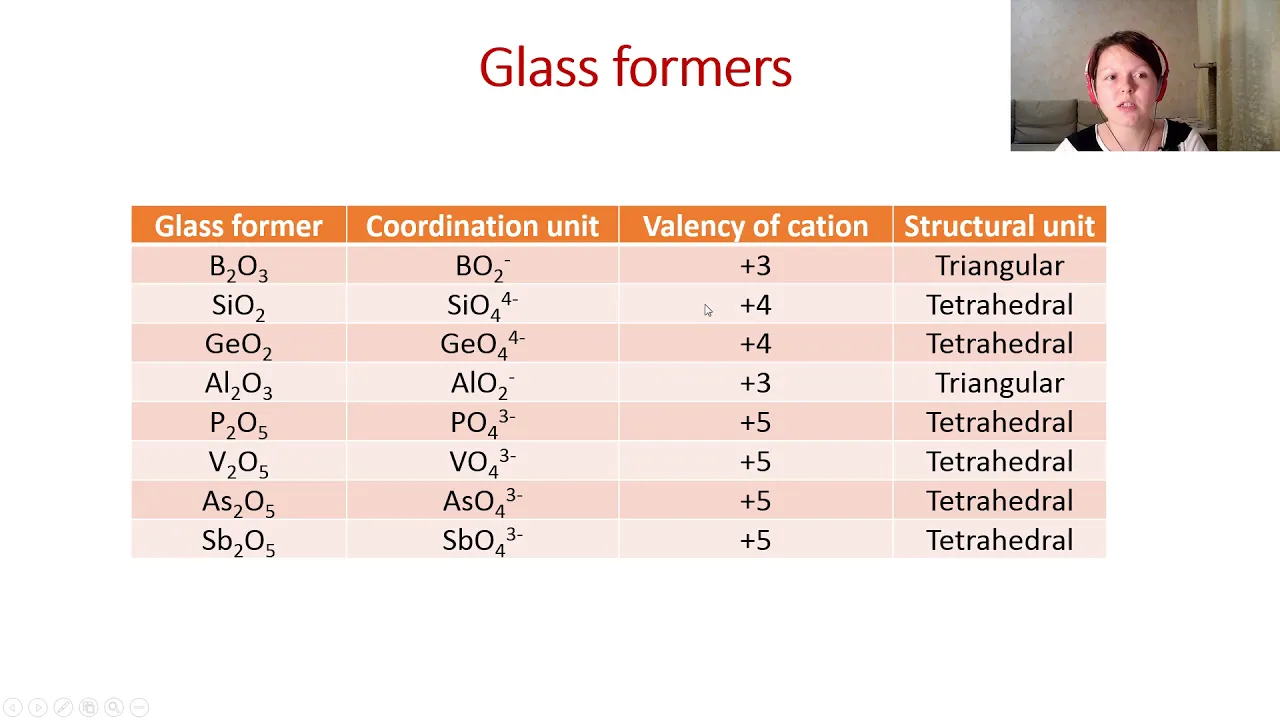
What are other glass forming oxides?
Well, what do I have to look for?
I should look for other compounds that form bridging oxygens, right?
That's the key here.
What's the unifying feature?
It's bridging oxygens.
Bridging oxygen leads to glass formation.
So what are other compounds that could give us such bridging oxygens?
Well, you could be lazy and say, well, if silica does it, then why don't I look up and down the column on a Periodic Table.
If you go up to carbon that's no good because it forms gas, but if you go underneath you will form germania glasses.
So this is germania, and the glasses are germinate glasses.
You can also go to group three.
B2O3.
B2O3 forms sp2 hybrids.
And the sp2 hybrids off of each boron, we have three oxygens.
And that oxygen can bond to another boron.
One, two, three.
And this is all going to lie flat in a plane, isn't it?
But this oxygen bridge is only specified in two dimensions, whereas the boron struts are specified in three dimensions, which means this oxygen bond between the two borons doesn't have to lie in the plane.
It could tilt this up and if it does, this is going to have a greater volume.
You can see this with the naked eye.
I mean, I could have just taught the lessen by putting this slide up.
If those are equivalent numbers of borons and oxygens, it's plainly obvious that on the right side you've got excess volume.
This occupies a much larger volume than the image to the left.
The image to the left is crystalline B2O3.
The image to the right is the same stuff, except in many instances this boron-oxygen-boron bond doesn't lie in the plane.
It tilts out of the plane and it causes all sorts of distortions and leads to excess volume.
So this is called a borate glass.
All right, so if we can do it with the borates, we can do it with anything that will form covalent bonds.
So we can do it with P2O5, phosphate glasses.
V2O5, vanadate glasses.
As2O5, arsenate glasses.
And Sb2O5, stibnite glasses.
And these are used, actually, as additives to some of the glass that's put in computer screens so that they will gobble up excess oxygen on cooling and avoid bubble formation, which then makes the glass foggy.
And a foggy computer screen is no fun to try to look through.
So what are the properties of these oxide glasses?
Well, first of all, they're chemically inert.
Why are they chemically inert?
Because they've got strong covalent bonds.
So if you try to react something with them, it's going to take a very special compound that can trigger reactions.
Which is why they're used for bottling beverages and packaging foods.
You put vegetables and fruits in glass jars going back to ancient times.
Until recent times, with the advent of the soda can, there were glass bottles and so.
They're electrically insulating.
Why are they electrically insulating?
Electronic structure.
These are all covalent bonds, high band gap, which is why the amorphous version is used in window glass.
High band gap, which means light goes through.
How do I think about whether something is transparent?
Do a little finger demonstration.
This is the band gap of the glass, and this is the band energy, the photon energy.
If the photon energy is small it goes right through.
That's called transparency, see.
You can study quantum mechanics, but you know what?
This is it.
That's all you have to know.
Now what happens if the band gap is small-- like around 2eV-- and here's the photon energy?
That's called absorption and re-emission.
Transparency, absorption.
That's all it takes.
You think I'm kidding.
That's all you need to know.
So now, the next thing.
Mechanically brittle.
Why are they mechanically brittle?
Strong bonds.
No opportunity for slip.
Please don't tell me-- this is what students tell me every year and they get zero for the stupid answer-- that the reason glass is brittle is it's a distorted solid and therefore has no dislocations.
Uh-uh.
Dislocations take the stress required to cause slip and reduce it to a lower value.
But you cannot cause this thing to slip once it is solidified.
The only way to get this silicon to move relative to that silicon in a vertical shear-- let's say I want to make this silicon move up and this silicon move down-- there's only one way.
It's called break that bond.
When you break that covalent bond, that's called fracture.
So there is no slip allowed because we have strong covalent bonds.
If you want to reshape glass, what do you have to do?
You have to heat it back up above its glass transition temperature.
But you do not shape glass once it is solidified.
You may have tried in the home, and then you end up with something called shards.
And that's the reason.
Optically transparent, we know that one already.
OK.
Last thing is the very high melting.
Melting point of silica is over 1,500 degrees Celsius.
You're saying, well, wait a minute.
He's telling me we're going to make beverage containers, we're going to make food containers, we're going to make all sorts of useful objects, but that's going to cost a lot of energy to go away up there to melt this glass.
But it does have desirable properties-- chemically inert, and so on.
So what can we do?
Back here.
Glass transition temperate is a function of cooling rate and a function of composition.
So next step is let's modify the composition of the silicate network in order to drop it's processing temperature so that we can make beverage containers at acceptable energy.
So what's it going to take?
I'm going to have to do something about those bonds.
Because those bonds are what caused me to have to go to such high temperatures.
So in order to reduce the processing temperature of silicate glasses via change in composition-- so this is material science-- change the composition in order to get desirable properties.
And specifically, I want to lower the processing temperature.
Even when I get these things liquid, they don't deform very well, because all these networks are entangled.
So I'll give you another analogy.
Suppose you're in the kitchen and you're going to cook some pasta.
So you take some linguine and it's about a foot long.
So you got this pound of linguine and you cook it in the boiling water and you pour in into a colander.
And you may or may not rinse it with cold water.
Whatever.
Just leave it in the colander for a little while and what you'll find is the whole thing turns into one big mass.
I'm not talking about the stuff got all gooey.
I'm just saying it just hangs together.
And if you're clever you can just gently slide it out.
And it'll slide out of this one big mass.
What's holding those strands of pasta together, by the way?
Well, are they covalent bonds?
Are they ionic bonds?
Are they metallic bonds?
I don't know, if you've got metallic pasta, you've got digestive problems. So what's the bonds?
It's van der Waals bonds, right?
Now, I can cause them to slip again, can't I?
I can put a little water in there.
And what does the water do?
It goes in between and then it's got hydrogen bonds and they slide.
I can put a little oil in there and then that slides.
or.
The other thing I could do is-- you know, have you ever seen some people, they break the pasta before they boil it?
I did this experiment.
So you take the pound, divide it two halves.
By my math, that's two half pounds.
So you cook the one half pound one foot in length and you cook the other half pound-- break them in three.
So they're about four-inchers.
And then you put them each in a separate colander.
Which one do you think is going to be much more difficult to move around?
It's the long stuff, right?
The long stuff entangles.
So we're going to do the same thing here with the processing.
And basically, you can study and learn pretty much everything you need to know about polymeric networks in the kitchen with a pound of pasta.
All you need to know.
All right, so let's go and look at it.
I want to reduce the amount, the length, of those chains.
If I reduce the length of those chains, I can process at much, much lower temperatures.
So what's my weapon, here?
My weapon here is oxygen.
Oxygen is going to go in there in the form of the oxide ion.
And the oxide ion, O double minus, has a very, very high affinity for the bonding.
And so what'll happen is oxide ion attacks the oxygen-silicon bond.
It attacks the oxygen-silicon bond and breaks it.
It breaks it in two and then incorporates itself into the network in the following way-- you see I have to silicons joined across an oxygen?
This free oxide ion will come in here, interrupt that network in the following manner.
So it's now broken the silicon chain.
Now, I've got conservation of charge.
This was 2 minus.
I don't see any exposed charge here.
I need 2 minus.
This'll be minus 1, this'll be minus 1.
I have conservation of charge, I have conservation of mass.
And what I've done is I've broken the chain.
This is called chain scission.
Shorter chains, higher fluidity.
Higher fluidity, which means lower processing temperature.
Now, where am I going to get my-- I can't go to the lab and get a bottle of oxide anions.
I have to have charged neutral species.
And so what I'm going to look for is an oxide ion donor.
I need an oxide ion donor.
And where do I find an oxide ion donor?
Well, better be something that's going to be a cation, isn't it?
Because if I've got an oxide anion, I need a cation.
And what kind of a cation?
How do I make an oxide anion?
I have to have electrons to give to the oxygen.
So I need a good electron donor.
Or to use a simple Anglo-Saxon word, a good metal.
So a good metal oxide like, say, calcium oxide.
So if I take calcium oxide and I dissolve calcium oxide in silica, it dissociates to give calcium cation plus oxide anion.
And then the oxide anion migrates over here to our pal the oxygen bridge and results in two of these broken pieces.
So we call this one a bridging oxygen, as I've been saying up until now, BO.
And this one is called a terminal oxygen.
This is bridging oxygen, this is terminal oxygen.
Or some people, I don't know why-- they have no literary skills-- they call it non-bridging oxygen.
I hate that because it tells you what it's not.
So you might see non-bridging oxygen.
So all of these up here, the silicates and so on, these compounds that have the ability to form oxygen bridges, these are called network formers.
These are all network formers.
Because they have the capacity to make oxygen bridges.
And then compounds like calcium oxide that have the ability to donate oxide ions that break bridges, these are called network modifiers.
So good examples-- any good metal.
So I can look at lithium oxide, sodium oxide, these will all disassociate to give oxide anion.
If calcium will work and you believe Mendeleyev, then you should probably think about magnesium oxide, calcium oxide, and anything in that series.
A good ionic oxide like lanthanum oxide, yttrium oxide, these will be oxide ion donors.
If you want to get yourself fired, use scandium oxide because it's frightfully expensive.
And you can go to Group four.
You can even use something like lead oxide or tin oxide.
Even they will donate oxide ions.
In fact, you can put a lot of lead oxide in, you'll modify this thing so much that it'll start to allow you to cut crystalline facets and this'll be called lead crystal.
Why do we use lead?
Well, number one, it modifies so I can cut it and I get a straight line instead of that conchoidal glass edge that if you've ever cut yourself you'll never do it again.
The other thing is lead, because it's got so many electrons, has a very, very high index of refraction.
So when you make your billion and you've got your crystal chandelier hanging, of course you want the cut crystal with a high index of refraction because it's going to make that candlelight look really elegant and romantic and so on.
And if you make a super boatload of money, then you're not going to go with lead crystal.
You're going to make diamond pendants, right?
Because they've got a higher index.
And we all want the best index, don't we?
OK, so I think this is probably a good place to stay.
So let's jump to the end, because we've got a few things here.
So I said I was going to show you about metallic glass.
Here's metallic glass.
1959, Pol Duwez, who was a professor at Caltech, reasoned that if he were able to cool liquid metal very quickly, at, say, a million degrees per second, he could freeze the random orientations of atoms in the liquid state and prevent them from finding even something, either simple cubic, body-centered cubic, face-centered cubic lattice.
So he worked with gold silicon.
Gold silicon has a very, very deep eutectic.
Even though gold melts to over 1,000, mixed with silicon, it gets down to about 400 degrees Celsius.
So he dropped this through a little orifice here.
This is molten and it drops onto a water-cooled copper wheel spinning at a very high speed.
And it makes a ribbon some tens of microns wide.
And what came out here was disordered solid.
It was metallic glass.
This was the birth of rapid solidification, and this is metallic glass.
This is metallic glass.
This has no long-range order, no grain boundaries, no dislocations, but it's not transparent.
Why?
Because it's a metal.
And what do you know about band gaps and metals?
And it's different.
It was a different Q-factor.
It has different mechanical properties.
It has no ductility in a classical sense.
This is just for your reference.
This is aluminum foil.
And you know what aluminum is.
It's got ductility.
It's got no grain boundaries so the corrosion properties are different.
It's got no magnetic wall boundaries.
So that a transformer made of this stuff is half the mass of a transformer made of crystalline glass.
It has some other uses.
So it's used in magnetoelastic resonators for theft prevention-- oh, I'm sorry.
I'm in Cambridge.
I can't say theft prevention-- for inventory control.
And so you see that it's 20% boron and all of this metal-- iron, chrome, and moly-- and they put this inside the object in the store.
And then there's a permanent magnet there, iron-cobalt-chromium, that sets the metglass to a field.
And then when you walk through the uprights, there's a 58-kilohertz signal that causes this thing to ring.
So it excites and listens for the ring.
And if you still have that little piece of metglass in there that hasn't been demagnetized-- Bing!
And then, oh, jeez, I'm sorry.
I really am.
I meant to pay for this.
Explain it to the police officer.
All right.
So that's inventory control.
Up Next
12:13
The Science of Borosilicate Glass: Pyrex Thermal Shock Resistance Explained
@thematsciguy6254
77.3K views•2019-04-03
83:56
Biocatalysis and Catalysis in Islatravir Synthesis | Merck Webinar
@SCIwheresciencemeetsbusiness
675 views•2020-10-08
6:57
Ocean Acidification Chemistry | MIT Solid-State Chem
@mitocw
5.5K views•2020-12-07
17:31
Edible Water Bottles: A DIY Guide to Sodium Alginate Spherification
@ryan
10.5M views•2019-06-21
Related Study Plans & Knowledge Roadmaps
Structured learning paths in Chemistry
chemistry
Nuclear Chemistry: Decay, Meds & Fuel Cycle
01Introduction to Nuclear Structure and Radioactivity
02Decay Dynamics and Kinetics
03Radiation Interaction and Detection
+ 2 more learning modules
24h5 modules
Explore Roadmap
chemistry
Supramolecular Chemistry: Forces & Machines
01Foundations of Chemical Bonding and Intermolecular Forces
02Introduction to Host-Guest Chemistry
03Thermodynamics and Dynamics of Self-Assembly
+ 2 more learning modules
16h5 modules
Explore Roadmap
chemistry
Photochemistry: Excited States & Reactions
01Foundations of Light-Matter Interactions
02Molecular Orbitals and Electronic States
03Photophysical Processes and Jablonski Diagrams
+ 2 more learning modules
18h5 modules
Explore Roadmap
chemistry
Coordination Chemistry: Bonding & Properties
01Introduction to Transition Metals and Ligands
02Crystal Field Theory (CFT) and Geometry
03Magnetic Behavior and Spin States
+ 2 more learning modules
14h5 modules
Explore Roadmap