















Hagia Sophia's revolutionary pendentive system allows a massive dome to rest on a square base by using triangular curved surfaces that convert perimeter loads into point loads, enabling unprecedented spatial openness and light-filled interiors while resolving lateral thrust through half-domes and vaulted cells that function as self-bracing structural elements.
Hagia Sophia Structural Genius: Byzantine Architecture Explained
Added:Fundamental principles of structural mechanics, specifically how compression, tension, and lateral thrust operate in masonry arches and vaults.
The architectural legacy of the Roman Empire, particularly the engineering of the Pantheon and its dome built on a circular drum.
Basic geometric concepts involving the intersection of spherical shapes and planes, which is crucial for understanding how a dome transitions to a square base.
The historical context of 6th-century Constantinople and the ambitious building campaigns of Byzantine Emperor Justinian I.
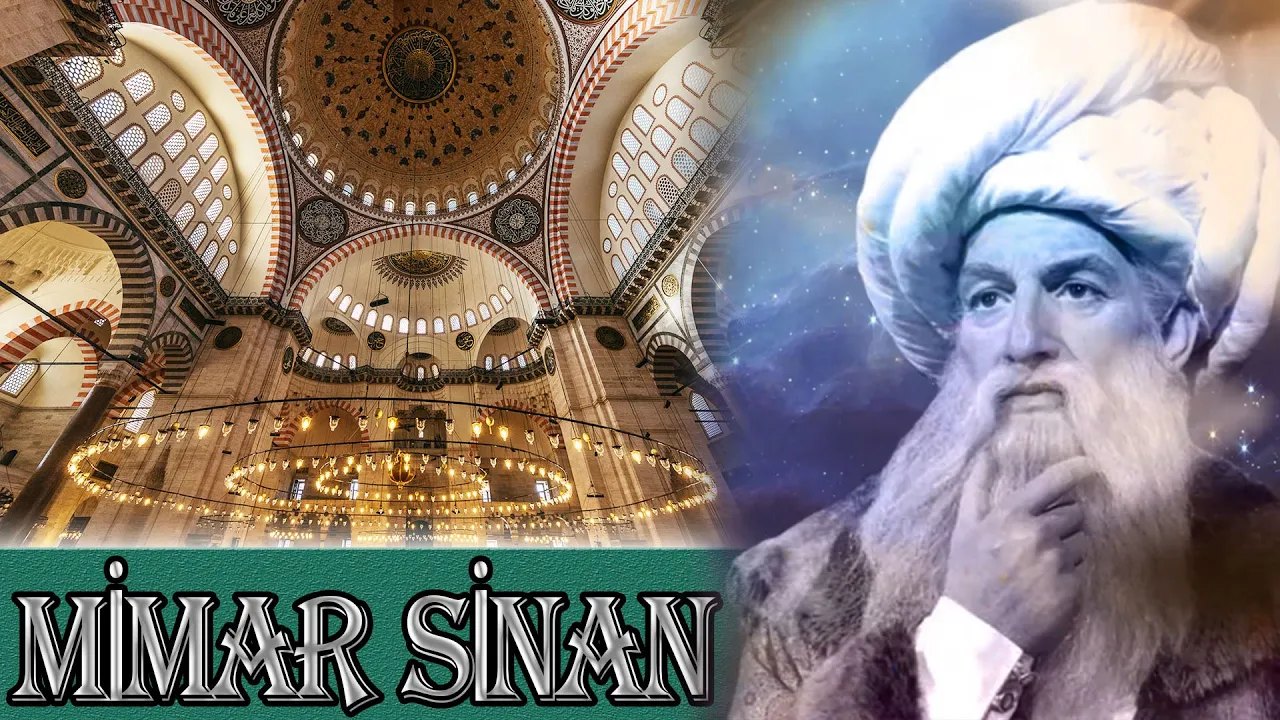
The evolution of Ottoman Imperial architecture, specifically how chief architect Mimar Sinan adapted and refined the Hagia Sophia's structural system for structures like the Süleymaniye and Selimiye Mosques.
Modern seismic engineering and retrofitting techniques used to preserve ancient masonry structures located in active fault zones.
A comparative study of Byzantine engineering versus Western European Gothic architectural innovations, such as rib vaults and flying buttresses.
The theological and aesthetic integration of light in sacred architecture, examining how structural openings at the base of the dome created the illusion of a floating canopy.
114.3K views3.8Klikes14:38Original Release: 2021-07-15
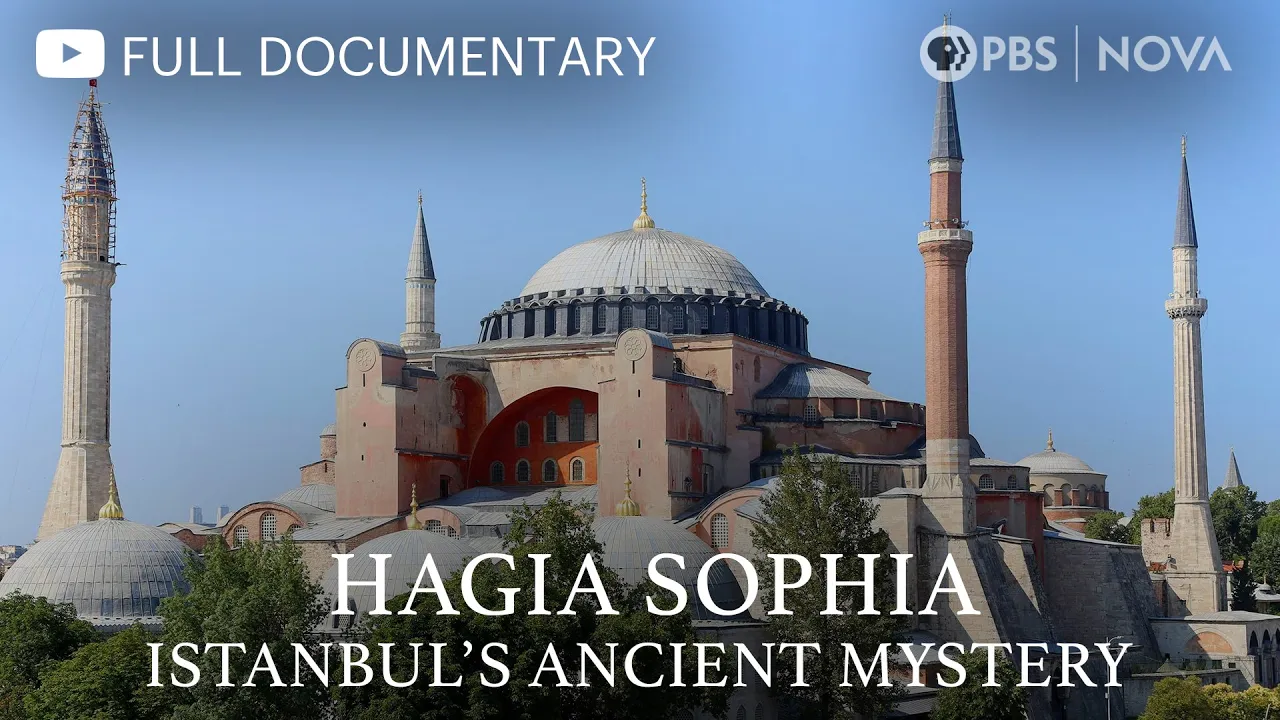
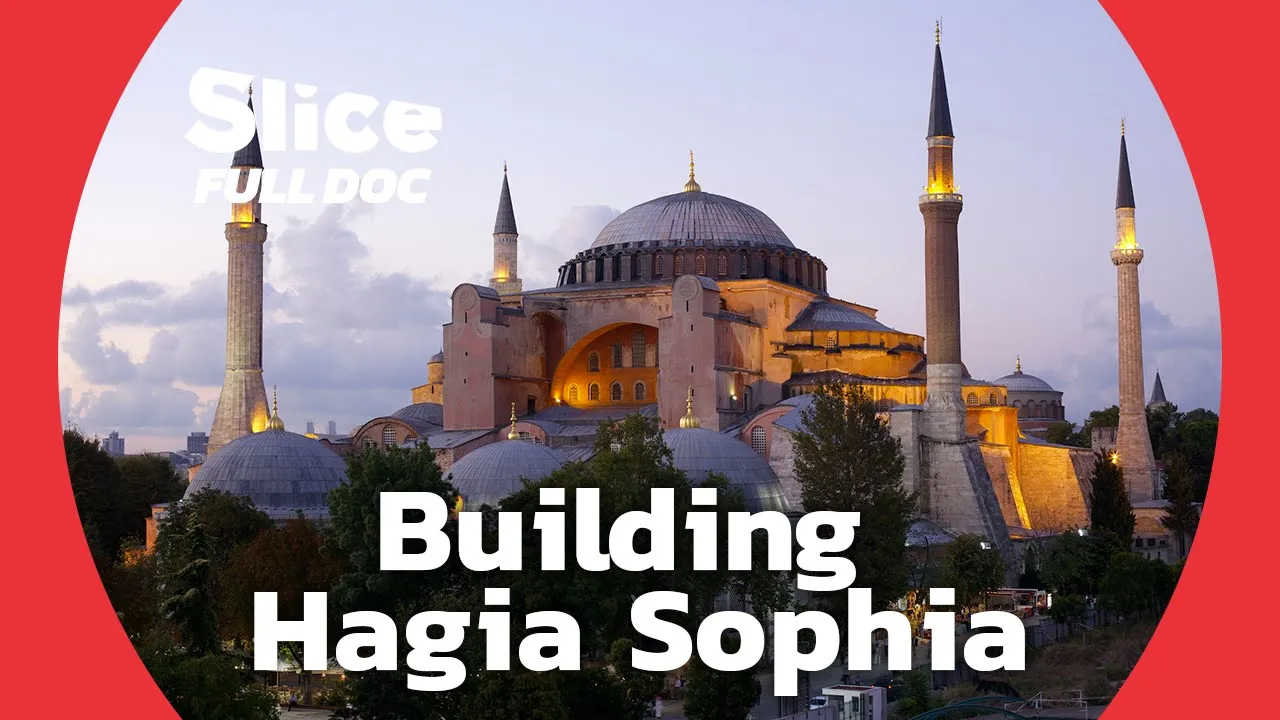
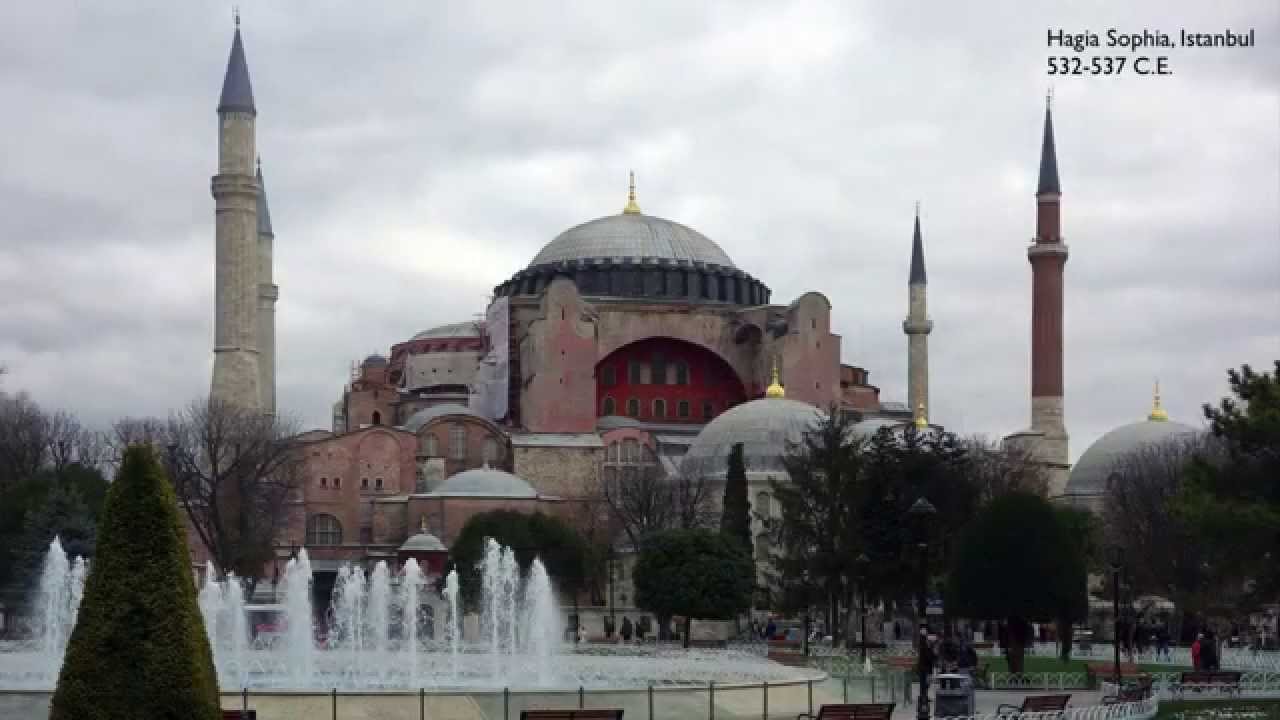
More impressive than Saint Peter's Basilica in Rome... An architectural wonder from Roman times that was the most important center of Christianity for close to a thousand years... This is Hagia Sophia in Constantinople, today Istambul, Turkey, and this church was built by Emperor Justinian, and he's thinking about what is Rome, what is the new Rome in Constantinople, a new city, so let's go take a look at it, come on!
One of the best churches ever made is the Hagia Sophia in Constantinople, modern day Istanbul, this was built over a church that Roman emperor Constantine had constructed that was burnt down in Nika riots in 532 until emperor Justinian, builds his church over the ruins of Constantine's church in the following years.
And Justinian is thinking about what it is to build a church in Rome and what is Rome in Constantinople, and he has his architects, Isidorus of Miletus and Anthemius of Tralles build him this thing.
So we're here in the vestibule of the basilica, and up here is a mosaic of the Emperor Constantine and the Emperor Justinian giving the city and the basilica to the Virgin Mary.
And it's quite an impressive building, because it seems as though it's some kind of hybrid, a sort of oscillation between two conditions.
In a sense it's like the early Christian basilicas, because we have a courtyard, we have an axis, we have an apse, we have some isles, it's exactly what we would expect a basilica to have, but at the same time it's emphatically centralized, because we have a giant dome, which becomes expansive and linear, so that the thing that reads as the nave if we think this is a basilica, becomes a dome if we think this is a centralized plan.
A completely new structural element is introduced here that makes it possible to simultaneously have the idea of central space with a dome, and the idea of linear space, and that element is called is the pendentive which are each one of those triangular segments carrying the dome.
The pendentive is a device to put a circular dome over a square base.
It has to do with these curving triangles, that come down with point loads at the corners of the square, and the triangles curve up and a circle is cut around them, so that you can then construct the dome over them.
So if you look at the plan these little curved triangles that you see are actually these curving surfaces called the pendentives that make the transition from square to circle.
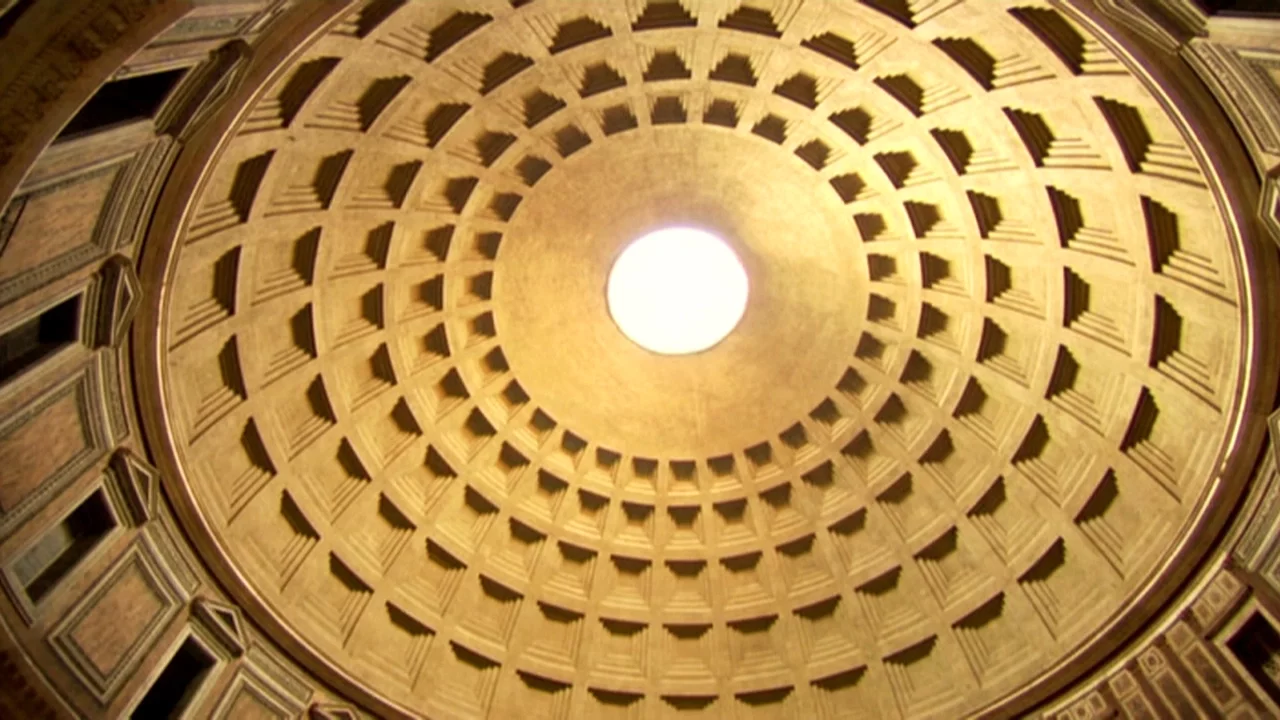
So that is really great spatially because it opens the space up, also because remember the Pantheon dome, we have these ponderous walls, you needed the walls because the loads were coming down all along the edge, and it was tough to make a breach in those walls, because you had all this lateral thrust kicking out, you needed a lot of mass.
But here perimeter loads have been resolved to point loads, which is pretty smart, but you're still getting lateral thrust kicking out, and that gets dealt with by displacing the supports from the perimeter to the edges, so these half-domes that are clipping on to the central dome of Hagia Sophia act as bracing.
Instead of having massive walls bracing the lateral thrust we now have domes that take the load, so the thrust is coming down through the half-domes.
And then this double shell that functionally is the isle of the basilica, also gets hollowed out, and a habitable void is created in between, so in the case of Hagia Sophia these vaulted cells down here become self-bracing, and the geometry of the arch becomes something that works as composite structure to brace the lateral thrust on the sides.
The pendentives worked very successfully as a structural device to dematerialize the building's envelope so that there can be this transparency and permeability of space at the ground plan, they also work very well symbolically, if you look at the plan you see a square and a circle, that's the same diagram that represented the Vitruvian Man, it's the diagram that represents the perfect nesting together between the symbol of the cosmos, the circle, and the symbol of the earth, the square, and in the sense that Hagia Sofia is a Christian Church, it is a triangle that acts as an intermediary between the heavens and the earth, the circles on the square is particularly loaded with significance, because the triangle is the symbol for the Trinity, the Christian unity of the Father Son and Holy Ghost, and so it is the Trinity or the Christian faith that brings together the cosmos and the earth into a reconciliation.
So this is what the Hagia Sophia looks like from a distance, you can see a real direct expression of the interior space on the exterior space, there is this wonderful cascading of domes down from one to the other, and if you look at it in its present condition, it looks a little bit surprising because it's flanked by minarets, these needle-like things, that has to do with the fact that of course Turkey now is an Islamic country for the most part, and over the centuries it has has gone toward serving one faith to serving another faith, it was even a public monument and a museum for a while, but now it's back to being a mosque.
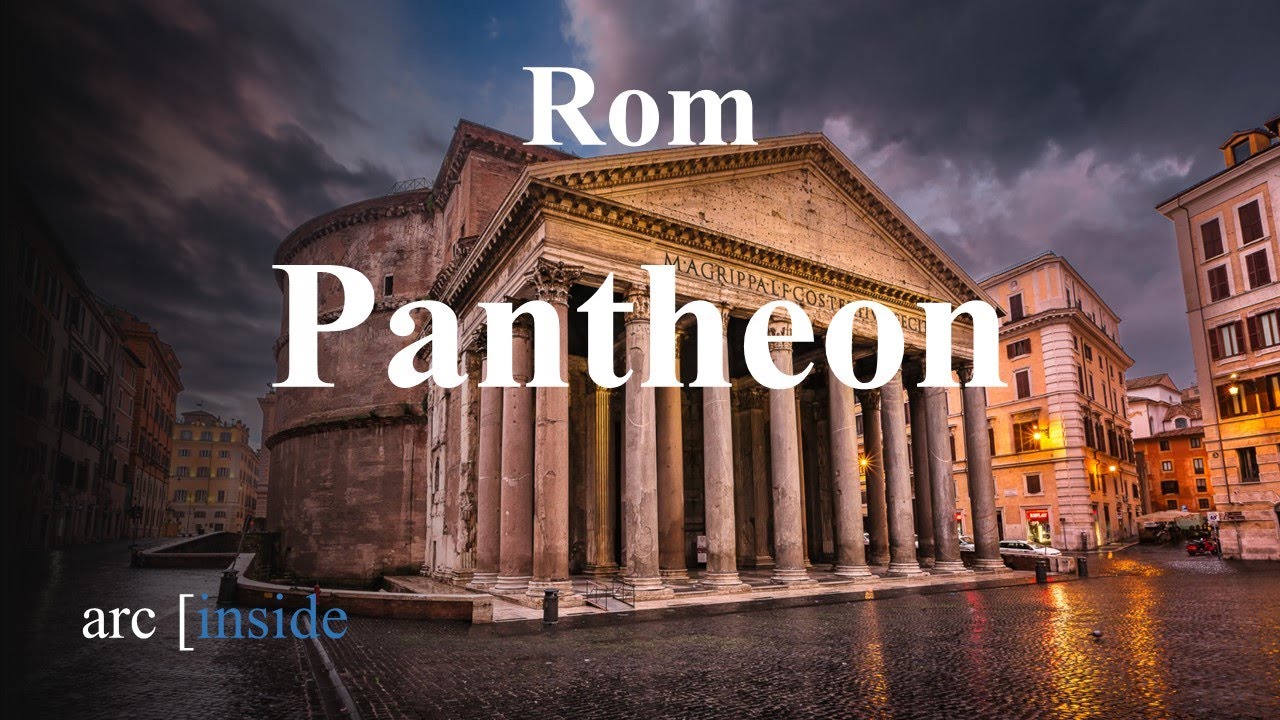
Here you can clearly see how these pendentives are working, here you can see the curved surface of the pendentive, and here you can see the base upon which the domes springs, where you have this very thin ring of pendentives coming down to this kind of double structure at the perimeter over here, and so, a point of comparison that's pretty useful is the Pantheon, because if you're building in Constantinople the new Rome, and you're building over the ruins of an old church that Roman emperor Constantine put there, you're not simply dealing with Constantine but you're dealing with the old Rome too, and so you're dealing with the Pantheon if you're dealing with a centralized Church.
So, the Pantheon is incredible don't get me wrong, but it's also kind of stupid, the technique for building the Pantheon dome is is not wizardry, it is actually a fairly straightforward way to make a dome, in many ways not so different from the dome of the treasury of Atreus in Mycenae, which is more than a thousand years older than the Pantheon, where there's a slight displacement of material having to do with compression rings that stack up, and finally you get a dome.
Of course, it's much more elaborated than the treasury of Atreus but it's a simple construction, it's not using elaborate ingenuity as opposed to the Hagia Sofia, which seems to take the ambitions of the pantheon and then dematerialize the envelope in a spectacular way.
We have the writings of a historian called Procopius who worked for Justinian, that described the contemporary impression of the Hagia Sophia, he's describing the effect of this church: <The church is singularly full of light and sunshine; you would declare that the place is not lighted by the sun from without, but that the rays are produced within itself, such an abundance of light is poured into this church... A spherical-shaped dome standing upon this circle makes it exceedingly beautiful; from the lightness of the building, it does not appear to rest upon a solid foundation, but to cover the place beneath as though it were suspended from heaven by the fabled golden chain.> And that's just a spectacular description of the ability of this architecture to impress in a way that's quite different from the way that Roman architecture impressed.
Roman architecture perhaps impressed through super abundance of material, like wow how'd they get all this stuff here.
Byzantine architecture on the other hand, impressed because it seems to defy gravity and it seems to be so thin and so so amaterial yet nonetheless contains this kind of pure disposition of space and light.
If you look at Hagia Sofia on the outside and compare it to the Pantheon, you can see that the typology and the facade articulation of the Pantheon is not a bit interesting to the people building Hagia Sofia, because it's a pagan temple dedicated to a whole bunch of pagan gods, and so there's no interest whatsoever in reprising the kinds of elements that articulated the facades of pagan churches.
In the section of the buildings you can see how these structural systems differ, we noticed when we looked at the walls of the Pantheon that there were these niches carved inside that helped transfer the load, and that their geometry helped brace the structure, and you can see that even so it is quite a thick structure, whereas in the case of Hagia Sofia it's incredibly light and incredibly delicate, and even more so in Justinian's age, when Procopius was writing this, it was a thinner less braced thing than it is now.
The dome used to be much lower and less braced.
It might have been something similar to the dome of this church from the same period, just in a much bigger scale.
This is Little Hagia Sophia, and it's a great place to visit because it preserves really well a lot of the elements and details from Byzantine Architecture from Justinian's age, and it's also located very near Hagia Sophia, it's right behind the Blue Mosque.
This sometimes happened with great architecture, you build it so closely to the tolerances that it falls down, so Hagia Sofia has fallen down at least three or four times.
Sometimes because of earthquakes and sometimes because it was just built too close to the tolerances when they constructed it.
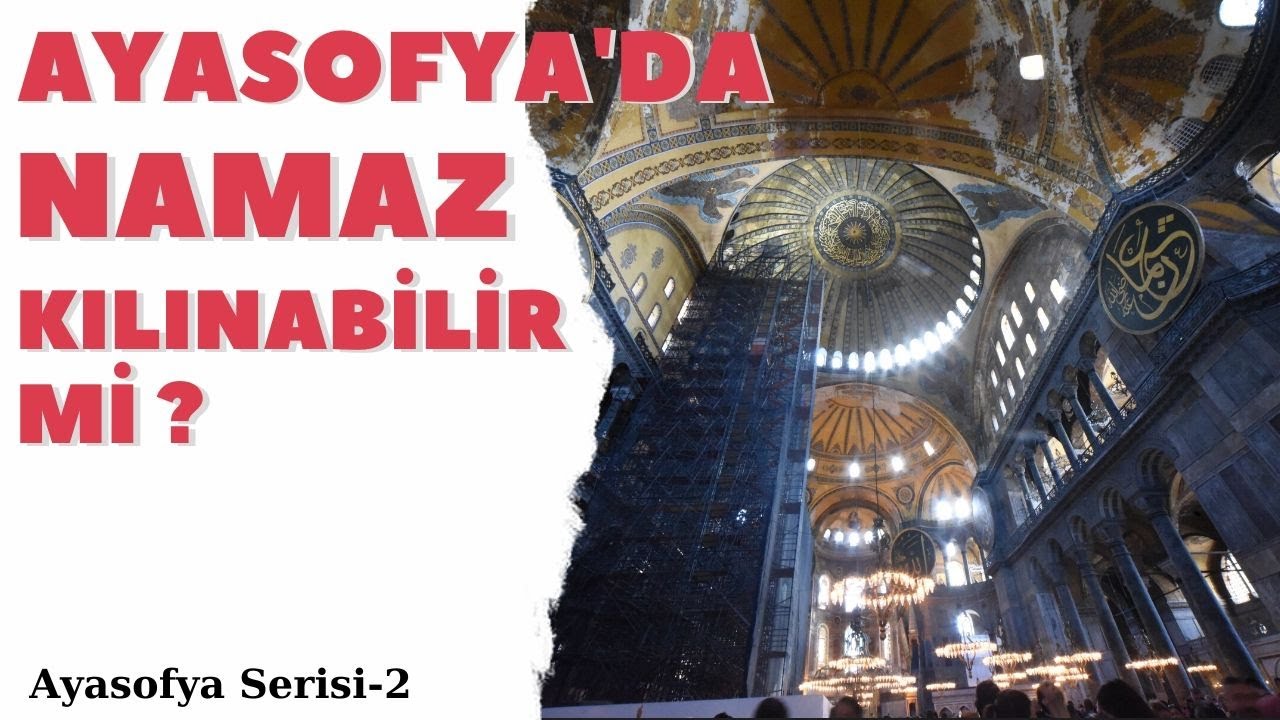
If you see it now, you will see that there are all kinds of buttresses all around it that are helping to brace the lateral thrust, all these were added later on to prevent the building from falling down again.
So let's look at this interior space that Procopius was talking about, it is pretty amazing, the ceiling is covered with golden tesserae which are the little glass pieces of a mosaic, which makes the interior more luminous, you can see how the dome sits on the pendentives, it looks as if the dome was suspended in the air because of all the windows in its perimeter, and you might think that a dome is heavy because you have seen the Pantheon, so how can you have this ring of windows here, God must be powerful to make this thing stand up.
For us the distinction between reality and myth is pretty clear, but not for a Byzantine from the 9th century.
An average Byzantine from the 9th century could not think that Hagia Sophia had not been built through some kind of supernatural intervention, that is to say, they could not conceive that an architect could have planned this construction with a mathematical precision, but the structure of this dome is quite different than the structure of the Pantheon dome, the Pantheon dome is held by a horizontal stacking of rings, the Hagia Sofia dome is held by all these ribs that come together, so you have lots of minor point loads that come down on the pendentives rather than the continuous perimeter load that you have in the Pantheon.
One of the most intriguing features of Hagia Sophia is this marble section of the floor known as the Omphalion, which means "navel of the Earth", and it's a space consisting of 30 circles of different types of marble, it is believed that the Omphalion marks the spot where Byzantine emperors were crowned, and that the circles were associated with the Sun and the planets.
The tesserae were texturized and oriented to reflect the light pouring in from the massive dome.
All the materials utilized in the interior of Hagia Sophia were selected to retain and reflect light.
All the marble in the walls, the columns, the floor, was brought from different parts of the empire, and it was placed strategically to reflect as much light as possible.
This is the surface of the interior which is very different from the way surface was articulated in Classical Architecture.
Classical Architecture emphasizes the plasticity, and the engagement with close observation of nature, if you look at a Corinthian column capital there are these leaves unfurling and little blossoms, things that are cut in relief, and Byzantine Architecture here instead emphasizes pattern making and surface making in the same way that the wall is being dealt with as a luminous ornamented surface.
And it has to do with these very different ambitions, the idea that light is created within the church and emanates out, is a beautiful observation of what a church could do, and this idea that associates light with divine presence is something that continues in church building throughout the Middle Ages.
But we'll get to that later.
We got to enter to the temple while it's really empty, and it feels amazing, like really relaxing, the space is incredible, we even got to walk on the altar back there, and it's simply incredible.
This is one of the most impressive buildings in the world, because of its art, its architecture, its history, it's impressive to think that this building was finished almost 1500 years ago, for it was finished in 537.
So if you like this type of videos, like this video, support me on Patreon, and subscribe to my channel.
Thanks for watching!
Up Next

9:25
DIY Visible Light Spectroscopy: Build a USB Spectrometer
@PublicLab
111.9K views•2011-11-30
30:32
Ultrasonic Transducers: Resonant Frequency Measurement and Horn Design
@imajeenyus42
229.9K views•2017-02-22
54:16
Polymer Environmental Degradation: Mechanisms & Stabilization
@iit
1.8K views•2012-07-10
33:39
How a Student's Question Saved a NYC Skyscraper from Collapse
@veritasium
22.8M views•2025-04-26
Related Study Plans & Knowledge Roadmaps
Structured learning paths in Engineering
engineering
Building Acoustic Levitators: Physics & Arduino
01The Physics of Sound and Standing Waves
02Piezoelectric Transducers and H-Bridge Drivers
03Arduino Programming: Generating 40 kHz Signals
+ 2 more learning modules
14h5 modules
Explore Roadmap
engineering
Building Peltier Cloud Chambers: Particle Tracks
01Cosmic Rays & Cloud Chamber Physics
02Thermoelectric Cooling (TEC) Fundamentals
03Custom Liquid-Cooling Loop Design
+ 2 more learning modules
18h5 modules
Explore Roadmap
engineering
Yagi-Uda Antennas: Modeling, Build & VNA Test
01Introduction to RF and Antenna Fundamentals
02Yagi-Uda Antenna Design Principles
03Antenna Modeling and Simulation in 4NEC2
+ 2 more learning modules
18h5 modules
Explore Roadmap
engineering
ECG Monitor Design: Op-Amps, Filters & Noise
01Electronics & Breadboard Basics
02Op-Amps and Instrumentation Amplifiers
03Bioelectricity and ECG Fundamentals
+ 2 more learning modules
18h5 modules
Explore Roadmap