The Standard Hydrogen Electrode (SHE) consists of a platinum electrode immersed in a 1M H+ solution with H2 gas at 1 atm pressure, where the platinum surface catalyzes the reversible reaction between hydrogen gas and hydrogen ions (H2 ⇌ 2H+ + 2e-), and is assigned a standard electrode potential of exactly 0.00 volts to serve as the universal reference point for measuring all other electrode potentials in electrochemistry.
Standard Hydrogen Electrode: Construction & Working | Electrochemistry Explained
Added:Deep Dive
Basic concepts of reduction-oxidation (redox) reactions, including electron transfer, oxidizing agents, and reducing agents.

كيمياء السادس العلمي // الفصل الرابع / الكهربائية / المحاضرة 2 / التأكسد و الاختزال / المنهج الجديد
129.9K
An oxidizing agent is a substance that gains electrons and causes oxidation in another substance. A reducing agent is a substance that loses electrons and causes reduction in another substance. The oxidizing agent is reduced, while the reducing agent is oxidized. For example, in the reaction between zinc and copper ions, zinc is oxidized and acts as the reducing agent, while copper is reduced and acts as the oxidizing agent. The definitions can be expressed in multiple ways: oxidizing agents gain electrons and decrease in oxidation number, while reducing agents lose electrons and increase in oxidation number.
Click to watch →

Class 9 Chemistry - Redox Reaction / Important Concepts | Xylem Class 9
104.4K
A redox reaction (or redox reaction) is a chemical reaction that involves both oxidation and reduction occurring simultaneously. The term 'redox' combines 'reduction' and 'oxidation'. An oxidizing agent (or oxidizing agent) is a substance that causes oxidation in another substance by accepting electrons from it. The oxidizing agent itself undergoes reduction. For example, in the reaction where Cu²⁺ causes Zn to oxidize, Cu²⁺ is the oxidizing agent because it accepts electrons from Zn. Understanding these concepts allows students to analyze any redox reaction by identifying which species is oxidized, which is reduced, and which acts as the oxidizing agent.
Click to watch →

4.4 Oxidation-Readuction Reactions (1)
77.5K
Redox reactions involve electron transfer between substances. Oxidation is the loss of electrons (appearing in products), while reduction is the gain of electrons (appearing in reactants). Half-reactions separate these processes: oxidation half-reactions show electron loss, reduction half-reactions show electron gain. The reducing agent undergoes oxidation and causes reduction in another substance, while the oxidizing agent undergoes reduction and causes oxidation in another substance. The number of electrons lost must equal the number gained.
Click to watch →

Chemical reactions & equations 🔥 COMPETENCY important Questions- Class 10 science!
59.3K
In redox (reduction-oxidation) reactions, substances undergo simultaneous oxidation and reduction. The substance that gains oxygen (undergoes oxidation) acts as the reducing agent. The substance that loses oxygen (undergoes reduction) acts as the oxidizing agent. For example, in the reaction of copper with oxygen, copper gains oxygen and acts as the reducing agent, while oxygen loses electrons and acts as the oxidizing agent. Understanding this concept helps analyze complex chemical reactions.
Click to watch →

الثانية باك : درس التحولات السريعة والتحولات البطيئة
172.3K
This section introduces the core concepts of redox chemistry. An oxidizing agent (مؤكسد) is a chemical species capable of gaining electrons during a reaction, while a reducing agent (مختزل) is a species capable of losing electrons. Oxidation is a reaction that produces an oxidizing agent, and reduction is a reaction that produces a reducing agent. In half-equations, the species gaining electrons is the oxidizing agent, and the species losing electrons is the reducing agent. The oxidizing agent gets reduced to produce the reducing agent, and vice versa. A redox couple consists of an oxidizing agent and its corresponding reducing agent.
Click to watch →
Deep Dive
The fundamental structure and operation of galvanic (voltaic) cells, including the roles of the anode, cathode, and salt bridge.

19.3 Galvanic Cells (aka Voltaic Cells) | General Chemistry
49K
A galvanic cell (also called a voltaic cell) is an electrochemical device that converts chemical energy into electrical energy through a spontaneous redox reaction; it consists of two electrodes (anode where oxidation occurs and cathode where reduction occurs) separated into half-cells connected by a salt bridge that maintains electrical neutrality, with electrons flowing from the anode to the cathode through an external wire, and typically the anode loses mass while the cathode gains mass, though inert electrodes do not participate in the reaction and therefore do not change mass.
Click to watch →

12.Sınıf Kimya 1.Dönem 1.Yazılıya Hazırlık | GENEL TEKRAR | 2025 - 2026 + 📂Ücretsiz PDF
72.9K
A galvanic cell consists of: (1) Anode (oxidation occurs, electrons leave), (2) Cathode (reduction occurs, electrons enter), (3) Salt bridge (maintains charge balance), (4) External circuit (electron flow). The anode is where oxidation occurs and electrons are released; the cathode is where reduction occurs and electrons are consumed. The anode electrode loses mass (oxidation causes metal to dissolve), while the cathode electrode gains mass (reduction causes metal ions to deposit).
Click to watch →
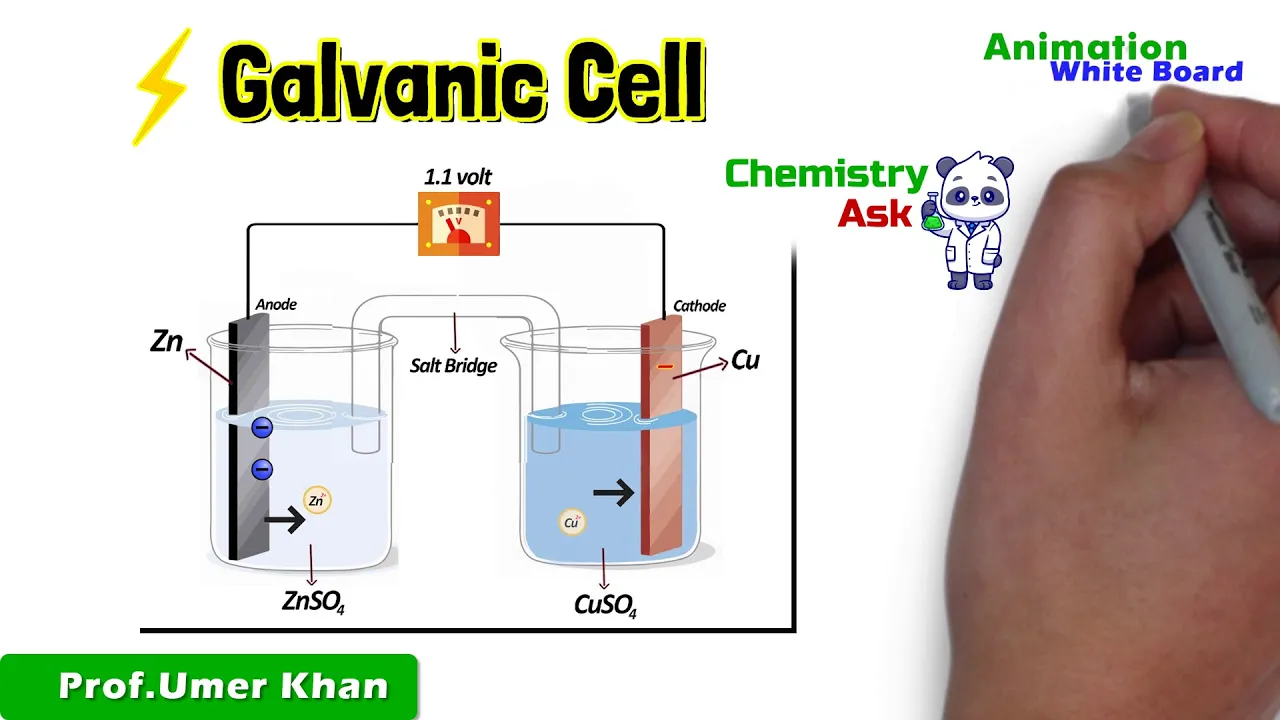
Galvanic Cell Or Voltaic Cell | Salt Bridge | Animation | Chemistry Ask
141.5K
A galvanic cell (or voltaic cell) is an electrochemical device that converts chemical energy into electrical energy through spontaneous redox reactions. It consists of two half-cells connected by a salt bridge, each containing an electrode (typically zinc and copper) immersed in an electrolyte solution. The electrode with higher oxidation potential undergoes oxidation (anode), while the one with lower potential undergoes reduction (cathode). The salt bridge maintains electrical neutrality by allowing ion flow between half-cells, preventing charge accumulation that would otherwise stop current flow. The overall cell potential is the difference between the reduction potentials of the cathode and anode.
Click to watch →
![Celdas Galvánicas 🧪 Química [CICLO FREE]](https://i.ytimg.com/vi/A6hO9_IZ0Ug/maxresdefault.jpg)
Celdas Galvánicas 🧪 Química [CICLO FREE]
24K
A galvanic cell consists of two half-cells connected by a salt bridge. Each half-cell contains an electrode (typically metal bars like zinc and copper) immersed in an electrolyte solution. The anode is where oxidation occurs and gets consumed (loses mass), while the cathode is where reduction occurs and gains mass. Electrons flow from anode to cathode through the external circuit. The salt bridge maintains electrical neutrality by allowing ion migration: anions move toward the anode, cations move toward the cathode. This prevents charge buildup that would stop the reaction.
Click to watch →

Plus One Chemistry | Redox Reactions | One Shot Revision | Eduport Plus One
10.7K
A galvanic cell is a device that converts chemical energy of redox reactions into electrical energy. It consists of two half-cells connected by a salt bridge. The anode is where oxidation occurs (negative electrode), and the cathode is where reduction occurs (positive electrode). Electrons flow from the anode to the cathode through an external circuit. The salt bridge maintains electrical neutrality by allowing ion migration between the two half-cells.
Click to watch →
Deep Dive
The definition of electrode potential and how potential differences arise at the electrode-electrolyte interface.

Electrochemistry 01 : Electrochemical Cells | Class 12 NCERT
334.4K
Electrode potential is the potential difference developed between the electrode and the electrolyte. This potential arises due to the charge separation that occurs at the electrode-electrolyte interface. The magnitude and sign of electrode potential depend on the tendency of the electrode to either gain or lose electrons.
Click to watch →

Electrochemistry in One Shot | JEE | NEET | Canvas Classes | Paaras Thakur
114.4K
Electrode potential is the electrical potential difference that develops between an electrode and its electrolyte solution due to the tendency of the electrode to either gain or lose electrons. This potential arises from the unequal distribution of charge at the electrode-electrolyte interface. The sign and magnitude of the electrode potential indicate whether the electrode tends to become positive or negative.
Click to watch →

Electro chemistry very important for neet ,,jee
230
Electrode potential is defined as the potential difference that develops between an electrode and the electrolyte when the electrode is immersed in the solution. This potential arises due to charge separation at the electrode-electrolyte interface. The magnitude and sign depend on the nature of the electrode and electrolyte. The formation involves the accumulation of oppositely charged ions near the electrode surface, creating a charged layer that establishes the potential difference.
Click to watch →

इलेक्ट्रोड विभव तथा मानक इलेक्ट्रोड विभव | वैद्युत रसायन | Class 12 Chemistry
92.6K
Electrode potential is the potential difference that develops at the surface of an electrode when a metal plate is immersed in a solution of its own salt. This potential difference arises due to the interaction between the metal and its ion in the solution. The electrode potential is denoted by the symbol E.
Click to watch →

Electrochemistry 6, Standard cell potential.
1.5K
Electrode potential is the potential difference between a metal electrode and its ions in an electrolyte solution. When a metal is dipped into an electrolyte containing its own ions, a potential difference develops due to the tendency of metal atoms to lose electrons and become ions, or vice versa. This potential difference arises from the electrochemical reactions occurring at the electrode-electrolyte interface, where oxidation or reduction processes take place.
Click to watch →
Deep Dive
Standard thermodynamic states in chemistry, specifically standard temperature (298.15 K), pressure (1 bar/atm), and solute concentration (1 M).

Chemical Thermodynamics One Shot | Class 12th | PYQs | #hsc | Sovind Sir | All about Chemistry #2025
71.7K
Standard state conditions for thermodynamic measurements are: (1) Pressure = 1 bar, (2) Temperature = 298 K (25°C), (3) For solutions, concentration = 1 M. When all reactants and products are in their standard states, the measured enthalpy change is called the standard enthalpy change.
Click to watch →

🔥 Maha Revision Day 1 | Most Expected Theory & Questions | HSC Chemistry 2026 #maharashtraboard
128.3K
A substance is in its standard state when: (1) Temperature is 298 Kelvin (25°C), (2) Pressure is 1 bar, (3) Concentration is 1 molar for solutions, (4) The substance is in its most stable form at these conditions. Standard state is important for thermodynamic calculations.
Click to watch →

Standard State I Thermodynamics I Particles Academy
2.3K
In thermodynamics, the standard state is defined as: standard pressure of 1 bar (P°), standard concentration of 1 molar for solutes in solution, and temperature can be any specific temperature; these conditions serve as reference states for thermodynamic calculations.
Click to watch →

Thermochimie (thermodynamique chimique): Etat standard,Loi de Hess, formation des composés partie 3
1.5K
Standard temperature is 298 Kelvin (25°C). Standard state refers to the physical state of a substance at standard temperature and pressure (1 bar). For pure substances, this means the most stable form at these conditions. For solutions, the standard state is 1 mol/L concentration. For gases, it's pure form at 1 bar. For solids, it's the pure solid form. The standard state must be the most stable physical form under standard conditions.
Click to watch →

What Are Standard Conditions?
40.5K
Standard conditions in chemistry are reference points established by IUPAC for consistent experimental measurements: Standard Temperature and Pressure (STP) uses 0°C (273.15 K) and 100 kPa (1 bar), while Standard Ambient Temperature and Pressure (SATP) uses 25°C (298.15 K) and 100 kPa; Standard State conditions add 1 atm pressure (760 mmHg or 101.325 kPa) and 1 M concentration for solutions, allowing scientists worldwide to compare data and simplify calculations by providing common reference points despite regional variations in laboratory environments.
Click to watch →
Prerequisite Knowledge
- Concept 01Basic concepts of reduction-oxidation (redox) reactions, including electron transfer, oxidizing agents, and reducing agents.
- Concept 02The fundamental structure and operation of galvanic (voltaic) cells, including the roles of the anode, cathode, and salt bridge.
- Concept 03The definition of electrode potential and how potential differences arise at the electrode-electrolyte interface.
- Concept 04Standard thermodynamic states in chemistry, specifically standard temperature (298.15 K), pressure (1 bar/atm), and solute concentration (1 M).
Subsequent Learning
- Step 01The construction and interpretation of the Electrochemical Series (Standard Reduction Potentials table).
- Step 02Calculation of overall standard cell electromotive force (E°cell) using half-cell reduction potentials measured against the SHE.
- Step 03Application of the Nernst Equation to determine electrode and cell potentials under non-standard conditions.
- Step 04Alternative reference electrodes, such as the Saturated Calomel Electrode (SCE) and Silver/Silver Chloride (Ag/AgCl) electrode, and why they are used in practical laboratory settings.
SHE function
Cell potential
SHE function
0:13Playing Section
- 1
Defines the standard hydrogen electrode structure and reactions.
- 2
PT catalysis facilitates both oxidation and reduction pathways.
- 3
Assigned potential is 0.00 V as the reference point.
The Concept of Absolute Electrode Potential and Practical Limitations
While the Standard Hydrogen Electrode (SHE) is the universally accepted thermodynamic benchmark in electrochemistry, its assignment of exactly 0 V is a relative convention rather than an absolute physical reality. The concept of 'Absolute Electrode Potential' serves as a critical counterpoint, seeking to measure an electrode's potential relative to a universal reference point, such as a free electron at rest in a vacuum. From this physical perspective, the absolute potential of the SHE is actually estimated to be approximately 4.44 V. Furthermore, from a practical standpoint, the SHE is rarely used in actual laboratory settings due to severe operational drawbacks. It requires highly flammable hydrogen gas, is difficult to construct and maintain, and the platinum catalyst is easily 'poisoned' by impurities. Consequently, modern electrochemistry heavily relies on more stable, user-friendly alternative reference electrodes, such as the Silver/Silver Chloride (Ag/AgCl) or Saturated Calomel Electrode (SCE), which challenge the practical dominance of the SHE.
Deep Dive
The construction and interpretation of the Electrochemical Series (Standard Reduction Potentials table).

Electrochemical Series - Electrochemistry | Class 12 Chemistry Chapter 3 (2022-23)
41.7K
The Electrochemical Series is a vertical arrangement of metals in decreasing order of their standard reduction potentials. It provides the scientific basis for the Reactivity Series (Class 10), explaining why certain metals can displace others from solutions. The series is constructed by measuring each metal's electrode potential against the Standard Hydrogen Electrode (SHE). When a metal naturally oxidizes when connected to SHE, the reading represents its oxidation potential; when it reduces, it represents its reduction potential. The relationship between oxidation and reduction potentials is: Reduction Potential = -Oxidation Potential. Metals are arranged in increasing order of reduction potential values, with the most negative values at the top and most positive at the bottom. Key values include: Lithium (-3.03 V), Potassium (-2.92 V), Calcium (-2.87 V), Sodium (-2.71 V), Magnesium (-2.37 V), Aluminum (-1.66 V), Zinc (-0.76 V), Iron (-0.44 V), Lead (-0.13 V), Hydrogen (0.00 V), Copper (+0.34 V), Silver (+0.80 V), and Gold (+1.50 V).
Click to watch →

NCERT series Chemistry | Electrochemistry One shot | NEET JEE Boards class 12
134.8K
Standard reduction potentials indicate reduction tendency. Positive values mean easier reduction (stronger oxidizing agents); negative values mean easier oxidation (stronger reducing agents). Fluorine (+2.87V) is the strongest oxidizing agent; lithium (-3.05V) is the strongest reducing agent. Cell potential is calculated as E_cell = E°_cathode - E°_anode. Positive E_cell indicates spontaneous reaction.
Click to watch →

Plus Two Chemistry | 2. Electrochemistry - Part 1 | Eduport Plus Two
505
Electrochemical series arranges electrodes by increasing/decreasing standard electrode potential (reduction potential). Key values: Zn²⁺/Zn = -0.76 V, Cu²⁺/Cu = +0.34 V, Ag⁺/Ag = +0.80 V. Positive potential indicates spontaneous reaction; negative potential means the metal can displace hydrogen from acids. Zinc can displace hydrogen, but copper cannot.
Click to watch →

AQA A-Level Chemistry - Electrochemical Series
94K
The electrochemical series organizes reduction half-reactions from most negative to most positive electrode potentials, referenced against the standard hydrogen electrode (0 V). Metals with more negative potentials are more reactive (easily oxidized), while non-metals with more positive potentials are more reactive (easily reduced). This table provides context for comparing redox reactions and predicting their feasibility.
Click to watch →

متسلسلة الجهود الكهربيه وشرح الخلايا الجلفانية الأولية | الباب الرابع- الثالث الثانوي-م.خالد صقر
501.8K
The electrochemical series is a fundamental concept in electrochemistry that arranges elements based on their electrode potentials. Scientists measure electrode potentials using the Standard Hydrogen Electrode (SHE), which consists of a platinum electrode coated with platinum black, immersed in 1M HCl solution with hydrogen gas at 1 atm pressure. Under standard conditions (1M concentration, 1 atm pressure, 25°C), the SHE potential is defined as zero volts. Each element has two standard electrode potentials: standard oxidation potential (E°ox) and standard reduction potential (E°red), related by E°ox = -E°red. A positive electrode potential indicates a spontaneous reaction that produces electrical energy, while a negative potential indicates a non-spontaneous reaction requiring external energy. The series is arranged in descending order of standard oxidation potentials (from positive to negative) and ascending order of standard reduction potentials (from negative to positive).
Click to watch →
Deep Dive
Calculation of overall standard cell electromotive force (E°cell) using half-cell reduction potentials measured against the SHE.

كيمياء السادس العلمي // الفصل الرابع / الكهربائية / المحاضرة 11 / نيرنست / المنهج الجديد
82.3K
To calculate E°cell: (1) Identify oxidation and reduction half-reactions, (2) Determine which is cathode (higher reduction potential) and which is anode (lower reduction potential), (3) Apply E°cell = E°cathode - E°anode. For Mg²⁺/Mg (E° = -2.37 V) and Sn²⁺/Sn (E° = -0.14 V), Sn²⁺/Sn is cathode, Mg/Mg²⁺ is anode, giving E°cell = 2.23 V. The standard hydrogen electrode (SHE) has a defined potential of 0.00 V and serves as the reference for all other half-cell potentials. For a cell with SHE and another electrode, compare reduction potentials: the higher potential becomes the cathode, the lower becomes the anode. For Zn | Zn²⁺ (1 M) || H⁺ (1 M) | H₂ (1 atm) | Pt, E°cell = 0.00 - (-0.76) = +0.76 V.
Click to watch →

19.4 How to Calculate Standard Cell Potential (Ecell) | General Chemistry
74.6K
Standard cell potential (Ecell) is calculated using the formula Ecell = Ecathode - Eanode, where both values are taken directly from a table of standard reduction potentials without changing their signs; alternatively, Ecell can be calculated as Ecell = Ereduction + Eoxidation, where the oxidation potential is obtained by reversing the reduction half-reaction and changing its sign. The Standard Hydrogen Electrode (SHE) serves as the reference point with an arbitrary value of 0 volts, and all other reduction potentials are measured relative to it. Coefficients in balanced redox equations do not affect the cell potential calculation since voltage is independent of stoichiometry. A positive Ecell indicates a spontaneous reaction under standard conditions, while a negative value indicates non-spontaneity.
Click to watch →

Question Practice(Imp. 20 More mcq) with Solutions & Discussion (Electrochemistry) By Arvind Arora
198.6K
The standard cell potential (E°cell) is calculated by adding the oxidation potential of the anode to the reduction potential of the cathode: E°cell = E°ox(anode) + E°red(cathode). Alternatively, E°cell = E°red(cathode) - E°red(anode). The species with the lower (more negative) reduction potential will undergo oxidation, while the species with the higher reduction potential will undergo reduction. This determines which half-cell acts as anode and which as cathode.
Click to watch →

الفصل الرابع م 5 معادلة نيرنست ضياء زكي
37.4K
The standard cell potential is calculated by adding the standard reduction potential of the cathode to the standard oxidation potential of the anode (which is the negative of the reduction potential). For example, if E°cathode = +0.80 V and E°anode = -0.34 V, then E°cell = +0.80 + (-0.34) = +0.46 V.
Click to watch →

Class 12 Chemistry Chapter 2 Numericals | विद्युत रसायन Most Important Numericals 2025
45.6K
The video demonstrates calculating cell EMF using the formula: E_cell = E_cathode - E_anode. Given E°(Cu²⁺/Cu) = +0.34V and E°(Zn²⁺/Zn) = -0.76V, the calculation is: E_cell = 0.34 - (-0.76) = 0.34 + 0.76 = 1.10V. The instructor emphasizes that the electrode with higher reduction potential acts as cathode and lower as anode.
Click to watch →
Deep Dive
Application of the Nernst Equation to determine electrode and cell potentials under non-standard conditions.

المراجعة المركزة الاقوى /الفصل الرابع
36.2K
This section teaches how to apply Nernst equation under non-standard conditions: (1) Calculate E°cell = E°cathode + E°anode, (2) Apply Nernst equation: Ecell = E°cell - (26,000/n) × log([products]/[reactants]), (3) Include only species with charge in the log term. Example: With Sn and Ag: E°cell = (+0.80) + (+0.40) = +1.20 V, then apply Nernst with given concentrations.
Click to watch →

JEE: Electrochemistry JPP - 1 | Unacademy JEE | IIT JEE Chemistry | Anupam Gupta
39.6K
The Nernst equation calculates electrode potential under non-standard conditions: E = E° - (0.059/n) log Q, where Q is the reaction quotient. For the MnO4- reduction reaction, Q = [Mn2+]/([MnO4-][H+]^8). When concentrations are 1 M, Q = 1 and log Q = 0, so E = E°. When H+ concentration decreases to 10^-4 M, the potential decreases by approximately 0.38 V.
Click to watch →

CUET 2024 Chemistry: Electrochemistry | CUET Preparation 2024
73.8K
To calculate electrode potential under non-standard conditions, use the Nernst equation: E = E° - (0.059/n) × log([products]/[reactants]). For solid reactants or products, their concentration is taken as 1. The number of electrons (n) must be determined from the balanced half-reaction. This equation allows calculation of cell potential when concentrations differ from standard conditions.
Click to watch →

25 Feb CHEMISTRY का महायज्ञ🔥पूरी Chemistry मात्र 1 वीडियो में खत्म (100 में 100),/12th Chemistry
72.5K
For Mg|Mg2+ (0.1M) || Cu2+ (0.001M)|Cu: E°cell = E°cathode - E°anode = 0.34 - (-2.37) = 2.71V. Ecell = 2.71 - (0.0591/2) × log([Mg2+]/[Cu2+]) = 2.71 - 0.02955 × log(0.1/0.001) = 2.71 - 0.02955 × 2 = 2.6509V. This shows how concentration affects cell potential.
Click to watch →

مراجعه الفصل الرابع #الوزارية 2025 الاستاذ فاضل الهاشمي محاضره 3 معادلة نيرنست
206.6K
To calculate non-standard cell potential: (1) First calculate E°_cell from anode and cathode potentials, (2) Determine n (number of electrons transferred) from one half-reaction, (3) Calculate Q (reaction quotient) using only charged species, (4) Apply Nernst equation: E_cell = E°_cell - (0.026/n) × log(Q). The instructor demonstrates this with a detailed example, showing how to substitute values, handle logarithms, and simplify the expression to find the final answer.
Click to watch →
Deep Dive
Alternative reference electrodes, such as the Saturated Calomel Electrode (SCE) and Silver/Silver Chloride (Ag/AgCl) electrode, and why they are used in practical laboratory settings.

12th | Chemistry | NCERT | Electrochemistry | Cell Representation & Standard Hydrogen Electrode | 02
700
Secondary reference electrodes (Saturated Calomel Electrode, Silver-Silver Chloride Electrode) are easier to maintain than SHE. SCE: Hg₂Cl₂ + 2e⁻ → 2Hg + 2Cl⁻, potential ~+0.24 V. Ag/AgCl: AgCl + e⁻ → Ag + Cl⁻. Advantages: More portable, compact, can be used with chloride solutions, less expensive. These electrodes provide practical alternatives to SHE for routine electrochemical measurements.
Click to watch →
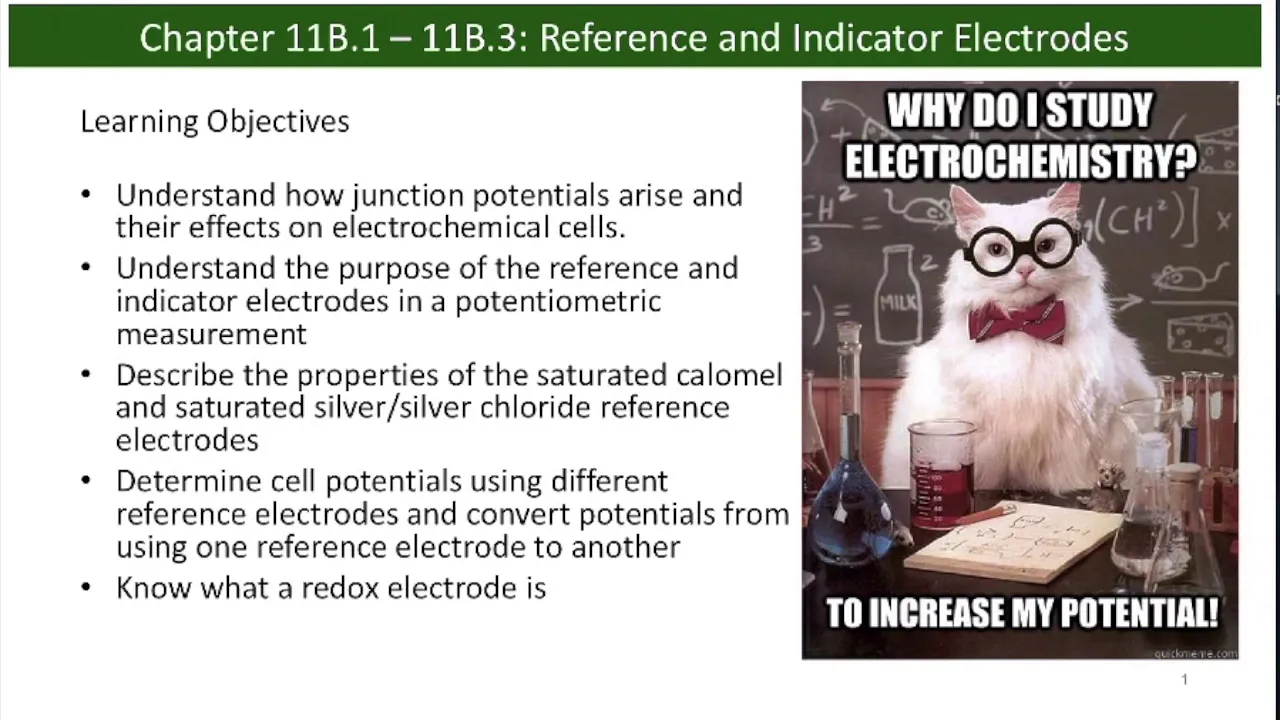
CHEM 283 - Reference and Indicator Electrodes (11B1- B3)
209
Practical reference electrodes (calomel and silver-silver chloride) replace the cumbersome Standard Hydrogen Electrode for routine laboratory and field measurements. The calomel electrode contains mercury in equilibrium with mercury(I) chloride and chloride ions, with a standard potential of 0.268 V. The silver-silver chloride electrode contains silver in equilibrium with silver chloride and chloride ions, with a standard potential of 0.222 V. Both use saturated KCl solution to ensure constant voltage output by preventing concentration changes. These electrodes are compact, portable, and can be miniaturized to very small sizes (pinhead-sized for microfluidic applications). The platinum in SHE serves only as an electron conductor and does not participate in the redox reaction, while practical electrodes integrate their own internal chemistry for stable reference potentials.
Click to watch →

Elektroda Ag/AgCl dan Kalomel - ELEKTRODA PEMBANDING
499
Secondary reference electrodes have known potentials determined by comparison with SHE. The Ag/AgCl electrode uses silver wire coated with AgCl in saturated KCl, with potential +0.220 V and reaction AgCl + e- → Ag + Cl-. The Saturated Calomel Electrode (SCE) uses mercury and Hg2Cl2 paste in saturated KCl, with potential +0.27 V and reaction Hg2Cl2 + 2e- → 2Hg + 2Cl-. Both electrodes feature layered constructions with salt bridges and use Nernst equations to calculate potential based on chloride ion concentration.
Click to watch →
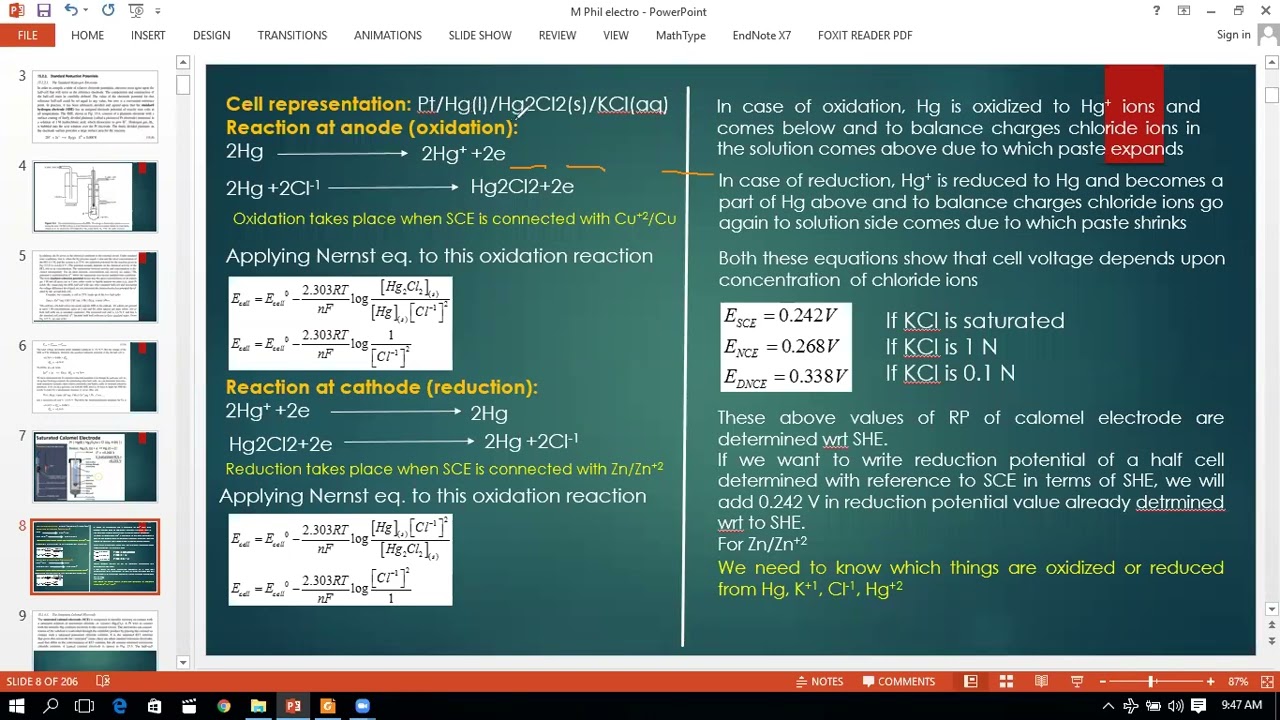
Saturated Calomel Electrode(SCE)//PART 1// Electrochemistry
420
A reference electrode has stable, non-changing potential for measuring other electrodes. The Standard Hydrogen Electrode (SHE) is impractical for routine use due to hydrogen gas handling. Some metals like sodium, potassium, and iron cannot serve as reference electrodes due to reactivity. The Saturated Calomel Electrode (SCE) is a practical alternative consisting of platinum wire, liquid mercury, mercury(I) chloride paste, and saturated KCl solution (4.5 M). At the SCE, oxidation occurs: 2Hg → 2Hg⁺ + 2e⁻, followed by Hg⁺ + Cl⁻ → Hg₂Cl₂. The Nernst equation shows potential depends only on chloride concentration since Hg₂Cl₂ and Hg are pure solids/liquids. The standard potential is +0.242 V vs SHE. To convert potentials from SHE to SCE reference, add 0.242 V. Different KCl concentrations give different potentials: saturated (4.5 M) gives +0.242 V, 1 M gives +0.280 V, and 0.1 M gives +0.334 V. The saturated solution is preferred for stability.
Click to watch →

Reference Electrode (Elektroda Pembanding) | MPI B | Marisa Aurelia Prawoto
601
Reference electrodes provide stable electrochemical potentials for measurements, with the Calomel Electrode (SCE) consisting of mercury, calomel paste, and saturated KCl solution (Hg2Cl2 + 2e- → 2Hg + 2Cl-, E° = +0.241 V), and the Silver-Silver Chloride Electrode (Ag/AgCl) consisting of silver wire coated with AgCl in saturated KCl (AgCl + e- → Ag + Cl-, E° = +0.235 V); both use Nernst equation calculations and can function as cathode or anode depending on the system, with Ag/AgCl being preferred for its non-toxicity compared to mercury-containing SCE.
Click to watch →
SHE function
Cell potential
SHE function
0:13- 1
Defines the standard hydrogen electrode structure and reactions.
- 2
PT catalysis facilitates both oxidation and reduction pathways.
- 3
Assigned potential is 0.00 V as the reference point.
The Concept of Absolute Electrode Potential and Practical Limitations
While the Standard Hydrogen Electrode (SHE) is the universally accepted thermodynamic benchmark in electrochemistry, its assignment of exactly 0 V is a relative convention rather than an absolute physical reality. The concept of 'Absolute Electrode Potential' serves as a critical counterpoint, seeking to measure an electrode's potential relative to a universal reference point, such as a free electron at rest in a vacuum. From this physical perspective, the absolute potential of the SHE is actually estimated to be approximately 4.44 V. Furthermore, from a practical standpoint, the SHE is rarely used in actual laboratory settings due to severe operational drawbacks. It requires highly flammable hydrogen gas, is difficult to construct and maintain, and the platinum catalyst is easily 'poisoned' by impurities. Consequently, modern electrochemistry heavily relies on more stable, user-friendly alternative reference electrodes, such as the Silver/Silver Chloride (Ag/AgCl) or Saturated Calomel Electrode (SCE), which challenge the practical dominance of the SHE.
Basic concepts of reduction-oxidation (redox) reactions, including electron transfer, oxidizing agents, and reducing agents.
The fundamental structure and operation of galvanic (voltaic) cells, including the roles of the anode, cathode, and salt bridge.
The definition of electrode potential and how potential differences arise at the electrode-electrolyte interface.
Standard thermodynamic states in chemistry, specifically standard temperature (298.15 K), pressure (1 bar/atm), and solute concentration (1 M).
The construction and interpretation of the Electrochemical Series (Standard Reduction Potentials table).
Calculation of overall standard cell electromotive force (E°cell) using half-cell reduction potentials measured against the SHE.
Application of the Nernst Equation to determine electrode and cell potentials under non-standard conditions.
Alternative reference electrodes, such as the Saturated Calomel Electrode (SCE) and Silver/Silver Chloride (Ag/AgCl) electrode, and why they are used in practical laboratory settings.
411.2K views4.9Klikes2:47@LearnEnggOriginal Release: 2016-06-20
the shg consists of platinum wire that is connected to a PT surface in contact with an aqueous solution containing One MH Plus in equilibrium with H2 gas at a pressure of 1 atmosphere let's take a look and see what happens at the standard hydrogen electrode in this hydrogen electrode hydrogen gas is bubbled around a platinum electrode in the molecular view the PT surface catalysis the oxidation of hydrogen molecules to protons or the reduction of protons to hydrogen gas at the electrode hydrogen gas can either be oxidized to form hydrogen ions or hydrogen ions can be reduced to form hydrogen gas hence two reactions are possible at the electrode oxidation H2 gives 2H plus plus 2E minus reduction 2 h plus plus 2E minus gives H2 this reaction is assigned a standard electrode potential e of 0.00 volt and serves as reference as you remember two half cells complete a voltaic cell let's take a closed look [Music] here on the left we have sink half cell and on the right we have standard hydrogen electrode electrons are moving from zinc electrode to hydrogen electrode so zinc is being oxidized the voltmeter shows that the standard cell potential of a galvanic cell consists of a s h e a z n by zn2 plus couple is each cell is equal to 0.76 volt because the zinc electrode in this cell dissolves spontaneously to form zn2 plus aqueous ions while h plus aqueous ions are reduced to H2 at the Platinum surface the standard electrode potential of zn2 plus by ZN couple is minus 0.76 volt foreign [Music]
Up Next

23:48
Kinetics of Electrode Reaction: Butler-Volmer & Tafel Equations
@advancedchemistr
88.1K views•2018-02-22

83:56
Biocatalysis and Catalysis in Islatravir Synthesis | Merck Webinar
@SCIwheresciencemeetsbusiness
675 views•2020-10-08
10:06
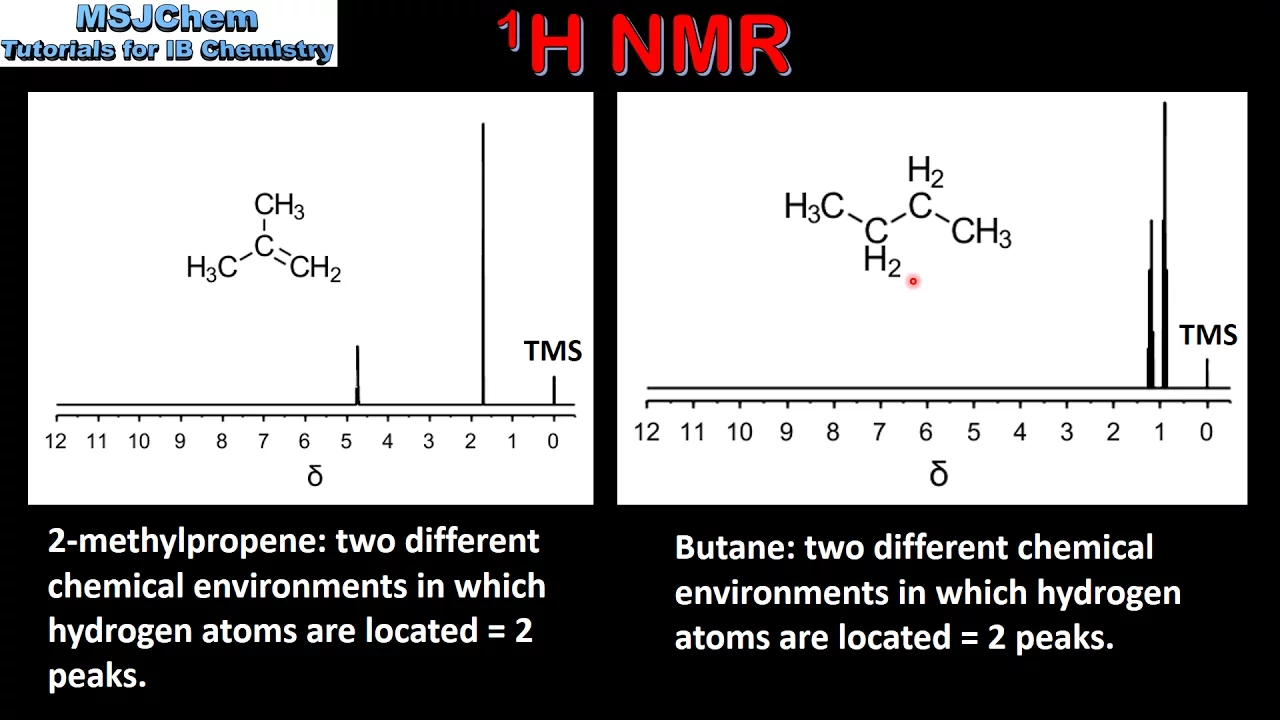
1H NMR: Determining Number of Peaks from Structure
@MSJChem
59.2K views•2017-04-06

17:31
Edible Water Bottles: A DIY Guide to Sodium Alginate Spherification
@ryan
10.5M views•2019-06-21
Related Study Plans & Knowledge Roadmaps
Structured learning paths in Chemistry
chemistry
Nuclear Chemistry: Decay, Meds & Fuel Cycle
01Introduction to Nuclear Structure and Radioactivity
02Decay Dynamics and Kinetics
03Radiation Interaction and Detection
+ 2 more learning modules
24h5 modules
Explore Roadmap
chemistry
Supramolecular Chemistry: Forces & Machines
01Foundations of Chemical Bonding and Intermolecular Forces
02Introduction to Host-Guest Chemistry
03Thermodynamics and Dynamics of Self-Assembly
+ 2 more learning modules
16h5 modules
Explore Roadmap
chemistry
Photochemistry: Excited States & Reactions
01Foundations of Light-Matter Interactions
02Molecular Orbitals and Electronic States
03Photophysical Processes and Jablonski Diagrams
+ 2 more learning modules
18h5 modules
Explore Roadmap
chemistry
Coordination Chemistry: Bonding & Properties
01Introduction to Transition Metals and Ligands
02Crystal Field Theory (CFT) and Geometry
03Magnetic Behavior and Spin States
+ 2 more learning modules
14h5 modules
Explore Roadmap