












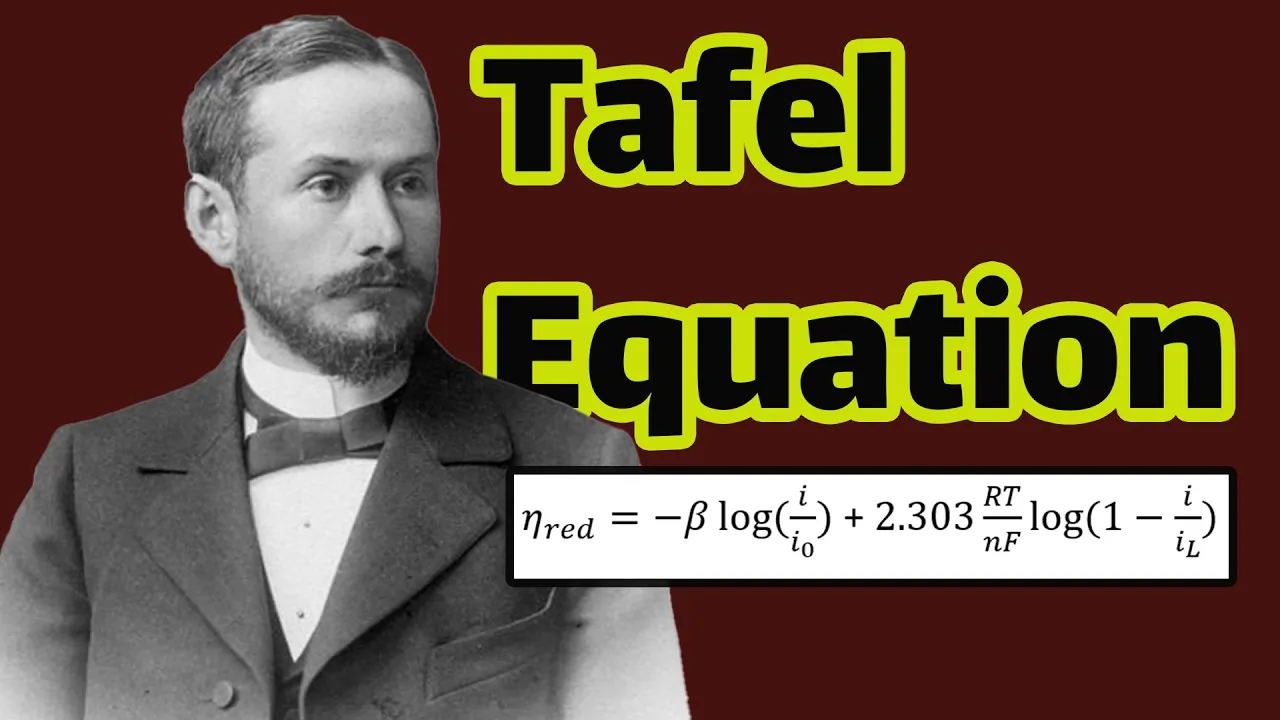







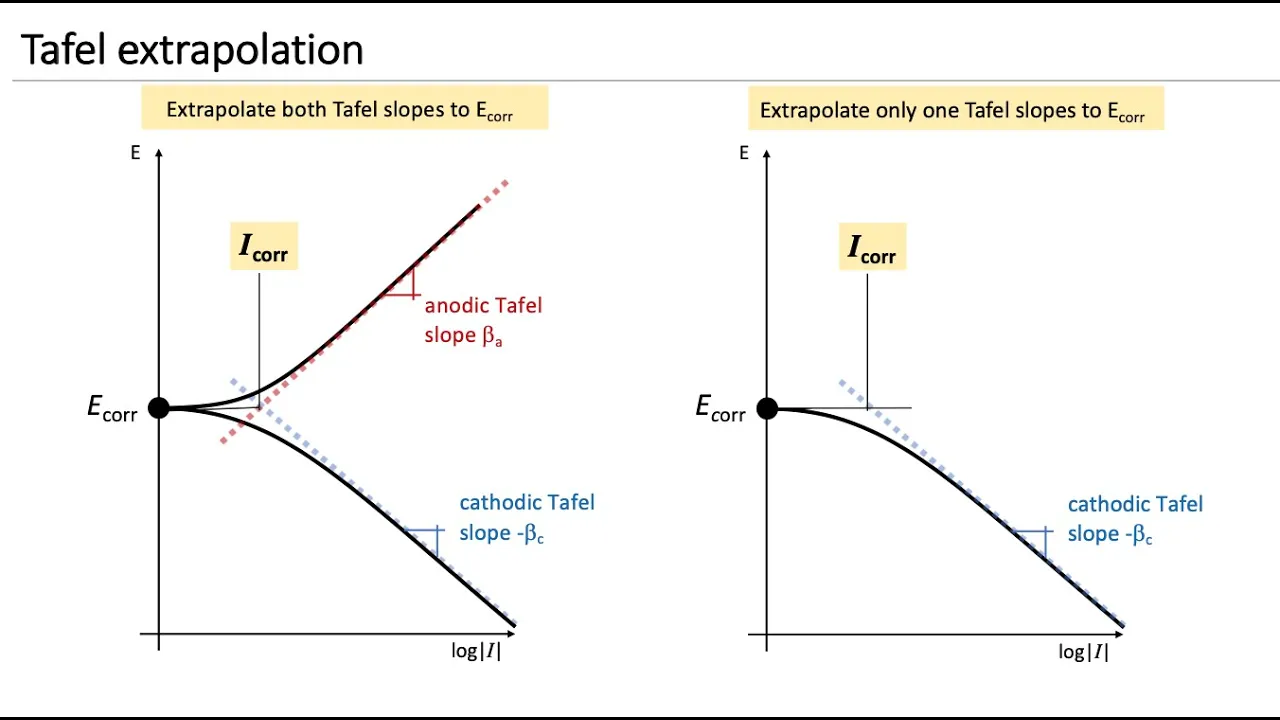


The Butler-Volmer equation describes the relationship between net current density and overpotential in electrode reactions as I = i₀[e^((1-α)Fη/RT) - e^(-αFη/RT)], where i₀ is the exchange current density, α is the transfer coefficient, F is Faraday's constant, R is the gas constant, T is absolute temperature, and η is the overpotential; under conditions of large overpotentials, this reduces to the Tafel equation, which shows that current density is exponentially related to overpotential (I ∝ e^(Fη/RT) for anodic polarization and I ∝ e^(-Fη/RT) for cathodic polarization).
Kinetics of Electrode Reaction: Butler-Volmer & Tafel Equations
Added:Fundamentals of chemical kinetics, including transition state theory, activation energy, and the Arrhenius equation.
Basic electrochemical thermodynamics, specifically the Nernst equation and the distinction between equilibrium and non-equilibrium states.
The concept of overpotential and how it drives electrochemical reactions away from equilibrium.
Faraday's laws of electrolysis and the mathematical relationship between electric current, charge, and reaction rate.
Mass transport-controlled kinetics, including Fick's laws of diffusion and the concept of limiting current density.
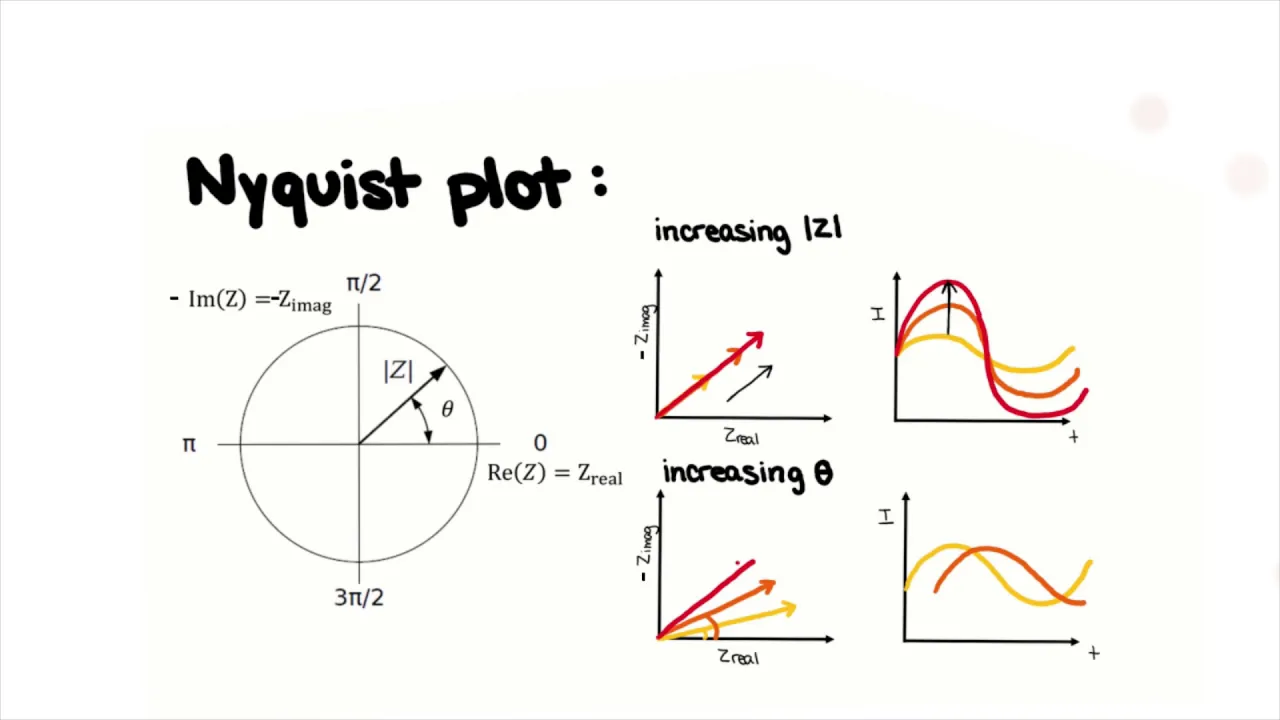
Electrochemical Impedance Spectroscopy (EIS) to analyze charge transfer resistance and double-layer capacitance.
Practical applications in energy storage, such as modeling charge/discharge kinetics in lithium-ion batteries and fuel cells.
Corrosion engineering analysis, specifically utilizing Tafel extrapolation to determine corrosion rates and polarization resistance.
88.1K views1.1Klikes23:48Original Release: 2018-02-22
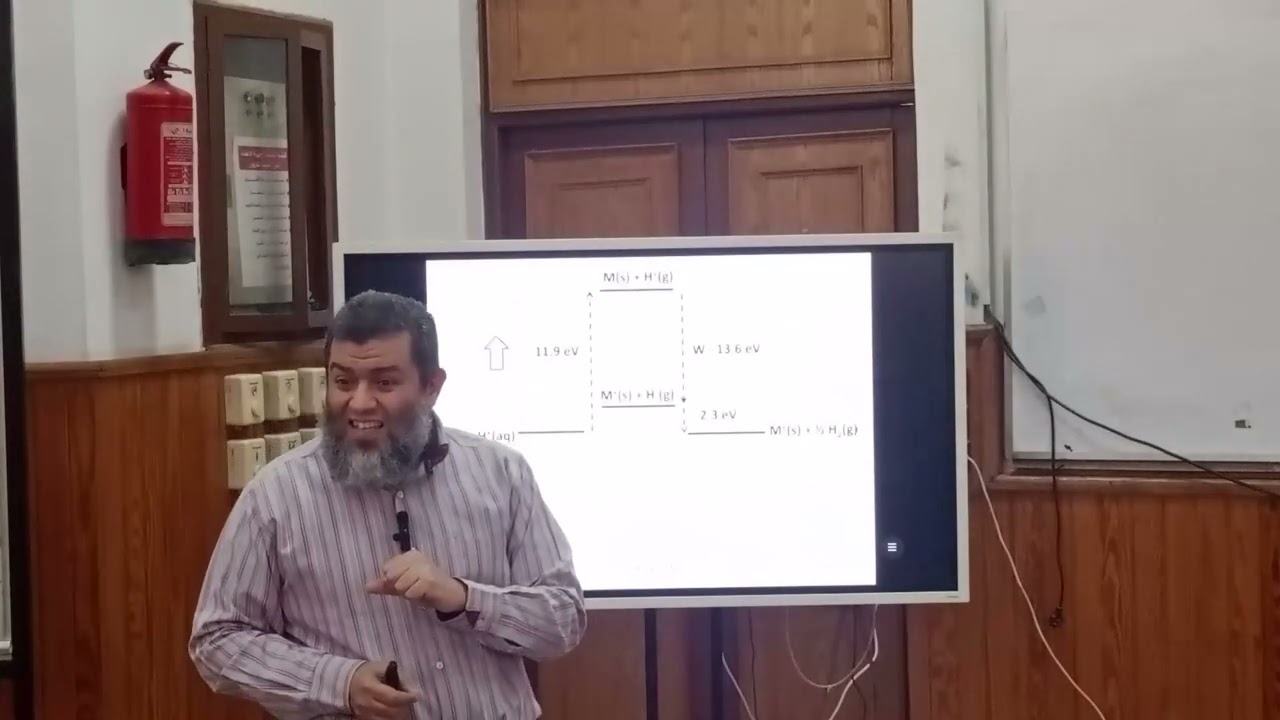
hi friends welcome today we are going to discuss kinetics of electrode reactions and that re mostly known as butler-volmer equation and from butler-volmer equation we are going to modify the better world equation to get - equation there are basically four to five reactions that we assume that they are taking place of course it may be the diffusion of the reactant to the electrode then absorption of the reactant on the electrode then the transfer of electron to or from the adsorbed reactant species and then dis option of the product from the electrode and the diffusion of the product away from the surface of the electrode so these are the some of the processes during the kinetics of the reaction all these processes are suppose again we consider a general example of conversion of any metal ion that is MN plus we will take up n number of electrons and it is converted into again our solid metal so suppose this is the temporal reaction that we are looking at where MN plus is our metal ion and it takes n amount of electrons and it is convert eco metal solid then according to airings activated complex theory the rate constant for a chemical reaction that is the rate constant K for any chemical reaction is given by the exponential of minus Delta G Star upon R T so this is our rate constant where Delta G Star is the Gibbs free energy of activation B is any constant R is our real gas constant and T is the temperature of the system at absolute scale for any metal m to convert it into the metal ion or any metal I am taking up an electron and to convert back into the metal it requires this much amount of energy and if you want to show it by the activation energy diagram then we can represent that suppose this is our any electro surface and this is the distance okay along x axis and this is our code so suppose over here I can write it as X 0 which is our outer Hellmann's plane over here so the minimum amount of energy that will be required to cross this energy barrier will be equal to Delta G Star okay so Delta G Star if the minimum amount of energy required to overcome the energy barrier and when we are moving from the electrode to the electrolyte this will be our anodic process and when we are moving depth from the electrolyte to liquid so this will be our quarry because electrode will lose electron and it will be converted into iron and over here so this is the length of our electrical double layer and the actual path of the formation of the metal ion and again formation bed of the metal is not known but it is believed that the electrical double layer will follow our helm on pairing model okay so as the we are considering that our electrical double layer is following Hellmann's parent model there will be a linear decrease in the potential as we move from the electrode to the outer Hellmann's plane or to the distance x 0 okay wherever reactant molecule is located so suppose over here we have M that is solid and over here we will have MN plus so metal will lose the electrons right will be converted into MN plus and this will take up the electron and it will come again metal suppose if we are considering that transfer of a single electron is taking place and suppose it is the rate determining step that is a 1 transfer or one metal is converting into a metal ion and again metal ion is converting back into the metal and if we are considering that only a single electron transfer is taking place okay then that and that transfer of electron is the rate determining depth suppose if we consider that C 0 and C are are the temptations oxidized and the reduced form of the species spectively outside the double layers the rims of the cathodic and the anodic processes will be given by the rates for cathodic and anodic process will be given by KC into C 0 and for anodic process it will be K into C R so this will be their rates their KC and ka are the rate constants for the reduction and oxidation processes respectively and in any process the magnitude of the charge transfer is given by F is equal to e into NH where F is about Faraday's constant is the end capital E is the charge and n is our aggregate rose number and if we are considering that we are having 1 mole of any species then ever get Rose number will be equal to the number of moles n if you are taking one mole of any species then this sin M will be equal to n and that will be equal to 1 and ultimately we will have F is equal to e that is Faraday's constant will be equal to the charge okay now amount of current I that is amount of the anodic current or the amount of the cathodic current which is arising because of the transfer of electron that is if we are considering our n ot current then I know the current will be due to the loss of electron and the cathodic current will be due to the gain of electrons so the anodic current I can write it as a I a will be equal to the charge into the rate okay so charge is step into I will have K into CR and similarly our cathodic current IC it will be F into sorry it will be small KB into c0 okay so this will be because charge into rate will give us or will give us our cathodic current and again charge into rate will give us our a no different and as we have seen the net current density I is always the difference between the anodic process and the cathodic process so I is the difference between ia - I see we have the value of ia we have the value of IC so both these values we can substitute right away in this relationship so the net current density I I can write it as f of K a into C ad minus F of K B into C 0 okay and again we have the expression for our rates that is K and that expression is from earnings activated complex theory that is k is equal to b e:h - - - star upon R T so Delta G Star C subscript will write for cathodic process and Delta G Star a we write for anodic process because the activation energy will be different for both cathodic as well as anodic processes so our relation will become I is equal to we have F into da into C R into e raise to minus Delta G Star a by RT minus F into BC so it will be C over here so will have me C into c o into th to minus Delta G Star C by RT so this will be our relationship after substituting the value of the rate constant now when we are considering that I is greater than IC then obviously from this value we know if I is greater than IC then I will be greater than zero and the current will be an anodic current and if IC is greater than ia then the current density or the net current density I will be less than zero and the current is of cathodic current now we will consider that our reaction is under non equilibrium condition suppose we are considering that reduction reaction is taking place so when reduction is taking place the metal ion will take up the electron and it will be converted into the metal solid and the electrical work done during this process will be e into laughs I okay that means when metal iron is converted into metal by taking up an electron during our reduction process okay so the amount of work done will be e is the charge and Delta Pi is the potential of your Delta Phi is the potential difference between the electrodes so this much amount of work will be done now under non equilibrium condition when we see this particular diagram then there is a change in this particular energy diagram and the new activation energy diagram which will be the result of non equilibrium condition will be in this particular manner that is this will be the new equilibrium diagram which is under non equilibrium condition and this much amount and so for cathodic process this much amount of more work will be required to transfer the electrons to the metal and this much amount of less work will be required for the transfer of any metal to the metal ion okay so this much amount of more electrical work has to be done and hence this amount of work is to be added with our activation energy okay so earlier our activation energy was Delta G Star and the amount of work done which we are getting was Delta Phi e so the total amount of work done for say suppose cathodic process Delta G Star C will be equal to Delta G Star Plus in place of e I can substitute F into Delta Pi because earlier we have seen F was equal to e and hence I can add Delta G Plus F Delta Phi so this F Delta Phi is this increase in the work and also the condition is that our metal ion has not taken up the electron totally and rich over here but it is in some way in the middle or it is in the path of the transit so we need to introduce one more factor that is on transfer coefficient or simit factor which is represented by alpha and this symmetry factor will tell us to varies or where we are in this path okay so hence we need to add four introduced simit symmetry factor in this representation so with the help of symmetry factor we will be able to know that we're in this path actually we are so our representation will be delta g star c will be equal to Delta G Star Plus alpha F Delta Phi where alpha is our transfer coefficient or symmetry factor and generally the value of alpha it lies between 0 to 1 the value of alpha lies between 0 to 1 so for cathodic process this much amount of more work is to be done whereas for anodic process this much amount of less work has to be performed ok our value of G Star C will be this much and similarly the value of Delta G Star a will be equal to Delta G Star minus 1 minus alpha into F into Delta Phi will be the amount of activation energy required for our anodic process and this will be the amount of the activation energy required for the cathodic process under non equilibrium condition so the value of delta g star a and delta g star C we will be substituting in this particular relationship we will get is equal to F into BA into C R so over here we have minus Delta G Star a so this will become minus Delta G Star and this will become plus and I can directly separate both of them so we will have e to the power minus Delta G Star upon R T into e to the power 1 minus alpha F Delta Pi upon r t- f DC c 0 e raise to minus delta g by RT into e raised to minus alpha F Delta Pi by RT so this will be the representation from the last lecture we know that the word potential Nita is potential difference under non equilibrium condition minus the potential difference observed potential minus equilibrium potential is our over potential so over here we have the value Delta Pi which is the value of the observed potential so I can rearrange this term and then I will substitute the value of Delta Pi in about representation and I will solve it individually by for I a and forth so the value of anodic current density I a can be written as f into VA into CR into e to the power this will remain as such so it will be minus Delta J star upon RT then we will have ear h2 and again we rearrange this representation in the form that is Delta Phi is equal to Nita plus Delta Phi EQ okay in place of Delta Pi I can write Nita plus Delta Pi EQ and again I will separate out the individual terms so the relation that we'll be having is 1 minus alpha F Delta Phi EQ pi Rd into e raised to 1 minus alpha F Nita by RT so on this will be the relationship and when we examine all this terms then this term because Delta G Star is our activation energy under equilibrium condition this is our equilibrium potential and these our rate constant and other are also under equilibrium condition so all these terms which I have kept in this bracket will constitute the anodic current under equilibrium condition so all the five terms I can write together in the form of I a EQ which is a or anodic current under equilibrium condition and into I am left with a raise to 1 minus alpha Nita F by RT okay and similarly for cathodic current IC again I can substitute over here in place of Delta Phi I will substitute beta and Delta Phi EQ so I am left with or I will have IC EQ into e raised to minus alpha Nita F by RT so this is what I am left with we know that under equilibrium condition our anodic current density is a pulled over cathodic current density and that is equal to the exchange current density i 0 so this is our cathodic current density under equilibrium these are anodic current density under equilibrium so both these current densities can be equated or can be written equal good exchange for intensity a 0 and further the current density I will be equal to as we know it is a minus IC and that I can write it equal to i0 or I can take a 0 common out remove this and hence I can write a 0 into e raised to 1 minus alpha beta F by RT minus e raised to minus alpha Nita f1 R T so this representation of the net current in terms of the power potential is known as butler-volmer equation and further in order to get the TEFL equation we will examine the exponents of this particular representation ok and this exponent or exponential series we know that suppose if we are having here h 2 X then exponential series will be X plus 1 plus X plus X square by 2 factorial plus X cube by 3 factorial plus and so on so this will be the exponential series and when considering that our war potential is very very small then the value of Nita F by RT is very very smaller than one and hence the square cube and the higher terms can be neglected and we are only left with the first two terms so the representation or the this representation we can write it as a 0 into 1 plus 1 minus alpha into Nita f by RT minus 1 minus alpha delta f by RT okay and further when we simplify this relation we will have I is equal to I 0 into 1 plus I can simplify this so I will help Nita F by RT minus alpha entire by RT minus 1 plus alpha Nita f pi hat so we can cancel both these terms out and 1 1 also will be canceled out and we are left with I is equal to I 0 into F 1 R T so from this relation we can say that the current density is directly proportional to the power voltage okay so when power potential is a very small over potential conversely if we are having that when the or potential or when the value of Nita is very large so this theta is small when we are having non polarizable left force okay so where in the value of potential is very small but when we are having a polarizable electrodes then in case of polarizable electrode the value of for potential is large and suppose when the value of whole potential is large and positive then under such cases the second term of our this particular representation so when Nita is large and positive then e to the power negative value or e to the power minus of something will be a very very small energy okay and when this value is very very small value we can neglect this part or the second term from this particular relationship and hence we will have I will be equal to I 0 into e to the power 1 minus alpha Nita F by RT so this will be the relationship and when we take logarithm on both hand side and we will have Ln of I is equal to Ln of Phi 0 plus 1 minus alpha leta f by RT and this relation is known as temporal equation so this condition is Vanita is very large and positive under such circumstances the current will be the anodic current and when we consider that the value of Nita it is very large and negative so when we are considering value Nita is very large and negative then in this representation over here for negative value this will become positive and this term will be negative and hence the current will be the cathodic current so the value of the first term in this particular relationship will be very very smaller as compared to the second term and this can be neglected and so we are left with only the second term and hence we will have I will be equal to i0 or I will write minus ahead high 0 here H 2 minus alpha Nita F by RT so we are only left with this particular terms so first we can take minus on both hand side so we will have minus of I is equal to i0 pH 2 minus alpha beta H by RT and further we will take logarithm so we will have Ln of minus of I is equal to Ln of hi 0 minus alpha beta F by party so this will be the relationship when the power potential is large and negative and the essentially the current will be the cathodic current and this situation is also known as definitions to both these relationships are definitions okay and when we plot a graph of the current density I versus the or potential data okay in butler-volmer equation that is for this particular representation when we plot a graph of I versus overpotential then you can see in this diagram we will get a diagram of this particular manner here we have considered two markings so one which is going along the current density I it is the case a where there is high exchange current density where in our electrodes our polarizable electrodes in in second case you can see there is B so which is moving across the or potential value and this is the case where the or potential is very high and the current density is very low so this is the case seen when we are using the polarizable electrode so in case of polarizable electrodes the poor potential will be very high whereas in case of the non polarizable electrodes the exchange density or the current exchange density will be very very high okay so these results that are obtained from butler-volmer equation hope the butler-volmer equation as well as both the TEFL equations are clear thank you very much
Up Next
11:23
Cyclic Voltammetry Explained: Principles and Applications
@emilytsui8841
78K views•2020-03-26

83:56
Biocatalysis and Catalysis in Islatravir Synthesis | Merck Webinar
@SCIwheresciencemeetsbusiness
675 views•2020-10-08
10:06
1H NMR: Determining Number of Peaks from Structure
@MSJChem
59.2K views•2017-04-06

17:31
Edible Water Bottles: A DIY Guide to Sodium Alginate Spherification
@ryan
10.5M views•2019-06-21
Related Study Plans & Knowledge Roadmaps
Structured learning paths in Chemistry
chemistry
Nuclear Chemistry: Decay, Meds & Fuel Cycle
01Introduction to Nuclear Structure and Radioactivity
02Decay Dynamics and Kinetics
03Radiation Interaction and Detection
+ 2 more learning modules
24h5 modules
Explore Roadmap
chemistry
Supramolecular Chemistry: Forces & Machines
01Foundations of Chemical Bonding and Intermolecular Forces
02Introduction to Host-Guest Chemistry
03Thermodynamics and Dynamics of Self-Assembly
+ 2 more learning modules
16h5 modules
Explore Roadmap
chemistry
Photochemistry: Excited States & Reactions
01Foundations of Light-Matter Interactions
02Molecular Orbitals and Electronic States
03Photophysical Processes and Jablonski Diagrams
+ 2 more learning modules
18h5 modules
Explore Roadmap
chemistry
Coordination Chemistry: Bonding & Properties
01Introduction to Transition Metals and Ligands
02Crystal Field Theory (CFT) and Geometry
03Magnetic Behavior and Spin States
+ 2 more learning modules
14h5 modules
Explore Roadmap