











![YOU vs. PHYSICS - Ask a Physicist with Dr. Blitz [12/24/2025] [V]](https://i.ytimg.com/vi/vOovwYga4pY/maxresdefault.jpg)


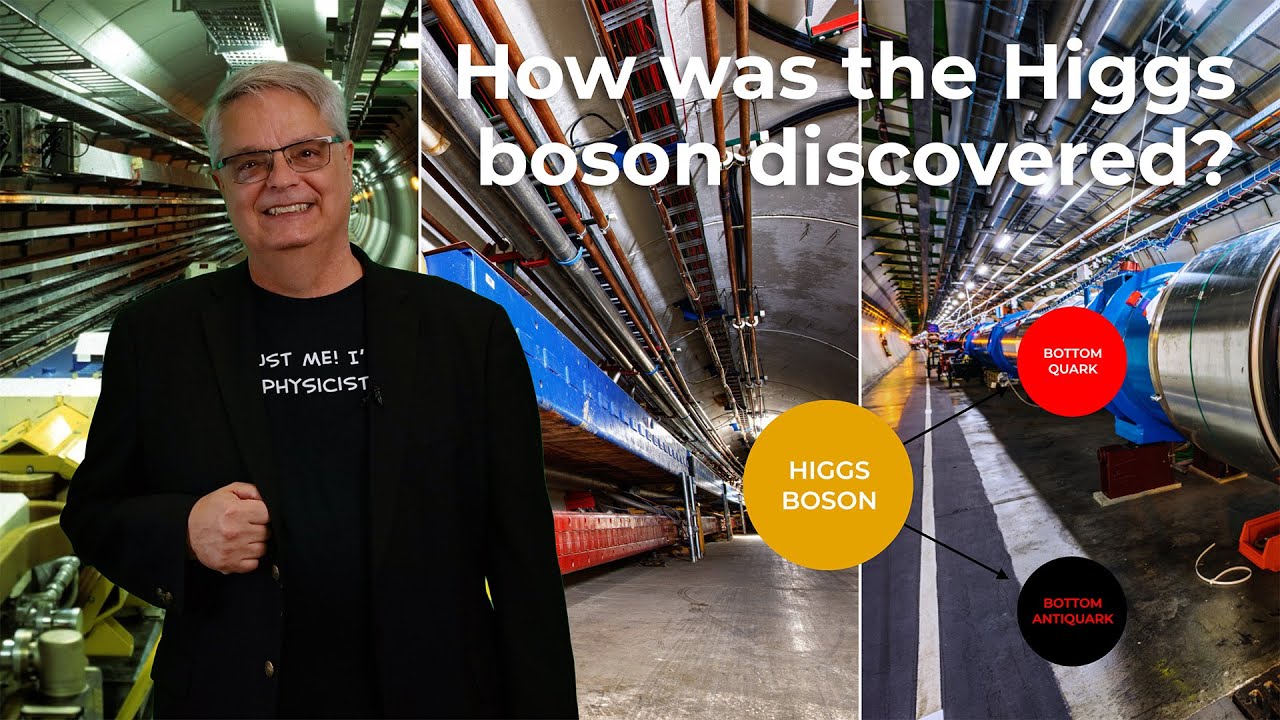



The Higgs field is a fundamental quantum field that permeates all of space and gives mass to elementary particles through their interactions with it; particles like electrons acquire mass because they constantly interact with this field, while massless particles like photons do not, as demonstrated by the 2012 discovery of the Higgs boson at CERN's Large Hadron Collider.
How the Higgs Field Gives Particles Mass: Quantum Field Theory Explained
Added:The Standard Model of Particle Physics, including the classification of fundamental particles like fermions (quarks, leptons) and gauge bosons.
The core concept of Quantum Field Theory (QFT), specifically that space is filled with quantum fields and particles are localized excitations of these fields.
The classical and relativistic definitions of mass, energy, and momentum, including Einstein's mass-energy equivalence equation (E=mc²).
Basic wave-particle duality and the relationship between a physical field (such as the electromagnetic field) and its corresponding particle (the photon).
Electroweak Symmetry Breaking, which explains how the electromagnetic force and weak nuclear force unified at high energy levels in the early universe.
The Hierarchy Problem in modern physics, which questions why the Higgs boson's mass is so light compared to the Planck mass.
Experimental particle physics at the Large Hadron Collider (LHC), focusing on how decay channels (like the Higgs decaying into two photons) are detected and measured.
The cosmological implications of the Higgs field, including vacuum stability and the role the Higgs potential may have played in cosmic inflation.
2.7M views45.7Klikes9:32Original Release: 2015-12-16
In 2012, a new particle was discovered by the Large Hadron Collider.
Physicists believe that the elusive Higgs boson has finally been found.
But what's the big deal with this whole Higgs thing, anyway?
[THEME MUSIC] We saw in a previous episode that most of the mass in your body, in fact, the mass of anything that's made of atoms, doesn't come from the mass of the elementary particles.
The electrons, and the quarks that comprise protons and neutrons, do seem to have intrinsic mass, but this is only run 1% of the mass of the atom.
Most of the atom's mass is the confined kinetic and binding energy of those quarks.
Now, today I want to talk about this so-called intrinsic mass of the elementary particles.
I want to show you that even in this case, mass is still just bound or confined energy.
In the case of the constituents of the atom, it comes from the Higgs field.
So, let's get to the bottom of this whole Higgs business.
To understand how all this works, we're going to need to learn a bit of quantum field theory.
Just the basics for now.
We'll get into it in more detail another time.
Now, QFT describes the fundamental particles as excitations in fields, fields that fill our entire universe.
For example, the electron is an excitation in the electron field.
Imagine that every point in the universe has a certain level of electron-ness.
In empty space, that level hovers around zero.
But even in a vacuum, the electron field is there.
But now, add some energy to that field at a particular spot, and it's like plucking a guitar string.
The field vibrates, and that vibration is our electron.
And it's not just electrons.
Every elementary particle is a vibration in its own field, and these vibrations and fields interact with each other, transferring energy, momentum, charge, et cetera, between particles and fields.
Now, this is a very simplistic explanation of a theory that has produced an astoundingly accurate description of the subatomic universe.
Given its incredible success, it was strange that quantum field theory, as it stood in the 1950s, gave a perfect description of the electron, and yes predicted that the electron should have no mass.
The basic QFT equations of all the components of the atom leave them massless.
As we'll see in the next couple of episodes, this masslessness means that particles should travel only at the speed of light and experience no time.
Their clocks should be frozen.
But these particles are distinctly not timeless.
They evolve.
Take the electron.
It has this type of intrinsic quantum spin that we call chirality, and this can either be clockwise or counterclockwise relative to the direction of motion.
We call this left-handedness or right-handedness.
Now, that spin constantly flips back and forth.
The electron evolves, meaning it does experience time, so it must have mass.
Also, we've weighed it.
We've measured that mass directly.
But a different sort of changeability is the only way that we know that the tiny neutrino has mass, and it was the measurement of those neutrino oscillations the won the 2015 Nobel Prize in physics.
Now, take the photon.
It is definitely massless.
It travels at the speed of light, and it experiences its entire existence in an instant.
It undergoes no internal evolution.
It has spin, but the spin never flips.
A photon only changes if it bumps into something else.
But the photon and the electron are both just excitations in their own fields, so why does the electron have mass and the photon not?
Why does the electron evolve?
There are different ways to interpret it, but perhaps the simplest is to say that while the photon can cross the entire observable universe without bumping into a single thing, the electron is never not bumping into things.
There's something in the substrate of space everywhere that impedes the electron.
It's the Higgs field.
To understand how this works, we need to come back to this spin flip thing.
Here, I need to tell you about a really odd fact about the universe.
It's not ambidexterous.
It actually cares whether a particle has left or right-handed chirality.
See, left-handed electrons have this extra little something something compared to right-handed electrons.
It's called weak hyper-charge, which by the way was the name of my high school garage band.
It's like regular electric charge, which lets all electrons feel the electromagnetic force, except in this case, it lets only left-handed electrons feel the weak nuclear force.
This cosmic asymmetry is incredibly weird, and it's part of a mystery called parity violation.
It's an open question why the universe cares which direction you're spinning.
In fact, it cares so much that it won't let an electron flip from left to right unless it can ditch its weak hyper-charge or flip back again unless it can pick some up.
But where does this charge come from, and where is it go to?
You probably guessed, the Higgs field.
The Higgs field is really weird.
While most quantum fields hover around zero in empty space, the Higgs field has a positive strength at all points in the universe.
There's a little bit of Higgs in us everywhere.
In some stunning quantum weirdness, this complex, multi-component field not only carries the weak hyper-charge, but manages to take on all possible values of this charge simultaneously.
This makes the Higgs field an infinite source and sink of weak hyper-charge.
Now, poor electron is bombarded by a flow of particles into and out of the Higgs field from all directions, giving and taking away the weak hyper-charge on infinitesimally short time scales.
On its own, the electron would travel at light speed, but trapped in this Higgs field buzz, the electron feels mass.
Honestly, this is a pretty wild story.
An invisible and infinite ocean of some sort of charge that we've never heard of all invented so that electrons can be left and right-handed at the same time?
How do we know it's true?
Well, something like this must be true, because all of the rest of quantum field theory hangs together too well.
We conclude that QFT is essentially correct, but it's an incomplete theory without a mass-giving field.
The Higgs field is the best, least silly option to do this.
But how do we prove it?
Enter the Higgs boson.
Just like the other fields, the Higgs field can vibrate around its baseline value, which gives us the boson.
This particle actually has nothing to do with giving anything mass.
However, if we observe the particle, then it means the field also exists.
Finding the Higgs boson was the biggest mission of the Large Hadron Collider.
Now, that's a topic well covered in other places, so just the TLDR.
In 2012, the LHC spotted the debris produced by the decay of an unknown particle, and those decay products are consistent with the disintegration of the highly unstable Higgs boson.
It seems very likely that the LHC did produce the Higgs boson, which in turn would mean that the field exists.
The whole story is now coming together very nicely.
But there's still a lot we don't know.
The Higgs boson is hopelessly unstable, and it decays in around 10 to the power of minus 22 seconds, which makes it very difficult to study its actual properties.
Could the Higgs field also explain things like dark energy, inflation?
There are reasons to think it might.
We'll come back to those in the future.
For now, we'll be delving deeper to the mysteries of matter and time in the next episode of "Space Time."
In the last episode, we told you how to build a real astrophysical black hole.
Some of you had some pretty heavy questions.
AFastidiousCuber wants to know how a black hole can grow if anything falling into it appears to freeze before it crosses the event horizon.
So, although an outside observer can never witness anything cross the event horizon, as something falls to the horizon, the light it emits is red shifted such long wavelengths that it effectively becomes invisible.
So, infalling stuff does vanish, and the event horizon that an outside observer sees does grow because anything falling into the black hole adds to its effective mass as seen by a distant observer even before it crosses the event horizon.
Casterverus would like to know if the potential event horizon that we talk about is the same thing as the Schwarzschild radius.
Well, that's exactly right.
The Schwarzschild radius is the radius of the event horizon of a non-rotating black, and it depends on the mass.
Any object that gets crushed down below its own Schwarzscihld radius becomes a black hole.
For the sun, that's 3 kilometers.
For the Earth, it's around 9 millimeters.
For a person, it's around 1/10 billionth of the radius of a proton.
Gareth Dean asks about this whole thing about using gravitational waves to turn up the core temperature of a star.
OK, so gravitational waves carry a lot of energy, and some of it can get dumped into a star by squeezing and stretching as the gravitational wave passes by.
Now, stars near the core of a galaxy with merging super massive black holes should have temperatures raised by an observable amount by the gravitational radiation.
There's a link in the description.
WR3ND says, "It only took 20 years out of high school to find the smart kid's table."
Glad you finally found us, WR3ND.
We saved you a seat.
[MUSIC PLAYING]
Up Next

24:35
Optics and the Nature of Light: Ibn al-Haytham's Legacy
@aljazeeraenglish
129.1K views•2015-10-06

12:53
21cm Hyperfine Transition in Neutral Hydrogen: Radio Astronomy Basics
@AaronRobertParsons
12.4K views•2011-10-13
6:59
Understanding Geodesics and Curvature in Spacetime: Clarifying Parallel Transport
@pbsspacetime
341.3K views•2015-07-08

27:14
Entropy and the Second Law of Thermodynamics Explained
@veritasium
27.5M views•2023-07-01
Related Study Plans & Knowledge Roadmaps
Structured learning paths in Physics
physics
Nuclear Physics (Decay, Fission & Reactors)
01Atomic Structure and the Binding Force
02Radioactive Decay and Half-Life
03Nuclear Fission Mechanics and Chain Reactions
+ 2 more learning modules
12h5 modules
Explore Roadmap
physics
Soft Matter (Polymers, Colloids & Rheology)
01Foundations of Soft Matter & Thermal Forces
02Polymer Physics and Macromolecules
03Colloids, Surfactants, and Self-Assembly
+ 2 more learning modules
38h5 modules
Explore Roadmap
physics
Analytical Mechanics: Lagrangian & Hamiltonian
01Mathematical Foundations: Calculus of Variations
02From Newtonian Mechanics to Constraint Dynamics
03The Principle of Least Action & Lagrangian Mechanics
+ 3 more learning modules
28h6 modules
Explore Roadmap
physics
General Relativity (Spacetime & Cosmology)
01Foundations of Relativity: Special Relativity
02The Geometry of Spacetime: Equivalence Principle & Curvature
03Einstein's Field Equations: The Mathematics of Gravity
+ 2 more learning modules
55h5 modules
Explore Roadmap