














This video provides a comprehensive strategy for approaching Multistate Essay Examination (MEE) questions, emphasizing systematic issue spotting, understanding business entity structures (LLCs, partnerships), product liability principles, contract assignments, personal jurisdiction analysis, and evidence rules. Key techniques include identifying parties first, recognizing when to apply black letter law versus creating reasonable legal analysis, and knowing when to make educated guesses about unfamiliar rules. The instructor demonstrates how to break down complex fact patterns into manageable legal issues while maintaining focus on the core question being asked.
MEE Black Letter Law Review | February 2026 Bar Exam Tips
Added:Familiarity with the structural format of the Uniform Bar Exam (UBE), specifically the allocation of time and scoring weights for the Multistate Essay Examination (MEE).
A foundational academic understanding of the core law school subjects tested on the MEE, such as Wills & Estates, Family Law, Secured Transactions, and Business Associations.
Competency in the IRAC (Issue, Rule, Analysis, Conclusion) essay writing methodology commonly utilized in professional legal examinations.
Drafting full-length, timed practice MEE essays using past National Conference of Bar Examiners (NCBE) questions to build pacing and endurance.
Conducting comparative self-grading analyses using official NCBE Point Sheets and representative high-scoring candidate answers.
Developing personalized mnemonic devices and utilizing spaced repetition systems to commit the reviewed black letter law rules to active memory recall.
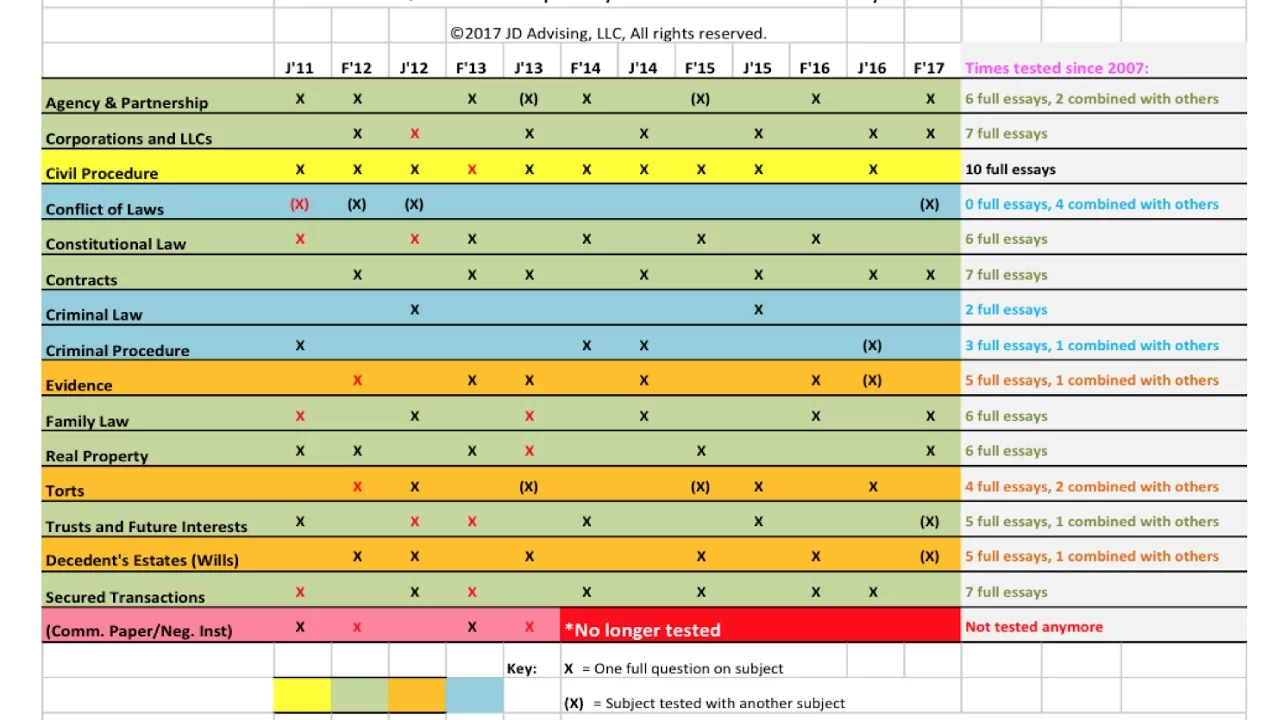
Analyzing historical MEE subject frequency charts to strategically prioritize highly-tested sub-topics for the February 2026 administration.
289 views14likes2:13:30Original Release: 2026-02-17
Hello everybody. We are reviewing MEES.
We are issue spotting and probably just talking about black letter law for time purposes to get through all six um instead of a full me like we've been doing in the past um cuz this is the review for the last week um for the February 2026 bar exam. So, let me get my highlighter out.
Um, and what I thought would be helpful is, um, as we're looking over this ME, I think what a lot of people get caught up in is when there's a lot of parties, right?
When there's like in this situation, two brothers, sister, brother, sister, cousin, um, there's a contracting party for tires. there's a person buying the farmland, right? Sometimes we have more than that, right? We especially in real property deed recordings, we have A goes to B and B goes to C and C goes to D and so on and so forth. Um, so if we have those types of mees where there's just a lot of parties that we want to get situated, I think a something that can help a lot of people get their footing when they're reading an ME. And I understand that on test day when we read this for the first time, it's going to be like tenfold experience, right?
because we're sitting there. Um it's like that day, right? Um there's going to be a lot of emotions that day and we're going to try and have our minds right when we're reading this thing. Um so I think I've probably talked about this, but I'm a big proponent on earplugs. Um I'm pretty sure all jurisdictions allow them, but I would check with your jurisdiction. But the foam earplugs that you just roll up and put in um I think makes all the difference of just to get the outside sound away from you. You don't know who your neighbor's going to be. You don't know if there's a they're a loud typer or they're sneezing or whatever. Um you kind of just want to be as focused as possible with the conditions that you're given. Obviously, we're not in the comfort of our room. We're not in the comfort of our local library or our kitchen or whatever like that.
um not some place that we're used to.
So, we want to anticipate that we're not going to be completely focused as we would be in our room. So, with that said, I think what would be helpful is if we get very overwhelmed where we're reading something and we're like, I have to read this five billion times. I'm not sure who's who. I'm in my scratch paper on the side. I'm going to say, who is B?
Right? Who is A? Who is C?
And then I'm going to put a little um asterisk here, right? Um they're a member of the LLC, right? At this point, I'm just kind of making up because I didn't read it yet. Um B is the buyer, right?
A is Adam, whoever the people are, just so I understand my parties because I think the parties are the first hurdle to go through. Um cuz when you see transactions going on and then you see is A liable to B. I don't know if A is liable to B because first I have to find out who is A and who is B. Is A the debtor or is A the dead? Right? Did A contract to paint the house or did A um ask their house to be painted? Right?
These are big changes that depending on what me we're given can really focus us on getting the correct answer because if we don't know who our parties are when we scroll down and they say um was the LLC bound by the sale of the farmland right I need to know who's in the LLC what they did and what happened in that conveyance of the farmland right I want to be situated I want to understand what's going on and even if I'm not saying we have to know the answer, right? That is definitely not what I'm saying. I think it's totally reasonable to not know the answer until we go through the analysis and we get to the end. And I've said that before. I think one thing we really do want to know is like what is going on? Like what is this story trying to tell me?
Um and I think that will get a lot of stress out of what we're going through.
um just by the mere fact that um we have understood who is who and I think in this me it's kind of like a little bit more simpler because there's an organization and stuff like that but in the other mees that we'll go through you'll see what I'm talking about with like who is who.
Um, okay. So, let's go through it. And after we're going through it and maybe even paragraph by paragraph, I'm going to go over what the issue spot is. And I'll give people, if they want to, an opportunity to say it if they want to. I understand people don't want to. It's late. Don't worry about it. Um, but, you know, think about it. I'm not going to jump into it. Let's think about it. Be like, what could I possibly write about in this situation? Okay. So, two siblings, brother and a sister, decided to start a bike shop with their cousin.
So, once I read that first sentence, I'm probably in some business entities type of me, right? Either a partnership or an LLC or LLP. Um, I can kind of just like quickly glance down and see I'm an LLC.
But why do I care that it's a bike shop?
Without jumping ahead, maybe they tell me that something is done through ordinary course of business that is involving bikes and maybe something is outside the ordinary course of business, meaning it's not involving a bike, right? I have to know what type of business it is. I want to know that they're selling bikes. Um, with their cousin, right? So, I have three parties in LLC.
Um, maybe that comes up, right? I want to know what's going on. They filed certificate of organization to form a limited liability company. Seems like they did all the formalities that they need to. I'm not going to fight the question and be like, "Oh, well, maybe the filing uh uh document was incorrect." If it's not pointing to that, if the facts don't give me that, I'm not going to hone in on something that's unimportant like that. Um, and the other LLC that we went over together, um, when we had our agency's agency and partnerships lecture, um, remember when we had an issue about the LLC, right? Because it talked a lot about it, right? They failed to file the organ organization. Um, they didn't file with the Department of State. So, if they don't do that, then we have a general partnership, right? That's the default. So, that would be a question where we're talking a lot about the defects in filing probably would be a question. But here, because they're just straight up telling me that they filed something, I'm probably just going to take it. Um, and I may not be told something that's that important, right?
All I want to know is that the LLC was filed. Um, it was created. So brother and sister paid for the LLC member interest each by contributing $100,000.
Right? So we know that just like in partnerships when we have an LLC, the members of the LLC can contribute monetary amounts in cash, they can contribute property, right? Whatever they contribute to the um organization um is their fair equity in that organization, right? So um the reason why that may come up is when a party wants to get out um what is their fair share of the equity in this organization right um is it a agreement that's in our documents that tells us what that interest is or was it just their amount that they have um provided right so when you contribute cash or you contribute property. Um, in return, you become a member of the LLC and you're able to run the company and you're able to get profit from it. Um, so that's why we just want to make sure that, you know, why does it, you know, what does this mean? Like when I get $100,000 and then I put in an LLC, what does that mean?
Well, now we know that that's how you become a member and that's how you get equity in that membership. That is your fair share of the um LLC or the partnership if it was a partnership, right? Because what's the difference?
Um, an LLC has different structure, right? We have membered member um, uh, member LLC or member manager LLC.
Um, and then the only difference is that we have limited liability, right? Um, we do have filing requirements. We do have different structures, but the whole point of an LLC is we have limited liability. Um, and so that's why people who are creating a general partnership want to go through the extra steps to make the LLC because if someone in the LLC gets sued, um, you yourself do not have, um, that much liability if you had an LLC. Compare that with a general partnership. Um, if your fellow partner screws up, you're you could also be on the hook, right? But for an LLC, not so much. Um, so LLC then recorded the deed.
So what did they record the deed to?
Before I skip that, the cousin paid for the L LLC member interest by conveying the LLC 5 acres of farmland valued $100,000. Um, and then the deed was recorded. So, like I said, you can contribute cash, you can contribute property, anything of value, you can contribute to the business, right? And then that is your fair share of the equity.
Um, it's also nice that they're making it the same amount as the cash. Um because then it looks like they have equal equal interest, right? We have a third each, 100, 100, and 100 100 because they each contributed 100.
Um neither the certificate of organizations nor the members operating agreement specifies whether the LLC is member managed or manager managed.
Right? The two types of LLC's that we have. However, the operating agreement provides that the LLC farmland may not be sold without the approval of all three members.
So if I have a specific statement in my documents for my LLC's or my partnerships or my LLP whatever in my operating agreement or in my articles of incorporation or my certificate of organization whatever my organization is if I have something in there that says the members cannot do this without this.
Okay, that is my new rule, right?
Because we have our default business entities rules, right? For um you know the uniform partner laws, you know, typically our ME will say this jurisdiction has adopted the uniform partner laws or whatever. Um we have those, but if I don't have my default rules, my members can write around it, right? They can create a document that says something else. They don't have to go through the default rules. They can change them, right? And it's just like mailbox rule or just like statute of frauds or something like that. We have those default rules, but you can write in your contract you were not going to follow that, right?
Um, so certificate of organization or operating agreement are also documents that the LLC needs, just so we know. Um, and then member manage or manager manage are two different types. and the argument I mean the agreement is not specific what it is maybe I'm going to be asked what different um structure I have if the agreements are silent spoiler alert member managed is the default why is it not manager managed as default because you have to hire a manager it would say that blah blah blah is hired as the manager we'll see that we don't have that in this me that's why I know my default is member managed and that's probably something that I'm going to want to talk about.
So, following formation of the LLC, the company rented our storefront commercial space for the bike shop, opened up their business 3 months ago, purporting to act on behalf of the LLC.
As soon as I see something like this, I'm probably going to be asked about agency.
What is agency? When you purport to act on behalf of the art of the organization or the company and you go do something, right? you buy something, you lease something, you mortgage something on behalf of the company. Um, then we need to know if that member/partner, and again, all of this can still be the same type of analysis in a partnership.
Um, just because we have an LLC here, it just changes the words, right? But I still have agency. I still have a parent versus um actual authority. Um, but I'm just now talking about members instead of partners, right? So, I just want to make sure everyone knows that this is still likely going to be the same exact um uh paragraph as long as I'm in business entities, but my my changing of the names is like the most important part that I want to know. So, when I'm writing my me answer, I'm going to want my grader to know that these are members, right? This is an LLC. I don't want to talk about partnerships because that's not what I have here. So I think calling the the people and calling the um entity the right name can actually take you a lot farther in your answer um because your grader understands that you know what you're talking about.
So purporting to act on behalf of the LLC brother entered into a written and signed contract to purchase 100 bike tires for $6,000 from a tire manufacturer. When the tires were delivered sister said they were too expensive and told her brother to return it. The brother was surprised by his sister's objections because twice he had purchased tires for the LSC for the same price from the manufacturer. Neither his sister or his cousin has objected.
Brother refused to return the tires, pointing out, "They're perfect for the bikes that we sell." Um, the sister responded, "Well, pay the bill with your own money. You bought them without my permission." Brother responded, "No way.
I bought them for the store. I didn't need your permission and the company will pay for them. To date, 6,000 has not been paid."
Why do I have all this background information on he's done it before without objection? Because that is great to weave into my facts when I talk about the differences between a parent and actual authority and the fact that this is within the ordinary course of business as a purchase. Therefore, the member LLC that is purporting to act on behalf of the LLC when he makes this transaction within the ordinary course of business because they're bikes and they have a bike shop. Um it seems that he does have um either implied apparent authority or um sorry implied actual authority or apparent authority from the third party that he bought the bikes from, right?
From the manufacturer. And so again, what is the difference? If I have actual authority, I either have expressed or implied. expressed is a um another member or a fellow partner um specifically tells me to go do something or it's specifically written in the agreement that brother has the right to purchase bikes whenever he wants. Right?
That would be expressed um actual authority. Um seems like he doesn't have that because they didn't specifically go tell him to do it. They just didn't object. Right? So omission and an object and not objecting is not the same as expressly going to be told to do something either in an agreement or orally.
Um actual implied is something like this, right? If it's within the ordinary course of business, then a member of the LLC who has interest in a business that sells bikes has implied authority, implied actual authority um to go do this transaction, right? And if not that then what is my other one? A parent that's in the mind of the third party.
So it'll be the mind of the manufacturer. Does the manufacturer believe that the brother is purporting to act on behalf of the LLC? Seems like he is right because he has purchased it two times before right and why would the manufacturer have any reason to believe he cannot do the transaction.
So in some that is what my issue spot is coming from here. I have an authority question. Um, I have an agency question.
Okay. Um, so then what happens? One month ago, purporting to act on behalf of the LLC, the cousin told the LLC farmland to a cousin sold the LLC farmland to a third party buyer. The buyer paid $120,000, which was well above the land's fair market value. Only after the cousin deposit the sale proceeds in the LLC bank account did the brother and the sister learn of a sale.
Both of them objected.
So, um, what do I have going on here?
Um, typically an LLC member, um, can, uh, once you transfer, like we said, once we transfer property into the LLC, that is an interest in an LLC, right?
Because that is your property that you put in there that's now owned by the LLC, and the fair market value of that is what your interest is. Um, so seems like if nothing else was happening here, um, the LLC, um, the cousin selling on behalf of the LLC, um, may not have a problem, right? However, I want to talk about agency as well, right? Because this is outside the ordinary course of business.
They have nothing to do with farmland if you have a bike shop. So if I'm doing a transaction that's outside the ordinary course of business, then I need a expressed authority to do so, right?
Expressed um actual authority.
And so what is my problem here? I don't have that because when they created their operating agreement, they said that it cannot be sold without approval of all three members. And that's exactly what I do not have here. So I want to talk about typically outside ordinary course of business all the members must agree there must be expressed um actual authority but in this situation I do not have that. I actually have documents in my operating agreement that specifies they cannot no one can sell the property without approval of all three members.
So it seems like you cannot be bound by that transaction. Okay.
Um, so that is what we're issue spotting there.
One week ago, the brother wrote in his email to his sister, I want out of our business. I do not want to have anything to do with the bike shop anymore. Please send me a check for my share. So, what is the brother trying to do here? Which is similar to the other other LLC one that we have.
Um, so in this situation, we are trying to leave the LLC, right? The brother is trying to give up his interest in the membership. Um, he wants to dissociate.
That is the language that we want to say for an LLC member dissociating from the LLC. Um, we do have some, if we remember it, some specific black letter law about a member of an LLC dissociating. Um, and it's typically when they're still liable for debts of the LLC. So, a dissociating member will remain liable for debts and obligations of the LLC until notice is given to all the creditors or 90 days after filing a notice of the Secretary of State. Um, so that is something that I want to know for LLC's because of that specific filing requirement. And again, that's only relevant to potential creditors um of that dissociating member as it relates to the LLC. So again, that dissociating member when he's trying to leave is like, I don't want any creditors coming after me. So I'm going to give notice to all these potential creditors that we have debts that are outstanding um that I'm dissociating. or instead of doing that and ask telling every single one, I'm just going to file something with the Secretary of State saying I'm dissociating and then 90 days after filing that I'm off the hook.
Right? So that's something that I want to issue spot when I'm looking at a dissociating member. We also want to know that um members of an LLC can dissociate anytime that they want.
Right? unless the operating agreement or the specific document saying that the LLC is continuing for this specific time or no one can dissociate unless this specific goal is met. Um it's similar to an at will partnership, right? It's not called an atill LLC. We're just saying that a member can dissociate at any time. Um as long as he unequivocally expresses his intent to dissociate and it seems that's that's what he's doing, right? And so that is my facteaving that I'm going to say is how do I know that he's expressly um you know showing his intent that he's unequivocally right. Unequivocal is a word that they like to say um especially in anticipatory um repudiation. They love the word unequivocal and that means like without a doubt. So he is saying he wants out of the business. I want nothing to do with the bike shop anymore. Right? That to me is an unequivocal statement that he wants to dissociate. Therefore that triggers that dissociating thing um that we want to worry about for creditors as regards to debts.
Um so and yes uh limited liability partnerships very very similar but again if I have an LLP what is my P at the end it's a limited liability partnership so if I have any type of partnership I want to make sure that I switch my mind into thinking about partnerships right I have at will partnerships partners can leave the partnership um whenever they want that triggers a dissolution of the partnership unless the remaining partners expressly want to continue. Um, so I have different terminology for a partnership. Um, I don't have to file anything with the secretary of state or department of state. Um, like I have to file with an LLC. Um, the only difference between a general partnership that we've talked about a lot and an LLP is you have a limited liability partnership, which means that you get to have limited liability where if your partner screws up, you're not necessarily on the hook like you are in a general partnership.
Um, but you still have the terms and the rules that a partnership would, right? So again, I think something super important is when I'm talking about a partnership, I want to talk about partners. Um, I want to talk about atwell partnership. If I'm talking about LLC, I want to talk about members.
Either it's membered managed or it's manager managed. And we know the default is member managed.
And how do I know that I have a manager managed? I start hiring some managers, right? And then um, yes, Dina.
>> Uh, sorry. So when you said that the dissociated um LL so if a partner wants to dissociate from an LLP is it I remember that it you can either uh file it in a um newspaper and that's like valid for 90 days as a notice to creditors or that you can send like mail directly to the creditors with with an LLC there is an option to go and file it with the state as well. Yes. So, dissociating from an LLC, you have that requirement for the creditors as well.
Um, I would check if that LLP still has the requirement to file. Typically, LLC's have the requirement to file and the LLP might just be you can dissociate at any time. There's nothing that you have to file. Um, I would just check on that because okay, the filings come from the the creation of an LLC, but typically partnerships, like even limited liability partnerships, if it ends in a P, it's a partnership. Those are kind of like hands off. Like the the state is not involved. You don't have to file anything typically. Um, >> but this this notifying creditors and having that 90 days if you do file, that is with this LLC that we're talking about.
>> Okay.
>> Um, okay. So um now I have my questions. What type of LLC was created? Just like we talked about, right? We have our default member managed because we don't have express language saying we don't we um have a manager managed. Are we bound to the tire contract authority within the scope of business within the ordinary course of business? Excuse me. LLC bound to the sale of the farmland have um authority.
We are outside the ordinary course of business but we also have that specific language in our operating agreement saying we need all members to agree which we don't have. And what is the legal effect of the brother's email? We have a dissociating member. We need to know the requirements of dissociating and what happens to a dissociating member. Also he gets his interest back.
So dissociating member um is able to get his interest that he gave into the LLC back. Okay. So, he's able to get his $100,000 back if that was the amount that he contributed to in the beginning.
That is his interest that he's entitled to a buyout for. Okay.
Um, any other questions before we move on?
>> Rebecca, hi.
>> Hi. Um, I have a question. It's not it's not necessarily related to this me, but me in general.
So I just um wanted to know so say you forget or you can't recall something on as you're writing like what is your best advice for that when it comes to >> Yeah.
>> Um we actually just talked about this in the last class which has definitely happened before. Um but the typical um situation that would happen is if so you either are issue spotting and you know that there's this specific problem that I just don't remember the black letter law for. Um or we can't issue spot, right? We have no idea what's going on. So those are two different things, right? So, if we can issue spot and we have no idea what's going on, I want you to let the um the answer choices I I mean the questions guide you, right? So, if I'm so confused, then I'm just going to, you know, start my IRAs. I'm going to start with my issues, rewrite my issues, and try and come up with something. And then, typically, if I can't issue spot, these will kind of tell me where the problems are that I should be looking. And if I have a super broad um like what is are the causes of action or is this constitutional just a super broad one. If I'm failing to issue spot and I have no idea what's going on um I'm going to just pick certain words that I am jogged my memory from studying and if it's like free speech I'm going to talk about free speech right? If it's an equal protection I'm going to talk about equal protection if I see something like that. So that's if I can't issue spot I just pick certain words and issue spot from there.
Um, if I can issue spot and I understand that there's this specific black litter law that I'm supposed to remember and I just don't remember it, um, I am going to make up the black letter law. So, I'm going to make it up to the point where if I, let's say, remember two out of three elements and I have just no idea what the third element is. I'm not going to forget and just put two and forget that the third one exists. I'm going to put a fake third one in there that kind of sounds of what I remember. If I don't remember anything, but I know that I have to talk about this specific black letter law, I'm just going to make the entire thing up and I'm gonna make it up to the point where it I I think it sounds pretty reasonable, right? And so if I forget the specific language that I have to say, I'm going to say things that kind of sound like that language.
If I forget that specific word that I have to use, I'm going to talk about things that sound like that word, right?
Kind of on par with what I think I'm supposed to write. Um, but I'm going to make it up, right? I'm going to make it up as best as I can, but after I make it up, I'm not just going to be like, "Wow, I screwed that up." And move on with my life. I'm going to apply my madeup law to the facts. So, just like this, if we forgot about what agency was about this tire contract, I'm just going to make it make it up that LLC members, and again, I don't want to make up law right now and confuse you guys. This is made up, by the way. LLC members um can enter into agreements as long as it's reasonable within the LLC, right?
Something like that. Um this tire contract is reasonable because they have a tire uh store and it's a similar type of business. Therefore, this is a reasonable contract and they're bound by it. Right? So, whatever my fake rule is, I'm going to apply it to the facts that I'm given to close that gap and at least get some points because madeup law will get you something if you analyze it comparing to the facts and conclude.
Does that make sense? Yeah, that makes a lot of sense. So, just basically remain confident in whatever you're doing even if it doesn't make sense to you. Like try and make it make some type of sense from the facts.
>> Correct. Try to make it some type of sense and do not just be like I I I lost on that. I'm moving on. Never skip. Put something down that kind of makes sense in our heads. Apply to the facts and move on. And I understand like I'm doing something I know is wrong, right?
Because you know you you don't remember the issue spot and you're you know you're writing something that's wrong.
So it like doesn't feel good and I understand that. Um, but I think try and get just like at least a couple sentences of a paragraph together to like finish that part and then move on.
Um, and again like this one through four, if I don't know two and three, but I know one and four, I'm starting with one and four because these don't really tie into each other. I want to do the ones that I know first to feel good. Um, and then I'll make up my lies on the other one. But you still can get points for making up fake law. And I've seen it before where people can make up things and still get a lot of points on their me.
>> Okay, thank you.
>> Not the end of the world. No problem.
>> That happens a lot with criminal for me.
Criminal sometimes I'll know like what it is, but I can't always remember all of the elements. So, >> and there's a lot there's a lot as long as you get enough of them on there and if you know there's others, just make up the others, >> right?
>> Um I'd like to follow up on um that question. Sometimes when I'm writing um or practicing to write messes, I find myself kind of explaining the law more so than you know reciting the rule statement as it is in my notes or in my outlines. And that obviously takes a bit more time while I'm trying to you know make the law make sense while I'm writing it. And a lot of the times also, and I'm sure that a lot can a lot of you guys can um understand what I'm saying, but sometimes while I'm writing the rule and trying to explain it, I'm I'm still remembering the different elements.
What do you suggest? Like because I know like memorizing all the rule statements is just going to be impossible, but like how can we kind of get over that and make it kind of sound like it's the actual like rule, not just like me explaining it. Cuz in my previous exam, I did lose points where I was I I thought I thought because I was like overexplaining the law because I couldn't remember it too well in like comparison to the actual black letter law.
>> Yeah. Um so when we're writing the black letter law and we don't remember it exactly, but like you said, you want to you want to explain it the best you can.
Um one thing is you got to know when to stop, right? You don't want your rule statements to be half the page and then your analysis is really small. Um, so know how to stop explaining because eventually the greater is going to get it right. Um, especially if you don't put that black letter law down that they're looking for. However, and you've seen in maybe online resources or outlines or other materials that the black letter law like the perfect black letter law changes slightly in different things that we've seen. So, I'm not saying that there is an exact sentence that everyone has to put down on their paper if they issue spot. Um, you know, third party beneficiaries and contract law. Like, there's not a specific statement that you have to say. There's probably one or two words that are like high ticket items that they're looking for and the rest you can kind of get away with your explanation part. So, I don't think you should look at the black letter law like I have to memorize this exact word for word because then you'll just overwhelm yourself. I think if you memorize it as like a gist with certain words that will trigger is easier, right? Because I know that the gist of it and if you understand the law, it's easier to memorize than just like word salad on a paper. And so again, if you say like for example that unequivocal, they love the word unequivocal. So if I can put that on the paper and the rest of it is like the gist of what the issue is, um they'll get more points than just having like a random rant of you trying to explain it to them and them getting confused. Um because again, your grader is a normal attorney, right? who's been looking at me all day long and the last thing they want is to look at something that they're like, I have no idea what's going on, right? And eventually if you maybe two or three sentences of explaining, just move on after that. Um because that's typically like how your rule statement would be, right? Your black letter law would be two to three sentences. So then you have two or three sentences of explaining what the black letter law is if you don't remember.
Okay. But memorizing the keywords kind of like just find buzzwords for each rule that you think could be relevant.
>> Yeah. The buzzwords and then like the gist around it if memorization for you is difficult and I understand that. Um like if we're talking about offer acceptance and consideration and contracts, I'm not going even when I'm writing I'm not going to have the exact this is what an offer is, this is what acceptance and this is what consideration is every single time. my sentences will be different, but I'll have the gist over it where again, and like we like to say, an unequivocal expression of intent to enter into a contract, right? That's something that we want to say. Um, so if you don't say those exact words, it'll be like the gist of it, right?
Um, but yeah, those are great questions.
So, but again, I think the more preparation and again in this week, you can get a lot done in this week. The more preparation you do, seeing different mees and getting just used to the way that they explain things um can help you when you see your ME not be like totally overwhelmed seeing the words on the paper. Um because I feel like in the comfort of our homes, we can probably do way better issue spotting just because we're relaxed. And I think on the test, trying to relax yourself the most, you'll be able to see things that um you know, if you were in a high intensity like mental state, you wouldn't. And again, if I've said this before um but if you look at your first ME, flip the page, and you're like, "Hell no." Right? I am not doing this.
If it's Civ Pro or something that you hate, skip it. Right there. There are other mees there. There's something that you're more comfortable with. Look for that one and do it first because you'll be in a better mental state to do the hard ones later. Um I definitely think it's all about like making yourself feel good.
>> I have one more question. Sorry.
>> No, that's okay. Um, just quickly for the um, Florida exams, I heard them talking about underlining and using bold and all the rest of it, and they didn't really talk about UB as much. Um, do we need to do that for for ours? Do we need to like bold keywords and underline phrases? Is it going to be better? Um, I w I wouldn't say underline or bold your your actual bodies of your paragraphs are important, but underlining or or bolding our headings, I think would be important. Um, because again, you are trying to make it easier on your grader.
If the eye is catching this is where I'm starting my first, this is where I'm starting my second, and this is where I'm starting my third, your grader will be like, "Oh, I understand the flow of this essay." Um but in the individual like if I'm bolding unequivocal you don't have to do that. I think just the the subtopics um especially like in this I would have my issue would be number one bolded right my issue number two would be bolded um and that would allow your grader to be like where is like where is everything starting and of course when we do the issue is blah blah blah the rule is blah blah blah here the facts suggest that D therefore likely the person will be liable right I want to know my grader wants to know where does my rule statement start where does my analysis start um and where does my conclusion right because we have to conclude right don't forget about the conclusion people forget about the conclusion um if you don't know pick one right wherever your facts are leading you um and like I've said before I hate cra because if you conclude first you box yourself in and you don't know what the answer is until after you do your analysis. Um, so doing IRA, I think, is way more helpful because once you weave in your facts and you kind of understand where it's going, then you're able to conclude where the facts are pushing you cuz typically the facts will push you one way or the other. Just like in this situation, I know I'm not going to really talk about formate um uh formulating an an LLC, creating an LLC, cuz that's not where my questions brought me, first of all. And second, I had like one sentence that there's an LLC, don't worry about it. Right? It's pushing me to like where is the problem here, right? Your problem will present itself to you with how many facts are given to you about that problem.
>> Okay. Thank you.
Do you usually read the questions first before jumping into like reading the question like the reading the whole fact pattern or >> um that so that to me is so personal depending on the person >> um I like to start from the top down. I like to uh to read my um questions last, >> okay?
>> Just because I'm the type of person that if I start reading these questions, I will freak out because I don't know what's going on yet because I didn't read yet. But once I get that idea of who my people are and what's going on, then I'll be like, "Oh, let's see where they're trying to get me to talk about something." And this will look familiar to me because I just looked at it. um if you are a different type of person and you want to know where to focus and I totally understand that like this will shorten your focus to specific things that they talk about here. So maybe I don't waste the time thinking about oh well the LLC was you know filed right is there going to be a problem about the filing? I understand that maybe it doesn't waste time like that but for me my brain likes top down. I don't like scrolling back up. That's just me. Um but please if you're the person that's like I need to know where to focus. I totally get that. read the questions first and if that's how you've been doing it, you know, it's it's stylistic, right? Not everyone's going to take the test in the same way. Um, but that's just how I how I always did it. Um, but that to me is stylistic, but I'm a huge proponent on Iraq. I think everyone should be irackcking. When I see a seat rack, I'm like, "Wow, bold."
>> Um, because you never know, right? You could be crackcking wrong. You could be concluding wrong. And then your grader is looking at something like, "Wow, this person's wrong." Right? Because if you're wrong at the end, that's different from being wrong in the beginning. And having a grader read your entire analysis thinking you're wrong, right? So I just again, you're you're re you're writing these for a person to read. So you want it to be easy on them.
>> Okay. Thank you.
>> Yep. Okay. So, a defendant was trial tried before a jury for robbery that occurred at Jojo Bar on November 30th, probably in a crim, possibly a crimO.
Um, let's keep going. At trial, prosecutor called the police officer who investigated the crime on defense council's objections. The officer testified as follows.
So once I'm testifying in a trial, I want to put my evidence cap on, right?
I'm this may be mixed with evidence just for the mere fact that we are testifying.
There's a block of testimony. Um, and I'm probably going to get asked if this can come in or not. So yes, I have my Crim Pro um situation that I want to think about, i.e. Miranda writes, but because that will also have a validity of the statement to come in. Um, but at the same time, I want to also keep my mind open that this might be an evidence question.
So, officer says, "I arrived at the defendant's home on the morning of December 1st." Um, and let me just one second x this out. Okay. Um, I arrived at the defendant's home on the morning of December 1st, the day after the robbery. He had invited me inside and I asked him, "Did you rob Jojo's bar last night?" The defendant immediately started crying. I asked him to take the I decided to take him to the station.
Before we left for the station, I read him Miranda warnings. He said, "Get me a lawyer." So, I stopped talking to him.
So, what the heck is going on in here?
Um, invited me inside. So, is there a problem if he's not on the premises lawfully? Right? Did he have to get a search warrant or entry warrant um if he was invited inside? Right? That's where my mind is going.
Did you rob Jojo's bar last night? He was told a statement that's likely to elicit an incriminating response. That to me is a Miranda warnings issue spot.
I want to know you need to be in custody and you need to have um you need to be interrogated for your Miranda warnings to be given to you. Right? If those Miranda warnings are not given to you, um, then any statement that you say will not be allowed in because it's a violation of Miranda, right? Um, however, I know he was probably said an incriminating um, he was being interrogated here because did you rob Jojo's bar last night to me is likely to elicit an incriminating statement. Um, but was he in custody? Right. He's in his own home. Do you feel free um does a reasonable person feel free to leave their own home whenever they want? I would probably make an argument and probably say he was not in custody, right? Because custody is typically in the back of a police car or I'm in the station um or I'm on the side of the road in handcuffs, right? That to me is a custody situation.
Um so that is my issue spot for that situation. Um, but at the same time, prosecutor says, "Did the defendant say anything else to you?" I think he did. I don't remember exactly what he said. Okay. Now, I'm probably getting into some type of evidence question, right? Because as soon as I see I he doesn't remember what he said, I'm probably going to have a recollection recorded um to try and refresh his memory. That is just where my mind goes when a um witness on the stand is testifying that they do not remember something. When that happens, I have immediately my evidence blinders going up saying that to me looks like a recollection recorded and I'm trying to refresh. Um, but let's see what happens.
And just because I'm I know I'm in this evidence flow, I also want to look at this in the context of evidence, right?
Because if I'm trying to get in a statement, um, if it's a statement made against the opposing party, right, that to me is opposing party statement, right? So again, if the defendant who's sitting right there, um, if he said something to the police and the police are saying, "Well, he told me that he robbed the store, that would be an opposing party statement.
That is the defendant's statement being brought in and used against him." So that is an exception to hearsay, right?
So I might have to do a little hearsay analysis here when I want to say, is this broadened for the truth of the mattered? And then I want to say that maybe this is an imposing party statement, right? So that's is just where my mind goes when I read this paragraph and especially because I have an evidence push. I want to look at each of these under the context of an evidence analysis as well. Um so immediately after this testimony, the prosecutor showed the officer a handwritten document. What is it? The officer identified the document as notes she had made on December 2nd concerning her interactions with the defendant on de on December 1st. Um prosecutor provided a copy to defense. The document stated this. So what are my elements for recollection recorded? Right. Um they need to be made in when the uh event was um fresh in the person's mind, right? Um, we have I'm just pulling it up here so I don't botch it.
Um, it was Yeah. So, they can't recall currently. Um, it was made fresh in her mind when she made it. Um, they were made by the actual declarant, right? The person, the uh the witness that is on the stand actually made by her. Um, and it was made under a time where the event was occurring, right? So, it was around that time that it was occurring. Um, so if that's all happening and she's saying she doesn't remember what's going on, that to me is recollection recorded, trying to refresh. And then I have my rules about that.
So, what does the document say?
Defendant burst into tears. If he committed the robbery, he then received and invoked Miranda rights. I stopped the interrogation. I didn't ask him any more questions, but as soon as we arrived to the station, the defendant said, "I want to make a deal. I think I can help you." I then reread Miranda warnings to him. And at this time, the defendant waved his rights and said, "I have some information that can help you." When I asked how he could help, he said, "Forget it. Want my lawyer." Defendant's lawyer arrived 30 minutes later. Defendant was then released. So, I have another Miranda warning situation here. I possibly have another statement against opposing party here because it's his statement being used against him if I have to bring that in. Um I have a waiver of Miranda, right? I need a waiver of Miranda to be voluntary and knowingly, right? Um so I want that to be an issue spot for sure.
Um so when I have a waiver of Miranda um that is a one that's one thing right if I wave my Miranda warnings then I can just say anything voluntarily to the police and they can use that against me right um however while I'm talking to the police even if I waved I can always ask for a lawyer and as soon as I ask for a lawyer the questioning has to stop so that to me is the parts of Miranda that are relevant to the situation. Right? Cuz in my Miranda warnings black letter law, it can be a huge page long if I really wanted it to be. There's a lot of black letter law about it, but I want to be able to parse the specific black letter laws that are relevant to this for time purposes. So to me, the big one is waver and it's right to counsel. Right? So the officer then testified after reviewing your notes, do you remember the events?
Right. They're trying to refresh her memory. She's saying no. But I do remember making the notes after I spoke with the defendant at that time. I remember the conversation clearly and I was careful to write it down.
Um so in this situation, we have a document that um was trying to you know have this officer refresh her memory. Um and then over def defense council's objection, the officer was permitted to read the document to the jury. The prosecutor also asked that the notes be received as an exhibit and the court granted that request. So that to me is a red flag for sure because when I have a recorded recollection being given to a witness on the stand trying to refresh their memory, um you can enter that as an exhibit only on crossexamination and they test this all the time. Um but you can only read it into evidence as the witness on the stand. So the witness can read it into evidence. However, if the c if the um opposing council wants to get it into um evidence as an exhibit, they can do so only on cross.
So on direct when the prosecutor um is asking the officer, do you remember this? Right? And they say no.
Okay, read from it. They're reading it into um to the jury right out loud. And then how do we get that document into evidence? Right? How do we get that as an exhibit?
When it's an exhibit, the prosecutor can't do it. It needs to be the defense that then asks the police officer, "By the way, are you sure?" You know, on cross, you are crossing a witness that is not your own, right? The prosecutor put the officer up there. So the defense would be crossing the witness, crossing the officer, and therefore allow this to be introduced as an exhibit. So that to me is what I'm issue spotting here where the document can be admitted on cross um but only on cross. And then here the document was admitted um with the prosecutor's request.
Big no, right? Right? I need it to happen on cross. This is the prosecutor's witness. So, this is on direct.
Does that make sense to everybody?
Um, so then the testimony continued.
Prosecutor I'm just going to check my chat. Yep. Um, prosecutor said, "Did you speak to the defendant anytime after December 1st following my discovery of additional evidence implicating the defendant in the robbery? I arrested him on the 20th. Again, I read the defendant his Miranda rights. The defendant said he would wave his Miranda rights. Then I asked him if he was involved in the robbery at George's bar. He said, "I was there on November 30th and saw the robbery. I had nothing to do with it."
Um, so what is happening here where the person is being released back into the public and then he's getting arrested.
He has to be remarized. Right? Does that sound familiar? Um, so when you're remarandized, um, and again, when why is he remarandized? Because when he was given his Miranda warnings up here, um, he waved his rights, right? So when you wave your rights and then you have to get arrested again, you have to be given your Miranda rights again, but you cannot be questioned until 14 days after you wave it initially. So that two week rule when you wave your Miranda rightites, you cannot be questioned again. The only way that you can be questioned again is if you're remarandized after 2 weeks and then every like the slate resets. Um but this problem is to me.
Um why they're giving me these dates, right? Because on the first, right, this was this was the second um either the first or the second, right? I think it was the first interactions with the defendant on the first. Yep. Um he's waving his rights, right? And then I'm getting told that he's getting arrested again on the 20th where he's giving his Miranda rights again. Um that to me is why am I giving getting these dates?
It's about remirandizing. When someone goes back to the public after two weeks of waving Miranda, they have to wait those two weeks, those 14 days to then give someone the Miranda warnings a second time. And then once you remarandise, then that person can um have another chance to wave or voluntary give voluntarily give a statement or ask for an attorney. Um but what a what a cop can't do is someone waves Miranda warnings and then they give the Miranda warnings again like 5 days later. No, you can't just keep giving my Miranda warnings like every single day and wait for me to just admit. We have this buffer, right? We have that twoe buffer.
So that is what this is issue spotting for me. Um so the defense council objected to the admission of the testimony as well. The court overturned the objection. Okay. So the defendant's trial for robbery was held in a jurisdiction that adopted all the federal rules of evidence. If I didn't think this was an evidence me already, this is definitely telling me that it is. So I know that I'm talking about evidence and I'm talking about Miranda warnings for sure, right? And sometimes they go hand in hand. But again, I want to be able to say that Miranda is either satisfied or violated.
And this evidence rule is either satisfied or violated.
So admitting the officer's testimony when he started crying and when he started crying, that is um up here, right? So when he started crying, I have hearsay. I want to talk about hearsay. I want to talk about the Miranda rights violations. Was he in custody or interrogated? And when I talk about Miranda the first time because I might have to um repeat some Miranda um when he gets re remirandized, right?
Miranda might pop up again. When I talk about Miranda in the first question, it's okay to say C above for elements of Miranda, right? And then I don't have to repeat myself again and I can go into some more in-depth black letter law about that specific Miranda issue that I see, i.e. waving Miranda. um because that is a specific question for that, right? So, I don't want to again waste time talking about the black letter law for Miranda because there's a lot. Um would I also say what Miranda is?
Probably. You have the right to remain silent. Anything you said can be used against you. You have the right to an attorney and if you can't afford one will be appointed for you. Do I want to talk about all four of them? If I have time, yeah, I want to tell my grader that I know what Miranda is and that Miranda is a big part of this me.
Um so, I would definitely say yes. And so the first one is again hearsay. Was the statement of crying hearsay? Right.
Um I want to talk about is it a statement? Is it made outside of court?
And is it being brought brought in for the truth of the matter asserted? Yes.
Um and so I need an exception to be admitted and the clear exception we have is opposing party statement which a lot of people forget about. Right? If I'm using this person's statements against himself and he's a party in this proceeding, he's either the plaintiff or defendant. Um, that's opposing party statement, right? Defendant told me that he robbed the place. Defendant told me that he owes me money. Defendant told me that blah blah blah. That statement against posing party. That's an easy hearsay exception to come in.
Um, so that's number one. Um, number two is all about recorded recollection, right? I want to know my elements for recorded recollection. They're jogging memory. um after reviewing that document to aid in the memory um then they can testify from their own memory. Um but if they are reviewing the document and they can't recall the memory still um then you can read it to the jury. However, offering it as an exhibit only on cross.
Okay, that's that big thing in the um in the second and the third, right?
Because reading handwritten notes to the jury is okay if they cannot remember, right? Because what's the point of refreshing a memory? I don't remember.
So, I'm reading this document to remember and then if I remember, I'm like, great. And I set it down and then I talk because I'm not putting in that document into evidence. I'm putting in my my testimony into evidence, right?
So, that document just aided me in refreshing. If it worked, then I set it aside and I testify because it worked. I remember and now I can testify for my own experience. If I don't remember it still, if I'm reading it and I'm like, "Yeah, I definitely still don't remember it." Then the document needs to be used, right? Because I don't actually remember in order to testify, the document has to be used. So when the document is used, then we can read it to the jury. So number two is okay. You can be you can read it into into the um jury, right?
Again, reading it to the jury is different than offering it as an exhibit. Those are way two different things. Reading it to the juries, as I'm reading it right now, offering it as an exhibit is they go to the jury room and they can look at it whenever they want.
Do you understand the difference there?
Um, also recorded recollection that we have going on here is an exception to hearsay.
So, I may want to say see above for hearsay. Recorded recollection is an exception to hearsay. allowing the um the officer to read the notes to the jury. Okay. But can we admit it into the can we admit it um to the ex as an exhibit for the jury to then go into the jury room with it? No. Right. Because it has to happen on cross and the prosecutor is talking to the um officer.
The prosecutor put the officer on the stand. So the prosecutor cannot cross the officer because it's on direct. The only person that can cross the officer is the defense. The defense is not even talking right now. Okay.
Um, that was a tricky one, but again, it's once we do something like this together, you'll like never forget it.
And you'll see in the next one, be like, "Oh, great. I'm so happy when we went over this a week before the exam." So, um, admitting the officer's testimony, saying, "I have information that can help rely you with the case." Um, so what is number four all about? Um that to me is a quick Miranda and a quick um hearsay party opponent thing again, right? That to me is almost the same as number one. So it's okay if I say see above for the black letter law on hearsay and see above for the black letter law on getting Miranda. Um how and therefore this statement seems to be a valid u statement and it wasn't made in violation of Miranda. Um because what happens when he says, "I have information for you."
Um he was then given Miranda warnings when he was in the station, right? Um I reread Miranda warnings to him and then he voluntarily waved his rights, right?
I would want to talk about how he waved his rights. And then after he waved his rights, he said, "I have information that can be helpful for you." So if he waved his rights knowingly and intelligently, that statement that he told the to the police can definitely come in because he waved his rights and he said that he only asked for an attorney after he said that statement.
So that statement was fair game. He asked for an attorney after he said it.
So that's four. And then five is about remarandizing, right? Um I was there on November 30th and blah blah blah. He was let out to the public. Two weeks passed.
I have to be remarized for that to be valid. And again, see above for rules of Miranda. I don't want to have to repeat myself a billion times.
Okay, does that make sense to everybody?
And I know that was long, but don't shy away from saying C above, but see above to things that I already talked about, not see above to I'm going to add another black letter law for three or four or five if this is now an additional black letter law that I didn't say in the beginning. Because in number one, if I talk about all the elements of Miranda custody and inter and interrogation, what is custody? A reasonable person to not feel free to leave. What is interrogation likely to elicit incriminating statements? Right?
When I that's a large black letter law thing that I want to talk about first easily when I go to four or five, I can say see above for elements of Miranda.
However, Miranda also needs to be waved knowingly and voluntarily. Right? Then I talk about that. So, see how I mean like you can add your black letter law on things you've already written above.
Um, that can save a lot of time.
>> Can I add the >> Sorry, would the would the confrontation clause be mentioned at any point in that question >> or no?
Um so the confrontation clause is where a defendant has a constitutional right to confront people who are accusing him of things. So confrontation clause would be like if a witness said I saw him kill somebody or he told me that he killed somebody and then he leaves the jurisdiction then I have a confrontation clause problem because then the defense is not allowed to cross-examine that witness. That's a confrontation clause issue. Does that make sense?
>> Yeah. I just was wasn't sure about the part when the defendant admitted something or they or he asked them some I think it was near the beginning the officer asked about something. I wasn't sure if it needed to be mentioned there or not, but it's fine if >> Well, there's Yeah. So, there's no confrontation clause if the officers are interrogating somebody.
>> Okay.
>> There's no confrontation clause issue.
It's only when we're in trial and I have a witness talking about a defendant and then leaving and not allowing the defense to cross-examine. Then I have a confrontation clause um which is and again and also this can come up where we have like hearsay within hearsay and a witness gets on the stand and says some my neighbor told me that the defendant killed somebody. Right? Then I have a confrontation clause issue two because the defendant never had the opportunity to cross-examine that neighbor. The neighbor is not even here. So again, confrontation clause is the defendant has to confront the people who are accusing him. Once I am able to confront and ask questions, there's no violation, right? That's allowing the defendant to do and again what is a trial? People are conf people are accusing all day long, right? But as long as a defendant has an opportunity to confront, i.e. cross-examine, there's no violation of confrontation clause. Does that make sense?
>> Yeah. Thank you.
>> Yep.
Okay.
Um I thought this one was a little bit difficult, but let's go through it. So, 6 months ago, a man visited family physician, general practitioner for routine examination. Based on blood tests, the physician told the man that his cholesterol level was somewhat elevated. Where is this going? Right? A lot of background. Physician offered to prescribe a drug that lowers cholesterol. Man said he did not want to start taking drugs because he preferred to try dietary change and natural remedies first. Relate. I hate taking medication. The physician told the man that natural remedies are not as reliable as prescription drugs and urged the man to come back in 3 months for another blood test. Physician also told the man about a recent research report that shows a herbal tea made from a particular herb can reduce cholesterol levels.
Where is this going? If we didn't think about this already, why do I have a feeling that this man is going to drink herbal tea and get super sick? Right?
That to me is just like things are going to go wrong. This guy goes to the doctor, the doctor recommends something um and he's probably going to get sick.
So, I'm ering on the side of tors, right? I'm airing on the side of physicians have a duty. They have a national standard, right? We don't have just a regular reasonably prudent person standard for a duty. We have reasonable position. Um as it uh is determined by a national standard.
Um so that is what is pointing out to me with the situation going on here. Okay.
So the man purchased herbal tea at a health food store and began to drink it.
The man also began cholesterol lowering diet. Um so now he goes to this health food store, right? what happens at the health food store. Um, 3 months ago, the man returned to the physician, underwent another blood test. The test showed that the man's cholesterol levels had declined considerably. However, the test also showed that the man had an elevated white blood count cell. The man's test results were consistent with several different types of infections and other types of cancer. Over the next two weeks, physician had the man undergo more tests. The test showed that the man's liver was inflamed, but did not reveal the reason. The physician then referred the man to a medical specialist who was an expert in liver disease. In the meantime, the man continues to drink the herbal tea. Um, so this this paragraph of facts is if if I'm correct and it's tors and we're talking about duty, breach, causation, and damages. Um, what is my breach, right? What does the physician have to do or not do? Well, yes, he recommended this herbal tea that may or may not be hurting him. Um, but then what did he do? Right? He ran a lot of tests. he um referred him to a specialist. So, these are just, you know, they're not giving me this information for no reason. This is telling me what the physician is doing to try and help the man in the situation that he's dealt with. Right?
So, two weeks ago, just before the man scheduled a consultation with the specialist, the man heard a news bulletin announcing that the government is investigating has found a type of herbal tea that the man has been drinking that was contaminated with a highly toxic pesticide. And something that I feel like can help us when we're reading MEES on test day is just to be like this is so dumb, right? Like this like like the world blows up in the MEES. Like the randomst craziest things happen in memes. You just like can't help to laugh to yourself. And I feel like I did that too when I was doing my ME. I was kind of like this is so insane. Like of course like this stuff would happen um in my me and I have to like deal with this, right? And I always like self-deprecating humor when I was going through my ME. I'm like, of course I got this ME, right? And we kind of just have to have that thought and then be like, you know, I'm locking in. Um, but what we don't want to do is like, oh my god, my life sucks. I got this ME that is so hard. Like it's we got to be in a good in a good mind, right?
Everyone is reading this next to us.
It's not like we have this hard one and everyone else has an easy one. Everyone has the same test.
So, the investigation took place after the liver specialists at a major medical center realized that several patients with inflamed livers and elevated white blood count cells like the man were all drinking the same type of herbal tea that the specialist reported oops this fact to the local health department.
Okay, so long story short, there's a tea that is probably causing issues and health issues and the physician recommended it, right? That's how it started. So that's where I am right now.
Um, and then I again he got it from the health food store, right? So how did that health food store get it? Maybe I'll know more about it down here. So all commercially grown herbs used for this tea come from country X and are tested for pesticide residues at harvest by exporters that sell the herbs in bulk to five US companies that process, package, and sell the herbal tea to retail retailers. US investigators believe that the pesticide contamination occurred in one or more exports warehouses in country X where bulk herbs are briefly stored before sales by exporters but they cannot determine important they cannot determine how the contamination occurred or what bulk shipments were sent to the five US companies. The companies that purchased the bulk herbs do not have any control over the warehouse. There have been no prior incidents of pesticides contamination and investigators have concluded that the US companies that process, package, and sell the herbal teas were not negligent in failing to discover the contamination. Hm. So, I have a lot of stuff going on in this paragraph. I'm probably confused, but then I'm going to take a little breath and take a step back and being like, well, I'm not going to fight me, first of all. So, I know that they're not negligent in failing to discover the contamination. Um, but I also know that country X sells to five US companies that process, package, and sell. So, these five US companies are all getting it from country X, but it seems like they don't know which US companies because we know that the country X is supplying the herbal tea, right? So, it's coming from country X. That is that is determined um because all the herbs used for the tea come from X. So, it's coming from X, but we just don't know which of the five US companies is the one that has the pesticide contamination in it. Um, because basically, long story short, in this whole thing is telling me that we just don't know, right? We don't know who of the five is it. It's one of the five. Um, but it's important that they one either of the five do not have any duty to discover contamination.
Um, so what is this pointing out to me?
I have product liability. I have a product that's coming in and I have a potential liability for people selling the product on the market to consumers.
As long as I have a product that hurts people or explodes when it's not supposed to or gets people sick when it's not supposed to, um, it's a product liability. Um, product liability can either be strict or negligent, right?
I'm likely wanting to talk about both if they don't point me in one way. Um, but I know for strict product liability, I have a lot of elements, right, that I'm going to want to talk about and we'll go through. But I just want to see that we know why this is that issue spot. Why this is products liability, right? And again, if I didn't think I was in tors before, I definitely think I'm in tors now. Right? I have basic negligence with that doctor. I have products liability with this country X and five US companies. And then what else do I have?
I probably have something with that health food store. So, packages of tea sold by different companies varied substantially in pesticide concentration and toxi toxicity. Some packages had no contaminants. So, that's even more proof of we don't know who, right? If it's saying that one US company has all of the pesticides and the other US company has no pesticides, obviously I know that that is the one that probably is is the one that's negligent. Um, but if I don't know which US company it is because some have the toxicity and some have no at all. It's completely random either way.
I have a problem with determining liability of multiple defendants. Right?
That is what the problem is. This product's liability.
So further investigation has established that the levels of contamination and toxy the herbal tea market by the five different US companies were non-existent.
So there's no um the uh for the herbal tea marketed by the five different companies were non-existent. So there was no levels of contamination and toxicity um in the herbal tea that's marketed by the five US companies. So that's also something that we want to talk about as well. Um so the man purchased all herbal tea from the same health food store. The man is sure that he purchased several different brands of herbal tea at the store, but cannot establish which brands. The store sells five brands of the herbal tea currently marketed in the United States. So, it seems like they sell all of the um brands that could potentially be um sold on the market, right? So, then what happens? The man suffered permanent liver damage sue to recover damages from his injuries. It's undisputed that the man's liver damage was caused by the herbal tea consumption. The man's actions are not preempted by federal, state, or regulation. Great. Thanks. So, basically, the third issue without even having to jump here is this health food store, right? And so, I have product liability situation where I have multiple defendants and we don't know which defendant is causing that harm.
And then I have products liability in the situation of the chain of consumption, right? And I know my chain is anyone on the chain can be sued as long as it's not um changed or contaminated when left uh that person's control, right? And so again, what's the chain? We have the manufacturer, the distributor, and the seller. Um the seller, the health food store, they didn't create the product. They didn't um manufacture the product. They're just selling the product. But they can still be liable in products liability just by the mere fact that they're selling the product, right? Um so we still want to talk about the um product liability elements. Um we may have to say see above for my third as it relates to the second because in my second I know I'm definitely talking about it. Um, but I'm going to want to conclude likely um that because I know that anyone on the chain of um distribution can be sold in strict products liability that the health food store is likely going to be liable. But this situation because of all the facts that I'm given that we do not know who is who is liable here. It literally says that they're not negligent and failing to discover and we do not know um uh that the contamination and toxicity levels are consistent. Right? We have no I this if I didn't think what was happening before I think the facts are pushing me that there is no proof of which of these five are negligent. And so if I'm unable to figure out that um then I have an issue, right? I can't meet my element that um we have sufficient evidence that's showing that one of these US distri distributors were responsible. Right? I have joint um uh defendants here, but I don't have enough evidence pointing to one specific defendant.
So, if I don't have enough evidence pointing to one specific defendant, typically burden would shift to the defendants to prove that they're not negligent. um and then therefore it's hard to pinpoint which of the companies has supplied the tea and therefore we can't find them liable as a group, right?
Um so that is the issue spot with the multiple defendant part. Um but we also know that the strict liability products we need a commercial seller which we definitely have here. We have a defective product and defectiveness can be defective in different ways. We can have a design defect, a manufacturing defect, or a label defect, like a failure to warn. So, yeah, I'm going to want to probably talk about all of those and get all my points. Um, it's defective when it left the hand of the defendant. Obviously, it was defective when it left. Um, it was foreseeably used. It was drank like a regular tea was supposed to be drank and damages.
The guy has liver problems, right? Um, so it seems like it is a manufacturing defect, right? because they have some contamination in there. Um it was defective when it left the uh company's hands. Um it was used in a foreseeable way and it did cause damage. However, he cannot prove which of the five were responsible. So that is the problem here is when we have multiple defendants and all of them have the same probably likely amount of uh possible liability.
We just don't know which one. It kind of collapses in itself and I cannot show negligence. Right? So, I'm I'm unable to show negligence in this situation. But even if you went through this and you threw some facts in there and concluded that one of them is potentially negligent. Um, and then you concluded that he can find one liable if there's sufficient evidence. Maybe that would be a weaker conclusion because they're looking for I can't find any of the negligent because I can't pinpoint. um you would still get a lot of facts again for having all of those strict liability elements all the different um defects the three different defects applying it to our facts that is the bulk of the points that we should not miss. Yes.
GOT.
>> Uh yes. Uh so can uh when we can raise the issue of resips when there is like multiple defendants issue.
>> So so res IPSA is not what's going on here because respsa is accident speaks for itself right. Um, when res IPSA is brought up, it's typically in a situation where the defendant has exclusive control of the premises.
Um, and this type of accident did not happen if there was no negligence. So, the problem that I have here is my five US companies do not have exclusive control because it's coming from country X.
>> Does that make sense? Like the exclusive control part would be if the grocery store doors that open and shut. And we've seen a question like this >> get stuck >> and hurt somebody.
>> It's a Razipsa because those doors are under exclusive control of the grocery store. No one else is is dealing with those doors, right? It's part of the grocery store and they are supposed to fix defective doors. So if someone gets hurt and we don't know what else happened, this type of accident would not have occurred without negligence and it's under exclusive control. That's to me as Reszipa, but I don't see reszipa here because I have this this pinpoint um where it's starting from. And we have defendants that are that are equally possibly negligent and we just don't know which one. That's not resppa. Respa is one defendant has exclusive control over something and something happens without um having to prove negligence.
Does that make sense?
>> Yeah. Thank you.
>> Yep. Yes, Dina. Um, so I'm so I'm actually so happy you did this question cuz I did it and it threw me off because I started to get confused between the I think it's like the summer vice situation and um these undeterminable cause situation and I get them confused cuz I remember reading an example where it's like one gun, two birds or and then there's Another situation where it's like two people are negligent. Their negligence is not sufficient to cause the accident or the damage. But combined they will create that that will be the accumulated um >> negligence. But if one person is negligent but it's not determinable then or it's in you can't distinguish between Sorry. Okay, now I'm confusing myself.
>> No, that's okay. Um, so you are correct.
So you don't have to know case law by the way, but yes. So I think what you're talking about is the model answer talks about Summers Vice. So in Summers Vice, it was two people with the gun and they both shot and the guy was blind, but we don't know who did it, right? So in that situation, what is negligence?
Negligence is an argument, right? We have duty, breach, causation, damages.
We have to know how much negligence, right? Typically is a percentage. The problem with this MEE situation is we have a strict liability analysis. So if these elements are met, which we talked about all of them, and they are all met, then we have strict liability. And what is strict liability? By merely doing it, you're liable. I don't have a negligence analysis where I have to prove that you had a duty and that you breached it and it was foreseeable.
I don't have to prove that. As long as I can prove all my elements for strict liability, it's strict liability. But what the problem is for strict liability is all five of mine, they can't all be strictly liable, right? I need to pinpoint at least one to be strictly liable. It's a little bit of a heightened standard because strict liability is so um you know like once you're li once you're strictly liable there's no getting out of it. But with summers vice that's in mere negligence.
So in mere negligence yes the burden shifts back to the defendants to prove that they didn't do it. So typically the plaintiff has the burden to show that the defendant was negligent. But in situations where you have multiple defendants all acting together and causing one um like funneled harm. If I'm in regular negligence where it's just duty breach causation damages, there's no product liability. There's no strict product liability. If I'm in regular negligence, then yes, the defendants have to prove that the other did it. It the burden shifts back to the defendants. But in this situation, I just have products liability. There's no shifting in products liability because once you're negligent, you're negligent, right? We're not there's no um once you have done this deed there is negligence right that's what strict um liability is does that make sense >> yeah yeah it does and thank you for that the the thing that kind of confuses me and it's not with this um fact pattern necessarily but when we're talking about the situation in summer vice cuz there's two different um fact patterns that could come up where it's either two people are both negligent their negligence alone wouldn't have led to um the harm and then so I can get joint and several liability from both of those defendants right and then there's the other situation there's another fact pattern which is the summer vice fact pattern where it's like one person is actually liable but I can't define who it is. So, I will shift the burden on those two defendants to prove that they didn't do it. Right? So, I need there needs to be a clear distinction between both of them.
>> Correct? If you can't prove who did it, but definitely one of them did, then yes, the burden shifts. If you have multiple defendants and they all did a different uh level of harm, but if you took one out, then he still would have gotten harmed, then yes, you have the the regular um argument that you would make. And then it's it's about allocating the liability to each defendant.
>> Um, and situations like that is where you have like a car accident where there's like five cars that are crashing into one person. You would have to prove that who who's contributed the most, right? That person would be the most negligent.
>> Um, but again, negligence is always like the percentage, right? And it depends on what jurisdiction we're in, if we're pure or partial. Um, but again, strict liability is like once you are strictly liable, you are strictly liable. And I'm not, you know, I have no argument otherwise.
>> Okay.
>> Um, but yeah, I thought this one was difficult because of just like what they were talking about. Um, but to have it more digestible. Um, and also we didn't even talk about this, but this is breach duty breach causation damages, right?
Typical for physicians. We have that different duty for physicians where they're held to a national standard.
it's not a reasonably prudent person.
That's the big issue spot that we want to talk about here. Um, this is the possible breach of what he did, right?
So, again, it's kind of up to you how you want to conclude if he breached or not. Um, was there enough evidence in the scientific journals that this doctor is studying or national doctors are studying for him to understand that this herbal tea could possibly be contaminated?
Maybe not because there was a news bulletin that just has this government investigation later. Therefore, maybe this doctor wasn't negligent because there wasn't enough information when he was given this um recommendation to the man. Just seeing the facts, right?
That's kind of what the facts are telling me. Um and then I have my strict products liability because I have a product that is causing harm, right? I have tea that is causing harm. Um, and then I have another strict products liability on the chain of distribution for that health food store. And the health food store is hard to get out of because I'm just suing the health food store. Right? If I'm suing someone in the chain of distribution, then it's easy to prove strict liability, get all my elements. As long as I'm in the chain and it wasn't substantially changed when it left the chain, not like the man added some chemical to it before he drank it. That would be substantially changed. Um, health food store can be liable, right? But the difference is here I have multiple defendants and I don't know which one. and I'm in short liability.
Um, but I thought that one was long and difficult. Dog just opened my door. Um, so yes, she tell can you um can you remind me which uh ME this is the this question?
>> This is uh number three in July 2016.
>> Okay, thank you.
>> Yep. Okay, let's go to four.
Um, so two years ago, and this one, I'll just say it now, is like something that you need to know the parties. Once you figure out who the parties are in this one, it'll be way more easier. Um, so two years ago, PT treatment, PTT, cuz there's a lot of PTTs and who else?
Incorporate a decided to build a new $90 million protein proton therapy cancer treatment in A. Okay, so they're building something in a total cost to PTT purchasing the land and constructing the building to the house to house the treatment facility was $30 million. PTT finance the purchase and construction with the 10 million of its own property and 20 million borrowed from the bank.
As soon as I have money borrowed from the bank to purchase and construct something, probably insecure transactions, I have a PMSI. I can see it from a mile away.
What is a PMSI? I take out a loan and the collateral is something that my loan is being used to purchase. So what that difference is is if I don't have any money and I need to get a loan from the bank and I borrow $400,000 and my collateral is the house that I purchased with that $400,000 that the bank gave me. They have a PMSI in my house. The house is the collateral used to the collateral that the loan was used to purchase with. That is a PMSI. The difference is if I have existing equipment in my farm company that I've had for 20 years and now I need a loan.
I go to the bank and I get a loan and my collateral is my equipment. I've already had this collateral for 20 years. I'm not using that loan to purchase my collateral. My collateral is already here. That is not a PMSI. So, see how this is a PMSI. Um, so that to me is secure transactions. And if I thought this was real property because I have a mortgage, maybe, but once I get into this paragraph, we know it's secure transactions. And I kind of like secure transactions because it's typically just attachment and perfection, right? I have like the same elements for both. Um, for attachment and perfection, those elements are repeated a billion times.
And to me, that's kind of like a simple one, but maybe this one has additional things that we can talk about. Let's see. To secure the obligation to the bank, PTT granted Oops.
PTT granted bank a mortgage on the land to structure to all structures erected on the land. Okay, so we have a mortgage on the band on the land that also extends to all structures, right? So maybe they create another structure that would fall under this mortgage and if the mortgage is defaulted on, they can then get all structures on the land, right? So, the mortgage was properly recorded in the count county real estate records office, but it was not identified as a construction mortgage.
Okay. Um, so let's see. 2 months after the mortgage was recorded, PTT finalized an agreement for the purchase of the proton therapy equipment from Ion Medical Systems for 60 million. What is happening? PTT gets PMSI from the bank.
That is the first creditor. I know PMSIs are like super um creditors, right? They typically pierce others, but it was done first, right? It was used to purchase the collateral anyway. Um it was used to construct the facility that is now my collateral, right? The land is the collateral. So that to me because it was done first has priority. And now I have a second creditor coming in. I have ion systems ion. Second creditor comes in and um purchases the equipment for $60 million. PTT made a down payment of $14 million and signed a purchase agreement.
Once I say purchase agreement, I know I'm in secure transactions. Promising to pay the remaining 46 million in semianual payments over 10 years. The purchase agreement provided that Ion had a security interest in the proton therapy equipment to secure the PTT's obligation to pay the remaining purchase price. So now PTT's equipment um that is probably being held in this land has a security interest on it with ION as the lender. Right? So now ION has a security interest in the equipment of PTT.
Um so let's think about it though. The equipment is the equipment part of the um land, right? Is the equipment fixed onto the land? Because if it's fixed onto the land, then the bank might be like, "Hey, I already have a PMSI on everything that's been constructed on this land, right?" So maybe that pops up.
So over the same day, I properly filed a properly completed finance agreement with the office of the Secretary of State. Seems like they perfected their security agreement, right? The central statewide filing office, thanks. listed PT treatment inc as a debtor and indicated the proton therapy equipment as the collateral. So once I see this, I know that in my um answer, I'm probably going to say what attachment is, what perfection is, right? These are all things that will get me a lot of points.
Shortly thereafter, ION delivered the equipment to PTT and PTT's employees installed it. So now that they're installing the equipment, it seems like it's being, oh, look, attached to the building in such a manner that under state law is considered a fixture. Great. So now what's going to happen? The bank's going to be like, hey, I have a mortgage on all that stuff that's part of the land.
And now I am, the second creditor that has a security interest in the equipment is probably going to say that they own the equipment once there's a default, right? And who's going to default? PTT is not going to pay back their loans.
Um, so let's see what happens. New PTT cancer treatment center opened for business last year. Last year, unfortunately, it was not an economic success. Shocker. For the short period, PZT contracted with state a oncology um for the later use of proton therapy equipment pursuant to a lease agreement.
Okay, so now we have oncology um using the proton therapy equipment pursuant to a lease agreement. But oncology paid to failed to pay the agreed fee for the use of the equipment.
So PTT terminated that arrangement. To date, PTT has been un unsuccessful in the efforts to collect the amounts that Oncology still owes it. So now PTT is owed money from Oncology. PTT's own doctors and technicians have not attracted enough business to fully utilize the cancer treatment center or generate sufficient billings to meet PTT's financial obligations. PTT currently owes ION 30 million and is default under the security agreement. I is concerned that PTT will soon declare bankruptcy.
So a lot going on here. Um but we have a oncology lease payment, right? So we have oncology is leasing the proton equipment therapy and paying PTT, right? So typic they were paying but then failed to pay the agree um upon equipment. So they terminate the arrangement. So the question that I'm probably going to be asked here is can a proceed that is being paid to someone who's owing money. So PTT is owing the bank and owing ION a lot of money, right? If PTT has people paying it from this lease agreement that Encology has, then those payments that PTT has can probably be paid to their creditors. So that is what is happening is proceeds from the equipment, right? Because they're contracting to use the equipment.
Oncology is saying I'll pay PPT if I can use the equipment. The equipment has a security interest on it, right? Might be owned by the bank or might be owned by ION depending on what my facts are telling me. But if I have someone using equipment that has a security interest on and then paying PPT as proceeds, proceeds might be attached to my security interest. Um, and therefore they might have the the uh lender might have the right to receive payments from that lease. So that is what that's telling me. In a few days, Ion will be sending a technician to PPT facility to perform regular maintenance on the equipment. Ion is considering instructing the technician to complete the maintenance and then disable the equipment so that it cannot be used by PTT until PP PTT pays what it's owed.
So, what is happening? The technician is going onto the property and trying to disable the equipment. If there's a default, can they um use self-help?
Typically, yes. Without breaching the piece.
Sound familiar? So that to me is what I'm issue spotting there. So before I jump the gun, in view of PTT's default, if ION disables the proton therapy equipment will incur liability. That's about a lender trying to resort to self-help and get their equipment back.
Um, I'm probably going to want to talk about what a security agreement is and how I perfect that, right, in my initial question so that I can just say see above for future ones. Um but what is my security agreement? Secured party gives value. Security agreement is authenticated by the debtor and the debtor has rights to the collateral. So I apply all those things. Seems like I have a attached security interest. Um and therefore because I have an attached security interest that is valid. Right?
So once I have an attached security interest perfection just perfects it to third parties. Right? Perfection just means that if there was another creditor out there and they want the same collateral, we're going to have to have a fight about it because it it we need to know who perfected first and if the perfection was valid. But once I have attachment, I don't need it to be perfected to then collect, right? It just is a priority for different people in the in the in the world out there. But attachment for my security interest still allows ion in this case to go collect the collateral once there's a default. There's nothing stopping ION once they have an attached security interest with all my elements met to go collect the collateral. But they can collect it with um reasonable self-help methods as long as they do not breach the piece. So repossession is what the first one is asking me about.
Um and so what is my second one asking me about? If PTT does not pay to either bank or ION, which of them has a superior claim to the proton equipment?
Well, this is where I want to talk about what a PMSI is. PMSI um is um looking for my black letter law here.
Wow, I don't think my model answer even said what a PMSI is. Well, that's fine.
Well, PMSI and so this this proves that you don't have to put all the black letter law down to get the model answer.
Um, but a PMSI is where the collateral is the actual um result of what the loan is, right?
So, the loan gives me $200 million. I use that $200 million for purchasing this land and building something on it.
The land itself is the collateral, right? So, that is what a PMSI is. Um, so I have a PMSI versus a nonPMSI and I want to talk about perfection, right?
PMSI interests are automatically perfected within 20 days. So I know that PMSIs are um they have high priority than other creditors. Um so typically PMSIs will be allowed to be collectible first um to other uh creditors that are out there. But that's where my perfection is going to come in. Um, and so I want to talk about um, perfection and how I can perfect where I can file a financing statement. Um, or sometimes I have automatic perfection like if I'm getting consumer goods, right? Um, so that is number three, I mean two. And then number three, does Ian have an enforceable and perfected security interest in any other PPT's assets other than the proton therapy equipment? If I'm looking at this, I'm saying what other assets are they possibly talking about? I'm going to go up and I'm going to read this one more time because this is the other asset. This is the right to get lease payments. There was a lease.
What are what is a lease? Someone pays you rent to use something on your property. PTT is receiving those rents.
PTT is receiving the lease payments. If PTT is receiving something then that is an additional asset that could possibly be taken by this creditor right by ION who has an attached security interest on PTT's um equipment i.e. proceeds from that equipment as as well right cuz proceeds are always collectible um if there is uh a valid security interest right there's automatic perfection in cash proceeds. So that is where my number three is going. Um and so I want to make sure that again with every single secured transactions me I have all my security interest attachment elements and all my perfection elements. Um and again PMSI is a big one's issue spot.
That's what they're looking for. I thought this one wasn't too bad. I know it was kind of confusing with like the medical stuff, but as soon as I understand like one and two I thought were kind of like yeah, you know, I have um resorting to self-help and then I have just typical attachment perfection with priority. Number three is what other assets? If I miss that, then I'm going to go back up here and find the other asset. The other asset is the lease.
Okay.
Um just check my chat.
Okay. So, I had Yep.
>> Sorry.
>> No, that's okay.
>> Um I wanted to because I whenever I practice security um secure transactions essays, I find it that it's takes me so long to write what a security agreement is, what attachment is, what perfection is before I even start talking about analysis. And yes, we I can refer to the first question in subsequent questions, but like do we need to always define what a security agreement is, attachment and perfection or like right off the bat or is there like can it be distributed a bit differently? So I would say 99% of the time when I have a secured transactions me I have to talk about attachment and perfection and especially in this one because I'm asked if um that is here right and even here because I have attachment in the first one and then I have perfection in the second one. So you're going to get asked about attachment and perfection in your secured transactions me and if you don't then I'll be very surprised but that is how the reason I like secured transactions is because those elements can be written down and you can get a lot of points for it. So yes I would I would definitely say what a security interest is how those are attached how attachment be how attachment happens and how I have perfected security interest and if it is perfected then who has priority if there's multiple perfections right and again first and right is typically how we find out who is perfecting first gets priority um but yeah I I wouldn't want to not put those down um because that's how I get a lot of points in secure transactions are typically harder to pick up other points in secured transactions because sometimes you like might miss like again for this lease payment for the other asset. I thought that was hard to issue spot. Um, and if you if you miss that for some reason, you would be able to be like, well, I got a lot of points on attachment perfection. So, I'm that's how I'm I'm putting that in my bucket because I'm going to bet that I got that and I don't have to worry about it. And if there is a more difficult issue spot, I can I can rest easy knowing that I have that cushion of points. Um, and I think that goes for other memes too.
>> Okay. Does do we always have to talk about like what um like the type of collateral it is like defining if it's an equipment or a consumer good or inventory or >> So that is like a long one, right?
Because we have different types of collaterals and you have to talk about either every single one. I would say that is like a secondary or tertiary issue spot when they say it's like right here they say it's equipment right I'm not going to want to do this whole analysis on if it's equipment or not because they told me it's equipment and just like in the other mees if they tell me there he's negligent if they tell me there's a statute I'm not going to like go into some long thing about that I'm just going to take it as what they're saying so in this particular me I would say no I would not talk about the different types of collateral and get into it because they're just being like and it's equipment right they're not even telling me there's like an issue if it is or if it isn't.
>> But again, you might get a secure transactions mess that talks about like guitars in a guitar store and then I have to figure out is that a consumer good is it inventory right? Is it the guitars in the back? So that to me would be an ME where the facts are suggesting that I have to talk about the different collateral but in this I would say no.
So again I don't want to say yes every single time you have to talk about collateral. I would say in the mees where the facts are telling you that is an issue. Um, but definitely I would talk about attachment and perfection in every single secure transactions. And even if you're looking at secure instructions, you're like, I have no idea what's going on here. Just talk about attachment and perfection. You'll get 10 points by doing that and then the rest will flow.
>> And do we have to always define what a security interest is or what a security agreement is? because like I that takes a bit more like when I write my security um secure transactions essays I spend a lot of time defining what is a security interest what are the elements of the secured um security agreement um and then I go into attachment and perfection and so that just takes a lot of time so I don't know if there's like a necessity to adding the definition of what is a security agreement um >> um I mean if it's taking you a long time I would definitely just try and get at least attachment and perfection elements down. I think those are where you get a lot of the points. Um, but you don't really have to go on this like whole essay about what a secured trans transaction is. Um, a secured uh a security interest is just something that allows a debtor to collect something in case of a of a default, right? You can dumb it down into like one sentence just to say like I know what it is and here's a quick summary of it. Um, but I think the the real points come from memorization of the elements and then connecting those elements to the facts, right? So, the debtor has rights to the collateral. Well, the debtor has the right to the equipment, right? So, I would want to connect it to the facts.
And I think that's where a lot of points are being lost is once I put my black letter law down, I'll be like, okay, now what's my next step? Go to my facts, find where each of these elements are connecting, and put that in my analysis.
And I think the model answer in this one does a pretty good job.
>> Um, but that is like where you get your point. So instead of going on a whole tirade talking about what that is, >> save it, at least talk about your elements, get into a really good analysis and conclude. And then when you have a lot of time at the end and you're like, listen, I just want to add another fact. I want to add another black letter law or fact in there that I felt like I didn't put enough in. You can always go back and then type some more in. But for time purposes, I think just putting the elements down is enough.
>> Okay, perfect. Thank you.
>> Yeah. Um, okay. So, five.
I'm going to try and wrap up here because it's almost 9:00, but we'll be fine. So, a homeowner and a neighbor live in houses that were built at the same time. The two houses have identical exteriors that are next to each other.
Homeowner and his neighbor have not painted their houses in a long time.
Exterior paint on both houses is cracking and peeling. A retiree who lives across the street from the homeowner and the neighbor has complained to both of them that the peeling paint of the houses reduces property values in the neighborhood. Um, is this real property cuz there's houses? Is this tors because there's a nuisance?
I don't know. Let me keep reading. Last week, the homeowner contracted a professional house painter. I'm in contracts, right? I I I'm in contracts because there was a contract and I don't have to think that hard, right? So, they contracted a professional house painter.
After some discussion, the painter and the homeowner entered into a written contract signed by both of them pursuant to which the painter agreed to paint the homeowner's house within 14 days. The homeowner agreed to pay the painter 6,000 no later than 3 days after completion of the painting. I have some terms here that I'm kind of want to just keep in mind. I don't have to memorize anything yet. Um, but I know that there's an amount to pay and when it's going to be paid and what the amount is going to be paid for, right? painting a house. So, price was advantageous for the homeowner um because to paint a house of that size, most professional house painters would have charged at least $8,000. Okay, so I have a fair market value of what the painting should have been. Seems like he's getting a deal. Good for him. So, who do I have? I have a homeowner contracting with a house painter. And then I have a neighbor that lives next door. That's the other house with the crack cracking paint. And then I have a retiree who's living across the street and is just upset about the condition of the house.
So, I have to know who's who, and that will help me. So, the day after the homeowner entered into the contract with the painter, he told his neighbor about the great deal that he made. The neighbor then said that her parents were coming into town and that she was reluctant to invite them because it was the first time the parents would see the house. She wants to invite them, but it's peeling paint. I'd be too embarrassed. I'd paint the house, but I can't afford the going rate, which is probably at least 8,000, right? So, what does the homeowner do?
The homeowner who was facing cash flow cash flow problems of his own decided to offer the neighbor a deal that would help them both. The homeowner said that for $500, the homeowner would allow the neighbor to take over the homeowner's rights under the contract. The homeowner said, "Pay me $500. Take the contract from me, and the painter will paint your house instead of mine, and when he's done, you'll pay him the $6,000." The neighbor happily agreed to this. What is happening? seems like there is an assignment, right? When I have rights or duties to a contract that is already in existence, um I have an ability to assign that to another person, right?
So, I can either assign rights or I can delegate duties, but they're typically called assignments, right, in one hole.
That's just like colloally what they're called. Um but what is a right?
Assigning a right to get paid. assigning a right to get your house painted, right? That's like a benefit to you. And delegating a duty is like the duty to paint or the duty to pay, right? I have a duty. So, I assign rights. I delegate duties. Um, and if I have a contract that doesn't say you can't assign or you can't delegate, then I typically can do it, right? there's no restriction unless there's um words in my language that tell me that I can't do it or if I do assign it then there would be a substantial change in the nature right and so what does that situation look like if I specifically got this this painter that came from Italy that is very good at doing this specific type of paint and I contracted with him and then that Italian painter assigns and delegates his duties to another painter, I'm going to say no.
You substantially changed the contract when you assigned that away from you because I asked for you specifically.
So, the assignment would be barred in that situation. But it seems like in this ME fact pattern, I don't have any of that. So, it seems like the assignment would be okay. Um, I know I hate concluding first, but again, just for the nature of this um exercise that we're doing together, it seems like the assignment would be valid in this situation because nothing tells me that there's a substantial change in circumstances or that anything is barring the assignment. And so once I have an assignment, then what does that mean? Um I have still rights to pay, right? So if that's the situation, then um assignees are given full rights and duties under a contract, right? That means that the neighbor that then gets assigned has a duty to fulfill the rights and duties of what the homeowner originally had. Um so that means that the neighbor who accepted this assignment, right? Thank you for assigning me. I want my parents to see my beautiful house. Um, they would have a duty to pay, right? They should pay the home, the painter. Um, but if they skip town and don't, because typically in the fact patterns, the neighbor will then be like, I can't pay. And if that happens, then the homeowner is still on the hook, right? The homeowner is still remaining liable for the contracts that they assign.
So, we don't have a expressed um like I don't have any more liability anymore as the homeowner unless I have a novation to remove my liability. Right?
So, that's the key that I need is a novation. So, before I jump too far into this, that is what I'm thinking. I have an assignment. Is the assignment valid?
Seems like it is. Once I assign, who is still on the hook to pay? cuz that's always going to be the issue cuz someone's going to skip town and no one's going to pay the guy and they're going to have to figure out who to collect from. So, typically in an assignment, the original contractor, the homeowner that originally contracted is still on the hook, still has to pay if he skips town. Um, unless there is a noation to substitute the homeowner for the neighbor with liability purposes.
Um, let's see if we have that. Don't have it yet. So, the following day, the neighbor paint uh the the neighbor paid the homeowner $500 and the homeowner said to her, "The paint deal is now yours." So, again, when I assign, I don't have to assign for money, right? I can assign for free if I wanted to. Um but in this situation, just because that they're giving another $500, um just allows a you know, additional consideration to be used, right? And so that to me is like, well, I'm not going to say that changes the assignment or not. Um I would say that that is just a way for these parties to understand that um the assign the assignor and the assenee and the consideration between them. Right? So the $500 isn't really jumping out to me too much. So the neighbor then invited her parents over for the visit. The neighbor also remembered how annoyed the retiree had been about the condition of the house. So she called the retiree and told him about the plans to have her house painted. retiree responded, "It's about time."
Is the retiree an incidental or intended beneficiary? That is what this is going for, right? So, when I have a third party involved in the contract in some way, I'm going to have incidental versus intended beneficiaries. I know that an incidental beneficiaries is just incidentally benefited by it, right? But an intended beneficiary is thought about before we enter into the contract, right? They are some they are the reason that we're entering into the contract is to benefit them. If I'm just merely incidental, then you don't have any rights. If I am intended, I do have rights, but the rights have to vest, right? And the rights vest by either learning about the contract, materially changing position on the contract, or suing. Got it. So later that day, the homeowner and the neighbor and the neighbor told the painter about the deal pursuant to which the neighbor had taken over control of the contract. The painter was unhappy with the news and said, "You can't change my deal without consent. I will honor my commitment to paint the house I promised to paint, but I won't paint someone else's house." So, painter is upset, but do they have any right to be upset? Probably not, right?
Cuz the assignment was valid. There's no difference in the magnitude or difficulty between the work required to paint the homeowner's house and the work required to paint the neighbor's house.
Great to know. That even goes a little bit more to the argument the assignment was valid because there's no substantial change in the contract, right? there's no substantial change in the um home in the painters's need to paint, right?
Because if it was like a 10 times bigger house for the same amount of money, that's unfair, right? That would be substantially changing it. So, what do I have here? I have general contract law, right? I may want to say something very, very quick about offer acceptance and consideration if I have the time. Um, I have assignments of contracts which are typically valid if nothing is expressly saying I can't or there is no substantial change in the contract rights.
I have who is liable for painting um I mean who is liable for paying if the um uh party who was assigned it refuses to pay. Is the assignor still liable? Yes.
Right. the homeowner that assigned it away, still liable if the assigne skips town. And then I have incidental um or intended beneficiary third party rights.
That is what I'm issue spotting here. So if the painter refuses to paint the neighbor's house, would the neighbor succeed in a breach of contract claim against the painter? Um seems like they would, right? They would be able to collect. Um so in the first situation neighbor would succeed in a breach of contract against the painter because we have to figure out if contracts are assignable absent any provision to the contrary which we talked about right so that's about the assignment assuming that the neighbor would be successful in the breach of contract even if it says assume this I'm not going to change my answer in one if I said that the other way right do not change your answer if it says assume I promise you it's just a bad idea um Would the retiree succeed in a breach of contract? That is incidental versus intended. This retiree is definitely incidental because he was not discussed while they were entering into the contract. They're not saying, "I'm entering into this contract because I want this retiree to be happy, right?
They are just getting the house painted." The retiree is an incidental beneficiary because he's just incidentally benefic um benefited by this contract going through, right? He's happy that it looks nice in the neighborhood, but he's not he doesn't have any vested rights. He doesn't have any rights.
So, that would be my um issue spot for two. M3 says, "If the painter paints the neighbor's house and the neighbor does not pay $6,000, knew that was coming.
Will the painter succeed in a contract claim against the neighbor, against the homeowner?" Yes. And yes.
So, what is the difference here? I don't have an ovation. If I have an ovation where we expressly get rid of liability for the original contracting party where the where there's like some written or oral agreement and oral noation saying that the homeowner is off the hook and the neighbor is the only one that's liable right now, then they cannot collect against the homeowner because there was a noation. But I don't have that here, right? So that is the um situation here and I don't want people to get confused with um assignments and subleasases. I know it's very similar but assignments and subleasases when you have a lease and you assign the remainder of your lease or you subleasase a portion of your lease where the original person then comes back. If someone does not pay, then there's the question of if you're liable or if the original lease uh lease holder is liable. That is different than this contract situation where I have just an assignment of the contract rights without an ovation. Right? So again, assignment of of the bubble is assigning rights and delegating duties together.
They're just called assignments, but you're doing both. Um but again, who is assigning in this situation? the homeowner is assigning to the neighbor.
So the homeowner doesn't have any doesn't have any duties to paint. They have the duty to pay. So they have the right to get their house painted and they have the duty to pay. If the artist or the painter assigned their rights, then they would have the uh right to be paid assigned like the new assenee would have the right to be paid and the duty to paint. So if I'm confused about what rights are being assigned or what duties are being delegated, I have to see who was the party doing it. That party, do they have the right to be paid or do they have the duty to pay, right? What part of they are they on this contract um dispute and whoever they assign it to then they're collects what they're supposed to do, right? Does that make sense? We have to know who the party is to figure out what rights and what duties are being assigned.
Um, so I thought that was an easy one.
So if I were flipping, I would probably do this one first because I like a simple contracts one. Um, but that's just me.
So this is not that long and we'll be finished in like 5 minutes, but I wanted to go over it uh even with time just because I thought this was good to see that we could also get something like this on our exam. Um, woman and a man lived in their entire lives in A. Once I see a state A, am I in civil procedure?
I don't know. I always think of that.
Um, why am I why am I in state A? Am I in family law? Right? Sometimes we have state A talking about family law. But th those are just things that are popping in my head because again, I'm going to read this, right? I'm not reading civil procedure, me, right? So, the man once went to a gun show in state B where he bought a gun. Otherwise, neither woman or man has ever left state A. The following events have occurred. Seems like I have a minimum contact analysis coming up because he goes to state B for one time to buy a gun, but maybe the gun results in this situation. So, I have to figure out where he has minimum contacts to be hauled into court, right? Is there personal jurisdiction? That to me is what I'm issue spotting right away without even looking at the rest of the stuff. So, woman and a man went hunting for a wild turkey in state a game preserve. The man was carrying the gun that he purchased in B. He permanently disabled the gun safety features to be able to react more quickly to a turkey sighting. The man dropped the gun and accidentally fired, inflicting serious chest wound on the woman. The woman was immediately flown to the hospital in C, and she underwent surgery. So now I have C where the surgery happened and where she's probably going to recover. Um, so let's see what's happening in A, B, and C. So A is where the accident occurred, where they went hunting. B is where they purchased the gun. A is where they live.
I want to know that C is where she went to um the hospital to have surgery. And one week after the shooting, the man traveled to C for business and took the opportunity to visit the woman in the hospital. So now he's in C for business.
She's in C to be in the hospital. During the visit, the woman's attorney handed the man the summon and complaint in a suit that the woman had initiated against the man in the US District Court of District State of C. So now she's suing in C. I wonder why she picked C.
Two days later, the woman was released from the hospital, returned home to A where she spent weeks recovering. Okay, so she's actually recovering in A because typically they tell you where where they recover. Um, so why is she in C? She's in C merely for going to the hospital and having surgery. He's in C for business. He was not tricked into that state. He was there for his own initiative for business. So when I'm doing my um personal jurisdiction analysis, I know I have my traditional methods, right, which is actually being personally served in the state without being tricked there. Um or consenting, right? I have my traditional methods.
And then I have my minimum contacts test which if I don't have a traditional method I have to comport to minimum contacts which is a whole analysis if I have general or specific jurisdiction if I'm at home or if I am purposely availing myself with the fairness doctrines with the fairness factors. So I have my personal jurisdiction analysis that I'm going to want to talk about.
That is where this is pushing me. So, the woman's complaint alleges separate claims against the man, state law negligence, and a federal claim against federal gun and safety. If I'm suing in federal court, I know I have diversity and I know I have federal question. If I don't have either of those, I cannot get into federal court. If I have one of those and my additional claim is not a federal question or does not meet diversity, but it comes in under supplemental, then I'm able to get it in, right? same transaction or recurrence. That is where this is taking me because state law claim is not going to be able to get into federal court. But a federal claim can be. And again, it's a federal claim arising. It's not a federal defense.
Federal defenses do not get you into federal court. It's only a federal cause of action. A federal claim.
The Safety Act provides as a cause of action for individuals harmed by gun owners who alter their safety features of a gun that have traveled to interstate commerce. That's exactly what happened here. The Safety Act caps damages $100,000 per incident, but does not preempt state causes of action. So, she can still sue on state cause of action. The woman's complaint seeks damages of $100,000 of the Safety Act and $120,000 on the state law negligence claim. Both sets of damages are sought for compensation for the physical suffering of the woman and the medical cost that she incurred as a result of shooting. So, she is from A and man is from A. I don't have diversity. Do I have federal question? Yes, because I have a federal question. I'm in a federal claim arising under a federal uh state statute uh sorry, federal statute for a situation that happened exactly like happened in our me and I have also supplemental jurisdiction for the state negligent claim because it's under the same transaction or occurrence.
Spoiler alert. The man has moved to dismiss the complaint saying there's no PJ, there's no SMJ, and there's no proper venue. State C jurisdiction allows the state court to exercise personal jurisdiction to the limits allowed by the United States Constitution. So that's pretty simple.
That's my minimum contacts, right? So again, minimum contacts is a minimum analysis and my state might give me more protections but cannot give me less protections. So, if I have a long arm jurisdiction um or a long arm statute in my jurisdiction that says if you specifically commit a car accident that hurts somebody, you can be hauled into court here. Right? So, that's an additional protection is yes, I have minimum contacts, but I also need to um hurt somebody in a car accident. Right?
So, a long arm jurisdiction can give an additional protection to someone, but it cannot take away protection. So, I still have to comport to minimum contacts. So, with respect to each um asserted basis for dismissal, should the man's motion be granted? Um so, looks like I don't have a typical 1, two, and three situation. I have an A, B, and C because he's trying to dismiss the complaint with three arguments. I have a PJ, SNJ, and improper venue. And that is everything that I kind of issue spotted, right? The venue one is is pretty typical in Civ Pro, right? We basically have venue when we're just bringing stuff into court. Look how small this ME has. Um, look how small it is, right?
It's one page. The other ones were like a page and a half, sometimes two pages.
This is a very, very small ME, but our answer might be a little bit longer just because minimum contacts for personal jurisdiction is a little bit long. And so this situation, because I have a big personal jurisdiction analysis and then I have a subject matter jurisdiction and venue, I'm going to want to be very cautious of the time.
I know that PJ can go on and on and on about at home and general and specific and minimum contacts um traditional notions, right? But I want to make sure that I talk about what is happening in the situation. So I know there's a traditional method because he was served in the state, but he also has to comport to um the minimum contact analysis. Um, however, I um am just trying to figure out if he had personal uh jurisdiction in that situation. But what's happening in C, right? He was served in C, but I want I don't want to just conclude that there was a traditional um method that was met and then move on with my life. I want to hit all the points, right? So, I want to talk about all of my juris all my personal jurisdictions, minimum contacts with the general versus specific. Yes, I want to say that a traditional notion was met, but I still want to talk about the general versus specific to get my points. Um, but I do want to say that because a traditional method was was done where he was personally served, then yes, there is personal jurisdiction over the man even though there wasn't that many minimum contacts cuz I want to talk about that. I want to say that there was they were only there for the um he was only there for business purposes and she was only there to have surgery, right?
Where are they from? They're from A. The accident happened in B. Right? So, there's other things that are going on that are taking that minimum context away from C. But I still want to know I still want to make sure that my grader knows that if there is a traditional notion, that's kind of like a done deal, right? Traditional notions are like the golden standard. If I have it, I'm good.
I still want to talk about minimum context just so I can get the rest of the analysis on the page and get points.
But I want to conclude that state C can exercise personal jurisdiction because of that traditional notion. Right? So, I thought that one was a little bit tricky.
Um, but I have my subject matter jurisdiction, right? I know I want to talk about diversity even though there's no diversity because I know there's only two methods of getting into federal court. I'm not just not going to talk about one of them. So, I'm going to talk about diversity. I'm going to talk about um subject matter jurisdiction.
Sorry, federal question. Um, and I do a federal question. I have supplemental jurisdiction for state law. Um, and so that to me is proper, right? I can um hear both of those claims. And then what is venue? Right? Venue is proper where all the defendants reside. If um all of them reside in the same place or if no uh different defendants don't reside in that place or not all of them reside in the same place um then it's where a substantial part of the event or um or claims giving rise have occurred. Right?
And so I would write that exactly down.
I have one defendant. He does not live in the state. can't get a venue proper with that situation. But what's my other way that I can get venue um to be proper? A substantial amount of um uh events occurred in that state. Did not happen here. Right. She was only recovering um sorry, she wasn't even recovering. She was just getting surgery. She recovered at home, I think.
Right. Um yeah, she recovered at home.
So that all my facts are pointing that I do not have proper venue. So, he is definitely going to have it dismissed for improper venue. Um, because of my black letter law for venue I know is not present here. Um, but I'm going to get a lot of points by weaving into my facts of what happened in A, what happened in B, what happened in C. There's a reason that I have three states going on here and I have a big PJ and SMJ and venue question. They're going to want me to talk about all those different states and what happened there and that's going to be the fact analysis that I'm going to get a lot of points for.
Um, so I would definitely look at the model answer for this because I thought they did a good job in parsing through how much black letter law of PJ to write in. That's appropriate because I understand that my PJ black letter law can literally be like a full page long.
I I I understand that's possible, but with time we want to be careful. And I think that the model answer there's two model answers. I would read them both. I think the um the second one in my opinion is a little bit better. But it kind of shows this is how much I would write with the time that I'm given. Cuz if I had all day, I could write a beautiful PJ analysis that is very long and detailed, but I don't really have that much time.
So, I'm probably going to write something that's around the same length as the model answer. Um and again this is very black letter law heavy. PJ has a lot of um definitions. It has a lot of parts that is like a flowchart. Um and I think it's something that has to be really committed to memory. And again if we it's if it's difficult for us to commit to memory we can do the gist. Um but I think the big uh words that they're looking for um you know purposeful availments privileges and benefits of the state things like that right they're looking for that so if we can give it to them will make them happy and that's all they want right so um yeah I honestly agree with you goi I like it I like it too so I thought this was helpful for you guys um to just have some practicing um issue spotting sorry that we went a little bit over time, but um I thought in your last week it was it was called for. Um, but so I'm going to stop the recording if there's questions.
Up Next

1:59
Lemon v. Kurtzman Case Brief: Establishment Clause | Quimbee
@QuimbeeDotCom
18.3K views•2020-11-13

4:27
US Secondary Sanctions Impact on EU Businesses and Blocking Legislation
@Bureauvandijk
1.6K views•2019-03-20

5:27
Forensic Phonetics: Speaker Identification in Legal Cases
@nptel-nociitm9240
539 views•2025-03-19

24:42
Police Interrogation Tactics: False Confessions & Legal Reform
@LastWeekTonight
7M views•2022-04-18
Related Study Plans & Knowledge Roadmaps
Structured learning paths in Law
law
Self-Defense Law: Imminence & Castle Doctrine
01Foundations of Self-Defense Law
02Imminent Threat & Reasonable Belief
03The Principle of Proportionality
+ 3 more learning modules
12h6 modules
Explore Roadmap
law
Defamation Law: First Amendment & Actual Malice
01Introduction to civil torts and the First Amendment
02Elements of Defamation: Libel and Slander
03Public Figures vs. Private Individuals
+ 2 more learning modules
8h5 modules
Explore Roadmap
law
Hearsay Rule: Trial Evidence & Exceptions
01Introduction to Trial Evidence & Courtroom Basics
02Demystifying Hearsay: The Core Definition
03Non-Hearsay: Exclusions Under FRE 801(d)
+ 3 more learning modules
14h6 modules
Explore Roadmap
law
Medical Malpractice: Law, Liability & Care
01Foundations of Tort Law and Civil Liability
02The Four Elements of Medical Malpractice
03Defining and Proving the Standard of Care
+ 2 more learning modules
12h5 modules
Explore Roadmap