
































The Mary's Room thought experiment, proposed by philosopher Frank Jackson in 1982, presents a neuroscientist who knows all physical facts about color vision but has never seen color; when she finally sees an apple in color, the question arises whether she learns anything new, challenging physicalism by suggesting that conscious experience (qualia) involves non-physical properties that cannot be fully captured by scientific knowledge alone.
Mary's Room: The Philosophy of Conscious Experience
Added:The concept of physicalism (or materialism) in the philosophy of mind, which posits that everything in the universe is fundamentally physical.
The philosophical definition of 'qualia', referring to individual instances of subjective, conscious experience (such as the redness of a rose or the taste of an apple).
The mind-body problem, specifically how subjective mental states relate to objective physical brain states.
The distinction in epistemology between propositional knowledge ('knowing that') and experiential knowledge ('knowing what it is like').
Physicalist counterarguments to Mary's Room, such as the Ability Hypothesis (knowing how vs. knowing that) and the Acquaintance Hypothesis.
David Chalmers' formulation of the 'Hard Problem of Consciousness' and how it differs from the easy problems of cognitive science.
The concept of 'Philosophical Zombies' (p-zombies) and its implications for physicalism and dualism.
The modern debates on artificial intelligence and machine consciousness, exploring whether an AI can ever possess true subjective experience (qualia).
4.7M views143.8Klikes4:52Original Release: 2017-01-24
Imagine a brilliant neuroscientist named Mary.
Mary lives in a black and white room, she only reads black and white books, and her screens only display black and white.
But even though she has never seen color, Mary is an expert in color vision and knows everything ever discovered about its physics and biology.
She knows how different wavelengths of light stimulate three types of cone cells in the retina, and she knows how electrical signals travel down the optic nerve into the brain.
There, they create patterns of neural activity that correspond to the millions of colors most humans can distinguish.
Now imagine that one day, Mary's black and white screen malfunctions and an apple appears in color.
For the first time, she can experience something that she's known about for years.
Does she learn anything new?
Is there anything about perceiving color that wasn't captured in all her knowledge?
Philosopher Frank Jackson proposed this thought experiment, called Mary's room, in 1982.
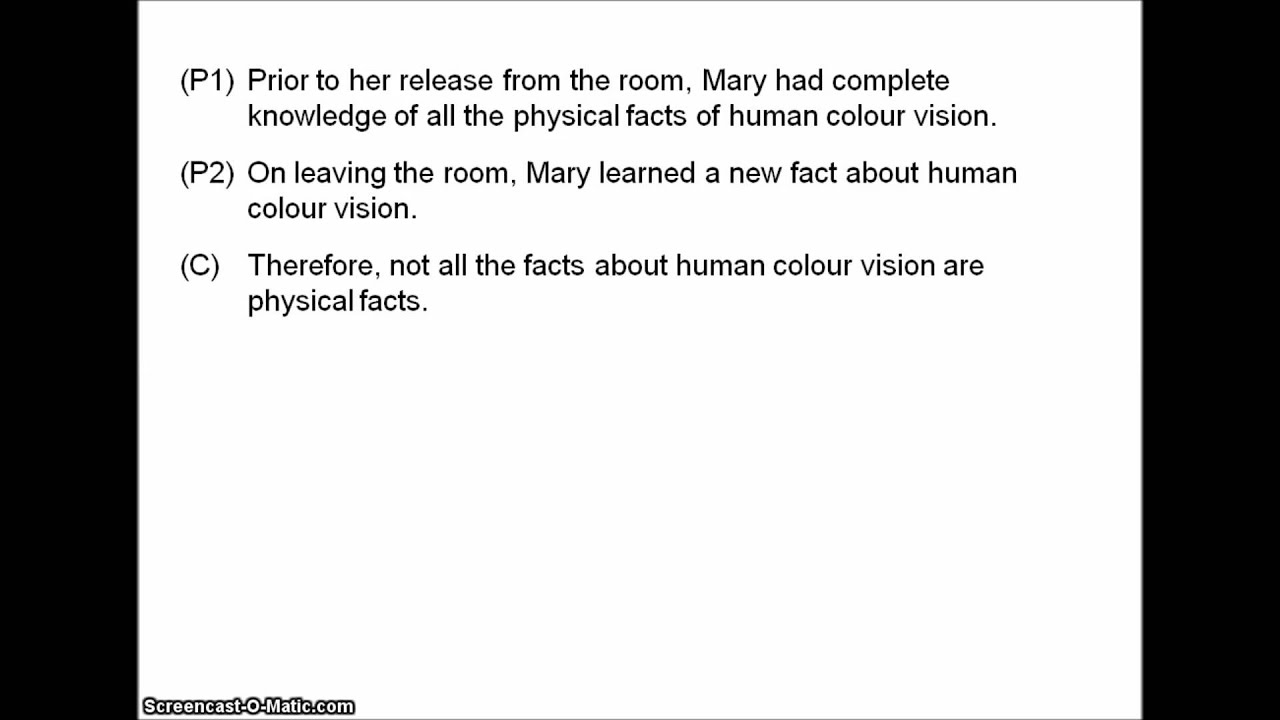
He argued that if Mary already knew all the physical facts about color vision, and experiencing color still teaches her something new, then mental states, like color perception, can't be completely described by physical facts.
The Mary's room thought experiment describes what philosophers call the knowledge argument, that there are non-physical properties and knowledge which can only be discovered through conscious experience.
The knowledge argument contradicts the theory of physicalism, which says that everything, including mental states, has a physical explanation.
To most people hearing Mary's story, it seems intuitively obvious that actually seeing color will be totally different than learning about it.
Therefore, there must be some quality of color vision that transcends its physical description.
The knowledge argument isn't just about color vision.
Mary's room uses color vision to represent conscious experience.
If physical science can't entirely explain color vision, then maybe it can't entirely explain other conscious experiences either.
For instance, we could know every physical detail about the structure and function of someone else's brain, but still not understand what it feels like to be that person.
These ineffable experiences have properties called qualia, subjective qualities that you can't accurately describe or measure.
Qualia are unique to the person experiencing them, like having an itch, being in love, or feeling bored.
Physical facts can't completely explain mental states like this.
Philosophers interested in artificial intelligence have used the knowledge argument to theorize that recreating a physical state won't necessarily recreate a corresponding mental state.
In other words, building a computer which mimicked the function of every single neuron of the human brain won't necessarily create a conscious computerized brain.
Not all philosophers agree that the Mary's room experiment is useful.
Some argue that her extensive knowledge of color vision would have allowed her to create the same mental state produced by actually seeing the color.
The screen malfunction wouldn't show her anything new.
Others say that her knowledge was never complete in the first place because it was based only on those physical facts that can be conveyed in words.
Years after he proposed it, Jackson actually reversed his own stance on his thought experiment.
He decided that even Mary's experience of seeing red still does correspond to a measurable physical event in the brain, not unknowable qualia beyond physical explanation.
But there still isn't a definitive answer to the question of whether Mary would learn anything new when she sees the apple.
Could it be that there are fundamental limits to what we can know about something we can't experience?
And would this mean there are certain aspects of the universe that lie permanently beyond our comprehension?
Or will science and philosophy allow us to overcome our mind's limitations?
Up Next

5:28
Functionalism in Philosophy of Mind | Definition & Examples
@CarneadesOfCyrene
123.3K views•2016-03-20

164:01
John of Damascus on Holy Images: A Theological Defense
@BannedBooks
139 views•2026-04-25

4:57
The Myth of Sisyphus: A Greek Legend of Eternal Punishment
@TEDEd
8.6M views•2018-11-13
10:35
Philosophy Explained: Origins, Metaphysics, Epistemology & Value Theory
@crashcourse
8.1M views•2016-02-08
Related Study Plans & Knowledge Roadmaps
Structured learning paths in Philosophy
philosophy
Frankfurt School: Critical Theory & Culture
01Foundations of the Frankfurt School and Critical Theory
02Horkheimer & Adorno: The Critique of Instrumental Reason
03The Culture Industry and Mass Deception
+ 2 more learning modules
12h5 modules
Explore Roadmap
philosophy
Philosophy of Language: From Frege to Austin
01The Linguistic Turn: An Introduction to Language in Philosophy
02Gottlob Frege: Sense and Reference
03Early Wittgenstein: The Picture Theory of Meaning
+ 3 more learning modules
15h6 modules
Explore Roadmap
philosophy
Feminist Epistemology: Standpoint & Injustice
01Introduction to Epistemology and Feminist Critiques
02Sandra Harding and Standpoint Theory
03Donna Haraway and Situated Knowledges
+ 2 more learning modules
12h5 modules
Explore Roadmap
philosophy
Environmental Philosophy: Ethics & Deep Ecology
01Foundations of Environmental Ethics & Anthropocentrism
02Biocentric Individualism and Animal Liberation
03Ecocentric Holism and Deep Ecology
+ 1 more learning modules
10h4 modules
Explore Roadmap