



![行動主義の学習理論 [1/6]: 行動主義の世界観と人間観](https://i.ytimg.com/vi/vYMq0zVTyA4/maxresdefault.jpg)


![¿PUEDE LA IA PENSAR? (Documental de Filosofía) - El EXPERIMENTO de la HABITACIÓN CHINA [EP.2]](https://i.ytimg.com/vi/syNX0o914r4/maxresdefault.jpg)



![[Seminários GHTC 30 anos] - Abertura / Inteligência humana e tecnologia](https://i.ytimg.com/vi/X465t00tibs/maxresdefault.jpg)




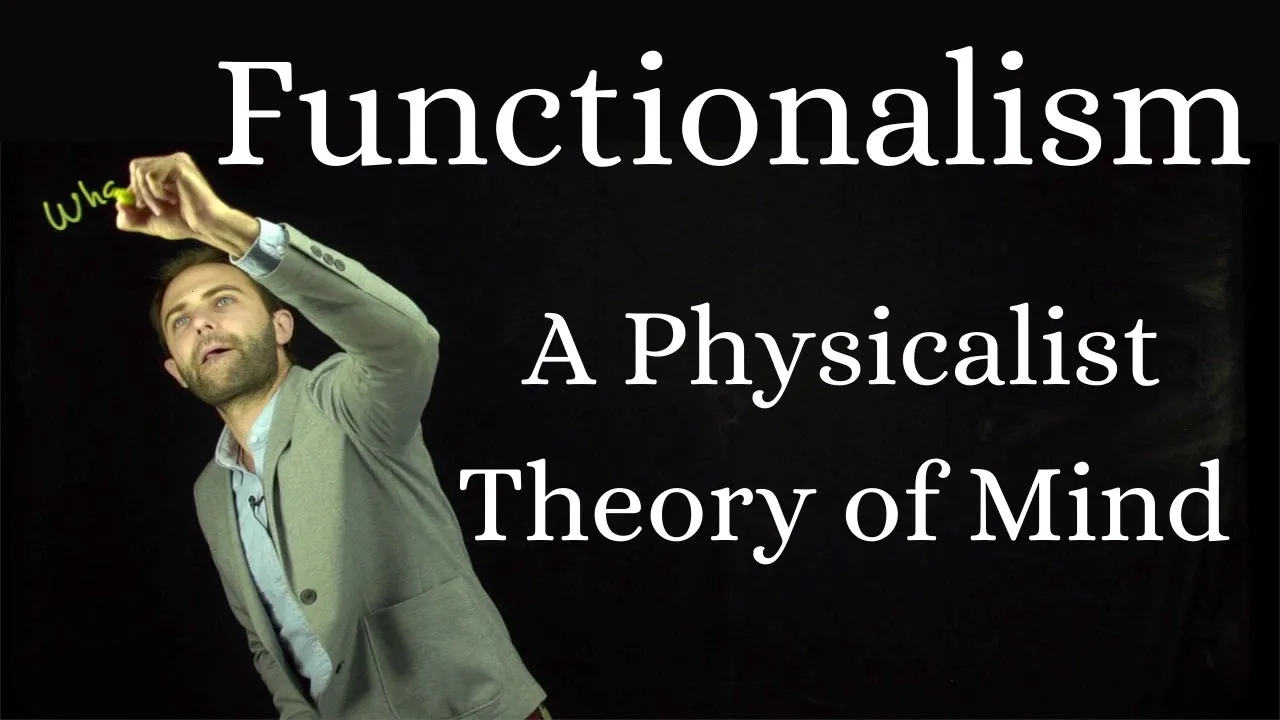
Functionalism is a philosophical position in the philosophy of mind that defines mental states by their functional roles and behavioral outputs rather than their physical composition; according to this view, if something acts like it has a particular mental state (such as fear, happiness, or belief), then it possesses that mental state regardless of what it is made of, meaning the same mental state can be realized by different physical systems like human brains, computers, or alien organisms.
Functionalism in Philosophy of Mind | Definition & Examples
Added:The Mind-Body Problem: Understanding the core philosophical debate regarding the relationship between mental properties and physical properties.
Mind-Brain Identity Theory (Type Physicalism): The ontological view that mental states are identical to specific brain/neurophysiological states.
Philosophical Behaviorism: The theory that mental concepts can be fully explained through observable behavior and behavioral dispositions rather than internal states.
The Concept of Multiple Realizability: Investigating how identical mental states can be realized by entirely different physical substrates (e.g., biological brains vs. silicon chips).
The Chinese Room Argument (John Searle) and Ned Block's 'Chinese Nation': Analyzing key thought experiments designed to challenge the functionalist definition of understanding and consciousness.
Computationalism and Artificial Intelligence: Exploring the philosophical foundation of cognitive science that treats the mind as a software program running on the brain's hardware.
The Problem of Qualia and Subjective Experience: Examining why functionalism struggles to account for 'what it is like' to experience sensations (the 'hard problem' of consciousness).
123.3K views1.4Klikes5:28Original Release: 2016-03-20
welcome back to cares.org today we are going to be continuing with th founding definitions dizzying distinctions and diabolical doctrines a series sorting through some of the jargon of philosophy in this video we're going to be looking at what is functionalism now functionalism is an opinion or position in the philosophy of mind it's pretty interesting position and it's one of the most common first positions you'll run into when you're first looking into philosophy of mind so a while ago quite a while ago we did a video on the Turing test and anyone that's watched that video or watched the lovely movie The imitation game may have a little bit of a sense of what that test is but that test is what gives rise to this intuition behind functionalism so the Turning test gives rise to the intuition that if a computer can act enough like a human such that we cannot tell that that computer is not a human then it is effectively conscious functionalism is basically going to be the formal position which Cod ifies this intuition so the intuition is basically I can't tell that another person is conscious anywhere Beyond just saying that well you kind of act like me and it kind of seems that I'm conscious so it would make sense that you're conscious too so if a computer started doing that or an alien started doing that acting enough like me that I would say well maybe you're conscious then that's all that Consciousness is just the way that one functions the central tenant of functionalism is that mental states are def defined by the way that something functions not its internal composition in other words if something acts like it is conscious then it is conscious if something acts like it's happy then it is happy if something acts like it's afraid or it believes something then it does regardless of what it is made of basically functionalism says that if something acts like a particular mental state then it is that mental state say that fear is a state which the functionalist defines as producing concern for bodily harm and the desire to either fight off an enemy or run from it yes that's an oversimplification of fear but take that definition for the moment it doesn't matter if the biological components like adrenaline are present so long as the products of fear namely that concern for bodily harm and kind of that fight or flight response they could be created by circuits organic compounds large rocks moving in a giant clock whatever you like as long as the products the functions of that emotion or mental state are created then that particular state is going to be defined by the functionalist as fear okay so for the functionalist mental States can be realized by different physical States even if we have drastically different internal components from say alien or synthetic life forms it doesn't mean that we cannot all experience the same kinds of M Al States so for the functionalist just because what it looks like inside my head and what it looks like inside a computer are completely different if me and that computer are acting the same way or me and that alien are acting the same way then we are still having the same experience we're having the same mental States okay because those shared mental states are just realized by different physical States the mental state of fear is realized by either a human or a dog or an alien or a laptop what have you now functionalism is going to be contrasted with something known as the psychophysical identity thesis which simply says that for every mental state there's a physical brain state that is identical to it so for every state of fear fear isn't defined by the consequences of fear or the products of fear but rather a physical arrangement of neurons and chemicals inside one's brain which are identical to it or inside one's body if fear is felt all throughout the body our emotions are nothing more than our physical States so we can't share these emotions with beings that have a different internal makeup than we do even if they act similarly so under these psychophysical identity thesis I might have fear and you might have fear so long as you have the same basic internal makeup that I do but if you are a computer or an alien with drastically different internal makeups then even if we act in the exact same way both of us can't have the same fear that same emotion because we don't have the same physical states that are being shared to a good functionalist such a position may seem very kind of discriminatory or chauvinistic based solely on our species what position is more appealing to you are mental States defined by the way that we act or the physical makeup of our minds this is a good introduction to philosophy of mind hopefully in the future we're going to be doing a lot more videos on philosophy of mind and kind of digging deeper into these Concepts but for now see if you can answer that question in the comments below watch this video and more here at cares.org and stay skeptical everybody
Up Next

98:48
Consciousness, AI, and the Simulation Hypothesis with David Chalmers
@lexfridman
504.3K views•2020-01-29

164:01
John of Damascus on Holy Images: A Theological Defense
@BannedBooks
139 views•2026-04-25

6:07
Gottlob Frege: Founder of Analytic Philosophy and Modern Logic
@CarneadesOfCyrene
15.3K views•2016-12-08
4:57
The Myth of Sisyphus: A Greek Legend of Eternal Punishment
@TEDEd
8.6M views•2018-11-13
Related Study Plans & Knowledge Roadmaps
Structured learning paths in Philosophy
philosophy
Frankfurt School: Critical Theory & Culture
01Foundations of the Frankfurt School and Critical Theory
02Horkheimer & Adorno: The Critique of Instrumental Reason
03The Culture Industry and Mass Deception
+ 2 more learning modules
12h5 modules
Explore Roadmap
philosophy
Philosophy of Language: From Frege to Austin
01The Linguistic Turn: An Introduction to Language in Philosophy
02Gottlob Frege: Sense and Reference
03Early Wittgenstein: The Picture Theory of Meaning
+ 3 more learning modules
15h6 modules
Explore Roadmap
philosophy
Feminist Epistemology: Standpoint & Injustice
01Introduction to Epistemology and Feminist Critiques
02Sandra Harding and Standpoint Theory
03Donna Haraway and Situated Knowledges
+ 2 more learning modules
12h5 modules
Explore Roadmap
philosophy
Environmental Philosophy: Ethics & Deep Ecology
01Foundations of Environmental Ethics & Anthropocentrism
02Biocentric Individualism and Animal Liberation
03Ecocentric Holism and Deep Ecology
+ 1 more learning modules
10h4 modules
Explore Roadmap