


![行動主義の学習理論 [1/6]: 行動主義の世界観と人間観](https://i.ytimg.com/vi/vYMq0zVTyA4/maxresdefault.jpg)















![[Seminários GHTC 30 anos] - Abertura / Inteligência humana e tecnologia](https://i.ytimg.com/vi/X465t00tibs/maxresdefault.jpg)
![¿PUEDE LA IA PENSAR? (Documental de Filosofía) - El EXPERIMENTO de la HABITACIÓN CHINA [EP.2]](https://i.ytimg.com/vi/syNX0o914r4/maxresdefault.jpg)

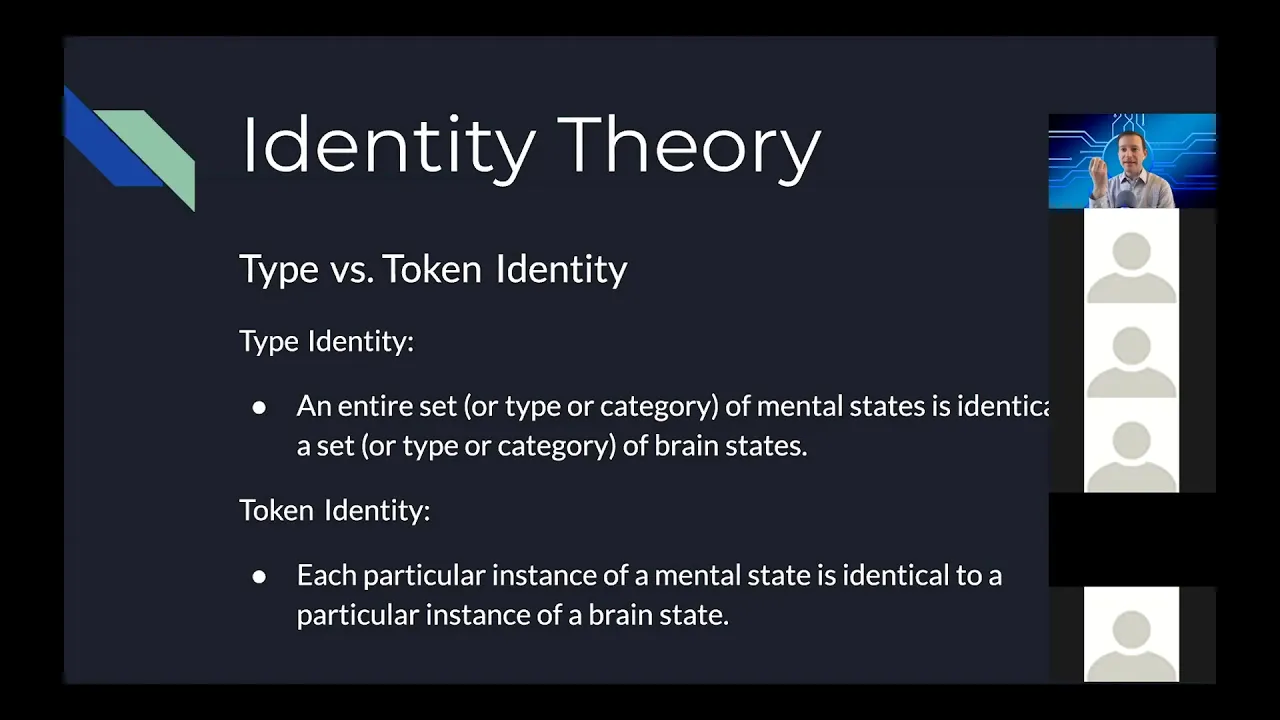

Functionalism is a theory of mind that defines mental states by their functional roles—what they do in terms of inputs and outputs or causes and effects—rather than by their physical composition. This theory emerged as a response to the mind-brain identity theory, which claims that mental states are identical to specific brain states. The key objection to identity theory comes from the concept of multiple realizability: if mental states were truly identical to specific brain states, then creatures with different brain structures (like octopuses) could never experience those mental states. However, since we observe that octopuses clearly experience pain despite having radically different nervous systems, mental states must be functional kinds that can be realized by many different physical systems. Therefore, being in a mental state just is being in a functional state with certain causal relationships, regardless of what physical substrate realizes it.
Functionalism in Philosophy of Mind: Putnam's Multiple Realizability
Added:if you can do the job of a table then you're a table it doesn't matter what you're made out of [Music] today we're talking about one of the most popular perhaps these days the most popular theory in the philosophy of mind and that theory is functionalism one of the earliest proponents of functionalism was hillary putnam we actually read putnam earlier in this course when he was attacking behaviorism that was the whole reading about the super spartans and all that sort of thing anyway we did not read putnam for today instead we read a reading by someone named adam bradley and bradley is really just summarizing the kind of argument that putnam originally made except for putnam's article is very difficult to read and difficult to understand and so in an introductory level course like this we read the much clearer exposition that we got from bradley okay but before we can get on to functionalism itself let's just do a little bit of a recap very very fast recap of the history of the philosophy of mind and this will sort of also be the history of this course up until this point the first philosophical theory of mind that we talked about was the theory that was advocated by rene descartes in the 17th century and that was dualism as you remember dualism was the theory that says that there's two kinds of stuff there's dual two there's the mental stuff and the physical stuff and those are just different fundamentally different kinds of things in the universe and uh well they're separate and so you have a physical body and then you have a mind and the mind is not made up out of physical particles like the body the mind is the kind of thing that thinks and the body is the kind of thing that moves in space and makes contact with other physical bodies and that sort of thing then you'll remember we ran into a big problem for dualism and that problem was presented by princess elizabeth who was a contemporary of descartes and she wrote him letters and explained why if the mind is an immaterial thing then it seems impossible for that immaterial thing to cause events in the body and that's a big problem because we normally think of our mental states like you know my desire to move my hand as being able to cause physical events like the movement of my hand okay so we had a theory of mind the duelist theory from descartes and then we had princess elizabeth's problem for that theory then it was time to move on to physicalism physicalism is the main alternative to dualism it's the view that the mind is real it's just some of the physical stuff in the universe so the mind is made up of atoms just like my hand is made up of atoms but then the question is okay which atoms like which parts of the physical universe are minds and so far we've talked about two theories that try to develop more specific versions of physicalism the first one was behaviorism right that was the view that to be in a mental state was merely to exhibit a certain kind of behavior or be disposed to exhibit a certain kind of behavior and then we had a problem for behaviorism and that was the problem that putnam presented that was the super spartans example and so now we've got a version of physicalism and objection to that and we're going to need another version of physicalism and the next version of physicalism that we talked about was the mind brain identity theory okay so this theory is actually the most important part of this recap like if you mostly understood what i said up here that's fine but you really need to know what i mean by identity theory or that's just a shortened nickname for the full name of the theory which is the mind brain identity theory you really need to know what that is to understand what i'm talking about today because what we're doing today is we're getting two things we're getting an objection that goes here an objection to the identity theory and then we're getting the next version of physicalism that goes down here right so we're doing double duty today we're getting the objection to to the theory from last time and we're getting the next theory the next theory of mind which is functionalism so functionalism is going to go here but before we can say what that is let me just remind you what the identity theory is and really you should probably watch my previous video and i'll put a link in the description to that or whatever about the mind brain identity theory that theory says that the human mind all of your thoughts and your hopes and your beliefs and your desires and your emotions and your sensations all of that stuff that's just some brain stuff being in pain for example that's a state of your mind is just identical to having certain fibers in the brain uh you know zapping each other at a certain rate and in a certain way that's all that the mind is the mind and the brain or at least the mind and parts of the brain are identical they're the same thing okay so now we're ready to start talking about the content that was in the reading for today we're ready to get the objection to the identity theory if you're going to understand this objection then you need to understand what a functional kind is what i've done here is i've written up a kind of definition of functional kind this is the definition that we'll use in this course a functional kind is a kind of thing that is defined in terms of its function or role or job and not the kind of stuff that it happens to be made out of we need an example to understand what's going on here um the example from the reading is a mouse trap you've got mouse traps mouse traps have a job they have a function the function of a mouse trap is to trap mice you've got different kinds of mouse traps right you've got uh the kind that's like a wood board on the bottom and then you put like a piece of cheese there or whatever there's the cheese um and then there's like a piece of metal and uh there's a spring or something i don't really understand how it works and but it's made out of a wood block and some cheese and some metal and when the mouse steps on there the the metal clamps down on the mouse that's one kind of mouse trap and then there are other kinds of mousetraps there are other kinds that are just like cages you know there's a cage and there's a door in the cage and then when the mouse goes in and they touch the cheese or the whatever else is in there right then the cage drops down the door drops down and they're locked in the cage and then there's other kinds of mousetraps too like there's the kind that's just like a sticky piece of paper or something and they get stuck on it those seem especially cruel to me i mean maybe all mouse traps are cruel i don't know i'm not endorsing the use of mouse traps in this video it's just an example from the reading anyway the point is this in order to be a mouse trap all you have to do is do the job it doesn't matter what you're made out of are you made out of metal are you made out of wood and a little bit of metal are you made out of plastic it doesn't matter to be this kind the kind mouse trap to be of that kind you just need to do the job another example is like a table right you know you got a table here the legs and here's the top of the table tables have a function the function is to is to place things on them and have those things not just like fall down and hit the ground and you know you're also supposed to be able to sit at a table or something like that if you can do the job of a table then you're a table it doesn't matter what you're made out of you can make tables out of plastic or wood or metal or glass or wicker or whatever because a table like a mouse trap is the kind of thing that's defined in terms of its function it's the job that matters one last example i am the instructor of this course the instructor is a role that i play right i have other roles i'm also like a dad and i don't know a driver i drive a car sometimes and when i'm driving a car my the role that i'm playing is the role of a driver on the road but in this context i'm an instructor to be the instructor of this course all you have to do is is have this function you know play this role grade the papers and lead the classroom discussions and give the lectures and and all that sort of stuff anything that does that that fulfills this function that does the job is the instructor right it could be me or someone else or a super intelligent robot or an alien or whatever okay so that's what a functional kind is notice though not all kinds of stuff are functional kinds so the example from the reading i think was water but if we want another example think instead of gold gold maybe sort of has a function like tables and mouse traps and instructors i mean what's the function of gold i don't know it's like to be shiny and to to be used to make jewelry i don't think i own any gold jewelry but you know and it's also good for putting into bouillon or i don't know what gold bouillon is but it's a store of value anyway gold has a whole bunch of functions to be gold it's not enough to merely perform the functions of gold whatever those functions happen to be no no to be gold you have to be made of a certain kind of stuff namely you have to be made of atoms with a certain number of protons in the nucleus i don't know how many protons i'll look it up when i'm editing this video but but that's what gold is gold is an element and it's got a certain number of protons if you are not made of the right stuff then you're not gold even if you perform the function of gold like you make up jewelry and whatever um you've got to be made of the right stuff gold is a chemical kind not a functional kind one more quick example cat cat cats are a kind of thing they're a kind and do they have a function i don't know not really maybe like the function of a cat is to be grumpy and to like scratch at your furniture or something like that but whatever the hell the function of a cat is that's not what defines cats as cats what defines a cat as a cat what makes it that kind of thing is its biology its genetics you need to have a certain genetic makeup to count as a cat to count as that kind of thing so a cat is a biological kind not a functional kind so now we know what functional kinds are what's the point of all this well here's the punch line and i'm going to write it up on the board because it's important and i'm probably going to have to erase this the punch line is this functional kinds are multiply realizable that's an important sentence by the end of this lecture video make sure you understand what that sentence means so what does it mean well i need to explain what multiple realizability is this is a point that we've basically already just made and we've now just given a name to it but here's the name and here's the definition that we're going to use in this course a kind is multiply realizable if there are many different physical systems or many different collections of physical stuff that can be of that kind i.e that can make it real think again of the table right you've got the table it's got legs and it's got a top there are many different physical systems there are many different collections of physical stuff that can make up a table that can make a table real if you like that's the realizability bit you get a collection of wood planks and you arrange them in a certain way and you nail them together for the purpose of making a table and then you've got a table that's one way to realize the kind table is with a bunch of wood planks that you put together another way to realize a table is to take like a cardboard moving box you just moved in somewhere so you take a box and you put it down in front of the couch there's your coffee table boom you just did it right that's another way to realize the kind table you just take this other thing cardboard a cardboard box right that's totally different than the wood planks or whatever that you could make a table out of and you place it in a certain part of your home and you start putting things on top of it now you're using the cardboard box as a table that is you're having the cardboard box fulfill a certain function right or a certain role it's now playing the role of coffee table and so it is a coffee table that cardboard box is your coffee table here here's the cardboard box i don't know whatever and whatever now we know what this sentence functional kinds are multiply realizable means it means that if something is of a functional kind then there are many different ways multiple ways to make one of those things you can make it out of all sorts of different stuff all that matters for being of that kind is that you play the role or fulfill the function or whatever okay i think we basically get this point um just sort of to put the final you know bit on it think again of some of the non-functional kinds like a cat cats the kind cat is not multiply realizable typically non-functional kinds are not multiply realizable say you've got some other thing like a little robot that you made and it fulfills the function of your cat right it scratches at your furniture and it comes over and cuddles with you while you're watching television or whatever i don't know whatever your your cat's job is and it and it you know excretes waste into the litter box i guess um and eats cat food sometimes but it's a robot is it a cat no no it's not a cat in order to be a cat you have to have a certain kind of genetics so the kind cat is not multiply realizable there aren't different ways to make a cat the only way to make a cat is with certain genetic material and some fur and some mussels and flesh or whatever that's the only stuff you can use to make a cat whereas there's all sorts of stuff that you can use to make a table so putnam and by extension bradley because bradley's the one that we read uses this concept or this idea the notion of multiple realizability to show that the identity theory of mind is false that's how all this fits together right is that multiple realizability is the thing that's going to go here in this box as an objection to the identity theory and here's how putnam is going to do that he's going to make the following point mental states are multiply realizable okay so to see how this works and why it's relevant imagine an alternative to the identity theory right the identity theory says that the mind and the brain are identical for a moment consider the wood table identity theory the wood table identity theory i'm making it up is the theory that says that you know to be a table just is to be some wood arranged in a certain way wood arranged in a certain way and tables are identical it's the same kind of thing that's not going to work we can disprove that theory because table the kind of thing table is multiply realizable you can make a table out of metal instead of wood so it's just not true to say that tables are identical with wood arranged in a certain way because you can have something that's not wood arranged in a certain way you can have metal or a cardboard box or whatever and it be a table and we can make the same kind of argument against the mind brain identity theory right we can point out that minds or mental states are multiply realizable there's different ways to make a mind other than with brains if it were possible to make minds with something other than human brains if mental states are multiply realizable then no identity theory of the mind is ever going to work because mental states would be a functional kind of thing here on page six of the reading is a sentence that begins to put this point very clearly for the identity theorist things with minds have to be made out of the right kind of stuff brain stuff neurons right that's the point of the identity theory minds are brains but if it turns out that minds are multiply realizable there's different kinds of stuff that you can make a mind out of well then the identity theory is just going to be wrong okay but is this even true is it true that mental states are multiply realizable that that you can make a mind out of different kinds of stuff and it doesn't matter what stuff you make it out of is that even true the argument that we get from the reading for today is yes and the argument centers around octopuses here's the important thing about an octopus an octopus has like totally different internal brain stuff than we do right the octopus is brain an octopus is a weird creature the octopus's brain doesn't look anything like our brain it doesn't have any of the same kinds of neurons it doesn't have any of the same kinds of stuff in there so in the human brain it might be that pain is brain state b but the octopus brain is so different an octopus brain is made out of different stuff it can't get into brain state b it's made out of different stuff it can't be arranged in the same way an octopus brain can only get into brain state o whatever brain state o is we're just making up these labels of course here's the thing if the identity theorist is right and pain is just identical with brain state b then octopuses because they can never be in brain state b because they have totally different brains they can never feel pain that just follows from the identity theory but octopuses obviously can feel pain octopuses are complex organisms with brains and nervous systems and all sorts of stuff and if you you know cut off their tentacle then they wither away they very much seem like they're in pain here's how this point is put in the reading on page seven this is putnam's multiple realizability argument against the mind brain identity theorist because mental states such as pain are multiply realizable any view which identifies mental states with some particular physical state must be false i hope that makes sense at this point right the identity theory says that being in pain just is identical with some specific state of the physical thing namely a human brain but that can't be right because pain and other mental states can be realized in multiple ways some of those ways of course involve human brains but other ways don't and so the identity theory is just wrong anyway that's the argument so now we've got the multiple realizability argument against the identity theory the next thing that we get in this reading and it follows very naturally from that is the statement of functionalism functionalism is the third version of physicalism that we're going to talk about in this course indeed there really only are three major versions of physicalism out there and functionalism is the third and last one okay so like i said functionalism is putnam's theory and we're just reading bradley who summarizes that theory very clearly so let's just sort of write up a definition for what functionalism is okay so this is the definition of functionalism that we're going to use in this course functionalism is the theory that what it is to be in a particular mental state is to be in a functional state which can be specified in terms of inputs and outputs or causes and effects okay so what's going on with all these inputs and output stuff uh where did that come from inputs and outputs or we'll see causes and effects which are a certain type of input and output whatever inputs and outputs are the way that we're understanding the notion of a function so to illustrate this let's just add one more example of a functional kind we didn't talk about this earlier maybe i should have used this earlier because it's a really good example but here's a functional kind of thing a vending machine a vending machine is a functional kind of thing to be a vending machine all you have to do is then you have to play the role of giving me potato chips when i put money inside of you if you can perform that function then you're a vending machine it doesn't matter what you make a vending machine out of you can make it out of plastic or metal or wood or play-doh or whatever i mean it would be hard to make a vending machine out of play-doh but if you were able to do it if you were able to make a machine that took in money and spat out potato chips and crackers and and soft drinks or whatever if your plato machine did that if it played that role if it had that function then it's a vending machine so a vending machine is a functional kind of thing and we specify what its function is in terms of the inputs and the outputs the inputs of a vending machine are cash or like credit cards you swipe your credit card or whatever right there's some inputs and then there's some outputs and the outputs are like bags of potato chips i don't know how to draw a bag of potato chips that's how we specify the role of a vending machine in the reading we get a similar example involving an adding machine an adding machine is a machine that takes certain numbers as inputs and gives you other numbers as outputs and as long as it does that job properly it's an adding machine it doesn't matter what it's made of here's where this is explained it's on page nine what is it for something to be an adding machine an adding machine is anything which takes two numbers as input and gives the arithmetic sum as an output for example which takes the numbers 2 and 3 as input and generates the number 5 as output so we can specify functions or jobs or roles of things in terms of their inputs and outputs and when it comes to mental states at least in the version of functionalism that putnam developed i think he did this back in the 70s or maybe 80s the inputs of mental states are causes what causes those those mental states and the outputs are effects we get a few examples to illustrate this in the reading i think the reading included an example of having a visual experience of the color red that was one example of a mental state specified in terms of its causes and effects and another one is believing something like believing that snow is white uh you know and and bradley goes through examples of the causes and effects let's just make up one now we're going to make up an example of a mental state that someone can be in and specify the inputs and outputs or the causes and the effects and that'll sort of illustrate what functionalism is all about let's go with jealousy jealousy is a possible state of a person's mind that's something about your mind if if you're jealous if we're going to specify the role or the function of jealousy in terms of causes and effects we need to specify what those causes and effects are so like what's something that causes like a jealous episode right that's an event in the mind well it's like seeing a photo of your ex on social media okay there i've drawn a photo of them at the beach in their bathing suits having a good time and in combination with seeing the photo you have some memory in your mind and it's like a memory of what you used to have or whatever i don't know how to draw the memory but i'll just say memory so you see the photo you have the memory those go in those are the inputs those are the causes and then what are the effects what comes out well there's like the like whimpering you whimper and you say stuff like no i'm cool don't worry about me i'm fine there it is we've got our causes and our effects the idea of functionalism is that anything that fits in here anything that takes these causes as inputs and spits out these effects as outputs anything that that functions in here that's jealousy so if an octopus or an alien or a robot or whatever with a totally different brain made out of totally different stuff right can can see a photo and have some memories and that causes whimpering and saying i'm fine or whatever if it can do that if it can take these things as output inputs and spit these things out as outputs well then that thing is jealous it doesn't matter what that thing is made of just like a vending machine any machine that takes the money in and gives the potato chips out is a vending machine so we're basically done right what we've done today is we got an objection the multiple realizability objection to the identity theory and then we got a presentation of functionalism this next physicalist version of a theory of mind here is functionalism in slogan form i'm not going to write this up but maybe i'll add the text in editing when i edit this thing later but here's the point functionalism says if you can do the job then you are the mental state it's the job or the function or the role that matters it doesn't matter what you put in here you can put in here brain state x in human brains made out of human neurons or whatever or you can put brain state g in there in the in the brains of gorillas or octopuses or bats or robots or aliens or whatever it doesn't matter what goes in here as long as it can do the job of taking this stuff and turning it into this stuff if you can do the job then you are the mental state that's functionalism
Up Next
Mary's Room: The Philosophy of Conscious Experience
@TEDEd
4.7M views•2017-01-24

John of Damascus on Holy Images: A Theological Defense
@BannedBooks
139 views•2026-04-25
Bertrand Russell's Theory of Descriptions Explained
@profjeffreykaplan
43.7K views•2026-01-19
The Myth of Sisyphus: A Greek Legend of Eternal Punishment
@TEDEd
8.6M views•2018-11-13
Related Study Plans & Knowledge Roadmaps
Structured learning paths in Philosophy