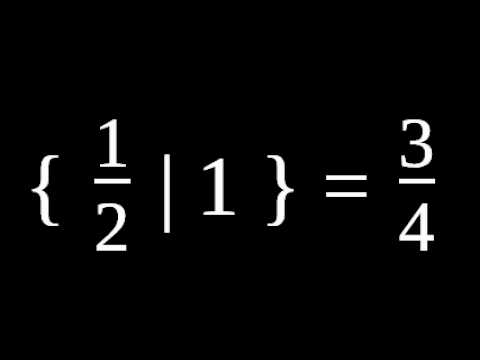





Surreal numbers are a groundbreaking number system invented by John Conway that encompasses all real numbers and infinitely many more numbers between any two real numbers, constructed recursively from two fundamental rules: every surreal number consists of two sets (left and right) of previously created numbers where nothing in the left set is greater than or equal to anything in the right set, and they can be extended to include infinite numbers, infinitesimal numbers, and even numbers like infinity plus one or square root of infinity, which can be added, subtracted, multiplied, and divided just like ordinary numbers.
Surreal Numbers: The Genesis of Conway's Number System
Added:Basic Set Theory and Dedekind Cuts: Understanding how real numbers are constructed from rational numbers using partitions or cuts.
The Concept of Algebraic Fields: Familiarity with ordered fields and how standard arithmetic operations (addition, multiplication) behave under formal axioms.
Mathematical Induction and Transfinite Induction: Comprehending inductive definitions, as surreal numbers are constructed recursively, extending into transfinite stages.
Intuitive Notions of Infinity and Infinitesimals: A baseline understanding of limits, calculus, or non-standard analysis where numbers can be infinitely large or infinitely small.
Combinatorial Game Theory (CGT): Exploring how surreal numbers correspond directly to positions and values in partisan games like Hackenbush, Nim, and Go.
Hyperreal Numbers and Non-standard Analysis: Comparing Conway's surreal numbers with Abraham Robinson's hyperreals to see how infinitesimals are used rigorously in calculus.
Transfinite Ordinal Arithmetic: Studying how Cantor's ordinal numbers embed within the surreal number system and how arithmetic operations differ between them.
Surreal Analysis: Investigating advanced mathematical research into defining functions, limits, derivatives, and integrals within the surreal number field.
556.5K views12.7Klikes14:06Original Release: 2016-06-27
[SFX: waves] I had this hotel room for a week. On the sixth day I finished it.
On the seventh day I rested; and on the seventh day I tried to write a letter to my secretary to tell her how I wanted this to be typed up and I couldn't finish a sentence!
It was gone; the muse was gone. I would start writing and all of a sudden I'd say "Now what was I going to say?"
It was flowing for six days and then it stopped and so I think it's an inspiration that I can't just turn on and turn off, either Well, I understand you've been considering all kinds of numbers under the sun and probably the greatest kind of numbers, because it includes everything, is the surreal numbers.
The name actually came to me in the middle of the night; I have no idea... I have a vague recollection that I saw, at one point, a French paper that talked about 'nombres sur ordinaux' I don't pronounce it well, but sort of sur- ordinal numbers I've never been able to track down that paper and I don't know if I heard about it before or after I thought of the name "surreal" but you'll see that it's a great name after you understand what surreal numbers are.
John Conway invented the concept, and his first description of it was "All numbers great and small" Not only big and small, but *inside* and everything.
So people know what the real numbers are, and I call them surreal because there are infinitely many surreal numbers between any two real numbers.
[off-camera] I thought the numbers between all the other numbers already existed, so...?
-Yes, that's what almost everybody thought except Conway So I learned about it... I happened to be visiting Calgary in Canada at the same day that John Conway was up there, and we had lunch together and he had recently discovered this concept, which we're going to describe. During our lunch he wrote out on a napkin all the rules of... a definition of surreal numbers. I was enchanted by this idea. Of course I had lots of other stuff to do, but I kept the napkin--I took it home with me.
The basic idea: you have a new way to describe all numbers: you build up all numbers starting from nothing, and actually nothing is kind of the representation of 0.
But then you can use 0 to describe another number which turns out to be 1.
And you can use 0 and 1 to make two other numbers, one of which is 2 and one of which is 1/2. And you can continue creating more and more numbers.
It's something like the creation of a universe. Here we're creating a universe of numbers. But the numbers that you get are always... the denominator is always 2 or 4 or 8 or 16 or something... You don't get everything... you'll never get 1/3 throughout the first part of this process, but you keep on creating numbers until you go to infinity. Then a big bang occurs and all of a sudden you get all the real numbers.
The next day after that then you create infinity plus 1 and infinity minus 1 You also have 1 over infinity which is a number that's bigger than 0 but it's less than any positive real number. That's why I started calling them surreal, because there's a number like pi plus one over infinity This is between pi and every real number that's greater than pi And also we keep on going and keep on creating, so at some point we get 1/2 of infinity, and we get square root of infinity, and we get infinity to the infinity.
All these numbers that we get we can add, subtract, multiply, and divide them So it goes way beyond any kind of numbers that people ever conceived of before [off-camera] These sound like tiny slivers that we're dropping into gaps that we didn't even know were there.
-We got the tiny slivers and we also have the reciprocal, 1 over a tiny sliver, which is a gigantic thing, larger than we've ever... people ever thought of before. So that's why Conway called them "All numbers great and small" One night in the middle of the night I said, "Hey, I bet why don't I call them surreal numbers?" But the the main inspiration that I had was, I said "Wait a minute, this is so cool, I think maybe I ought to write a book for high school students that would teach them what surreal numbers are." There was a need for a book that shows how mathematical research is done, and how you take some simple laws and create gigantic universes out of simple laws.
And the process of discovering is something that's usually not taught in schools.
You just are taught the facts, but you don't get to see the thrill of developing these facts. I woke my wife up.
We were on sabbatical year in Norway and I... Well maybe I didn't wake her up till the morning, but anyway I had the idea in the middle of night and I couldn't go to sleep and I said "Wait a minute, a book like this ought to be written." I was already years behind on books that I'd promise to write, and I'm still not done writing... that was 50 years ago But I told my wife, you know Jill, I decided I have to write another book, but it's only gonna take me a week.
She said, well you know that's actually kind of a nice idea......time in your life when you can do this, here we are in sabbatical and so we worked it out that a few weeks later I would rent a hotel room and downtown Oslo and spend a week writing this book. She would come visit me a couple times that week, because we always wondered what it would be like to have an affair in a hotel room! So that was the plan, and it actually worked out so marvelously, it was probably the greatest week of my life.
I started out every morning having a big Norwegian breakfast.
My hotel was very near where Ibsen used to live so I could get some of his vibes at breakfast.
There were a group of 50 American students and I could listen to what they were saying, because I had decided to write this book in dialogue between two characters: Alice and Bill. Might as well show you the book. Here's the book and you can see Alice and Bill here. My wife did the illustrations.
[reading] How two ex-students turned on to pure mathematics and found total happiness If you look on the web you find out that that there's a bimodal distribution of reader comments: there are those who are looking for beautiful mathematics and those people are rating it at five, and then there are people who are looking for a novel and and some cool sex scenes and things like this, and they're reading in a zero and they're saying it's the stupidest thing I ever did and "Why would anybody waste his time?" So it's a kind of a litmus test as to what you like Oh by the way, A is Alice and B is Bill, but there's one line here which is said by Conway and I went and visited John Conway a few months later to try to make sure that I could quote him. So in this particular part, he's... Conway says "Rubbish. Wait until you get to infinite sets."
Alice says "What was that? Did you hear something? It sounded like thunder." Bill says "I'm afraid we'll be getting into the monsoon season pretty soon." [off-camera] Is that the only line from Conway? or is he here multiple times? - I believe it's the only line that Conway has in here. In the book, he's the creator and he's not only J.H. Conway, but he's J. H. W. H. Conway, which is an allusion to the tetragrammaton, the Hebrew name for God. And the characters in the book discover two axioms on a stone tablet and also some markings on the stone tablet: a surreal number consists of two parts and you indicate it by brackets and a colon. You have a bracket on the left. To the left of the colon your put some number and on the right, er... some set of numbers and on the right you put some set of numbers, and then you create more numbers. So you start out with this number which is 0 and if you put 0 on the left, you get a number which called 1 and if you put 0 on the right you get a number which is called minus 1. And this stone that Alice and Bill find has these markings on it, but they have to decode what it means for these markings to do. Even though I have hardly any plot in this book the fact that I do refer to nature and have a little story going on, meant that I was watching everything in the world much more intensely.
Not only was I listening to what these students said at breakfast but I'm also seeing the colors..., the leaves on the trees... everything outside There was more, too, because every morning I was actually trying to create the theory myself.
Conway had told me the thing and I saved the napkin on which he wrote it down, but I lost it, somehow, in the next month, so I had to try to remember it and then I had to try to remember how did he prove all these marvelous things that he had told me about during the lunch? And I purposely didn't plan that in advance, but every day I would work on it and then the mistakes that I would make, the characters in my story would make those mistakes. But then eventually, you know, I got further and further and was able to develop the theory.
[off-camera] Had Conway not published it himself and he just...?
-No, he had the report: "All numbers great and small" was his report.
Then he was writing this book on numbers and games that came out a few years later. But at that point it was brand new [off-camera] If you are so much pleasure from this form of writing, why don't you do it more often?
-Oh no, it's too scary.
It's not sustainable! [laughing] I think you... These are moments that come once in a lifetime. But I think also there was... it wasn't just me, there was something... the ideas were coming to me as if they were being dictated, by some muse. The last thing at night, I'd turn out the light the next several sentences would flow into my head. I couldn't sleep, so I'd turn on the light, I would write down those sentences, but they were coming so fast, I only had time to write the first letter of every word, so I jotted that down, turn out the light, go to sleep. The next morning I can figure out what I was going to say and continue. But if I had been doing that all my life, I think I'd be dead long ago! So the characters discovered this rock and it's covered with Hebrew writing that explains two rules, and everything flows from two rules: The first rule is: every number corresponds to two sets of previously created numbers and furthermore, there's a left set and a right set Nothing on the left is greater than or equal to anything on the right That's the first rule. This makes a new number. The second rule describes what does it mean to be greater than or equal?
So this is the number that we call 0, there's nothing on the left and nothing on the right.
Here we put 0 on the left and nothing on the right, and this is a number that we now call 1, but on the stone that Alice and Bill discover, it was indicated by a vertical line. And if we put 0 on the right and nothing on the left then we get something that on the stone was indicated a by horizontal line. Now this sort of Day Zero is when we got the number 0. The next day we got the number 1, we'll call it Day One. On Day Two, now we can have a set of numbers, so we can put 0 and 1 on the left and nothing on the right, for example. And this is actually... turns out to be 2.
Or we could put 0 on the left and 1 on the right this is the number that turns out... is going to be 1/2. But now, there was a classical definition of real numbers by Dedekind called Dedekind cuts: you have a set of rational numbers on the left and a set of rational numbers on the right. That defines a cut between the two and that gives real numbers. So Conway's genius was that... keep on going and allowing, besides rational numbers, to allow any set of surreal numbers. After i get to a point where 0 and 1... (let me put a comma here) And a 1 and 2, let's call it, and you get all of these here, but nothing on the right, this is infinity. Then we find out what's infinity plus 1? And that turns out... actually got an infinity here,... These rules might have been invented before Dedekind's rules and that everybody for 100 years had learned about this in school, and we'd considered that this is the way numbers are. Then physicists would have said that this is actually part of the real universe, that these numbers aren't strange but that that these are basic. And people probably would have discovered the real numbers as a special subset of the surreal numbers. There's no reason for us to think that the universe obeys the laws of real numbers.
People used to think that the real world had Euclidean geometry, but now people know that space bends. The patterns that are revealed here are as mind-boggling as anything in mathematics and are far from being explored. Every year more and more converts come along and and we find people winning prizes because they've advanced the theory of surreal numbers.
...which is a subtle point... So, I'd lost a napkin but it turned out that the rule that I gave in my first draft during those six days was not his rule actually, but it was subtly different.
Here, for example, is Chinese translation. [Conway]...don't like thinking of my impending death, [pauses] and you know, I haven't got all that many years left... I don't quite know how many
Up Next

52:18
Combinatorial Game Theory: Hackenbush, Part 2 (Advanced Concepts)
@USFMathematicsGraduateSeminar
427 views•2023-10-23
8:17
JEE Maths | Circles: Pole & Polar Explained with Equations
@TargetPublications
14.4K views•2019-02-23
16:19
The Cross Ratio: Geometry of Roberto Carlos' Free Kick
@numberphile
313.4K views•2018-07-06

6:00
The Mathematical Impossibility of Accurate World Maps
@Vox
23.3M views•2016-12-02
Related Study Plans & Knowledge Roadmaps
Structured learning paths in Mathematics
mathematics
Projective Geometry: Coordinates & Conics
01From Euclidean to Projective Space
02Homogeneous Coordinates
03Duality and Projective Transformations
+ 2 more learning modules
14h5 modules
Explore Roadmap
mathematics
Tensor Calculus: Vectors to Riemann Curvature
01Mathematical Foundations: Linear Algebra & Calculus
02Covectors, Dual Spaces, and Tensor Basics
03The Metric Tensor and Index Gymnastics
+ 2 more learning modules
40h5 modules
Explore Roadmap
mathematics
Gödel's Incompleteness: Logic, Proofs & Limits
01Introduction to Formal Systems & Hilbert's Dream
02Set Theory, Cardinality, and Cantor's Diagonal Argument
03Arithmetization and Gödel Numbering
+ 2 more learning modules
14h5 modules
Explore Roadmap
mathematics
Galois Theory: Fields, Groups & Solvability
01Foundations of Abstract Algebra: Groups & Fields
02Polynomials & Field Extensions
03Splitting Fields & Symmetries
+ 2 more learning modules
24h5 modules
Explore Roadmap