

















![[LIVE] GIẢI PHƯƠNG TRÌNH MŨ VÀ LOGARIT _ LỚP 11 _ Thầy Nguyễn Quốc Chí](https://i.ytimg.com/vi/ROBXg_D0Ld0/maxresdefault.jpg)






![COMO APRENDER LOGARITMO EM 15 MINUTOS.[2019]](https://i.ytimg.com/vi_webp/TgZST8VYD8w/maxresdefault.webp)



A logarithm is the inverse operation of exponentiation, meaning it answers the question 'to what power must a base be raised to obtain a given number?' For example, since 2^3 = 8, we say log base 2 of 8 equals 3. Logarithms are only defined for positive numbers (the argument must be greater than 0) and bases must be positive and not equal to 1; attempting to take the logarithm of zero or a negative number results in an undefined value.
Introduction to Logarithms: Inverse of Exponentiation
Added:Understanding the mechanics of exponentiation, including base, exponent, and power (e.g., b^y = x).
Familiarity with basic algebraic manipulation and solving single-variable equations.
The conceptual understanding of mathematical inverse operations (such as addition/subtraction and multiplication/division).
Familiarity with integer and fractional exponents and their basic properties.
Mastering the basic laws and properties of logarithms (product, quotient, and power rules).
Understanding the difference between common logarithms (base 10) and natural logarithms (base e).
Solving more complex exponential and logarithmic equations.
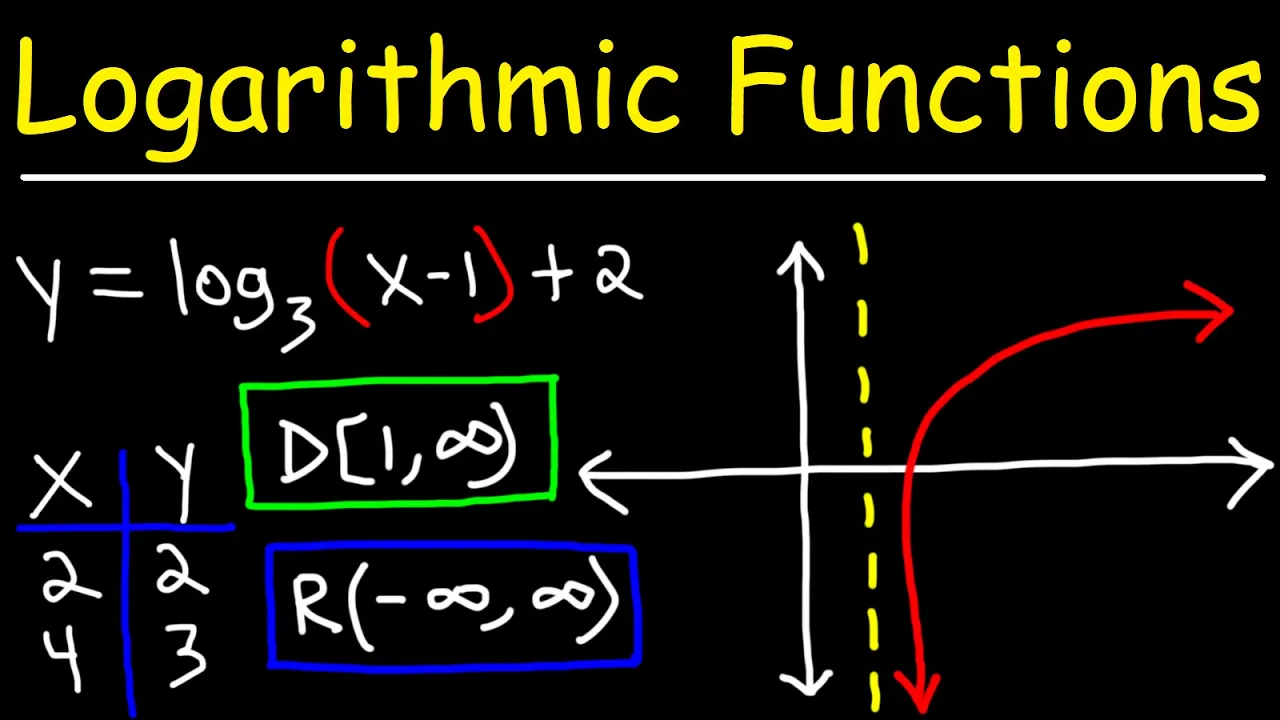
Graphing logarithmic functions and identifying their key features such as vertical asymptotes, domain, and range.
Applying logarithms to real-world scientific scales, such as the Richter scale for earthquakes, pH for acidity, and decibels for sound intensity.
2.3M views22.6Klikes9:48Original Release: 2007-05-17
Welcome to the logarithm presentation.
Let me write down the word logarithm just because it is another strange and unusual word like hypotenuse and it's good to at least, see it once.
Let me get the pen tool working.
Logarithm.
This is one of my most misspelled words.
I went to MIT and actually one of the a cappella groups there, they were called the Logarhythms.
Like rhythm, like music.
But anyway, I'm digressing.
So what is a logarithm?
Well, the easiest way to explain what a logarithm is is to have first-- I guess it's just to say it's the inverse of taking the exponent of something.
Let me explain.
If I said that 2 to the third power-- well, we know that from the exponent modules.
2 the third power, well that's equal to 8.
And once again, this is a 2, it's not a z.
2 to the third power is 8, so it actually turns out that log-- and log is short for the word logarithm.
Log base 2 of eight is equal to 3.
I think when you look at that you're trying to say oh, that's trying to make a little bit of sense.
What this says, if I were to ask you what log base 2 of 8 is, this says 2 to the what power is equal to 8?
So the answer to a logarithm-- you can say the answer to this logarithm expression, or if you evaluate this logarithm expression, you should get a number that is really the exponent that you would have to raised 2 to to get 8.
And once again, that's 3.
Let's do a couple more examples and I think you might get it.
If I were to say log-- what happened to my pen?
log base 4 of 64 is equal to x.
Another way of rewriting this exact equation is to say 4 to the x power is equal to 64.
Or another way to think about it, 4 to what power is equal to 64?
Well, we know that 4 to the third power is 64.
So we know that in this case, this equals 3.
So log base 4 of 64 is equal to 3.
Let me do a bunch of more examples and I think the more examples you see, it'll start to make some sense.
Logarithms are a simple idea, but I think they can get confusing because they're the inverse of exponentiation, which is sometimes itself, a confusing concept.
So what is log base 10 of let's say, 1,000,000.
Put some commas here to make sure.
So this equals question mark.
Well, all we have to ask ourselves is 10 to what power is equal to 1,000,000.
And 10 to any power is actually equal to 1 followed by the power of-- if you say 10 of the fifth power, that's equal to 1 followed by five 0's.
So if we have 1 followed by six 0's this is the same thing as 10 to the sixth power.
So 10 to the sixth power is equal to 1,000,000.
So since 10 to the sixth power is equal to 1,000,000 log base 10 of 1,000,000 is equal to 6.
Just remember, this 6 is an exponent that we raise 10 to to get the 1,000,000.
I know I'm saying this in a hundred different ways and hopefully, one or two of these million different ways that I'm explaining it actually will make sense.
Let's do some more.
Actually, I'll do even a slightly confusing one.
log base 1/2 of 1/8.
Let's say that that equals x.
So let's just remind ourselves, that's just like saying 1/2-- whoops.
1/2.
That's supposed to be parentheses.
To the x power is equal to 1/8.
Well, we know that 1/2 to the third power is equal to 1/8.
So log base 1/2 of 1/8 is equal to 3.
Let me do a bunch of more problems.
Actually, let me mix it up a little bit.
Let's say that log base x of 27 is equal to 3.
What's x?
Well, just like what we did before, this says that x to the third power is equal to 27.
Or x is equal to the cubed root of 27.
And all that means is that there's some number times itself three times that equals 27.
And I think at this point you know that that number would be 3.
x equals 3.
So we could write log base 3 of 27 is equal to 3.
Let me think of another example.
I'm only doing relatively small numbers because I don't have a calculator with me and I have to do them in my head.
So what is log-- let me think about this.
What is log base 100 of 1?
This is a trick problem.
So once again, let's just say that this is equal to question mark.
So remember this is log base 100 hundred of 1.
So this says 100 to the question mark power is equal to 1.
Well, what do we have to raise-- if we have any number and we raise it to what power, when do we get 1?
Well, if you remember from the exponent rules, or actually not the exponent rules, from the exponent modules, anything to the 0-th power is equal to 1.
So we could say 100 to the 0 power equals 1.
So we could say log base 100 hundred of 1 is equal to 0 because 100 to the 0-th power is equal to 1.
Let me ask another question.
What if I were to ask you log, let's say base 2 of 0?
So what is that equal to?
Well, what I'm asking you, I'm saying 2-- let's say that equals x.
2 to some power x is equal to 0.
So what is x?
Well, is there anything that I can raise 2 to the power of to get 0?
No.
So this is undefined.
Undefined or no solution.
There's no number that I can raise 2 to the power of and get 0.
Similarly if I were to ask you log base 3 of let's say, negative 1.
And we're assuming we're dealing with the real numbers, which are most of the numbers that I think at this point you have dealt with.
There's nothing I can raise three 3 to the power of to get a negative number, so this is undefined.
So as long as you have a positive base here, this number, in order to be defined, has to be greater than-- well, it has to be greater than or equal-- no.
It has to be greater than 0.
Not equal to.
It cannot be 0 and it cannot be negative.
Let's do a couple more problems.
I think I have another minute and a half.
You're already prepared to do the level 1 logarithms module, but let's do a couple of more.
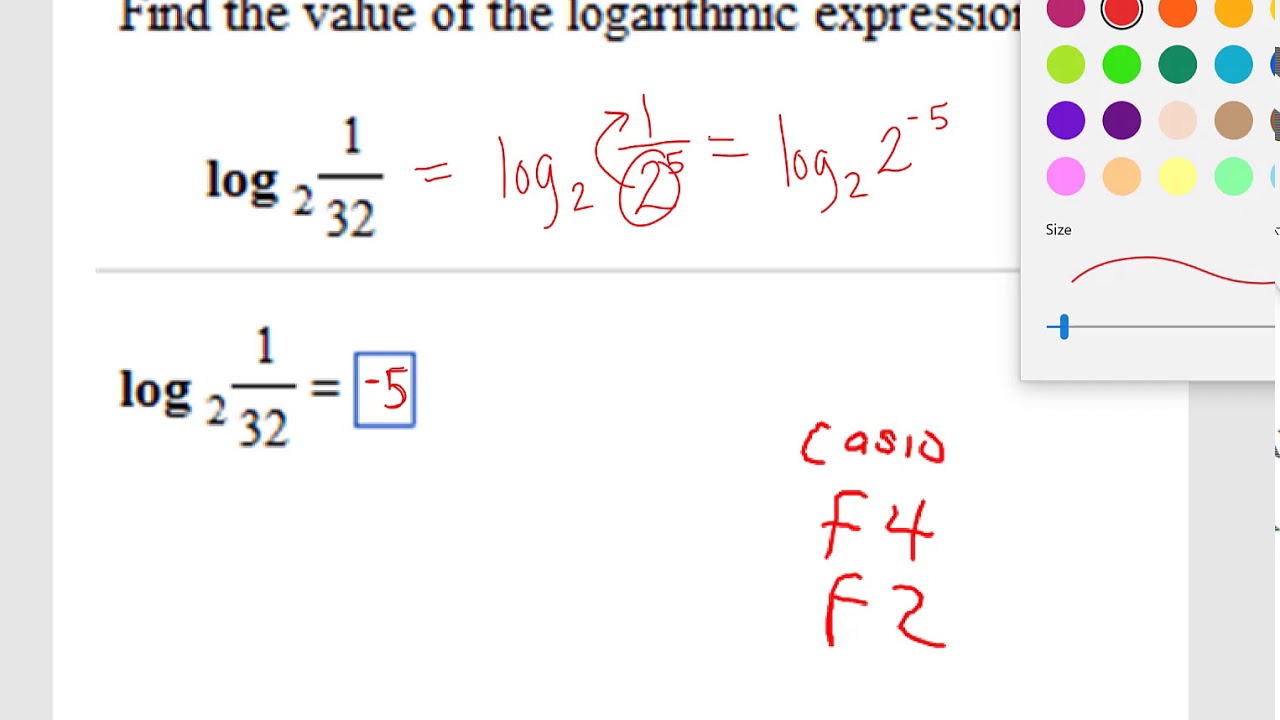
What is log base 8-- I'm going to do a slightly tricky one-- of 1/64.
Interesting.
We know that log base 8 of 64 would equal 2, right?
Because 8 squared is equal to 64.
But 8 to what power equals 1/64?
Well, we learned from the negative exponent module that that is equal to negative 2.
If you remember, 8 to the negative 2 power is the same thing as 1/8 to the 2 power.
8 squared, which is equal to 1/64.
Interesting.
I'll leave this for you to think about.
When you take the inverse of whatever you're taking the logarithm of, it turns the answer negative.
And we'll do a lot more logarithm problems and explore a lot more of the properties of logarithms in future modules.
But I think you're ready at this point to do the level 1 logarithm set of exercises.
See you in the next module.
Up Next

7:04
Shannon's Information Entropy Explained with Yes/No Questions
@ArtOfTheProblem
152.1K views•2013-11-27
4:43
Elliptic Curve Cryptography Explained: ECC, ECDSA, ECDH
@PracticalNetworking
28.5K views•2024-10-21
6:22
Jacobian Matrix Explained | Local Linearity & Transformations
@khanacademy
580.9K views•2017-01-10

6:00
The Mathematical Impossibility of Accurate World Maps
@Vox
23.3M views•2016-12-02
Related Study Plans & Knowledge Roadmaps
Structured learning paths in Mathematics
mathematics
Tensor Calculus: Vectors to Riemann Curvature
01Mathematical Foundations: Linear Algebra & Calculus
02Covectors, Dual Spaces, and Tensor Basics
03The Metric Tensor and Index Gymnastics
+ 2 more learning modules
40h5 modules
Explore Roadmap
mathematics
Gödel's Incompleteness: Logic, Proofs & Limits
01Introduction to Formal Systems & Hilbert's Dream
02Set Theory, Cardinality, and Cantor's Diagonal Argument
03Arithmetization and Gödel Numbering
+ 2 more learning modules
14h5 modules
Explore Roadmap
mathematics
Galois Theory: Fields, Groups & Solvability
01Foundations of Abstract Algebra: Groups & Fields
02Polynomials & Field Extensions
03Splitting Fields & Symmetries
+ 2 more learning modules
24h5 modules
Explore Roadmap
mathematics
Non-Euclidean Geometry: Models & Geodesics
01Euclid's Fifth Postulate and the Birth of New Geometries
02Hyperbolic Space and the Poincaré Disk Model
03Geodesics: Defining Straight Lines in Curved Spaces
+ 2 more learning modules
15h5 modules
Explore Roadmap