



![[오이 과학] 54강 전류, 전압, 저항의 기초이해 [ 14강 리메이크 버전^^] ㅣ 암페어, 볼트, 옴의 단위 ㅣ I, V, R](https://i.ytimg.com/vi_webp/Sc1nX21UQlU/maxresdefault.webp)






















A Battery Management System (BMS) is an embedded system that controls and manages battery packs built from multiple lithium-ion cells, with five primary functional categories: sensing and high voltage control (measuring cell voltages, currents, and temperatures while managing contactors), protection (preventing over-discharge, overcharge, excessive current, and extreme temperatures), interface and communication (providing information to host applications like remaining range and creating diagnostic logs), performance management (estimating state of charge, power limits, and performing cell balancing), and diagnostics (detecting abuse, determining state of health, and predicting remaining battery life). The BMS prioritizes safety (protecting human operators), battery pack protection, prolonging battery life, maintaining functional state, and optimizing performance. Implementation sophistication depends on battery cost and application requirements, with expensive batteries (like electric vehicles) justifying more advanced BMS features.
Battery Management System (BMS) Fundamentals Explained
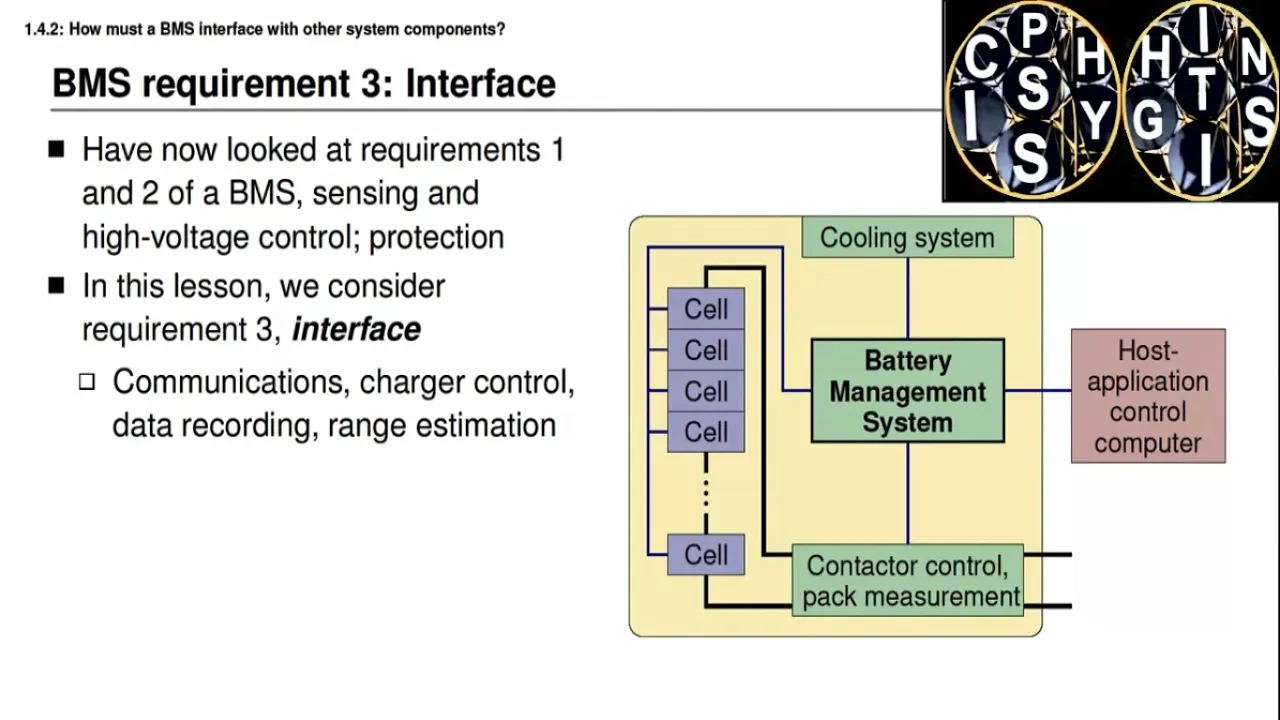
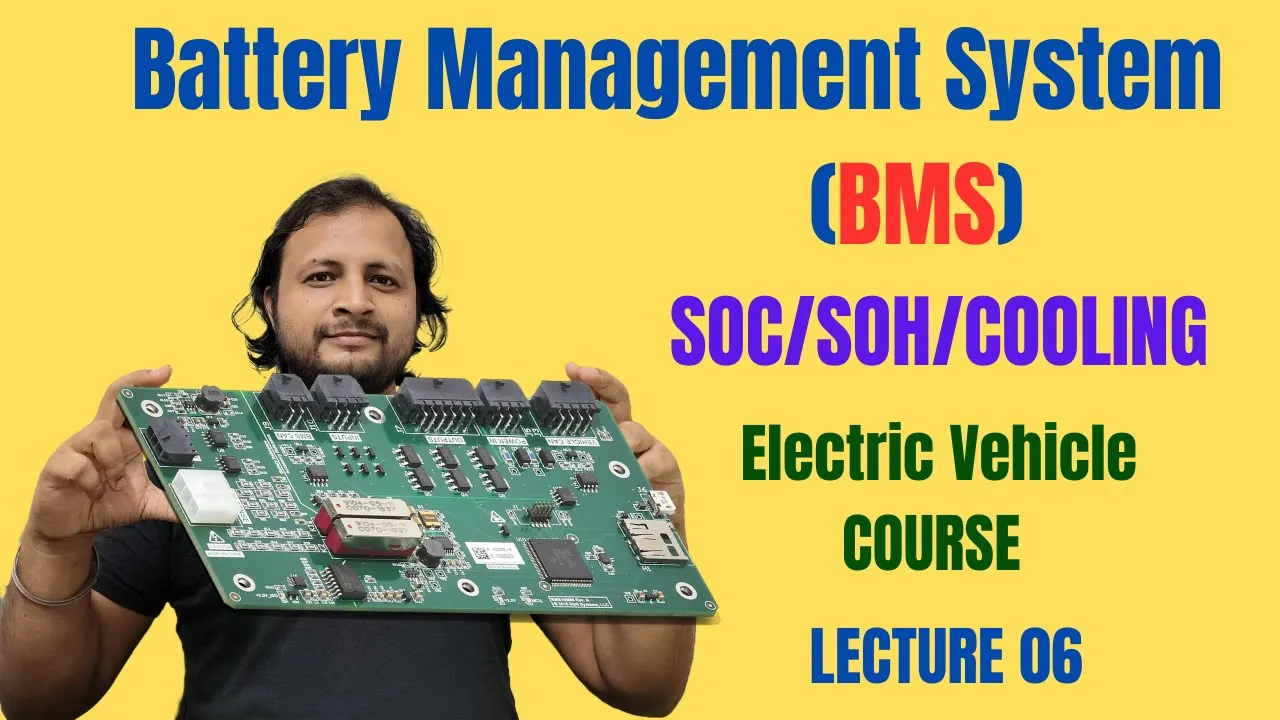
Added:so far in this course who spent looking at how battery cells operate and during the first week you learned how standard electric chemical battery cells work and during the second week you learned more about how lithium-ion battery cells work and how they work a little differently now we're beginning to turn our attention to the battery management system that controls and manages battery packs built from many lithium-ion battery cells and during the next two weeks you're going to learn the principle requirements of a battery management system and some ideas of how those requirements can be satisfied we will not discuss algorithms themselves in any depth we will learn we will leave that for later courses in the specialization to do so again at this point our primary objective is to get a fundamental understanding of what a battery management system is and what it must do remember that a battery management system or a BMS is something that we called an embedded system in the first week of the course an embedded system is made from purpose-built electronics combined with purpose-built software or processing in order to enable a specific application the photograph on this slide shows the battery management system electronics from a Ford c-max Energi plug-in hybrid electric vehicle my research team happened to purchase a battery pack from a totaled vehicle from a salvage yard because we wanted to do some research using the battery cells but when we disassembled the battery pack we also disassembled the battery management system casing to see what was there and this is what we found you can see that this battery management system has a large number of electronic components on a circuit board and around the edges of the board you can see connectors in a variety of different colors most of these connectors are wired directly to the terminals of the cells that enable measuring the individual cell voltages others of the connectors are wired to different other computing elements in the vehicle such as the master vehicle controller and so forth in order to enable the battery management system to communicate with the host application what are the available limits of the of the battery pack all of these connectors turn out to be slightly different mechanically from one another so it's physically impossible to plug in the wrong connector in the wrong connection and when we look at the circuit board itself you can also notice that the color of the circuit board is different on one side from the other the left side of the circuit board houses most of the analog sensing elements that measure voltages in perform balancing that we will discuss in the coming weeks and the right side of the circuit board contains most of the digital elements to do the computations required by the battery management system when we're operating the battery pack and the battery management system the the cells in the battery pack are going to generate some heat because of their some resistance in them and that heat must be dissipated by the thermal management system of the vehicle but it also turns out that the electronics of the battery management system generates heat that must also be managed by the thermal management system of the vehicle so this circuit board that you see on this slide is housed in a metal case using thermally conductive paste so that there's good thermal conductivity but bad electronic conductivity between the components on the circuit board and the metal casing so that heat can be removed from the metal case and in this picture I scraped off that paste so you could see the main circuit elements more clearly the majority of the paste was over the elements in the top and left part of the the battery management system it looks almost like a grid and also over some of the computing elements to the right where the computing elements may generate more heat but on the left side the grid like elements are a lot of individual resistors that are used when balancing the battery pack using a passive balancing scheme where excess energy and some cells is dissipated as heat through these resistors and that heat must be removed through the thermal paste through the casing of the battery management system using the thermal management system of the vehicle the example battery management system on the previous slide was from a vehicle application but regardless of what the application happens to be the battery management system has a few different priorities the first priority is of course safety a battery management system first and foremost is a design to protect the safety of the human operator of the host application so the battery management system must detect unsafe operating conditions and respond to those in some way in some applications the battery management system is not given the authority to take action on its own so in that case it must recommend certain actions to the host application that it can take instead to perhaps turn off the battery system and and shut it down the second priority of a battery management system is to protect the battery pack itself this is especially important if the host application fails in some way and is beginning to cause abuse to the battery pack in many cases the battery pack has some authority to detect these conditions and to disconnect from the load if it is sensing some abuse that would cause damage to the battery pack and especially if it's sensing some abuse that would cause a safety hazard instead a third priority of a battery management system is to prolong the life of the battery as long as possible under normal operating conditions and this is in a non abuse situation when the host application is correctly following all the directives that the battery management system gives we want to make sure that we give those directives in such a way that we maximize performance in some sense but we also maximize the life and we do this generally by informing the host application what is the maximum power that can be drawn from the battery pack or that can be sunk by the battery pack at any point in time over some horizon some time horizon another priority is to maintain the battery pack in a state in which the battery pack is able to fulfill all of its functional design requirements what do I mean in some applications like an automotive application it may be a requirement that under every circumstance I retain enough reserve in my battery pack that I can always accomplish some acceleration and event event for a short period of time or some breaking event for a short period of time so in other words I can give some amount of power or sink some amount of power for a safety reason in that case I must make sure that the state of charge of each of the cells does not get too high so that I can always accept some charge or it doesn't get too low so that I can always deliver some charge to the load so in those cases the battery management system will not give permission to the host application to discharge the battery pack beyond some point or charge beyond some point and the final design priority is performance for the battery management system to inform the host application how to make the best use of the battery pack right now and I might not be near any of the major limits of the battery pack where it might be close to over charge or over discharge but I might still want to know what is the best way to use the battery pack so that I prolong the life and get the most performance possible and we do this usually again by informing the host application what the power limits are right now and sometimes also how to charge the battery pack what is the best profile of charging power versus time to charge this battery pack in a way that extends life the charges quickly in order to achieve these priorities that battery management system must be connected to all of the internal battery pack components to be able to sense and understand what is happening inside of the battery pack and it must also be connected to the host application to be able to communicate with that application to give its recommendations on how the battery pack should be used and the diagram on the right of this slide shows this in a block diagram kind of sense the cells of the battery pack are shown as blue and they're drawn as being connected in series with one another using thick lines to represent the high power primary high current connecting path of the battery and these high power lines are connected to the host application load through devices called contactors which we will study in more detail later on but you can think of the contactor as being a switch and on-off switch that either connects the high voltage high power battery pack to the load or disconnects it from the load under software control the same unit that controls the contactors often does all of the high current and high voltage monitoring of the battery pack and we can also see that the battery management system must be connected to the individual cells and the sense that it must be able to measure all of the cell voltages and perhaps even all of the cell temperatures the battery management system is further connected to the thermal management system the cooling system usually inside the battery pack and so everything that you see inside of the yellow rectangle in the diagram is typically contained inside the enclosure the physical enclosure of the battery pack outside of this enclosure you can see the host application with which the battery management system must constantly be in communication in order to understand the requirements of the host application and an or to convey the limits of the battery pack at this point in time so when we think about how to achieve these priorities we can divide the functionality of the battery management system into a number of major categories and I will outline five major categories and for the remainder of this lesson I will simply identify what those five categories happen to be and then we will spend the remaining part of this week and all of next week looking at these five functional categories in more detail the first requirement that we look at has to do with sensing and high voltage control the battery management system must be able to measure all of the voltages of every cell in the battery pack and it must be able to measure the overall battery pack current and different temperatures inside the battery pack as well in terms of control I must be able to control the contactors that connect the battery pack to the load and disconnect it from the load in order to do that we have to be able to perform an operation called pre charging that you will learn about as well we must be able to detect when there's a ground fault or an isolation Fault between the battery pack and some point that should not be electrically connected but might be under some extreme conditions and the battery management system must also be able to control the thermal management system the second aspect of functionality that we will look at has to do with protection in this case we're thinking primarily of how do we protect the battery pack itself how do we pack protect the battery pack against over discharge and how do we protect it against overcharge and how do we protect against excessive electrical current and how about a short circuit or extreme temperatures the third area functionality has to do with interface and under this category we think about some of the requirements of the host application and how those rely on information that are known inside the battery pack so these might have to do with computing remaining range in an electric vehicle and we certainly need to be able to communicate with the host application itself and in many applications it's also important to create within the battery pack some kind of a permanent record or permanent log of different conditions and have maybe a separate interface for Diagnostics purposes as well the fourth basic area functionality has to do with performance management of the battery pack and this is where we will spend almost all of our time in this specialization learning how to accomplish the requirements of performance management this has to do with being able to estimate the state of the chart state of charge of the battery cells and estimating power limits and how much energy is available and how to do the balancing or the equalization of the cells in the battery pack the fifth and final area of BMS functionality has to do with Diagnostics this has to do with detecting abuse of the battery pack by the host application it has to do with determining the state of health of the battery cells under either normal or abuse conditions and in some cases it also has to do with estimating the present state of life and predicting from that perhaps how much future life we expect the battery pack to deliver before the battery pack must be replaced and recycled as we think of these five major aspects of functionality that are required really in any battery management system it turns out that some applications find these requirements more important than other applications and some applications maybe we don't even implement all of these features because we determine that they are not critical in most cases the question regarding when to implement a feature or not and how much effort we put in to implementing that feature very very well or not has to do with how expensive it is to do so if there were no cost associated with implementing all of these features using the best technology available then of course we would do that but there is a cost associated with each one of these features and so we must make a decision does this cause really is this cost really necessary in this application so I have a rule of thumb to propose to you if you are not familiar with the term a rule of thumb is a broadly applicable principle that is developed by experience this is not something that we can derive with math this is more experiential and a little bit more ad hoc it's not always true but it's true often enough that it can be a guiding principle unless we have some more detailed analysis that contradicts the rule of thumb so the rule of thumb I propose in this case is the following your battery is cheap enough it is inexpensive enough if you cannot remember the last time that you replaced it so for example for my television remote control it's operated using disposable batteries and a few times a year these batteries wear out and I must recycle the old ones and replace the battery cells with new ones and if these batteries were very very expensive then you know I would remember with perfect precision the date and time when I went to the store and purchased a new battery pack because it would be just nagging at the back of my brain at how much I spent to replace the battery and how I could used have used that money for something that was more important to me and how upset I am that I had to replace the battery but it turns out I don't remember the last time I replaced the batteries in my TV remote control and so by this rule of thumb then that must mean that the financial investment in these batteries was low enough that any kind of more advanced circuitry and my television remote control that would have cost more money would not really have been worth it so the battery must have been cheap enough but think about the battery and an electric vehicle the battery in this electric vehicle will cost thousands of dollars or thousands of euros to replace so you know that if I had to replace the battery pack in my electric vehicle I would remember for a very long time and the exact date that I replaced the battery and the exact amount that I paid to do so and may turn out that I would never purchase that vehicle again or anything like that vehicle because I was just so upset by it what do we learn from this rule of thumb we learned that inexpensive batteries don't need to last very long but that large battery packs or expensive batteries need to last as long as physically possible so large battery packs represent a greater investment by the consumer and they motivate better battery management even if it costs more to implement that better battery management this specialization is really focused on large applications with large battery packs for example vehicle applications or maybe Grid applications and the methods that we discussed our very general and they also apply to consumer electronics but you have to make the decision of when does the cost of implementing a sophisticated battery management system with sophisticated algorithms when is that cost okay when is the battery pack so expensive that I can justify this additional cost and honestly the cost isn't that much more than you would using a simpler approach but there is some cost and even for the consumer electronics many mobile phones nowadays have non user replaceable batteries in them so that means that in order to replace the battery you have to make an appointment with some store and you must take your mobile phone to the store physically and you must wait while they replace it and so forth so there's a big opportunity cost in terms of time and even in terms of money to do so so even for a fairly small battery pack you might want to implement the best battery management that you can in order to extend that battery packs life as long as possible to have the greatest consumer acceptance possible because that's what's going to drive future sales and reviews and so forth so in this specialization we will spend the majority of our time investing creating fairly sophisticated methods that work well in any scenario this sophisticated methods may require maybe some more expensive sensors and maybe some more expensive processors than some less sophisticated methods so you may not be able to justify the methods economically in every case we will spend a little bit of time looking at less sophisticated methods and that will allow you to perhaps implement both of them in simulation or even in a prototype to see which one works best for you which is the best trade-off and in the end only you can make the design decision for your particular application as to which is the best method to use but you're going to see that in most cases inexpensive electronics and inexpensive processors only allow for very poor battery management and if you were to spend just a little bit more on electronics and a little bit more for a better processor you can build a much better battery management system that can extend battery pack life and can enhance safety so that brings us to the end of this lesson where you've learned that a battery management system is an embedded system that protects the safety of the host application operator it protects the battery from abuse it prolongs the battery's life it maintains the battery in a functional state and informs the host application regarding how to make best use of the battery pack at this present point in time in order to achieve these priorities we can come up with a list of battery management system functional requirements and place these lists into different categories and the categories that we will look at this week and next are the following five the first that we will look at for the remainder of this week has to do with battery management system sensing and high voltage control next week we begin by looking at protection then we look at interface then at performance management and finally at Diagnostics we noted that there are different levels of sophistication and how a battery management system works and not every battery management system will implement all of the features that we talked about but our focus is going to be on advanced methods that might have a higher cost but give better results in most cases and based on what you learn you will be able to make informed design decisions in your own application as to which features you implement and how to do so you
Up Next
Porsche Taycan High-Voltage Battery Pack Engineering Teardown
@MunroLive
103.1K views•2023-11-13

Ultrasonic Transducers: Resonant Frequency Measurement and Horn Design
@imajeenyus42
229.9K views•2017-02-22

Polymer Environmental Degradation: Mechanisms & Stabilization
@iit
1.8K views•2012-07-10

How a Student's Question Saved a NYC Skyscraper from Collapse
@veritasium
22.8M views•2025-04-26
Related Study Plans & Knowledge Roadmaps
Structured learning paths in Engineering