















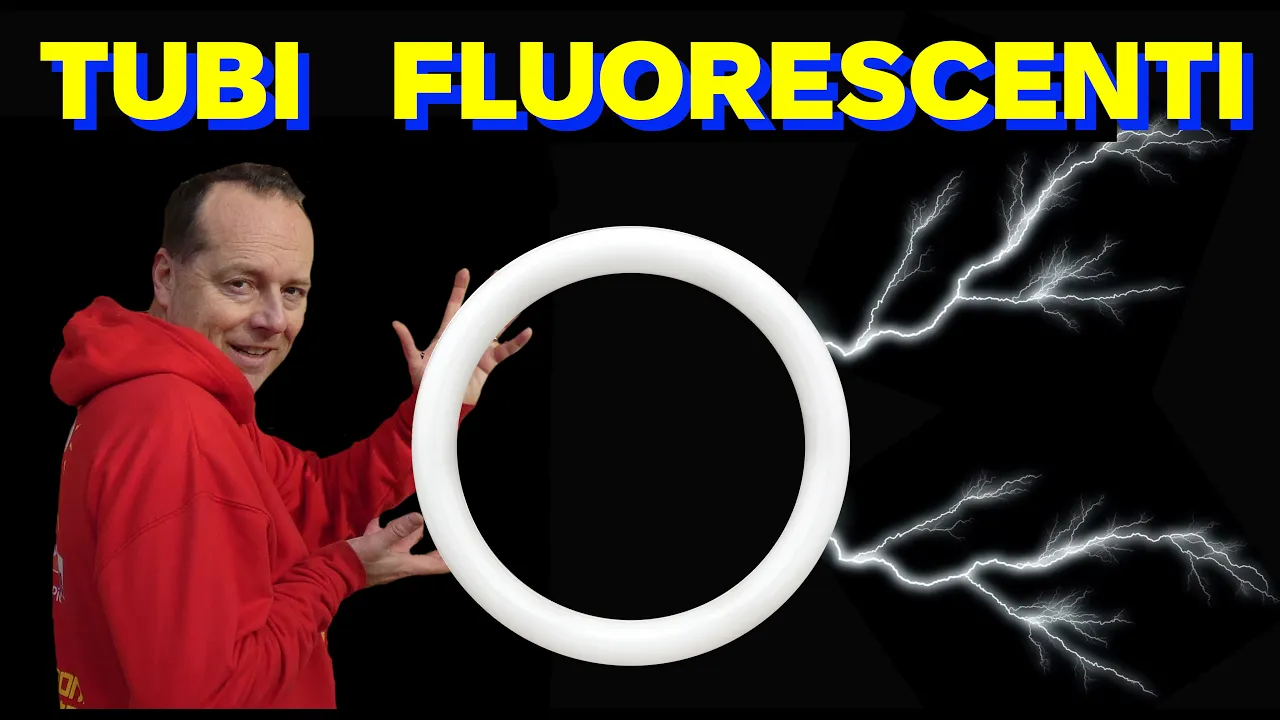

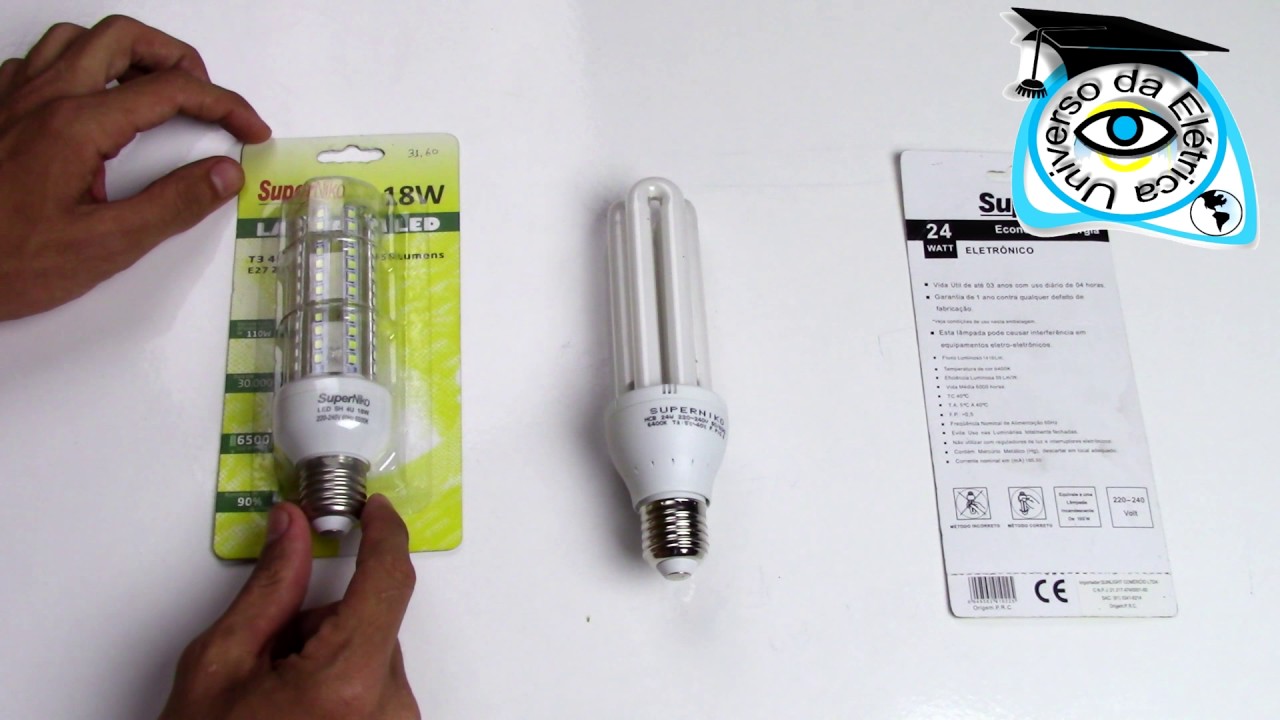


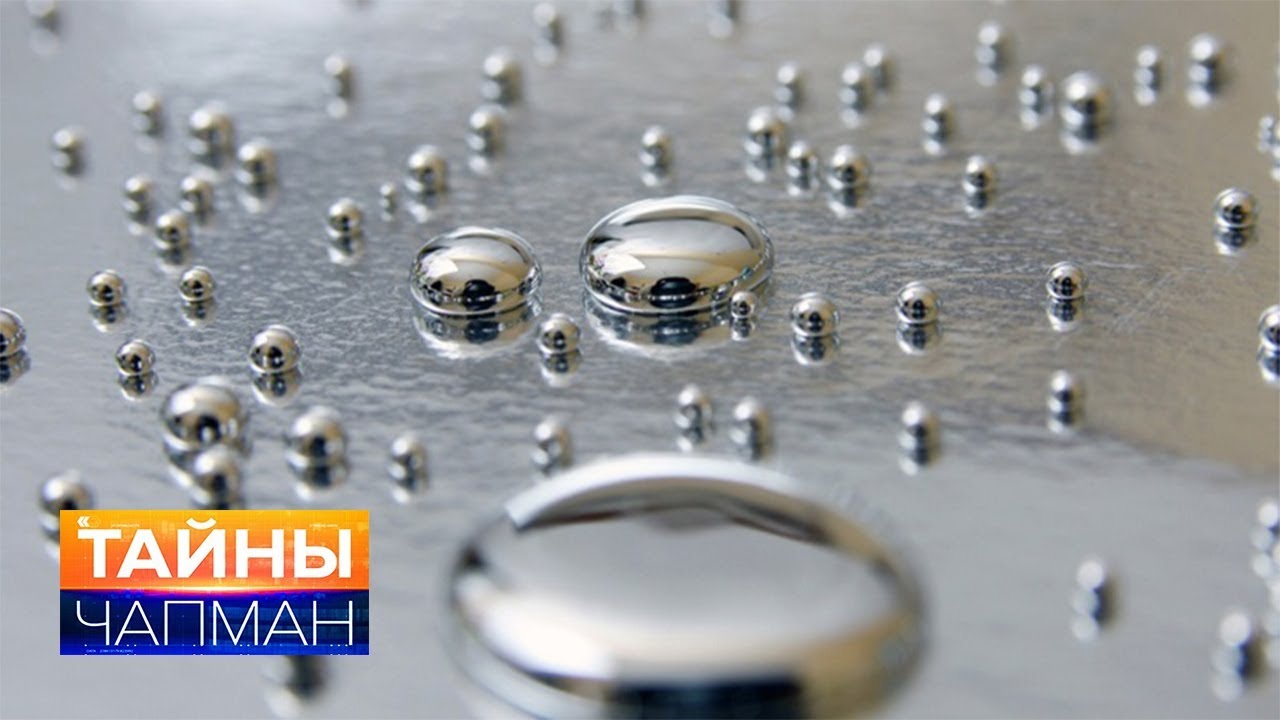


Fluorescent lamps require a three-stage process to operate: first, the filaments at each end are heated by the ballast to vaporize mercury inside the tube; second, a high voltage kick from the collapsing magnetic field in the ballast ionizes the mercury vapor, creating a plasma path; third, the 120V AC maintains the arc through the low-resistance plasma, while the UV light produced excites the phosphor coating to emit visible white light.
How Fluorescent Lamps Work: The Complete Physics & Mechanics Explained
Added:Basic AC circuit theory, specifically the concepts of voltage, current, and how inductors (like ballasts) oppose changes in electrical current.
Atomic structure and quantum energy levels, specifically how bound electrons transition between energy states to absorb and emit photons.
The electromagnetic spectrum, including the physical differences in wavelength and energy between ultraviolet (UV) light and visible light.
The process of gas ionization and the creation of plasma, wherein neutral gas atoms are stripped of electrons to conduct electricity.
The material science of phosphors, exploring how different chemical compounds and rare-earth dopants convert UV light into warm or cool visible light.
Advanced power electronics, specifically the transition from magnetic ballasts to high-frequency electronic ballasts and integrated starter circuits.
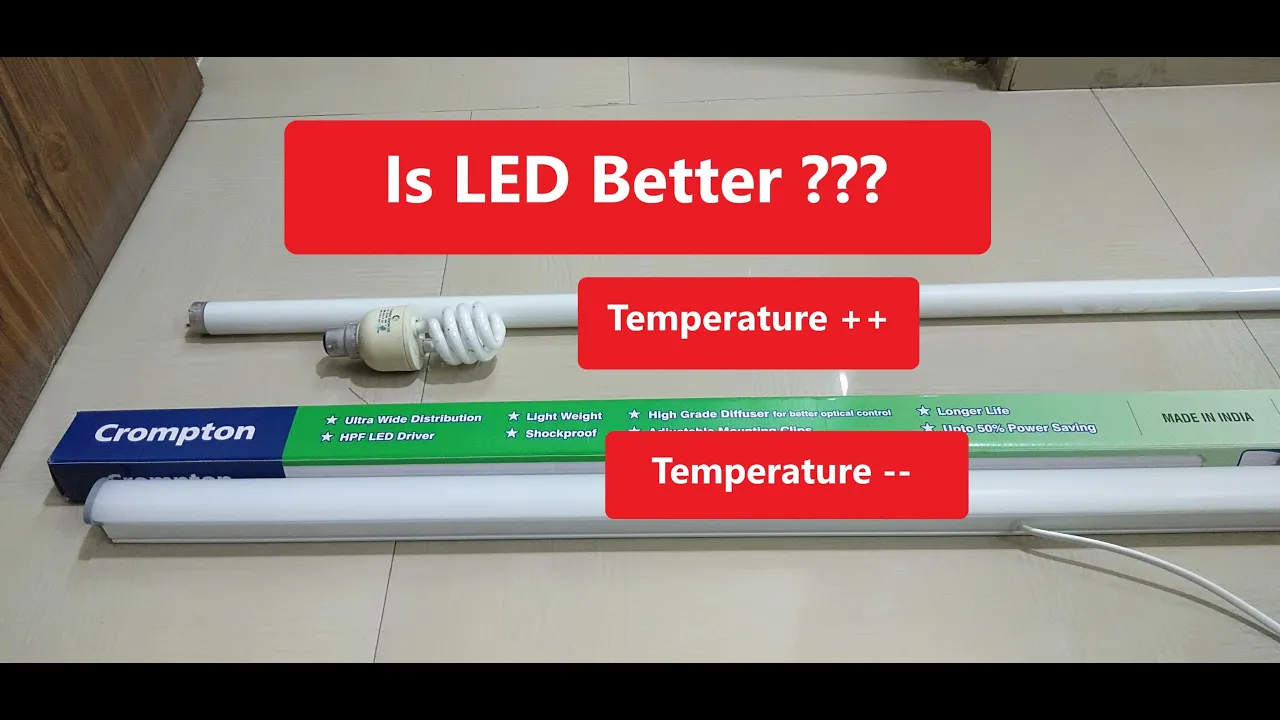
A comparative study of alternative lighting technologies, analyzing the efficiency, lifespans, and physical mechanisms of LEDs versus fluorescent lamps.
Environmental physics and safety, focusing on the handling of mercury vapor in gas-discharge lamps and the recycling of hazardous waste.
4.7M views112Klikes10:02Original Release: 2017-12-22
Hi. I just realized that I've never actually tried to turn on a fluorescent lamp in its intended use and I don't quite know how it works.
So I decided to buy a bunch of lamps and see if I can make at least one of them turn on.
Let's see if we can discover how it works. I know it runs on city voltage, which is 120V AC here.
Let's do some continuity check and figure out what's inside the lamp.
There are two contacts at each end.
*BEEEEEEEEEEEEEEEEEEEEP* These two are shorted. These two are shorted too, and there is no path across the lamp.
So if I understand correctly, there seems to be a filament on each side of the lamp and there is no path between them.
So I'm guessing each filament would turn on like a regular light bulb...? That's odd.
Okay, let's try it.
I have my 120 volt AC live wires here, and I'm just gonna connec- *WRONG CHOICE MEHDI* *Profanity* Handling live loose wires like this is quite dangerous, so I tied one side to the filament and I'm gonna carefully touch the other side of the fila- *More profanity* You know what? F@#$ this. Never handle live loose wires. Always turn off the breaker, make all your connections, and then turn the breaker on.
Okay. Let's turn it on!
*Flash of light, but lamp fails to turn on* What the F@#!?
What happened?
*Trigger mode activated. Intense switch flipping.* The hell? Did it pop? I thought it was designed for 120V AC!
Okay, I have one good filament here, and I connected it to my power supply and I will slowly raise the voltage and see what I see.
It's starting to draw like 0.3A of current.
There's still nothing... Yeah, it's turning on. I don't know if you see it... See? You see that?
Yeah, I think it's turning on, yeah. At 15V, *oop* The F*&!?
Did it pop?! *S**t* It popped at 16V. Does it run on low voltage?
I don't think there's a transformer in the lamp circuit, but the filament definitely doesn't run on 120V.
You know what? I'll place 120V AC across a new lamp and there doesn't seem to be any paths, but there might be some capacitive... whatever.
Let's just try it.
*Braces for impact* *Flicks switch, but all went well...?* *Flicks switch off* *Flicks switch on again* *Flicks switch off again* Nothing... Huh, it's funny. I can turn on a blown fluorescent lamp using wireless power and a sophisticated Tesla circuit, and I can't figure out how it works!
Ooh! (Light bulb!)
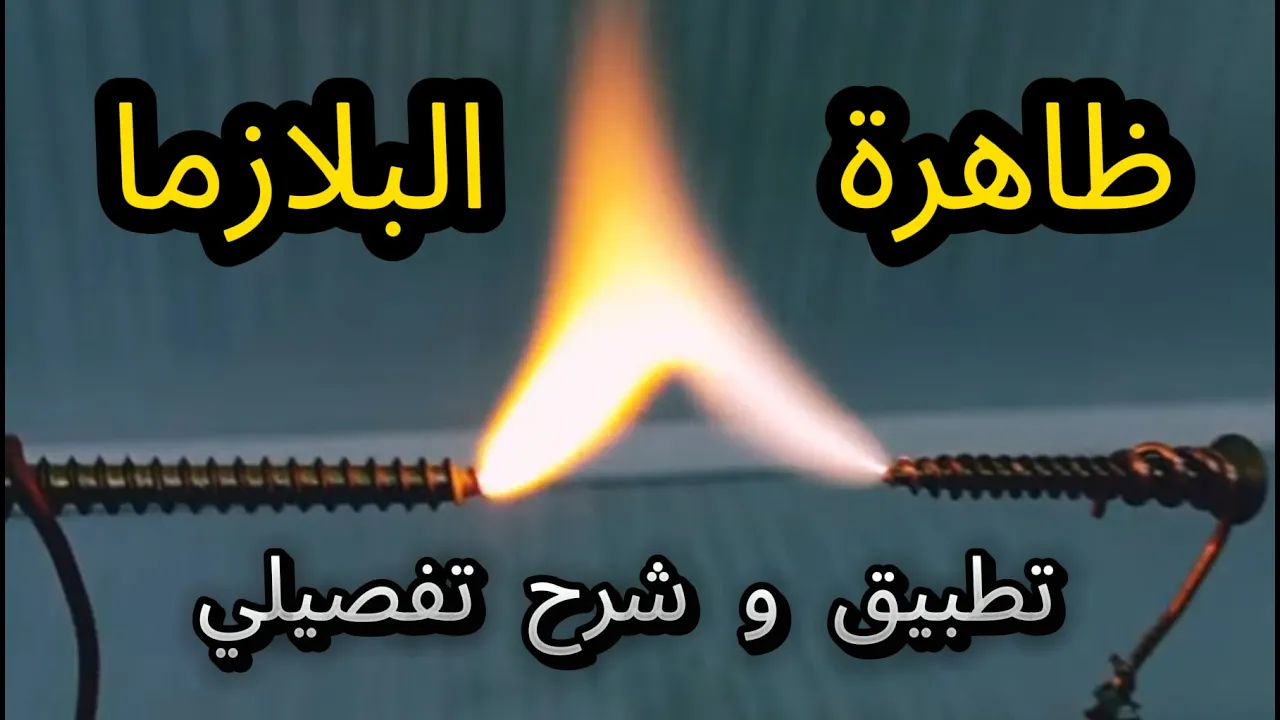
High voltage! It is the super high voltage of the Tesla coil. The energy finds its path through the lamp to my body and the environment.
The gases inside ionize, get excited and start illuminating when energy passes through them.
Oh S$@%.
Apparently it is the mercury vapour inside the lamp that creates UV light when excited. Then the UV light excites the phosphor coating inside the lamp and creates the white visible light.
UV and mercury. They don't sound very safe. The UV converts into regular light, but if you break one of these make sure not to inhale the gases.
Okay, so I need high voltage. But how do I make it besides the Tesla coil?
*DING!* (Idea) Say hello to my microwave transformer. My little friend here has almost killed me once before when I was trying to make a Jacob's Ladder.
*Arc buzzing* *RIP Mehdi* But you know what they say: Kill me once, shame on you. Kill me twice... *realization* Well, you can't kill a dead person again.
"I couldn't have said it better myself."
It's input connects to 120V AC, and at the output it generates around 2500V which I'll connect across the lamp.
Something tells me this is not the right setup but, whatever (YOLO).
*Flickerino switch* *Bright light emerging from the fluorescent lamp* OOH *swearing* *Blows smoke away profusely* *Ape noises* *Last blow* (Relieving sigh) Okay.
*Sniffs and breathes out* Well it kind of turned on, but my alligator clip acted like a fuse. So I have to pick a thicker wire.
There we are.
*Flicks switch, again..* *HALLELUJAH MEHDI* *PROFANITY* *Grunt* *Breaker opens circuit* *Untelligible, followed by more swearing* (Sigh) The breaker popped.
Hmph, it's like a video game where you only get one life, and if you lose you have to throw your computer into garbage.
That's why they call discovering new things the bleeding edge of technology, except that this technology has been bleeding ages ago. People have been using this safely forever.
You know what, a bit of research doesn't hurt. Well... apparently I was partially right. You power the lamp with 120V AC across it AND at the beginning you need to kick-start a lamp with high voltage, AAAAAAND you need to power the filaments at each end at least at the beginning.
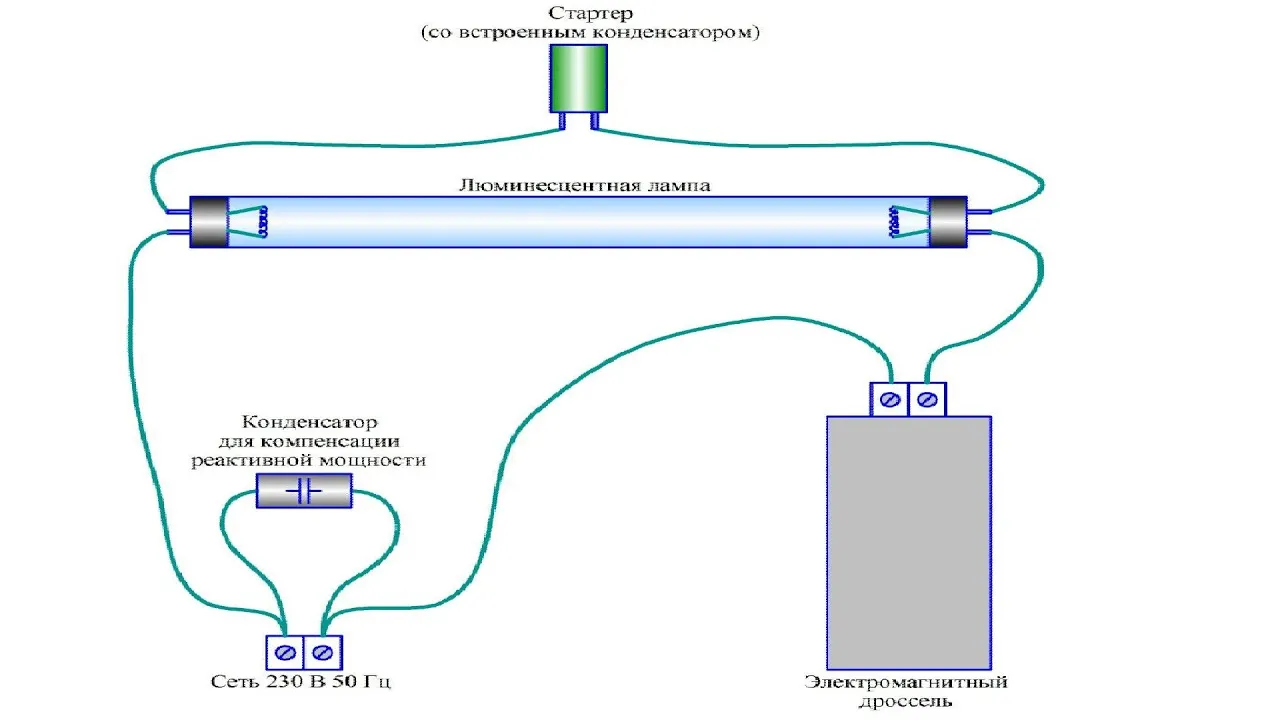
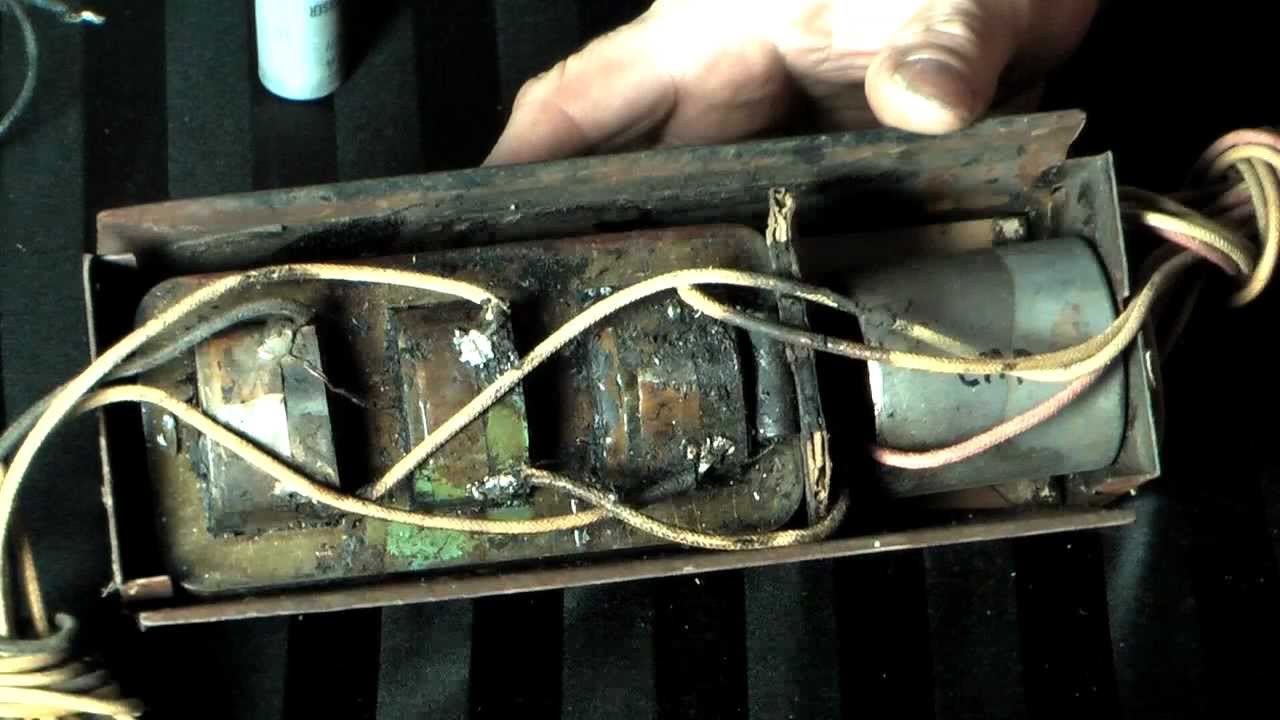
See, in old-fashioned design the AC goes through an inductor called ballast in series with the lamp and goes to the lamp filaments. Then, the other side of the filaments connect to a special switch, which is a gas discharge lamp.
This is called a starter and is a normally open switch.
At the beginning, when you power the circuit and the lamp is off the entire city voltage goes across the starter, and so there will be a tiny arc across the starter plates, and that arc heats up the filaments, and they bend under the heat, and touch each other.
Kind of like those christmas toggling lights, except that... they're different.
So when the starter filaments are shorted that arc goes away and the filaments start to cool down and when they cool down they open up again and the arc comes back and the cycle continues going *Chick chock chick chock chick chock chick chock* When the starter switch is closed the current runs through the ballast and through the filaments of the lamp and two things happen. First is that the filaments heat up, which vaporises the mercury inside the lamp, and that makes it easy for the electrons to fly later, AND also it charges the ballasts with magnetic fields.
When the starter switch opens, all the energy stored in the ballast must go somewhere.
As the magnetic fields collapse, it pushes a very high voltage across the lamp, which is the kick it needs to ionize the gases inside and send an arc through. An arc is a low resistance plasma path.
After the first kick the 120V AC can continue pushing energy through it and keep the path alive.
You create a plasma path with high voltage, but you can maintain it with low voltage.
Well, this is not the same, but kind of similar. Using 2500V I need a very small gap to get the arc going.
*Buzzing from manually created Arc* But after I create the gap I can maintain it with lower power over a wider distance.
*More manually created arcs* See umm, this is very dangerous. Never try this, just watch.
*BUZZZZZZZZZZZZZZZZZZZZZ* The starter switch has to switch a couple of times before there is a proper kick and the lamp can turn on and maintain its function.
You probably remember with this kind of circuit, these lamps flash a couple of times before they stay on, especially in scary movies.
*JIJIZZJIZZJIZZJIZZ* After the lamp turns on, the ballasts also acts as an impedance series with the lamp that limits the voltage across it.
Now that the voltage is lower, the starter switch won't switch either, and the heat generated from the lamp keeps the mercury vaporized.
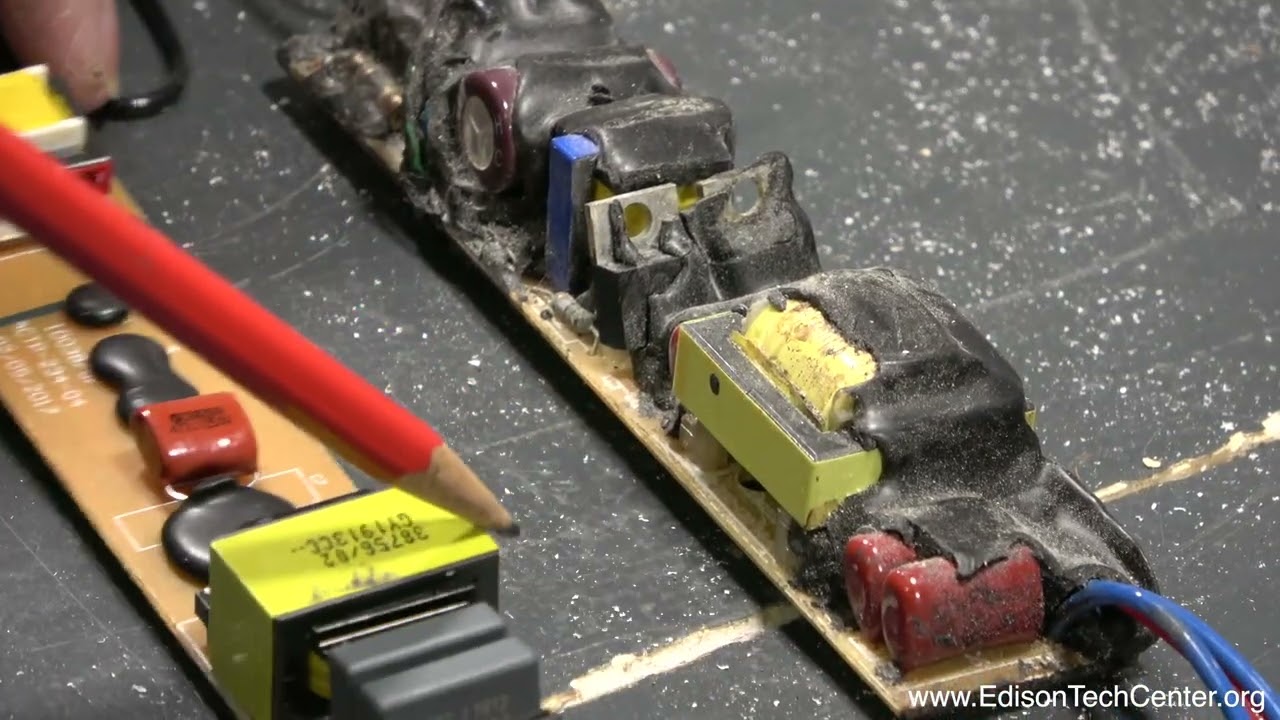
Nowadays, the circuit is replaced with the electronic ballast which turns on the lamp in one shot.
It creates the high voltage kick and maintains a fixed current and controls and everything. You won't see those flashes anymore.
So to turn this on, I need a high voltage kick. I could use my transformer... I will use one of my lamps with blown filaments.
I connect a 120V AC on this side and then momentarily touch the other side with the 2.5k voltage to kick-start it.
Okay. Let's kick it *Flicks switch* *Transformer buzzing* *Arcing, and lamp turns on* S&^!%. Oh Oh Oh Oh!
(Talking to fluorescent lamp) You want to keep up!
Come on!
(Frustrated) AHhh Seems like the 120V doesn't want to keep it on.
Likely because the filaments are blown. I guess I have to find another way.
I don't have a ballast or a starter. I need to find an inductor. Oh yes!
Oop, yep.
*Mehdi sounds* Say hello to my "little" auto transformer.
Every transformer of course has two inductors, but I think this makes a better ballast.
I'll use its outputs because then I can change its inductance and see the effect.
Okay, everything is set up as the normal circuit, just that I don't have this starter switch, so I have to act like one and short the contacts. Let's do it!
*Whoop* There you go!
You probably can't see it, but there are some tiny arcs jumping between the contacts.
*Whispers* Come on!
National Geographic: And here, we have a wild Mehdi in his natural habitat trying to light a lamp. A very smart creature indeed.
Primitive technology: How to start a light.
LOL Ooh! You see? I see the light flickering once in a while.
Maybe if I change the inductance a bit... There are these tiny arcs when I disconnect the contacts.
*Mehdi starts to get irritated* *Drops wires dramatically* (Mehdi's caveman celebratory voice) Oooooooooooooooooooooooooooooooooooooooooooooooooooooooooooooooooooooooooooooooooooooooooooooooooooooooooooooooooooooooh yeah.
*Weird Mehdi celebratory noises* Finally it's on. And if I change the inductance, the brightness changes a little bit too, because the voltage across the lamp changes.
Well like I said, nobody uses this old type of circuit anyways, and frankly fluorescent lights are being replaced with LEDs.
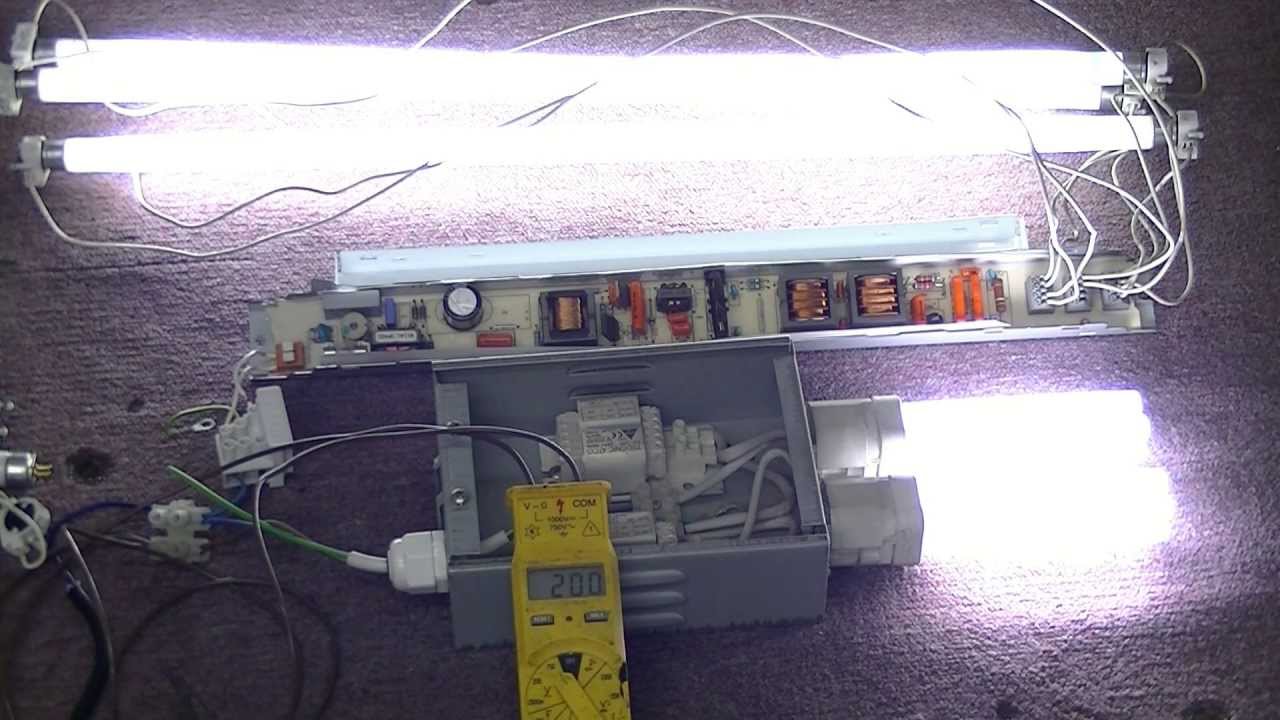
But anyways, I went and bought one of these electronic ballasts. It handles everything internally with all the safety and protection, and it even has the circuit printed on the label.
See? Let's wire it up.
Okay, all wired.
*The "moment of truth" switch flick* *Lamp turns on almost immediately with no trouble* HAAAAAAAAAAAAA It's a christmas miracle! (chuckles) I'm happy. It feels good to know you know, and happy holidays to everyone!
(Choir) GIVEAWAY T- I SAID, HAPPY HOLIDAYS TO EVERYONE!
Subtitle creator: Aw, no giveaways? :C FIN, with Mehdi's majestic unibrow dance.
APPLES
Up Next

97:24
Debugging Embedded Devices with GDB: Lessons Learned
@LinuxfoundationOrg
18.3K views•2020-09-11

48:00
Clean Water, Green Concrete & Nickel from Plants: Sustainable Inventions Explained
@business
94.3K views•2025-11-06
20:32
Brushed DC Motor Drivers: Theory, PWM, and H-Bridge Design
@ElectroBOOM
4M views•2019-01-25
33:39
How a Student's Question Saved a NYC Skyscraper from Collapse
@veritasium
22.8M views•2025-04-26
Related Study Plans & Knowledge Roadmaps
Structured learning paths in Engineering
engineering
Building Acoustic Levitators: Physics & Arduino
01The Physics of Sound and Standing Waves
02Piezoelectric Transducers and H-Bridge Drivers
03Arduino Programming: Generating 40 kHz Signals
+ 2 more learning modules
14h5 modules
Explore Roadmap
engineering
Building Peltier Cloud Chambers: Particle Tracks
01Cosmic Rays & Cloud Chamber Physics
02Thermoelectric Cooling (TEC) Fundamentals
03Custom Liquid-Cooling Loop Design
+ 2 more learning modules
18h5 modules
Explore Roadmap
engineering
Yagi-Uda Antennas: Modeling, Build & VNA Test
01Introduction to RF and Antenna Fundamentals
02Yagi-Uda Antenna Design Principles
03Antenna Modeling and Simulation in 4NEC2
+ 2 more learning modules
18h5 modules
Explore Roadmap
engineering
ECG Monitor Design: Op-Amps, Filters & Noise
01Electronics & Breadboard Basics
02Op-Amps and Instrumentation Amplifiers
03Bioelectricity and ECG Fundamentals
+ 2 more learning modules
18h5 modules
Explore Roadmap