






















![[생활과 윤리 강의-31강] 환경윤리 입장 구분하는 방법 | 도덕적 행위주체, 도덕적 고려대상 | 개체론, 전체론 | 인간중심주의, 탈인간중심주의](https://i.ytimg.com/vi/lg9eJ2xyHEc/sddefault.jpg)




Environmental ethics is an emerging discipline in applied philosophy that examines how humans ought to interact with the non-human world, addressing unprecedented anthropogenic changes to Earth's ecosystems. The field emerged from key historical developments including Aldo Leopold's land ethic (1940s), Rachel Carson's 'Silent Spring' (1962), Arne Naess's deep ecology (1973), Peter Singer's animal liberation (1975), and Paul Taylor's biocentric theory (1986). Central to environmental ethics are three fundamental questions: which ethical theories apply to human-environment relations, how we value the environment (instrumentally or intrinsically), and whether we adopt anthropocentric (human-centered) or non-anthropocentric ethics. The debate between anthropocentrism (which holds only human interests matter) and non-anthropocentrism (which extends moral consideration to non-human nature) continues to shape contemporary environmental discourse.
Environmental Ethics: Anthropocentrism, Biocentrism & Ecocentrism
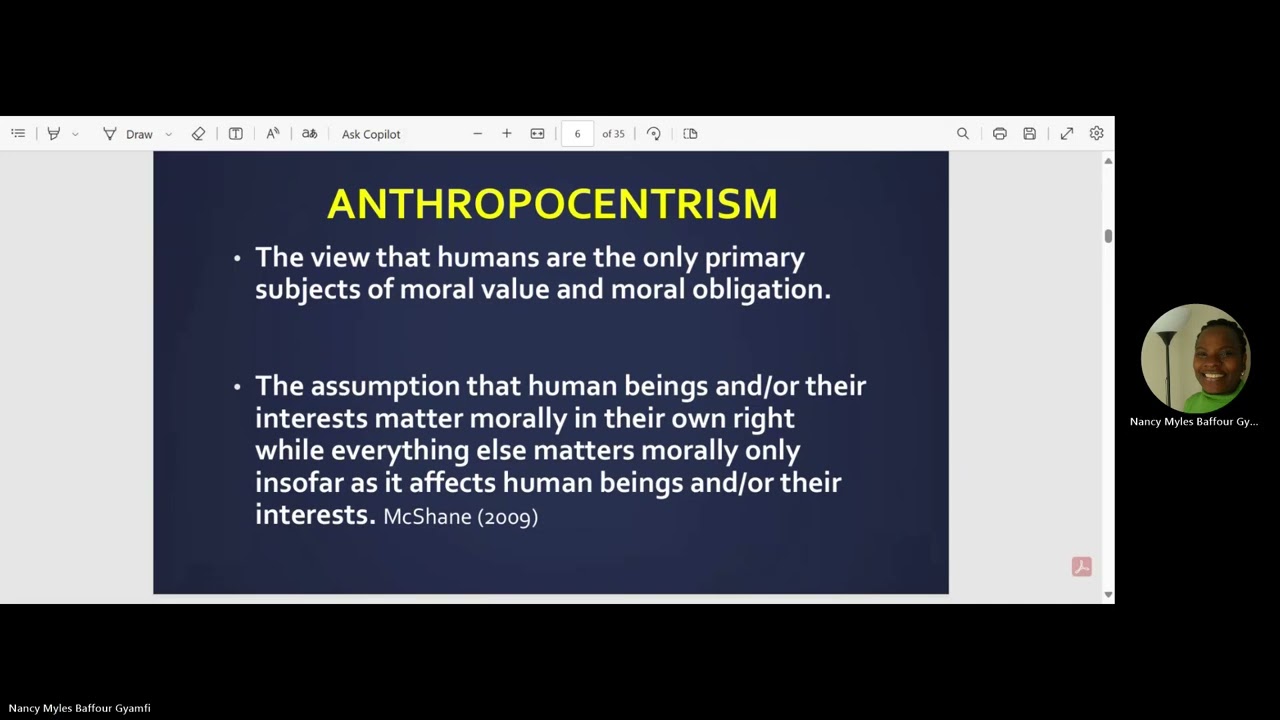
Added:[Music] today we shall talk about environmental ethics have you heard of the term anthropocene at the start of the 21st century anthropos scine became an environmental b word the term was actually coined by biologist Eugene Stormer and chemist Paul cron in 2000 well the anthropos epoch is an unofficial unit of geologic time that is used to describe the most recent period in Earth's history when human activity started to have a significant impact on the planet's climate and ecosystems well the debate on whether we are there yet or if we are there when did this start is not of much importance in our discussion for today but I mentioned anthropos sin because whether it is backed up by hard science or you know mere pop culture it is actually hard to deny that uh the human activities have been causing lot of changes in the landscape of the earth climate plants and animals around us and even the way we humans live our lives of course you can be about it and say well uh there's nothing unprecedented in all these changes that uh that are happening by the way heraclitus is a presocratic philosopher who once said you cannot step on the same river twice his claim is that everything changes the universe keeps on changing everything is in flux Panay so if if you're familiar with what you know the the cliche the only thing in this world that does not change is change well that's herac and so you you can opt to believe that well you know just like heraclitus there's nothing unprecedented in all these changes so what is the difference the changes that we have right now appear to be so drastic they happen so fast and second they seem to be predominantly caused by one species alone humans and what is said to be well for the scholars what is said to be more unique with what is happening is that we the species actually know that we are doing it that we are causing the changes so questions concerning how human beings do and should interact with the non-human world have long existed throughout the recorded human history and since these are questions on how humans ought to act and relate with a certain ex then they become legitimate concerns of Ethics ethics however for a long time has been concerned primarily with the relationship among humans relationship with our neighbors our friends our families or in the vertical Dimension the transcendental relationship that we have with the Divine me and my God in recent years however we realize the need for an ethic that will appraise our dealings with the land the plants and animals and all the other parts of the environment well this is because we bear witness to the unprecedented anthropogenic changes in the environment well the possible markers of the anthropos which have resulted in various ecological problems rivers are polluted mountains flattened we consume resources to depletion climate change among so many others and as rational and reflective beings we can actually make critical assessments of these problems from the frame of our moral relationship with nature we don't make any assumption here that the nonhumans or the non-human environment will be able to you know enter a reciprocal uh ethical relationship with humans the non-humans and the natural environment actually lacked the capacity of reflective thinking they could not understand much more act in accordance with what is right and what is wrong what is good and bad well as our dogs may not be capable of reflective thinking we cannot expect them to act ethically around us so when a dog bit a human we cannot say the dog has wronged the human but if the human bites the dog well that's another story and that could be of ethical concern that could be a very good subject of an ethical discourse in other words humans remain to be the moral agents here making moral decisions but now since humans are reflective beings it is expected that since they know how their actions affect the environment then there will be a recognition of those who or which are somehow affected by their actions well these are the moral patients moral patients are in general the things that are valuable and at the same time well vulnerable to Human Action in a variety of different ways well it is environmental ethics then that can actually provide the philosophical approach to this through a DI set of religious indigenous cultural perspectives and of course the traditional ethical theories environmental ethics actually facilitates the application of uh the ethical perspectives and principles to environmental issues and problems as we continue to Define human relationship with the environment well I used to say this uh in the early 90s not to my classes when I started teaching environmental ethics as a special H special problem in Practical ethics I used to tell my students well environmental ethics you know is an emerging discipline in applied ethics well these days such claim is no longer true well this is an area of Applied philosophy that has gained a strong ground with its voluminous scholarship that continuously grows and offers developing theories and ways of understanding human relationships with the environment so let me share with you an overview of environmental ethics the literature in environmental ethics that was shared by by CLA Palmer so that we can have a rough sketch of the historical development of uh this particular discipline well I also took the liberty to add a few which I think are also relevant in accounting for the mainstream philosophical environmental ethics it all started I would like to say with the work of Aldo lupold the father of the land eth ethics Leupold was a conservationist he was a Forester and eventually became an ethicist no he was distressed at the degradation of the environment and argued that we must begin to realize our symbiotic relationship to Earth so that we could value the land or for him when he talks about the land you know it is not uh it does not only refer to the soil but it refers to the flora fauna even the natural processes that go goes on in the in the land so by the land or the biotic Community for its own sake that we start to see ourselves not as conquerors of the land but as plain members and citizens of the biotic Community another Monumental work was that of Rachel Carson Silent Spring this was released this was published in 1962 and in the book Carson actually warned us of the dangers of DDT or the toxic pesticide residues to humans and to Wildlife this particular work actually sparked the environmental movement that we know today well shortly after 1970 was the celebration of the first Earth Day this was when you know environmentalists got together and uh started calling for the preservation of the earth that was April 22 1972 again a year after the first environmental philosophy Conference was held then 19 73 RS shallow and deep long range ecology movements actually was uh printed no and this introduced the theory of deep ecology or ecosophy ecological wisdom and it seeks the realization through Oneness with things so humans are not just part of nature but humans the species are actually one with nature so it's the Oneness with things that uh nest is actually advocating here again the year after it was the work of Peter Singer that uh paved the way for another a new uh area no in environmental ethics 1975 the publication of Peter singer's animal Liberation ethical questions concerning the treatment of nonhumans started to become part of the philosophical agenda with Peter singer's animal Liberation the utilitarian approach to the treatment of sentient animals was introduced and subsequently Advanced the discourse on the ethical treatment of animals to achieve philosophical respectability 1979 the the first environmental e uh ethics Journal came out and um this uh actually publish new influential collections on environmental Philosophy from the mid 1980s to the present teaching research publication of an environmental ethics have rapidly expanded including Publications from areas outside of the United States 1986 Paul Taylor's respect for nature another one that U that introduced A New Perspective in in environmental ethics which is the biocentric theory uh came out that was 1986 and 1989 the first International Society for environmental ethics was established I have been part of this uh Society for quite some time having attended uh many of their uh International conferences 1990 there were journals many journals came out that would publish articles no um works on environmental philosophy and environmental ethics at the end of the 20th century environmental ethics has already become a widely studied subject well in the Philippines many articles on environmental ethics were produced at the turn of the century when I was scanning actually the local literature on this I came across my in a small contribution my old article that came out in 2002 titled from capr to ecological conscience let me now bring you to the central questions in environmental ethics this is not the all questions in environmental ethics but these are questions that often times you will encounter in your study of environmental ethics one what ethical Theory may be applied in the study of the human environment relation two how do we value the environment and where the such value come from third do we promote an anthropocentric or human centered environmental ethics or a nonanthropocentric ethics question on what ethical Theory may be applied in the study of environmental ethics is our main concern here the central question is actually on whether it is possible that within an ethical constituency so large that it includes the entire planet if it is possible that we arrive at a single governing ethical principle or a set at least of consistent ethical principles that may be applied to all ethical problems well there are different approaches in an ethical Theory building that could provide an answer to this central question ethical munism ethical pluralism Environmental pragmatism are only some of them so let's start with ethical monism remember the question on whether it is possible to have you know such a comprehensive theory that can be applied to all sorts of environmental problems in the analysis of the different environmental problems well ethical monism would Advance the conviction that there is actually and there could be a single governing ethical principle that may be applied to all ethical problems of course this is not acceptable to the other ethicist um they contested that no one ethical principle or set of principles can possibly perform such a comprehensive such a gigantic task or function so ethical pluralism was therefore offered in response Scholars like Peter Wentz for example even offered a three-fold classification of ethical pluralism the extreme the moderate and the minimal so for extreme ethical pluralism alternations between different ethical theories um may be used in the analysis of a certain environmental problem so for example if you choose the consequentialist or the theological tradition for example utilitarianism in your analysis of the use of a single uh use plastic then that could be used at one at one uh in one context no in one in one problem but in another in another problem that you will have to analyze you may have to use you know another uh another uh Theory you may have to Anchor your analysis on a different um uh perspective for example the deontological tradition the rights-based theory that of c and so you you try to analyze problems in relation to Performance of certain duties well you do that in extreme ethical pluralism an alternation of you know the ethical theories in in your analysis of environmental problems the second one actually brings us to the moderate environmental pluralism well in this case it is pluralistic in the sense that it contains or it makes use of a variety of independent principles which actually could not be derived entirely or which could not be you know reduced entirely to a single Master principal so there may be in in one problem for example uh you may be applying different uh ethical principles but the ethical principles are not derivable or reducible to you know one established ethical system like for example utilitarianism or uh the deontological tradition Etc so that's the moderate uh ethical pluralism now in the minimal ethical pluralism the moral theory use simply lacks the universal algorithmic decision procedure so you use a variety of strategies that may not be derived you know from any established ethical theories or principles the third one is environmental pragmatism influential figures have advocated different ethical Frameworks which may be applied to different situations the environmental pragmatist simply Advanced the idea to get away from too much theorizing and just develop strategies by which environmental ethics could contribute to the resolution of practical EnV environmental problems methodologically this implies the acceptance of moral pluralism and therefore argues that environmental ethics is plural and contextual however environmental pragmatists seek ways in which the different ethical perspectives can converge in actual practice philosophically taking off from the work of American pragmatist John Dy environmental pragmatism veers away from foundationalism and therefore the denial of the aiori or moral absolutes you know it Advocates what is Central to environmental pragmatism which is democratic public conversations about social values let's discuss let's Converse about this problem and let's and out of that let's try to come up with a possible resolution another central question concerns the value Theory how do we value the environment and where the such value you come from well generally discussions on the valuation of the environment Center on whether the environment has intrinsic or instrumental Worth or value so what's instrumental value instrumental value is actually the value that you assign or ascribe to something because of its usefulness as a means to an end so when we say the environment has an in has an instrumental value that means that the value emanates from its usefulness to us it is it serves as a means to forward our end no what what would be good for us so that's instrumental value however on the other side is uh the intrinsic value which other environmental ethicist would like to Advocate intrinsic value is the value that is assigned to someone or something that is pursued for its own sake no longer because it is useful not for expediency but because in itself by virtue of its existence it is uh it is already intrinsically valuable or intrinsically worthy so for those who Advocate intrinsic value there are those who actually believe that the intrinsic value is created only by humans in other words uh it's a human construct no intrinsic value that is created only by humans which they attach to their own lives the lives of the other people or particular State of Affairs or maybe in this case the environment jbeard calicot would actually say all values are subjective human created anthropogenic but they need not be human centered or anthropocentric in other words even if the value is created by humans and attached to you know the environment uh this values need not be anthropocentric or human centered we'll talk about that in a little while now the other group would actually claim that this intrinsic value is already there in existence it was not created by human it is something that simply needs to be recognized by human and as as mentioned by Holmes Roston the value of the natural world has pre-existed before human beings and they will continue even when humans become extinct so this discourse become important as we approach the third question about perspective so let's now move on to the third question no uh do we Embrace an anthropocentric Ethics or do we Embrace a non-anthropocentric ethics the biggest debate may be in more specific approaches like do we promote an anthropocentric or human- centered environmental ethics or a nonanthropocentric one now anthropocentric environmental ethics is the human centered environment Al ethics that actually holds one none but human interests matter and simply stated human interests become part of the moral consideration in other words when we make moral decisions regarding the environment or on an environmental problem the moral consideration simply centers on human interest human interest alone yeah although the anthropocentric idea may not always command Reckless exploitation of the environment even when only human interests become part of the moral consideration only human interest count in the moral calculus still we are not to always assume that it's uh it's a command to recklessly exploit the environment because an anthropocentric perspective can only be construed in terms of you know maintaining the soundness of the environment we protect the environment because it is instrumental for human good in other words the environment is instrumental to human good and therefore as such when we talk about for example managing natural resources we say natural resources must be carefully managed for the good of humans well this basically underpins uh most environmental policy-making decisions including you know sustainable uh development and so we we try to manage we try to protect the environment because we know that our sound existence and the planet basically depends on the sound existence of the environment as well but um mind you the end of the end of this the end of this remains to be the good of humans so still the human interest is what is what matters what counts in this particular instance also in the case of animal welfare when we take care of our dogs we feed our dogs basically we do that because we love them basically we do that because they give us happiness pleasure they confort Us in times or during times of stress and anxiety and therefore taking care of the dogs ultimately is for our own good right and because the environment is instrumental to human good then we can assign it an instrumental value yeah and so with the anthropos perspective we just say environmental ethics need not be anchored on a difficult to justify claim to Intrinsic values and to give us a better perspective on the anthropocentric P perspective then we say human beings as the planet's most important and dominant species can and should manage the planet mostly for their own benefit other species are seen as having an instrumental value only that is their value depends on whether they are useful to us so basic environmental beliefs of the anthropocentric perspective include the following we say we are the planet's most important species and we are in charge of the rest of nature so that means we're the Masters of the Universe uh we are the leader of you know the rest of the creation we are the planet's most important species that's the Assumption also anthropocentric perspective would claim that there is always more more no it seems like there is an assumption that the resources are infinite the assumption that if uh one part of the environment uh is lost it goes extinct then maybe technology could pave the way for the replacement of such there is always more third along the anthropocentric grounds all economic growth is good more economic growth is better and the potential for economic growth is essentially Limitless our success therefore will depend on how well we can understand control and manage the Earth's life support system for our benefit how well we can manage how well we can control the life support system of the Earth for our own benefit and of course it says human actions are only problematic when they have damaging implications for humans so this anthropocentric inst instumental valuation of the nonhuman natural world has been attacked by various groups within the circle of environmental ethics that forward the recognition of their intrinsic value remember for the anthropocentric perspective the value of the environment is only instrumental means towards human ends and so on the other side of it are those environmental ethicist who would advance that the environment instead of the instrumental value do have the intrinsic value on the other side of the fence we'll see the non-anthropocentric perspective but even within this group we find that there are varying views one holds the environmental individualism and for the other group the environmental holism now both of them would Advocate that the nonhuman parts of the environment actually do have intrinsic value as opposed to the instrumental value claimed by the by the proponents of the anthropocentric ethics so on one side of the non-anthropocentric uh proponents are the envir are those who Advocate environmental individualism so this will include those that promote Animal Welfare animal Liberation rights we we'll talk about this later but uh this would also part include those who forward another perspective which is biocentrism so within this framework of environmental individualism we will see that they actually are giving premium to the individual interest of every organism to the individual interest of uh the species no maybe based on several criteria that are actually being used to make them part of the moral community so it is recognized that organisms do have their interests and because they have their interest then that interest should count in the moral consideration that should be part of the moral calculus and uh along environmental individualism they would actually make use of certain you know criteria so that the organisms would become part of the moral community so one one perspective would actually call for Consciousness the other one would would call for sentience or the ability to you know suffer so organisms that are sentent or have the ability to suffer would be and may be made part uh of the moral Community or for some the ability to flourish or for others uh the simple possession of Life simply because these organisms are alive and so by virtue of this criteria they now become part of the moral Community they are now being accommodated as part of the moral community and as such their individual interest now counts on the other side however are the proponents of environmental holism environmental holis holism um includes those of uh actually uh e those who who are who Advance the idea of ecocentrism and also that of the land ethic um recently some would actually call this ecological ethics no but the difference in environmental holism is that they give premium not on the individual interest of the organism rather on the interest of the ecological whole the interest of the whole community no and therefore in the determination of whether the action is good or bad right or wrong they would now look at the uh what what would what would be good for the entire Community what would be good for the ecological whole well uh I I guess uh the land ethic of Aldo Leopold um would would give us you know the the best uh idea about the the holistic I mean the about holistic this holistic view about environmental holism when Aldo Leopold uh said an action is right if tends to promote the beauty the Integrity the stability of the whole biotic Community hence the premium is being placed now on what would be good for the entire Community for the entire ecosystem instead of you know the claim of environmental individualism which is just the good of individual organism differentiation between the anthropocentric versus the non-anthropocentric perspectives often times compare the anthrop Centric with environmental holism ecocentrism or ecological ethics as some would call it we have seen the basic beliefs of the anthropocentric perspective so let us now take a look at the basic assumptions of the ecocentric perspective or the ecological ethics what does it say human species are part of and not apart from remember for the anthropocentric human species are the conquerors no they are the dominant species but here human species is are part of not apart from the community of life and the ecological processes that sustain all life an individual is therefore a member of a community of interdependent Parts well among the basic beliefs of the ecocentric perspective are this one nature exists for all of the earth species not just for humans you can now see the big difference second the claim that there is not always more the recognition that make maybe our resources are finite now third some forms of economic growth are environmentally beneficial and should be encouraged but some which are environmentally harmful should therefore be discouraged and in the case of humans our success in the planet therefore depends on learning how to cooperate with one another and with the rest of nature by learning how to work with the Earth remember in the anthropocentric perspective the success of of humans would depend on how well we are able to manage and control the environment for our own benefit in this particular case we are being told that our success as species would depend on how well we'll be able to work with one another for the protection for the conservation of the planet the debate on these perspectives and questions continues and this has made the discourse on environmental ethics reach and deeper as we continue to question and find ways on how to address the changing environmental [Music] problems [Music] a
Up Next

Climate Crisis in Social Thought: Chakrabarty on Capital & Planetarity
@harvard
5.3K views•2014-02-13

John of Damascus on Holy Images: A Theological Defense
@BannedBooks
139 views•2026-04-25

Should We Destroy the Machines? Big Tech Surveillance Critique
@TheStoriesWeTell303
167.9K views•2025-11-30
The Myth of Sisyphus: A Greek Legend of Eternal Punishment
@TEDEd
8.6M views•2018-11-13
Related Study Plans & Knowledge Roadmaps
Structured learning paths in Philosophy