
















![[Classic] ImageNet Classification with Deep Convolutional Neural Networks (Paper Explained)](https://i.ytimg.com/vi_webp/Nq3auVtvd9Q/maxresdefault.webp)


A hypercolumn is a fundamental organizational unit in the visual cortex consisting of two main components: ocular dominance columns (which alternate between receiving input from the left and right eye to enable depth perception) and orientation columns (where neurons with similar orientation preferences are grouped together in a pinwheel-like pattern, with each column responding to slightly different line orientations). This dual organization allows the brain to process visual information from both eyes simultaneously while analyzing various line orientations, forming the basis for depth perception and visual scene interpretation.
Hypercolumn: Ocular Dominance & Orientation Columns
Added:The anatomy of the visual pathway, specifically how signals travel from the retina, through the Lateral Geniculate Nucleus (LGN), and into the Primary Visual Cortex (V1).
The concept of receptive fields and how simple cells in the visual cortex respond preferentially to edges and bars of light of specific orientations.
Basic principles of binocular vision, including how the brain receives and separates inputs from the left and right eyes before they are integrated.
The developmental plasticity of ocular dominance columns, particularly how sensory deprivation during 'critical periods' affects cortical organization (e.g., Hubel and Wiesel's experiments).
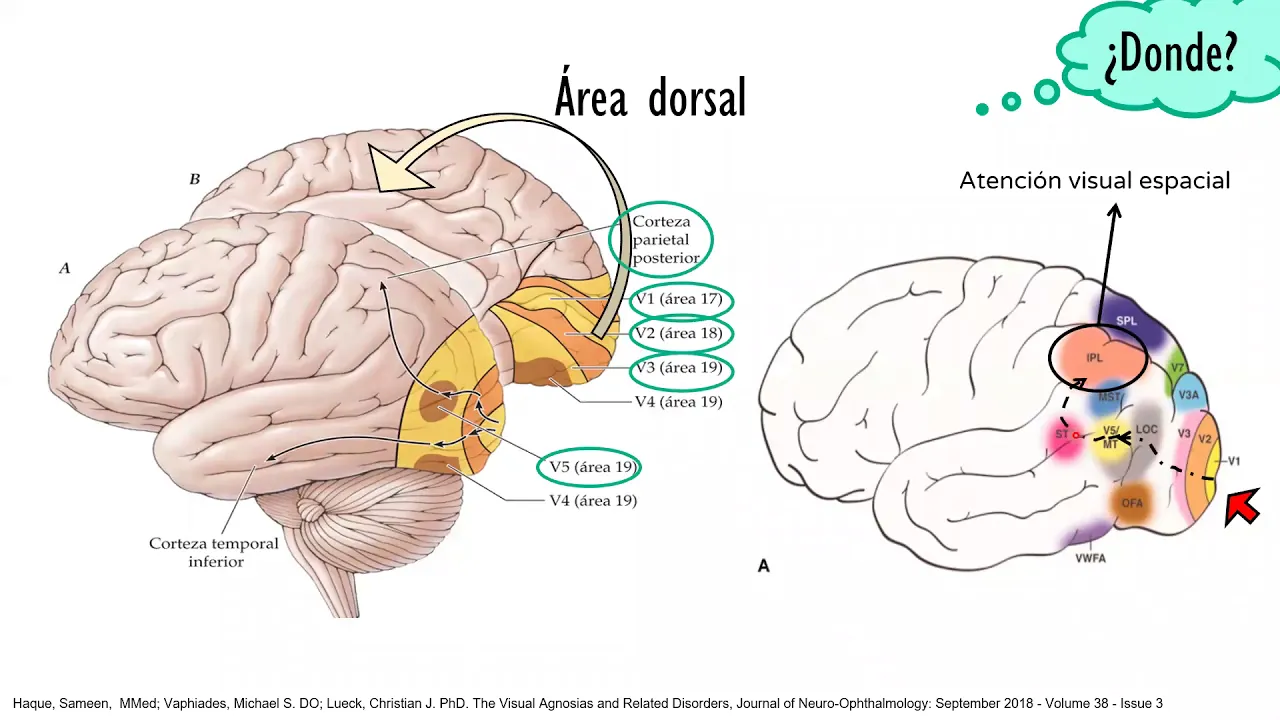
The flow of visual information beyond V1 into the Extrastriate Cortex (V2, V3, V4, and V5/MT) and the segregation into the Ventral ('What') and Dorsal ('Where/How') pathways.
Advanced mechanisms of stereopsis (3D depth perception) and how binocular disparity is computed in higher visual areas.
The application of hypercolumn architecture in computer science, specifically how it inspired early Convolutional Neural Network (CNN) designs for image recognition.
18.8K views143likes3:41Original Release: 2011-09-06
all right the next thing I want to talk about is the hyper column and essentially the question says what is a hyper column so a hyper column is a set of columns that is responsive to lines of all orientations from a particular region in the visual field and viewed by both eyes so there's really the definition of what a hyper column is set of columns responsive to lines of all orientation from a particular region in the visual field and viewed by both eyes but what does the hyper column consist of well the hyper column has ocular dominance columns okay that can be divided into a left ocular dominance column that receives information from the left eye only then a right ocular dominance columns which receives information from the right eye only the columns are arranged so that they alternate between left and right and I want to show that real quick before I go on so here's a little pitcher diagram here of what a hyper column looks like and what you can see here is these are known as the ocular dominance columns these are them and look it's left eye right eye left eye right eye and just like I said they alternate left and right and by alternating left and right basically essentially the columns are arranged so that they alternate left and right bringing the inputs from both eyes so what they do is they bring the inputs from both eyes together at this particular level they lines up providing the basis for the sensation of depth perception so really a lot of what these ocular dominance columns do and the way of bringing the inputs from the left and right eye together at this particular level results in the sensation of depth perception okay which is extremely important and we need it every day for driving or just navigating our environment so that's what the ocular dominance columns are about now there's another set there's another part to the hyper column and there are simple cells which with the same orientation preference are grouped together into what are known as orientation columns so simple cells with the same preference with same orientation preference are grouped into are grouped together into orientation columns organized with an orderly shift in orientation preference so what you can see over here is that these are the orientation columns and if you can see I don't know if this is too visible yes pretty visible um you have slightly different angle each one I think changes by about 15 degrees if I'm not mistaken and it creates sort of like this pinwheel like structure and that's exactly what and talked about next so the orientation preference of neurons with simple receptive fields changes in a continuous fashion that's what I would say this changes in an organized and orderly fashion by a set number of degrees each one of these columns responds to a line of different orientations slightly different orientation and what ends up happening here is it forms a pinwheel like area and the map of the orientation preference is then repeated for neurons with adjacent receptive fields so essentially this hyper called really consists of two main parts I mean it consists of the ocular dominance columns and the orientation columns and they each provide a different role one of them in the case of the orientation columns provides the depth perception sensation and this is basically how the hyper column functions and how it works and this is a you know a good diagram of basically what one of these hyper columns looks like
Up Next

6:29
Dorsal and Ventral Streams: Visual Processing Pathways Explained
@wikifigures
136 views•2025-09-04

21:55
Deciphering Neural Circuits Controlling Anorexia in Mice | Richard Palmiter
@AllenInstitute
2.3K views•2011-10-10

4:10
Vagus Nerve (CN X): Anatomy, Nuclei & Functions Explained
@Alilamedicalmedia
305.2K views•2022-10-31

13:03
How Exercise Benefits Your Brain: Science Explained
@TED
11.4M views•2018-03-21
Related Study Plans & Knowledge Roadmaps
Structured learning paths in Neuroscience
neuroscience
Appetite Regulation: Brain Circuits & Hormones
01Foundations of Endocrinology and Brain Anatomy
02Introduction to Energy Homeostasis
03Peripheral Signals: Leptin, Ghrelin, and Insulin
+ 2 more learning modules
14h5 modules
Explore Roadmap
neuroscience
Neuroeconomics: Value, Risk & Brain Mechanisms
01Foundations of Neuroscience and Brain Anatomy
02Introduction to Neuroeconomics and Subjective Value
03Dopaminergic Prediction Errors & Reinforcement Learning
+ 3 more learning modules
18h6 modules
Explore Roadmap
neuroscience
Spatial Navigation: Cells, Grids & Brain Maps
01Foundations of Brain Anatomy and Memory
02Place Cells and Head-Direction Cells
03Grid Cells: The Brain's Coordinate System
+ 2 more learning modules
12h5 modules
Explore Roadmap
neuroscience
BCIs: Neural Decoding & Prosthetic Control
01Neuroscience Foundations: How the Brain Signals Intent
02Signal Acquisition: Recording the Brain's Activity
03Neural Decoding: Translating Brain Waves into Data
+ 2 more learning modules
25h5 modules
Explore Roadmap