


















Martha Rosler's 1975 video 'Semiotics of the Kitchen' is a sly feminist critique of women's domestic labor, presented as a parody cooking show featuring the artist performing absurd kitchen tasks with household appliances while delivering deadpan narration; the work exemplifies early video art's potential for social commentary by using minimal, fixed-camera techniques and embracing technical imperfections to create a satirical vocabulary that challenges traditional gender roles in the home.
Semiotics of the Kitchen: Martha Rosler on Feminist Video Art
Added:Basic principles of Semiotics (the study of signs and symbols), particularly how everyday objects and language carry encoded cultural meanings.
The historical context of Second-Wave Feminism in the 1970s, specifically the critique of the nuclear family, domesticity, and confined gender roles.
The emergence of Video Art in the late 1960s and 1970s as a democratic, accessible medium used by artists to bypass traditional gallery systems and mainstream television.
The artistic strategy of parody and subversion, understanding how humorous or exaggerated imitation can be used as a tool for serious socio-political critique.
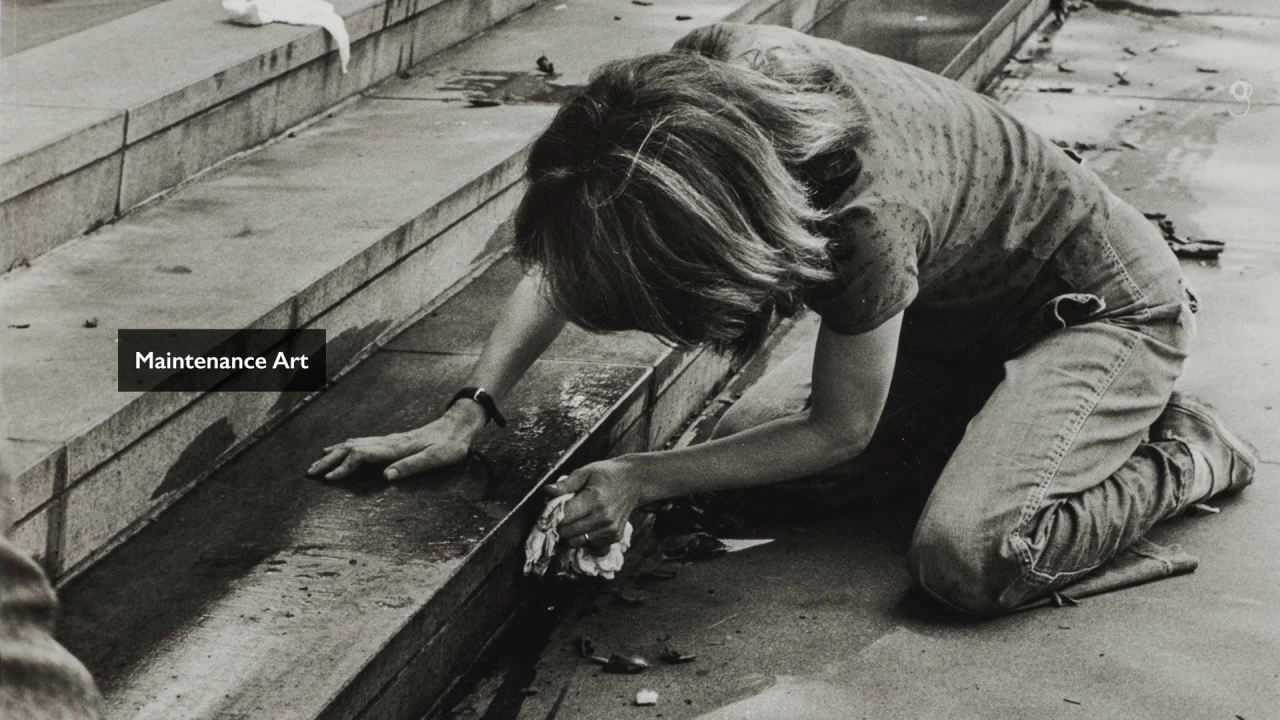
The trajectory of Institutional Critique, exploring how artists like Mierle Laderman Ukeles and Barbara Kruger continued to challenge patriarchal and art-world power structures.
The evolution of feminist performance art into the digital age, examining how contemporary artists use platforms like YouTube and TikTok to subvert modern domestic expectations.
Advanced film and media theory regarding the 'male gaze' and the representation of women's bodies and labor on screen.
A comparative study of post-structuralism, exploring how later artists deconstructed the stable meanings of language, signs, and identity.
50.6K views534likes11:25Original Release: 2012-11-12
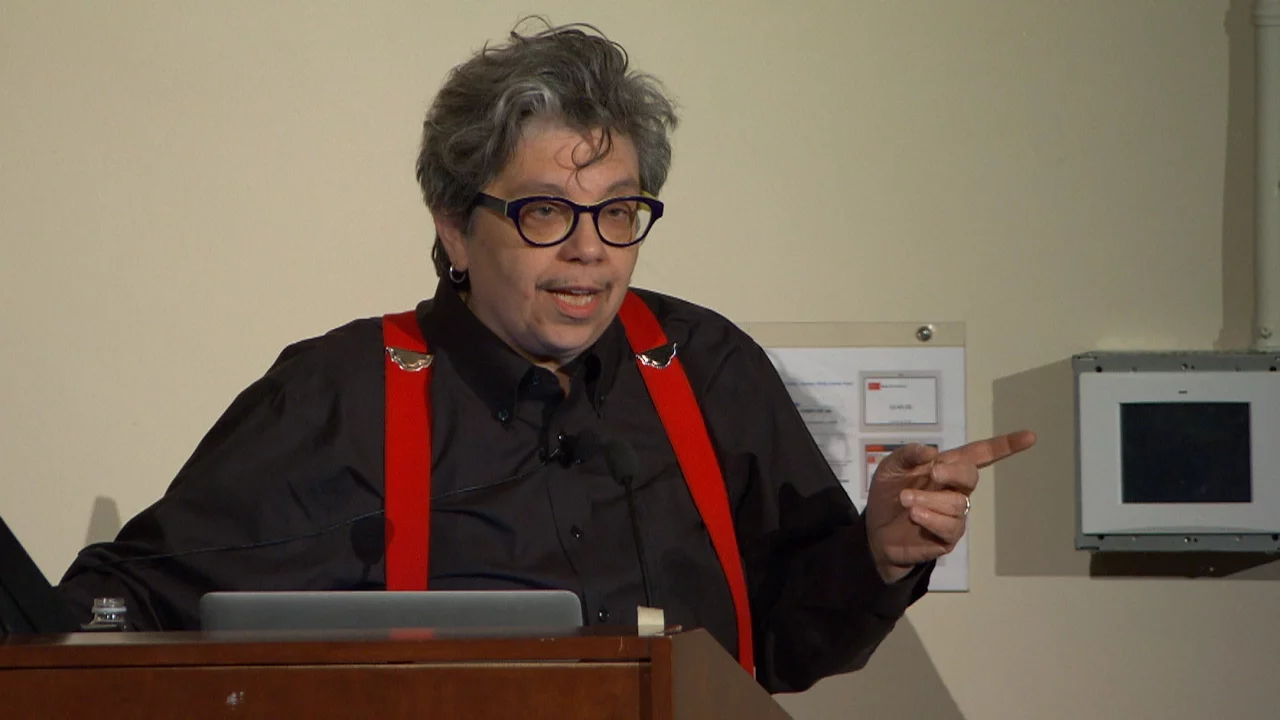
[Music] Thanks for agreeing to meet with me in the storage space for the garage sale that will be in a month and a half at uh the Museum of Modern Art in New York in the atrium and this is our backstage area.
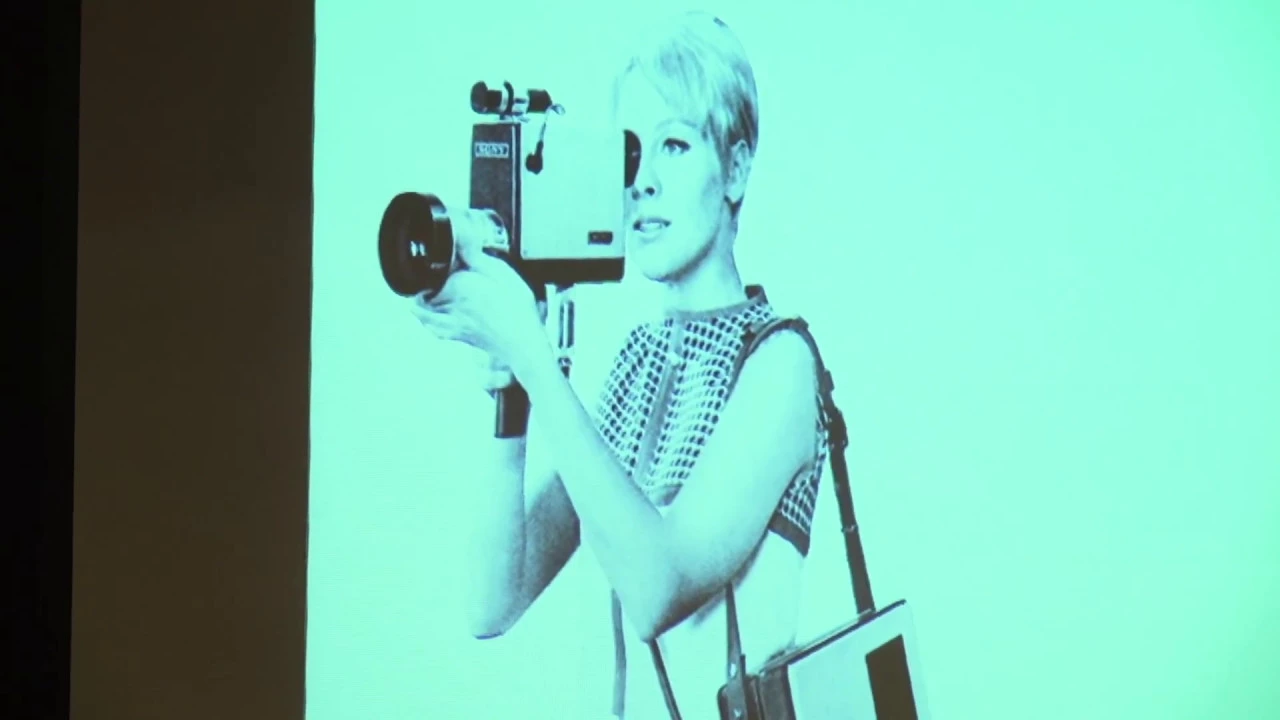
I got into video because I was a grad student at UC San Diego and they had an actual video studio whose purpose was to um make tapes of autopsies and operations. and David Anon who was the department chair at the time uh was in conversation with Charlie Cox who was the guy who was running the studio and they came up with the idea that we would all learn video. So David and four other guys and I all learned video in the studio from Charlie Cox in about 1972 or three in the basement of the medical school. And of course, this was a moment when artists were interested in video and had begun working with video. And Elellanar Anon, who was David's wife, was beginning to make video as well. So, it was in the air. You know, cheap movies, lousy quality, but so many possibilities. This was a good way to evade having to think about making money because, of course, we wanted, that is my little cabal. I don't know about anyone else. We were interested in making things that were easily disseminable, transmissible, mailable, show in the basement, show in a classroom, whatever. And open edition, meaning it wasn't editioned and it wasn't intended for sale. We were all in it for the idea, the love, the possibility of experiment. What I was really interested in was looking like good dard.
So what did that mean to me? It meant fixed camera with very few movements.
That is Gdard in the digertov moment where the apparatus is so crudely unwieldy that it made itself visible by not doing the things that video and more to the point cuz who ever heard of video film was supposed to do. that is to have clean cuts and uh fades and cross fades and edits and in particular I wanted to do only in camera edits for a while so that I really wanted to stick to the most minimal presentations possible and semiu Kitchen was built around a single zoom out at the end fixed camera zoom out. Uh it was um an idea I got walking down the street on the Bowerery and just thinking, "Oh, words, things, women, images, kitchen. Where can I get a kitchen? I need an alphabet. I'm going to call it semiodics, but it's going to be a vocabulary." And that was it just came together in a short time. I went to film video arts. They lent me a Panasonic where the blanking interval was out of sync. So there's a you can see the blanking interval. There's a line across the bottom and it did it was striping black and white porta pack.
What the hell? I was interested in the idea. So just to say again, I knew very well how to edit. I knew very well how to do a and b rolling. I knew how to use a color camera. I knew how to use a studio. But I didn't care about any of that stuff. This is a work that is um midway between an artist's loft posing as a kitchen and the television studio of people like Julia Child. It also is meant to evoke late night commercials of the Ginsu knife variety where you have amateur performers kind of hacking away.
And uh it's a dead pan comedy New York style. Even though I was in fact a California artist at the time, it was made in New York in the loft of an artist. And it was intended to look like some kind of strange set with a strange woman doing strange things that hopefully would make you laugh.
Apron bowl chopper.
Er, [Music] dish. Egg beater.
[Music] Fork.
grater. Hamburger press.
Ice pick.
Juicer. Knife.
Ladle, measuring implements.
Nutcracker.
Opener pen cork bottle.
Rolling pin. Spoon.
tenderizer. You V W X Y See?
Up Next
59:26
Margaret Atwood Discusses 'Oryx and Crake' at MIT, 2004
@MITVideoProductions
33K views•2019-09-05

12:54
Triumph of Orthodoxy Icon: Byzantine Art & History Explained
@BenCallan
2.1K views•2024-08-06

9:49
FastAPI vs Flask vs Django: Choosing the Right Python Web Framework
@TechWithTim
302.5K views•2024-05-26

1:42
Game of Thrones Opening Credits: A Cinematic Analysis
@gameofthrones
46.3M views•2011-04-18
Related Study Plans & Knowledge Roadmaps
Structured learning paths in General & Interdisciplinary Studies
general-studies
Elevator Engineering: History, Physics & Cities
01From Hoists to Safety Brakes: The Dawn of Vertical Lift
02Hydraulic vs. Traction: The Engineering Physics of Elevators
03Modern Speed, Safety, and Algorithms
+ 2 more learning modules
12h5 modules
Explore Roadmap
general-studies
Rubber: Material Science, History & Geopolitics
01Origins of Natural Rubber & Mesoamerican History
02The Chemistry of Natural Rubber & Vulcanization
03The Geopolitics of the Rubber Boom & Colonization
+ 2 more learning modules
12h5 modules
Explore Roadmap
general-studies
Containerization: Evolution, Logistics & Trade
01Ancient Trade & Bulk Cargo: Amphorae to Barrels
02The Industrial Revolution & Cardboard Packaging
03The Containerization Revolution: Malcom McLean
+ 2 more learning modules
12h5 modules
Explore Roadmap
general-studies
Textile Tech: Evolution, Labor & Global Impact
01Pre-Industrial Textiles: Handloom & Cottage Industry
02Mechanization: The Spinning Jenny to the Power Loom
03The Factory System & Global Labor Transformation
+ 2 more learning modules
10h5 modules
Explore Roadmap