












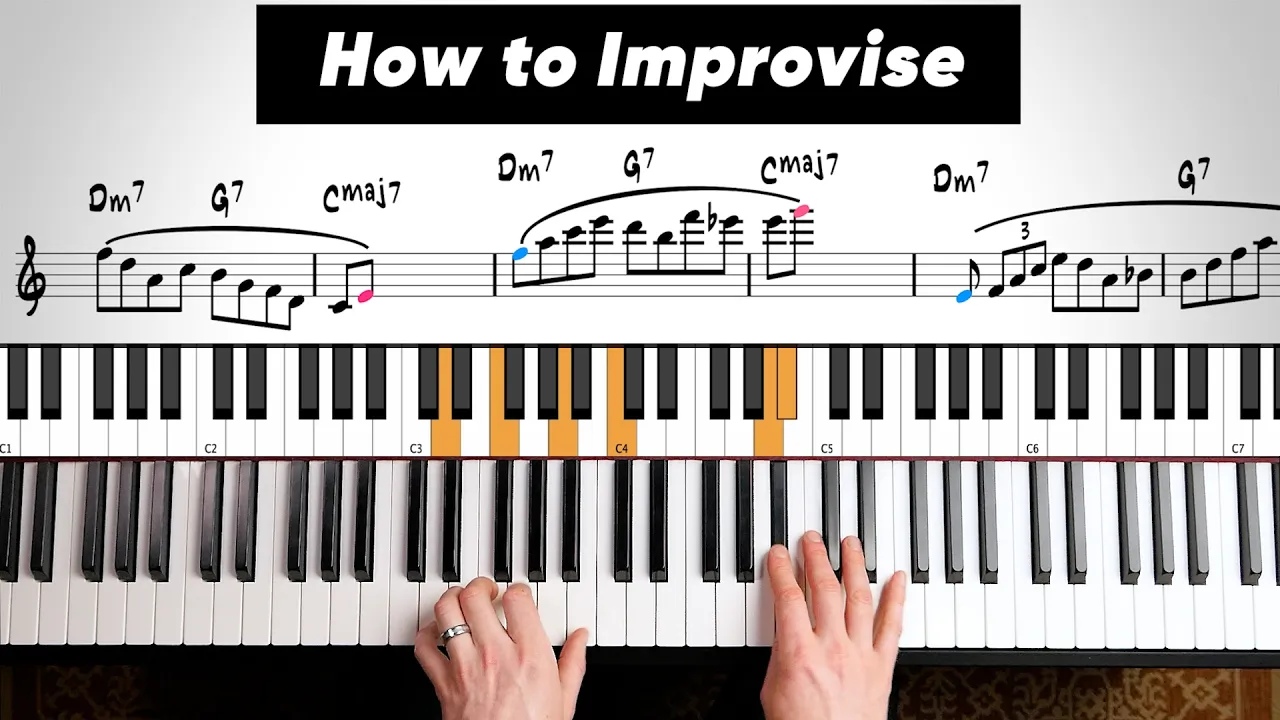

This video teaches three progressive techniques for transforming simple pop songs into jazz arrangements: (1) Block Chords - playing chords in root-third-fifth-sixth or root-third-fifth-seventh formations in the left hand; (2) Spread Voicings - distributing chord notes between hands by moving middle notes to the right hand; (3) Jazz Reharmonization - adding color tones (11ths, 13ths, flat 13ths, flat 9ths) and using substitute chords (including tritone substitutes) to create richer, more sophisticated harmonies. The instructor demonstrates these techniques using 'Love Me Tender' as an example, showing how each step progressively increases harmonic complexity.
Jazz Piano: 3 Steps to Reharmonize Pop Songs
Added:Basic Keyboard Proficiency: The ability to play simple melodies with the right hand and basic triads with the left hand.
Diatonic Seventh Chords: Understanding how to construct and identify major 7th, minor 7th, and dominant 7th chords.
Fundamental Chord Progressions: Familiarity with common pop chord progressions (such as I-V-vi-IV) and basic Roman numeral analysis.
Introductory Voice Leading: Knowing how to transition between chords smoothly by minimizing hand movement and utilizing basic inversions.
Rootless Voicings: Learning how to play rich jazz chords by omitting the root note (often left to the bass player) to free up fingers for extensions.
Advanced Extension and Alteration: Incorporating 9ths, 11ths, 13ths, and altered dominants (b9, #9, b5, #5) into block and spread voicings.
Tritone Substitution and Secondary Dominants: Applying advanced chromatic reharmonization techniques to create tension and resolution.
Jazz Improvisation: Learning to solo over the newly reharmonized chord progressions using scales, modes, and arpeggios.
3.6K views205likes8:25Original Release: 2023-06-05
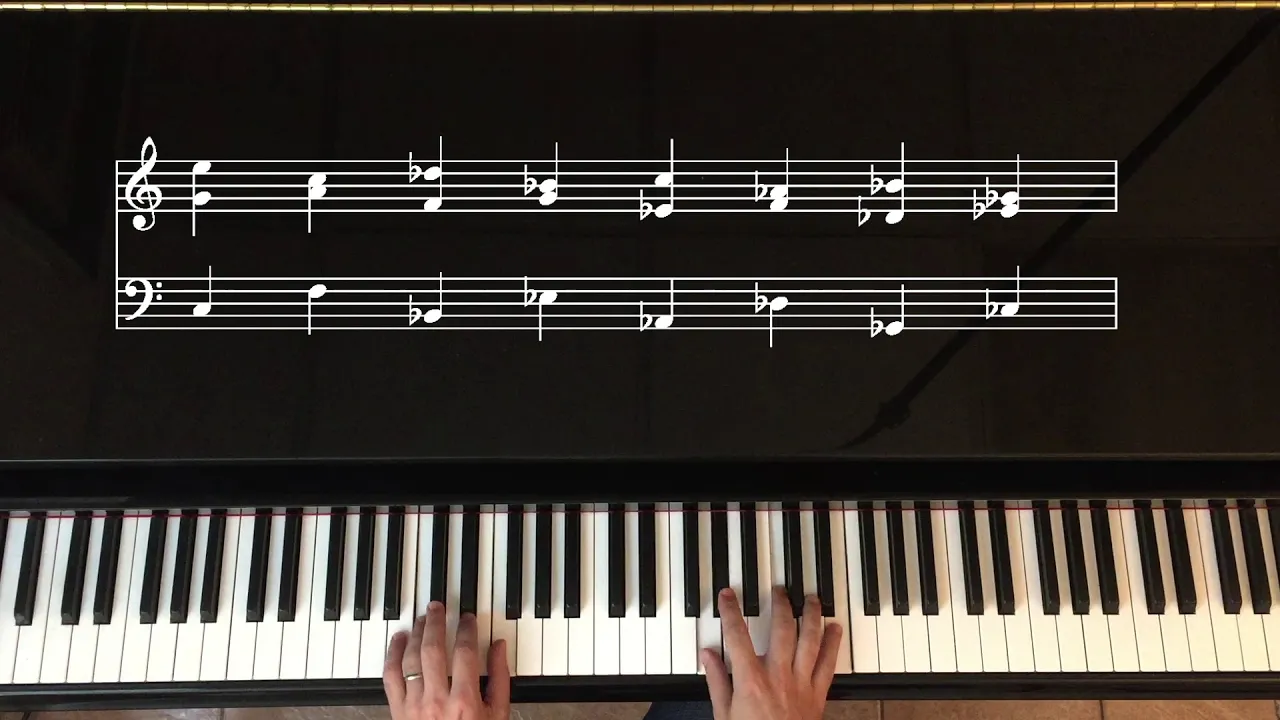
[Music] foreign [Music] welcome back today I want to play a song for you that was made Popular by Elvis Presley it's a very simple song Beautiful song called Love Me Tender I'm gonna play it in the key of C no sharps or flats I'm going to play it with three techniques the first technique is going to be block chords in the left hand melody in the right hand block chords being chords built in Block formation root third fifth sixth or root thirds fifth seventh in the left hand the second technique I'm going to spread out the harmonies between the two hands I'm going to call that the spread voicing and then the third technique I'm going to be adding upper structure chords and some re-harmonization and some what I would call color tones to fill it out more so I'm going to be going from the very simple to the more complex so we'll start with step one which is the basic block chord technique [Music] thank you thank you in step two we're taking the basic block chord like this and we're moving the notes that are in the middle of the chord up to the right hand so like the E will come up to the right hand like this and we have just the G and we can add the a if we want but we get we're going to put the middle note [Music] in the right hand like this now this chord here I'm taking these middle notes and putting them up here in the right hand so now you're going to hear how this particular technique sounds [Music] thank you [Music] okay in step three I'm going to spread out the harmonies even more I'm going to re-harmonize so that means I'm going to add color tones and I'm also going to change the bass line so I'm going to be playing some substitute chords and I'll explain them later but I want you to hear what it sounds like when we expand it that way [Music] thank you foreign [Music] so you heard how the third step with the reharmonization is quite a Quantum Leap going from step two to step three and that takes a lot of experience and knowledge to know how to do that I'm going to explain a little bit of it for you now but you should go on to my website if you like and you can download these three examples you know there'll be scores there for you and you can study them and perhaps learn by looking at the music but just briefly I just want to say that I'm adding harmonies I'm also changing the Baseline in some cases now here I'm adding us an 11th or you could call it a sustained fourth and I'm adding a 13 here so it's a color tone going through a flat 13 and then 13 and a flat nine so these color tones fill out the Harmony and give it a lush sound now here I'm re-harmonizing the Baseline so I'm using a different chord here that's a g diminished G sharp diminished moving to an A Minor up to the D so that's then here it's a pretty colorful sounding chord because it has a sharp nine it's a D7 with a sharp nine and a flat 13.
there I'm adding a flat 9 and a 13 again now here I'm re-harmonizing the Baseline instead of a G chord I'm playing a a d flat which is which is a tritone substitute so I use those a lot and we'll have a special lesson on tritone substitutes here we go expanding the left hand at the tenths down here there's a substitute for the B flat seven adding some moving lines in the left hand here's a substitute chord a chromatic movement down to the A7 then here's a tritone substitute now when you add the tritone substitute you need to adapt it to the melody so in this case it's an A flat seven with a 13 a 9 and the melody gives it a sharp 11.
so [Music] these color tones are the result of understanding how to use the upper extensions and we'll have another lesson on that at some point or you can ask me questions I'll be happy to answer them okay so finishing up the last couple measures that's a g with a sustained four or an 11 you can think of it going to a G7 with a sharp five D Minor nine there's the nine and there's a tritone substitute of the d flat nine chord to a c69 so all these color tones and substitutions give it a rich sound and expand the harmonies and like I said I'll give you a separate lesson on this at some point but you can go to the website and download these scores and study them and hopefully you've you can gain some knowledge from this so thanks for watching I'll see you next time foreign [Music] foreign [Music]
Up Next
25:24
Yohan Kim Amazing Grace Gospel Jazz Reharmonization Tutorial
@thegiftedhandsmusic
68K views•2019-08-15

10:20
Mozart's Musical Dice Game Explained: History, Rules, & Fun
@webpianoacademy
5K views•2023-03-13

47:36
Understanding Diatonic 7th Chords in Major Keys | Music Theory Tutorial
@GracieTerzian
54.7K views•2022-03-02
10:49
Understanding John Coltrane's Giant Steps: A Music Theory Analysis
@Vox
10.4M views•2018-11-12
Related Study Plans & Knowledge Roadmaps
Structured learning paths in Music Theory
music-theory
Composing Galant Music: Partimento & Schemata
01Foundations of Figured Bass and Keyboard Harmony
02The Rule of the Octave (Regola dell'Ottava)
03Galant Schemata: The Building Blocks of Form
+ 2 more learning modules
30h5 modules
Explore Roadmap
music-theory
Decoding Overtone Series: Tuning & Drone Music
01Acoustic Foundations: The Physics of the Overtone Series
02Tuning Systems: Equal Temperament vs. Just Intonation
03Microtonality and Spectralism: Beyond Standard Pitches
+ 2 more learning modules
24h5 modules
Explore Roadmap
music-theory
Impressionist Harmony: Scales, Planing & RPGs
01Foundational Music Theory: Keys, Intervals, and Seventh Chords
02Impressionist Color: Chord Planing and Parallel Harmony
03Whimsical Textures: Pentatonic Cascades and Whole-Tone Scales
+ 1 more learning modules
14h4 modules
Explore Roadmap
music-theory
Negative Harmony: Axis Reflection in Indie Pop
01Music Theory Foundations: Scales, Intervals, and Triads
02Functional Harmony and the Circle of Fifths
03Demystifying the Negative Harmony Axis Reflection
+ 2 more learning modules
16h5 modules
Explore Roadmap