

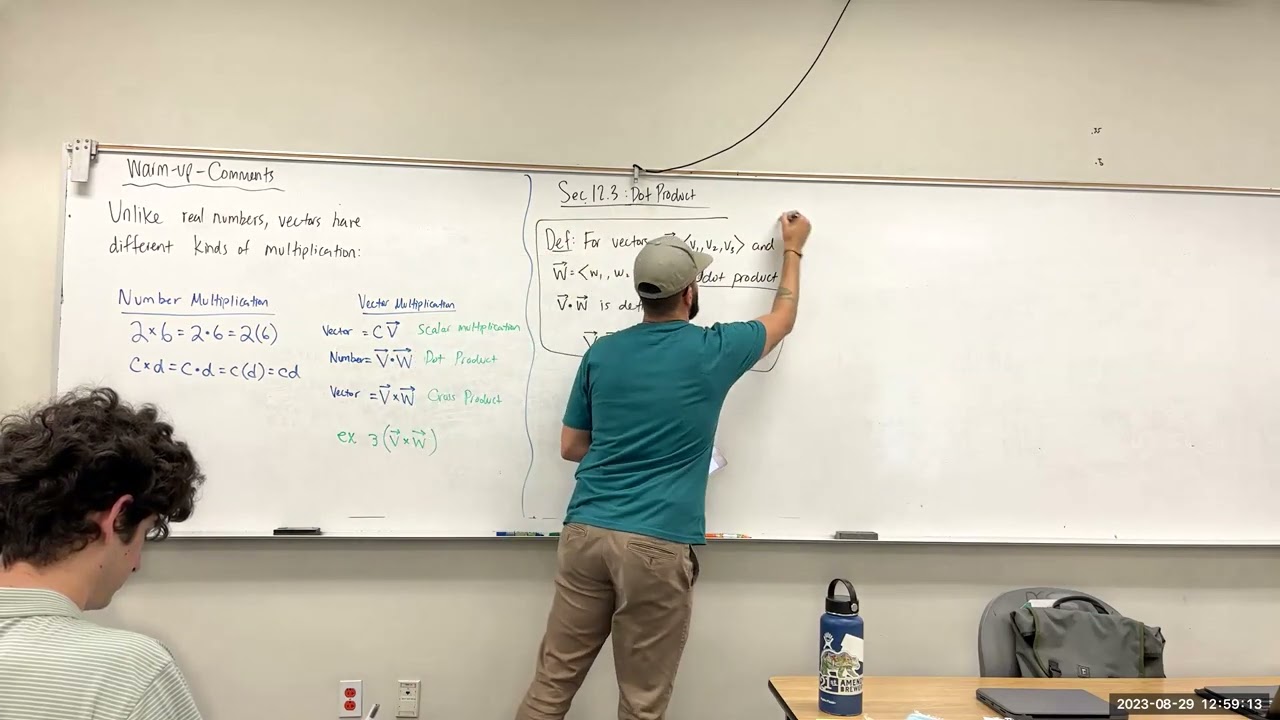



















This lecture introduces the three fundamental mathematical objects used in orbital mechanics: scalars (magnitude-only quantities like speed), vectors (magnitude-and-direction quantities like velocity denoted with an overhead arrow), and matrices (arrays of scalars). Key vector operations include addition (head-to-tail summation with commutative and associative properties), scalar multiplication (scaling magnitude without changing direction), the dot product (producing a scalar equal to ||u||×||v||×cosθ, where perpendicular vectors yield zero), and the cross product (producing a vector with magnitude ||u||×||v||×sinθ and direction determined by the right-hand rule, which is anti-commutative: u×v = -(v×u)). Reference frames are defined by three orthogonal unit vectors (ax, ay, az) that must satisfy ax·ay=0, ax·az=0, ay·az=0, and ax·ax=ay·ay=az·az=1. Any vector can be expressed in a reference frame using the vectrix notation: u = [ax, ay, az]^T × [ux, uy, uz]^T, where the transpose of the vectrix (column matrix of unit vectors) multiplied by the column matrix of scalar components gives the vector. The norm of a vector from its components is calculated as ||u|| = √(ux² + uy² + uz²).
Orbital Mechanics: Vector Analysis, Reference Frames, Vectrix
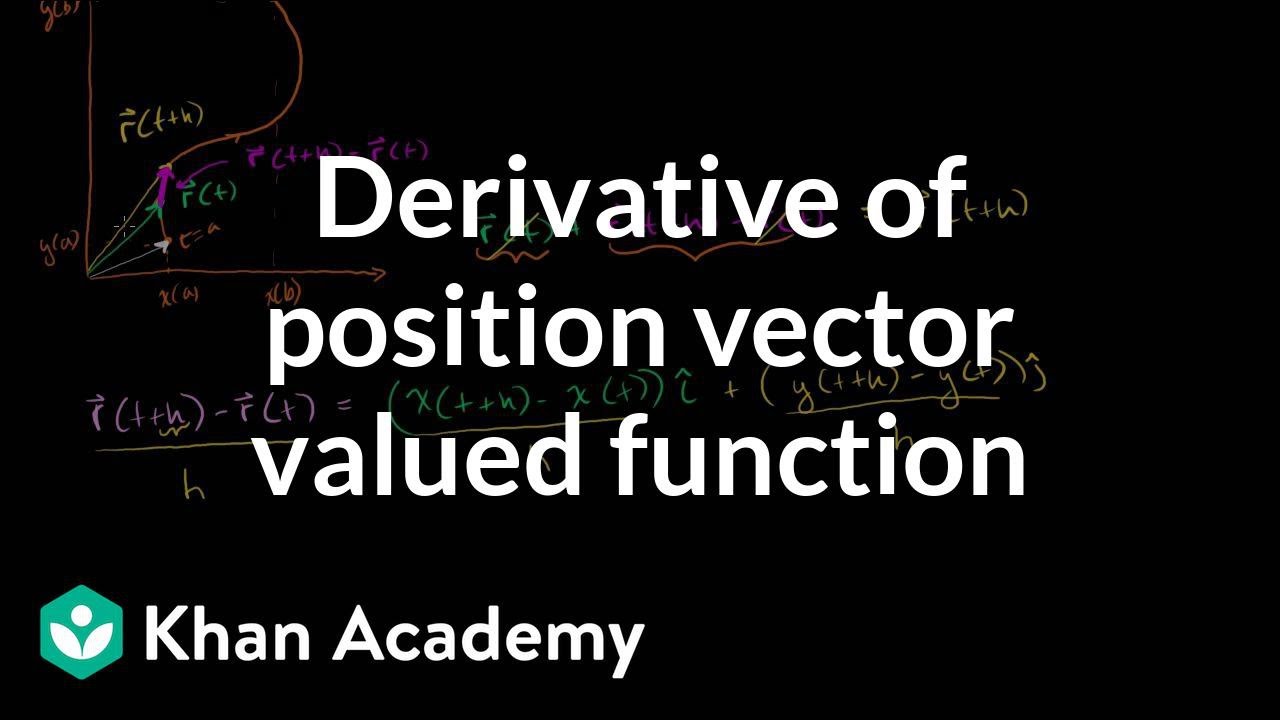
Added:all right hello everyone before we jump in with the first lecture i just want to clarify something and that is the use of the online lecture notes that i've posted as a pdf document so while you watch those videos i highly recommend you that you take a stack of loose piece of paper and that you copy down on those pieces of paper all and every equations i'm going to write down on the board as well as copying down all the figures because as you probably noticed in the lecture notes all the figures are missing okay so this way when you're done watching one of those pre-recorded videos go back to the printed lecture notes and fill the blanks with your handwritten notes that you would have written while watching the videos okay and also by writing all the equations as i write them on the board it's a way for you to be active in the learning process instead of being passive and just watching a video okay and that is key to the success in this course being active throughout the entire learning process ie copying down everything i'm going to write down on board on your loose piece of paper as you watch the videos is really again the key to success all right so let's jump in with the first chapter which is all about kinematics and dynamics okay chapter one kinematics and dynamics first thing we're going to have a look at is the fundamental definition and vector analysis so that would be in section 1.1 letter and uh analysis okay so throughout the course we're going to use three objects that we're going to play with in various ways the first one of which is a scalar okay so in one point one point one now we'll have a look at scalars so what is a scalar well hopefully you all know that but just to make sure that we're all on the same page a scalar is a mathematical object that has a magnitude only okay there are no direction or heading or bearing associated with it it's only the norm of something or the magnitude of something think of it as the speed at which you travel on the highway okay it doesn't give you any information about are you going east west north or south it's just the speed okay and i'm going to denote the scalars in this course by just a letter say v for speed or a acceleration i don't know h for height r for distance and so on and so on are we going to use also greek letters gamma beta and so on all right next up is vectors okay so vectors are pretty much the same thing as scalars but on top of giving the information about the magnitude we also provide the direction so throughout the course vectors will be denoted by a letter so v but this time because it's not a scalar you're going to add the little overhead arrow on top of it okay so whenever you see a letter with this kind of error on top of it you know that this is a vector and the difference between a vector and scalar again is that here a vector has a magnitude and a direction so if you want to relate the velocity vector which is this guy v overhead arrow to the speed well you can write that the velocity vector has a magnitude equal to the speed v okay or in other words you can say that the speed is mathematically equal to the norm of this velocity vector which is v overhead arrow whenever you see those vertical bars enclosing a vector that means the norm okay or in other words they're just taking a tape measure and just measuring the vector you're just providing the magnitude of it that's what this notation means okay and of course that's just for the velocity vector but you can think of the acceleration vector a overhead arrow position vector r overhead arrow and so on and so on okay scalar vector and the third mathematical object is going to be very useful throughout the course is matrices so that will be in 1.1.3 matrix a matrix is essentially an array filled with several scalars in it so if you have say matrix a it could be a three by three meaning that this array has three columns and three rows one two three or in other words has nine elements in it but to make sure that we can easily distinguish matrices from scalars we're going to have another notation for matrices and that is the use of the underline okay now if you go back to the printed pdf document the lecture notes i've posted online you'll notice that i then use this underline notation but rather i have used the bold font notation so matrix a in the lecture notes or any matrices are denoted in bold fonts like that but because it's not very practical to write bold fonts on the board i'm simplifying my life by simply using the on the line notation on the whiteboard okay so this means matrix a has written on the whiteboard and this is exactly the same as matrix a again but this time this notation only applies to the lecture notes so matrix a written in lecture notes okay so these are the fundamental building blocks that we're going to use to develop pretty much all equations in this course so again scalar only the magnitude of something written by just a letter or a greek letter like that then we have vectors which is providing information about the magnitude and the direction written with the overhead arrow symbol and lastly we have matrices denoted with the underline notation on the white board or in the lecture notes by bold fonts like that okay now that we hope you understand these three fundamental building blocks let's have a look at what we can do with vectors specifically in terms of operations and that will be in 1.1.4 vector operations now the reason why we're covering this is because when we're going to derive any equations in this course we're going to begin with first principles and that is to say that we're going to start out by a vector analysis okay so it's very important to understand how to play with vectors properly and the first thing we're going to have a look at is how to add vectors together well the easiest approach is just to if you have say vector a don't forget the overhead arrow notation plus vector b and you're looking at the result here what you do is that you use the head-to-tail summation so you take vector a which is graphically represented by this arrow that has by the way the magnitude that's the length equal to a and a given direction okay so you have vector a plus vector b what you do is that you stack them up on top of each other like that head to tail and the result from the origin of vector a all the way to the end of vector b will give you the result vector c okay so vector c is the result here that you've been able to now find the magnitude or the norm or the length and the direction as well by just a very simple graphical illustration of the problem okay now that we understand that there are a couple of rules that apply to addition of vectors the first one is that say you have vector u plus vector v and you add them both together and then to which you finally add the third vector well you can just say that this is exactly equal to taking vector u plus the result of vector v plus vector w like that in other words the order with which you perform the summation of the vectors is not important all right that was the first rule here a second rule is that well even even simpler than that u plus v is exactly equal to v plus u okay the result will be exactly the same the third rule is that if you have vector u and you add to it a particular vector that has a norm or a length of zero and an unspecified direction and this particular vector is denoted by zero overhead arrow like that and is known as the null vector what you're going to get exactly the same as what you had before you vector like that okay don't forget the overhead arrow i'll see a lot of students even at the midterm write just zero when they want to talk about the vector but keep in mind that just zero like that is a scalar okay whereas here what we really want in this operation is a vector plus a vector so that is a vector while you better have the overhead arrow on top of it make sense perfect the fourth rule is that if you have vector u plus vector u itself but in the opposite direction you're going to get the null vector in the end if you're not too sure about that well just use the head-to-tail summation idea that i've talked about and pretend that this is vector u and then head to tail you you're gonna begin the second vector at the end of this one is u again but instead of doing like that going up it's minus u meaning that this is in opposite direction so minus u is this guy so it has the same length as u but again in opposite directions so u plus minus u you get back at the origin with just a dot essentially that has a non-specified direction and that is the very definition of the null vector which is dot plus no defined direction all right so that's about it for adding vectors together now we're going to have a look at how can we multiply a scalar with a vector we're still in section 1.1.4 but now we're going to look at multiplication with scalar so this one is very simple and intuitive so when you take a vector that has a given magnitude and a given direction and you multiply it with a scalar all you do is that you're not changing the direction at all but you're only scaling the vector you're shrinking it if the scalar is less than one or you are stretching it if the scalar is larger than one essentially graphically to illustrate that if you have a vector u and you multiply it with a scalar a well if that was vector u and let's pretend a if a is larger than one you're gonna stretch it by a factor a so that would be a times u vector you didn't change the direction okay but if a is less than one you are compressing the original vector so that was the same original vector u times a less than one what are you going to get a smaller vector yet in the same direction like that okay so that is the fundamental idea of multiplication of a vector with a scalar but there are a couple of rules or interesting facts about this particular operation that i like to go over with you so the first one is that if you have a scalar a and multiplies scalar b times vector u well that is exactly equal to taking the two scalars a and b multiply them together first and then take the result of that multiply it with the original vector you're going to get the exact same result the next rule is that if you have scalar a plus scalar b and multiplies vector u well that is going to be equal to distributing the scalars to the vector and then summing those two vectors together so in other words scalar a times vector u plus scalar b times vector u okay so those two things are perfectly equivalent similarly if you have one scalar that multiplies the summation of two vectors u plus v well you can also distribute the scalar to both vectors and sum the resulting vectors together so that would be a times vector u plus a times vector v like that hopefully this is all a review of what you already know uh but i feel that this is very important to pay attention to all the details and that we all go together step by step starting from the very fundamental of well what is a scalar what is a matrix what is a vector all the way to deriving equations of motion in orbit to model the dynamics of two spacecraft information flying for example but to get there ultimately we have to go through the fundamentals first and make sure that we lay down a very solid foundation okay another property of multiplication of the scalar with vector is active the scalar happens to be one times a particular vector u while surprise surprise you get vector u because you've only stretched the magnitude by factor one in other words you didn't change the magnitude of at all and you didn't change the direction either so you get back with your original vector and the last rule of property is that if that scalar happens to be zero times any vector say u what are you going to get and this is actually a tricky question because half of you will say well this is just zero right zero times something happens to be zero well no because here on this side you had a vector being stretched or compressed by a particular factor which happens to be zero still in the end you need to have a vector okay otherwise mathematically this equation doesn't make any sense so all you have to write down is to use the null vector notation so 0 with the overhead arrow on top of it to really reinforce the fact that you do get a vector on this right hand side here okay okay so let's move on with a third vector operation which is the dot product also referred to as the scalar product and you'll understand why we call it a scalar product as well as a dot product in a minute so i'm going to first give you the definition i like to call it dot product because that's how i've been taught so the definition of the dot product so say you have vector u dot product which is denoted by just a dot vector v the difference definition says so whenever it's equal by definition i'm going to use the equal by definition mathematical symbol which is a triangle on top of the equal sign like that so that means equal by definition is equal to taking the norm of the first vector or just the length times the length of the second vector v times cos of theta where theta happens to be the angle between those two vectors so graphically if you have vector u like this and another vector v like that to perform the dot product you need to know the angle between both vectors and that's why i made sure to draw them starting from the same origin because the angle is this one between both vectors okay and u let's say u norm that you need in this equation is just the length here so this is u norm whereas the norm is just this particular length so you measure the side times this side in terms of length times cos of this angle and that's going to give you the result of the dot product operation well one thing to realize here is that when you do that you don't get a vector out of this but you get a scalar so although on this side you have a vectorial operation you still end up with a scalar on that side and this is why the dot product is widely referred also to as the scalar product because the result is a scalar okay now if you know this definition you can draw some conclusion or derive some rules and the first one is that vector u dot product with itself will be equal to well to figure this out you have to go back to the definition of the dot product here and just write it with u dot product u so you're going to get norm of u times norm of u again times cos of the angle well what is the angle between a vector and itself it is zero meaning that cos of zero is one so you're left with norm of u times norm of u again or the length of vector u squared and typically the length of the vector is denoted by just the letter of the vector u in terms of scalar because you're talking about the length square so u vector dot product with q vector gives you the length of u vector which is u square okay now if you have u vector dot product v vector and this dot product happens to be zero well what does that mean well it means that those two vectors have to be perpendicular to each other u vector perpendicular to v vector y well because if they are perpendicular to each other it means that the angle is 90 degrees or pi over 2 cos of pi over 2 is 0 and then you get 0 for the dot product on that side so if you have two vectors that are perpendicular to each other their dot product will always be zero that's all it means okay and the reason why i've been able to say this is just again to go back to the definition and realize that well there's a cost of the angle here so the angle happens to be 90 degrees but it's going to cancel everything out on that side so that's what it means here a third property i'm going to write it on top here the dot product is that say you have u vector dot product with a scalar and multiplies another vector v like that well that happens to be equal to taking the scalar out of the parenthesis and then doing the dot product of u and t together like that the reason why you can do that is because the dot product gives you a scalar so this will give you just a number and then you can just take that number and multiply it with the scalar in front of it and you're going to get the same result okay next vector operation is a cross product now the main difference between the dot product and the cross product is that the cross product gives you a vector whereas the dot product gave you scalar as you uh just and this one you have to look at first the magnitude of the cross product result and then we'll have a look at the direction of the result so in terms of the magnitude of the cross product so okay so let's say you have u cross product v gives you a vector w like that well the magnitude of this guy can be found out by taking the magnitude of u times the magnitude of v now this times sine of the angle between both vectors instead of using the cos as we did with the dot product now you have to use the sign between both vectors and for the direction you're going to use the right hand rule and how can you use the writing rule to figure out the direction well you first i'm gonna lay it out lay out the rule here first step that you're gonna use obviously the right hand point your fingers forward the first vector in that case you and then you're gonna roll the fingers toward the second vector which is v in this example and then three this is tonight that means look it's going to look at the pump which will be the direction all right sorry about that my computer just the computer just shut down because i had forgotten to plug it into a wall so we're back all right sorry about that so we're just talking about the cross product and how to figure out the magnitude and the direction of the result the resulting vector which happens to be w so for the magnitude it's very simple all you have to do is to apply the definition here and then for the direction all you have to use the right interval so let's have a look at a quick example on how to use the right numeral to figure out the direction of w so let's say you have vector u and the plane of the white board vector v also in the plane of the white board and you're trying to figure out where is w pointing to okay well ranting rule tells you first that you point the fingers of your right hand that is my right hand here which happens to be on the left side of the screen obviously point the fingers towards the first vector so towards you and then you're going to roll the fingers towards v here but notice that i can't roll my fingers back towards v like that without breaking them so the only way i can do that is to flip my hand around so that i can now roll my fingers towards the second vector so point towards the first one roll towards the second and then you look at the thumb while my thumb here i'm not sure if you can see but my thumb points into the board that means that w is pointing into the board like that just like that okay so w is into the white board or you could have had u vector like that but this time v vector pointing like this and now if you apply the right hand rule again point the fingers towards you roll your fingers towards v and there's only one way you can do that because you cannot flip the fingers backward towards v again without breaking them don't do that at home so you have to flip the hand around you roll towards v like that and look now my thumb points away from the board that means that w is pointing at you so w is out of the board okay that's just a quick example on how to use the right hand rule properly to figure out the direction of the cross product now i know some of you will try to use what you've learned in maybe first or second year and that is to use the little you know i j k blah blah blah and taking the norm of it and this but just just don't do that okay if you do that i almost guarantee you that you're gonna fail finding the proper direction of the cross product okay so no don't use that silly trick you've learned in first and or second year that is the proper way of figuring out the direction of the cross product through the right hand rule okay super easy the only thing just point the fingers towards the first one roll them towards the second one and look at the top it doesn't get any easier than that so forget about this trick you know only confuse yourself you don't waste time on an exam and lose mark because you won't get the right answer so and the reason why now we have to figure out the direction for the cross product is because the result again is a vector and remember that a vector has a magnitude and a direction as opposed to the scalar so magnitude and direction like that well as before for the dot product we didn't care about the direction because the result was simply a scalar so all we had to do for the dot product was to figure out a scalar in the end so the magnitude of something but now we have this extra step to figure out the direction okay so now that you know how to use a cross product efficiently let's have a look at some rules or facts are related to this definition here so if you have say one vector cross product with itself what are you going to get well first you need to know or you have to remember that in the end you have to get a vector no matter what you do because the cross product is a vectorial operation that gives you vector in the end now if you go back to the definition here you cross product with itself okay so it means that the norm of this will be u norm times u norm times sine of the angle between u and itself which is zero and that happens to be zero so the cross product of the vector with itself gives you the null vector because that is the vector that has a magnitude or norm of zero okay if you have now a scalar that multiplies vector u take this and then cross product with vector v this can easily be rewritten as scalar a that multiplies the result of u cross product v okay that's just a simple rule that can in some instances simplify greatly you like when you get to uh deriving equations further down the road okay also u cross product v and that one is very important to realize okay is not equal to v cross product u that is not true why is that well because although the magnitude of those two sides of that equations are perfectly equal through the definition here the direction is opposite okay because if you have if you take vector u and vector v that are like that you're trying to find the cross product of u and v you bring them in the same origin u v cross product right hand rule turn like that and then the result is into the board like this that is for u cross product b can you all see that yeah can't see me but you can see the board which is what matters but if you take v cross product u you have the same vectors and mu right hand rule point the fingers towards v roll them towards you and then you're going to get the vector which is out of the board so as you can see the result of u cross v is totally different than the result of v cross u one is pointing at you outside the board and one is into the board okay and that's why the order of the cross product operation is crucial because u cross v is not the same as v cross u but is actually equal to minus because the minus sign here is as if you had minus one times that so it doesn't stretch or compress the the norm or the magnitude all it does it's still minus sign here is that it flips the direction upside down so minus v cross u which was out of the board is now into the board okay so if you want to have the same vector on both sides if you flip the order of the vectors inside the cross product you do need to apply the minus sign never forget about it okay so that concludes the cross product although there are some just to finish off the vector operations sub sub section 1.1.4 a couple of useful properties i'm just going to list on the board you don't have to know them on top of your head but it's good to know that they exist somewhere in the lecture notes and that you could refer to them later on if you need if you need to okay so if you have there are three of them the first one is known as the triple cross product so u cross v cross w like this can be written in terms of the dot product as follows so this is u dot product w which gives you a scalar if you remember our discussion earlier right dot product is known as scalar product because this operation is a scalar and you know that you can take a scalar and multiply directly with a vector by stretching the magnitude or compressing the magnitude by this factor minus u dot product v another scalar that multiplies w vector okay very useful property another one is u vector dot product v vector cross product w this is equal to the vector dot product with w cross u this is a vector so dot product of a vector with another vector is a scalar and this is exactly what you had here too right this is a vector so vector dot product another vector gives you scalars so this gives you a scalar so you're good and this can also be rewritten as w dot product u cross v okay so all these are exactly the same in terms of magnitude uh but just written in different ways sometimes when you play with equations it's good to be able to flip things around so those things can be done through those properties and rules and identities the last one is a bit more complex and says that u cross product v dot product w cross product a vector is equal to u vector dot product w which is a scalar times v dot product a minus u dot product a times v dot product w don't worry you'll never have to remember these three identities on top of your head but again they're it's good to know that they exist and that whenever you see something like that and a derivation that you need to kind of expand or express differently go back to the lecture notes where you'll find those useful identities all right so that concludes section 1.1 on fundamental definition and vector analysis now we're going to start talking about something which is paramount in this course and that is the use of reference frames you've probably heard the term somewhere else in some other courses in the past but probably as cartesian system instead of reference frames those two things are perfectly equivalent it's just a different way of naming them i personally prefer the word reference frames as opposed to cartesian system but again they're exactly the same so that is in 1.2 we're going to look at reference frames and components why is that important well when you talk about a vector and you're trying to figure out its magnitude it's really easy take a tape measure and measure the vector we take a ruler and measure it and that is the magnitude of the vector which will be the same in any cartesian systems or any reference rate okay but if i were to ask you what is the direction of this vector while you cannot tell me unless you know in which reference frame i want you to give me the direction in do you i want you to give me the direction based on a cartesian system x y like that in which case yeah you could give me the direction by measuring this angle for example but maybe i want you to give me the direction of the same vector but this time seen in some other cartesian system or other reference frames which would be oriented totally differently with y like this and with its x direction like that okay so same vector vector u vector u but two different directions because now you're looking at the same vector from two different perspectives here you're looking at the vector from reference frame one whereas here you're looking at the same vector but this time from reference frame let's call it two and the answer to what is the direction of vector u will be totally different based on which reference system or reference frame you are looking at set vector okay and here the vector u has an x component as well as a y component whereas here same vector seen in that particular reference frame only has an x component okay so for example you could write u vector and then you would go and measure the x component here which could be 2 along x plus i don't know 1.5 along y that would be your answer but here same vector would have all of its component along x direction so that would be say 3 long x but no y component 0 times y you can actually just drop this out okay again same vector seen from two different perspective or seen from two different reference frames will give you the different answer in terms of its x y and ultimately z component or in other words direction but the length of the vector let's note it with you as a scalar will be exactly the same in both situations you in terms of magnitude okay so hopefully that is clear this is the basis of pretty much everything we're going to do we're going to do in this course we're going to look at the motion of spacecraft in a given reference frame and then derive the equations look at the same motion the same spacecraft but this time in different reference frame so this concept of using reference frame to express the components x y and z of vector is fundamental to this course okay so hopefully this little preamble here kind of gave you uh an idea of what we're going to do with reference friends in terms of components okay but let's begin from the beginning of this discussion and let's first define a reference frame properly if you're talking about three dimensions because ultimately the motion of the spacecraft evolves in three dimension then a reference frame will have three unit vectors three unit vectors that are used to define x y and z direction the reason why i said unit vectors here is because those three vectors all have a magnitude of one all right and another thing to realize is that those three vectors aren't arbitrarily oriented with respect to each other but they have to be orthogonal meaning that they are all all unit vectors of a given reference frame are all perpendicular to each other okay the way we're gonna refer to a reference frame in this course is through a calligraphic f symbol and wow i've spent the last year on sabbatical so it's been a while since i wrote this symbol on the board there you go calligraphic f and then subscript of the reference frame you're talking about in the previous example we had reference frame one so we're going to look at telegraphic f one calibration and that that's what it is calligraphic f1 for reference frame one calligraphic f2 for reference frame two okay that is the meaning of this symbol reference frame one whereas this means reference frame number two so all this to say that any reference frames for any reference frame is defined by its three orthogonal unit vectors okay so if they are all orthogonal it means that if you look at say reference frame let's call it a for example meaning that this is this guy reference frame a is defined by its tree orthogonal unit vectors that will be denoted as a vector a unit vector that has the same letter as the reference frame in this case a unit with the vector symbol on top of it in the direction of x another unit vector in the direction of y and the third unit vector in the direction of z so those are the three unit orthogonal vectors defining reference frame a okay but if they are all orthogonal it means that ax cross product with a y has to give you a z no matter what if this equation isn't satisfied that isn't a reference frame because the proper reference frame will always have this kind of rule being satisfied so in other words if you have ax unit vector in this direction a y pointing up while the a z direction has to obey the right hand rule that's what it means so a z will be out of the board towards you like this because again write in rule fingers for words ax roll them towards a y and the thumb gives you the direction of a z which is out of the board towards you that's what you get if you refer to this diagram it also means that uh a y cross product with a z gives you what right-hand rule gives you a x like this and lastly if you have a z out of the board cross product ax which is pointing like this you're going to get a y pointing up so a z cross product ax gives you a y okay if any of these isn't satisfied again this is not a proper reference frame and also you can also infer the dot product definition we talked about earlier to write that ax dot product with itself is equal to a y dot product with itself equal to a z dot product with itself and all of this is equal to one why one well because according to the definition of dot product to find out the scalar at the end of the day out of the dot product you take the magnitude of the first vector while magnitude of ax you know that we're talking about unit vectors means that this side is has a length of 1 times the magnitude of the second one which happens to be the same ax so that's one again so one times one if you remember the definition of the dot product this is and times cos of the angle between the two vectors in question here well cos of the angle between ax and ax is one because the angle is zero okay that's why you get this and any other combination ax dot a y will be equal to ax dot a z which would be equal to a y dot product a z unit vector and all of these will be equal to zero okay why well because all vectors all unit vectors of a reference frame are all perpendicular to each other which means that they're all separated by 90 degree angle or pi over 2 radian so if you take the cos in this definition of the dot product of pi over 2 you'll always get zero that's why they are all equal to zero here so is it 0 scalar 0 in terms of vector null vector well you have to remember that the dot product gives you a scalar at the end of the day and not a vector okay so you see that we are slowly building on top of the previous knowledge that we saw in this lecture right dot product gives you vector cross product gives you sorry dot product gives you scalar and the cross product gives you a vector don't get confused all right so now that we know how to define a reference frame and the answer is through its orthogonal unit vectors ax ay azad reference frame a now we're going to have a look at how can we express the components of any given vector seen in any reference frames and that will be in one point two point two we're going to have a look at components of a vector well the first thing to understand is that any vector say good old u vector we know very well by now can be expressed in terms of its scalar components in a given reference frame through a linear combination okay and that linear combination let's just say that here first would like to express express u in reference frame say a okay how we're going to do it well we're going to take our vector u and express it in terms of its components in reference frame a as a linear combination so i'm going to take our ax unit vector plus our a y unit vector plus our a z unit vector that are all uh creating reference frame a as we talked about previously and here all we have to do is to multiply those three orthogonal unit vectors by the magnitude of u vector along the x direction along the y direction and along the z direction and those scalar components are going to be denoted as u x component of vector u in reference frame a and a comma yeah here we're going to have components of u vector along the y direction of reference frame a and here we're going to have component z of u vector along reference frame in reference frame a or along a z direction okay now those three scalars in green are known as the scalar components of vector u in reference frame a holographic f a like that whereas those three things or what well you're talking about a scalar that multiplies a vector here another scalar multiplies another vector and lastly another scalarium multiplies the last vector so those three boxes are known as the vector components of vector u and reference frame a organ reference frame a being denoted calligraphic f subscript a all right so this is how you've learned in past to express a vector in terms of its x y z component along the x direction y direction and z direction respectively but in this course we're going to do things a little bit smarter i'm going to do things differently than that why well because in this course we're going to play extensively with vector operation and derive several equations based on vector form so to simplify our life we're going to see next in 1.2.3 how to rewrite this notation that we're all familiar with in a new way in a more compact way okay and to do that we're going to use a new mathematical object known as a vectrix okay so vectrex is essentially a matrix of vectors hence the name vectors that is 1.2 0.3 vectrex aha so if you remember if you're still talking about vector u expressed in reference frame a in terms of its xyz components in that reference frame we said that that was u times u x a ax plus u y a a y vector plus z scalar component times a z direction turns out that this can be rewritten as u vector times ax unit vector a y unit vector a z unit vector times a collection of these scalar components u x a u y a and u z a like that right those two things are perfectly equivalent and hopefully you remember matrix operations because this is equal to this times that plus this times this plus the last one times the last one here and indeed you get back on your feet with the previous expression here for vector u expressed in reference frame a now this column matrix here is essentially collection of the components the scalar components of vector u seen in reference frame a right it's just a collection of these three skaters scalar components of vector u in reference frame a like that and turns out that this will be rewritten as simply u matrix remember previous discussion on matrix notation on the white board so that's the underlying notation so that is a matrix three by one matrix components of vector u and reference frame a okay so this is how we're going to denote this particular matrix from now on so instead of writing those three components separately we're going to concatenate them in a column matrix and write them compactly using this notation which is a matrix of the components of this vector u in which reference frame one in reference frame a like that so that is to say that this previous expression of u vector equal to unit vectors x a y a z can be rewritten by making use of this like that and already this is a lot nicer than this long equation where we had explicitly written all the terms one by one right so this is going to be a lot faster to play with in the future when we get to the right equations but that's not the end of it we're gonna further compact this equation by the use of a vectrex right so if you look at this this is not conventional right this is a matrix filled with not scalars as you're used to but this time fills with three vectors ax and y is that those three particular vectors happen to define a reference frame right talked about that ax ay and z are three unit vectors are all orthogonal to each other that define the x y z direction of reference frame a so this thing here is what we refer to as a vectors because this is a matrix of vectors so vectrix is not a vector of matrix but a matrix of vectors and vectrix related to reference frame a by definition is a column matrix that contains x y and z unit vectors of reference frame a and the way we're going to denote that is through the same calligraphic f notation that means reference frame subscript a means reference frame a but now because we are using it in a mathematical sense instead of just in sentence we have to use the overhead arrow and that is equal by definition so vectrix a is actually defined by a column matrix three by one that contains a x a y a z unit vectors but if you go back here you say well that's not exactly the same right because here we have a a row matrix one by three as opposed to a column matrix three by one well no problem because making use of the vectrix definition we can say that this is vectrix a overhead arrow but the transpose of it times components of vector u in reference frame a and this thing here is how we're gonna write a vector in terms of its components seen from a specific reference frame represented through its vectrix object here okay so this notation is exactly the same as the long one we had previously where u vector was equal to u x a times a x vector plus u y a times a y vector plus u that a times a z vector well that was a lot of terms here we've been able to compact everything down to this very simple elegant expression through the use of the transpose of the vectors okay get used to it i'm going to use it extensively all the time so quick exercise for you if you need to express the vector v in reference frame b how would you do it without even thinking about it you have to be able to do it on the fly by saying while v is vectors b transpose times components of vector v in that reference frame b and don't forget the underlying notation because this is a three by one vector that contains the scalar components of this particular vector seen in that specific reference frame okay or express vector w in reference frame c how would you write it easy peasy w vector transpose of vector c times components of vector w seen in that reference frame like that and so on and so on so very quickly you know that you see that you've been able to effectively and efficiently write down vectors in terms of their components seen from a specific reference frame as opposed to using the long way of doing it we've been able to take major shortcuts here all right by the way the vectrex notation this mathematical object was introduced in the i would say late 70s early 80s only so that's relatively recent by a professor at the university of toronto uh named peter hughes and peter hughes was an expert in spacecraft attitude dynamics and felt that to derive his equations he needed something a lot more simpler and more compact and hence he came up with this way of writing vectors in terms of the components to the use of the patrick's okay peter hughes taught it to my former masters supervisor jean de la fontaine at university child work who then taught it to me in 2004 and now i'm teaching it to you so you are the second you you are the fourth generation of people of future spacecraft engineers to know about the vectrex notation so please learn it use it and you'll get to love it okay what's next i think oh yeah another thing to realize if you have vector u expressed in terms of its components in reference frame a like that real quick turns out that this is also equivalent to flipping these two objects around and using this first times vectors a non-transpose okay so they are perfectly equivalent i prefer to use this way of writing it but this is acceptable as well in some situations and deriving equations will encounter something like that and real quick we'll have to realize oh well this is simply vector u that's what it is okay because this contains information about the x y z components or the norm of the vector and the directions of the vector okay yeah i want to show you a little trick here it's going to come handy later on and the thing is how can you extract the xyz components out of that equation why well because as engineers typically that's what we want to know so okay we have this velocity vector but in which direction is that vector pointing to is it all along x all along y along z a combination of all of the above i don't know so i need to figure out the x y is the direction of the velocity vector but what i have is this expression so the trick is how to solve for in that case let's just say solve for components of a vector given it's uh given it's uh given this so given its expression in a given reference frame right so this is how we're going to do it we're going to start out with what we're given and that is the expression of u in reference frame a that the goal is to solve for this here well the trick is to use the dot product with the vectors on both sides of the equation i'm going to take vectors a not the transpose just the vector x dot product u then i'm going to say same thing here vectors a dot product with everything you have i'll product vectors a transpose times matrix filled with xyz components of vector u in reference fret a so all i did as you can see from here to here is to take the dot product on both sides with the vectors a okay and now you're done because this sides this side remains as it is but this here vectors a dot product vectors a transpose is cancelled and gives you directly what you are looking for and that is the components of vector unit reference frame expressed in the three by one column matrix why is that why does that cancel out well let's have a look let's say because this times this okay so let's expand this based on what we know you know from the very definition of the vector x earlier on that a vectrex is defined as a three by one column matrix filled with the three orthogonal unit vectors of in that case reference frame x that's a x a y a z this dot product with the transpose of that so you flip the columns with the with the rows and you're going to get this this that okay now what well from linear algebra you'll remember that a three by one matrix times a one by three gives you a three by three at the end of the day right so equal to a three by three giant matrix now what is inside this matrix well it turns out that this matrix is filled with nine dot products right because here you have the dot product symbol so three by three indeed you have nine elements first one would be ax dot product ax here we're gonna have ax dot product a y and row one column three gonna have ax dot product a z and so on and so on just fill the matrix as per usual as you sign linear algebra right three by one times one by three i'll find out the elements of that if you're not too sure go back to your previous courses and i'm going to cover that here i'm assuming you have some basic knowledge of linear algebra that's a z and y finally azad dot product but itself like that all right now what well now you have to solve for these nine entries of the three by three matrix okay well because you're smart and that's why you're an arabi i assume most of you are inevitably those who aren't inaudible you're smart still because you had the wisdom to select this course as an elective congratulations so we're going to say that okay vectrix a dot product but it's transpose is equal to now we know a three by three matrix ax dot product with itself oh boy it's been a while it's been like what 20 minutes while i go back to the definition tells you that this is the norm of the first vector times the second vector times cos of the angle between both vectors okay so norm of the first one one times norm of the second one one is all right those are all unit vectors defining reference frame a so their magnitudes are all one they're all orthogonal to each other in other words separated by pi over two radians so that is one okay like that so this entry is one ax dot product a y the angle is pi over two whereas here with itself it was zero degrees so cos pi over two in that case zero one times one cos of pi over two zero one times one times cos pi over two zero one times one times cos of zero because now the angle between a y and itself is zero so that gives you one one times one times cos of pi over two zero zero zero one wow this particular matrix that is filled with ones on the lead diagonal and zero elsewhere is known as the identity matrix and is denoted by capital i and because this is a matrix don't forget the underlying notation furthermore to specify dimensions of this matrix you just add a subscript in that case three okay because this is a three by three matrix identity matrix are always square matrices meaning that number of rows are always equal to number of columns and that's why i don't need to write three by three only with the first three i know right away it's full dimensions okay so this gives you identity three by three wait why did i cancel this out of the original equation well because a three by three matrix which is that entity matrix times a three by one column matrix gives you the column matrix itself so let's have a look at that this and we had times uh that side of this equation equal to we had vectors a dot product with q on that side that's what we had so now we've been able to replace this with the identity three by three but now let's have a look at what happens here one one one zero zero zero zero like that i think d3 by three times components of vector u in reference frame a that is u x a u y a u z a the scalar components of vector u in reference rate a and that column matrix here is equal to well again an algebra three by three times three by one gives you three by one right hopefully you remember that so 1 times this is u x a plus 0 times this 0 plus 0 times this one zero second entry of this three by one zero times u x a zero plus one times u y a plus zero times u said a zero and similarly for the last uh entry of this three by one matrix i'm gonna get you that a here or in other words that's u x a u y a u z a like that which is by now you know u a matrix okay so that's why when you have an identity matrix that multiplies a column matrix three by one you can tell right away that this is just the column matrix itself and that's why i had originally canceled this out the original equation so the bottom line given an expression of a vector in a given reference frame say a like that if you want to extract the scalar components of that vector in that reference frame all you need to do is take the dot product with the vector x on both sides and you're going to get what you're looking for okay that's just a neat little trick to keep in your back pocket that's that's going to come very handy in the future all right last thing just want to clarify something i should have done it perhaps earlier but that is how to calculate the norm of a vector given its x y z components actually it fits in that section because we just started to talk about components of vector okay i'm going to say another trick how to calculate the norm on the vector given its scalar components all right well say you're looking for the norm of vector u so mathematically you take the norm of that with the vertical lines that's going to give you a scalar just u as the length and the way to do it is to take the oak leading euclidean norm of the components of that vector okay this is a vector norm that means that you have a vector bring your tape measure measure itself that's your answer but if you are given its scalar components that's what you have available to you so the way to do it is just to take the square root of the x component squared plus the y component squared plus the z component squared like that and doing that will give you the norm of the vector given its scalar components now when you do that this way what you do is that you are taking effectively the euclidean pleading have a hard time pronouncing that word including lydian norm or just taking the square root of the squares of the x y z components all right so that concludes this lecture hope you learned something hope you enjoy keep writing the equation on your new sheet of paper keep drawing the figures i draw on the board and then after watching these videos go back to the set of lecture notes posted online and now fill the blanks and read the lecture notes against your handwritten notes and this way by being by being very active in the learning process you're going to do well see you next time
Up Next
Polar Equations of Conic Sections in Polar Coordinates
@TheOrganicChemistryTutor
180.2K views•2018-04-08
Elliptic Curve Cryptography Explained: ECC, ECDSA, ECDH
@PracticalNetworking
28.5K views•2024-10-21
Fourier Series Introduction: The Big Idea Explained
@DrTrefor
387K views•2021-05-03

The Mathematical Impossibility of Accurate World Maps
@Vox
23.3M views•2016-12-02
Related Study Plans & Knowledge Roadmaps
Structured learning paths in Mathematics