




















![Solucionario UNI 2024 I 📢 MATEMÁTICA ✨ [EN VIVO]](https://i.ytimg.com/vi/2d33efnPspU/maxresdefault.jpg)

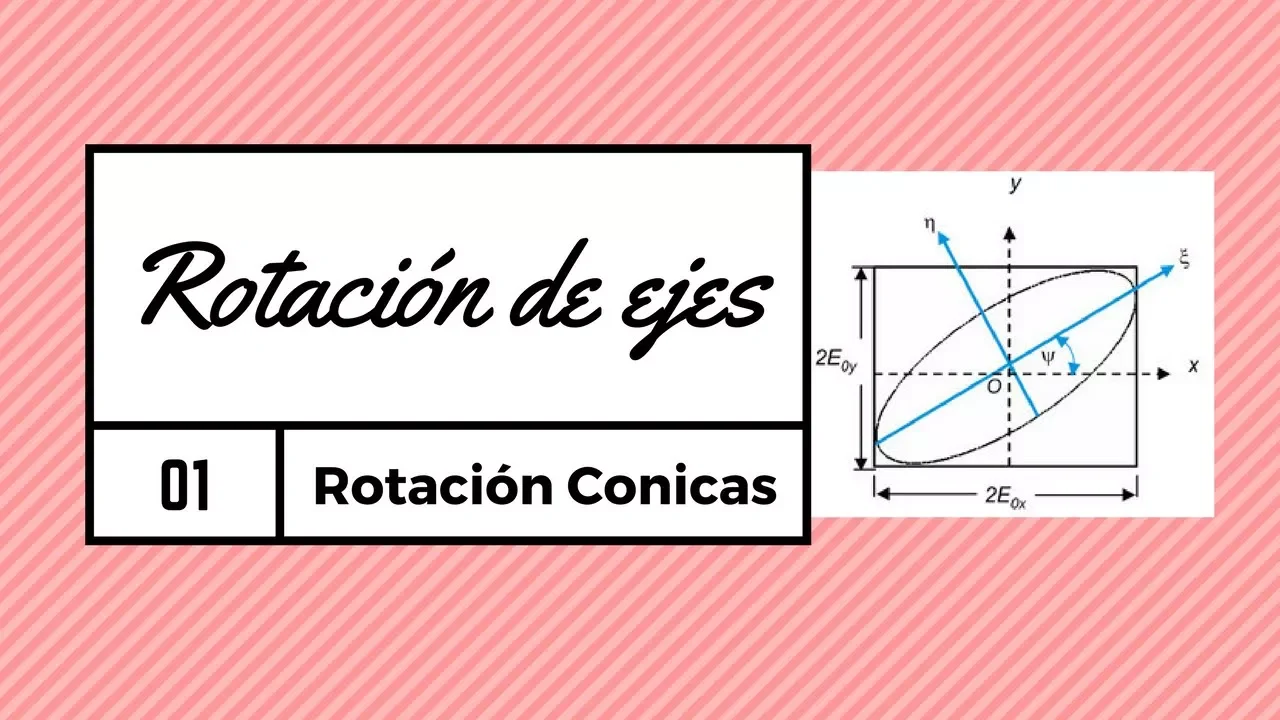



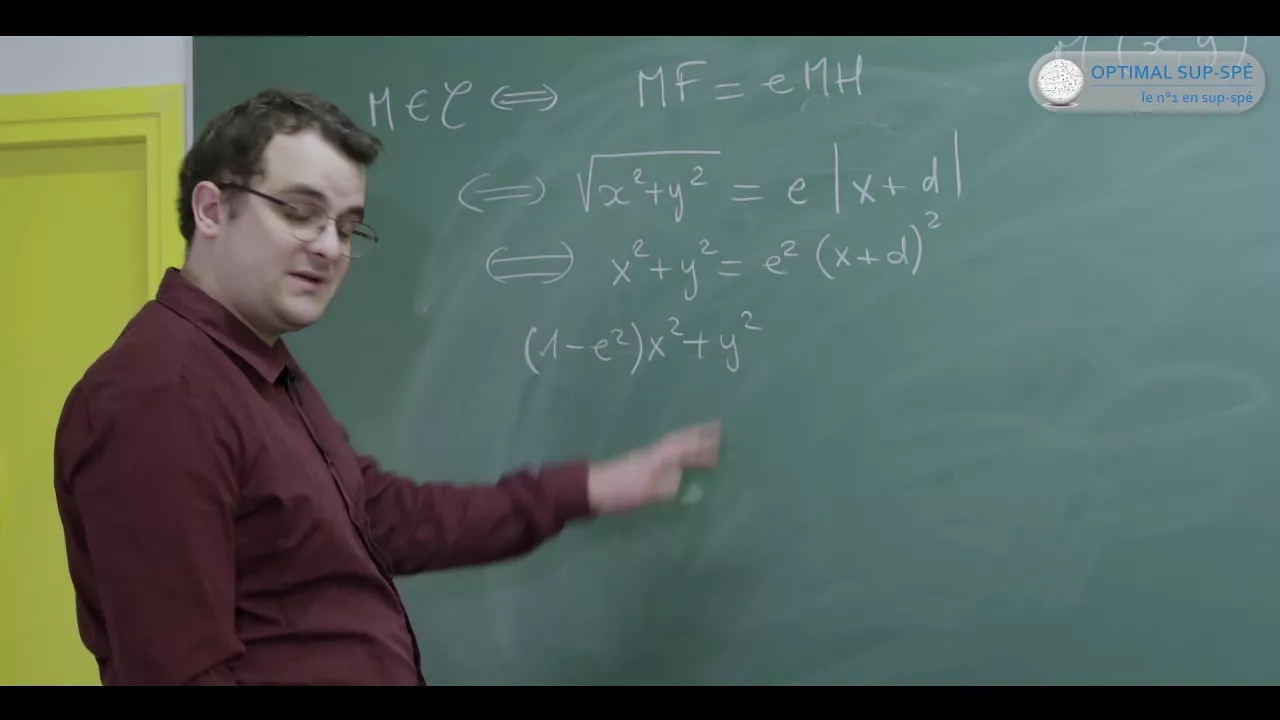
Conic sections in polar coordinates are represented by the equations r = ed/(1 ± e sin θ) or r = ed/(1 ± e cos θ), where e is the eccentricity that determines the type of conic: e < 1 indicates an ellipse, e = 1 indicates a parabola, and e > 1 indicates a hyperbola; the directrix location and orientation depend on the sign and trigonometric function used in the equation, allowing students to graph these conic sections and determine their eccentricity and directrix by identifying e and d from the given equation.
Polar Equations of Conic Sections in Polar Coordinates
Added:Understanding of the Polar Coordinate System, including plotting points (r, theta) and converting between Cartesian and polar coordinates.
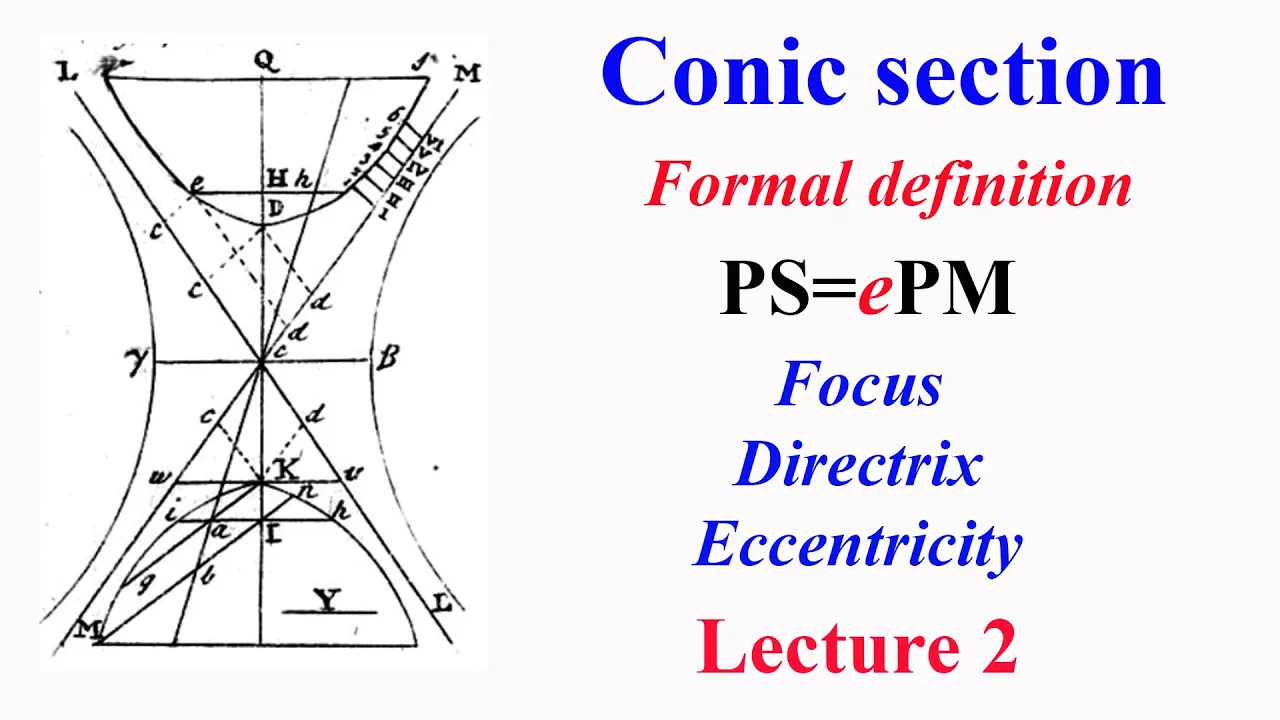
Familiarity with the geometric definitions of conic sections (ellipse, parabola, hyperbola) in terms of a focus, directrix, and eccentricity.
Knowledge of standard Cartesian equations of conic sections and their key features such as vertices, axes, and asymptotes.
Basic trigonometric proficiency, particularly understanding the graphs, periods, and values of sine and cosine functions.
Application to orbital mechanics and Kepler's Laws of Planetary Motion, where celestial orbits are modeled as conic sections in polar form.
Calculus in polar coordinates, including calculating the area enclosed by polar conics, arc length, and rates of change.
Analyzing the rotation of axes to handle conic sections that are tilted relative to the standard coordinate axes.
Extending 2D conic sections to 3D space by exploring quadric surfaces (ellipsoids, paraboloids, hyperboloids) in cylindrical and spherical coordinates.
180.2K views2.2Klikes42:10Original Release: 2018-04-08
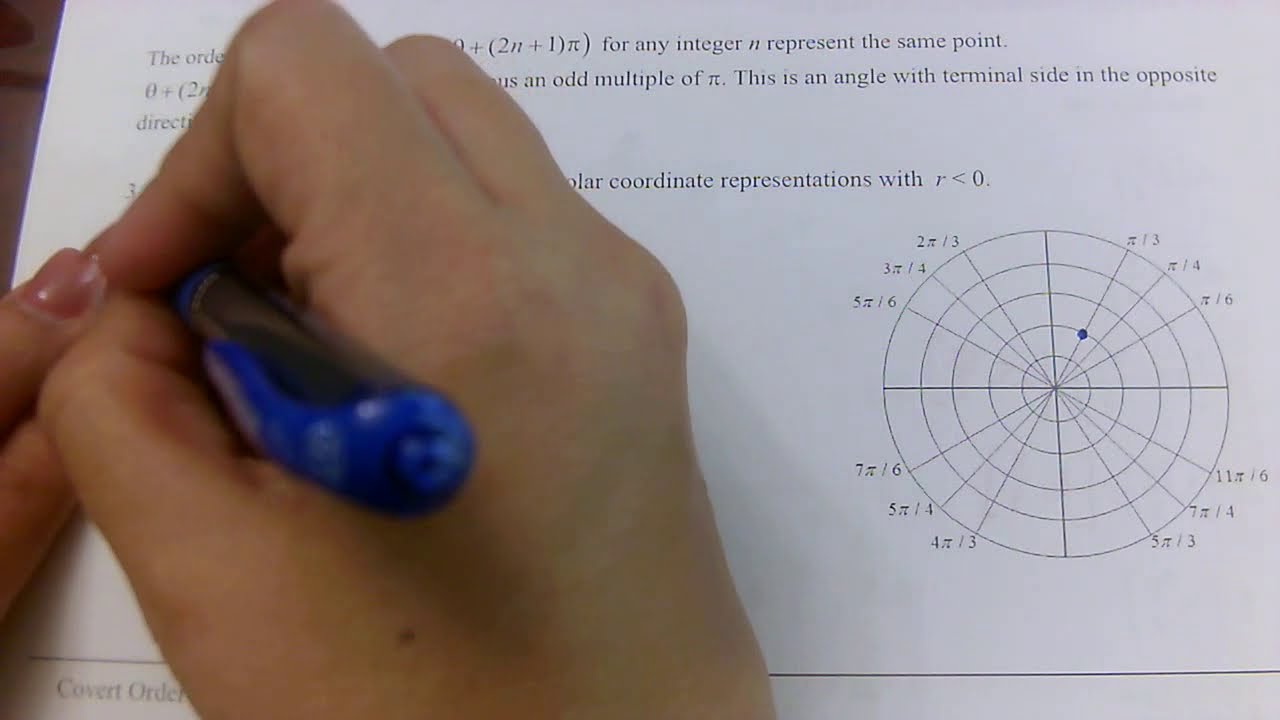
in this video we're going to talk about how to graph polar equations of conic sections so let's start with this example let's say that r is 6 divided by 2 minus cosine theta sketch the graph and determine the eccentricity of it now there's two forms you need to be familiar with r can equal e d divided by 1 plus or minus e sine theta or it can equal e d over one plus or minus e cosine theta e is the eccentricity of the graph now if e is between 0 and 1 then the conic section is an ellipse if e is equal to 1 then we have a parabola if e is greater than one then it's a hyperbola now there's four variations that you need to be familiar with so here's the first one r equals e d divided by 1 plus e sine theta the origin also known as the pole this is going to be the location of the focus now for this particular graph it's going to open towards the focus in the downward direction and above it you have the directrix the distance between the directrix and the focus is known as d and so that's the d in this equation e is the eccentricity so in this case we have a horizontal directrix above the pole and the focus is the pole which is the origin now the next one is r equals e d divided by 1 minus e sine theta so once again we're going to place the focus at the origin but this time the graph is going to open upward as opposed to downward and the directrix is going to be below the pole and we still have a horizontal directrix and so you could say that the directrix is y equals negative d it's d units below the focus for the first one it was y equals positive d but for this one it's negative d now the next two are these two equations e d divided by one plus e cosine theta and the other one is e d over one minus e cosine theta so if we have positive e cosine theta it's going to open towards the left with the focus being at the origin so the directrix is vertical this time and it's to the right of the pole and the equation is going to be x equals d for this one the conic section will open towards the right and the directrix will be x equals negative d now let's go back to this equation r equals 6 over 2 minus cosine theta so the first thing i want to do is identify which of those four equations i have and so i'm going to have this one e d over 1 minus e cosine beta now what i want to do is turn this number into a 1. so that's the first thing i'm going to do to do that i need to multiply the top and the bottom by one half half of six is three half of two is one and i'm going to have minus one half cosine theta so now i can clearly see that e is one half so if e is one half what type of conic section do i have is it an ellipse a hyperbola or parabola because e is between one and zero the conic section is an ellipse so that gives me a good idea of how to graph it now the next thing i need to calculate is d so this is equal to e times d and e is one half so i'm going to multiply both sides by two two times three is six one half times two is one so d is equal to six so now let's graph it keep in mind that e is one half d is six so for this particular graph with the focus at the center and then we have a negative cosine so when dealing with cosine it opens either to the left or to the right but if you see negative cosine the graph is going to open in this direction so we have an ellipse which means it's going to look like this that's a rough sketch and then the directrix is going to be on this side now what we need is some points so we need four points i'm going to highlight those points in green so these are the four points we need to calculate now keep in mind we're dealing with polar coordinates as opposed to rectangular coordinates so we're going to be focused on r and theta let's call this point a b c and d at point a theta is zero degrees at point b theta is pi over two at point c theta is pi point d three pi over two and then a is back with two pi so let's make a table so i'm going to plug in 0 degrees pi over 2 pi and 3 pi over 2 into this equation so when theta is 0 what is r so it's going to be 6 over 2 minus now cosine of 0 is positive 1.
so this becomes six over two minus one which is one so r is equal to six now what about when cosine is pi over two cosine pi over two is zero so we get six divided by two which is three now what about cosine pi cosine pi is negative one two minus negative one is two plus one so that's three six over three is two and then cosine three pi over two that's zero so six over two is three now let's go ahead and graph it so the majority of the graph will be on the right side so the first point is at 0 6 so theta is 0 which means it's on the x axis and r is 6 so we need to go 6 units in this direction now at pi over 2 which is the y axis let me just put that so this is pi over two zero pi three pi over two r is three so we're gonna go three units away from the center and at pi which is the negative x axis we need to go two units away from the center and at three pi over two r is equal to three and now we can make a graph of the ellipse and so that's just a rough sketch of the ellipse that we have let's see if i can make it look better now we need to plot the directrix it's d units away from the focus and so for this type of equation if you have a negative sign it's going to be x equals negative d and we can see that d is six so it's x equals negative six so we need to extend the left side so it should be over here and so that is the equation of the directrix and so that's how you can plot this particular ellipse so we have the point six negative two three and negative three now when dealing with ellipses sometimes you may need to determine the length of the major axis and the length of the minor axis so what is the length of the major axis it's the distance between these two points so the major axis is horizontal and if we subtract 6 by negative 2 that will give us 8 so it's 8 units long the major axis has a length of 2a so a is going to be 8 over 2 so therefore a is 4.
now how can we determine the length of the minor axis so this is b which means that this entire length is 2b if we could find b we could find the length of the minor axis so how can we determine that now e the eccentricity is c over a the eccentricity is one half a is four so we can calculate c if we cross multiply it's going to be 2 times c equals 4 times 1.
so c is 4 over 2 which means c is 2.
now for ellipses c squared is a squared minus b squared c is 2 so c squared is 4 a is 4 so a squared is 16 and now we need to solve for b squared so i'm going to move negative b squared to the left side so it's going to be positive b squared and i'm going to move the 4 from the left to the right where it's going to be minus 4.
so b squared is 16 minus 4 which means b squared is 12 and so b is the square root of 12.
and the square root of 12 is the square root of 4 times the square root of 3 and the square root of 4 is 2.
so b is 2 square root 3 which means that the length of the minor axis which is 2b it's equal to 4 square root 3.
so now we have the length of the minor axis and the length of the major axis which is eight so now that you have a b and c you can do anything else that you want to do also keep this in mind the distance between the vertex or one of the vertices of the ellipse and the focus is two and so that's c which means that for this ellipse there's another focus here but the focus that we're focused on is the one at the pole so c is the distance between the vertices and the foci of an ellipse now what if we wanted to find the rectangular equation of this ellipse how can we do so we need to know the values of a b and the center of the ellipse so the center of the ellipse is here it's the midpoint between negative two and six negative two plus six is four divided by two will give us an x coordinate of two and the y coordinate is zero so the center is at two comma zero a is four and b is two square root three the major axis for this particular ellipse is horizontal so therefore the standard equation is x minus h squared divided by a squared plus y minus k squared over b squared equals one so we can see that based on the center h is two k is 0.
so it's x minus 2 squared over a squared a is 4 so a squared is 16 and then y minus 0 squared or simply just y squared over b squared now b is two square root of three so if we square that two squared is four and the square root of three squared is three so four times three is twelve b squared is twelve and so this is the rectangular equation of the ellipse let's move on to our next example so let's say that r is 4 divided by 1 plus cosine theta go ahead and sketch the graph of this equation so it's in the form e d divided by 1 plus e cosine theta so we already have a one which is good therefore the number in front of cosine is e since we don't see a number there it's a one so e is one now e times d is four and since e is 1 that means d is equal to 4.
so what type of conic section do we have since e is equal to 1.
if e is equal to 1 we have a parabola now in what direction will the parabola open so we have the focus at the center and we have positive cosine which means that it's going to open towards the left so this is the general shape of the graph that we have in order to sketch it we need three points the y-intercepts and one x-intercept so we need theta equals zero pi over two and three pi over two so let's make a table with those three values using this equation when theta is zero degrees what is r zero that's one and so one plus one is two four over two is two now what about when cosine when theta is pi over two what is the value of cosine pi over 2 cosine pi over 2 is zero so this becomes four over one which is four and when theta is three pi over two cosine three pi over two is zero so we get the same r value so now let's go ahead and sketch this graph so the first point is 0 2 or 2 0 in polar coordinates we've got to write it like this so at an angle of 0 degrees which is the x-axis the r-value is 2.
so we're going to travel two units away from the center along the positive x-axis now the next point is at pi over 2 with an r value of 4.
and then at 3 pi over 2 the r value is also for and here is the focus and the parabola is going to open in that direction so that's the general shape of the parabola now we need to find the equation of the directrix so we said d is four and for this particular type of shape that the matrix is going to be x equals d so therefore it's i'll write it here x equals four so we're gonna have a vertical line at x equal four now in rectangular coordinates you've learned that p is the distance between the focus and the vertex of the parabola p is also the distance between the directrix and the vertex and this distance here that's 2p now how can we write an equation of this parabola using rectangular coordinates x and y so we need to know the vertex which is 2 0 and we need to know p because it opens towards the left p is negative 2 as opposed to positive 2.
the standard form of the equation that we need to use is going to be y minus k squared and that's equal to 4p times x minus h so the vertex is h comma k so h is 2 k is 0.
so this is going to be y minus 0 squared or simply y squared and that's equal to 4p or 4 times negative 2 and then x minus h which is x minus two so then we have y squared is equal to negative eight times x minus two so this is the equation of the parabola in rectangular form now let's try this example let's say that r is 10 divided by 2 plus 3 sine theta so let's go ahead and graph this particular conic section so let's recognize the form that it's in so this is r equals e d over 1 plus e sine theta so what is e and d in this example so first let's turn the two into a one and so let's multiply the top and the bottom by a half half of ten is five half of two is one and then we're going to have plus 3 over 2 sine theta so therefore we can see that e is equal to 3 over 2.
so what type of conic section do we have if e is greater than 1. if e is greater than one then we have a hyperbola now what is the value of d in this form we can see that e d is equal to five and we know that e is three over two so let's multiply both sides by two two times five is ten so ten is equal to three d and then let's divide by three so d is ten over three so let's start with a rough sketch of the graph that we have so as you mentioned before we have the form e d divided by one plus e sine theta and we have the focus at the pole or at the origin and the hyperbola is going to open in this direction in the downward direction and we're going to have a horizontal directrix above the pole now since we're dealing with a hyperbola there's going to be another portion of it going up in this direction and we can sketch it using symmetry so if we can get this one then using symmetry we can sketch the one above it so there's three points of interest we need to find the two x-intercepts and the y-intercepts and so the angles that we need to use are zero pi over two and pi there's nothing at 3 pi over 2 so we're not going to worry about that if we do plug in 3 pi over 2 we could get this point but we don't need to because we could find that point using symmetry so let's go back to this equation r is equal to 10 over 2 plus 3 sine theta so let's get all four points zero pi over two pi and three pi over two so when theta is zero what is r sine of zero is zero so it becomes ten divided by two which is five now what is sine pi over two sine pi over two is one and two plus three is five ten over five is two sine pi is zero so this is going to be five again now what about three pi over two sine three pi over two that's going to be negative one so then we have two minus three which is negative one and so the whole thing is going to be negative ten now let's put this together so i'm going to go by twos this is going to be 2 4 6 and so 2 4 6 8 10 12.
so this is zero pi over two pi and three pi over two so let's plot this point r is five theta is zero so theta is zero on the x axis and this is going to be a value of five five units away from the center now at pi over two r is two so that's going to be this point and then at pi r is five and at three pi over two r is negative ten if r was positive ten this would be three pi over two we go ten units that way because it's negative ten we need to go ten units in the other direction so that gives us the first point of the upper part of the hyperbola now let's go ahead and draw a rough sketch so that's the lower part now for the upper part we need to use symmetry to sketch it so going from this point to this point we need to travel 5 units to the right and down 2 units so we're going to do the same thing so we're going to travel 5 units to the right but up 2 units so that's going to give us the point 5 comma 12 which should be somewhere in that region and then if we do the same for the other side it's going to be negative 5 12.
so that's it for the graph of this hyperbola now let's talk about the directrix for this type of equation it's y equals d or y equals 10 over 3.
ten over three is about three point three three and so that's somewhere between two and four so that's the location of the directrix and here we have the focus now let's write a rectangular equation for this hyperbola so we need to calculate a b and c notice that the center of the hyperbola is the midpoint between these two vertices so this is at 2 and this is at 10.
the midpoint of 2 and 10 is basically the average of the two numbers 2 plus 10 is 12 12 divided by 2 is 6.
so the center of this hyperbola is located at 0 comma six now the distance between the two vertices is the major axis and so the length of the major axis is two a and 2a is going to be the difference between 10 and 2.
so the major axis is 8 units long so a is going to be 8 over 2 which is 4.
so keep in mind a is the distance between the center and the vertices so between six and two that's four units now let's determine the value of b so e is c over a and e is three over two a is four so if we cross multiply we have three times four equals two c and so twelve is equal to two times c twelve divided by two is six so c is six and c is the distance between the center and the focus and we can see that it's six units apart this has a y value of zero and this has a y value of six so c is six now that we have a and c we can calculate b for a hyperbola c squared is a squared plus b squared since c is equal to six c squared is going to be 36 and since a is 4 a squared is 16.
so b squared is 36 minus 16 which is 20.
and so b is going to be the square root of 20 which is the square root of four times the square root of five and the square root of four is two so b is two square root five so we have a b and c so a is four b is 2 square root 5 a squared is 16 b squared is 20.
and the center is 0 6.
now for this particular type of hyperbola where it opens up and down we can use this standard equation y minus k squared over a squared minus x minus a squared over b squared is equal to one h is zero k is 6.
so it's going to be y minus 6 squared over a squared which is 16 minus x minus h or x minus 0 which is just x and then b squared is 20 and that's equal to 1.
so this is the rectangular equation of the hyperbola so now that you know how to sketch a polar equation you need to be able to write them given certain information so let's start with this problem write a polar equation of a conic section with eccentricity 5 over 4 and directrix y equals 7.
so let's plot the directrix first so let's say this is y equals seven what this means is that the conic section is below it and it's going to point downward or open downward rather so what type of polar equation corresponds to this type of shape well because it's going down it has to be sine and not cosine so it's e d divided by 1 plus e sine theta since the horizontal directrix is above the pole now all we need to do is plug in e and d so keep in mind the directrix is y equals d so that tells us that d is seven and we already have e now because e is greater than one we know that this particular type of conic section is a hyperbola so there's another part of the graph that will open upward in that direction but we don't need to worry about that so e is five over four d is 7 and so this is what we now have now at this point i recommend multiplying the top and bottom by four to eliminate all the fractions so on the top we can cancel the four and so in the numerator we're gonna have just five times seven on the bottom one times four is four and then four times five over four the fours will cancel leaving five sine theta so the final answer is r is equal to five times seven which is 35 over four plus 5 sine theta and so this is the polar equation with eccentricity 5 over 4 and the directrix y equals 7.
now let's work on a similar example write a polar equation of a conic section with eccentricity one-half and directrix y equals negative four so let's start with a rough sketch let's plot the directrix so this time it's going to be below the x-axis which means the conic section is opening upward in this direction and so here's the focus now because e is one-half e is less than one and when e is less than one or rather more specifically between zero and one we have an ellipse and so the shape of that ellipse will look something like that now for this particular type of shape the equation that we need to deal with is e d over 1 minus e sine theta because the directrix is below the pole now e is one half now what's d this equation is y equals negative four and for this particular type of shape the divatrix is y equals negative d so we could set negative d equal to negative four so that's the case if you multiply both sides by negative one d is four now to get rid of the fraction let's multiply the top and the bottom by two so a half times two is one and so we're going to get 4 on top and then 2 minus 1 sine theta or simply sine theta and so this is the answer write a polar equation of an ellipse with vertices 2 comma 0 and a comma pi go ahead and try this problem so let's begin with a sketch and so these coordinates are polar coordinates in the form r comma theta so this is when theta is zero degrees and the negative x axis corresponds to pi so we have the point two comma zero so when theta is zero r is two and a comma pi so r is eight when theta is pi so we have an ellipse that looks something like this so we're going to say that we have a conic section that opens in this general direction with the center being the focus so therefore we need to use this particular polar equation e d over one and then because it's going towards the left we need to use cosine but it's going to be positive e cosine theta the directrix is going to be to the right to the right of the pole and so that's going to be x equals d now somehow we need to determine e and d how can we do so in terms of rectangular coordinates this has an x value of 2 and that has an x value of negative 8.
so therefore this particular ellipse has a major horizontal axis length of 2 minus negative 8 which is 2 plus 8 so that's 10 units long and the major axis is equal to 2a so 10 divided by 2 is 5.
so a is equal to 5.
now what is c first we need to identify the center and that's the midpoint between negative 8 and 2 negative 8 plus 2 is negative 6 divided by 2 so that's negative 3.
the distance between the focus and the center is our c value and so we could say that c is equal to 3.
the eccentricity is c over a so c is three a is five therefore the eccentricity is three over five now what we need to do is determine d somehow how can we determine d at this point we can get rid of the graph we don't need anymore now that we have the eccentricity so keep in mind the values of r and theta that we have when theta is zero r is two and when theta is pi r is eight so right now the eccentricity is three over five and so we have this equation to get rid of the fraction let's multiply the top and the bottom by five so we're going to get r is equal to three d over five plus three cosine theta at this point so now we can solve for d let's use the point a comma pi so r is eight and cosine is pi cosine pi is negative one five plus negative 3 is positive 2. if we cross multiply we'll get 3d is equal to 16.
and so dividing both sides by 3 we can see that d is 16 over 3.
so now let's plug that into this expression so that's going to be 3 times 16 over 3 over this stuff and so the threes will cancel and we can write the final answer for this problem so the polar equation for this particular ellipse is r equals 16 over 5 plus 3 cosine theta and so this is the answer now to check it let's see if we'll get the second point so let's plug in 0 for theta cosine of 0 is 1 and 5 plus 3 is 8 so we're going to have 16 over 8 which is 2 so that will give us an r value of 2. therefore this equation works and so that's it for this example write a polar equation of a parabola with a directrix of x equals six so let's begin by plotting the directrix so this is going to be somewhere on the right side and we're going to have the focus at the center as always and so the parabola is going to open towards the focus but away from the metrics so it has to go towards the left which means that the equation that we're dealing with is e d over one plus e cosine theta since it's going towards the left if it was going towards the right it would be minus e cosine theta now for the directrix we know that x is equal to d so that tells us that d is equal to 6.
and by definition what do you think the eccentricity of an ellipsis i mean not an ellipse of a parabola for a parabola the eccentricity is always one so e is one d is six so the answer is going to be r equals 6 over 1 plus cosine theta and this is the equation of the parabola that's it number five write a polar equation of a parabola with vertex two comma pi so the angle is pi this is zero pi over two pi and three pi over two at pi r is two and so this is the vertex the focus by definition will be at the origin and so the parabola has to open towards the focus which means the directrix is on this side now for a parabola the distance between the directrix and the vertex is p also the distance between the focus and the vertex is p and this part is 2p but we don't need to worry about that in this problem now for a parabola we know by definition e has to be one now what is the equation for the directrix we know this is zero this is negative two as an x-coordinate so therefore we could say that p is two units long therefore this must be negative four so the equation of the matrix is x equals negative four so in this form it's x equals negative d which means that d is four and so we have this particular polar equation e d over one minus e cosine theta since it opens towards the right so e is one d is four so the answer is going to be r equals four over one minus cosine theta so that's the polar equation for this particular parabola you
Up Next

3:51
Nonlinear Dynamics: Fixed Points and Stability in Flows
@ComplexityExplorer
5K views•2019-03-07
4:43
Elliptic Curve Cryptography Explained: ECC, ECDSA, ECDH
@PracticalNetworking
28.5K views•2024-10-21
12:11
Simpson's Rule & Numerical Integration | Calculus Tutorial
@TheOrganicChemistryTutor
812.9K views•2018-03-13

6:00
The Mathematical Impossibility of Accurate World Maps
@Vox
23.3M views•2016-12-02
Related Study Plans & Knowledge Roadmaps
Structured learning paths in Mathematics
mathematics
Tensor Calculus: Vectors to Riemann Curvature
01Mathematical Foundations: Linear Algebra & Calculus
02Covectors, Dual Spaces, and Tensor Basics
03The Metric Tensor and Index Gymnastics
+ 2 more learning modules
40h5 modules
Explore Roadmap
mathematics
Gödel's Incompleteness: Logic, Proofs & Limits
01Introduction to Formal Systems & Hilbert's Dream
02Set Theory, Cardinality, and Cantor's Diagonal Argument
03Arithmetization and Gödel Numbering
+ 2 more learning modules
14h5 modules
Explore Roadmap
mathematics
Galois Theory: Fields, Groups & Solvability
01Foundations of Abstract Algebra: Groups & Fields
02Polynomials & Field Extensions
03Splitting Fields & Symmetries
+ 2 more learning modules
24h5 modules
Explore Roadmap
mathematics
Non-Euclidean Geometry: Models & Geodesics
01Euclid's Fifth Postulate and the Birth of New Geometries
02Hyperbolic Space and the Poincaré Disk Model
03Geodesics: Defining Straight Lines in Curved Spaces
+ 2 more learning modules
15h5 modules
Explore Roadmap