













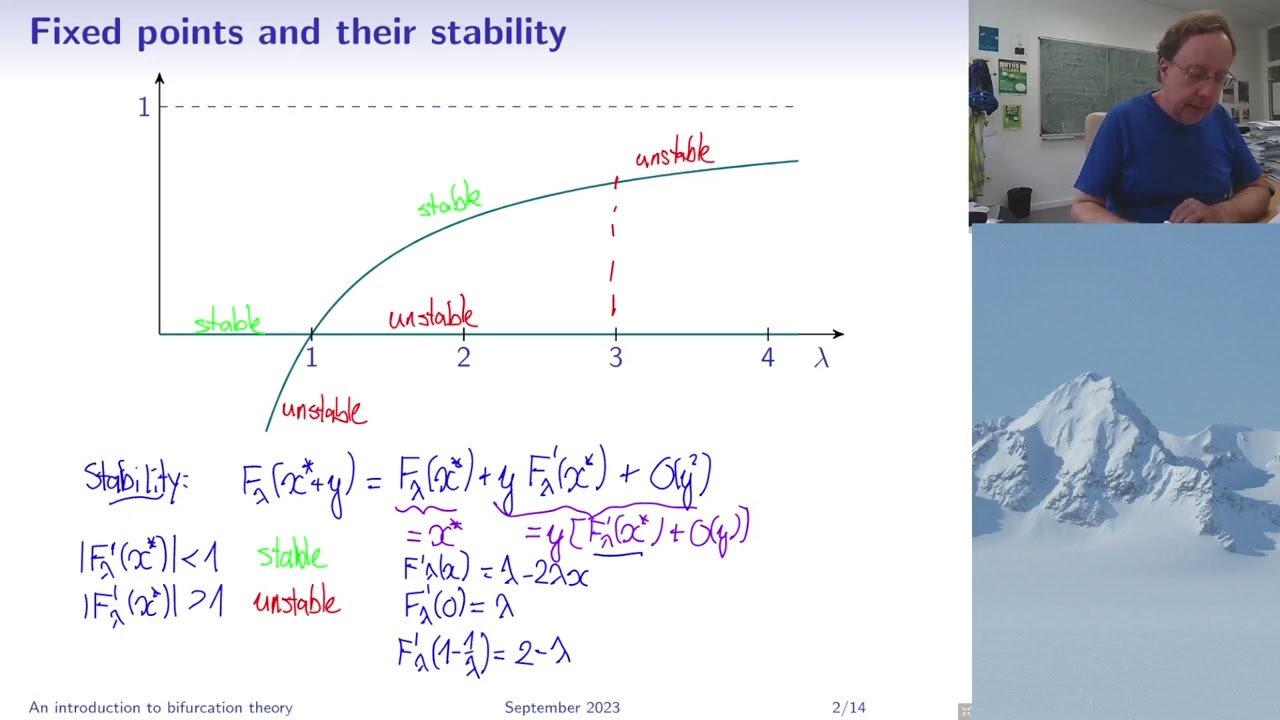







A fixed point in a dynamical system is a stationary state that remains unchanged under the system's dynamics; its stability determines whether nearby trajectories converge toward it (stable fixed point, like a marble rolling into a bowl) or diverge from it (unstable fixed point, like a marble balancing on an inverted bowl or saddle). In dissipative systems with friction, stable fixed points act as attractors with basins of attraction containing all initial conditions that eventually reach them, while conservative systems without friction can still exhibit chaos but lack attracting fixed points or chaotic attractors.
Nonlinear Dynamics: Fixed Points and Stability in Flows
Added:Basic concepts of Ordinary Differential Equations (ODEs) and how they represent physical systems over time.
Differential Calculus, particularly derivatives and the concept of linearization using Taylor series expansions.
Linear Algebra fundamentals, including eigenvalues and eigenvectors, which are essential for determining stability.
An intuitive understanding of phase space and how trajectories represent the states of a dynamical system.
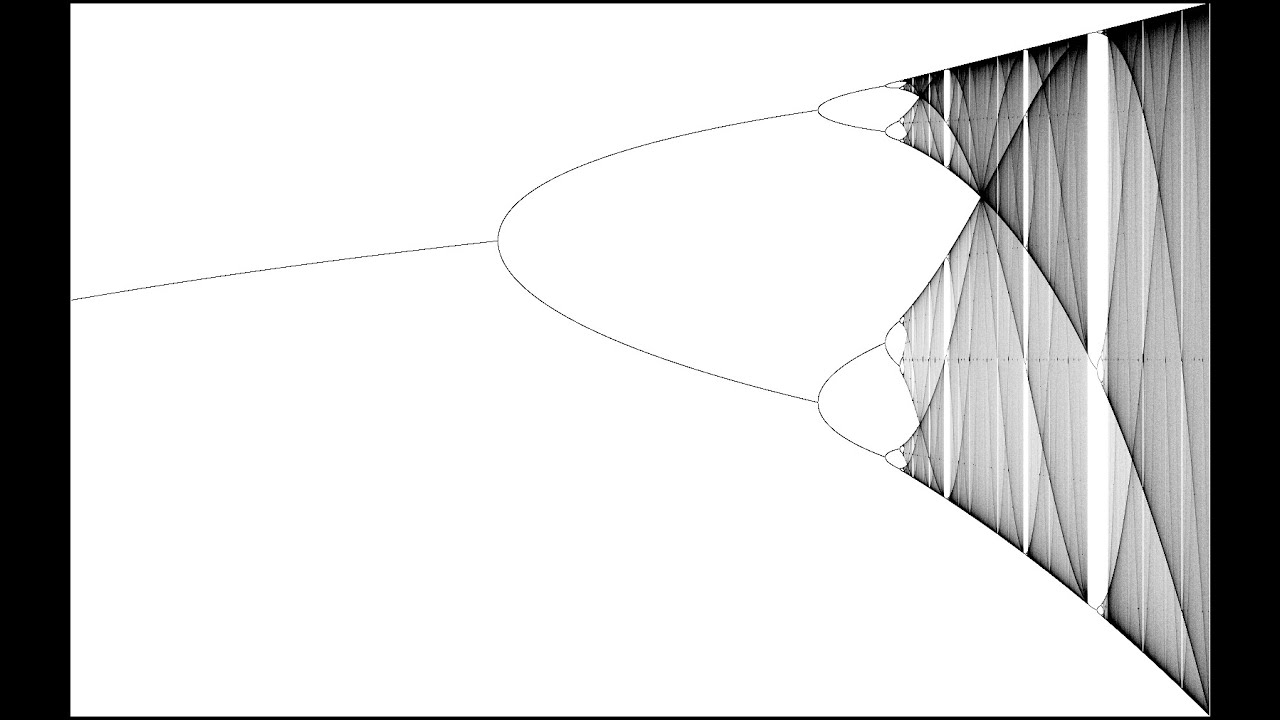
Bifurcation Theory, to study how the number and stability of fixed points change as system parameters vary.
Limit Cycles and the Poincaré-Bendixson Theorem, exploring isolated closed trajectories in two-dimensional flows.
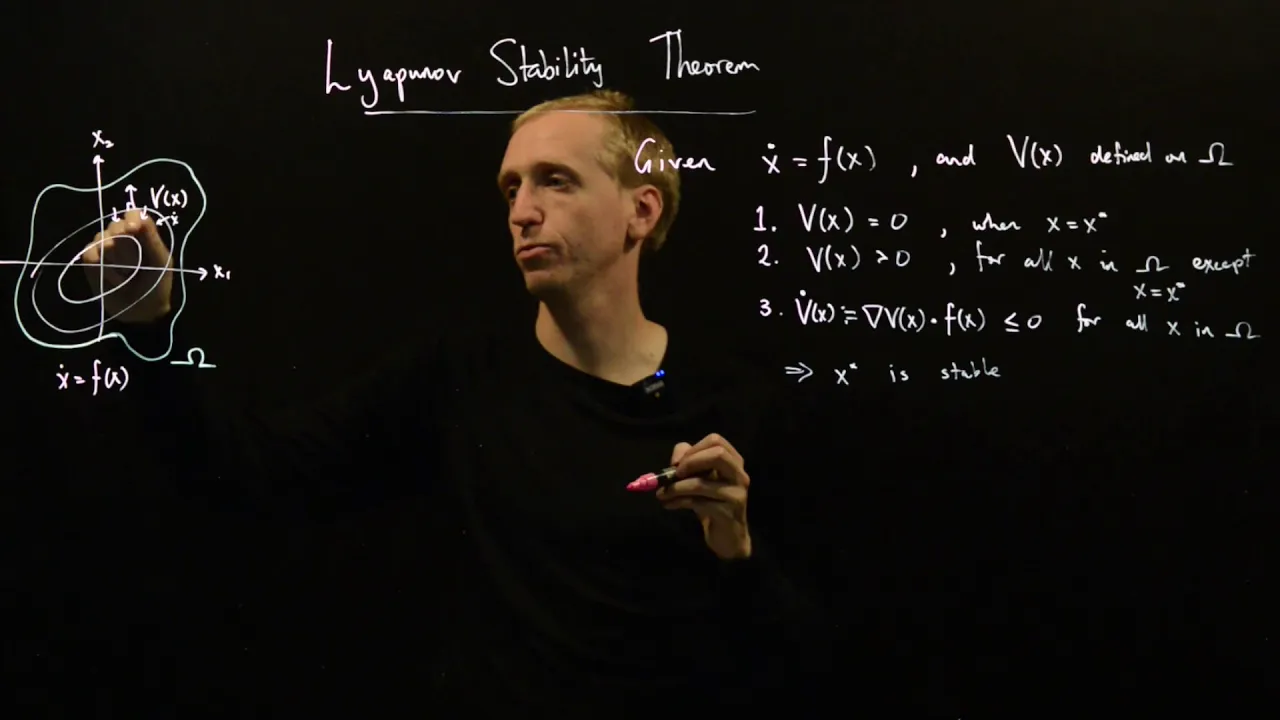
Lyapunov Stability Theory and the construction of Lyapunov functions to prove global stability of equilibrium points.
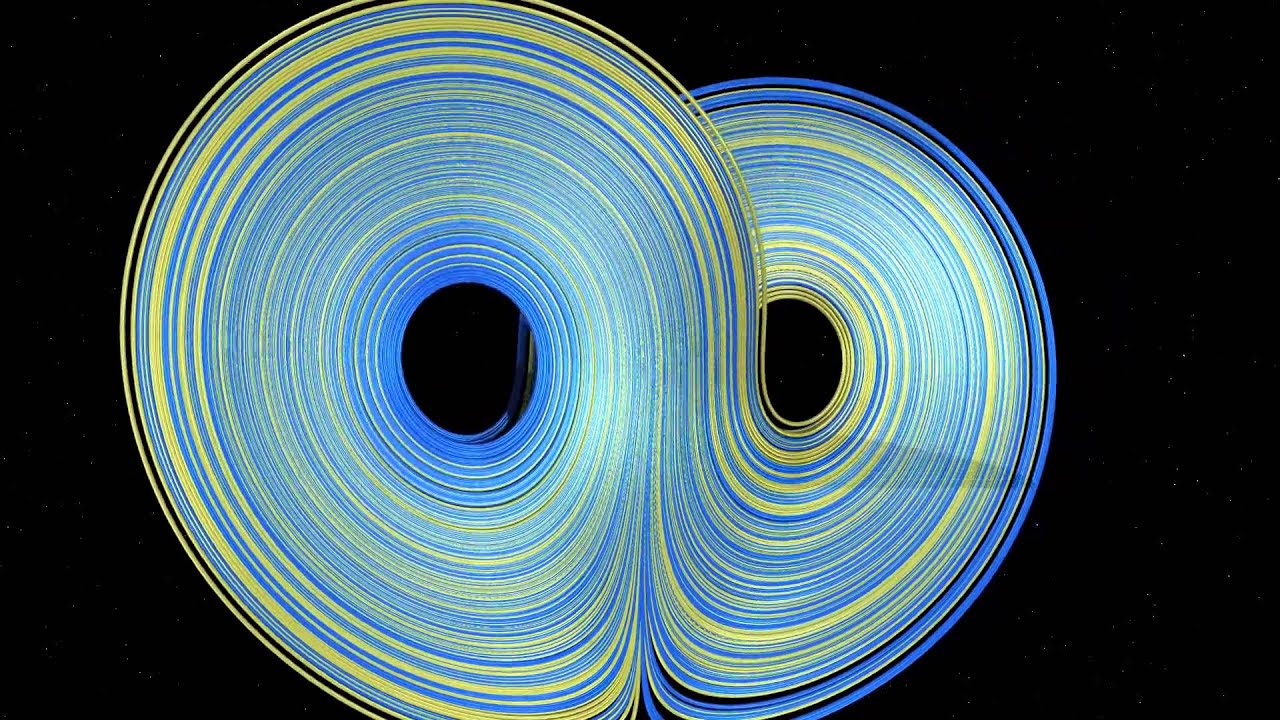
Introduction to Chaos Theory and Strange Attractors, examining deterministic non-periodic behavior in three or more dimensions (e.g., the Lorenz system).
5K views31likes3:51Original Release: 2019-03-07
In this segment, we're going to circle back around to the notion of a fixed point, a point in the state space of a dynamical system that's stationary under the influence of the dynamics like, for example, that point of the pendulum.
This is a stable fixed point because perturbations to it will shrink over time. This is also a fixed-point, in the sense that if you put the system there, it stays there, but it's an unstable fixed point because if you perturb it, that perturbation grows. That's the right set of ideas and terminology by the way for what are called dissipative dynamical systems. Those are the kinds that have attractors. In conservative dynamical systems where there is no friction, there are no attractors. There are still fixed points in conservative dynamical systems and there is still chaos, it's just that there are not attracting fixed points and chaotic attractors.
A bit of this came up when we drew the state space portrait of this beast, pretending that it had no friction. Again, conservative systems can be chaotic even though they don't have attractors.
The solar system, for instance, is a conservative system, at least on human time scales. But, remember that Pluto's orbit is chaotic.
We'll touch on so-called Hamiltonian chaos at the very end of this course, but it is not in our critical path yet. Okay, back to fixed points.
Recall the definition of a fixed point in a map. It's a point that doesn't move under the influence of the dynamics. The definition is the same in flows.
A point that doesn't move under the influence of the dynamics. So how to think about that properly? That's going to lead us to our first encounter with the notion of a dynamical landscape; a topography layered over the state space that is defined by the dynamics of the system. We'll come back to that idea again in unit 5 and formalize it mathematically. In the mean time, we'll just draw.
Recall that the state variables of the pendulum are theta and omega. Theta, the angle measured in radians.
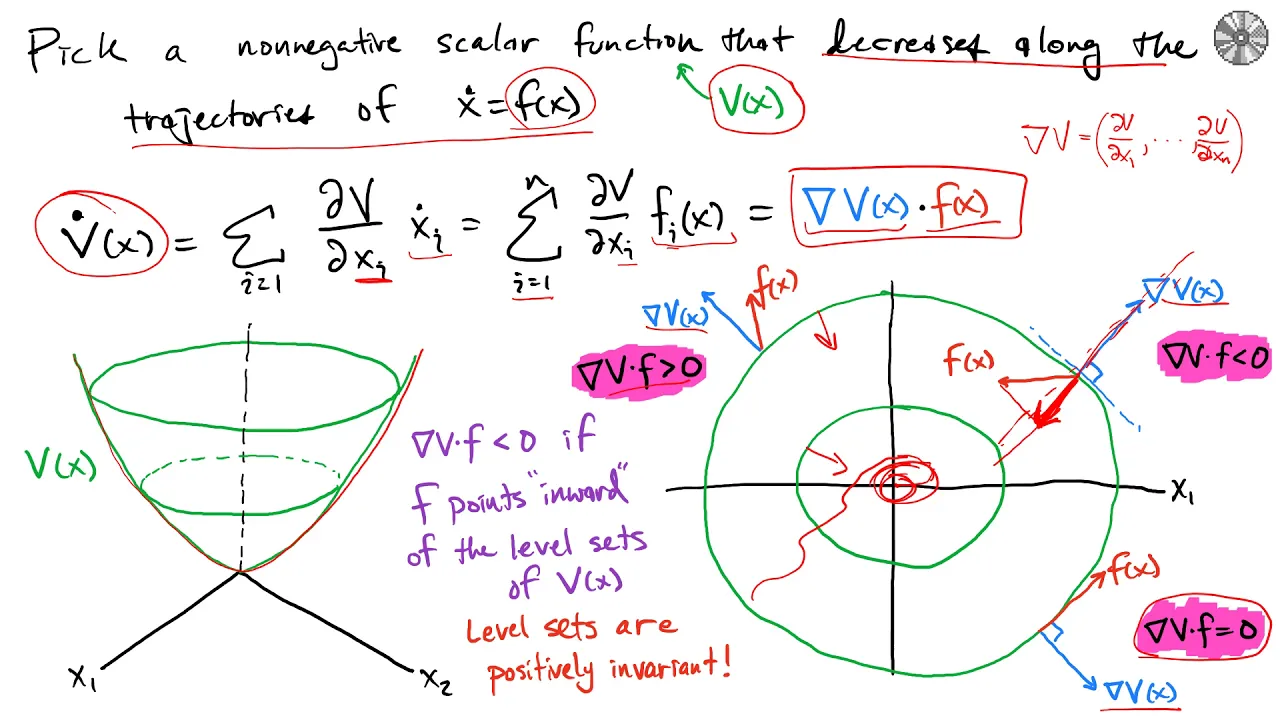
And omega, the angular velocity measured in radians per second. And the state space has those variables as axes. Now, think about the fixed point at the origin and what initial conditions converge to it. You could imagine starting the pendulum at a small positive angle or a small negative angle, or a small velocity of either sign. And the trajectories from all of those initial conditions would converge to the fixed point at the origin. So really, that fixed point is in the bottom of some kind of bowl. It may not be a hemispherical bowl, it may have some sort of elliptical shape or something stranger, but it's the kind of shape where a marble will roll around the bowl and end up at the bottom unless of course you push the marble so hard that it hops out of the bowl.
That's an initial condition that's outside the basin of attraction of that fixed point.
Now, the shape of the bowl is dictated by the dynamics. Indeed, that shape actually is the dynamics as we will see in unit 5 when we do the math. That landscape tells you for every value of the state variables which way is downhill. A trajectory of a dynamical system is a ball rolling on that landscape defined by the dynamics. This metaphor is useful, but really only in 2-D systems that have 2 state variables, since you need another axis to think about the landscape and its slope. So an unstable fixed point is like an upside-down bowl, but that's not the only possible shape of the dynamical landscape for an unstable fixed point. There's another kind of topography of a landscape on which a marble can balance, but will roll away from that point if it's perturbed; and that's a saddle.
In the next segment, we are going to talk about more about stability and saddle points.
Up Next

26:49
Phase Plane Analysis of Nonlinear Systems | Control Engineering
@shoeb-lectures
128 views•2021-08-18

4:43
Elliptic Curve Cryptography Explained: ECC, ECDSA, ECDH
@PracticalNetworking
28.5K views•2024-10-21
10:44
Fourier Series Introduction: The Big Idea Explained
@DrTrefor
387K views•2021-05-03

6:00
The Mathematical Impossibility of Accurate World Maps
@Vox
23.3M views•2016-12-02
Related Study Plans & Knowledge Roadmaps
Structured learning paths in Mathematics
mathematics
Tensor Calculus: Vectors to Riemann Curvature
01Mathematical Foundations: Linear Algebra & Calculus
02Covectors, Dual Spaces, and Tensor Basics
03The Metric Tensor and Index Gymnastics
+ 2 more learning modules
40h5 modules
Explore Roadmap
mathematics
Gödel's Incompleteness: Logic, Proofs & Limits
01Introduction to Formal Systems & Hilbert's Dream
02Set Theory, Cardinality, and Cantor's Diagonal Argument
03Arithmetization and Gödel Numbering
+ 2 more learning modules
14h5 modules
Explore Roadmap
mathematics
Galois Theory: Fields, Groups & Solvability
01Foundations of Abstract Algebra: Groups & Fields
02Polynomials & Field Extensions
03Splitting Fields & Symmetries
+ 2 more learning modules
24h5 modules
Explore Roadmap
mathematics
Non-Euclidean Geometry: Models & Geodesics
01Euclid's Fifth Postulate and the Birth of New Geometries
02Hyperbolic Space and the Poincaré Disk Model
03Geodesics: Defining Straight Lines in Curved Spaces
+ 2 more learning modules
15h5 modules
Explore Roadmap